In Episode 62, Frederick, Maryland-based public historian Jake Wynn joins co-hosts Tom McMillan and John Banks for a discussion about what happened in Frederick and beyond in the aftermath of Antietam. Plus, enjoy a lively discussion about the Pry House — McClellan HQ or not? — and some Abraham Lincoln chit-chat. Wynn writes online at wynninghistory.com and is a co-host on the "Public History with Justin, Jake and Molly" podcast.
Showing posts with label Maryland. Show all posts
Showing posts with label Maryland. Show all posts
Friday, May 15, 2026

Tuesday, May 21, 2024
Check out new Civil War Trails markers in Maryland, Virginia
 |
| Maureen O’Connell with Christopher D. Brown, assistant director of the Civil War Trails program, at the new marker in Poolesville, Md. (Courtesy: Civil War Trails, Inc.) |
Like this blog on Facebook | Follow me on Twitter | My YouTube videos
So I finally made it back to the loving arms of Mrs. B on Sunday night after a six-state, 2,200-mile Civil War odyssey. I have two observations:
- Whoever created I-95 should start over.
- Those great Civil War Trails markers are seemingly everywhere. And a birdie told me of two new ones that I missed:
POOLESVILLE, Md.: A marker at the John Poole House, the oldest building in town. The log structure — located in the historic Medley District at 19923 Fisher Ave. — was built in 1793 by John Poole Jr. and served as a trading post for merchants and families from the surrounding farms and plantations.
APPOMATTOX, Va.: On the grounds of The American Civil War Museum, where fighting swirled in April 1865. Inquisitive visitors inspired this marker, which highlights the chaos among Confederates as United States cavalry approached and the climactic moment when African American soldiers crossed over museum ground to stop a counter attack.
Let’s keep history alive. 👊
 |
| Megan Glewen, Robert Hancock (center) and Bob Sayre of the American Civil War Museum in Appomattox, Va., pose with the new interpretive sign. It is located just behind the museum at 159 Horseshoe Rd. (Courtesy: Civil War Trails, Inc.) |
Monday, February 12, 2024
Podcast: Dr. Emilie Amt on 'Black Antietam'
A native of Maryland, Amt is an emeritus professor of history. From 1998 to 2021. she held the Hildegarde Pilgram Chair of History at Hood College in Frederick, Md. She earned a B.A. in medieval studies from Swarthmore College and a D.Phil. in modern history from Oxford University.
Sunday, October 02, 2022
See battle damage on house in Sharpsburg, Maryland
 |
| Historic house at 111 East Chapline Street in Sharpsburg, Md. |
 |
| Artillery damage visible near a second-story window. |
 |
| Artillery damage to stairs railing. |
Private property. Do not trespass.
GOOGLE STREET VIEW: Battle-damaged house at 111 East Chapline Street.
 |
| Artillery damage on side of the house on East Chapline Street |
 |
| Longtime historian Dennis Frye points to an inscription on a brick. |
— Have something to add (or correct) in this post? E-mail me here.
Monday, September 21, 2020
Appalachian Trail or towering achievement? It's not a close call
 |
| The original Washington Monument was built by Boonsboro, Md., citizens in 1827. |
 |
| The spectacular view of the Hagerstown Valley from near the base of the monument. |
 |
| For this blogger, the monument visit was the right call. |
Atop South Mountain, where the often-overlooked Civil War battle was fought Sept. 14, 1862, stands the country's first monument to our first president. On July 4, 1827, according to a period newspaper account, many of the 500 citizens of Boonsboro, Md., marched two miles up the mountain to construct a 15-foot, cannon-shaped stone monument to honor the guy with the wooden teeth. Upon completion later that day -- a towering achievement -- the Declaration of Independence was read and a salute was fired by three Revolutionary War veterans. Later that year, workmen enlarged the monument, making it 30 feet high. (You can read much more about its history on this National Register of Historic Places Registration form.)
My takeaway: Sheesh, what a fabulous view of the Hagerstown Valley below. (Squint and you can see the Antietam battlefield.)
By the Civil War, the Washington Monument had been victimized by vandals and nature, turning it into a pile of rubble. During the Battle of Antietam in 1862, the Union Army used the site as a signal station, and it served the same purpose post-Gettysburg as Lee's Army of Northern Virginia retreated back into Virginia.
The tower was rebuilt in 1882, but it eventually fell into disrepair again. It was rebuilt from 1934-36 by the Civilian Conservation Corps. The Washington Monument stands near the Appalachian Trail, where if you ever see a certain former South Carolina governor, tell him we said hello.
Also, don't feed the bears! (See below.)
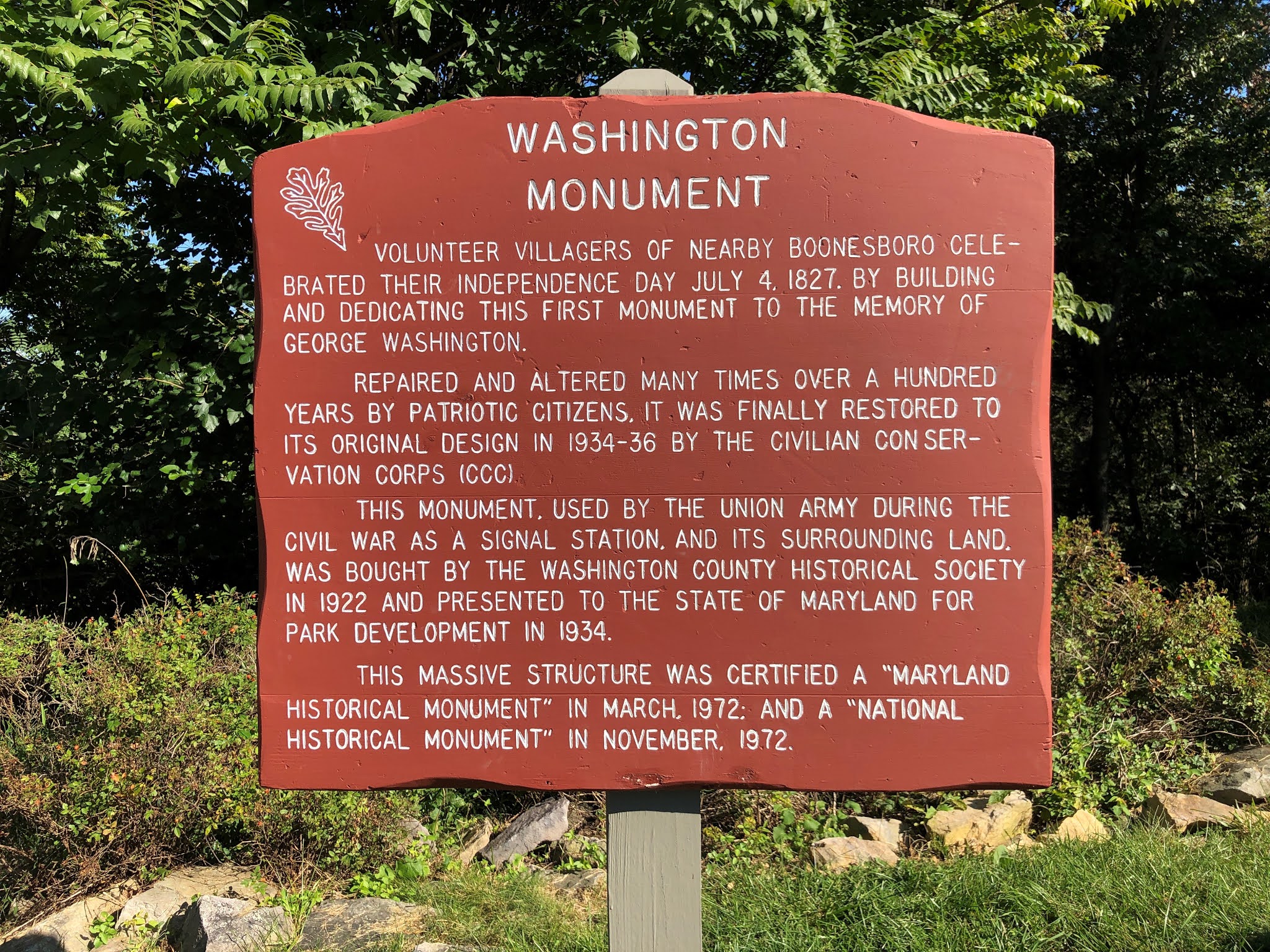 |
| At the monument site, a brief history. |
 |
| Stairs lead to the top of the monument, but the interior is closed because of you-know-what. (CLICK ON ALL IMAGES TO ENLARGE.) |
 |
| To the east of the monument, you can hike the Appalachian Trail if you dare. |

-- Have something to add, correct? E-mail me at jbankstx@comcast.net
Sunday, June 21, 2020
Re-discovered Antietam map gives new life to a soldier's story
 |
| A cropped enlargement of the S.G. Elliott's Antietam map shows dozens of Confederate graves (dashes) and 10 U.S. Army graves (crosses) near the Dunkard Church. The "apostrophes" mark sites of dead horses. EXPLORE A COMPLETE, HIGH-RES VERSION on New York Public Library site. |
A re-discovered map of Antietam showing battlefield graves set the Civil War community abuzz in June 2020. Drafted in 1864 by cartographer Simon Green Elliott, it includes the location on the battlefield of more than 5,800 graves of Union and Confederate soldiers. Elliott marked U.S. Army graves with crosses, Confederates' with dashes. He even denoted the location of dead horses — 269 in 40 locations, according to National Park Service research.
The map — similar to a better-known Gettysburg graves map created by Elliott — is a stunning visual representation of the carnage from the battle on Sept. 17, 1862. Researchers Timothy Smith and Andrew Dalton found a digitized version of the tattered original — which is in the New York Public Library's collection — on the NYPL web site.
 |
| A cropped enlargement of an Alexander Gardner image shows the grave of a 51st New York soldier by a stone wall near Burnside Bridge. (READ MORE ON MY BLOG.) |
Did he have aid, military or otherwise? Where did Elliott create it? Did he keep detailed notebooks of his work and, if so, do they survive? How accurate is the map? Mistakes have already been noted. The grave of a "J.O. Burns" of the 16th Connecticut in the 40-Acre Cornfield, for example, must be another soldier — perhaps Jesse Barnes of Canton, Conn. No soldier with the surname "Burns" in that regiment was killed at Antietam.
But there's no doubt Elliott's creation will fuel storytelling and much more for historians and others. It might fuel some anger, too — the Antietam visitors' center footprint appears to cover 1862 soldier gravesites. In 1866-67, the remains of hundreds of soldiers were exhumed from battlefield graves and elsewhere in the area for re-burial in Antietam National Cemetery. Could more rest on the hallowed ground?
But there's no doubt Elliott's creation will fuel storytelling and much more for historians and others. It might fuel some anger, too — the Antietam visitors' center footprint appears to cover 1862 soldier gravesites. In 1866-67, the remains of hundreds of soldiers were exhumed from battlefield graves and elsewhere in the area for re-burial in Antietam National Cemetery. Could more rest on the hallowed ground?
Besides "Burns," the names of 49 other soldiers and their marked gravesites appear on Elliott's map. I focused on one — "J. Adams 155 Pa." — who, according to the map, was buried near 17 other U.S. Army soldiers a short distance from Main Street in Sharpsburg.
Unlike the other named soldiers, Joseph Adams — a 39-year-old coal miner from Elizabeth Township, Pa. — wasn't a battle casualty at all.
 |
| According to S.G. Elliott's 1864 map, Joseph Adams was buried in a field outside Sharpsburg, near a mass grave for 17 Union soldiers and a strip of woods. (CLICK ON IMAGE TO ENLARGE.) |
By the time the 155th Pennsylvania had arrived in Sharpsburg, the Battle of Antietam was over. But Private Adams and other soldiers in the newly formed regiment got an ugly eyeful in the western Maryland village.
"On porches and in back yards were to be seen terrible effects of battle, many dead bodies of Confederate soldiers, terribly mangled, lying where they fell," according to the Zouave unit's regimental history. "The scenes being the first introduction that the new troops had to real war made a deep impression upon all."
Superiors sent Company G — whose officers were the "most inexperienced, and least competent at that time" — on a reconnaisance across the Potomac River in Shepherdstown to aid the 118th Pennsylvania. (Confederates routed the Corn Exchange regiment on the bluffs near the town on Sept. 20, 1862.) Meanwhile, the rest of the 155th Pennsylvania set up camp near the river.
During the day at Camp McAuley, soldiers enjoyed the picturesque scenery; at night, they listened to music until the wee hours. One afternoon, officers were among the many in the regiment who gathered in a grove to watch two privates settle a dispute "according to the Marquis-of-Queensberry rules of the London prize ring." (The mock bout ended in a draw.)
But the seemingly carefree atmosphere was soon fraught with peril. Typhoid fever swept through General Andrew Humphreys' III Division in the V Corps. Two newly appointed assistant surgeons reported to the 155th Pennsylvania at Camp McAuley, but they lacked medical supplies, hospital tents and other accommodations.
"This camp was ... the scene of much suffering and misery because of the inadequate provision for the care of the sick," the regimental history noted, "and the increase of the mortality among the soldiers war very great." Enlisted men and officers were incensed, and "discipline was severely impaired."
In mid-October, 19-year-old Abraham Overholt of Company E died of disease in the V Corps, III Division hospital at the Mount Calvary Lutheran Church in Sharpsburg. Comrades gave him a military funeral and buried him in the church cemetery among the freshly dug graves of other soldiers.
At about the same time, Adams was suffering from either typhoid fever or dysentery — symptoms of both can include severe, often bloody, diarrhea. He ended up at the Lutheran church hospital, where the father of five children died on Oct. 26, 1862.
"On porches and in back yards were to be seen terrible effects of battle, many dead bodies of Confederate soldiers, terribly mangled, lying where they fell," according to the Zouave unit's regimental history. "The scenes being the first introduction that the new troops had to real war made a deep impression upon all."
Superiors sent Company G — whose officers were the "most inexperienced, and least competent at that time" — on a reconnaisance across the Potomac River in Shepherdstown to aid the 118th Pennsylvania. (Confederates routed the Corn Exchange regiment on the bluffs near the town on Sept. 20, 1862.) Meanwhile, the rest of the 155th Pennsylvania set up camp near the river.
 |
| A cropped enlargement of Alexander Gardner's photograph of Mount Calvary Lutheran Church in Sharpsburg. It was used as a V Corps hospital by the U.S. Army. Private Joseph Adams died here. (Library of Congress | READ MORE ON MY BLOG.) |
But the seemingly carefree atmosphere was soon fraught with peril. Typhoid fever swept through General Andrew Humphreys' III Division in the V Corps. Two newly appointed assistant surgeons reported to the 155th Pennsylvania at Camp McAuley, but they lacked medical supplies, hospital tents and other accommodations.
"This camp was ... the scene of much suffering and misery because of the inadequate provision for the care of the sick," the regimental history noted, "and the increase of the mortality among the soldiers war very great." Enlisted men and officers were incensed, and "discipline was severely impaired."
In mid-October, 19-year-old Abraham Overholt of Company E died of disease in the V Corps, III Division hospital at the Mount Calvary Lutheran Church in Sharpsburg. Comrades gave him a military funeral and buried him in the church cemetery among the freshly dug graves of other soldiers.
At about the same time, Adams was suffering from either typhoid fever or dysentery — symptoms of both can include severe, often bloody, diarrhea. He ended up at the Lutheran church hospital, where the father of five children died on Oct. 26, 1862.
Using documents from his widow's pension file, let's tell the rest of the story.
 |
| (National Archives via fold3.com | CLICK ON IMAGES TO ENLARGE.) |
In this declaration for a widow's pension from 1865, we find important details of Adams' family life. On May 19, 1846, he married his wife, Mary Jane, in a Presbyterian church in Saltsburg, Pa. The couple had five children: Ann, 15; William, 10; Mary, 8; Sarah, 6; and Laura, 3.
 |
| From left: 155th Pennsylvania Private William Rankin, Lieutenant James Strong and Private Philip Douglass. Rankin and Douglass attended Joseph Adams' funeral. Strong was one of Adams' commanding officers. (PHOTOS: Under The Maltese Cross: From Antietam to Appomattox) |
 |
| (National Archives via fold3.com | CLICK ON IMAGES TO ENLARGE.) |
In this signed deposition from August 1866, William Rankin and Phillip H. Douglass — veterans of the 155th Pennsylvania's Company I — noted they "visited [Adams] and helped to take care of him while he was in the regimental hospital in Sharpsburg." They attended the funeral for Adams, "a man of good moral character." Adams' cause of death was misspelled "disentary."


In this document, 155th Pennsylvania 1st Lieutenant James Strong, one of Adams' commanding officers, noted the cause of Adams' death (typhoid fever) and that he "attended to his burial."
Did Adams also receive a military funeral, as Private Abraham Overholt had earlier in October 1862? And why was Joseph buried in a strip of woods, near the mass grave of 17 other Federal soldiers, instead of in the cemetery by the Lutheran church where he died? Was the church cemetery graveyard already filled by late October? Or was there another reason for this burial location?
Thanks to Simon G. Elliott and his re-discovered Antietam map, we have another source to use to explore the stories of soldiers from the bloodiest day in American history. And who knows — perhaps a Civil War photography collector or Adams descendant will read this post and share with the rest of us a war-time image of the 155th Pennsylvania soldier.
Did Adams also receive a military funeral, as Private Abraham Overholt had earlier in October 1862? And why was Joseph buried in a strip of woods, near the mass grave of 17 other Federal soldiers, instead of in the cemetery by the Lutheran church where he died? Was the church cemetery graveyard already filled by late October? Or was there another reason for this burial location?
 |
| Joseph Adams' gravestone at Antietam National Cemtery. (Find A Grave) |
Postscript: James Strong, "a gallant and faithful officer," was killed at Quaker Road, Va., on March 29, 1865. He left a wife and six children "in a little cottage by the coal works on the Youghiogheny" to mourn, according to the regimental history.
In 1868, William, Sarah and Mary Adams were living at a soldiers orphans home, perhaps a sign Mary Jane was struggling financially. Mrs. Adams initially received a widow's pension at the standard rate of $8 a month.
By 1867, Joseph Adams' remains had been recovered from his burial site in a field near a strip of woods and re-buried in the newly established national cemetery in Sharpsburg. Adams, who served only 73 days in the U.S. Army, rests under Grave No. 3,601.
Have something to add (or correct) in this post? E-mail me here.Explore a complete, high-res version of the Elliott map.
SOURCES:- Joseph Adams' widow's pension file, National Archives and Records Service (via fold3.com), Washington, D.C.
- Under the Maltese Cross, Antietam to Appomattox, By Pennsylvania Infantry 155th Regiment, The 155th Regimental Association, Pittsburg, Pa., 1910
- 1860 U.S. census
Monday, December 02, 2019
Killed at Antietam, Georgia captain wanted horse 'fast as hell'
 |
| 6th Georgia Captain John Guinn Hanna was killed at Antietam on Sept. 17, 1862. |
 |
| I enjoyed visiting with semi-retired attorney Neal Thompson, who lives on Missionary Ridge in Chattanooga, Tenn, |
It was but a moment before the Captain [Hanna] of the 6th Georgia approached Lieutenant Colonel [James] Newton and reported that they were being flanked and instantly both the Captain and Newton were killed by the first volley of the 66th Ohio.Hanna and his wife Virginia had a 2-year-old son named William, who died less than two months after John was killed in Maryland. Although Captain Hanna has a marker in a family cemetery in Rising Fawn, Ga., his remains were not returned to his native soil. He may be buried in the Confederate section of Rose Hill Cemetery in Hagerstown, Md., or Elmwood Cemetery in Shepherdstown, W.Va. Hanna has no known gravesite.
In the kitchen of his house on Missionary Ridge, Thompson showed me photographs of his ancestors. His late father, who loved history, compiled information on Hanna -- a signed copy of a request for clothing for his men, copies of regimental returns and other documentation.
On June 27, 1862, Hanna was wounded at the Battle of Gaines' Mill, near Richmond, where he recuperated in a hospital. Weeks before he died, Hanna wrote a letter to his father back in Rising Fawn, requesting a horse that was "fast as hell" to replace another that was shot and killed under him.
No word if he got the horse.
Thankfully, the copy of the image above of Hanna, looking resplendent in his officer's uniform, survives.
And Neal Thompson proudly shares it with us.
 |
| Thompson poses with battle artifacts found in his Missionary Ridge neighborhood in Chattanooga, Tenn. |
-- Have something to add (or correct) in this post? Email me here.
SOURCES
-- Carman, Ezra Ayers, and Dr. Thomas G. Clemens, editor, The Maryland Campaign of September 1862, 3 volumes, El Dorado Hills (CA): Savas Beatie, 2010-17, Vol. II, pg. 137;
Sunday, October 27, 2019
Elmwood Cemetery, where Confederate Antietam dead rest
Monday, September 16, 2019
History up close: A Maryland man's presidential connection
 |
| Donald Shank holds an image of Rutherford Hayes given to his grandfather by Hayes' son. |
Years later, Hayes’ son visited with Shank’s grandfather at the residence — he lived there, too — and gave him an image of his father in uniform. Shank, who was born in the historic house and has lived in it since 1960 with his wife Lois, posed for me with the framed photo, a family heirloom. The couple was gracious during my short visit two years ago. (Read my Civil War Times column on Hayes.)
 |
| Early 20th-century postcard of Jacob Rudy house, where Rutherford Hayes recovered from battle wounds. |
THEN AND NOW
Have something to add (or correct) in this post? E-mail me here.
Tuesday, December 04, 2018
From Antietam to West Point: 18 of my favorite 2018 photos
 |
| FRANKLIN, TENN.: Bullet-riddled Fountain Carter farm office interior, stark evidence of battle Nov. 30, 1864. (CLICK ON ALL IMAGES TO ENLARGE.) |
 |
| FRANKLIN, TENN.: Lighted inside on the anniversary of the battle, the bullet-riddled Carter outbuilding. (SEE MORE.) |
 |
| ANTIETAM: 50th Pennsylvania monument on Rodman Avenue at sunrise. (SEE MORE "MONUMENTAL" IMAGES FROM ANTIETAM.) |
 |
| ANTIETAM: Irishmen Thomas Meagher in bas-relief on Irish Brigade monument. |
 |
| NASHVILLE: The pedestal of the old Battle of Nashville monument, which was toppled in a storm in 1974. (READ MORE.) |
 |
| GETTYSBURG: Winfield Scott Hancock monument on East Cemetery Hill. |
 |
| NASHVILLE: At Richland Country Club, massive Sharps carbine bullets serve as tee markers. (READ MY BATTLE OF NASHVILLE STORY IN CIVIL WAR TIMES.) |
 |
| ANTIETAM: Sunlight squeezes through openings in William Roulette barn, a hospital during and after battle. |
 |
| ANTIETAM: Sunrise at the Mississippi monument on Cornfield Avenue. |
 |
| BOONSBORO, MD.: Miniature donkeys and a peacock greeted me at the crumbling house where a Union officer died from his Antietam wounds. (READ MORE) |
 |
| ANTIETAM: Shadow of the old War Department tower at Bloody Lane. (SEE/READ MORE.) |
 |
| WEST POINT, N.Y.: Grave memorial for General John Buford, a hero of Gettysburg. (READ/SEE MORE.) |
 |
| FRANKLIN, TENN: Heavenly effect at South Carolina monument at McGavock Confederate Cemetery. (SEE MORE.) |
 |
| ANTIETAM: A figure of an eagle atop the 28th Ohio monument on Branch Avenue. (SEE MORE "MONUMENTAL" IMAGES FROM ANTIETAM) |
 |
| GETTYSBURG: Irish wolfhound on the tremendous Irish Brigade monument. (SEE MORE.) |
 |
| ANTIETAM: The 16th Connecticut monument in the 40-Acre Cornfield, the southern end of the battlefield. |
 |
| FRANKLIN, TENN.: Two markers for the same unknown soldier at McGavock Confederate Cemetery. (SEE MORE.) |
 |
| ANTIETAM: 124th Pennsylvania monument at sunset. |
-- Have something to add (or correct) in this post? E-mail me here.
Tuesday, February 27, 2018
Rambling in Maryland: On the trail of U.S. Grant to Antietam
 |
| In the fall of 1869, President Grant visited the Antietam battlefield. |
Like this blog on Facebook | My YouTube channel
On the morning of Oct. 15, 1869, President Ulysses S. Grant climbed into a carriage in Frederick, Maryland, and headed toward Sharpsburg to visit the Antietam battlefield. It was his first publicly known trip to the place where, seven years earlier, George McClellan had stopped Robert E. Lee — Grant’s old rival and sometime nemesis.
 |
| Correspondent George Townsend's story on President Grant's journey through western Maryland to Sharpsburg was published in Chicago Tribune on Oct. 23, 1869. |
Along for the ride were a few heavy hitters: his good friend, 49-year-old William Tecumseh Sherman, and Jacob Cox, the Secretary of the Interior. Cox, 40, knew the ground well — he’d fought there in 1862 at both South Mountain and Antietam. The presidential party, which also included “several ladies” and a few state politicians, had been in Frederick for the county fair and a handful of political events.
The 20-mile journey west through rolling Maryland countryside was anything but dull.
“On the way, Secretary Cox and Colonel Vernon pointed out the various scenes of the conflict in which they both were engaged,” The New York Times reported the next day, “with South Mountain possessing peculiar interest for President Grant and General Sherman.”
Sherman — or “Cump,” as his friends called him — couldn’t resist hopping out to explore on foot, eager to get a better feel for the ground and how the battle had unfolded. Presidential security in those days was practically nonexistent, so crowds had no trouble getting close to the carriage.
“At Middletown large crowds surrounded the open carriage of the President, greeting the visitors with cheers,” The Times noted. “Handkerchiefs and miniature flags were waved by the ladies, and the bells of the village rung.” The scene was much the same in Boonsboro and Keedysville, where Grant’s arrival was met with more cheers and waving flags.
By about 2:30 that afternoon, the 47-year-old president and his entourage rolled into Sharpsburg. There, Grant and Sherman were mobbed — in a friendly way — by “a number of ladies and children,” according to one account. The two old warhorses shook hands and smiled their way through the crowd, clearly enjoying the attention. They didn’t linger long, though.
Short on time, Grant offered a few brief remarks before catching a 3:30 p.m. train from Keedysville back to Washington. There’s no record that he visited Burnside Bridge or Bloody Lane — two of Antietam’s most famous landmarks — but it’s easy to imagine him thinking about what happened there.
Trailing behind Grant’s group that day was the ever-curious newspaperman George Alfred Townsend, then writing for the Chicago Tribune. During the war, Townsend had made a name for himself covering battles for the Philadelphia Inquirer and New York Herald, and he was on hand in Washington when Lincoln was assassinated. (After the Civil War, he built an estate called Gapland on South Mountain near Burkittsville, Maryland, where he also constructed the National War Correspondents Memorial to honor journalists who lost their lives in war.)
But on this day, Townsend — who wrote under the pen name “Gath” — fell behind and never caught up with the president in Sharpsburg. Still, he filed a long, sometimes meandering story for the Tribune about his own journey through western Maryland.
Let’s tag along with the 28-year-old reporter and see what he found.
(From Our Own Correspondent)
WASHINGTON, Oct. 17 --Thanks to Mrs. Stowe, while I was reading again the preface to Childs Harold, on Friday, I saw the words: "Travel, except ambition the most powerful of all excitements;" and this made me remember that General Grant had gone up to Frederick City. I took the first train that presented a chance, and was speedily in the midst of the most graceful sceneries and thickest clustering recollections of the midlands of the Atlantic slope. I was on the former city of the frontier, in the heart of the "Little West.":
FREDERICK CITY
Here, fifty miles west of Baltimore, was a capital of the Great West one hundred years ago. What are now stations of Chicago, St. Louis, and Cincinnati, then drew the attention of capital and industry to Utica, Winchester, and Frederick. West of Frederick, not many miles, stands an old fort, which was one of the last defences toward the Mississippi. In 1796 Frederick had 700 houses, and four thousand people, while Winchester, its rival, was half as large. The National Road, which Mrs. Trollope called "the Simplon of America," drew off the frontiersmen to Hagerstown, Cumberland, and Wheeling.
But I am sure that one hundred years hence Chicago will not look half so old as Frederick now. They built here in the proportions of humility, and the houses went up old, because the people were oldish, the manners quaint, and the time demure. The founders of the town were German Palatines, precisely the same people who settled the Mohawk Valley and the valleys of East Pennsylvania. Frederick City is now about 160 years old, and it contains ten thousand people. It is one of the most exquisite country towns to be found in any nation, and is also remarkable for the beauty of its women, and the thrift and fertility of the neighboring country. Very many of its people are directly descended from Hessian prisoners who were confined near by this place during the Revolutionary war, as are numerous Winchestrians from the English and Germans captured at Yorktown and elsewhere.
The country between and adjoining to Frederick and Winchester is the Belguim, the cockpit of America. At Winchester the rebel army of the Flank made its rendezvous for every new campaign; at Frederick, the corresponding Union army. It was to look at some of the battle-fields by Frederick that General Grant, with a part of his cabinet, came up to the agricultural fair on Friday, and on Saturday he took a noble carriage drive across the Catoctin and South Mountains to Antietam, returning thence by a new railroad which descends by the valley of the Antietam to the railway for Baltimore and Washington.
GOOGLE STREET VIEW: Market Street in Frederick, Md., perhaps much as
President Grant and correspondent George Townsend may have seen it in 1869.
The fair at Frederick, like every agricultural fair of the East in our days, was less a collection of huge and curious products of the soil and the stock-yards than a place of advertisement and exhibition for the numerous machineries which have stripped husbandry of its picturesqueness, while they have added to its comfort. I was much more interested in going through the agreeable streets of the place, reading the signs of old inns, peeping into stable yards, looking at the numerous priests, and at their large convent and seminary. Some of the residences are large and imposing; the streets are lined with shade-trees, and Barbara Freitchie's old house is torn down. These were the chief matters of the moment. President Grant was received with manifest respect, and by the folks of German descent particularly, while the traditional hospitality of Maryland was not evaded or grudged by the political opponents of Republicanism.
The Republican party of Maryland is divided into two bitter factions -- one led by Creswell and Fulton, and the other by Judge Bond. The former section is represented by the leading daily paper of Baltimore, and by a seat in the Cabinet, so that Bond's party may be said to be in disfavor at present. Yet one section is ostensibly as radical as the other; the Bond folks claim Creswell was an original rebel who was cozzened to loyalty by Winter Davis with the gift of Senatorship; the Creswell people have read Bond out of the party as a malcontent. I guess they both are right, and both politicians. Bond is the best talker I ever listened to, and he has the reddest nose, while Creswell quotes Latin elegantly, and is getting round in the belly.
I do not suppose that Grant cares anything about this feud of the caucuses, After the Fifteenth Amendment is passes, both these parties will find that merely blind Radicalism and the indiscriminate federalization of every issue and interest will be losing stakes. Not what they were, but what they know, and what judgment they show will be indices of their political standing. Both of them are progressive and talented men who would probably be in accord if it were not for tattlers and hangers-on who keep the flame of discord alive and prejudice the cause of toleration and charity in the important State of the city of Baltimore.
RIDE TO ANTIETAM BATTLEFIELD
So many events of battle and biography have been crowded upon my attention in the past eight years that it took a strong effort to summon any enthusiasm at following Grant over the route of McClellan's last important campaign. I had small hopes of overtaking him, provided as he was with a fleet span, and as I had determined to remain over Sunday in the region, I drove quietly, stopping often to examine a map or to ask a question. The entire ride was over a most noble country, the streams tilted out of their destined channels by a pair of mountain ranges, so that instead of flowing eastward to the Chesapeake they ran southward to the Potomac.
The first stream of this region, the Monocacy, separating Frederick and the Baltimore plains, had interposed in 1864 between Jubal Early and Washington, so that, as it is alleged, the battle of Monocacy, fought a little south of Frederick, saved the capital. On the Pennsylvania headwaters of the Monacacy the battle of Gettysburg had been fought the previous year. Nearly opposite the mouth of the Monacacy the battle of Ball's Buff occurred, in 1861. And in 1862 the struggles of South Mountain and Antietam formed another group of great actions in this historic district. It has been so long since these battles happened that any mere reproduction of them would weary your readers. At the present time they are interesting only as they lead to some comparative remarks upon McClellan and Grant, the idol of the early part of the war and the hero of its termination, one of who is now visiting the best contested battle-field of the other.
The roads in this part of the country are as admirable as the sceneries. Before us rose the long arcs of the wooded Catoctin Mountains, broken through at the gaps, and plain views were afforded, at a little distance from Frederick, of both Turner's and Crampton's Gaps; where Reno died, the present Secretary Cox fought with admirable persistence and success, and Joe Hooker won another Battle of the Clouds. The German-looking farmhouses and barns by the way were light patches of white and vermilion in the midst of long declivities of shocked corn, plentiful stacks of golden straw, and green fields of grass, freshened by rills and springs of bright water. We heard of Grant ahead at every few rods, and the answers were always given with a mixture of heartiness and interest which made us feel that the office of President was still considered far remote from party.
“What do you think of him?” said my companion to an Irishman.
“Will! He just looks like a murthern’ little feller. But he don’t say much, while he look at you mighty hard.”
“You think he’s game, don’t you?”
“Yes! Him and Micklillin is great boys. I fought wid ‘em both.”
Here is the old superstition of McClellan again, and we left the Irishman in the road protesting that the “government wouldn’t give Mack troops because, gorrah! They were afraid of him.”
The Germans, interrogated in a like manner, always roused a little from their stolidity, and pointed after the Magistrate’s carriage. “He’s there. He spoke to me and other men. You’re bout d right.”
Not only were there cheerful indications of that undertone of personal loyalty which shows the citizen beneath the partisan, but in this part of Maryland the bulk of well-to-do partisanship seemed to be Republican. Wherever Saxon blood grows the purest the principle of liberty is most universal; it is more conspicuous in the Swede and German than in the Englishman, and with these, besides, it is idealized by some fine show of confidence in the ruler. I had talked at Frederick with a group of Germans who stoutly protested that Barbara Freitchie did shake the American flag in Stonewall Jackson’s face, notwithstanding the decisive evidence that this alleged incident was merely an exaggerated form of another episode in which the old lady figured; the German faith was based upon the German wish.
I also noted along the way, and even at Sharpsburg, the acrimonious remembrances of the war are nearly exaggerated. The eternal hate of which poets and town orators tell is soon overgrown like the graves all round about. It would serve a politician’s purpose to keep one set of the people from father to great-grandson at dagger’s points, but war, being one, is a practical issue in America and can survive as a handle to office-getting no longer than the question undetermined by it. The Maryland rebels who hid their faces at the time of danger are much bitterer at this safe distance than the poor devil of a Virginia rebel who looked to them for comfort in vain.
It is also a mistake to suppose that the ravages of war endue heavily upon the surface of nature. They continue to exist most onerously upon the body of society, and are felt more keenly a thousand miles distant upon the spot of conflict. I defy any man to come from a long distance blindfolded and detect this region between the Monocacy and the Potomac as having been marched over, encamped upon, and fought upon, at one time or another, by four hundred thousand men. The traces of battle are microscopic at this day. Of several hundred strong block houses put up along the Baltimore & Ohio Road, not five now exist, and even they have been transformed into corn cribs or cattle sheds. The rankest and most ardent vegetation of nature has entered into contract to cover the rifle-pits and fortifications of five years ago. Of graves of slain soldiers, except in decent graveyards, there are positively none that can be found without a guide. I was shown the place of interment of about thirty rebel dead by the Dunker Church, on the field of Antietam, and it was a serene duck paddle, with swimming muscovites quacking and mating over the handful of bones, well covered, below.
Human nature does wisely to imitate nature in aversion for keeping conspicuous the souvenirs of slaughter. The rebellion was the culmination of the crime of generations of a bloody blunder by the last generation, and its penalties reached from cotton mills of Manchester to Mexico, and to Nova Scotia, even more terribly than to the actual battle-fields. Maximilian died at Queretaro by the rebellion; Canada lost profitable reciprocity by the rebellion; and England acquired the Alabama debt by the rebellion. But whoever drives through Turner’s Gap to see the havoc of war will have little for his pains. In this gap, lifted sixteen hundred feet in the air, with cones of mountain rising four hundred feet higher on either side, with my horse’s head in a pleasant tavern water-bucket, and the landlord, well-pleased at having spoken a President of the United States, chattering at the wheel. I felt that there was no dead man so inconsistent as to get up from his grave to disturb this way-side scene. The dead are nuisances as the living in crying “Hate! hate!” You may put your ear to any soldier’s grave and hear nothing harsher than the blowing of the grass.
At this gap, Secretary Cox, a modest scholar and hero of South Mountain, entered into some description of the fight for Grant’s edification, Creswell listening. Joe Hooker’s name was mentioned with sad respect, for he was a beaked eagle here as elsewhere. I asked the landlord if anything was said about McClellan. Nothing had been expressed as to him; but I believe that Grant invariably mentions him respectfully, and says that he is an accomplished engineer.
ANTIETAM AND ITS JUDGMENTS
GOOGLE STREET VIEW: Townsend's trip to Antietam took him through
Keedysville, Md. Many buildings on the main street there date to the Civil War era.
In little better than an hour more we were in Keedysville, having beheld exquisite pictures of valley country on the descent. As we drove into the village a whistle sounded; it was Grant departing in a special train, and our only satisfaction was to hear the talk of the people assembled, none of whom expressed other than warm gratification at having looked at leisure upon the conqueror of Lee. The frequent remark was:
“Well! I’ve seen him, anywho!”
“What do you think of him, Squire?”
“Spry little fellow! He’ll do!”
Fifty years hence this recollection of Grant’s visit will be a thrilling reminiscence through all this country, fully as vivid as any stories of the battle, and much more cheerful. It is the best privilege of eminence that by its mere appearance it can commemorate places and rejoice society. I heard a woman say:
“Wel’, Hannah! I’ve heard my mother say that she expected she would die without seeing any President. I’ve seen one!”
GOOGLE STREET VIEW: George Townsend's route to Sharpsburg took him over
Antietam Creek. The war-time bridge long ago was replaced by this modern span.
As an instance of the march of improvement in this country, observe that over the field of Antietam passes a railway, entirely built since the warfare. The stone bridge over the Antietam Creek, by which insufficient portions of our forces moved while the great battle raged on our extreme right wing, gave me passage to the Soldiers’ Cemetery, which stands on a ridge where Lee in person is said to have taken position, almost within the limits of the clean village of Sharpsburg. The Southerners call this battle after the village; we name it, more picturesquely, in honor of the valley and stream.
The cemetery is the worthiest of the whole series of battle graveyards that I have seen, albeit it contains no monument like Gettysburg; a plain and stable grandeur of site and elaboration mark it; a strong stone wall set round, surmounted by a stately iron paling, while the enclosure is sloped like the cross-section of a huge dome, columns of white boards – and under every board a martyr – rising to the chord of the dome, and in the concentric arcs above are the unknown dead and those from States feebly represented in the fight. Here are buried, also, the dead of South Mountain, of Shepherdstown, and of innumerable skirmishes all round about. The farmers in many cases refused to indicate the site of graves, because their growing crops would be disturbed in the disinterment. While I was in the cemetery, a man of surly countenance said to me:
“The State of Maryland will put Southern dead in here yet.”
If he wanted to get an angry answer he was disappointed,
“I hope they will be put here,” I replied, “if there’s room for them.”
This would be better than at Winchester where the rebel dead lie in a separate cemetery, near by ours, and the two cemeteries make as much contention in the community as a homeopathic and aliopathic doctor pitched side by side. The one is always covered with flowers, and the other scarcely with grass.
 |
| George Townsend, a Civil War newspaper correspondent, followed President Grant's caravan to Antietam in 1869. |
WASHINGTON, Oct. 17 --Thanks to Mrs. Stowe, while I was reading again the preface to Childs Harold, on Friday, I saw the words: "Travel, except ambition the most powerful of all excitements;" and this made me remember that General Grant had gone up to Frederick City. I took the first train that presented a chance, and was speedily in the midst of the most graceful sceneries and thickest clustering recollections of the midlands of the Atlantic slope. I was on the former city of the frontier, in the heart of the "Little West.":
FREDERICK CITY
Here, fifty miles west of Baltimore, was a capital of the Great West one hundred years ago. What are now stations of Chicago, St. Louis, and Cincinnati, then drew the attention of capital and industry to Utica, Winchester, and Frederick. West of Frederick, not many miles, stands an old fort, which was one of the last defences toward the Mississippi. In 1796 Frederick had 700 houses, and four thousand people, while Winchester, its rival, was half as large. The National Road, which Mrs. Trollope called "the Simplon of America," drew off the frontiersmen to Hagerstown, Cumberland, and Wheeling.
But I am sure that one hundred years hence Chicago will not look half so old as Frederick now. They built here in the proportions of humility, and the houses went up old, because the people were oldish, the manners quaint, and the time demure. The founders of the town were German Palatines, precisely the same people who settled the Mohawk Valley and the valleys of East Pennsylvania. Frederick City is now about 160 years old, and it contains ten thousand people. It is one of the most exquisite country towns to be found in any nation, and is also remarkable for the beauty of its women, and the thrift and fertility of the neighboring country. Very many of its people are directly descended from Hessian prisoners who were confined near by this place during the Revolutionary war, as are numerous Winchestrians from the English and Germans captured at Yorktown and elsewhere.
The country between and adjoining to Frederick and Winchester is the Belguim, the cockpit of America. At Winchester the rebel army of the Flank made its rendezvous for every new campaign; at Frederick, the corresponding Union army. It was to look at some of the battle-fields by Frederick that General Grant, with a part of his cabinet, came up to the agricultural fair on Friday, and on Saturday he took a noble carriage drive across the Catoctin and South Mountains to Antietam, returning thence by a new railroad which descends by the valley of the Antietam to the railway for Baltimore and Washington.
President Grant and correspondent George Townsend may have seen it in 1869.
The fair at Frederick, like every agricultural fair of the East in our days, was less a collection of huge and curious products of the soil and the stock-yards than a place of advertisement and exhibition for the numerous machineries which have stripped husbandry of its picturesqueness, while they have added to its comfort. I was much more interested in going through the agreeable streets of the place, reading the signs of old inns, peeping into stable yards, looking at the numerous priests, and at their large convent and seminary. Some of the residences are large and imposing; the streets are lined with shade-trees, and Barbara Freitchie's old house is torn down. These were the chief matters of the moment. President Grant was received with manifest respect, and by the folks of German descent particularly, while the traditional hospitality of Maryland was not evaded or grudged by the political opponents of Republicanism.
The Republican party of Maryland is divided into two bitter factions -- one led by Creswell and Fulton, and the other by Judge Bond. The former section is represented by the leading daily paper of Baltimore, and by a seat in the Cabinet, so that Bond's party may be said to be in disfavor at present. Yet one section is ostensibly as radical as the other; the Bond folks claim Creswell was an original rebel who was cozzened to loyalty by Winter Davis with the gift of Senatorship; the Creswell people have read Bond out of the party as a malcontent. I guess they both are right, and both politicians. Bond is the best talker I ever listened to, and he has the reddest nose, while Creswell quotes Latin elegantly, and is getting round in the belly.
I do not suppose that Grant cares anything about this feud of the caucuses, After the Fifteenth Amendment is passes, both these parties will find that merely blind Radicalism and the indiscriminate federalization of every issue and interest will be losing stakes. Not what they were, but what they know, and what judgment they show will be indices of their political standing. Both of them are progressive and talented men who would probably be in accord if it were not for tattlers and hangers-on who keep the flame of discord alive and prejudice the cause of toleration and charity in the important State of the city of Baltimore.
RIDE TO ANTIETAM BATTLEFIELD
 |
| George McClellan and Ulysses Grant: "Him and Micklillin is great boys," an Irishman who served under them said of the generals during Grant's 1869 journey to Antietam. |
The first stream of this region, the Monocacy, separating Frederick and the Baltimore plains, had interposed in 1864 between Jubal Early and Washington, so that, as it is alleged, the battle of Monocacy, fought a little south of Frederick, saved the capital. On the Pennsylvania headwaters of the Monacacy the battle of Gettysburg had been fought the previous year. Nearly opposite the mouth of the Monacacy the battle of Ball's Buff occurred, in 1861. And in 1862 the struggles of South Mountain and Antietam formed another group of great actions in this historic district. It has been so long since these battles happened that any mere reproduction of them would weary your readers. At the present time they are interesting only as they lead to some comparative remarks upon McClellan and Grant, the idol of the early part of the war and the hero of its termination, one of who is now visiting the best contested battle-field of the other.
 |
| Former Union General Jacob Cox traveled with President Grant from Frederick to Antietam. He was Grant's Secretary of Interior. |
“What do you think of him?” said my companion to an Irishman.
“Will! He just looks like a murthern’ little feller. But he don’t say much, while he look at you mighty hard.”
“You think he’s game, don’t you?”
“Yes! Him and Micklillin is great boys. I fought wid ‘em both.”
Here is the old superstition of McClellan again, and we left the Irishman in the road protesting that the “government wouldn’t give Mack troops because, gorrah! They were afraid of him.”
The Germans, interrogated in a like manner, always roused a little from their stolidity, and pointed after the Magistrate’s carriage. “He’s there. He spoke to me and other men. You’re bout d right.”
Not only were there cheerful indications of that undertone of personal loyalty which shows the citizen beneath the partisan, but in this part of Maryland the bulk of well-to-do partisanship seemed to be Republican. Wherever Saxon blood grows the purest the principle of liberty is most universal; it is more conspicuous in the Swede and German than in the Englishman, and with these, besides, it is idealized by some fine show of confidence in the ruler. I had talked at Frederick with a group of Germans who stoutly protested that Barbara Freitchie did shake the American flag in Stonewall Jackson’s face, notwithstanding the decisive evidence that this alleged incident was merely an exaggerated form of another episode in which the old lady figured; the German faith was based upon the German wish.
I also noted along the way, and even at Sharpsburg, the acrimonious remembrances of the war are nearly exaggerated. The eternal hate of which poets and town orators tell is soon overgrown like the graves all round about. It would serve a politician’s purpose to keep one set of the people from father to great-grandson at dagger’s points, but war, being one, is a practical issue in America and can survive as a handle to office-getting no longer than the question undetermined by it. The Maryland rebels who hid their faces at the time of danger are much bitterer at this safe distance than the poor devil of a Virginia rebel who looked to them for comfort in vain.
 |
| During Grant's trip to Sharpsburg, Joseph Hooker's name was "mentioned with sad respect," George Townsend wrote. |
Human nature does wisely to imitate nature in aversion for keeping conspicuous the souvenirs of slaughter. The rebellion was the culmination of the crime of generations of a bloody blunder by the last generation, and its penalties reached from cotton mills of Manchester to Mexico, and to Nova Scotia, even more terribly than to the actual battle-fields. Maximilian died at Queretaro by the rebellion; Canada lost profitable reciprocity by the rebellion; and England acquired the Alabama debt by the rebellion. But whoever drives through Turner’s Gap to see the havoc of war will have little for his pains. In this gap, lifted sixteen hundred feet in the air, with cones of mountain rising four hundred feet higher on either side, with my horse’s head in a pleasant tavern water-bucket, and the landlord, well-pleased at having spoken a President of the United States, chattering at the wheel. I felt that there was no dead man so inconsistent as to get up from his grave to disturb this way-side scene. The dead are nuisances as the living in crying “Hate! hate!” You may put your ear to any soldier’s grave and hear nothing harsher than the blowing of the grass.
At this gap, Secretary Cox, a modest scholar and hero of South Mountain, entered into some description of the fight for Grant’s edification, Creswell listening. Joe Hooker’s name was mentioned with sad respect, for he was a beaked eagle here as elsewhere. I asked the landlord if anything was said about McClellan. Nothing had been expressed as to him; but I believe that Grant invariably mentions him respectfully, and says that he is an accomplished engineer.
ANTIETAM AND ITS JUDGMENTS
Keedysville, Md. Many buildings on the main street there date to the Civil War era.
In little better than an hour more we were in Keedysville, having beheld exquisite pictures of valley country on the descent. As we drove into the village a whistle sounded; it was Grant departing in a special train, and our only satisfaction was to hear the talk of the people assembled, none of whom expressed other than warm gratification at having looked at leisure upon the conqueror of Lee. The frequent remark was:
“Well! I’ve seen him, anywho!”
“What do you think of him, Squire?”
“Spry little fellow! He’ll do!”
Fifty years hence this recollection of Grant’s visit will be a thrilling reminiscence through all this country, fully as vivid as any stories of the battle, and much more cheerful. It is the best privilege of eminence that by its mere appearance it can commemorate places and rejoice society. I heard a woman say:
“Wel’, Hannah! I’ve heard my mother say that she expected she would die without seeing any President. I’ve seen one!”
Antietam Creek. The war-time bridge long ago was replaced by this modern span.
As an instance of the march of improvement in this country, observe that over the field of Antietam passes a railway, entirely built since the warfare. The stone bridge over the Antietam Creek, by which insufficient portions of our forces moved while the great battle raged on our extreme right wing, gave me passage to the Soldiers’ Cemetery, which stands on a ridge where Lee in person is said to have taken position, almost within the limits of the clean village of Sharpsburg. The Southerners call this battle after the village; we name it, more picturesquely, in honor of the valley and stream.
 |
| An early post-war view of Antietam National Cemetery, probably much as it looked to George Townsend during his 1869 visit. (Library of Congress) |
“The State of Maryland will put Southern dead in here yet.”
If he wanted to get an angry answer he was disappointed,
“I hope they will be put here,” I replied, “if there’s room for them.”
This would be better than at Winchester where the rebel dead lie in a separate cemetery, near by ours, and the two cemeteries make as much contention in the community as a homeopathic and aliopathic doctor pitched side by side. The one is always covered with flowers, and the other scarcely with grass.
 |
| "There is an old but juicy look about the region, pastoral and precipitous together," Townsend wrote about the Sharpsburg, Md., area. Here is a view of the 40-Acre Cornfield at Antietam. |
I used to imagine Antietam to be a creek in the Wilderness; but the scene from this cemetery is one of the most delightful stretches of fertile landscape in the world, and, to my experience, the noblest battle-field in America, not excepting the Plains of Abraham or the field of Brandywine. On the crest of the hills across the Antietam is McClellan’s signal station, marked by a bare spot amongst the timber. At the foot of these hills the green and golden undulations of vegetation roll for several miles, and ample timber patches standing straight and dark, and cosy farms and orchards thick together, and cattle plentiful.
There is an old but juicy look about the region, pastoral and precipitous together, and here the North and South struck their alternate flanks together, with centres immovable, like a couple of magnetic eels till one withdrew and the other was unwilling to follow. Here expired Mansfield; but here died McClellan and his little group of personal Generals. Mansfield was an old soldier of duty, who went down at his work. This battle put Burnside at the head of the army, disastrously, though Sprague does say the same thing. Quietly looked into after this interval, it is manifest that Burnside at Antietam was ineffective and dispirited, and no such prompt soldier as Joe Hooker, who opened the battle on the tick of time, prompt as the sun. If McClellan had advanced his centre that day, with Fitz-John Porter in command, and Porter had died on the field, it would have been better for his memory, because lying idle in this action the old due of Chantilly had to be settled by court-martial, to his disgrace.
In this, his last campaign, McClellan showed that he had no heart, that his errors were chronic. Possessed of Lee’s plans by a lucky miracle, he permitted that fine Captain to practically disband an army in his face, and to send separate corps on several errands, while he was too indecisive to mass upon any one of them. Lee showed practically contempt for McClellan at Antietam, and late official developments of Confederate forces have shown that McClellan was never aware of the strength of his enemy; that he was never cheerful, much less sanguine, in the presence of battle, and that he was the very feeblest commander ever brought into prominence by any considerable nation of men. The gigantic error of his existence at the head of our army will provoke wonder of history; and that he should have presumed to add to his military imbecility political advice to Abraham Lincoln will ever be a monument to the forebearance of that first of politicians and best of Americans.
Among the souvenirs of the battle-field of Antietam is an inscription, written in lead pencil by a visitor, upon one of the head-boards:
ONE UNKNOWN UNION SOLDIER
Here, where you boys shall come
On the tree trunks your names to indite,
I, one of “The Boys” at sound of the drum,
Carved my life into the fight,
I lost my name in the shout
That we litted into the rout
Of the rebs, as we beat ‘em;
My birthplace I lost in my death;
Into my fame leaped my breath;
Call the one and the other “Antietam!”
-- GATH
SOURCES
There is an old but juicy look about the region, pastoral and precipitous together, and here the North and South struck their alternate flanks together, with centres immovable, like a couple of magnetic eels till one withdrew and the other was unwilling to follow. Here expired Mansfield; but here died McClellan and his little group of personal Generals. Mansfield was an old soldier of duty, who went down at his work. This battle put Burnside at the head of the army, disastrously, though Sprague does say the same thing. Quietly looked into after this interval, it is manifest that Burnside at Antietam was ineffective and dispirited, and no such prompt soldier as Joe Hooker, who opened the battle on the tick of time, prompt as the sun. If McClellan had advanced his centre that day, with Fitz-John Porter in command, and Porter had died on the field, it would have been better for his memory, because lying idle in this action the old due of Chantilly had to be settled by court-martial, to his disgrace.
 |
| George Townsend wasn't a fan of George McClellan, seen here in a cropped enlargement of his post-Antietam meeting with President Lincoln. (Library of Congress) |
Among the souvenirs of the battle-field of Antietam is an inscription, written in lead pencil by a visitor, upon one of the head-boards:
ONE UNKNOWN UNION SOLDIER
Here, where you boys shall come
On the tree trunks your names to indite,
I, one of “The Boys” at sound of the drum,
Carved my life into the fight,
I lost my name in the shout
That we litted into the rout
Of the rebs, as we beat ‘em;
My birthplace I lost in my death;
Into my fame leaped my breath;
Call the one and the other “Antietam!”
-- GATH
-- Have something to add (or correct) in this post? E-mail me here.
SOURCES
- Chicago Tribune, Oct. 23, 1869
- Pittsburgh Weekly Gazette, Oct. 16, 1869
- The New York Times, Oct. 16, 1869
Subscribe to:
Posts (Atom)