Showing posts with label Virginia. Show all posts

Monday, February 10, 2025

The new (and perhaps most remote) Civil War Trails sign

Jason Saffer of Civil War Trails levels the new sign in Virginia Beach, Virginia.

                                     Like this blog on Facebook | My YouTube videos

As regular readers of this page know, I am a huge fan of the Civil War Trails program. A birdie recently revealed to me a new CWT sign — the first in Virginia Beach, Virginia. You’ll probably need to burn off calories to reach it, because it’s six miles beyond a parking lot, over a dune, past a primitive campground and within eyeshot of the breaking surf.

Per Virginia State Parks, “Visitors who hike or bike to the location will be standing in the footsteps of over 70 [Confederate] prisoners of war who managed to land right there in 1863.”

Park manager Austin Monnett and chief
ranger Rachel Harrington help install
the new sign.
Fellow blogger Phil Gast (The Civil War Picket) dived into the story of the new CWT marker at False Cape State Park.

Per Gast, "Not everyone breaks a sweat to reach the marker." A tram goes fairly close to the site of the landing and informs participants of the Civil War history. 

"The Civil War episode took place in June 1863," Gast recently wrote, "when 97 captured Rebel officers were being taken on the vessel Maple Leaf from Fort Monroe, Va., to Fort Delaware, then to a Northern prison camp. They quickly took control of the transport ship from 12 soldiers carrying unloaded muskets. They did not have enough coal to flee to the Bahamas and after sailing south for about 30 miles some 70 officers decided to land small boats on what is now the state park.

"The soldiers split up and headed toward friendly lines in nearby North Carolina," Gast continued. "Despite heavy Union cavalry pursuit and the challenges of the Great Dismal Swamp, they rendezvoused in Weldon, N.C., before taking a train to Richmond, Va. Local sympathizers gave them a hand during their odyssey."

You can also read more about this episode in Chesapeake Bay magazine.

Saturday, September 28, 2024

Tales from the road: Peanut soup but no 'ghost cats' in Virginia

Historical marker in front of The Wayside Inn in Middletown, Va.

                                     Like this blog on Facebook | My YouTube videos

What a grand overnight stay at The Wayside Inn & Larrick’s Tavern in the heart of history-rich Middletown, Va.

Quick recap: During a tour of the place by Piers — the inn’s excellent and enthusiastic communications director — he pointed out a historical marker in front of the inn that references General Nathaniel “Bobbin Boy” Banks.

Nathaniel Banks
“We are NOT related,” I announced to my fellow tour attendees, mostly from a septuagenarian motorcycle club called the Voyagers. (Banks was a lousy Civil War commander.) The bikers briefly chuckled and then looked at me the way your dog might when you blow a shrill whistle.

At dinner Thursday night at the tavern, I met two gentlemen from Europe. Here’s a complete transcript of our convo:

“Where are you from?”

“Sweden.”

“Welcome.”

Plus, I struck up a conversation with a delightful couple — shout-out to Sheri and Hugh! — from California dining at the table next to me. They offered me some of their yummy-looking peanut soup (I respectfully passed) and bought a copy of my book (A Civil Road Trip Of A Lifetime), cementing what should become an eternal friendship.

By the way, Sheri and Hugh — who told me of their deep respect for journalism — sat next to the ancient (circa 1740) and deep (45 feet) town well. (Earlier, our tour group peered into the mysterious well.)

Guests peer into the ancient well at The Wayside Inn & Larrick's Tavern.

A view of the well through Plexiglass.

Overnight, I slept in the Jubal Early Room at the reputedly haunted inn. I heard no tramping of Civil War soldiers’ boots and didn’t see those “ghost cats” that allegedly walk between Room No. 2 — the room where “Little Phil” Sheridan supposedly stayed — and Room No. 1, the “Old Jube” room. And, no, the ghost of General Early didn’t torment me with any Lost Cause musings. (I did, however, hide my wallet inside the case for my drone — you know, just in case any spirits came looking.)

Early this morning, I spied strange flashes of light dancing on my wall. (Probably should be title of my autobiography.) But I figured they were merely the nasty effects of those CBD gummies I take to sleep.

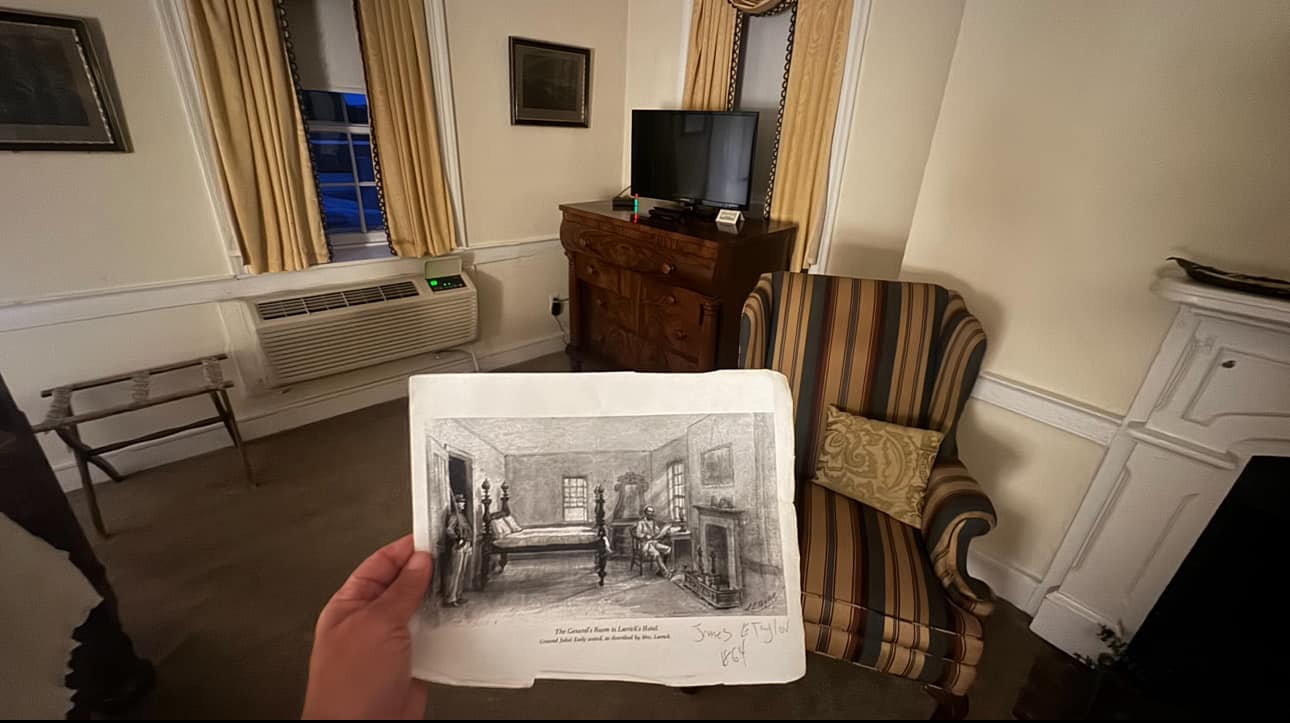
A sketch created during the war by James E. Taylor of Rebel General Jubal Early in the
room where I slept at The Wayside Inn.

Friday, September 27, 2024

Tales from the road: 'Ghost cats,' communing with Early's spirit

Piers Lamb, the excellent communication director of The Wayside Inn, conducts a tour.


After a nine-hour drive through the rain from Nashville — including a brutal stretch on I-81 (“The Devil’s Highway”) — I finally pull into the parking lot of my accommodations at The Wayside Inn & Larrick’s Tavern in Middletown, Va. A short distance up the old Valley Pike here in the Shenandoah Valley the armies clashed during the Battle of Cedar Creek, fought Oct. 19, 1864, which just happens to be Mrs. B’s birthday (but not the same year!). 

Kyla is related to some guy
named Robert E. Lee.
Minutes after parking, I check in with a nice, young lady at the front desk named Kyla, who spills the beans on her 5x great uncle, some dude named Robert E. Lee. Never heard of him.

“His painting stares at me every day,” she says cheerfully, gesturing toward the wall in front of her.

Anywho, the next thing I know I’m standing, dazed, in front of the late 18th-century inn, where Piers — The Wayside Inn’s enthusiastic communications director — is conducting a tour for a septuagenarian motorcycle club called the Voyagers. The drone of traffic on the Valley Pike in front of the inn nearly spoils his excellent talk about the colorful history of the place.

Over the years, according to Piers, a veritable who’s who of arts, culture and finance have stayed at the Wayside Inn, including Eleanor Roosevelt, James Earl Jones, Tom Cruise and John Rockefeller Jr.

During the Civil War, officers from both sides frequented the inn and tavern, including “Little Phil” Sheridan of Battle of Cedar Creek renown. (A monument to Union Colonel Charles Russell Lowell, mortally wounded at Cedar Creek, stands in front of the Wayside Inn.)

Jubal Early
A few feet away, a motorcycle club member enjoys a huge martini, which I need about nine of following my nerve-wracking drive. Seconds later, the white-haired, martini gulping biker club member — Kim from Illinois, an inn guest — blurts: “I think ghosts rearranged the change in my room.” 

OMG! I’m staying in spacious Room No. 1, inhabited by Confederate General Jubal Early during the war. If the grumpy ghost of “Old Jube” haunts me with Lost Cause mythology or moves my change tonight, I may have to move to the Hampton lnn in Harrisonburg.

Naturally, guests in the tour group wonder about ghosts in the inn, so Piers feeds the need.

“This is one of the seven most haunted inns in Virginia,” he says.

The Wayside Inn in Middletown, Va., has welcomed guests since the late 18th century.

Piers tells us of an old telephone in one of the rooms that would never stop ringing, even after the yanking of its plug from the wall. Plus, among other ghostly experiences, guests have heard troops tramping through the inn and kitchen workers have had their aprons tugged by unknown forces. (The Mirror Room, where seances once were held, is supposedly the most haunted in the place.)

But by far the weirdest Wayside Inn story is of “ghost cats” moving from Room No. 2, where Sheridan supposedly stayed, to Room No. 1, Early’s room and — gulp! — MY ROOM.

I think this is gonna be a long, one-eye-open night.

READ MORE about The Wayside Inn & Larrick’s Tavern. 

The Jubal Early Room, where I spent a sleepless night.

Tuesday, May 21, 2024

Check out new Civil War Trails markers in Maryland, Virginia

Maureen O’Connell with Christopher D. Brown, assistant director of the Civil War Trails program,
at the new marker in Poolesville, Md.  (Courtesy: Civil War Trails, Inc.)

                 Like this blog on Facebook | Follow me on Twitter | My YouTube videos

So I finally made it back to the loving arms of Mrs. B on Sunday night after a six-state, 2,200-mile Civil War odyssey. I have two observations:

  • Whoever created I-95 should start over.
  • Those great Civil War Trails markers are seemingly everywhere. And a birdie told me of two new ones that I missed:

POOLESVILLE, Md.: A marker at the John Poole House, the oldest building in town. The log structure — located in the historic Medley District at 19923 Fisher Ave. — was built in 1793 by John Poole Jr. and served as a trading post for merchants and families from the surrounding farms and plantations. 

APPOMATTOX, Va.: On the grounds of The American Civil War Museum, where fighting swirled in April 1865. Inquisitive visitors inspired this marker, which highlights the chaos among Confederates as United States cavalry approached and the climactic moment when African American soldiers crossed over museum ground to stop a counter attack.

Let’s keep history alive. 👊

Megan Glewen, Robert Hancock (center) and Bob Sayre of the American Civil War Museum in
Appomattox, Va., pose with the new interpretive sign. It is located just behind the museum
at 159 Horseshoe Rd. (Courtesy: Civil War Trails, Inc.)

Thursday, August 04, 2022

'Incredible bravery': A visit to New Market Heights (Va.)


Tim Talbott stands by Four Mile Creek, an obstacle for the USCT on Sept. 29, 1864.

Like this blog on Facebook | Follow me on Twitter | My YouTube videos

Dripping with sweat on a sweltering Virginia morning, I trudge behind Tim Talbott deep into the woods, a half-dozen or so miles south of Richmond. In the distance, traffic drones on the interstate. But it seems like we’re in another world.

Talbott's T-shirt, drenched in sweat, features a copy
of a painting of a USCT soldier.
“Is this remote enough for you?” says Talbott, the 52-year-old chief administrative officer for the Central Virginia Battlefields Trust. We are tramping upon the New Market Heights battlefield, where, on Sept. 29, 1864, 14 U.S. Colored Troops and two of their white officers earned the Medal of Honor for valor.

Days before I set up my visit to Virginia, Talbott messaged me about New Market Heights: “It’s always an honor to be on that ground.” But this important battle gets stiff-armed in the history books.

Talbott grew up in Madison, Ind., a stop on the Underground Railroad—the network escaped slaves used to flee to free states and Canada. He has a deep interest in the experiences of Black people during the Civil War. The wallpaper on his phone is of Frederick Douglass, the famous orator, abolitionist, writer, and reformer. The copy of the painting on his maroon T-shirt, drenched in sweat, is of a one-legged USCT soldier on crutches. New Market Heights is his favorite battlefield.

During our nearly two-hour trek, Talbott and I examine the remains of earthworks of the famed Texas Brigade, swat away spider webs and mayflies, battle briars, remain wary of ticks, and explore Four Mile Creek—a major obstacle for the USCT as they advanced under withering fire toward the Rebel works. The USCT eventually forced the Confederates to abandon their line.

“Incredible bravery,” Talbott says of the Black soldiers at New Market Heights.

For more, read my book, A Civil War Road Trip of a Lifetime, coming soon.

Remains of earthworks constructed by the Texas Brigade
Tim Talbott navigates a path deep in the woods.

 Have something to add (or correct) in this post? E-mail me here.

Thursday, June 30, 2022

Then & Now: Deep Bottom Landing (Va.) at James River

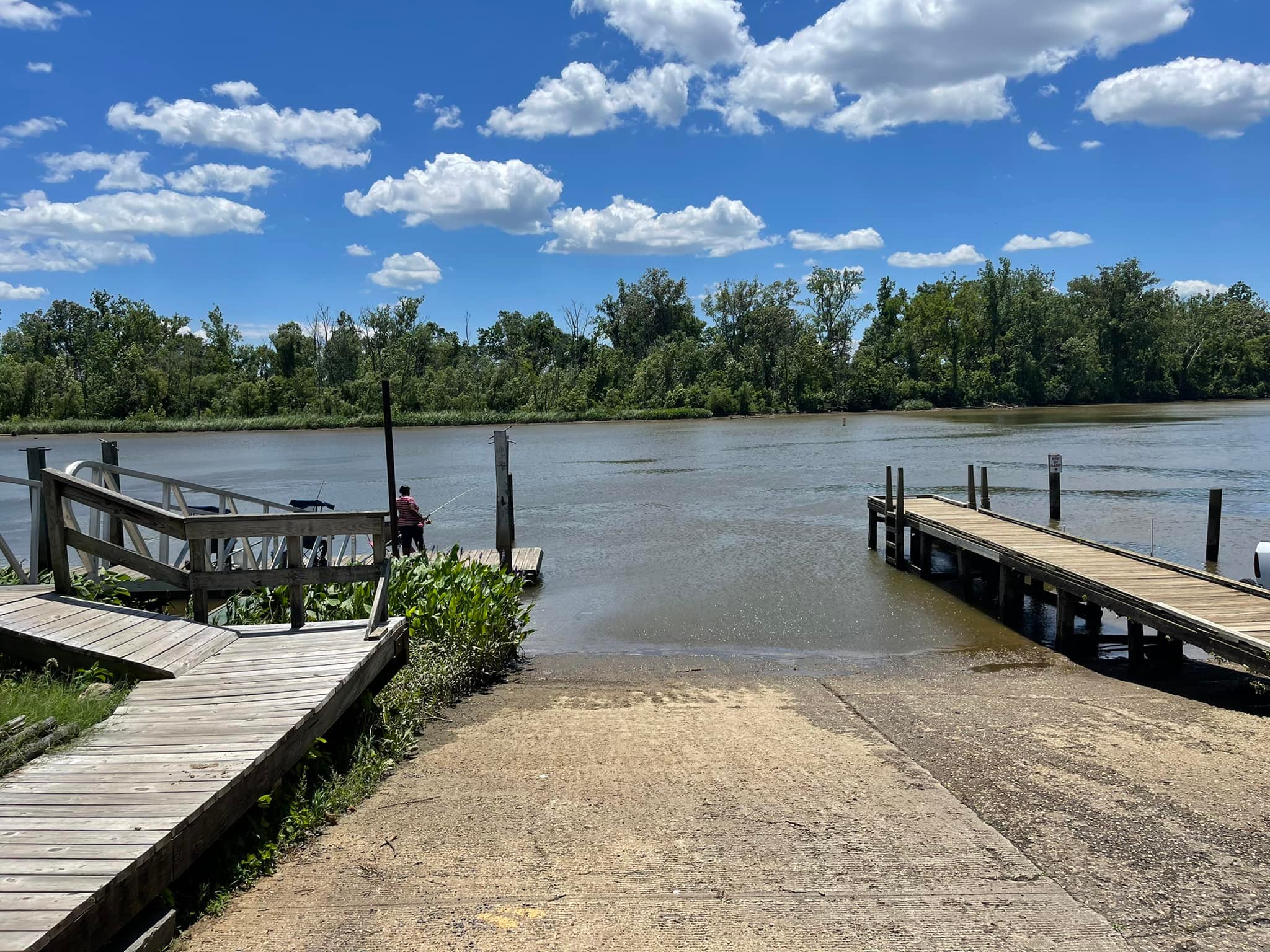
1865 image of Deep Bottom Landing pontoon (Andrew Russell | Library of Congress)
Present-day view of the site, a popular fishing spot.

Like this blog on Facebook | Follow me on Twitter | My YouTube videos

After the Battle of Cold Harbor in June 1864, Ulysses Grant had Benjamin Butler place a small force from his Army of the James here at Deep Bottom Landing to protect the pontoon bridge that allowed Union forces to cross the James River. It’s an important but seldom-visited spot. Apparently it’s a good place to fish. The site is south of seldom-visited Fort Harrison, Confederate defenses south of Richmond. A fabulous bike trail nearby. I’ll be back.
 Have something to add (or correct) in this post? E-mail me here.

Friday, April 08, 2022

Virginia man: I'll be buried on my battlefield someday

Cattle farmer Dirk Warner on his Cumberland Church (Va.) battlefield.
(CLICK ON IMAGES TO ENLARGE.)

Like this blog on Facebook | Follow me on Twitter | My YouTube videos

Meet Dirk Warner: former musician in amateur rock bands Captain Jack and Radio Silence; a 30-year cattle farmer; longtime producer at a Richmond TV station; owner of a Siberian Husky-American Eskimo mix named Izzy, who tried to kiss me; and a black Angus named Nibbles, whom he doesn’t have the heart to take to market.

Oh, and Warner owns core battlefield.

Nibbles and I share a special moment.
Not just any battlefield. The Cumberland Church (Va.) battlefield, where Robert E. Lee earned his final victory of the Civil War on April 7, 1865. Warner cherishes the place, plans to be buried someday on this very field—“over by those red buds,” he told me during the chilly, deep-blue sky morning we walked his farm.

When Warner is out here on his tractor, near a stretch of the Old Jamestown Road that snakes through his field, he often relives the battle. This hallowed ground—Union Army headquarters for the unheralded, five-hour brawl—is part of his soul. He relishes sunsets from a chair near his fire pit, the history unearthed in the fields, the poignant stories uncovered—everything about his battlefield.

“This is sacred ground,” Warner told me. “I’m out here baling hay some day and it hits me, ‘Holy crap! I live here.’ "

At Cumberland Church, Ulysses Grant asked for Lee’s surrender. “Not yet,” James Longstreet told Lee. Two days later, at Appomattox Court House, roughly 30 miles away as the crow flies, it was all over.

Warner may bawl his eyes out on his battlefield someday. A 148th Pennsylvania soldier, decapitated by Confederate artillery, may rest somewhere on the field. His descendant plans to walk the farm this year with Warner—an experience guaranteed to be emotional for him and his host. Maybe he and Warner will discover the soldier’s remains.

Warner’s father-in-law once owned this farm. The man had two requests of Dirk when he married off his daughter: “Promise to look after my daughter and look after my place.”

Sir, it’s in fabulous hands. Consider this a perfect marriage of person, passion and place.

Old Jamestown Road snakes through Dirk Warner's battlefield.
Sunset on Warner's Cumberland Church battlefield.

 Have something to add (or correct) in this post? E-mail me here.

Saturday, April 02, 2022

A Cedar Creek (Va.) battlefield snake killer and Louie the boar

Jesse Rudolph, farmer and snake killer.

Like this blog on Facebook | Follow me on Twitter | My YouTube videos

Meet Jesse Rudolph, who farms hallowed ground with his dad and once woke up to a five-foot black snake next to his bed in the historic house he leases on the battlefield. That’s one of the perils of living at the circa-1780s Dinges place, used as a hospital during the battle on Oct. 19, 1864, which happens to be Mrs. B’s birthday. (But not the same year!)

Louie. What a boar.
Jesse was alerted to my presence by the yapping of his dogs, Stella and Hank. During our brief visit, he lamented the development in the area. Pitiless bulldozers have destroyed many battlefield acres throughout Virginia’s Shenandoah Valley, so that’s why your support of preservation organizations such as the Shenandoah Valley Battlefields Foundation is so important. Nearby, a housing development sprouted up recently on hallowed Cedar Creek ground.

Ugh.

Jesse and I also discussed snakes.

“Black snakes have germs in their mouth,” he said. “They’re disgusting little animals.” Jesse has been known to dispatch the beasts with firepower. So beware, black snakes. I also had the pleasure of meeting Louie, Jesse’s 325-pound wild boar. Now I’m not exactly positive he’s a boar—I usually skipped the “Mutual of Omaha’s Wild Kingdom” show on TV as a kid—but the animal is definitely in the hog and pig family. I can confirm, however, meeting many other bores during my journalism career. Louie’s gleaming, white tusks must impress his dentist. The animal, however, refused an interview request.

“What does Louie eat?” I asked.

“Whatever he wants.”

At the Battle of Cedar Creek, Phil Sheridan mounted his grand counter-attack against the Rebs near Jesse’s place. As Nick the Guide took me to another secluded battlefield location, I silently cursed those damn black snakes and shot an image of the field where the Yankees advanced.

Until next time, Jesse, Stella, Hank and Louie.

Phil Sheridan’s grand Cedar Creek counter-attack occurred here.
This once was battlefield.

 Have something to add (or correct) in this post? E-mail me here.

Friday, August 27, 2021

Will historic 'Bachelor's Rest' farmhouse walls be saved?

In early April 1865, the Union Army used Truely Vaughan's farmhouse near Deatonville, Va.,
 as a makeshift hospital. Confederate prisoners may have been cared for here, too. 
(All photos courtesy of Michael Meehan)

Like this blog on Facebook
 | 
Follow me on Twitter | HELP SAVE THE WALLS

In early April 1865, as the battered but still deadly Army of Northern Virginia crept toward Appomattox Court House, the U.S. Army fought Robert E. Lee's rearguard near Truely Vaughan's farm outside Deatonville, Va. To care for their wounded, the Federals' III Division, II Corps established a makeshift hospital at the bachelor farmer’s modest, four-room plantation house.  

The farmhouse, now in disrepair, dates
to the late 18th century.

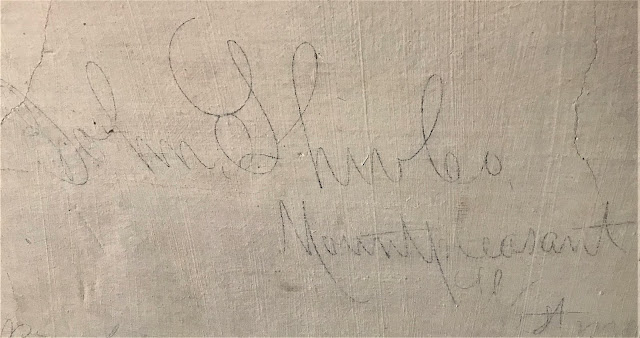
For posterity or perhaps simply because they were bored, some of the 250 to 300 wounded at Vaughan’s farm—it was known during the war as “Bachelor’s Rest”—wrote their names or initials on the homestead's walls. One of them, John Shivler of the 105th Pennsylvania, suffered from a ghastly, life-altering battle wound to his face. 

More than 155 years after the corporal left his mark in a house near Lee's final retreat route, his heart-rending story touched a Pennsylvania native with a deep interest in Civil War history and historic preservation.

“It’s almost like he has reached back in time—I really have affinity for this guy,” says Michael Meehan, who aims to preserve the scrawling in the farmhouse for future generations.

“Just walking into that room in the farmhouse and seeing that man’s name on the wall and you go, ‘Holy cow!’”  

Meehan—who grew up in Stewartstown, Pa., roughly 45 miles from Gettysburg, but now lives in Meherrin, Va.—must work fast. Victimized by nature, time, and neglect, Vaughan’s late-18th-century house has nearly deteriorated beyond repair. With the blessing of the farm’s current owner, who acquired the house and surrounding property in 2011, Meehan intends to remove the walls. But he needs the public's help, so he has established a GoFundMe Page to raise $3,500 to defray costs. Ultimately, Meehan and other local preservationists want to have the artifacts displayed in a museum.   

A view of the Virginia countryside from the farmhouse.

Besides Shivler, Meehan has identified three other soldiers who wrote on the farmhouse walls: Privates Luther Calkins and Cornelius Mahorn of Company K of the 105th Pennsylvania; and Corporal George McKechnie of Company I of the 1st Maine Heavy Artillery. With the aid Patrick Schroeder, the historian at Appomattox Court House National Historical Park, and others, Meehan has researched the backgrounds of each soldier. Pension file documents provide rich details.

On April 6, 1865—three days before Lee's surrender at Appomattox Court House—the 105th Pennsylvania fought Confederates near Deatonsville, a continuation of fighting at Saylor’s Creek. Among the regiment's 16 wounded that day were Shivler, Calkins, and Mahorn. 

Calkins suffered a wound in his left foot, between his second and third toe, with the bullet coming to rest near his ankle. “It must have been incredibly painful,” Meehan says. Less than a year earlier, he had suffered a wound in the right arm in brutal fighting at the Wilderness. After the war, he married, raised a family, and moved throughout the country. 

Meehan identified Mahorn by his initials on the wall, but the nature of the Pennsylvanian’s wounds and his background require more research. 

McKechnie, who battled dysentery in 1864, suffered a wound from a stray bullet in his left hand in support of a firing battery near Amelia Springs, Va. The bullet tore through his index finger and middle finger, exiting below the thumb. Following the war, McKechnie—who was probably in his late teens when he enlisted—returned to Maine.

Near his name, Private Luther Calkins of the 105th Pennsylvania may have drawn
 the illustration at lower left.
Severely wounded John Shivler of the 105th Pennsylvania wrote his name on the farmouse wall.

But it’s the story of Shivler, who served in the 105th Pennsylvania’s color guard, that moves Meehan most. 

After a bullet struck the corporal in the face, a 105th Pennsylvania comrade feared he was dead. As Shivler, who was 30 or 31, staggered to his feet, a horse nearly trampled him. He made it to Vaughan's farmhouse, where he received treatment for his wound. Perhaps Vaughan, who remained on his farm during fighting in the area, walked through his house as Shivler and other Federal wounded lay in the cramped quarters. 

An illustration from John Shivler's pension file
depicts his April 1865 battlefield wound.
(Courtesy Michael Meehan)
In an era long before plastic surgeons,  Shivler endured with a terribly mangled face. After the war, the veteran married a widow named Maria and became a  tailor. But by 1902, he resided in an insane asylum in Mahoning Township, Pa. Nine years later, Shivler died at age 77 and was buried in a cemetery in South Philipsburg, Pa.

“This incident affected him forever,” says Meehan of the corporal's wounding, perhaps in a “grand charge” on earthworks near Deatonville. 

In addition to money, the removal of the  fragile walls requires expertise. Meehan's brother, a building contractor, will aid the effort. The plan is to cut studs from the walls, put plywood behind and Plexiglas in front of them, squeeze the Civil War treasure together “like a sandwich,” and remove the artifacts.

"I saw John Shivler wounded in the face," 105th Pennsylvania comrade Daniel Shomber
testified in an affidavit found in Shivler's pension file. "He fell and I thought was killed."
(Courtesy: Michael Meehan)

Meehan will continue to research the backgrounds of each of the ID’d soldiers as well as Truely Vaughan, who owned roughly 1,400 acres, 30 slaves and farmed tobacco, among other crops. Through ancestry.com, a genealogy site/rabbit hole, Meehan has even tracked down descendants of Calkins and McKechnie. The Maine soldier’s descendant was “absolutely stunned” when Meehan contacted her.

Meehan also will continue to research the fighting at Deatonville, the little-known scrap in the war's waning days. "We are still trying to lay out battle there because there are very sparse records on it," he says. Dozens of soldiers wounded from the battle may have been cared for on Vaughan's farm.

For Meehan, the effort brings immense satisfaction.  

“I have been passionate about history since I went to Gettysburg when I was 6,” he tells me, "and I’ve been married to it ever since.”

John Shivler's grave in Philipsburg Cemetery in South Philipsburg, Pa.
(Find A Grave)

-- Have something to add (or correct) in this post? Email me here.

Tuesday, December 03, 2019

From Antietam to Shiloh, my 25 favorite 2019 photos


"The world is a book and those who do not travel read only a page."

 -- Saint Augustine


LOOKOUT MOUNTAIN, CHATTANOOGA, TENN: Reenactor Todd Watts of Nashville. 
ANTIETAM (MD.) BATTLEFIELD: 132nd Pennsylvania monument at Bloody Lane. 
ANTIETAM (MD.) BATTLEFIELD: Sunrise at the Samuel Mumma farm.
LEXINGTON, VA.: Lee Chapel, Washington and Lee campus. (READ POST.)
SHILOH (TENN.) BATTLEFIELD: Trapper Haskins, vintage baseball league player.
CHICKAMAUGA (GA.) BATTLEFIELD: Confederate Brigadier General Bushrod Johnson monument. 
ANTIETAM (MD.) BATTLEFIELD: Early morning at Dunker Church.
LOOKOUT MOUNTAIN, CHATTANOOGA, TENN.: Marker near the Cravens House, vortex of battle.
MISSIONARY RIDGE, CHATTANOOGA, TENN.: Witness tree.
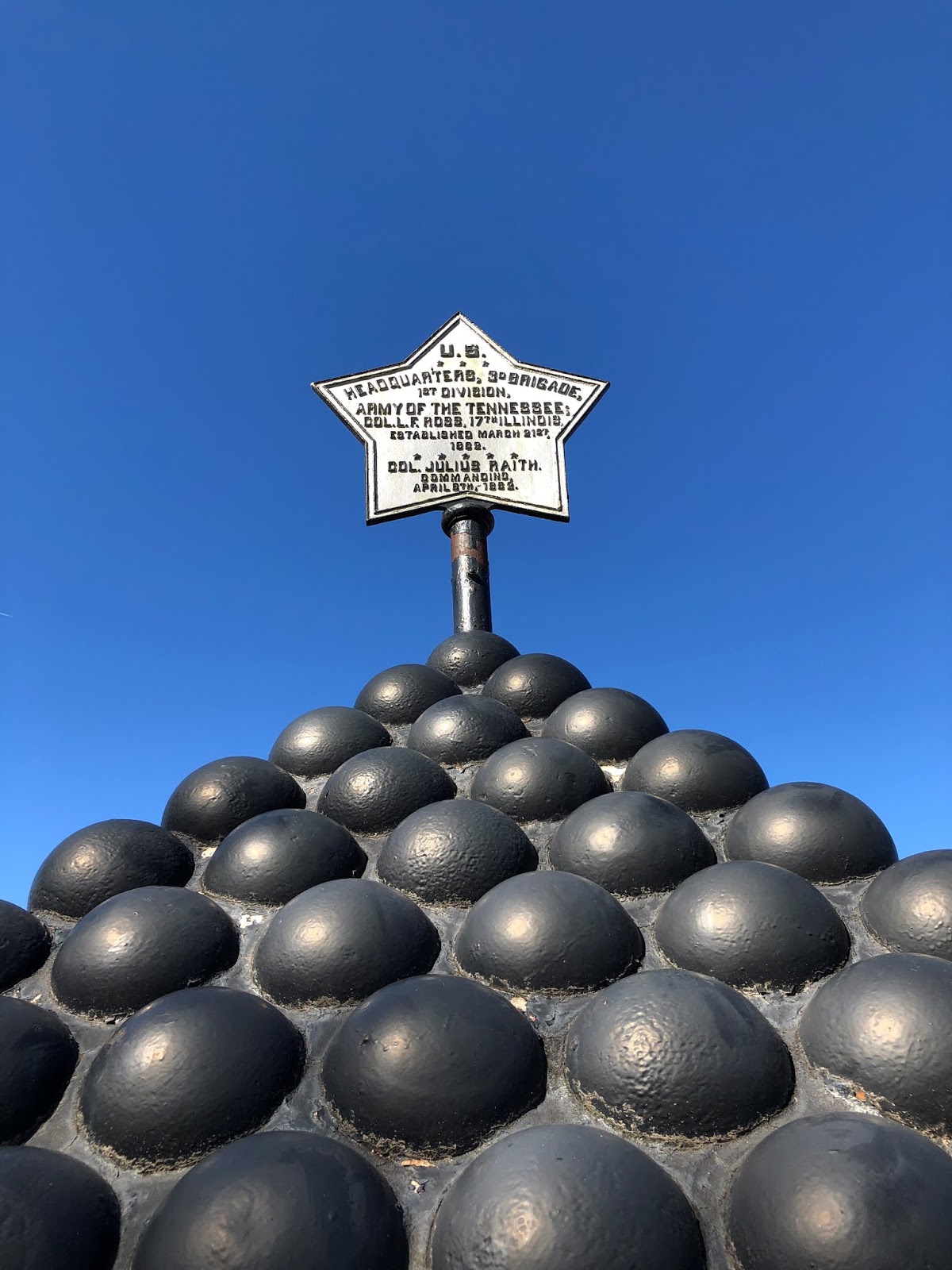
SHILOH (TENN.) BATTLEFIELD: Union brigade headquarters marker.
SAVANNAH, TENN.: Ulysses Grant headquarters site before the Battle of Shiloh.
ANDERSONVILLE, GA.: Site of  infamous deadline at the notorious POW camp. (READ POSTS.)
SHILOH (TENN.) BATTLEFIELD: Close-up of old, cast-iron marker for Confederate unit. (READ POST.)
ANTIETAM (MD.) BATTLEFIELD: William McKinley monument near Burnside Bridge.
CROSS KEYS (VA.) BATTLEFIELD: James Madison University professor Ken Rutherford,
a landmine explosion survivor. (READ MY CIVIL WAR TIMES COLUMN.)
RESACA, GA.: 83-year-old reenactor Jere McConnell. (READ MY CIVIL WAR TIMES COLUMN.)
SHELBYVILLE, TENN.: Bronze plaque on grave of Sumner Cunningham, founder and publisher 
of Confederate Veteran magazine, at Willow Mount Cemetery.  (READ POST.)
LEXINGTON, VA.: Lee Chapel on Washington and Lee campus. (READ POST.)
LEXINGTON, VA.: Stonewall Jackson statue at Virginia Military Institute.
SHILOH (TENN.) BATTLEFIELD: Monument for Union brigade headquarters. (READ POST.)
WHITES CREEK, TENN.: Tennessee Association of Vintage Baseball game. Love Norman Rockwell-like
quality of this image. League plays by Civil War-era rules. (READ MY AMERICA'S CIVIL WAR STORY.)
FORT PILLOW, TENN.: An attacking Confederate's view of the fort. (READ POST.)
ANTIETAM (MD.) BATTLEFIELD: 11th Connecticut monument near Burnside Bridge.
CORINTH, MISS.: Statue at contraband camp.
FRANKLIN, TENN.: Half-dozen red roses on grave of 16th South Carolina Private Hembry Chapman 
 at McGavock  Confederate Cemetery. Chapman, killed at the Battle of Franklin, was 17 or 18. 
His brother also is buried here. (CLICK ON ALL IMAGES TO ENLARGE.)

-- My favorite photos of 2017 and 2018
-- Have something to add (or correct) in this post? Email me here.