 |
| Boarded up and battered by time and nature, the circa-1850 Jacob A. Thomas house near Boonsboro, Md. (CLICK ON ALL IMAGES TO ENLARGE.) |
 |
| The summer kitchen and farmhouse have seen much better days. |
In its death throes, the circa-1850 red-brick house seems cloaked in sadness.
As if scooped out by a massive hand, gaping holes expose the heart of the abandoned, two-story structure on a knoll just off a Maryland country road. Tall weeds sprout from a pile of rubble — all that remains of what was once a splendid bay window. An ancient, well-worn set of stone steps stands orphaned after the collapse of a small wooden porch. A second-floor porch, once an eye-catching feature that mirrored others in the area, is nearly gone. Peeling green paint and graffiti scar the front door.
As if that weren’t warning enough, a small sign on the weather-beaten white transom cautions would-be intruders: Private Property — Keep Out.
Likely baked decades ago in a farmstead kiln, bricks litter the sloping front yard. Just steps from the back door, a wooden privy and summer kitchen slowly lose their fight for survival, while only yards away a beautifully restored post–Civil War barn stands in striking contrast.
Likely baked decades ago in a farmstead kiln, bricks litter the sloping front yard. Just steps from the back door, a wooden privy and summer kitchen slowly lose their fight for survival, while only yards away a beautifully restored post–Civil War barn stands in striking contrast.
 |
| The interior of the once-stately home may be seen through gaping holes. (CLICK ON ALL IMAGES TO ENLARGE.) |
 |
| A warning sign to trespassers on the weather-beaten and graffiti-marred front door. |
 |
| Who trod on these well-worn -- and probably original -- steps? |
 |
| A view of the once-splendid second-floor porch. |
 |
| A close-up of outside brickwork reveals effects of time and neglect. |
Time, nature and trespassers have conspired to wreak havoc inside the Greek Revival–style house. Debris spills from a first-floor fireplace — one of five in the once-stately home.
A brown doorknob lies forgotten on the floor, perhaps pried loose by a vagrant. Boarded-up windows block what would have been a sweeping view of South Mountain. Wary of falling through rotted wood, two visitors gingerly climb the stairs, stepping carefully over rubble. Bricks choke the hearth of a bedroom fireplace.
Nearby, a shaft of daylight reveals deep-blue walls in a small room. A gaping chasm where part of the second floor has collapsed halts further exploration. Briefly alone upstairs, one visitor closes his eyes and offers a silent prayer for a long-ago inhabitant of one of the bedrooms.
 |
| Debris litters the steps leading to the second floor. (CLICK ON ALL IMAGES TO ENLARGE.) |
 |
| Bricks and debris clutter a second-floor bedroom. Could this be where Wilder Dwight died? |
 |
| Light streams into a second-floor bedroom, revealing the remains of a bed (left) near a wall. |
In late-summer 1862, this was the home of Jacob and Sarah Thomas and their daughters, 23-year-old Annie and 17-year-old Eliza. In the vortex of the war in mid-September 1862, families such as the Thomases heard the boom of artillery and crackle of musketry as Union and Confederate armies clashed nearby at South Mountain and at Sharpsburg, near the banks of Antietam Creek.
 |
| Wounded at Antietam, Wilder Dwight died two days later in a bedroom at the Jacob A. Thomas house near Boonsboro, Md. |
As comrades lifted him into his bed at the Thomases' house, the soldier repeated, "Now, boys, steady and true! Steady and true!" Soon after soldiers left the bedroom, the wounded man summoned enough energy to tell them, "Wait a minute, boys; you've taken good care of me, and I thank you very much. God bless you!"
Thankfully, the beloved officer was in good hands -- unlike many of their neighbors, the Thomases were a staunch Union family. A devout man and member of the United Brethren Church, 46-year-old Jacob Thomas may have even tended to the spiritual needs of his important house guest.
Also shot in the left wrist, the officer -- who "seemed quiet" -- suffered intense pain in his wounded leg that afternoon. But 2nd Massachusetts Chaplain Alonzo Quint still expected he would live a few more days. Growing weaker, the officer sent a note to a surgeon. "They tell me," he said, "that I may recover. I do not believe it ... " He wondered if his brother, William, a colonel in the 70th New York, were near. Preparing for the worst, he also had a dispatch sent to his father back home in Brookline, Mass., urging him to quickly travel to the red-brick house near Boonsboro, Md.
 |
| Painting of Wilder Dwight, completed in 1863. (Harvard University Portrait Collection, Gift of the children of Mrs. William Dwight to Harvard College, 1884.) |
Pale and his eyes sunken, the lieutenant colonel slipped away at about 12:30 p.m. on Sept. 19, 1862. "Oh, my dear mother!" he said shortly before he died.
Wilder Dwight -- "the best man in the world," according to a 2nd Massachusetts comrade -- was only 29. He left behind his parents, William and Elizabeth; three brothers and scores of comrades and friends to mourn.
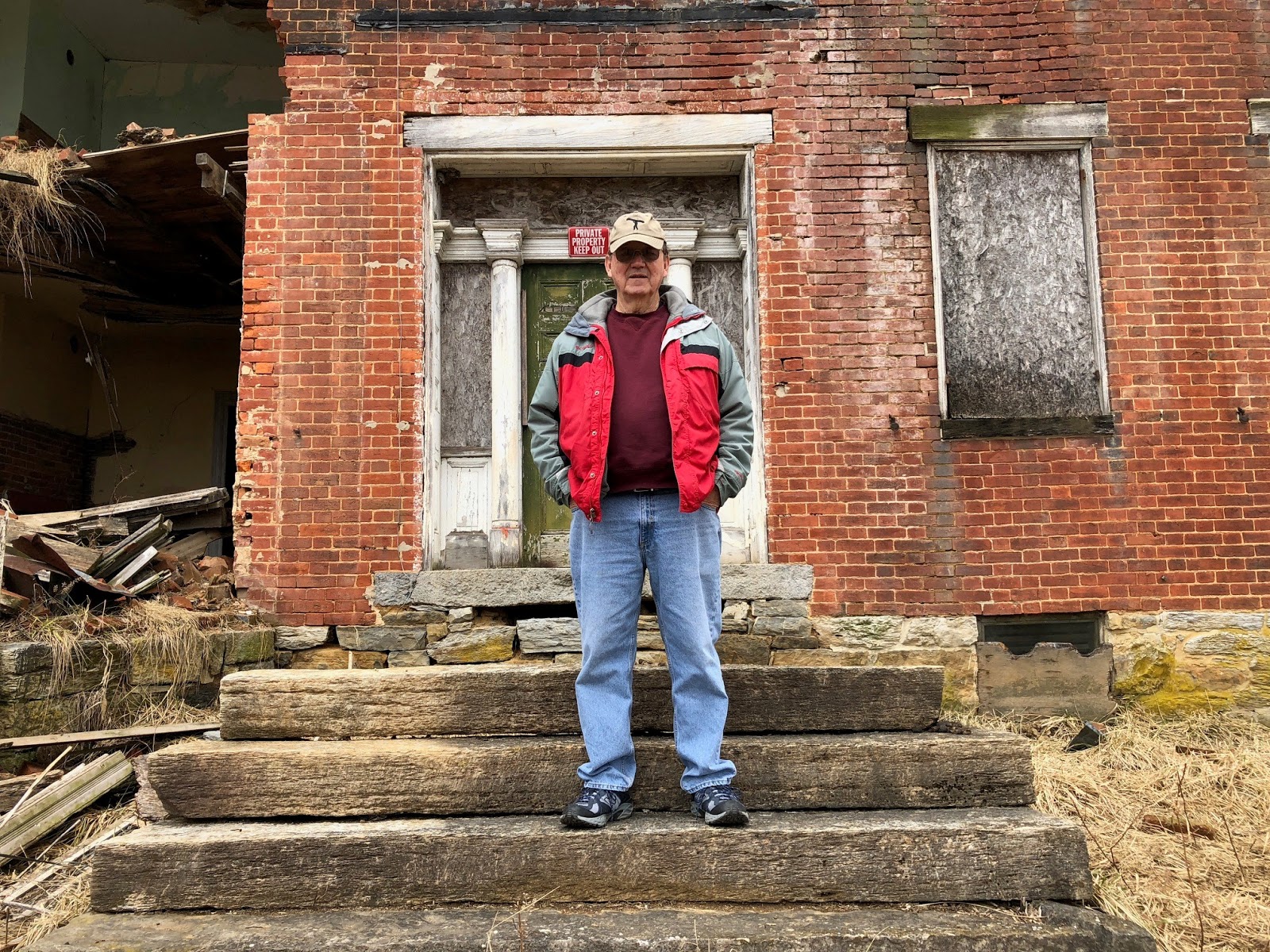 |
| Art Williamson, the friendly owner of the old Jacob Thomas property, on the front steps of the crumbling farmhouse. (CLICK ON ALL IMAGES TO ENLARGE.) |
Understandably, this Civil War story of the old house and the Massachusetts officer fascinates more than just its two visitors.
"If only I had known this history back then," says 76-year-old Art Williamson, who bought the Jacob Thomas house and surrounding property, including a barn, in 1986.
 |
| A peek inside the decrepit summer kitchen, which also pre-dates the Civil War. |
In 1999-2000, Williamson did sink a considerable sum into renovating the circa-1870 barn on the farmstead. Justifiably proud of that fabulous structure, he also enjoys showing visitors about his farm, where he raises llamas, emus, toy donkeys and an assortment of goats. "It's my funny farm," Williamson says with a chuckle. On a recent morning, the gregarious man flaps his arms to shoo away two pesky llamas while an inquisitive donkey nudges a visitor.
Some think the Thomas house is haunted, says Williamson, who regrets that wayward youths have used it for parties and other mischief. As visitors inspect the back of the house, he tells the story of a local man who used a first-floor room for much more ceremonial purposes. His fiancee relished old houses, and so one day the man took her to the Thomas house, where he had a bottle of wine, two glasses and an engagement ring placed on a small table. He proposed right there. "How 'bout that?" says Williamson.
As the visitors leave the property, they try to imagine the terrible September day when Wilder Dwight was carried into this quiet western Maryland landscape. They are left with questions — some likely unanswerable.
Could the house have been saved? In which room did Dwight die? What passed through his mind as his life slipped away?
What did the Thomas family feel when the young officer breathed his last?
As the car pulls onto the road, one thought lingers. A remarkable house is dying, and with it a small but powerful fragment of American history.
I thank my friend, longtime Washington County (Md.) resident Richard Clem, among the best Civil War detectives around, for his tremendous assistance on this story.
SOURCES
-- Dwight, Wilder and Dwight, Elizabeth Amelia, Life and Letters of Wilder Dwight, Lieut.-col. Second Mass. Inf. Vols, Boston, Ticknor and Fields, 1868.
-- Wilder Dwight battlefield letter to his mother, Sept. 17, 1862, Massachusetts Historical Society Collection.
I thank my friend, longtime Washington County (Md.) resident Richard Clem, among the best Civil War detectives around, for his tremendous assistance on this story.
 |
| Donkeys and an emu approach a visitor on Art Williamson's "funny farm." |
-- Have something to add (or correct) in this post? E-mail me here.
SOURCES
-- Dwight, Wilder and Dwight, Elizabeth Amelia, Life and Letters of Wilder Dwight, Lieut.-col. Second Mass. Inf. Vols, Boston, Ticknor and Fields, 1868.
-- Wilder Dwight battlefield letter to his mother, Sept. 17, 1862, Massachusetts Historical Society Collection.

So sad to see this beauty in such shape.
ReplyDeleteThis comment has been removed by the author.
ReplyDeleteAs much money as our government wastes it is a shame they do not assist in the preservation of historical sites such as this.
ReplyDeleteThanks! John for recording for history this site with your photos and narrative. As a reader, I greatly appreciate the care you have taken to link to sources...Maryland Historical Trust report and photos from 1978...the Thomas family information...especially. It is interesting to note that according to the 1978 Trust report that "this is one of the several farms in the Keedysville area owned by the US Steel Corporation. At one time fine agricultural properties with substantial improvements, these farms have deteriorated seriously in recent years."
ReplyDeleteThank you for keeping the memory of the houses existence alive.
ReplyDeleteI used to live just down the road from this house. i always wanted to go inside but never got the chance. thanks for the pictures and the history lesson
ReplyDeleteIts a disgrace that the house got to that level of disrepair at all.
ReplyDeleteThank you for posting the photos and for caring sir.
As always! History which is not available anywhere but John Banks blog.It doesn't get better than this.I eagerly await the next expedition!!!
ReplyDeleteIt's too bad it has come to this, wish there was something that could be done - unfortunately it sounds like it is too late. Good read John even though a sad one.
ReplyDeleteJust looking at these photos of this once magnificent home, made me cry.
ReplyDeleteSad story in more ways than one. Thank you again, John.
ReplyDeleteI do know what room the soldier died in
ReplyDeleteI found some hidden coins dated 1850 in some places im takeing care of the house now keeping it clean around it.
ReplyDeleteThank You for the history lesson and keeping this history alive. I love these old houses and the history behind them!
ReplyDeleteJohn you do inspired work.
ReplyDeleteJohn, any update on this house?
ReplyDeleteHi, Todd... no update. will check when I get back East (hopefully) in the spring... JB
DeleteDo you have any information about where on the battlefield Dwight lay wounded for a time? My great (?) grand uncle, Rupert Sad(d)ler is reported to have sought him out, brought him water and stayed with him until becoming one of the group to carry him to the Thomas house. There is a letter from Rupert to his mother detailing his time sitting with Dwight. Apparently, Dwight had represented Rupert on a manslaughter charge before the war. Rupert was killed at Gettysburg on July 3rd, during a skirmish at Culp's hill where he rescued the flag only to be shot and killed.
ReplyDeleteMy names is Peyton Doub and my family owns and lives in two similar farmhouses within 2 miles of this house. I have seen and frequently passed the Thomas House (we used to call it the Flook House) since the 70s. Great story here. Every house, especially here, can tell many stories. Unfortunately, this house was too far gone to restore even in the 70s, before the Williamson's bought it. Part of the problem may have been a bay window, obviously constructed later after the house was built, the likely compromised the structural integrity of the walls. I remember seeing that bay window in the 70s and wondering why this out of place feature would exist on a house of this type. In any event, this web page memorializes the house as well as restoration ever could. Our houses stand intact, but I feel that most of their stories are lost to history.
ReplyDelete