Showing posts with label Gettysburg. Show all posts
Showing posts with label Gettysburg. Show all posts
Thursday, February 26, 2026
Podcast: Author Brad Gottfried compares Antietam, Gettysburg

Thursday, July 03, 2025
Tales from the road: A purr-fect stop in Gettysburg
.jpg) |
| Rebecca Brown and Joanie, an eight-year-old pit bull mix, at the George Meade HQ diorama. |
Like this blog on Facebook | My YouTube videos
Sometimes dreams do come true.
Instead of returning to home base for a cat nap, I stroll into the strangest place in all of Gettysburg. (And, no, it’s not the Lincoln Links miniature golf course on Steinwehr Avenue.)
At the entrance The Civil War Tails at the Homestead Diorama Museum on Baltimore Street, a smiling Rebecca Brown greets me. She, along with her twin sister, Ruth, created dioramas of famous Gettysburg battle scenes with thousands of miniature cats.
In all, Rebecca says they have 9,000 tiny soldier felines on display. But she and Ruth have created a shade over 10,000 total according to the sisters’ “cat census.” ( I didn’t have the heart to ask who counted all the faux critters, an egregious example of journalistic malpractice.)
“My God,” I say to myself soon after forking over my seven bucks to enter this wonder of history, “there’s a diorama of Pickett’s Charge!”
And Devil’s Den… and the fighting at East Cavalry Field… and General Meade’s HQ… and Little Round Top, complete with a “Joshua Chamberlain” brandishing a sword.
“Look,” Rebecca says, “here’s Wade Hampton.”
 |
| "Joshua Chamberlain" (bottom middle) brandishes a sword in the Little Round Top diorama. |
 |
| Union cats maneuver a cannon in the Devil's Den diorama. |
 |
| Charge! A diorama of the fighting at East Cavalry Field. |
“Our handmade miniature soldiers give you 3-D snap-shots of the American Civil War,” the museum web site says. “Get a bird’s-eye view of a battle or get down to eye-level and see what a soldier would have seen: soldiers, horses, cannons and places.”
Like a cat on a hot tin roof (sorry), I bound from room to room examining dioramas, which also include Fort Sumter, the Monitor and Merrimac duel and Andersonville. Meanwhile, Rebecca’s bemused mother Linda and bored 8-year-old pit bull mix named Joanie take in the weird scene.
For decades, the cat-loving sisters — like, no kidding — have been creating mini felines. Mom and Dad aid the effort on the dioramas.
“Anything made of wood is Dad,” Rebecca tells me. “Anything made of fabric is Mom.”
Before departing, I marvel at “Robert E. Lee” and “Ulysses Grant” sitting at their teensy-tiny desks. Then I briefly mull the purchase of a 100-piece jigsaw puzzle of Michigan cavalry cats on the attack — it’s called “Come On, You Wolverines!” and probably the perfect gift for Mrs. B back in Nashville. (Someone purr-suade me that’s a bad idea.)
I probably need to come in from the Civil War wild.
 |
| The diorama of Pickett's Charge from above. |
Sunday, October 13, 2024
Tales from the road: 'The King' and I and a 'Harvest of Death'
 |
| Bob Kalasky explains a detail in "The Harvest of Death" image. |
Like this blog on Facebook | My YouTube videos
“Watch out for ticks,” warns the author of Shadows Of Antietam, a well-received book on images taken in 1862 on that bloody battleground. “I hate ticks.” My gawd, will short-pants me be ravaged by those nasty, little bloodsuckers?
On this glorious day, we’re here on the Day 1 field, within site of Barlow’s Knoll and the 17th Connecticut monument, for Kalasky to persuade me that this is indeed the spot where Timothy O’Sullivan photographed United States Army dead in the aftermath of the battle. The location of (in)famous “A Harvest Of Death” photograph has eluded historians and others. Over the years, 40 locations have been identified as the spot, but none of those investigations have led to a consensus among experts. |
| The ghastly Gettysburg photograph known as "The Harvest of Death." (Library of Congress) |
 |
| "The King" with a blow-up of "The Harvest of Death" photo. |
Kalasky — whom I fondly call “The Shadow King” or simply “The King” — is convinced we stand at the location. I consider him a friend, although our association led to brief tension/unintended hilarity with Mrs. B, who as de facto family chief financial officer oversees nearly all of my purchases topping, say, 40 bucks.
True story: Weeks after buying Kalasky’s book, Mrs. B spotted “massage” on my credit card bill. Gulp. It took all my vast powers of persuasion to convince her of the legitimacy of the purchase.
 |
| "The King" and I. |
“This is nuts!”
His research and interpretation of it seem good to me, but I’m no expert.
“Look at that horse’s ass,” Kalasky says of O’Sullivan’s photograph. Is it a grand clue or merely a false lead?
What we both know for certain is that we stand on hallowed ground. Union soldiers from the 11th Corps, including those from Kalasky’s Ohio, fell in this unremarkable field on July 1, 1863.
“Those poor bastards,” I say of those men.
“Oh, absolutely,” says “The King. “Absolutely.”
 |
| Kalasky traipses over the Day 1 battlefield at Gettysburg, near Barlow's Knoll. where he believes Timothy O'Sullivan created his famous "Harvest of Death" photo. |
LISTEN to Kalasky on our "The Antietam And Beyond Podcast."
Sunday, June 30, 2024
Podcast: Antietam-Gettysburg ties with guide Larry Korczyk
Korczyk co-authored Top Ten at Gettysburg, published March 2017. Since 2002, he has reenacted with the 2nd Rhode Island Infantry Volunteers, acting as company commander. A longstanding member of the Robert E. Lee Civil War Round Table and chairman of the James I. Robertson Jr. Literary Prize for Confederate History, Korczyk shows his passion for history in each battlefield tour he gives.
Saturday, March 18, 2023
Where is General John Bell Hood's amputated right leg?
 |
| Get me the re-write desk! |
 |
| John Bell Hood |
At Tunnel Hill, Ga., recently, I mulled the whereabouts of John Bell Hood’s leg.
At Gettysburg on July 2, 1863, the Confederate general lost the use of his left arm to U.S. Army artillery. On Sept. 20, 1863, at the Battle of Chickamauga (Ga.), he suffered a wound in his right leg, near the hip.
A surgeon amputated the leg, which may have made its way with Hood—a tough man—to a house in the area. The general also spent time in Rev. Clisby Austin’s house at Tunnel Hill, Ga. In spring 1864, Austin’s house served as an HQ for William Sherman.
Somewhere nearby, Hood’s leg is said to be buried, but that’s open to debate. At the edge of a stretch of woods, a marker stands for the lost limb. It makes copy editors throughout the world frown.
 |
| Historical marker at Chickamauga (Ga.) points the way. |
 |
| The general area where John Bell Hood took a bullet in the right leg at Chickamauga. |
— Have something to add (or correct) in this post? E-mail me here.
Thursday, June 23, 2022
'Are you Union?': My first ghostly adventure in Gettysburg
 |
| Weirdness at the Sachs Covered Bridge |
 |
| Your adventurous blogger |
So I went on a paranormal adventure in Gettysburg over the weekend, words I never in the history of ever expected to type. It was a night of spirit meters, ectoplasm, EVP recorders, and a bump in the night on the Sachs Covered Bridge at 12:03 a.m., which is roughly five hours past my usual bedtime.
Oh, that bump in the night isn’t what you think. It was merely a Rem Pod placed on the bridge to detect spirits. You can get one of those merry-go-round-like thingies online if you are interested, according to Hayden, the dude from an after-hours paranormal place in town.
 |
| A Rem Pod used to detect ghosts. |
“Are you Union?”
“Are you Confederate?”
I was told that a Sachs Covered Bridge spirit nicknamed “Tennessee” will smoke your cigarette if you leave one on the railing. I got a chill just writing that sentence, and I don’t even smoke.
Our lead investigator told me of a soldier ghost she spotted on the Baltimore Pike one night after her shift at the Dairy Queen. So, I clutched the steering wheel extra-hard and kept my eyes peeled on the drive back to my hotel. Don’t worry, Mrs. B. All is well.
Much more on this adventure in my book, coming soon. 🙏
Let’s keep history alive. 👊
 |
| A skirmish was fought here near the McCurdy Schoolhouse. But I detected no ghosts. |
 |
| A device used to detect spirits. |
— Have something to add (or correct) in this post? E-mail me here.
Tuesday, August 17, 2021
Are there other Gettysburg stories like Amos Humiston's?
 |
| An enlargement of a CDV of 154th New York Sergeant Amos Humiston's children. (Library of Congress) |
 |
| Amos Humiston |
Thousands of cartes-de-visite of the ambrotype were created and distributed in the hope someone would recognize the children and thus lead to the soldier’s name. The publicity campaign worked. Months after the battle, Humiston was identified by his widow, who learned of his fate after reading a detailed description of the photograph in a religious publication. (In 1999, Mark H. Dunkelman's definitive Humiston biography was published — the book was reprinted in 2020 by Gettysburg Publishing. Read a Q&A with Dunkelman on my blog here.)

Four years after the battle, a daguerreotype of a woman—in her early 20s with “dark hair, combed back and falling loosely over her shoulders”—was found inside a cartridge box near a soldier's remains. Presumably the image was of the soldier's wife or sweetheart. This story was originally reported Oct. 30, 1867, by the Gettysburg Star and Sentinel and subsequently picked up by other Pennsylvania newspapers (see newspaper clip in this post).
"There was nothing to indicate the corps, division, regiment or name," the newspaper reported. "From the locality, it is presumed to be that of a Rebel soldier. The cartridge box was marked U.S., but many of these, captured during the war, were carried in the Rebel ranks."
The Star and Sentinel reported the image was in possession of M.J. Emory, a Pennsylvania College student.
What happened to the photograph? Was it ever identified?
Do you know of similar stories involving photographs found on the battlefield?
I'm working on a story about two photographs found on the Gettysburg battlefield with fallen Confederates and could use your help.
E-mail me at jbankstx@comcast.net if you know more.
-- Have something to add (or correct) in this post? Email me here.
Friday, July 09, 2021
Interview: Laura DeMarco, 'Lost Civil War' author. Plus, a list!

Here's more on DeMarco at her author page. Here's where you can purchase the book on Amazon.com.
Below, Laura offers a list of sites she wishes had been preserved and/or properly memorialized. Plus, an outside-the-box bonus.
 |
| The 8th Vermont monument on the Cedar Creek battlefield. |
SHENANDOAH VALLEY BATTLEFIELDS: Some of the most important battlefields of the Civil War in Virginia are buried under asphalt and concrete. A drive down Interstate Highway 81 provides a tour of Shenandoah Valley Civil War battlefield sites — planned or not. The interstate travels through the valley for 150 miles, cutting through seven battlefields as it winds through the picturesque countryside, including: Second and Third Winchester, First and Second Kernstown, Cedar Creek, Fisher’s Hill, Tom’s Brook. and the New Market battlefields.
 |
| An August 1863 image of Camp Letterman. (Library of Congress) |
 |
| Hard-to-get-to Fort St. Phillip in Louisiana. This is an 1898 addition to the fort. (NPS photo) |
FORT ST. PHILLIP (LA.): Founded by the Spanish in 1792, Fort St. Philip has the most fascinating history of any American fort. It was ruled by the Spanish, French, and United States, and was the location of a Civil War siege, a Civil Rights threat, and a cult. The remaining structures were severely damaged by hurricanes Katrina and Rita in 2005. Today, portions of the original masonry fort and rusty artillery remain abandoned and covered in overgrowth. The land is shrunk more and more by erosion each year. Fort St. Philip, which played such a vital role protecting New Orleans, is only accessible by boat or helicopter.
 |
| A stereoview of Marshall House in Alexandria, Va. (Library of Congress) |
MARSHALL HOUSE (ALEXANDRIA, VA.): One of the most significant deaths in the early days of the Civil War took place not on the battlefield, but in an inn. The Marshall House at 480 King Street in Alexandria, Va., was the site of the May 24, 1861, assassination of Col. Elmer E. Ellsworth, founder of the 11th New York Volunteer Infantry Regiment and close friend of President Abraham Lincoln. It was a day that would live in infamy in the Civil War, energizing both Union and Rebel troops. The Marshall House was badly damaged in an 1873 arson, though it was rebuilt. The infamous location was demolished in 1950. But the controversy didn’t end with its removal. The Sons and Daughters of the Confederate Veterans hung a historic plaque on a new hotel on the site, The Monaco, that only mentioned Jackson, “the first martyr to the cause of Southern Independence” — not Ellsworth. The controversial sign was finally taken down in 2017 when Marriott purchased the property and renamed it The Alexandrian.
 |
| Brady, post-war |
-- Have something to add (or correct) in this post? Email me here.
Sunday, April 25, 2021
Gettysburg Then & Now: Forbes Rock (and a look at God Tree)
 |
| THEN: In this cropped version of Mathew Brady's photo of "Forbes Rock," his assistant sits on a boulder in the foreground. (Library of Congress) |
 |
| NOW: View shot by your blogger on April 17, 2021. |
Last weekend, Civil War Times editor Dana Shoaf, director of photography Melissa Winn and I were wowed by an up-close look of Forbes Rock, among the most famous boulders on a battlefield studded with them. I was in Gettysburg to report for a column in Civil War Times on the rehabilitation of Culp's Hill. As part of that effort, trees and brush have been cleared around Forbes Rock.
 |
| The "God Tree," a witness tree on Culp's Hill, near Forbes Rock. |
The battle-scarred tree in the foreground of the 1863 Forbes Rock image is long gone, but there are other witness trees on Culp’s Hill -- including the "God Tree," which more than 100 years ago someone filled with concrete and rebar in a misguided preservation effort. "Horrible," Jason Martz, our National Park Service guide, told us.
In the 1863 image, a Brady assistant sat on a boulder in the foreground. He gives us a good sense of the size of the massive boulder, used by Confederates for cover from withering fire from the U.S. Army postioned behind breastworks. Is that the “Brady boulder” in the present-day view? Hmmm, if so, it looks different than it appeared in 1863. Weigh in, photo nerds.
The massive boulder was named for wartime battle sketch artist Edwin Forbes, who created a view of the July 2, 1863, attack here from the Confederates' perspective.
Great news: The National Park Service soon may have a trail for visitors to this off-the-beaten path spot.
 |
| Edwin Forbes' depiction of Confederates' attack at Culp's Hill on evening of July 2, 1863. (Library of Congress) |
-- Have something to add (or correct) in this post? Email me here.
Wednesday, April 21, 2021
Thursday, December 17, 2020
Zoomcast: Interview with author of new Gettysburg book
In a 22-minute Civil War Zoomcast, I interviewed James Gindlesperger, author of the newly published Bullet & Bandages | The Aid Stations and Field Hospitals at Gettysburg. (Gotta love the Tom Hanks reference.) By Blair Publishing, the book is 336 pages, with lots of color photos.

Jim and I share a western Pennsylvania connection -- he's from Johnstown, Pa., where it sometimes snows, according to sources. He and his wife, Suzanne, co-authored So You Think You Know Gettysburg and So You Think You Know Antietam?
From Antietam to Wartrace: My favorite photos of 2020
 |
| BRENTWOOD, TENN.: A wilted rose left on a small, weather-worn gravestone in a small slave cemetery in a road median. (READ MORE | CLICK ON ALL IMAGES TO ENLARGE.) |
What a crazy year ...
In Tennessee alone, I met a woman named "Blossom" at the tavern where Patrick Cleburne might have hung out in Wartrace, patted a dog named "River" at 20th Tennessee Colonel Bill Shy's grave in Franklin, and peered into a church in Denmark where Confederate soldiers hid under hoop skirts.
 |
| A poignant note left at a slave cemetery. |
"Thank you. I so very hope someone thanked you during your life here. You could not have imagined so many wonderful things we have today because of your labors, and how much farther we have to grow."
There were road trips to Antietam, Chickamauga, Corinth, Miss.; Crampton's and Fox's gaps in Maryland, Gettysburg, Perryville, Ky.; Port Republic and Cross Keys in the Shenandoah Valley of Virginia, and for the first time, Brice's Cross Roads (Miss.), Mill Springs (Ky.) and Britton's Lane, Tenn. And I visited the grave in Glade Spring, Va., of the general with the fabulous nickname, "Grumble" Jones. Closer to home, I traveled to Franklin, Shiloh, Stones River, and Lookout Mountain. And, of course, many Nashville battlefield sites were only a bike ride away.
Besides my University of Alabama cap and a smile, I always traveled with my iPhone, eager to document the journeys. Here are some of my favorite photos from 2020. Hope you enjoyed riding "shotgun."
Remember: Life, enjoy the journey.
Always...
 |
| ANTIETAM, MD.: A misty early morning at Bloody Lane. |
 |
| FRANKLIN, TENN.: A dog named "River" at grave of 20th Tennessee Colonel Bill Shy. |
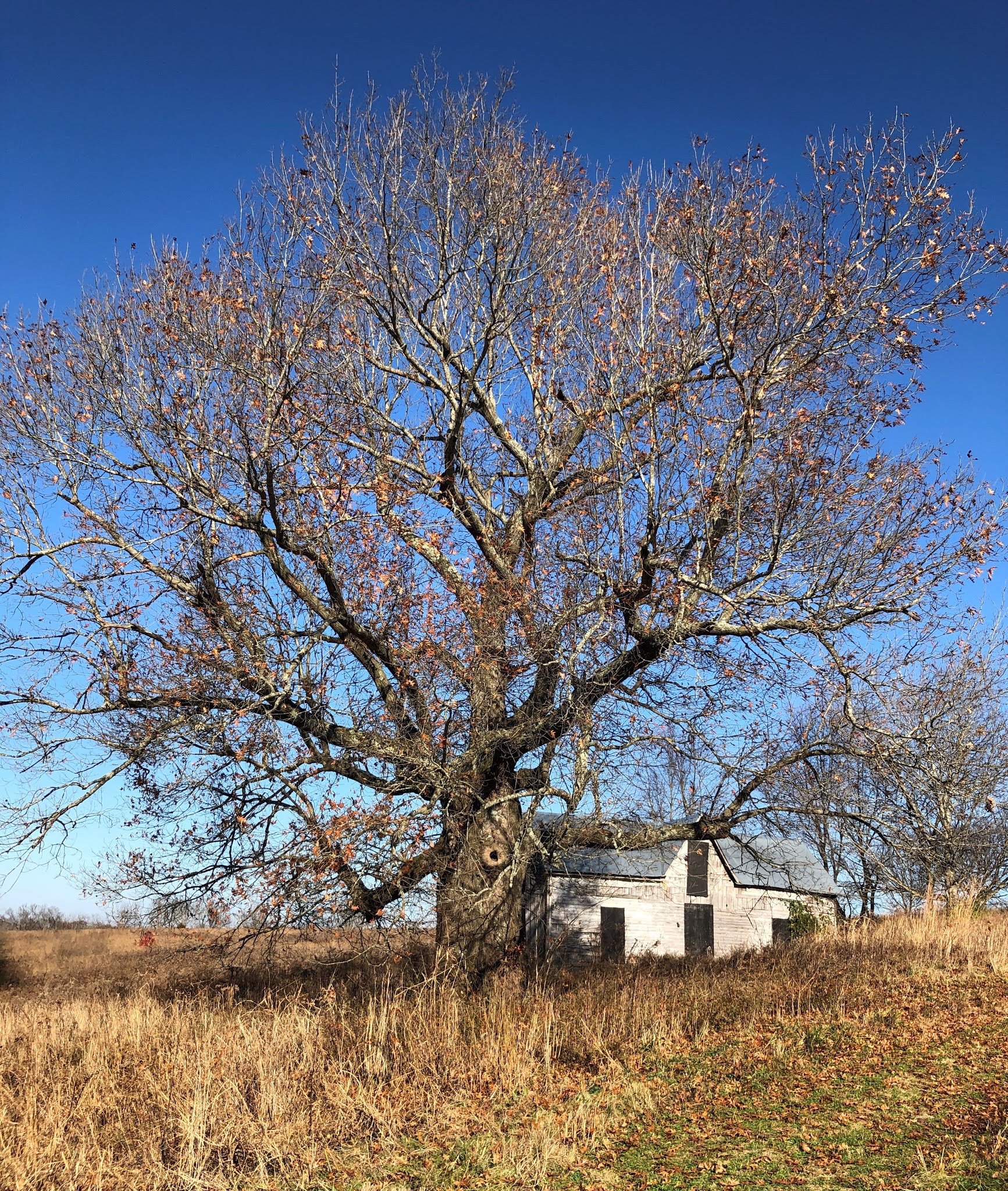 |
| PERRYVILLE, KY.: The lone witness tree remaining on the battlefield. |
 |
| GETTYSBURG: 27th Connecticut monument in The Wheatfield. |
 |
| BRENTWOOD, TENN.: Abandoned antebellum farmhouse of slaveholding family. (READ/SEE MORE.) |
 |
| PERRYVILLE, Ky.: View advancing Confederates had on Henry Bottom's farm. (READ/SEE MORE.) |
 |
| ANTIETAM: An epic carved eagle atop New York monument. |
 |
| ANTIETAM, MD.: Reenactors in the Bloody Cornfield. |
 |
| SHILOH, TENN.: Battlefield marker denoting burial location for 28th Illinois fallen atop ancient Indian mound. The dead were later moved to Shiloh National Cemetery. |
 |
| BRENTWOOD, TENN: A mural depicting in a tony subdivision depicting the capture of Confederate Colonel Edmund Rucker on Dec. 16, 1864. |
 |
| CHICKAMAUGA, GA.: Michigan monument. |
 |
| MILL SPRING, KY.: Coins left at Confederate mass grave. (READ MORE.) |
 |
| NASHVILLE, TENN.: A massive battlefield witness tree, toppled in a storm, and my brother-in-law/bike riding pal, Nels Jensen. (SEE/READ MORE.) |
 |
| BRENTWOOD, TENN.: Locked door of slave cabin. (READ/SEE MORE.) |
 |
| FRANKLIN, TENN.: Confederate monument in the town square. |
 |
| CHICKAMAUGA, Ga.: Bullets in bas-relief on an Ohio monument. |
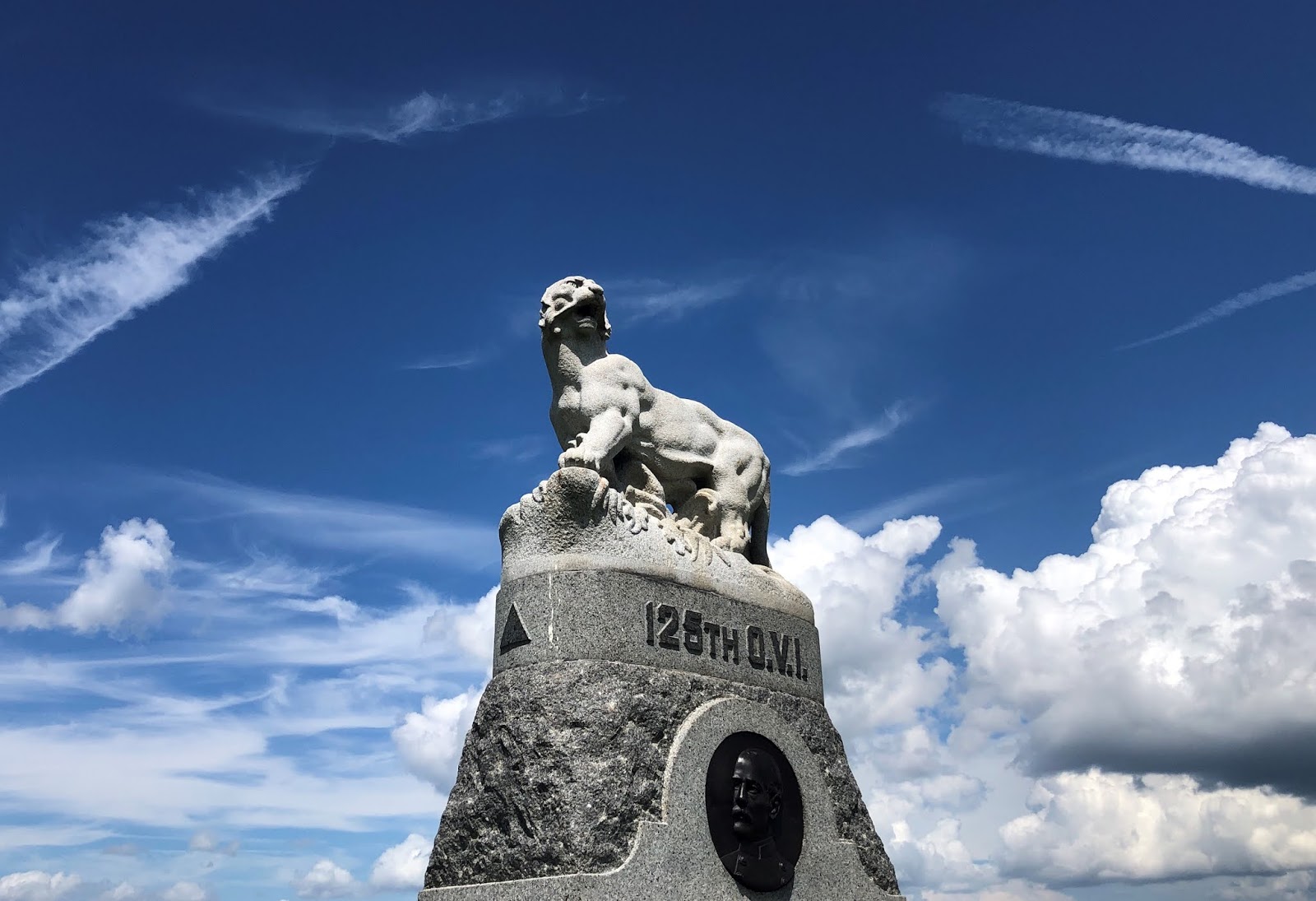 |
| CHICKAMAUGA, GA.: 125th Ohio monument on Snodgrass Hill. |
 |
| GETTYSBURG: Union General Philip Kearney, killed at Chantilly (Va.) on Sept. 1, 1862, depicted in bronze on a New Jersey monument. |
 |
| MURFEEESBORO, TENN.: Shadow play with relic hunter Stan Hutson at Lunette Negley at Fortress Rosecrans site. (READ MORE.) |
 |
| BURKITTSVILLE, MD.: Union General William Franklin's headquarters. (SEE MORE.) |
 |
| NASHVILLE: Shy's Hill, taken by the Federals on Dec. 16, 1864. |
 |
| BRICE'S CROSS ROADS (Miss.): A grave in a cemetery overrun during the battle. (READ MORE.) |
-- My favorite photos of 2017, 2018 and 2019.
-- Have something to add (or correct) in this post? Email me here.
Subscribe to:
Posts (Atom)