Showing posts with label West Virginia. Show all posts

Friday, May 24, 2024

Tales from the road: The kid who died in Mrs. Cross' yard

Sharpshooter Lewis Branscomb, an Alabaman, suffered a mortal wound in the yard of this house.

                Like this blog on Facebook | Follow me on Twitter | My YouTube videos

Each morning during my stay in Harpers Ferry, W.Va., I walked a short distance over the hill from the inn on Washington Street once owned by Robert E. Lee’s father, “Light Horse” Harry Lee, and on into the heart of town.

I walked past this house every day during
a three-day stay in Harpers Ferry.
Along the way, I passed two Civil War hospital sites, the fire department, a gorgeous bed of flowers, the Woman’s Club (est. 1915) and a coffee shop that serves massive chocolate chip cookies worth every calorie. At a red-brick house on Washington Street — the one where the 13-star United States flag slowly flaps in the breeze from the front porch — I lingered for a minute or two.

Here, on July 4, 1864 — our nation’s 88th birthday — a 21-year old private from Union Springs, Ala., named Lewis Branscomb fell victim to a Union sharpshooter’s bullet. A sharpshooter himself, the 3rd Alabama soldier ("Blackford’s Sharpshooters") had already lost two brothers during our awful war.

In the flyleaf of the Bible Lewis carried until his death, he had written a short note: “If found on my person please send to my mother Mrs. B.H. Branscomb at Union Springs, Alabama. Do so and oblige (friend) who ever you be.”

Nearly a year later, after the war’s end, the woman who lived in the red-brick house sent a letter to Lewis’ mother. Margaret Cross had discovered Lewis’ Bible in her yard.

Lewis Branscomb
“If you wish for the book you can [write me],” she wrote. “I will send it by mail immediately and if you wish to know any thing more I will then write you all that I know concerning your son. “

Several years ago, I connected with Frank Chappell, a Branscomb descendant, who guided me to the red-brick house over the phone from his house in Huntsville, Ala. What a surreal day that was.

Lewis' Bible remains lost to history and his final resting place is unknown despite efforts of his descendants to find it. But nearly 100 of the Branscomb brothers' wartime letters remarkably survived the war. They surfaced in 1991 in an old BVD underwear box marked "War Letters" in the family's possession.

On every visit to Harpers Ferry, I sneak a glance of the red-brick house on Washington and wonder about Lewis Branscomb, the kid from Alabama.

Where did he fall in Mrs. Cross’ yard?

Did he linger after the bullet tore into him?

What was that Union sharpshooter thinking when he squeezed the trigger of his weapon?

And, most importantly, was Lewis Branscomb’s sacrifice really worth it?

580 Washington Street in Harpers Ferry. Lewis Branscomb died in the yard of this house.

SOURCE

Sunday, October 27, 2019

Elmwood Cemetery, where Confederate Antietam dead rest


Like this blog on Facebook | Follow me on Twitter

Many Confederate Antietam dead are buried here at Elmwood Cemetery in Shepherdstown, W.Va., across the Potomac River from Sharpsburg, Md., or at Washington Confederate Cemetery in Hagerstown, Md. Shepherdstown was part of Virginia in 1862.

Sunday, May 22, 2016

A soldier's death in Mrs. Cross' yard in Harpers Ferry

A Union sharpshooter killed Lewis Branscomb of the Third Alabama in the front yard of
 this house on Washington Street in Harpers Ferry, W.Va.
 (Lewis' photo courtesy Frank Chappell)

Like this blog on Facebook | Follow me on Twitter

Shortly after war erupted, four sons of  Bennett and Eliza Branscomb enlisted in the Third Alabama Infantry, causing great angst in their household in Union Springs, 45 miles southeast of Montgomery.

A little more than a year into the fighting, tragedy hit home when word arrived of the death from measles of 31-year-old William Branscomb in a military hospital in Richmond. 

"Don't grieve Ma," Private James Branscomb wrote to his mother on June 25, 1862, 10 days after William's death. "He is better off though tis hard to lose him. You may have more to grieve for than him before this war ends."

Those words proved prophetic.

On May 19, 1864, James fell at the Battle of Harris Farm, near Spotsylvania Courthouse, Va. He was only 25.

Private James Branscomb of the 3rd Alabama
was killed at the Battle of Harris Farm
on May 19, 1864.
(Photo courtesy Frank Chappell)
During a break in brutal fighting near Richmond in early June 1864, probably at Cold Harbor, Va., Private Lewis Branscomb wrote a short note to his sister, Lucinda. Apparently unaware of his brother's death in battle, the Third Alabama sharpshooter poured out his feelings about a war that had claimed several of his friends and messmates.

"My mess is all gone but me," the 21-year-old soldier wrote on June 5, 1864. "... I know I have a few good christians far away praying for me. The fighting still continues. No more. Give my love to all and write soon. I have not received but one letter since the first of May. If you all knew how much comfort it would give me to get a letter from home you would write.

"Excuse this note," Lewis concluded, "as I have almost lost my mind."

Less than a month later, on July 4, 1864, a United States sharpshooter killed Lewis in the yard of a house on Washington Street in Harpers Ferry, Va., (now West Virginia). The owner of the house recovered Lewis' Bible, and nearly three months after the war had ended, she wrote a letter to his mother in Alabama:

Harpers Ferry, Va.,
July the 2nd, 1865

Mrs. Branscomb 
Dear Madam

On the 4 of July will be one year since the Confederate soldiers was here and there was a young man killed in my yard by a sharpshooter. At the place he died I picked up a Bible and written on the fly leaf was his name 'L.S. Branscomb, Co. D, 3d regiment of Alabama.' On the next leaf was written.'If found on my person please send to my mother Mrs. B.H. Branscomb at Union Springs, Alabama. Do so and oblige (friend) who ever you be.' I should have done so sooner but not knowen that the way was open between here and there and as I have just heard that I could send a letter through embrace the first opportunity. If you wish for the book you can [write me]. I will send it by mail immediately and if you wish to know any thing more I will then write you all that I know concerning your son. If you wish to write address Mrs. 

Margarett Cross, 
Harpers Ferry, Virginia, 
In care of Cathrin Shillings

Lewis' Bible has been lost to history, but nearly 100 of the Branscomb brothers' wartime letters remarkably survived. They surfaced in 1991 in an old BVD underwear box marked "War Letters" in the family's possession. In 2012, Branscomb descendant Frank Chappell edited the letters for publication in an excellent book, Dear Sister. The Third Alabama was one of the hard-fighting regiments in the Southern army, seeing action at Seven Pines, Malvern Hill, Antietam, Fredericksburg, Chancellorsville, Gettysburg and elsewhere.

During a visit to Harpers Ferry, Chappell guided me over the phone from Alabama to Mrs. Cross' house on Washington Street. The two-story red-brick house stands a short distance from the Appalachian Trail Conervancy headquarters.

Postscript: A fourth Branscomb brother, John, survived a wound at Antietam and the war. William Branscomb was buried in the Confederate section of Oakwood Cemetery in Richmond. Despite efforts by Chappell and other Branscomb descendants, the gravesites of Lewis and James are unknown,

SOURCE

Margarett Cross' wartime house on Washington Street in Harpers Ferry, W.Va.

Have something to add (or correct) in this post? E-mail me here.

Tuesday, September 30, 2014

For sale: Hanging site of John Brown in Charles Town, W.Va.

John Brown was hanged in what now is the yard of this Victorian mansion in Charles Town, W.Va.
                Click on image for full-screen interactive panorama of Brown hanging site.

Like this blog on Facebook | Follow me on Twitter

A "gentle haze" hung in the air at high noon Dec. 2, 1859, as roughly 1,500 people, mostly military men and cadets, gathered in a large, vacant field in Charles Town, Va. 

VMI professor Thomas J. Jackson, who two years later would be better known as Confederate General "Stonewall" Jackson, stood among the crowd. So did famous actor John Wilkes Booth. Six years later, he would become infamous for shooting the president in the back of the head with a Deringer pistol. John Brown, the fiery 59-year-old abolitionist leader, attended the event, too, but not of his own volition.

John Brown, about 1856.
One month after his conviction for treason for an ill-fated raid on the Federal arsensal at Harpers Ferry, Va., Brown appeared for his execution by hanging.

Jackson wrote that Brown wore carpet slippers, white socks, black pants, a black frock coat and vest and a black slouch hat and "behaved with unflinching firmness." His hands tied behind him, Brown ascended the gallows with "apparent cheerfulness," according to the professor, who was "much impressed with the thought that before me stood a man, in the full vigor of health, who must in a few minutes be in eternity." 

Another witness, John L. Preston, a founder of Virginia Military Institute, described the somber scene as well as the final moments of the Connecticut-born Brown's life after his body dropped from the gallows:
"There was profound stillness during the time his struggles continued, growing feebler and feebler at each abortive attempt to breathe. He knees were scarcely bent, his arms were drawn up to a right angle at the elbow, with the hands clenched; but there was no writhing of the body, no violent heaving of the chest. At each feebler effort at respiration his arms sank lower, and his legs hung more relaxed, until at last, straight and lank he dangled, swayed to and fro by the wind.
"It was a moment of deep solemnity, and suggestive of thoughts that make the bosom swell. The field of execution was a rising ground, and commanded the outstretching valley from mountain to mountain, and their still grandeur gave sublimity to the outline, while it so chanced that white clouds resting upon them, gave them the appearance that reminded more than one of us of the snow peaks of the Alps."
Today, the execution site looks nothing like it did in 1859. Impressive, old houses dominate the tree-lined street, blocks from the still-active Jefferson County Courthouse where a court passed judgment on Brown. The site of the gallows where a crowd watched Brown stand "upright as a soldier in position" before his execution is in the yard of a 7,000-square foot Victorian mansion that's on the market. Asking price: $749,000.

John Gibson built the five-bedroom, 6 1/2-bath home at 515 South Samuel in 1891. Thirty-two years earlier, he had commanded troops who battled Brown and his band of escaped slaves and renegades at Harpers Ferry. 

The red-brick house features Tiffany windows, Waterford chandeliers, French-laid fireplaces, a gourmet kitchen, a roof deck, a 9-foot claw foot tub and rooms with 19-foot ceilings. It's listed on the National Register of Historic Places. The one-acre property also includes an ornamental wrought-iron fence, a barn, in-ground pool and a gazebo.

There's no mention in the listing if the ghost of John Brown, whose body the wind blew to and fro after his hanging, lingers on the property.

A section of  the ornamental fence that surrounds the area where Brown was hanged.
Abolitionist leader John Brown was convicted of treason at Jefferson County Courthouse in
Charles Town, Va.  (now West Virginia) on Nov. 2, 1859. The courthouse is still in use.

-- Have something to add (or correct) in this post? E-mail me here.

Wednesday, October 30, 2013

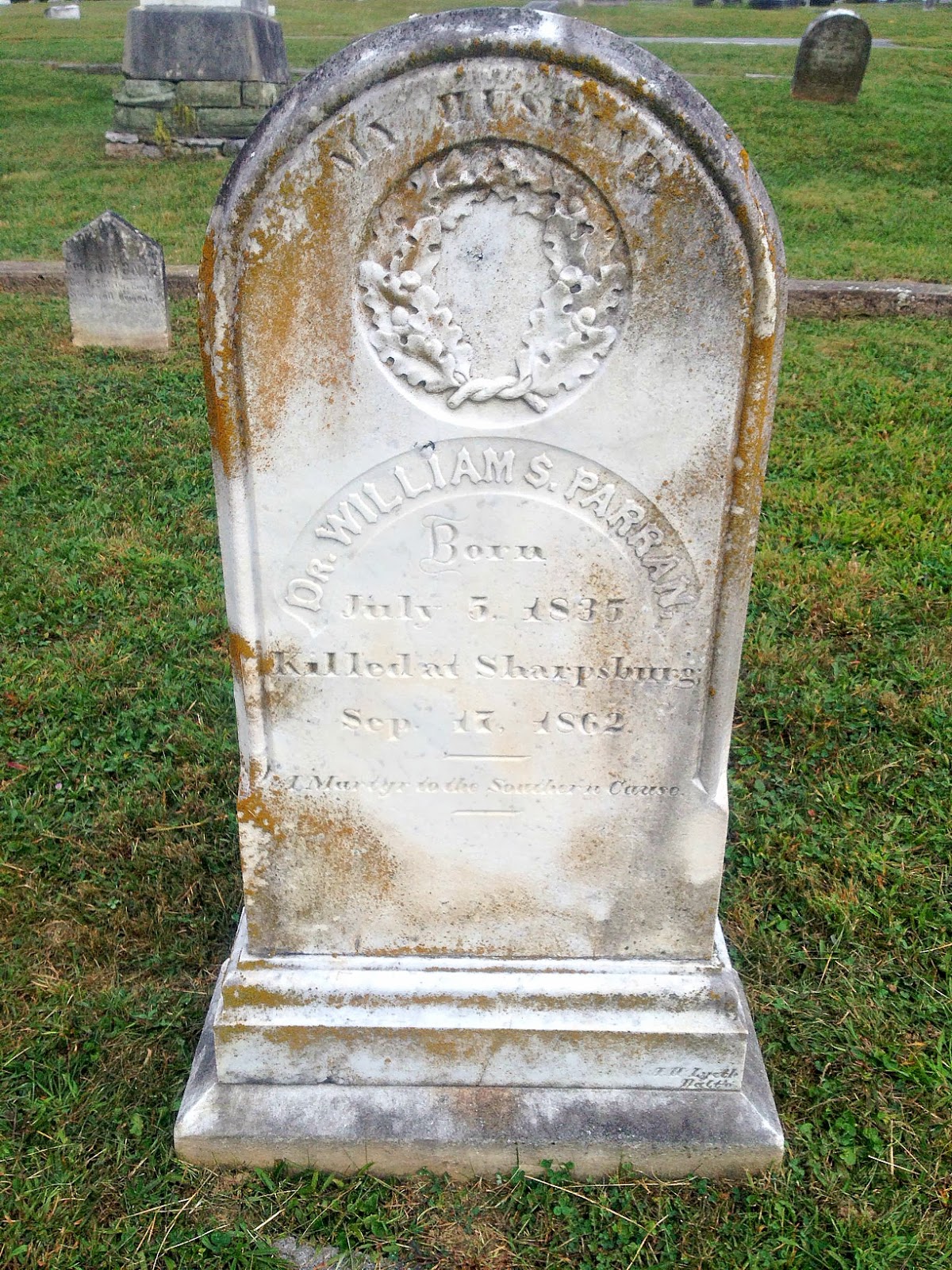
Faces of the Civil War: Rebel surgeon William S. Parran

Mortally wounded at Antietam, Rebel doctor William Parran is buried in Elmwood Cemetery in 
Shepherdstown, W.Va., which was part of Virginia during the Civil War. 
Close-up of William Parran's gravestone. (CLICK ON IMAGE TO ENLARGE.)
The wives of at least five Connecticut soldiers who died at Antietam were pregnant at the time of the battle. Of course, Southern families weren't immune to such awful tragedy either. Mary Virginia Parran, wife of Confederate doctor William Sellman Parran, was pregnant with the couple's second child when her husband was mortally wounded at Antietam on Sept. 17, 1862.

The son of a doctor, William Parran was mustered in to
the Confederate army as a captain on April 17, 1861.
(Photo: Museum of The Confederacy, Richmond, Va.)
From Barboursville, Va., Parran was mustered into the Confederate army as a captain in Company F in the 13th Virginia on April 17, 1862, five days after the Rebels bombarded Fort Sumter. He became ill, apparently from jaundice, and resigned his commission and was dropped from the regiment's rolls by late April 1862. The son of a doctor, Parran rejoined the Army of Northern Virginia as an assistant surgeon later that year, and by the time of Antietam served with Courtney’s Artillery Battalion. After the Rebels captured the Union garrison at Harpers Ferry, Parran was detached and sent to Sharpsburg. As the Union army neared a breakthrough at Bloody Lane, Parran is believed to have helped man a short-handed battery of Washington Artillery on the Piper Farm. Apparently mortally wounded during the action, the 27-year-old doctor was taken across the Potomac River to Shepherdstown, where he died later that night.

"He was never backward in offering and rendering services whenever and wherever he thought they were needed and would be accepted," a friend wrote about Parran in November 1862. "He lost his valuable life while nobly working at another's battery, to which he had offered his services. He was a tender and affectionate father, and left a fond and devoted wife and a darling little daughter to mourn his untimely death. May the widow's God be her God, and a father to her fatherless!"

Parran's son, William S. Parran II, was born on April 19, 1863. His father lies buried in Shepherdstown, W.Va., in Elmwood Cemetery, where more than 100 other Confederates who were killed or mortally wounded at Antietam are also interred.

"Dr. Parran was ever an affectionate and dutiful son, a devoted husband and parent, a true friend, and an unswerving patriot," a short account of his life published in 1875 noted. "His genial social nature, his frank and manly qualities, made for him, wherever he went, hosts of friends, in whose memories and affections he has a monument to his honor more enduring and more to be coveted than brass or marble."

Friday, September 20, 2013

Harpers Ferry panorama from Maryland Heights

                                     Click on image for full-screen interactive panorama.

During the Civil War, the imposing Maryland Heights, overlooking the strategic town of Harpers Ferry, Va., was bristling with Union guns and encampments. In the spring of 1862, Federal engineers installed a seven-gun Naval battery atop the Heights, a spectacular feat just for the effort that it took to haul the heavy weapons up the steep mountain that rises to 1,400 feet.

Evidence of  the Union army's stay atop Maryland Heights abounds even today, including the remains of a parapet for the Naval battery and a stone fort near the summit. After a serpentine, butt-kickin' 40-minute hike this afternoon,  I arrived at the Harpers Ferry overlook, a stone outcropping that offers a breathtaking view of the formal arsenal town at the confluence of the Shenandoah and Potomac rivers. Of course, the town is best known for the attempted slave revolt incited in October 1859 by John Brown, who was born in Torrington, Conn. Brown, a hero to some and a villain to others, was captured at Harpers Ferry and later hanged in nearby Charles Town. Below is an interactive panorama from town level; Maryland Heights may be seen at left.

Click on image for full-screen interactive panorama

Thursday, April 26, 2012

David Thatcher's final resting place

Confederate soldier David Thatcher, mortally wounded on Oct. 19, 1863,  is buried in
Tuscarora Presbyterian Church in Martinsburg, W.Va.
This ambrotype of David Thatcher is in the
 Library of Congress collection.

In early March, I blogged about a Martinsburg, W.Va., woman who provided the name of a long-unidentified image of a young Confederate soldier that's now in the collection of the Library of Congress.

Last week, I visited the grave of that soldier, 19-year-old David Thatcher, who was mortally wounded Oct. 19, 1863, at the Battle of Buckland Mills, near Warrenton, Va. Thatcher, who served in the 1st Virginia Cavalry, is buried in a small cemetery behind Martinsburg's Tuscarora Presbyterian Church, several miles down the road from where I started my journalism career as sports editor of the Martinsburg Evening Journal many years ago.

The bottom of Thatcher's tombstone reads:

When thou goest out to battle
against thine enemies, be not
afraid of them, for the Lord
thy God is with thee.

When I lived in Martinsburg, the road past the little church wasn't nearly as busy as it was last Thursday. Greater Martinsburg -- that sounds a little odd -- is encroaching on an area that undoubtedly was very rural decades ago.

The ambrotype of Hatcher is one of hundreds of Civil War images donated to the Library of Congress in the past two years by Tom Liljenquist of McLean, Va. He and his sons collected high-quality images of Union and Confederate soldiers.

Thatcher is buried behind Tuscarora Presbyterian Church, which dates to the mid-18th century.
Close-up of top of Thatcher's tombstone.

Saturday, March 10, 2012

Faces of the Civil War: David Thatcher

David Hatcher of the First Virginia Cavalry was mortally wounded on Oct. 19, 1863.
Buried
at Tuscarora Presbyterian Church in Martinsburg, W.Va., he was only 19 when he died.
(Library of Congress, Liljenquist Collection)
Unfortunately, many Civil War-era photos of soldiers are unidentified, their names lost to history forever. Several unidentified tintypes and ambrotypes of Civil War soldiers are in my collection, including this one, this onethis one and this one.

That's why this Washington Post story of a Martinsburg, W.Va. woman who provided the name of a long-unidentified image of a young Confederate soldier is so compelling.

While scanning the Post's Civil War supplement, Karen Thatcher noticed a photo in a Library of Congress advertisement that bore a remarkable resemblance to a larger, crayon image of a soldier that had been in her husband's family for many years.

Her immediate reaction: “That’s Uncle Dave!”

A farmer's son, 19-year-old David M. Thatcher was mortally wounded Oct. 19, 1863, at the Battle of Buckland Mills, near Warrenton, Va. David, an ancestor of Karen Thatcher's husband, is buried at Tuscarora Presbyterian Church in Martinsburg, where I started my journalism career as sports editor of the Martinsburg Evening Journal about three years after the Civil War ended.

“We’re just tickled to death,” Thatcher told the Post. “There’s something very satisfying about this 19-year-old boy who died in 1863 who was [listed as] unidentified. ... that we’re able to put a name to that face.”

The ambrotype of Hatcher is one of hundreds of Civil War images donated to the Library of Congress in the past two years by Tom Liljenquist of McLean, Va. He and his sons collected high-quality -- and very $$$$$ -- images of Union and Confederate soldiers.

Earlier this week, the Library of Congress replaced "Unidentified" with David Thatcher's name in the description of the photograph. So perhaps there's hope afterall for these nameless soldiers in my collection:. 

Who are these Union soldiers?