|
Each number on this map represents a Connecticut town in which a family lost at least two
sons during the Civil War. Numbers denote a story below. (CLICK TO ENLARGE.) |
Five years of conflict.
Eight sets of brothers.
Seventeen separate Civil War tragedies.
The siblings from Connecticut whose stories are told below died far from their hometowns in such places as New Bern, N.C., Sharpsburg, Md., and Florence, S.C.
They died from gunshot wounds, disease ... or worse. Two of them lingered for weeks after being wounded, dying in their hometown. Two were only teenagers. One man's fiancee died almost exactly a month after he was killed in battle. Most left behind a wife and children. At least five were not even returned to their home state for burial. One soldier's brother
and father died in service for their country during the war.
Who knows what all the ripple effects were of the deaths of these soldiers during the most tragic five years in American history?
In an e-mail to me more than two years ago, a descendant of a set of these brothers wrote that their loss is felt in her family even today. I'm not surprised.
 |
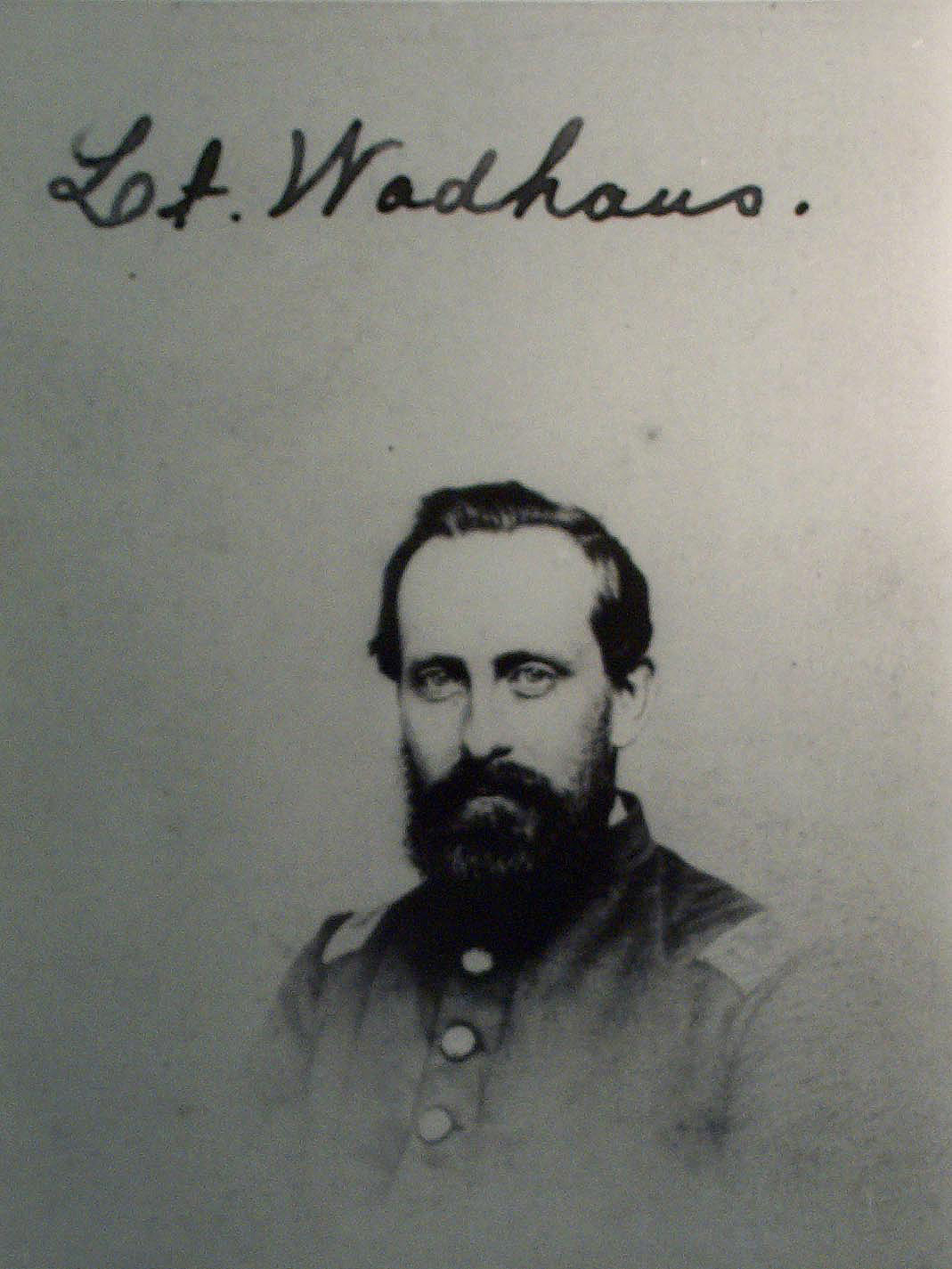
| Luman, Edward and Henry Wadhams: The brothers died in Virginia in 1864. |
1. LITCHFIELD: The Wadhams brothers
In late spring 1864, Deacon Adams made several trips to the farmhouse of Edwin and Mary Wadhams, not far from the center of Litchfield, to deliver terrible news.
One of the Wadhams' sons had died.
Then another.
 |
The Wadhams brothers' marker at
West Cemetery in Litchfield, about 35 miles
west of Hartford. |
And another.
Within an 18-day span, three Wadhams sons were killed in battles near Richmond.
The first to die was Edward, a 27-year-old sergeant in the 8th Connecticut who was killed at Fort Darling on May 16. Ten days later, Henry, a 33-year-old lieutenant in the 14th Connecticut, was killed at North Anna River. Finally, Luman, the well-regarded captain in the 2nd Connecticut Heavy Artillery, was mortally wounded at Cold Harbor on June 1. Carried off the field by fellow soldiers using muskets as a makeshift stretcher, Luman died in an ambulance two days later en route to White House Landing, Va. He was 29 years old.
Luman's funeral service, held at the Congregational Church opposite the Litchfield village green, was "crowded to its utmost capacity by sympathizing friends, and large numbers of strangers from out of town came to pay their respects to the lamented deceased." (1)
Luman is buried beneath an impressive, white marker in Litchfield's West Cemetery. Perhaps his brothers are buried there too, although that merits more research. On a side of the marker are these words:
"The battle is fought, the victory won. Rest, soldiers, rest."
2. BARKHAMSTED: The Lee brothers
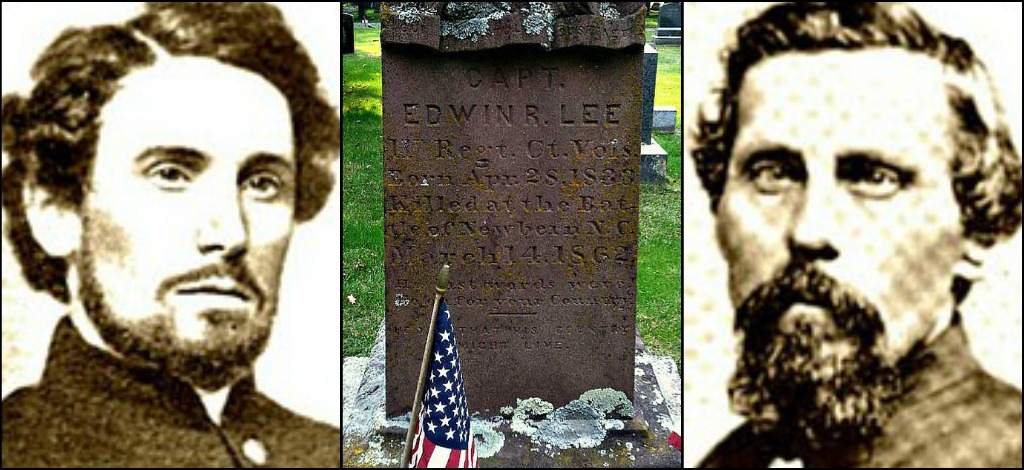
A captain in the 11th Connecticut Infantry, Edwin Lee was just 28 years old when he was struck and killed by an artillery shell on March 14, 1862 at the Battle of New Bern (N.C.). Before he died, Edwin reportedly said: "Tell my brother I died at the post of duty. Good-by. Go on for your country!" (2) He was buried near the battlefield and later disinterred and brought back north for re-burial at Riverside Cemetery in Barkhamsted, about 20 miles northwest of Hartford. Edwin's brother, Henry, was killed on Aug. 16, 1864 at the Battle of Deep Run (Va.). His final resting place is
Fort Harrison National Cemetery, near Richmond, where his body lies with many other Union soldiers whose tombstones are marked "Unknown." The 35-year-old lieutenant in the 7th Connecticut, described as a "brave, faithful, uncomplaining soldier," left behind a wife and four young children. (3)
 |
Brothers John and James Willard have memorial markers in West Avon Cemetery, next to
West Avon Congregational Church. Each man, however, is buried elsewhere. |
3. AVON: The Willard brothers
Two weather-worn markers stand in West Avon Cemetery in memory of John and James Willard. Sadly, neither brother's final resting place is back home in Connecticut. James, a 20-year-old private, was killed in the 7th Connecticut's attack on Fort Wagner, near Charleston, S.C., on July 10, 1863. He was buried on the battlefield, perhaps thrown into a trench by the enemy. The son of Julius and Damaris Willard "sleeps where he fell," according to his cemetery marker. John, a 32-year-old wagoner in the 11th Connecticut, died of yellow fever in New Bern, N.C., on Oct 3, 1864, and according to his marker, he is "buried in that city."
4. BERLIN: The Bacon brothers
 |
Medal of Honor marker next to Elijah Bacon's grave
in Maple Cemetery in Berlin, Conn. |
On July 3, 1863, Private Elijah William Bacon of the 14th Connecticut was a hero at Gettysburg, snatching the colors of the 16th North Carolina during Pickett's Charge. Less than a year later, on May 6, 1864, he was killed in action at the Wilderness. Posthumously awarded the Medal of Honor for valor at Gettysburg, Elijah left behind a wife, Eliza, and two daughters. Elijah's brother, Andrew, was captured in early May at Ely's Ford, Va., and sent to Andersonville, the notorious Rebel prisoner-of-war camp in Georgia. After being transferred from Andersonville, Andrew died on Jan. 25, 1865 at a POW camp in Florence, S.C. He and his wife, Marissa, had no children. The brothers are buried in Maple Cemetery in Berlin, about 15 miles south of Hartford.
5: EAST HARTFORD: The Flint brothers
 |
| Alvin Flint Jr. |
Death was no stranger to the Flint family during the Civil War. In the winter of 1861-62, Alvin Flint Jr.'s mother and sister died of consumption in East Hartford. Just 18 years old, Alvin joined the 11th Connecticut as a private on Oct. 1, 1861. Less than a year later, he too was dead, killed in the 11th Connecticut's fruitless attack at Burnside Bridge at Antietam. The loss was no doubt excruciating for 53-year-old Alvin Flint Sr., who had enlisted in the 21st Connecticut along with his 13-year-old son, George, in August 1862. "Hardly had the sadness of the death of a dear daughter, that I had lost last January, worn off when this sad, sad calamity should come upon me," he lamented in a letter published in the
Hartford Courant on Oct. 29, 1862. In another unbelievably tragic turn of events, Alvin Sr. and young George died of disease within several days of each other in mid-January 1863. In a 13-month timeframe, five family members -- including two brothers -- were dead. They are all buried in Center Cemetery in East Hartford.
6. COVENTRY: The Talcott brothers
A private in Company D of the 14th Connecticut, 26-year-old Henry Talcott was wounded when an artillery shell burst near a wall in the lane leading up to William Roulette's farmhouse, wounding three other men and killing three in his company. (4) Samuel, Henry's 20-year-old brother, also was severely wounded at Antietam; he lingered for several weeks before he died on Oct. 14, 1862. Samuel was buried in Center Cemetery in his hometown of Coventry, about 25 miles west of Hartford. "After the services the congregation viewed the remains," the
Hartford Courant reported on Oct. 27, 1862, "and the sad procession slowly wended its way to the cemetery. The flag draped in black was borne by the members of the Sunday School Class of Talcott, to whom he was strongly attached." Like his brother, Henry also lingered for several weeks before he died on Nov. 10. He is buried to the right of his brother in the family plot.
 |
Close-up of Samuel Talcott's gravestone. The 20-year-old private was mortally
wounded on Sept. 17, 1862. He died four weeks later. |
7. EAST HADDAM: The Bingham brothers
 |
John Bingham was killed at Antietam. Wells Bingham survived.
Another brother, Eliphalet, died during the Civil War.
It's unclear which brother is which in these photos.
(Photo courtesy of Military and Historical Image Bank) |
A little more than a month after he enlisted in the Union army on Aug. 7, 1862, 17-year-old John Bingham, a private in the 16th Connecticut, was killed at Antietam. Younger brother Wells, also a private in Company H of the 16th Connecticut, apparently survived Antietam physically unscathed, but the memory of that terrible day was probably seared into the 16-year-old boy soldier's brain the rest of his life. Three other Bingham brothers served during the Civil War, including Eliphalet, who died May 1, 1864 at Arlington Heights, Va. It's unclear whether he died of a battle wound, disease or another cause. John and Eliphalet are buried at First Church Cemetery in East Haddam, about 35 miles southeast of Hartford. Apparently upset over a failing business, Wells committed suicide in 1904.
8. CANTERBURY: The Lewis brothers
A sergeant in Company F of the 8th Connecticut, Charles Lewis -- described as a man who "had always fought in the front ranks" -- was killed at Antietam. (5) His fiancee, 21-year-old Sarah Hyde, died nearly a month later, on Oct. 16, 1862, and is buried next to Charles at Carey Cemetery in Canterbury. "They had been brought up together in life, in death they were not divided," the
Hartford Courant reported on Oct. 24, 1862, "and together they sleep the last sleep." Charles' brother, Albert, was a 28-year-old corporal in the 5th Connecticut. Captured at Winchester, Va., on May 24, 1862, he was a prisoner of war for four months before he was paroled. Like other Union POWs who were paroled or released -- see my blog post on
Wallace Woodford of Avon -- Albert no doubt was in poor health when he finally returned home to Canterbury. Discharged because of a disability on Dec. 15, 1862, he died on March 23, 1863.
 |
Charles Lewis, a sergeant in the 8th Connecticut killed at Antietam, is buried next to his
fiancee, Sarah Hyde, at Carey Cemetery in Canterbury, Conn. |
(1)
The Litchfield Times, June 1864
(2)
The Military and Civil History of Connecticut During the War of 1861-65, William Augustus Croffut, John Moses Morrism 1869, Page 175
(3)
Barkhamsted And Its Centennial, William Wallace Lee and Henry Roger Jones, 1881, Page 175
(4)
History of the Fourteenth Regiment, Conneticut Volunteer Infantry, Charles Davis Page, Page 43, 1906
(5)
The Military and Civil History of Connecticut During the War of 1861-65, William Augustus Croffut, John Moses Morris 1869, Page 272, Page 277