Showing posts sorted by relevance for query bacon. Sort by date Show all posts

Sunday, June 19, 2011

Civil War under my nose: Berlin's Bacon brothers

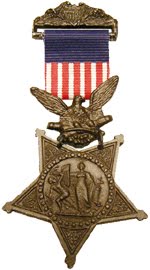
Elijah William Bacon, awarded the Medal of Honor posthumously for capturing a Rebel flag at
Gettysburg, was killed at the Wilderness on May 6, 1864. 
Almost every family in Connecticut was touched in some way by the Civil War. Many families were jolted more than once by tragedy.

As I wrote in this post, Edwin and Mary Wadhams of Litchfield lost three sons, all dying within 18 days of each other in fighting near Richmond, Va., in 1864.

The Bacon family of Berlin also suffered more than most.
Marker for Andrew Bacon, who served 
in the 14th  Connecticut,  in Maple Cemetery
in Berlin, Conn.

By 1860,  Roswell and Betsy Bacon had a typically large family for the era: sons Oliver, Andrew, Elijah and Almeron and a daughter, Maria. In his early 50s, Roswell was a stonecutter, and at least two of his sons followed in his footsteps at the family quarry in Berlin, a small town about 15 miles from Hartford. Because of  the expansion of the railroads in the 1840s and a thriving brickmaking industry, Berlin enjoyed a solid economy at the start of the Civil War in April 1861. (1)

Like many Berlin men, the Bacon's sons joined the Union army, with Oliver enlisting first, on Aug, 9, 1861, as a saddler in the 1st Connecticut Volunteer Cavalry. After President Lincoln called for 300,000 volunteers in the summer of 1862, Andrew and Elijah enlisted as privates in Co. F of the 14th Connecticut Infantry on July 28. Berlin, a stop on the Underground Railroad for runaway slaves, strongly supported the Union cause: 216 men from the town served in the Federal army out of a population of nearly 2,200. (2).

On Aug. 25, the 1,015 soldiers of the 14th Connecticut left the state for Washington, where they served in the defenses of the capital until early September. By that time, Andrew and Elijah Bacon likely were well aware that a Rebel army under Robert E. Lee was moving north to draw the Army of the Potomac from its encampments around Washington.
At Antietam, 14th Connecticut troops
"didn't know what they were expected
to do," Captain Samuel Fiske wrote.

Along with the rookies of the 108th New York and 130th Pennsylvania, the barely trained troops of the 14th Connecticut received their baptism of fire at Antietam on the morning of  Sept. 17, 1862. The performance of the Connecticut boys at the Roulette Farm and nearby sunken road was hailed as "behaving like veterans" in some accounts, but the reality was probably quite different.

"The battle was a scene of indescribable confusion. Troops didn't know what they were expected to do and sometimes, in their excitement, fired at their own men," Captain Samuel Fiske of the 14th Connecticut wrote. Some of the raw troops even "shut their eyes, and fired up in the air" (3). Elijah and Andrew escaped unscathed, but the 14th Connecticut suffered 38 killed and mortally wounded, 88 wounded and 21 missing.

By July 1, 1863, the 14th Connecticut had suffered heavy losses in major battles at Fredericksburg and Chancellorsville and was "reduced in size to a battalion," according to its chaplain, Henry Stevens. The remaining 200 men in the regiment fought well at Gettysburg, flushing sharpshooters from the Bliss Farm and helping stop the Rebels during Pickett's Charge on July 3. Incredibly, the 14th Connecticut captured nearly 200 prisoners and five Rebel battle flags during that fighting.

I haven't found an account detailing the specifics of Elijah Bacon's role at Gettysburg, but he captured a flag of the 16th North Carolina during Pickett's Charge. For his valor, he was awarded the Congressional Medal of Honor on Dec. 1, 1864 --  one of 63 Union soldiers so honored for their actions at Gettysburg.

But the son of a stonecutter from Berlin, Conn., never received the medal.
 Medal of Honor marker for  Elijah Bacon.

Civil War Medal of Honor.
(National Park Service)
Elijah William Bacon was killed in action at the Wilderness on May 6, 1864. He left behind a wife, Eliza, and two daughters. (4)
Also in early May, Andrew was captured at Ely's Ford, Va., and sent to Andersonville, the notorious Rebel prisoner-of-war camp in Georgia. Seven months later, he too was gone. After being transferred from Andersonville to another camp in Florence, S.C., Andrew died on Jan. 25, 1865, one of 10 Berlin men to die as a prisoner of war. He left behind a wife, Marissa, but no children. (5)


Word likely traveled slowly, but sometime in May 1864, Roswell and Betsy Bacon were notified that one son was dead and another was captured. Sadly, this was not unusual news in Berlin -- at least 42 soldiers from the town died during the Civil War. (6)

Oliver Bacon, whose cavalry regiment also served at Gettysburg, survived the war, but not without tragedy. After he was discharged Sept. 15, 1864, he married a Berlin girl, Rosa Woods, the 16-year-old daughter of Charles Woods. Rosa was "pretty as a picture, with her great brown eyes and dark curling hair." Soon after they were married, however, Rosa died, another terrible blow for the Bacon family. (7)

It's unclear if the bodies of either brother were returned to Connecticut..

Markers for Elijah Bacon (left) and Andrew Bacon next to the grave of their father.
a Confederate prisoner-of-war camp in Florence, S.C., on Jan. 25, 1865.

(1) Berlin (Conn.) Historical Society
(2) American Civil War Research Database
(3) Mr. Dunn's Experiences in the Army: The Civil War Letters of Samuel W. Fiske, Pages 8-9, edited by Stephen W. Sears, 1998.
(4) Research by Cathy Nelson, historian and assistant director Berlin-Peck Memorial Library
(5) Cathy Nelson research
(6) American Civil War Research Database
(7) The History of Berlin, Catherine M. North, Page 249, 1916

Friday, September 25, 2020

Buried with comrades under an elm near Crampton's Gap

The American Battlefield Trust has saved some of the old Jacob Goodman farm, where
3rd New Jersey Private Charles Hamilton Bacon was originally buried.
(CLICK ON IMAGE TO ENLARGE.)

Like this blog on Facebook | Follow me on Twitter | Crampton's Gap map from ABT
 
I have driven Mountain Church Road, near the beautiful, forever-in-a-19th-century time caspule village of Burkittsville, Md., scores of times. Now that drive near Crampton's Gap will be even more meaningful.

A father of five, Charles H. Bacon
was killed at Crampton's Gap
on Sept. 14, 1862.
(Historic Days in
 Cumberland County
 New Jersey
)
Late on the afternoon of Sept. 14, 1862, VI Corps troops swept across Mountain Church Road in hot pursuit of vastly outnumbered Confederates retreating toward Crampton's Gap. Among those soldiers was 3rd New Jersey Private Charles Hamilton Bacon, a father of five and a "consistent Christian" from Bridgeton, N.J. Sometime during the attack -- perhaps at Crampton's Gap on the mountain or near Mountain Church Road below it -- the 32-year-old soldier in Company F suffered a fatal wound in the abdomen.

When I returned from my weekend trip to Antietam and beyond, I found an email from a Bacon descendant in my in-box. "I am obsessed," she wrote, "with trying to find any information I can about him." 

Serendipitiously, the final image I took during my  Burkittsville excursion was of the very farm on Mountain Church Road where Charles was buried under an elm tree with eight other comrades. I forwarded the photo and other information on Private Bacon to her.

The descendant also shared with me this heart-rending condolence letter -- published in the West-Jersey Pioneer on Sept. 25, 1862 -- from regimental chaplain George R. Darrow to Bacon's widow, Ann: 

            GOOGLE STREET VIEW: View of old Jacob Goodman farm and ground upon
    which VI Corps advanced near Burkittsville, Md., on Sept. 14, 1862. (Battlefield map)


Mrs. Charles Bacon

The papers, 'ere you receive this, will have announced to you the sad intelligence of the death of your husband. Amid the carnage of the battlefield he fell, having with his regiment charged on the enemy and while pursuing them in hot haste and pouring a deadly fire upon a routed foe. He went into the fight with unusual vigor, his health having greatly improved recently, faltering not until a ball passing through his Testament, which he always carried with him, entered his abdomen and caused his immediate death. His captain was wounded at the same time, and while I was assisting in getting him to the rear where a surgeon could be found, he told me of Bacon's fall.

I went immediately in pursuit of him and found him dead. His diary, Testament and purse I took from his person and handed them to his Lieut. [Charles F. Salkeld], who will forward them to you [at] the earliest opportunity. I buried him with eight of his comrades, who fell in the same fight, under an elm tree in the same field where the regiment charged on the enemy, on the estate of Jacob Goodman, north of the village of Burkittsville, about half a mile distant. We had our funeral on Monday afternoon, the drum corps and comrades of the deceased assisting in the burial of our brave dead. 

Brother Bacon was a good man, a consistent Christian, and I feel that his loss to me is very great. But what an affliction to you, his companion. May the God of all grace abundantly sustain you in your loneliness and sorrow -- you know how to trust Him. Let your faith take hold of the Everlasting arm and you shall be borne up a little while longer when all our sorrow shall end.

Yours truly, 

G. R. Darrow, Chaplain 3d N.J. Volunteers, Franklin's Army Corps

In the 1860 census, Charles Bacon's occupation was listed as "roller." He probably was
a factory worker. (National Archives via fold3.com.)

On Nov. 8, 1862, the West-Jersey Pioneer wrote that "perhaps our sadest duties as a journalist is to chronicle the decease of the brave hearts who go forth to battle for their country," And it singled out Bacon, noting the "stern worth, intelligence and patriotism" of the private "entitles him to more than a passing notice, and will long keep green the memory of that brave, true man." 

The remains of Bacon and his comrades probably were disinterred from the Goodman farm shortly after the war. Charles' final resting place is unknown. 

-- Have something to add, correct? E-mail me at jbankstx@comcast.net

Saturday, December 18, 2021

Then & Now: The sad decline of Custer's 'honeymoon house'

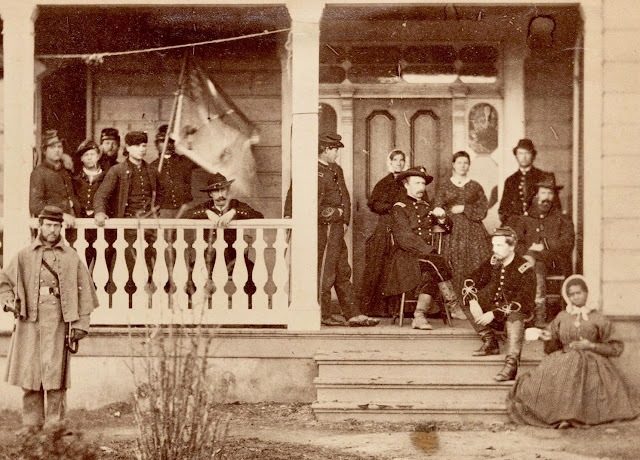
"Clover Hill" in March 1864
A cropped enlargement of Custer with his staff on the front porch of "Clover Hill"
 in March 1864. (CLICK ON ALL IMAGES TO ENLARGE.)

Like this blog on Facebook | Follow me on Twitter

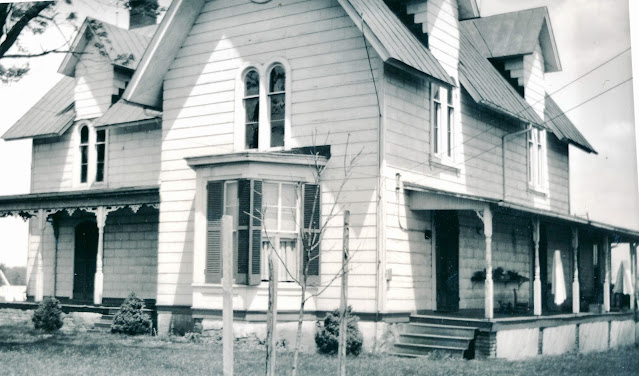
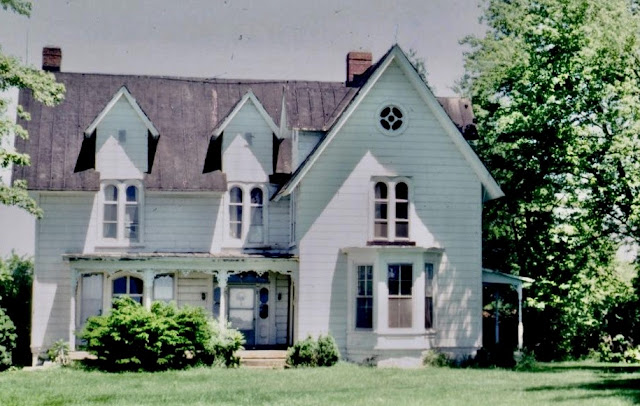
Every year since 1984, my friend Clark "Bud" Hall — a Vietnam vet and former FBI agent — has photographed "Clover Hill," the Stevensburg, Va., plantation house where George Armstrong Custer honeymooned with his 22-year-old bride, Elizabeth "Libbie" Bacon. The most recent photographs of the abandoned. circa-1775 house aren't pretty — nearly obscured by trees and undergrowth, it barely clings to life.

Frank Hampton
(Find A Grave)
Clover Hill — which sits 300 yards north of Route 3, near Culpeper — has a rich history beyond "The Boy General": It was home to James Barbour, a prominent lawyer, planter and delegate to the Virginia secession convention. Barbour served as a major in the Confederate Army. 

In the aftermath of the Battle at Brandy Station, 2nd South Carolina Cavalry Lt. Col. Frank Hampton — Rebel cavalry commander Wade Hampton's younger brother — died in the house from a saber wound suffered in fighting nearby. "Utterly disfigured," diarist Mary Chestnut wrote about his wound. (Hall was instrumental in saving "Brandy" from developers.)

Last week, Hall — who lives in Culpeper — shot his annual Clover Hill photograph. Here's a selection of those photos and Hall's story about the house, Libbie and her "dear life hero.":

1937

Works Progress Administration photo


Most married men — if honest about it — will admit their good fortune to have wed women who are better human beings than themselves. (I confess.) This marital dynamic proved uniquely valid when George Armstrong Custer won the hand of Elizabeth Clift Bacon, one of the most persevering wives in American military history. It is of note that nearly 158 years ago, “Autie and Libbie” honeymooned in Stevensburg, Va.

Spending part of his boyhood i n Monroe, Mich., George “Autie” Custer went off to West Point, where the undisciplined cadet graduated last in the class of 1861. Advancing rapidly in the Civil War, Lieutenant Custer functioned as a key aide and received high marks for his role at the Battle of Brandy Station, June 9, 1863. Appointed in late June 1863 as a brigadier at the age of 23 — the youngest general in the Union army — Custer received command of the Michigan Cavalry Brigade. He then effectively led his “Wolverines” in the Gettysburg Campaign. 

Incontestably, Custer was a superb cavalry officer. Further, his men adored him simply because he led them into battle.

George Armstrong Custer and his
bride, Elizabeth — best known
as "Libbie," — about Feb. 15, 1864.
(Library of Congress)
On Sept. 13, 1863, General Custer received a slight leg wound at the Battle of Culpeper Court House. Granted leave, the opportunistic Custer traveled west and audaciously courted Monroe’s most beautiful belle, 22- year old Libbie Bacon. Judge Daniel Bacon had no desire to see his beloved only child marry an intemperate soldier of modest roots, especially one known to favor “excessive alcohol and gambling.”

Now a nationally heralded officer, however, Custer convinced both Judge Bacon and Libbie he had given up alcohol (true) and gambling — untrue; he never quit gambling. As usual, Custer succeeded in capturing his objectives, and vows were exchanged on Feb. 9, 1864, in the “most splendid wedding ever seen in the state,” according to a reconciled Judge Bacon.

Departing on their honeymoon, Custer escorted his bride to West Point, New York City and Washington, where huge receptions awaited them. An attentive Custer never left Libbie’s side, and her own early devotion to him was evident: “Every other man seems so ordinary beside my own particular star.” She also referred to Custer as “my dear life hero, my boy general.”

While in Washington, Custer received urgent telegrams from Army of the Potomac winter headquarters at Brandy Station directing him to report immediately for a “secret” assignment. Libbie pleaded not to be left behind, and the couple trained to Brandy Station in late February.

Soon arriving by coach at Stevensburg, Libbie was made comfortable at “Clover Hill,” the beautiful, church-appearing home of Jack Barbour. Barbour was not in residence. Custer quickly departed for a raid toward Charlottesville on Feb. 28 and returned to Clover Hill on March 2, where he determined to provide his wife an “army honeymoon.” 

In honor of his bride, General Custer re-named Clover Hill “Camp Libbie.” For entertainment, Libbie was often hoisted into a “silver harnessed coach” and escorted to Mount Pony, where she toured the army’s main signal station. From atop the summit, Libbie wrote her parents that she observed the “white tents of the Army ... stretched far as eye could see.”

With her coach accompanied by mounted escort, Libbie also attended “six-course dinners” hosted by Custer’s superiors at Rose Hill and at the Dr. Daniel Green farm near Brandy. After spending just short of a month at Camp Libbie, General Custer secured a leave and took his wife on General Ulysses Grant's “special train” to Washington where their “official honeymoon” continued.

In mid- April, Custer deposited his wife in a Washington boarding house and he returned to the army for the “Overland Campaign.” Libbie much enjoyed Washington, where she met President Lincoln, commenting to her parents that he appeared to be the “most painfully careworn ... man I ever saw.”

Libbie lived in Washington throughout the remainder of the war and later followed her husband west to the plains. Following his death at the Little Big Horn, Libbie survived him by 57 years and “devoted the rest of her days to defending and gilding his memories.” They are buried together at West Point. 

One is certain Libbie never forgot her “Stevensburg honeymoon.”


1984

Clark Hall

1991

Clark Hall

1998

Clark Hall

2016

Clark Hall

2021

Clark Hall

2023

Clark Hall


-- Have something to
add (or correct) in this post? E-mail me here.


SOURCE:

Chestnut, Mary Boykin, A Diary From Dixie, Edited by Isabella D. Martin and Myrta Lockett Avary, New York: D. Appleton and Company, 1906

Sunday, July 28, 2013

Photo journal: Oldest permanent Civil War memorial in U.S.

                                    Click on image for full-screen interactive panorama.

Ivy covered the memorial during this 10th anniversary gathering in 1873.
CLICK ON IMAGE TO ENLARGE.
The memorial includes the names of soldiers from the Berlin, Conn., area who died during the 
Civil War, including Private John Kent of the 16th Connecticut. He was killed at Antietam.
CLICK ON IMAGE TO ENLARGE.

A souvenir from the 50th anniversary 
celebration of the memorial in 1913.
On a sweltering July day a little more than three weeks after the Battle of Gettysburg, a small crowd gathered on the lawn of the Kensington (Conn.) Congregational Church for the dedication of  a Civil War memorial.  The event would have been better attended, the Hartford Courant reported the next day, but area farmers were too busy tending to their crops.

With the nation mired in a hellish war, area residents listened to Sen. Lafayette Foster's stirring speech on July 28, 1863, in which he decried the "wicked ambition of southern leaders" before the 18-foot brownstone obelisk that honors the fallen sons of the Berlin, Conn., area., was unveiled. Among the names the etched on the monument were Private John Kent, who was killed at Antietam about 10 months earlier, and Private Birdsey J. Beckley, who was killed at Fredericksburg on Dec. 13, 1862.

 Rev. Elias Brewster Hillard, who delivered a patriotic sermon from the pulpit of his church after the Rebels shelled Fort Sumter on April 12, 1861, was instrumental in developing the idea for the monument and another church member, Nelson Augustus Moore, designed it.

Church members and area residents raised funds for the monument -- one account said it cost $350, another indicated $475 -- and since its dedication the congregation has dutifully taken care of the upkeep of what now is recognized as the oldest permanent Civil War memorial in the country. The monument is in fine shape despite its age.

On Sunday at the 150th anniversary re-dedication ceremony, Hillard and Moore undoubtedly would have been pleased. More than 200 people, including an Abraham Lincoln lookalike, re-enactors, a descendant of Moore and descendants of  Civil War Medal of Honor winner Elijah Bacon, attended the event on the muggy afternoon. An application to place the monument on the National Registry of Historic Places was recently approved, ensuring that it will be in good hands for future generations.
The oldest permanent Civil War memorial in the United States was dedicated on July 28, 1863.
Even President Lincoln, escorted by reenactors, showed for the re-dedication ceremony.
A plaque near the base of the memorial honors 14th Connecticut Private Elijah Bacon, who was
 posthumously  awarded the Medal of Honor for capturing a Rebel flag at Gettysburg on July 3, 1863. 
Bacon was killed at the Battle of the Wilderness on May 6, 1864. 
CLICK ON IMAGE TO ENLARGE.

Tuesday, June 21, 2011

Civil War under my nose: Kensington, Conn.

This flag in the Kensington Congregational Church in Kensington, Conn, was sewn by
church members during the Civil War and hung from the belfry.

In researching Berlin's Bacon brothers -- try saying that three times really fast -- I stumbled upon a few nuggets of Civil War history early Sunday afternoon.

The Kensington Congregational Church
was dedicated in 1774.
Behind the Kensington Congregational Church stands what some claim is the first monument in the United States dedicated to Civil War soldiers. (Kentuckians may want to duel Nutmeggers for that honor.) If you think it's a little odd for a war monument to be placed next to a church, you aren't alone. But passions ran high during the Civil War.

On July 28, 1863, a little more than three weeks after the Battle of Gettysburg, a small crowd gathered at the church for dedication of the 18-foot brownstone obelisk, a word that will never again appear on this blog. The event would have been better attended, but area farmers had more important things to do, according to an account in the Hartford Courant. (1) Rev. Elias Brewster Hillard apparently was instrumental in developing the idea for the monument and another church member, Nelson Augustus Moore, designed it. Church members and area residents raised funds to build it -- some accounts say it cost $350, others $475. (2)

On the monument are listed the names of 14 area soldiers who died during the Civil War, including a pair of brothers (John and William Warner) and a father and son (Richard and James Ringwood).  A bronze plaque for Berlin's Elijah Bacon, who was killed at the Wilderness on May 6, 1864, was added at the base of the monument in 1988. (Another soldier listed, Nelson Ritchie of the 16th Connecticut, died after the Civil War.) Interestingly, Bacon's father, a stonecutter from Berlin, may have cut the stone for the memorial. That merits more research.
"Erected to commemorate the death of those who perished in
suppressing the Southern Rebellion." an inscription
on the monument reads.

I wanted to know more about this large, old relic, so I rang the church doorbell. Rev. Olivia Robinson, a friendly, soft-spoken woman, answered and quickly took me to the back parlor of the church, where she pointed out an even more impressive relic behind protective glass: a 10-foot by 18-foot red, white and blue flag with 33 stars. (Thanks for correcting me on the stars, mstrauch.)

There's a neat story on the history of the flag that I found in a book published in 1912 on the 200th anniversary of the founding of the congregation. On the morning of April 13, 1861, the good Rev. Elias Brewster Hilliard, apparently an excitable sort, heard word that the Rebels had shelled Fort Sumter in Charleston Harbor in South Carolina.
“(Hilliard) was standing at the door of the church … when Mr. Samuel Upton, at the time the village postmaster, came in, bringing the news that Fort Sumter had been fired on the day before. Mr. Hillard entered the pulpit, laid away his prepared sermon, and delivered a stirring patriotic address whose echoes rang in the town for many a day. During the following week the ladies of the church held a meeting, and made, without the aid of sewing-machines, the grand old flag which was hung from the belfry of the church at its completion, and continued to float in the breeze throughout the war.” (3)
Nice.

The flag was restored in 2002.

(1) Connecticut Civil War monuments web site
(2) Research by Cathy Nelson, historian and assistant director Berlin-Peck Memorial Library
(3) Two Hundreth Anniversary, Kennington Congreational Church, Page 100, 1912

This Civil War monument next to the Kensington Congregational Church
  was  dedicated July 28, 1863.  The cannon was added in 1913.
  Approximately the same view as above in 1913, on the 50th anniversary of the  monument's
dedication. Note the ivy on the monument. (Photo courtesy Kensington Congregational Church)

Wednesday, November 30, 2011

Brothers: Connecticut's Civil War sacrifice

Each number on this map represents a Connecticut town in which a family lost at least two
 sons during the Civil War.  Numbers denote a story below. (CLICK TO ENLARGE.)
Five years of conflict.

Eight sets of brothers.

Seventeen separate Civil War tragedies.

The siblings from Connecticut whose stories are told below died far from their hometowns in such places as New Bern, N.C., Sharpsburg, Md., and Florence, S.C.

They died from gunshot wounds, disease ... or worse. Two of them lingered for weeks after being wounded, dying in their hometown. Two were only teenagers. One man's fiancee died almost exactly a month after he was killed in battle. Most left behind a wife and children. At least five were not even returned to their home state for burial. One soldier's brother and father died in service for their country during the war.

Who knows what all the ripple effects were of the deaths of these soldiers during the most tragic five years in American history?

In an e-mail to me more than two years ago, a descendant of a set of these brothers wrote that their loss is felt in her family even today. I'm not surprised.

Luman, Edward and Henry Wadhams: The brothers died in Virginia in 1864.

1. LITCHFIELD: The Wadhams brothers

In late spring 1864, Deacon Adams made several trips to the farmhouse of Edwin and Mary Wadhams, not far from the center of Litchfield, to deliver terrible news.

One of the Wadhams' sons had died.

Then another.
The Wadhams brothers' marker at 
West Cemetery in Litchfield, about 35 miles
 west of  Hartford.

And another.

Within an 18-day span, three Wadhams sons were killed in battles near Richmond.

The first to die was Edward, a 27-year-old sergeant in the 8th Connecticut who was killed at Fort Darling on May 16. Ten days later, Henry, a 33-year-old lieutenant in the 14th Connecticut, was killed at North Anna River. Finally, Luman, the well-regarded captain in the 2nd Connecticut Heavy Artillery, was mortally wounded at Cold Harbor on June 1. Carried off the field by fellow soldiers using muskets as a makeshift stretcher, Luman died in an ambulance two days later en route to White House Landing, Va. He was 29 years old.

Luman's funeral service, held at the Congregational Church opposite the Litchfield village green, was "crowded to its utmost capacity by sympathizing friends, and large numbers of strangers from out of town came to pay their respects to the lamented deceased." (1)

Luman is buried beneath an impressive, white marker in Litchfield's West Cemetery. Perhaps his brothers are buried there too, although that merits more research. On a side of the marker are these words:

"The battle is fought, the victory won. Rest, soldiers, rest."
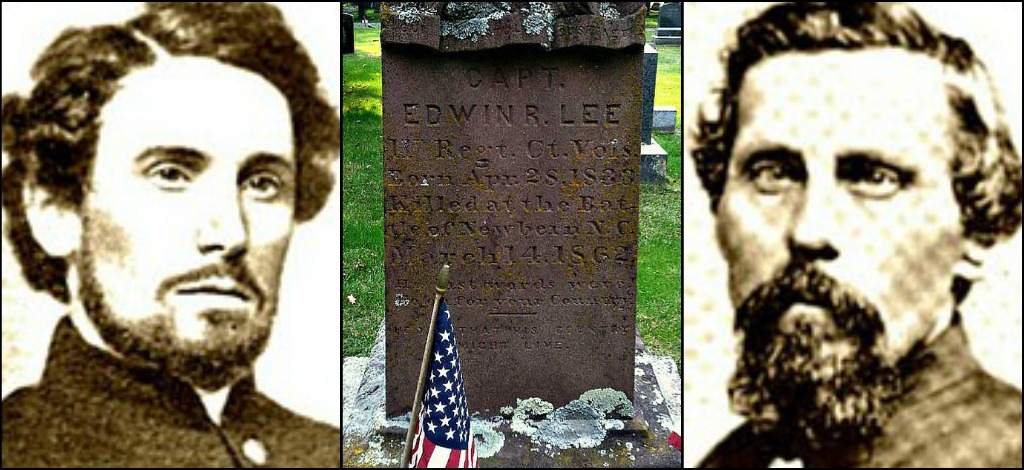
Edwin Lee (left) is buried in Barkhamsted, Conn. His brother, Henry, is buried under in an
unknown  grave in Virginia. (Photos John Lee of Hartford Co. and His Descendants)
2. BARKHAMSTED: The Lee brothers

A captain in the 11th Connecticut Infantry, Edwin Lee was just 28 years old when he was struck and killed by an artillery shell on March 14, 1862 at the Battle of New Bern (N.C.). Before he died, Edwin reportedly said: "Tell my brother I died at the post of duty. Good-by. Go on for your country!" (2) He was buried near the battlefield and later disinterred and brought back north for re-burial at Riverside Cemetery in Barkhamsted, about 20 miles northwest of  Hartford.  Edwin's brother, Henry, was killed on Aug. 16, 1864 at the Battle of Deep Run (Va.). His final resting place is Fort Harrison National Cemetery, near Richmond, where his body lies with many other Union soldiers whose tombstones are marked "Unknown." The 35-year-old lieutenant in the 7th Connecticut, described as a "brave, faithful, uncomplaining soldier," left behind a wife and four young children. (3)

Brothers John and James Willard have memorial markers in West Avon Cemetery, next to
West Avon Congregational Church. Each man, however, is buried elsewhere.
3. AVON: The Willard brothers

Two weather-worn markers stand in West Avon Cemetery in memory of  John and James Willard. Sadly, neither brother's final resting place is back home in Connecticut.  James, a 20-year-old private, was killed in the 7th Connecticut's attack on Fort Wagner, near Charleston, S.C., on July 10, 1863. He was buried on the battlefield, perhaps thrown into a trench by the enemy. The son of Julius and Damaris Willard "sleeps where he fell," according to his cemetery marker. John, a 32-year-old wagoner in the 11th Connecticut, died of yellow fever in New Bern, N.C., on Oct 3, 1864, and according to his marker, he is "buried in that city."

4. BERLIN: The Bacon brothers

Medal of Honor marker next to Elijah Bacon's grave
in Maple Cemetery in Berlin, Conn.
On July 3, 1863, Private Elijah William Bacon of the 14th Connecticut was a hero at Gettysburg, snatching the colors of the 16th North Carolina during Pickett's Charge. Less than a year later, on May 6, 1864, he was killed in action at the Wilderness. Posthumously awarded the Medal of Honor for valor at Gettysburg, Elijah left behind a wife, Eliza, and two daughters. Elijah's brother, Andrew, was captured in early May at Ely's Ford, Va., and sent to Andersonville, the notorious Rebel prisoner-of-war camp in Georgia. After being transferred from Andersonville, Andrew died on Jan. 25, 1865 at a POW camp in Florence, S.C.  He and his wife, Marissa, had no children. The brothers are buried in Maple Cemetery in Berlin, about 15 miles south of Hartford.

5: EAST HARTFORD: The Flint brothers

Alvin Flint Jr.
Death was no stranger to the Flint family during the Civil War. In the winter of 1861-62, Alvin Flint Jr.'s mother and sister died of consumption in East Hartford. Just 18 years old, Alvin joined the 11th Connecticut as a private on Oct. 1, 1861. Less than a year later, he too was dead, killed in the 11th Connecticut's fruitless attack at Burnside Bridge at Antietam. The loss was no doubt excruciating for 53-year-old Alvin Flint Sr., who had enlisted in the 21st Connecticut along with his 13-year-old son, George, in August 1862. "Hardly had the sadness of the death of a dear daughter, that I had lost last January, worn off when this sad, sad calamity should come upon me," he lamented in a letter published in the Hartford Courant on Oct. 29, 1862. In another unbelievably tragic turn of events, Alvin Sr. and young George died of disease within several days of each other in mid-January 1863. In a 13-month timeframe, five family members -- including two brothers -- were dead. They are all buried in Center Cemetery in East Hartford.

6.  COVENTRY:  The Talcott brothers

A private in Company D of the 14th Connecticut, 26-year-old Henry Talcott was wounded when an artillery shell burst near a wall in the lane leading up to William Roulette's farmhouse, wounding three other men and killing three in his company. (4) Samuel, Henry's 20-year-old brother, also was severely wounded at Antietam; he lingered for several weeks before he died on Oct. 14, 1862.  Samuel was buried in Center Cemetery in his hometown of Coventry, about 25 miles west of Hartford. "After the services the congregation viewed the remains," the Hartford Courant reported on Oct. 27, 1862, "and the sad procession slowly wended its way to the cemetery. The flag draped in black was borne by the members of the Sunday School Class of Talcott, to whom he was strongly attached."  Like his brother, Henry also lingered for several weeks before he died on Nov. 10.  He is buried to the right of his brother in the family plot.
Close-up of Samuel Talcott's gravestone. The 20-year-old private was mortally
wounded on Sept. 17, 1862. He died four weeks later.

7. EAST HADDAM: The Bingham brothers

John Bingham was killed at Antietam. Wells Bingham survived.
Another brother, Eliphalet, died during the Civil War.
It's unclear which brother is which in these photos.

(Photo courtesy of Military and Historical Image Bank)
A little more than a month after he enlisted in the Union army on Aug. 7, 1862, 17-year-old John Bingham, a private in the 16th Connecticut, was killed at Antietam. Younger brother Wells, also a private in Company H of the 16th Connecticut, apparently survived Antietam physically unscathed, but the memory of that terrible day was probably seared into the 16-year-old boy soldier's brain the rest of his life. Three other Bingham brothers served during the Civil War, including Eliphalet, who died May 1, 1864 at Arlington Heights, Va. It's unclear whether he died of a battle wound, disease or another cause. John and Eliphalet are buried at First Church Cemetery in East Haddam, about 35 miles southeast of Hartford. Apparently upset over a failing business, Wells committed suicide in 1904.

8. CANTERBURY: The Lewis brothers

A sergeant in Company F of  the 8th Connecticut, Charles Lewis -- described as a man who "had always fought in the front ranks" -- was killed at Antietam. (5) His fiancee, 21-year-old Sarah Hyde, died nearly a month later, on Oct. 16, 1862, and is buried next to Charles at Carey Cemetery in Canterbury. "They had been brought up together in life, in death they were not divided," the Hartford Courant reported on Oct. 24, 1862,  "and together they sleep the last sleep."  Charles' brother, Albert, was a 28-year-old corporal in the 5th Connecticut. Captured at Winchester, Va., on May 24, 1862, he was a prisoner of war for four months before he was paroled. Like other Union POWs who were paroled or released -- see my blog post on  Wallace Woodford of Avon -- Albert no doubt was in poor health when he finally returned home to Canterbury. Discharged because of a disability on Dec. 15, 1862, he died on March 23, 1863.

Charles Lewis, a sergeant in the 8th Connecticut killed at Antietam, is buried next to his
fiancee, Sarah Hyde, at Carey Cemetery in Canterbury, Conn.
(1)  The Litchfield Times, June 1864
(2)  The Military and Civil History of Connecticut During the War of 1861-65, William Augustus Croffut, John Moses Morrism 1869, Page 175
(3) Barkhamsted And Its Centennial, William Wallace Lee and Henry Roger Jones, 1881, Page 175
(4) History of the Fourteenth Regiment, Conneticut Volunteer Infantry, Charles Davis Page, Page 43, 1906
(5) The Military and Civil History of Connecticut During the War of 1861-65, William Augustus Croffut, John Moses Morris 1869, Page 272, Page 277

Sunday, January 14, 2024

Tales from the road: Where 'The Wizard,' 'Stovepipe' fought

"Cannons are loud," reads the marker on the Battle of Sacramento (Ky.) reenactment site. 

                   Like this blog on Facebook | Follow me on Twitter | My YouTube videos

The Civil War was fought in 10,000 places,” historian David McCullough told us in Ken Burns’ epic TV documentary Civil War, “from Valverde, N.M.,, and Tullahoma, Tenn., to St. Albans, Vt., and Fernandina on the Florida coast.” Here’s another one of those 10,000 places, Sacramento, Ky. — a blink-and-you’ll-miss-it, no-stoplight town a two-hour drive north of Nashville.

Adam "Stovepipe" Johnson
Since 2009, Betty Howard has served as mayor of Sacramento (population 425), which holds a reenactment of the battle in the spring. “Caution: Cannons are loud,” reads a marker on the battlefield about the event. (Who knew?) In town, I spotted one carwash, one battlefield monument, one Dollar General, two service stations and bristled at the yapping of two nervous hounds.

Now, how many of you have heard of the Battle of Sacramento?

Here, on Dec. 28, 1861, notorious slave trader Nathan Bedford Forrest — the Rebels’ “Wizard Of The Saddle” — earned his first victory and honed fighting skills that would serve him later in the war. “Forrest’s First Fight,” the locals call the battle against United States cavalry.

Casualty figures are murky, perhaps as few as a dozen total, but loved ones mourned the dead of Sacramento just as they did the dead of major battles at Shiloh, Antietam, Gettysburg and elsewhere. Confederate Capt. Ned Meriwether — the father of six — fell here. Two bullets to the head. So did 45-year-old Captain Albert Gallatin Bacon of the 3rd Kentucky Cavalry (United States), mortally wounded by thrusts of a sword by Forrest.

A report in the Jan. 14, 1862, Daily Selma (Ala.) Reporter of  the death of Albert Bacon.

Forrest scout Adam “Stovepipe” Johnson — who later became a semi-famous Confederate guerrilla — fought here, too. The former drugstore employee earned his nickname during an 1862 raid by his scant force on Newburgh, Ind., a town astride the Ohio River. As a ruse, Johnson tied pieces of stovepipe to blackened logs and pointed out the “cannons” in the far distance to a Unionist in Newburgh. (What a day to not carry binoculars.)

Mollie Morehead's grave
Blinded in a skirmish in 1864 at Grubbs Crossroads, “Stovepipe” Johnson served out the war as a POW at Fort Warren, in Boston Harbor. After the war, he made his way to Texas, where be founded Marble Falls, which became known as “The Blind Man’s Town.”

For the Rebels, this battle also featured a heroine/amateur scout. As Forrest’s cavalrymen approached Sacramento, they spotted a young woman riding a bareback horse. “There the Yankees are! Right over there!" 18-year-old Mollie Morehead shouted, pointing back over a hill.

In the northeast corner of Cumberland Presbyterian Church Cemetery, near a toppled tombstone, I found Mollie’s grave. The wife of a dentist, she died during child birth in 1870, 13 days after her 27th birthday.

Let’s keep history alive. 👊 

Enjoy stories like this? Consider purchasing a copy of my book, A Civil War Road Trip Of A Lifetime. Email me a jbankstx@comcast.net for details on how to get an autographed copy.

A Commonwealth of Kentucky historical marker in Sacramento.
Where United States and Rebel cavalry clashed during the Battle of Sacramento (Ky.). 
Take the driving tour of the battlefield. 

Tuesday, January 20, 2026

Letters From Triune: Tennessean grapples with 'monster Secesh'

Photo illustration of newspaper clippings of accounts from wartime Triune.

                                    Like this blog on Facebook | Watch my Triune video

Second in an occasional series.

My recent visits to Triune — where the Union army built a network of redoubts, earthworks and rifle pits 20 minutes east of Franklin, Tenn. — inspired this "Letters From Triune" series. 

The writer, an East Tennessee private who signed the letter “S.K.H.,” had to scout for months just to reach Federal lines. Writing as a common soldier, he believed a man risking his life for a pittance deserved as much respect as any general.

From Triune, his thoughts turned home. Loyal East Tennessee families, he wrote, were trapped behind Confederate lines, facing violence or slow starvation as rebels seized corn, wheat and bacon to feed their own ranks first. 

The letter, published in The Nashville Daily Union on April 26, 1863, closes with loyalty tempered by frustration and a clear sense of what mattered to him. Above all, he supported preserving the Union — even if that meant slavery remained. 

“We say give us the Government of our fathers and let the negro slide,” "S.K.H." wrote.

Earthworks at Triune, a Union Army complex near Franklin, Tennessee.


TRIUNE, April 21, 1863 | Mr. EDITOR: Dear Sir,

Allow me to write a short article for your most excellent paper, which has more, character in our camps than any other sheet. I claim no position in the army higher than a private, yet I know what East Tennesseans have suffered; having had to scout for four months before I could reach the Federal army. And I think a private soldier, if he demeans himself aright, deserves as much respect as a Major General. The one exposes his life for big pay, the other for a mere pitance; at least the private can claim as much unbought patriotism as the officer, and that is all that should command respect in a war like the present one. 

We, as East Tennesseans, are peculiarly situated. Our homes are in the hands of a bloody and cruel enemy. We know not how soon the fiends incarnate may murder our fathers, and brothers, and even our mothers and sisters, that we have left behind us. They have murdered the kind mother while attempting to save her beloved son, and why will they not do the same thing again? Let man commit murder once, and he can commit the same crime a second time with more ease. But if they do not abuse the persons of our friends, they will take their corn, wheat, and bacon, those things they must have, or perish, and leave them in a state of complete destitution--a condition more deplorable than death itself. 

Remains of Union earthworks at Triune
This is no overstrained picture, for the rebels are now in a starving condition, and every man of sense knows they will let their enemies suffer before they will suffer themselves. How much the poor soldier, cut off from all communication with his home, fears that his wife and little ones will suffer for the want of food, and how it gladens his heart to hear, through some poor refugee who may have made his escape, his friends still live, and have the common comforts of life. 

Our only hope is that the Government will immediately relieve our portion of the State. Oh! what hours of anxiety to the poor refugee soldier. We are all waiting to see if the authorities intend to send us back in the direction of our homes. If those who command us only knew how it would gladen our hearts, they would say, Go, join Gen. BURNSIDE, penetrate East Tennessee, whip the rebels, and liberate your homes.

I sometimes think that we as soldiers have been treated badly, yet I am not disposed to complain. When this rebellion first broke out, every public journal praised the noble hearted East Tennesseans, who, in spite of all opposition, held The Star-Spangled Banner aloft, and claimed that they were loyal. And those in power told us to hold out for a short time, and we will come, to your relief, if we have to come through a wall of living fire.

A road leading to one of the three redoubts at Triune

But how is it today? Two long years have passed away — and our people are still pressed beneath a despotism more cruel than that of Austria or Turkey. Rebel Middle and West Tennessce have been redeemed, at least to a great measure. The Government has spread the broad wing protection over the disloyal portion of the State; yet our people, who have ever been loyal, are left to grapple with the monster Secesh. 

We don't like to grim fight over Middle Tennessee soil, while the rebels are insulting friends and insulting our people. All we ask is, let us try our sabres with the traitors about Greenville, Knoxville and Chattanooga. If we fall in the contest, history's page will give us a spot upon which we will live, and in the agonies of death we will have this consolation, that we died trying to do our duty. 

But, on the other band, if we should be successful, no pen can tell the joy we will bring to our friends at home. And none can paint the visions of horror that will flit across the minds of the secesh that are there. They will have to cry out, let rocks and| mountains fall on us, and hide us from the wrath of the coming Yankees. We are for supporting the Administration at all hazards, as the only chance to save the Government; and if we have to give up the Union, or the institution of slavery, we say give us the Government of our fathers and let the negro slide.

No more at present, but remain yours, truly, S.K.H.