Showing posts with label 16th Connecticut. Show all posts

Wednesday, November 13, 2024

Tales from the road: A visit to boyhood home of KIA soldier

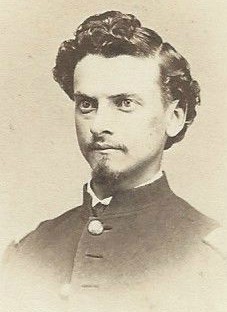
Ken Hintz at the boyhood home of 16th Connecticut Captain Newton Manross.

                                      Like this blog on Facebook | My YouTube videos

The beautiful wood floors in the house where 16th Connecticut Captain Newton Manross grew up in Bristol, Conn., are original but have settled in places over time.

“Put a marble on the floor of one side of a room and it might roll to the other,” the owner of the house, Ken Hintz, told me with a chuckle during an impromptu guided tour years ago.

Captain Newton Manross of the 
16th Connecticut suffered a 
mortal wound in the 40-Acre Cornfield
at Antietam.
Hintz and his wife bought the historic property on Washington Street in 1974, adding over the years modern amenities such as a clay tennis court and a swimming pool as they raised their family. But the Greek Revival house, part of which dates to 1746, still has many of its original features, including a bee-hive oven, stone fireplaces and even a tin roof painted bright red.

Manross was one of nine children of well-known Bristol clockmaker Elisha Manross and his wife, Maria. (Two of Manross' brothers, John and Eli, also served in the Union Army.) Newton was a brilliant man, graduating from Yale with a degree in geology in 1850, and a world traveler. A 37-year-old professor at Amherst College in Massachusetts, Manross enlisted in the United States Army on July 22, 1862, excitedly telling his wife Charlotte, "You can better afford to have a country without a husband than a husband without a country." (Love that!)

A little more than a month later, Manross was commissioned captain of Company K of the 16th Connecticut, composed mostly of men from prosperous Hartford County towns. “The father of the company,” one soldier called him. Another recalled how Manross earned the respect of his men by carrying the muskets of three soldiers (and a drum) while on the march from Washington to Maryland.

That's me with window frames from the 
boyhood home of Newton Manross.
In the 40-Acre Cornfield at the Battle of Antietam on Sept. 17, 1862 — the first battle of the war for his regiment — Manross was killed by cannon fire. His death had a profound effect on his comrades.

“The loss of our Captain was keenly felt by every member of the Company, for he not only recruited the men, mostly from the town of Bristol, Conn., but he cared for his men constantly,” wrote Pvt. George Robbins of the 16th Connecticut. “They felt for him almost a filial affection.”

Manross was buried in Forestville Cemetery in Bristol, about a mile and a half from his boyhood home.

“Come out back,” Hintz said during our visit. “I have something you might be interested in.” He took me to a barn-like structure and pointed to the floor at two ancient window frames — original to the house, he said.

“Would you like to have these?”

“Of course,” I told Hintz, who died in June 2024.

One of the treasures I gave away. The other remains in the garage, near the hunks of “witness trees” from the battles of Champion Hill and Nashville. Mrs. B insists they remain there, but despite their out-of-the-way location, neither the window frame nor the other “stuff” are ever far from my mind. 

Neither is one of my heroes, Newton Manross. Nor Ken Hintz, too.

Wednesday, September 25, 2019

An early morning walk in Antietam's 40-Acre Cornfield


Like this blog on Facebook | Follow me on Twitter

Decades after the Civil War, 16th Connecticut veteran William Relyea drew the diagram below showing where soldiers discovered the bullet-riddled body of 16th Connecticut Captain Samuel Brown (arrow) in the 40-Acre Cornfield after the Battle of Antietam. Brown, a teacher as a civilian, was 26. The location is near the 16th Connecticut monument that was dedicated in 1894. On Saturday afternoon, I walked the hallowed ground upon which 43 soldiers in the 16th Connecticut were killed on Sept. 17, 1862, and shot the video above.

Connecticut State Library archives | CLICK ON IMAGE TO ENLARGE.

-- Have something to add (or correct) in this post? Email me here.

Friday, May 24, 2019

Captain Tim's souvenir from Andersonville 'prison pen'

16th Connecticut Captain Timothy Robinson's Andersonville souvenir. (The piece of wood, not the banana.)
Image courtesy Robinson descendant.
Like this blog on Facebook | Follow me on Twitter

On post-war visits to Civil War sites, veterans often grabbed a souvenir -- a spent bullet, a piece of artillery shell, a sliver of stone from a wall, a brick from a war-time structure. During his visit to Andersonville, 16th Connecticut vet Timothy Robinson -- whose remarkable story is told here on my blog -- snatched a section of the old stockade fence at the notorious former prison camp.

Post-war image
of Timothy Robinson.
A Robinson descendant emailed me about the souvenir: “I’m happy to say it’s still in our family. The inscription reads, ‘From Confederate Prison pen, Andersonville, Ga.’

“Tim’s brother, Henry, was also in the 16th and both Robinsons were captured along with the rest of the regiment April 20, 1864, in Plymouth, N.C. Henry was wounded that day and being an enlisted man, he was sent to Andersonville. Tim, who was an officer and was treated better, ended up in Camp Sorgum, Columbia, S.C., from which he later escaped. But Henry died in Andersonville 4 months later and is buried there.

“Tim visited Andersonville at least once in his life and he was there for the October 1907 dedication ceremony honoring Connecticut war veterans who died at Andersonville.”

Known as "Captain Tim," Robinson served as president of the 16th Connecticut's regimental association for many years. Crippled by a cerebral hemorrhage, he died in Bristol, Conn., on Feb. 6, 1918. He was 83.

-- Have something to add (or correct) in this post? E-mail me here.

Monday, March 11, 2019

Andersonville anguish: 'Hand of God ... laid heavily upon me'

16th Connecticut Private Emerson Nichols' gravestone at Andersonville (Ga.) National Cemetery. 
Like this blog on Facebook | Follow me on Twitter

On a gloomy afternoon in Andersonville, Ga., I walked the grounds of the national cemetery, a place of immense sadness. It reminded me of a long-ago visit to the German World War II concentration camp at Dachau, where one almost expects the earth to open up and groan.

An angel figure hovers over bas-relief figures of Union prisoners 
on the huge plaque on the New York monument.
(CLICK ON IMAGES TO ENLARGE)
In the national cemetery, the pearl-white gravestones for nearly 13,000 Union POWs — mostly victims of disease at the notorious Confederate prison camp nearby — are grouped closely together. Row upon staggering row of markers stretch across the landscape.

Throughout the vast, well-kept grounds, memorials honor Federal dead  On a massive plaque on the New York monument, certainly a work of art, a glorious figure of an angel hovers over bas-relief figures of two prisoners — one looking hopeful, the other hopeless. "Death before dishonor," an inscription on the Iowa memorial reads. On the Illinois monument nearby, a statue of a doleful Union officer stands next to a slab of granite inscribed with that magnificent quote from Lincoln’s first inaugural address:
“The mystic chords of memory, stretching from every battle-field, and patriot grave, to every living heart and hearth-stone, all over this broad land, will yet swell the chorus of the Union, when again touched, as surely they will be, by the better angels of our nature.“
The monument honoring the 258 Connecticut dead is beautiful in its simplicity: A 7-foot bronze figure of a young soldier, kepi in hand, stands atop a granite pedestal. ”Andersonville Boy,” as the statue is known, reminded me of one of the reasons for my trip: Emerson A. Nichols of Company G of the 16th Connecticut. A friend suggested I visit his grave.

"Andersonville Boy" is featured on the Connecticut monument at Andersonville (Ga.) National Cemetery.
A private from Bristol, Conn., Nichols rests in red Georgia clay, Grave No. 5044, between soldiers from Wisconsin and Pennsylvania. He  enlisted six days before Christmas in 1863. In April 1864, he was captured at Plymouth, N.C., with most of the rest of his regiment and eventually shipped by train to Andersonville. On Aug. 8, 1864, a grievously ill Nichols was carried from the prison stockade a short distance to the camp hospital. He was so far gone he couldn't speak. He died later that day.

Emerson was only 16.

My God, 16 years old. 

In a letter to the Pension Bureau in July 1865, Emerson’s mother Candace told of multiple family tragedies. Her husband William died in April 1861, shortly before the war began. In the previous six years, Candace said she had also lost another son and two grandchildren. A son-in-law, too. A Union soldier, he was shot and mortally wounded while on picket duty in Louisiana.

"I feel that the hand of God has been laid heavily upon me," the widow wrote.

Candace Nichols, whose pension request was approved at the standard $8 a month, died in 1904. Whether or not she ever visited her son's grave in Georgia is unknown.


MRS. NICHOLS' LETTER TO PENSION BUREAU: "I AM A POOR WIDOW"


National Archives via fold3.com.
Bristol July 10/65

Mr. A. Johnson, Sir


May I ask one favor of you that is in regard to a pension that I made application for in April. It was sent back for want of evidence of my son's death, Emerson A. Nichols. He was a member of Co. G, 16 Regt C.V. He was taken prisoner in April 1864 at Plymouth [and] was taken to Andersonville with his Regt. except Co. K whitch was away at that time. Last Oct. I saw the chaplain of the 16th and he says the sutlers clerk gave a list of names of the dead and he was one of the number. He says he died the 8 of Aug. Edward Allen of this place helped carry Emerson out of the stockade and others took him away to the hospital. Edward says he don't think he lived to get there. He could not speak when he left him he was so near gone.


Mr. Albert Walker of Hartford Ct a member of the 16 Regt C.V. brought a list of the 16th that died there and the number of their graves. Emersons was among the number. He says their graves were all numbered where their name was known. I am a poor widow and this son I looked to for my support in part for I am not able to do but very little. I don't feel as though I should want help long. I feel that the hand of God has been laid heavily upon me for within the past 6 years I have buryed my husband, 2 sons, one son in law and 2 grand children. My son in law was buryed at Port Hudson. He was shot while on picket. I will not weary your patience any longer. I only ask your advise in regard to this pension.

Candace M. Nichols

-- Have something to add (or correct) in this post? E-mail me here.


Monday, November 12, 2018

Antietam souvenir hunt: What two veterans snatched in 1889

At a reunion of 16th Connecticut veterans at Antietam in 1889, Alonzo Case took this piece from the
"stone wall where the 16th Conn. received their terrible fire." (Simsbury Historical Society collection)
Alonzo Case also took this piece of stone from the Dunker Church on the Antietam battlefield
at the 1889 reunion of 16th Connecticut veterans. (Simsbury, Conn., Historical Society collection)
A Page 1 story in the Hartford Courant on Sept. 27, 1889, detailed Julian Pomeroy's souvenir hunt. 
Like this blog on Facebook | Save Historic Antietam Foundation

Years after the Civil War, veterans returned to battlefields for reunions or monument dedications, events that allowed them to relive memories and to renew acquaintances with old comrades. Many also returned to the battlegrounds for another reason: to snatch a war souvenir.

Here's how to contribute to the
Save Historic Antietam Foundation:
Donate | Mission | More
At a veterans' gathering at Antietam on Sept. 17, 1889, Alonzo Case took a small piece from a stone wall in the 40-Acre Cornfield where, according to a period tag on the relic, "the 16th Conn received their terrible fire." On the northern end of the battlefield, "within a few rods where Gen. [Joseph] Mansfield fell," Case snatched a stone from the famous Dunker Church. (Perhaps Dunker Church souvenir-seekers' efforts led to the structure's collapse in a wind storm in 1921.) Case was a officer in 16th Connecticut. His brother, Oliver, a private in the 8th Connecticut, was killed at Antietam.

Not to be outdone, 16th Connecticut veteran Julian Pomeroy also found time to collect a souvenir at the same veterans' gathering. Twenty-seven years earlier, the 16th Connecticut was routed in the 40-Acre Cornfield. To shield himself from Confederate fire that afternoon, Captain Pomeroy briefly rested behind a large tree, "about half the size of his body."

It may have saved his life.

During his 1889 battlefield visit, Pomeroy claimed he found the same tree he hid behind on Sept. 17, 1862. He removed "the bullet that tried to kill him" from it, and, according to a newspaper account, returned to New England with it.

Believe it or not.

-- Have something to add (or correct) in this post? E-mail me here.

Thursday, November 01, 2018

A walk in Antietam's 40-Acre Cornfield, where stories linger


Like this blog on Facebook | Save Historic Antietam Foundation

Under a blue sky and billowy gray and white clouds, a lone Antietam battlefield visitor walks to the crest of the hill, stands for a minute next to a tall, granite monument and stares into a rolling field. A fall chill invigorates in the 40-Acre Cornfield this morning. In the distance, silent sentinels stand guard while a large bird circles... circles ... circles until it finally drifts away. Few visit this ground on the battlefield's southern end, a pity because stories linger here like mist over nearby Antietam Creek.

Mortally wounded Newton Manross, a captain in the 16th Connecticut, was found in this field, his chest and shoulder carved open by artillery on Sept. 17, 1862.

Here's how to contribute to the
Save Historic Antietam Foundation:
Donate | Mission | More
Seriously wounded Private Henry Adams, Manross' comrade, lay in this field for more than 40 hours before he was discovered. "Why did I not die?" he wondered years later.

On a slope steps from the 16th Connecticut monument, Samuel Brown's body was discovered, riddled with bullets. The 16th Connecticut captain was a school teacher in civilian life.

Somewhere in this field, Bridgeman J. Hollister, a 16th Connecticut private, was shot through the throat as he helped carry a comrade away from hell. He died eight days later.

Visit this place for the gorgeous scenery and solitude. And visit it for the stories, too.
16th Connecticut monument in the 40-Acre Cornfield.

-- Have something to add (or correct) in this post? E-mail me here.

Saturday, September 29, 2018

For these vets, Antietam wounds a longtime pain in the ... ankle

A circa-1890s X-ray of 16th Connecticut veteran Bela Burr's ankle revealed a Rebel bullet.
(New England Civil War Museum)
Like this blog on Facebook  | Save Historic Antietam Foundation

For at least two Union veterans, the painful price of fighting at Antietam was suffering with a bullet in the ankle for decades.

16th Connecticut veteran Bela Burr, 
second row in middle.
(New England Civil War Museum)
Bela Burr -- a private in 16th Connecticut who became a newspaperman after the war -- was severely wounded in both legs during his regiment's disastrous attack in the 40-Acre Cornfield. Burr used a cane much of the rest of his life because of the wounds, and he groused that his crippled right leg felt like a "block of wood" or as though a "weight was tied to it." When Burr's doctor X-rayed his left ankle more than 30 years after the battle, he discovered a "small, hard oval object," about an inch above the joint. It was a small piece of Rebel lead, later removed.

When "Captain" Crowley was wounded in the ankle at Antietam, the Regular Army officer went down on his face "like a flash." Soon blood oozed over the top of his shoe. A Federal surgeon examined the wound, advising amputation, but Crowley wanted no part of that. Before the harried division surgeon moved on, he gave Crowley hope and a prediction: the lead would someday work itself out of the ankle.

Flash forward to the summer of 1900: As Crowley walked down a staircase, he slipped, the sudden movement loosening the bullet that long ago had lodged in his ankle, just as the surgeon had predicted. The old soldier, whose foot had swelled, sought a doctor to finally remove the tiny clump of lead. Crowley -- who told his bullet story to a Washington Evening Star reporter -- found the perfect man for the job.

Read on ...


Washington Evening Star, Aug. 17, 1900


Nearly 40 years have gone by since the first gun was fired at Fort Sumter, and it would seem that all the incidents relating to the war which followed have been since told and retold several times, but a fresh one came to light a few days ago through an accident.

Capt. Crowley, stopping at the Takoma hotel, slipped while coming downstairs recently and the jar loosened from its place a bullet that had been located beneath his ankle bone since the battle of Antietam. The leaden missile had troubled the captain at different periods since, but the accident precipitated a climax. The foot immediately began to swell and the next day he decided to go to a hospital.

"Captain" Crowley's Antietam bullet story appeared in many
newspapers in 1900. He had the removed bullet

made into a watch charm.
On his way to one of the local institutions, Capt. Crowley happened to glance over a paper and noticed that his old division surgeon, Dr. Woodall, had but recently returned from the Philippines and was stopping in Baltimore. Without further discussion the captain was taken to Baltimore.

Surgeon Woodall was located and by a short operation the ball was removed. In conversation with Capt. Crowley, a reporter of the Evening Star was told the story of the bullet which had been carried about by him for more than a third of a century.

The captain said: "I was a lieutenant in the regulars at the time the battle of Antietam was fought, and the first day of the struggle I was leading my company up a short hill, on the crest of which was located a large body of 'confeds.' As we charged, with every man yelling at the top of his voice, I went down on my face like a flash. Thinking I had stumbled over something, I immediately arose as one of the boys called back to me: "'Hello, lieutenant, are you hit?'

"'Not a scratch,' I replied, and at once started after my company.

"I had hardly taken a dozen steps before I felt something wet around my shoe, and, stooping down to turn up my trousers (we didn't wear leggins then), I found blood oozing over my shoetops. As soon as I pulled off my shoe, my foot became swollen to twice its natural size, and I started for the rear.

Here's how to contribute to the
Save Historic Antietam Foundation:
Donate | Mission | More
"You may have heard what a field hospital was like, but as the thermometer registered fully 125 in the sun that poured down on us further description is unnecessary. Surgeon Woodall, God bless him, was in command, and after a hurried examination told me the foot would have to come off. But I protested, and the surgeon said all right; he would examine it later. As there were hundreds of brave boys lying around waiting to be attended to, the surgeon passed on.

"But an accident again brought him near the spot where I was lying on the ground and he once more probed for the ball. It was no use, however; it could not be found. The surgeon then said: " 'Crowley, that ball has gone up under your ankle bone, and if you want it out now the foot will have to come off. The wound may heal up and enable you to walk upon the injured foot. Some day you will jar the ball from its place, and then it can be taken out easily.'

"Quite a prediction, wasn't it?

A Confederate bullet, perhaps
like one that lodged
in Crowley's ankle.

"A few minutes after the surgeon left me back came our men on the run, and confusion was everywhere. The army was retreating and the wounded men were to be left behind. Try as I could, no one cared to help a regular, and I thought my chances pretty good of falling into the hands of the Johnnies. Just then a mule team with supplies halted near me, and in the twinkle of an eye I was on the back of one of the animals. The darky driver made no objections, and we went off of that battle field with a skip and a jump.

"I remained in the hospital for two months and was then discharged, being able to walk with a crutch. Since those days I have had numerous operations performed on the foot, but the bullet refused to come from its hiding place. The jar given me last week, however, did the trick.

"The strange part of the wound was that the bullet when taken out was encased in a sort of amber-like covering, and this had prevented blood poisoning. I have had the bullet made into a watch charm, and money couldn't buy it."'

Capt. Crowley fought through the entire civil war, being with the Second division of the Fifth army corps, and to-day is hale and hearty, a slight limp and stoop being the only reminder that many years have elapsed since he fought for Uncle Sam.

-- Have something to add (or correct) in this post? E-mail me here.

SOURCES

-- Bela Burr widow's pension file, National Archives and Records Administration, Washington, D.C.

Wednesday, April 18, 2018

Antietam video: 40-acre Cornfield, 16th Connecticut monument


Like this blog on Facebook

On Sept. 17, 1862, the green 16th Connecticut was routed in the 40-acre Cornfield at Antietam, suffering 43 killed among more than 200 casualties. Decades later, a veteran in the regiment described the fighting there:
“We were but a lot of green boys, many under 19 years old when we went into the Antietam fight. Only a few knew anything about guns. We had received our guns at Arlington Heights but had not had any drills in shooting of the manual of arms. As we forded the creek on the morning of the battle, we could see the Confederates. After we crossed the creek, we marched in line of battle for some time. Shells were coming our way and some men of the Eighth regiment we could see falling. A shell burst and a part of it flew up striking me on the side, and making a sore place which lasted several days. Finally we were ordered to go by the left flank and enter the corn field. We could not see any Confederates and went out in that field. The Rebels opened on us with several volleys. We did not know what to do. After a while, Captain Pasco said, 'Boys, I don’t know what orders to give but you had better disband and get out of this field.' "
-- 16th Connecticut Sergeant John Gemmill

On Sept. 17, 1915, the 53rd anniversary of Antietam, the Hartford Daily Times published
16th Connecticut veterans' recollections of the battle.  John Gemmill is at bottom left.
                                40-acre Cornfield and 16th Connecticut monument.
                                     (Click at upper right for full-screen experience.)

-- Have something to add (or correct) in this post? E-mail me here.

Tuesday, February 27, 2018

'Masterpiece' no more: Antietam secretary exposed as fake

The "Antietam secretary" in Massachusetts antiques dealer Harold Gordon's house in 2011.
Read my story on the fake in The New York TimesLike this blog on Facebook

The eight-foot-high memorial secretary -- a piece of American folk art with a tie to the Battle of Antietam -- has been described as "astonishing," "a rare example of a Civil War mourning rite," "extraordinary" and a "profound piece."

Now there's a new description for the ornate piece of furniture in the collection of the Wadsworth Atheneum Museum of Art in Hartford, Conn.:

"One of the best folk art fakes of all time."

The secretary on display at Hartford's Wadsworth Atheneum
Museum of Art in August 2017.
In a lengthy story posted Monday afternoon, Clayton Pennington of Maine Antique Digest reported the secretary was a forgery created by Massachusetts antiques dealer and craftsman Harold Gordon. “I’m going to keep this short. I did it. I made it," he told Pennington.

In 2014, Gordon sold the secretary to noted Connecticut-based antiques dealer Allan Katz, who had the piece tagged at $375,000 at a 2015 winter show. In March 2015, the Wadsworth purchased it from Katz for an undisclosed price, and the museum had it prominently displayed last summer.

Gordon had touted the secretary as a gift presented on July 4, 1876, by Civil War veterans to Wells Bingham in honor of his brother,  John, who was killed at Antietam. The brothers served as privates in the 16th Connecticut. (I first blogged about the secretary in 2011 here, and mentioned it in a story about the Bingham brothers in my 2013 book, Connecticut Yankees at Antietam.)

"Allan fell for it, and to be honest with you, I want to make him whole," Gordon told Pennington. "It was not fair what I did. It was a terrible thing, but I did it for the money — I didn’t do it for the glory." Gordon said there was "nothing" on the secretary when he began turning it into "Antietam" folk art -- a project that took him months to complete.

Spelled out in cattle bone on the ornate front are the words "Antietam" and "Sept. 17, 1862" as well as John's first two initials and last name. A Ninth Corps badge is mounted between the "18" and "76," which are also made of cattle bone. The knobs are bird's-eye maple with bone inset circles. A clock, crowned with an eagle and including the words "The Union Preserved" near the base, is mounted on top. When the inside right front door is opened, "Yankee Doodle Dandy" plays on a music box.

All expertly faked, of course.

Pennington told me the clincher for him was a 2011 photo of the secretary that I had taken at Gordon's house. He compared my image, seen at the top of this post, to another image of the secretary -- unadorned with the bells and whistles -- in the same spot in Gordon's house. In 2011, Gordon told me he had purchased the secretary from a member of the Bingham family.

A close-up of the front of the secretary at the Wadsworth Atheneum Museum of Art.
Katz said he plans to offer the Hartford museum a full refund. In a statement e-mailed to me this morning, the Wadsworth Atheneum Museum of Art said:
As stated clearly in our mission statement, we hold our collections in trust for all people, and we are dedicated to advancing knowledge and inspiring everyone to experience and appreciate excellence in art and culture. To realize that mission, we work to acquire items for our collections. In the acquisition and accession process we strive to confirm the authenticity of every item in accordance with our Collections Management Policy.

In late 2016, we received an anonymous report that one of the items acquired for our folk art collection in February 2015 – a piece of antique furniture adorned with relics of the civil war at the time of the American centennial, 1876 – was fake. We began to investigate and in 2017 took the item off view at the Atheneum until the investigation could be completed. One of the steps we took was to engage a materials scientist to try to determine the age and timeframe of the adornments. Other steps included a thorough review of a wide variety of historical sources and our own records in an attempt to scrutinize the authenticity. 
This week, we learned that a Massachusetts antiques picker and craftsman has reportedly confessed to adorning the antique secretary himself, forging the provenance documentation, and misleading the dealer to whom he sold the piece. That dealer, who sold it to the Atheneum, has offered the museum a complete and total refund. We are also in contact with the appropriate authorities to follow up on this matter.

While it can be difficult to authenticate folk art of this kind, and this was by all accounts a masterful forgery that fooled a number of experts in this field, we will review our accession process and make every effort to ensure that art we acquire is what it purports to be.

We thank the concerned individuals who brought this to our attention and pursued this matter to this conclusion. We take our role as a steward of the public trust to be paramount and appreciate your support. Collections are fundamental to this institution’s identity, essential to its core function as a place for art and public engagement, and a defining element of our present and future plans. We will continue to do our best to identify, authenticate, acquire, preserve and present culturally significant works of art in our collections.

-- Have something to add (or correct) in this post? E-mail me here.

Tuesday, February 13, 2018

Video: Visit to 16th Connecticut monument at Antietam


On a crisp February afternoon, I visited the 16th Connecticut monument in the 40-acre Cornfield at Antietam, where the Nutmeggers were routed on the afternoon of  Sept. 17, 1862, in their first battle of the war. Seldom-visited by battlefield tourists, this is my favorite spot on the field. My aim was to shoot a "Now" image of the photo William Tipton took the day the monument was dedicated on Oct. 11, 1894. I'll post the result soon.

Sunday, February 11, 2018

View digitally restored Antietam monument photo from 1894

AFTER DIGITALLY RESTORED: An image of 16th Connecticut veterans at the dedication of their
monument at the 40-acre Cornfield at Antietam on Oct. 11, 1894.
 (SEE HOVER EFFECT AT BOTTOM OF POST.)
BEFORE RESTORATION: The original albumen is tattered and separated into two large pieces.
Like this blog on Facebook

On Oct. 11, 1894, 16th Connecticut veterans gathered in a rolling field at the south end of the Antietam battlefield for the dedication of a monument where the regiment had shed so much blood. A prominent inscription on the multi-colored granite obelisk told of the regiment's sacrifice in the notorious 40-Acre Cornfield on Sept. 17, 1862 -- the Nutmeggers' first battle of the war:

"Number engaged --779
Casualties
Killed 43
Wounded 161
Total 204"

Post-war image of  Frank Cheney,
 the former 16th Connecticut 
lieutenant colonel.
The afternoon was marked by speeches, of course, as well as by the invocation by former 16th Connecticut chaplain Charles Dixon, who recalled "noble men whose hearts glowed and burned with patriotic fire." But the most poignant event that day may have been the reading of a poem by 60-year-old Nathan Mayer -- the regiment's former surgeon -- which brought many of his comrades to tears.

At least two photographers were there to document the solemn event. Before the monument dedication -- one of four that early-fall day at Antietam for Connecticut regiments -- an unknown photographer shot an image of the monument blanketed by a massive American flag. Afterward, Gettysburg-based photographer William Tipton took several images, including the previously unpublished photo seen at the top of this post. The tattered and torn original -- digitally restored with the magic of Photoshop -- was found in a box with other family items by Willa Biewald, who has generously allowed me to dig into its secrets. (Hat tip: Matt Reardon, executive director of New England Civil War Museum.)

Unfortunately, there are no identifications on the front or reverse for the 28 people shown in the 13- x 16-inch albumen. The white-bearded gentleman to the immediate right of the monument almost certainly is former 16th Connecticut Lt. Colonel Frank Cheney, who suffered a severe wound to his left arm at Antietam and was discharged from the army on Christmas Eve 1862. A 62-year-old wealthy businessman and a beloved figure in the regiment, he contributed a large sum to pay for the land where the 16th Connecticut monument was located.

Here's how to contribute to the
Save Historic Antietam Foundation:
Donate | Mission | More
Further research surely will yield the names of some of the other veterans, several of whom hold canes, as well as the women who appear to the right of the monument. Those ladies, probably wives of veterans, may have traveled from the village of Sharpsburg, Md., to the dedication site in the carriage seen in the left background. Thanks to a complete list of the "excursionists" published in October 1894, we have a starting point for our investigation into the names of all subjects who appear in the photograph.

We do know with 100 percent certainty the photograph was taken by Tipton, whose name appears near the bottom left of the image. A meticulous record-keeper, Tipton compiled a catalogue of images he shot at Gettysburg and elsewhere in 1894. But the 16th Connecticut monument dedication photograph surprisingly does not appear in his 40-page booklet.

Perhaps by sharing this post with readers we'll soon know much more about this old image taken in the 40-acre Cornfield.

In the left background, a carriage used by some of the "excursionists" to get to the remote field. 
Photographer William Tipton included his name near the bottom of the image.
Among those who attended the dedication were four women, probably wives of 16th Connecticut veterans.
A photograph number and date the image was taken appear near the bottom right of the albumen.

HOVER ON IMAGE TO VIEW COMPARISON *


* Hover effect does not work on phones, tablets

-- Have something to add (or correct) in this post? E-mail me here.

Thursday, January 25, 2018

Keeping history alive: Preserving the Bauers' war-time letters

William Griffing created a web site for war-time correspondence between Jacob and Emily Bauer.
Like this blog on Facebook  | 'This is a dreadful war': The Bauers' correspondence.

At a Connecticut flea market in 2016, I purchased a packet of war-time correspondence between 16th Connecticut soldier Jacob Bauer and his wife, Emily. I have no plans to keep these letters. Like anything else in my modest Civil War collection, I rent what I have. I strongly believe in sharing history, so the letters will eventually be donated to a historical society, a library or returned to descendants of the Bauers.

Jacob and Emily Bauer in Virginia in the summer of 1863.
(Connecticut State Library)
In the meantime, I have collaborated with William Griffing to make the Bauers' correspondence available to the public. Griff, featured in my Civil War Times column, has become expert in creating web sites for war-time correspondence of Civil War soldiers. In two days, he transcribed my eight Bauer letters and created this site for them. (Visit his landing page of soldier correspondence here and his "Spared & Shared Facebook page here.)

In my favorite letter, dated Oct. 5, 1862, a worried Emily wrote Jacob, then a private in the 16th Connecticut. A German immigrant, Bauer had recently survived the Battle of Antietam -- the regiment's first fight of the war. In a 40-acre cornfield near the village of Sharpsburg, Md., on Sept. 17, 1862, more than 200 soldiers in his regiment became casualties -- 43 were killed in action.

“Mr. [Jacob] Eaton was wounded at the battle of Antietam and the ball is in his leg yet,” Emily noted about the private in the 8th Connecticut. “[Private] William Pratt was also wounded in that battle, I believe pretty severely in the hip. [Sgt.] Edward Parmalee’s remains were carried here from Hartford on the one o’clock train and buried up town where his mother was buried. [Sgt. Wadsworth] Washburn’s body has not come up yet.”

Added Emily: “This is a dreadful war. I hope and pray it may cease soon.”

In a letter to Emily on Aug. 20, 1863, Jacob wrote how he eagerly anticipated her visit to the regiment's camp in Virginia.

Jacob Bauer of the 16th Connecticut survived Antietam.
Many of his comrades did not.
"... do not trouble about the cost at all," he wrote. "You will never be sorry of having been here. There are several ladies here now with their husbands and a good many more coming."

Later, he added: "I think I can get a room and board near our camp but if not, can you sleep with me on a hard board and a single blanket for covering?"

On April 20, 1864, Bauer, a sergeant, was captured in Plymouth, N.C., with most of the rest of his regiment and sent to Andersonville, the most notorious POW camp of the Rebellion. He somehow survived the camp where 13,000 Union soldiers died; Bauer was paroled on Dec. 10, 1864.

After the war, Jacob was active in veterans’ organizations. He died in 1931 at age 92, outliving his wife and most of his fellow veterans. Emily, with whom he had four children, died in 1900. (In A Broken Regiment, Lesley Gordon's excellent book on the 16th Connecticut, Bauer is featured.)

There are no amazing revelations in the Bauers' correspondence, which provide a glimpse into the lives of a loving couple during the Civil War. At the very least, that alone makes them worth preserving and sharing with others.

Let's keep history alive.

All William Griffing's transcriptions of Civil War soldier letters here.

Have something to add (or correct) in this post? E-mail me here.

Sunday, November 19, 2017

'Remarkable': How 'Captain Tim' escaped from Rebels in 1864

Timothy Robinson's grave in West Cemetery in Bristol, Conn.
1894 image of 16th Connecticut Captain Timothy Robinson. (Connecticut State Library)
CLICK ON IMAGES TO ENLARGE.
Like this blog on Facebook | Follow me on Twitter

On Halloween Night 1905, more than a dozen 16th Connecticut veterans gather at the home of Timothy and Sophia Robinson to celebrate the couple's golden wedding anniversary. It's a grand occasion,  befitting for the old soldier and his wife, among the most respected citizens of Bristol, Connecticut.

This inscribed silver loving cup was given
 to the  Robinsons by 16th Connecticut vets
 in 1905. (Courtesy Garth Gustafson)
While the Robinsons stand in the front parlor where they had been married in 1855, Colonel Frank W. Cheney delivers a short speech and then hands the couple an inscribed, silver loving cup. "Presented to Captain Timothy B. Robinson, by his old comrades of the Sixteenth C.V., 1855-1905," the words on it read.

In a wonderful gesture, Cheney — one of the 16th Connecticut's more beloved figures — also presents Timothy and Sophia each a $20 gold coin. As long as they have the shiny gifts in the house, the 73-year-old veteran tells them, surely tongue in cheek, neither of them would be out of money. Robinson thanks Cheney and the group celebrates in "a sort of old time reunion."

The gray-haired 16th Connecticut veterans, each of whom had suffered significant hardships during the war, have plenty to discuss. Many of them had been captured at Plymouth, North Carolina in April 1864 and imprisoned at Andersonville, the deadliest of all Civil War POW camps. The captain's own brother, 19-year-old Henry, died there in the summer of 1864.

Henry Robinson, Timothy's 19-year-old 
brother, was captured at Plymouth, N.C.,
 on April 20, 1864. He died at Andersonville.
(Courtesy Garth Gustafson)
In brutal fighting at Antietam on Sept. 17, 1862, the hard-luck 16th Connecticut's first battle, Cheney suffered a serious wound in the arm, knocking him out of the war for good. Eighty-three-year-old Charles Dixon, the 16th Connecticut's chaplain, had been briefly imprisoned at Andersonville and then in Macon, Georgia, where he defiantly disobeyed the Confederate commander's demand that he not pray aloud for President Lincoln. Sixty-one year-old William Nott had survived Antietam, Andersonville and a little-known collision of ships on the Potomac River days after the war had effectively ended — an accident that claimed the lives of seven other soldiers in the regiment.

But perhaps no man in the frame house on Wolcott Street that Tuesday night has a greater war story to tell than 71-year-old Timothy Robinson himself. His is a story of derring-do and survival behind enemy lines — a tale that included a goat, the kindness and bravery of escaped slaves, a failed attempt in a rowboat to reach a Union blockader off the coast of South Carolina and, ultimately, a successful escape from a Confederate POW camp.

By 1905, the two 16th Connecticut officers who shared in Robinson's amazing story had long since gone to their graves.

PRESENT DAY: Robinson's house on Wolcott Street, where the vets gathered Halloween Night 1905.

Inscribed scabbard for sword presented in 1862 to Timothy Robinson.
(Courtesy Garth Gustafson)

When the Civil War erupted in April 1861, the E.N. Welch Clock Company employed Timothy Boardman Robinson as a machinist in the Forestville section of Bristol — an area that for decades had been hub of clockmaking in western Connecticut. In August 1862, he enlisted in the U.S Army, mustering into Company K of the 16th Connecticut as a 2nd lieutenant under the command of Captain Newton Manross, a Bristol native and an assistant professor at a college in Massachusetts. Before the two men marched off to war together, friends in Bristol presented each an inscribed sword and scabbard.

A war-time image of Timothy Robinson, who
twice escaped from Rebel POW camps.
Barely a month after their mustering in, 16th Connecticut soldiers found themselves on the front lines at Antietam as part of the Ninth Corps of the Army of the Potomac. Smashed in the left flank in the 40-Acre Cornfield by veteran troops under A.P. Hill, the green Nutmeggers suffered more than 200 casualties on the bloodiest single day of the war. Struck by Confederate artillery, Manross was killed, one of three soldiers in his company who did not survive the battle; Robinson, meanwhile, survived without any physical wounds.

Ushered to the war's backstage, the 16th Connecticut never saw major action again. And then came April 20, 1864 — another tragic day that defined the 16th Connecticut's Civil War experience. Nearly surrounded,  the regiment and the rest of the Union garrison in Plymouth surrendered to Confederate forces under General Robert F. Hoke.
Forced by a Confederate to give up his prized sword and scabbard, Robinson — who had been promoted to captain in April 1863 — and other officers were inititally imprisoned at Camp Oglethorpe in Macon. Their captors sent enlisted men — including Timothy's brother, Henry, who suffered a wound at the Battle of Plymouth — to Andersonville.

When Sherman's march through Georgia in the fall of 1864 made prison camps in the state untenable, the Rebels transferred Robinson and other Federal POWs to a camp in Charleston, South Carolina. During a trip in early October from Charleston to Camp Sorghum in Columbia, South Carolina aboard a heavily guarded train, Robinson and 16th Connecticut captains Thomas Burke of Hartford and Charles Morse of New Hartford leaped from a boxcar and escaped. In the woods six days later, a hunter discovered the exhausted men, who had endured on a diet of parched corn. His dogs guarded the escapees while he sought help.

"Here again commenced a course of treatment which was made none the less revolting by the five months experience they had already endured," an account noted, "and thoughts of escape did not die out among them."

A late-19th century illustration of Camp Sorghum in Columbia, S.C. Robinson and two
fellow 16th Connecticut POWs fled the camp in the fall of 1864.

Returned to Camp Sorghum, Robinson, Burke and Alfred Dickerson, a 16th Connecticut captain from Hartford, didn't stay put for long. After collecting wood with many other officers near the lightly guarded camp, the three malnourished soldiers snuck into the woods, beyond reach of their captors. The date was Nov. 3, 1864. The escapees' audacious plan was to somehow follow the Congaree and Santee rivers downstream to the Atlantic Coast, a staggering distance of more than 175 miles. From there, well, who knew.

"The night was dreary and rainy and the roads were very muddy," an account of the escape noted, "but, emaciated as they were by over six months confinement and exhausted with the labors of the day and with anxiety, they resolutely pushed on all night and the next day, carefully avoiding the habitations of men, and finding their subsistence in the fields they passed through."

A war-time image of 16th Connecticut
Captain Alfred Dickerson, who died in 1868.

He was only 27. 
In a surprising twist on Nov. 4, Robinson, Burke and Dickerson connected with five other Federal escapees from Camp Sorghum. The men had bribed a guard in exchange for their freedom and survived for two days in a swamp. Luckily for the Connecticut men, those  soldiers had met local Blacks, probably escaped slaves, who furnished them with two rowboats as well as sweet potatoes, turnips and cornbread.

Sleeping and cooking by day and traveling mostly at night to avoid detection by the enemy, the bedraggled band slowly made its way down the Congaree and Santee rivers. Camped near the river bank one day, the men heard loud voices.

"[W]e discovered a boat below us upon the river, being poled up the river by negroes," Dickerson recalled. "One of our party posted himself upon the bank of the river where he could hail the boat without discovering the presence of the rest of the party, and hailing down the negro in charge of the boat informed him that he was in want of provisions."

The man continued downriver, refusing to stop.

When a Union officer informed the Black man of his escape from a Rebel prison, he "immediately landed," Dickerson recalled, and stayed with the soldiers all day, "cooking rations and giving very valuable information." Directed by their newly-made Black friend, the soldiers stopped downriver that night at a farm, where they captured and killed a goat that supplied them with meat for the rest of their journey. Robinson and Burke each kept one of the animal's horns as a souvenir.

Several days later, the escapees met four other Black men, who gave the group "a large quantity of sweet potatoes, salt and meat." Upon parting with them, Dickerson remembered, "they bade us God speed and a safe journey. Elated and happy with our success, we kept steadily forward and soon after we landed to again consult the negroes who told us we were but five miles from a battery mounting two pieces, upon the right bank of the river, guarded by rebel soldiers.

16th Connecticut Captain Thomas Burke,
 shown in a war-time image, 
died in 1887. He was 50.
"After receiving other information and provisions," Dickerson added, "we parted company with the last of our negro friends, and proceeded down the river, passed the battery in safety, and landing waited for darkness of the night to finish our journey to the coast. Thursday night, full of hope, we again took to our boats and meeting no interference, reached the coast safely."

More than a week after their journey had begun, the escapees finally had reached the mouth of the Santee River, which empties into the Atlantic. Miraculously undetected by the enemy, the group had passed two guarded bridges, two guarded ferrys and Battery Warren during their adventure.

But a huge challenge remained.

On the horizon, they spotted the spars of a ship, a Union blockader. Taking their best boat, three of the men rowed about eight miles from shore before a fast-approaching storm forced them to turn around.

Undaunted, Robinson, Dickerson and another fugitive made a second attempt at sunrise the next day, rowing their ramshackle vessel miles into the Atlantic. Stunned crew on the Union blockader Canandaigua spotted them. According to an account written years later:
"To the officers and men it seemed as if the thunder of their own guns must have startled these fugitives from the caverns of the deep, so incredibly daring was the voyage upon the foaming sea with a boat so leaky and so frail, as hardly to withstand a zephyr, and orders were at once given to take it aboard and keep it as a token of what men would dare to do."
Another boat was sent ashore to rescue the remaining five escapees. Crew handed the eight former POWs new uniforms. Their tattered rags ended up in the ocean.

"[W]hen all were safe upon the deck of the ship and under the protection of the Star-Spangled Banner," Dickerson wrote, "our hardships ended and pleasure took the sway. Our feeling of joy when safe in the protection of our Government can be conceived only by those who have been called upon to undergo similar privations and hardship, and who beheld the dawn of Freedom upon their toilsome efforts."

With their stunning great escape complete, Robinson, Burke and Dickerson received furloughs to return home.

Timothy Robinson, believed to be second from left in the front row, and other 16th Connecticut vets
at the Bristol, Conn., grave of  Newton Manross, the Company K captain who was killed at Antietam.
 The photograph was taken in June 1885. (Courtesy Bristol Public Library)

Each of the Connecticut escapees survived the war, but neither Thomas Burke nor Alfred Dickerson lived to see the end of the century.

Only 27, Dickerson died on Oct. 24, 1868, of a "very malignant type of erysipelas." His death "brought deep sorrow not only into the circle of his own family friends," an account noted, "but also into a much larger circle of those who knew and loved him." He left behind a wife named Mary and a three-month old daughter named Alfreda.

Nearly 17 years later, on April 17, 1885, Burke — "a man of warm heart and unquestioned courage" — died of pneumonia at a hospital in Hartford, Conn. At the end of his life, he had suffered from financial hardship. "He had not the business turn that would give him success," the local newspaper reported in a front-page obituary, "and he saw hard days which he took quietly and without complaint."

A widower who had lost his wife in a boarding house in 1872, Burke received a funeral with military honors in Cedar Hill Cemetery in Hartford. He was only 50.

Active in veterans' organizations, Robinson — known as "Captain Tim" to family and friends — served as president of the 16th Connecticut's regimental association for many years. Crippled by a cerebral hemorrhage, he died in Bristol on Feb. 6, 1918. He was 83.

In an obituary, a Hartford newspaper called Robinson "the survivor of one of the remarkable escapes of the war."


A war-time image of
O.P. Mills.
POSTSCRIPT: After the war, Burke gave Robinson, an avid collector of Civil War relics, his horn from the goat the escapees had killed in November 1864. Along with his own horn, Captain Tim displayed the strange souvenirs in his den in Bristol.

According to a descendant, Robinson's personal papers, including many of his wartime letters and his map of the successful 1864 escape route, were destroyed in a house fire in Winsted, Conn., in the early 1970s.

After the Civil War, the scabbard from the sword presented to Robinson by friends in Bristol in 1862 was returned to him. But the sword, snatched by a Confederate at Plymouth, N.C., in the spring of 1864, remained missing,

By accident, a 16th Connecticut veteran learned Robinson's sword was in possession of  O.P. Mills, a former Confederate infantry officer and successful cotton mill entrepreneur in Greenville, South Carolina. Robinson's friends attempted to acquire the sword from Mills, who refused to return it, keeping it as a war prize. When Mills died in 1915, the sword was still in his family's possession.

The current whereabouts of the prized weapon are unknown.

Timothy Robinson's grave in West Cemetery in Bristol., Conn., is yards from the town's
Civil War memorial and the Robinson family memorial (background and below)
.

Have something to add (or correct) in this post? E-mail me here.


NOTES AND SOURCES

  • Blakeslee, B.F, History of the Sixteenth Connecticut Volunteers, Hartford, Conn., The Case, Lockwood & Brainard Co., Printers, 1875
  • Bristol (Conn.) Press, June 7, 1872
  • Hartford Courant, April 18, 1885, Nov. 1, 1905, Feb. 8, 1918
  • The Connecticut War Record, December 1864, Page 6. The letter writer signed his account of the escape "One of the Party." The man was undoubtedly Alfred Dickerson.
  • The Soldiers' Record, Oct. 31, 1868
  • Timothy Robinson descendant Garth Gustafson supplied information from his family's archives for this story.