Showing posts with label 1862. Show all posts

Thursday, November 13, 2014

Fox Gap panorama: Where Jesse Reno was mortally wounded

                                Click on upper right of image for interactive panorama.


Jesse Reno
 Like this blog on Facebook

On Sept. 14, 1862, 39-year-old Union Major General Jesse Reno, a native Virginian who stayed loyal to his country, suffered a mortal wound in the chest at Fox Gap during the Battle of South Mountain (Md.).

At least one Rebel did not mourn his passing.

"The Yankees on their side lost General Reno," General D.H. Hill sarcastically noted in his official report, "a renegade Virginian, who was killed by a happy shot from the Twenty-third North Carolina."

Twenty-seven years later, 100 Civil War veterans were among the 1,000 people who gathered for the dedication of a monument near the spot where Reno suffered the wound. After members of Reno's wartime staff unveiled the 8-foot granite marker and patriotic music was played, former Union General Orlando B. Wilcox delivered a speech that highlighted the general's distinguished service in the army.

But the best event of the day may have been saved for last.

"The farmers and others in the vicinity had an ample dinner spread on the grounds," reported the Herald And Torch Light, a Hagerstown, Md., newspaper, on Sept. 19, 1889, "and all of the visitors were made guests of the citizens."


The monument at Fox Gap to Jesse Reno was dedicated on Sept. 14, 1889.

Have something to add (or correct) in this post? E-mail me here.

Saturday, September 06, 2014

Antietam veterans' recollections 53 years after battle

The Hartford Daily Times on Sept. 17, 1915 -- the 53rd anniversary of the Battle of Antietam.
(CLICK ON IMAGES TO ENLARGE.)

 Like this blog on Facebook | Follow me on Twitter

On Sept. 17, 1915, the 53rd anniversary of the Battle of Antietam, The Hartford Daily Times published short profiles and recollections of more than two dozen veterans who fought on the bloodiest day in American history. Images of many of the men, their mustaches or beards bathed in gray, accompanied a full-page story that spilled onto another page. 

Present-day view of 40-acre Cornfield.
Most of the veterans, all Hartford residents in their 70s, had served with the 16th Connecticut, whose first major battle of the war at Antietam resulted in a horrendous toll in the unit: 43 killed, 161 wounded and 204 captured or missing.

Three veterans recalled crawling off the battlefield as the Rebels poured fire into the 16th Connecticut in the 40-acre Cornfield.

“We did not know what to do," two of them remembered, while another recalled being "thrown into confusion" as Confederates routed his comrades. 

"We were but a lot of green boys," another veteran lamented, 

So frenzied was the fighting that one 16th Connecticut veteran had his little finger shot off but didn't realize it until another soldier told him. Moments after a comrade suffered a mortal wound and fell into his lap, a veteran recalled being struck under the lip by a bullet that sent blood spurting and loosened his teeth but did no other physical damage. When the battle was over, another soldier discovered his clothing riddled by Rebel fire.

"[I]t certainly was best for us to break and run," a 16th Connecticut veteran remembered, "than to stay and be killed by the hundreds.”

Another veteran, a private in the 14th Connecticut at Antietam, suffered a disfiguring buckshot wound under his left eye. Six decades after the battle, he apparently couldn't put into words what he witnessed.

"Captain Murdock," The Harford Times reported, "is uncommunicative concerning his activities on the battlefield."

Here are accounts of Antietam veterans as they were published in The Times in 1915:                                              

                                  40-ACRE CORNFIELD: UNION PERSPECTIVE.
                                   (Click at upper right for full-screen experience)

George Q .Whitney, 16th Connecticut


George Q. Whitney of No. 70 Lorraine Street is a veteran of Antietam who was in active service only one month of the great war, but into that month crowded more real excitement than was the lot of many another veteran. Although he enlisted July 14, 1862, with Company A of the Sixteenth, it was not until August 29 that the regiment was ordered into active service. They arrived at South Mountain after the battle for that position, and at once were sent on ahead to Holland’s brigade. They came up with the Confederate army the night of September 16, and the next day after being held in reserve for the forenoon, they were ordered to join the left wing under Burnside in the afternoon. In the attacks and counter attacks, Private Whitney was in the midst of the thickest fighting, so much so that when the little finger of his left hand was shot away, he thought the blood on his gun stock was only grease, and did not know his finger was gone until a companion called his attention to it. After the battle, when Mr. Whitney took inventory, he found that a bullet went through his cap without touching his hair, two bullets went through his knapsack, piercing a number of sheets of writing paper on which afterwards Mr. Whitney wrote an account of the battle home, one bullet went through his trousers between his knee and hip, and another hit the stock of his rifle, chipping off a piece of the wood. In short, the 17th of September, 1862, was Mr. Whitney’s busy day, and he is still wondering how he became a target of so many southern rifles without losing more than a finger.

                                 40-ACRE CORNFIELD: UNION PERSPECTIVE
                                 (Click at upper right for full-screen experience.)

William H. Lockwood, 16th Connecticut


Captain William H. Lockwood of No. 63 Farmington avenue was first lieutenant of Company A of the Sixteenth. He enlisted August 1, 1862.

“When we entered the cornfield,” said Captain Lockwood, “we saw ahead on a hill a Confederate battery, which we thought was supported by infantry, lying back of the battery. We advanced, little thinking of what would soon befall us. The cornfield had a stone wall between us and the open land beyond and there was a stone wall on each side. We were well into the field on the charge when suddenly the Confederates, who were lying behind the wall ahead and on each flank, poured a volley into our ranks. We were thrown into confusion. The Confederates kept on firing and our men continued to fall.

“Finally Major George A. Washburn said ‘lie down boys.’ So we lay down. The bullets kept on coming and it seemed foolish to remain there. I crawled over to Captain Henry L. Pasco of my company and said: ‘Major Washburn has disappeared and you as captain of the senior company are now in command, What shall we do?’ Captain Pasco said we had better quit. So we started. Lieutenant Charles A. Tennant and I decided we would keep together. We two began to retreat. Men were falling on all sides.

“Finally we reached the rail fence which bordered the corn field. Tennant and I saw men being hit as they climbed the fence, but we decided to get over. We threw ourselves over quickly, breaking off part of the rail. We crawled across the 12-foot road and under the fence on the other side. Then we went up a short incline and dropped over the ridge on the other side, where we were safe. We went to Burnside’s bridge where we found others of our company and regiment.”

                                 40-ACRE CORNFIELD: REBELS' PERSPECTIVE.
                                   (Click at upper right for full-screen experience.)

Norman L. Hope, 16th Connecticut


Norman L. Hope of No. 166 Wethersfield avenue enlisted as a member of Company A, Sixteenth Connecticut volunteers on August 7, 1862. While his experiences in Andersonville prison have made more of an impression because he is so often called upon to relive them as a speaker at various gatherings, Mr. Hope has by no means forgotten that day in the forty-acre corn field when 150 of the brave fellows in his regiment were killed or wounded. The battle ground is familiar to Mr. Hope, as he was the man selected to buy the ten-acre place of the corn field for Colonel [Frank] Cheney of South Manchester when the monument was erected and presented to the regiment by that gallant officer, who was badly wounded in the engagement. It was in the corn field that the “Rebs” came in shouting “don’t fire on your own men,” and the Sixteenth retired to the position behind the old stone wall.

Eugene D. Ames, 4th Rhode Island


When the parents of Eugene D. Ames of 191 Prospect avenue objected to his taking the field, he straight away left for Providence and enlisted in the Fourth Rhode Island battery at age 19. This was August 25, 1861. He was mustered out three years later. He took part in thirty-two battles and had seven horses shot under him. In speaking about Antietam, he says: “We were under fire all day and fought hard. That’s all.”

                         40-ACRE CORNFIELD: 16th CONNECTICUT MONUMENT.
                                 (Click at upper right for full-screen experience.)

William Huntington, 8th Connecticut


William Huntington of No. 60 Evergreen avenue was a member of Company D, Eighth Connecticut volunteers, and was in one of the severe charges of the day, during the course of which he was shot on the left side of the head.  He was carried off the field and from that day to this he has been deaf in his left ear, the shot having injured his ear drum. At the battle of Wathall Junction in an attempt to cut the railroad from Petersburg to Richmond, Mr. Huntington was shot in the leg.

16th Connecticut veteran John W. Loomis's grave
in Old North Cemetery in Hartford.

John W. Loomis, 16th Connecticut


John W. Loomis, of No. 7 Highland street, was not in the thick of the battle, but he saw to it that nobody ran away with the fighting boys’ knapsacks during the day’s struggle, and never knew at what time the detachment of which he had command would be called upon to fight. Enlisting in Company D, of the Sixteenth, August 5, 1862, Mr. Loomis was raised to the rank of quartermaster sergeant. At Leesburg, the command left knapsacks, and Sergeant Loomis was detailed to guard the paraphernalia as the rest of the troops went into the conflict. All day long he listened to the firing of guns at Antietam, fearful that at any moment the Confederates might break through.


George S. Merritt, 16th Connecticut


George S. Merritt of No. 63 Fern Street, a clerk in the office of the Aetna Life Insurance company, was a member of Company D, Sixteenth Connecticut volunteers, and on the 17th of September was with a brigade that went into action during the afternoon. Private Merritt and his companions had enlisted only a few months before. During the morning of the 17th they were held in reserve, but in such a position that most of the field was visible to Private Merritt and none of the fighting was missed by him. Toward 3 o’clock in the afternoon his brigade charged.

The Confederates, fighting under the Union flag, had surrounded the brigade on three sides, while the northern commander, deceived by the flag, failed to give any commands to fire. So when the Confederates opened the attack, many of the raw northerners broke and ran, and with them Mr. Merritt’s company. But they reformed later and joined with the famous New York contingents to regain four pieces of a field battery that the Confederates took in the first onslaught.

                               8TH CONNECTICUT MONUMENT AT ANTIETAM:                                                            The regiment's dead and wounded lay in this field after the battle.
                                 (Click at upper right for full-screen experience.)

Timothy E. Hawley, 8th Connecticut


Deputy United States Marshal Timothy Hawley, who resides at No. 48 Crown street, enlisted in Company K, Eighth Connecticut regiment, at Meriden, October 6, 1861, and came through the war without a wound, but he says the nearest he came to being hit by a rebel bullet was at Antietam.

“Our regiment, reduced to 464 men, had just come up from the Peninsula campaign, and we lost 196 more – killed, wounded and missing – in the Antietam fight,” he says. “Early in the activities we were sent into support a battery on that twelve-mile battle line around Sharpsburg, and later we were taken down to the creek to ford it, but our guide carried us further than the ford, and we started across in water waist deep. I scooped up my canteen full of water as we passed through the stream and up the bank to get a crack at the Johnnies.

“God, how those fellows could fight. We pushed them a ways and our regiment got nearer to Sharpsburg than any other, but the enemy pushed us back, and in climbing over a board fence, we lost a lot of our boys. It was a pretty warm place, and after it was over I thought I would take a drink. I pulled up my canteen, but there wasn’t a drop of water in it. One of the Confederate bullets had gone straight through it. I threw it as far as I could and picked a canteen off one of the dead Hawkins zouaves from New York. Those fellows wore a red fez and had been shining marks for the Johnnies. Today I would give $25 to have that canteen I threw away."

“God, how those fellows could fight."

-- 8th Connecticut veteran Timothy Hawley on the Rebels

Walter E. Smith, 16th Connecticut


Walter E. Smith of No. 57 Plainfield street was one of the boys of the Sixteenth, enlisting July 26, 1862, in Hartford in Company G. He was in the Antietam fight from morning until about 4 o’clock in the afternoon and saw his regiment cut to pieces in the slaughter in the cornfield. Smith with his comrades had been lying in the corn most of the day and when the order for the bayonet charge came he had risen to one knee.  At this moment a bullet struck his companion who fell dead across Smith’s lap. Then Smith, too, was wounded. He found the blood spurting from his lips and seeing Colonel [Francis] Beach leaving the field on his old white horse Smith made up his mind he would get out of there. How Mr. Smith managed to get out of that field and back across the stone bridge again without being further wounded he does not know. His wound he found was not very serious and resulted from a lead slug passing under his lip and into his teeth. These were knocked loose, but after Mr. Smith had picked the pieces of lead out he pushed his teeth back and they grew back in again.

John Gemmill, 16th Connecticut


“We were greatly surprised when the confederates opened fire on us in the cornfield,” says Sergeant John Gemmill of No. 53 Concord street. Mr. Gemmill enlisted July 15, 1862 in Company A of the Sixteenth.

“We were but a lot of green boys,” he says, “many under 19 years old when we went into the Antietam fight. Only a few knew anything about guns. We had received our guns at Arlington Heights but had not had any drills in shooting of the manual of arms. As we forded the creek on the morning of the battle, we could see the Confederates. After we crossed the creek, we marched in line of battle for some time. Shells were coming our way and some men of the Eighth regiment we could see falling. A shell burst and a part of it flew up striking me on the side, and making a sore place which lasted several days. Finally we were ordered to go by the left flank and enter the corn field. We could not see any Confederates and went out in that field. The Rebels opened on us with several volleys.

“We did not know what to do. After a while, Captain Pasco said, 'Boys, I don’t know what orders to give but you had better disband and get out of this field.'

“Then it was every man for himself. So I started to get out of danger. I laid down and began to crawl. I had on my haversack and a woolen blanket and a rubber blanket strapped to my back. These I gradually removed as I crawled along, and kept only my gun and cartridge belt. After awhile I crawled into a large open field and crossed that to a ditch where I found several other soldiers. This was the first notice I had taken of anyone else, as I was so occupied in looking after myself as I had no thoughts for any other men. I got down by Antietam creek, where I stayed all night. The next morning I found my regiment and for the next two days we were busy burying the dead.”


"...it was every man for himself."

-- 16th Connecticut veteran John Gemmill on the fighting in Otto's cornfield (above)


James B. Whalen, 16th Connecticut


“We saw a few men killed in the Eighth Connecticut as we stood waiting orders, after crossing the creek, “ says James B. Whalen, who makes his home at Long’s hotel. Corporal Whalen enlisted July  18, 1862, in Company A, Sixteenth Connecticut. “But we knew that we must expect that more would be killed and we braced up and nerved for what might come,” he adds. “The shells were followed by minie bullets, which sang over our heads. The Confederates fired at us just as we had been ordered to fix bayonets for a charge. We were thrown into great confusion. The order was given to get back out of the cornfield. So we started. I crawled and ran in turn and got out of the cornfield to Burnside’s bridge. I was staying there when a soldier came from the rear and asked me to go to the regiment headquarters and dress two head of beef. I went and had no further part of the battle, which was then about over."

James B. Clancy, 16th Connecticut


“We were all green boys at Antietam, and badly frightened,” agrees James B. Clancy of Company A, Sixteenth regiment, who registers at Long’s hotel. “I enlisted,” he continued, “July 17, 1862. We got our guns at Arlington September 5, and when we went into the battle we had not had drills with the guns and most our men knew nothing about loading and shouldering a rifle. We forded a creek and formed a line of battle. Then we entered the cornfield. The corn was as high as our heads. The Confederates began to shoot into the field and men began to drop by our sides. We did not know what to do and when the order was given to break ranks and get out of danger I with the others ran and  crawled to get out of the way. Inexperienced alike were our captains and the minor officers and privates and it certainly was best for us to break and run than to stay and be killed by the hundreds.”

                               14TH CONNECTICUT MONUMENT AT ANTIETAM.                                                                        (Click at upper right for full-screen experience.)

William Murdock, 14th Connecticut


William Murdock: He was wounded at
Antietam and at the Wilderness.
(MOLLUS Collection)
As a lasting memorial of Antietam, Captain William Murdock of No. 86 Capitol avenue, carries a mark caused by a buckshot wound over his left eye. At the time he was hit he was not obliged to leave the field and never dreamed that the mark would show at this late day. Captain Murdock is uncommunicative concerning his activities on the battlefield. In 1864, he was wounded at the battle of the Wilderness and laid up for five weeks. Captain Murdock was born in Scotland, June 22, 1836. He went to Middletown in 1855 and joined the Fourteenth Connecticut, Company H, in August 1862, as a private. He rose from private to corporal, sergeant and sergeant major, then second and first lieutenant, until his appointment to captaincy of Company A. He was mustered out, May 31, 1865, in Alexandria, Va., and located in Hartford that spring.

Charles Jackson, 8th Connecticut


Charles Jackson, the one-armed letter carrier from the Hartford post office, had two arms before the battle of Antietam. He enlisted on September 8, 1861 in Willamantic in Company D of the Eighth Connecticut regiment – the Norwich Company. He was badly wounded in the right arm after the boys of the Eighth had crossed Antietam creek, worked their way up the hill under Confederate fire and had reached the farthest point of advance of the Union army on Sharpsburg.

Jackson was taken prisoner and taken toward Williamsport and when near that place his arm was amputated by a surgeon in the Twelfth Massachusetts who had been captured – assisted by two Confederate surgeons.

Strange as it may sound, the following day Jackson escaped. A band of Confederates told the Johnny guarding Jackson that he had better pick up his gun and come along as the Yankees were coming. Jackson induced the guard to go on the road with him and they started along toward the Union lines.

Meeting a troop of Feds, the sorry-looking pair were halted and asked where they were going. Jackson answered he was looking for his regiment and had brought this bare-footed Johnny along with his gun. Jackson was told where he could find the Eighth and he told his comrades to be sure to take good care of the Johnny.
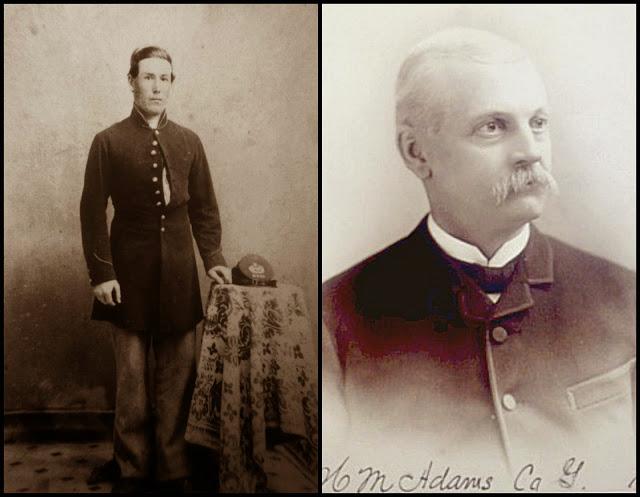
A war-time and post-war photo of Henry Adams, who was severely wounded at Antietam.
(Left image: U.S. Army Military History Institute. Right: Connecticut State Library)

Henry M. Adams, 16th Connecticut


At the age of 21 years on August 7, 1862, H.M. Adams of No. 621 New Britain avenue, enlisted in Company G, Sixteenth Connecticut. He received his baptism of fire at Antietam where he received a wound of which he still bears the marks. He was struck between the knee and the thigh by a minie ball which passed entirely through the leg, taking a part of the bone with it. Mr. Adams lay on the battlefield for forty-two hours, fully conscious, before he was found and taken to a field hospital. Here he remained from September 19 until April 1 when he was discharged because of disability.

Jeffrey D. Miller, 16th Connecticut


Jeffrey D. Miller of No. 131 Wethersfield avenue enlisted in Company A, Sixteenth Connecticut in this city August 5, 1862 and served to the end of the war as a private. In speaking of Antietam, he said: “I remember they (the confederation) woke us up mighty early in the morning. We had to leave our position and marched away and around somewhere. I was nothing but a boy and didn’t know anything about war and fighting. Finally we got into the corn field and began to blaze away. First thing I knew I was all alone. The Eleventh Connecticut  [probably 8th Connecticut] was a few yards away and I joined. Two wounded men said, ‘Don’t leave us ‘ and so I stood by. Then the southerners came up and I took at shot at them thinking I was going to die anyway. The two wounded men plead for their lives and an officer replied ‘all right boys, we won’t hurt you.’ I surrendered and just then a nearby confederate took a shot at me. I dropped and pretended to be dead. Then our reinforcements came.” Mr. Miller’s clothing was hit five times.

Ethelbert French, 16th Connecticut


Ethelbert French enlisted in Company A, Sixteenth, August 6, 1862 at the age of 24 years. At the battle of Antietam, he received a severe wound in the left breast, which necessitated his remaining in the hospital from more than a month, and which finally led to his discharge nearly two years later. He returned to Hartford still in ill health and has since lived here. Mr. French is 77 years old and lives at No. 103 Ashley street.

16th Connecticut veteran Henry Tracy's grave in Hazardville Cemetery in Enfield, Conn.

Henry F. Tracy, 16th Connecticut


Henry F. Tracy of No. 115 Oakland terrace enlisted in Company C Sixteenth, July 25, 1862. In September, the regiment joined Burnside’s command. The day was hot and Tracy was overcome. He was left within a fly tent within cannon range. Recovering, Tracy reached a building near the Otto farm, used as a hospital, where Dr. [Abner] Warner, a surgeon in the Sixteenth, was in charge, who gave him work in the place. He pays a tribute to the work of the late Dr. [Nathan] Mayer, a surgeon in the regiment.

After the battle, the men were removed to Sharpsburg. There the Dutch Reformed church was made over into a hospital. Mr. Tracy tells about the death of John Loveland, whose leg was shattered by a cannon ball. The operating surgeon had the reputation of saving every man put under his knife.  Some time after the operation Tracy saw that Loveland’s face was becoming ashen. He threw back the covering and saw that the main artery had burst. Clasping his thumb, he stopped the flow until the surgeon came running up. The dying man requested that his trinkets be sent to his wife. Tracy stoutly refused to withdraw his thumb. Finally, his hand all a tremble, he let go from sheer exhaustion. [Loveland died and was buried in an orchard near the church. His final resting place is Antietam National Cemetery.]

Have something to add (or correct) in this post? E-mail me here.

Sunday, August 31, 2014

Antietam: Relics, skeletons and a 'long lost fabled well'

In this 1937 newspaper photo, Maryland state senator Ernest Miller holds two Civil War
 artillery shells  that he discovered while plowing a field  in Sharpsburg, Md., where grew up.
Like this blog on Facebook | Follow me on Twitter

Days after a July 1933 rainstorm "almost amounting to a cloudburst," George Alexander had his hands full.

With lead.

Astonishingly, the Antietam battlefield superintendent picked up 250 bullets that had washed up in farm fields and woodlots where soldiers had killed and maimed each other more than 70 years earlier. (Tourists also carried away relics that summer day.) Alexander also discovered on the Henry Piper Farm a much more sobering reminder of the carnage at Antietam: bones of three soldiers, including two skulls.

In the decades immediately after the war, it was not uncommon for area farmers and others to recover remains of soldiers from makeshift battlefield graves. While searching for relics in the East Woods in 1913, longtime battlefield guide O.T. Reilly, who claimed to have witnessed the battle when he was 5, unearthed a nearly complete skeleton. Only the skull was missing, prompting the Frederick (Md.) News to report that Reilly "thinks the soldier's head was shot off by a shell in the battle."  The latest discovery of soldier remains at Antietam occurred in 2008, when a hiker found bones of a New York soldier near the Bloody Cornfield.

O.T. Reilly: Longtime Antietam battlefield guide 
sold battlefield relics from his shop on
Main Street in Sharpsburg.
(Photo courtesy Stephen Recker)
Almost immediately after the Battle of Antietam, souvenir hunters descended on the battlefield for pieces of the action. A local man named Cyrus Mondell recovered a drum that belonged to a soldier in the 29th Massachusetts, an Irish Brigade regiment that saw heavy fighting near Bloody Lane. Nearly 33 years later, in May 1895, he donated it to Sharpsburg's Lutheran Church, which apparently sold it and used the proceeds to pay off its debt.

In 1877, a Sharpsburg man described as "something of an amateur antiquarian" was given a pocket mirror that a local had recovered from a soldier's temporary grave. Inside the case made of laurel was the name of the owner: 19-year-old Private Francis B. Reynolds of the 8th Ohio, who had been reported missing after the battle. The relic's owner contacted the postmaster in the soldier's hometown and sent the mirror back to the private's friends in Ohio "accompanied by a very feeling letter."

In 1895,  Reilly, who for years sold battlefield relics from his shop on Main Street in Sharpsburg, purchased a sword that was found embedded in the bank of the nearby Potomac River. Rusty but complete, it may have been left there three days after Antietam by a sergeant in the 118th Pennsylvania, the Corn Exchange Regiment, after the Battle of Shepherdstown.

Born six years after the Civil War ended, Ernest Miller often found war debris such as bullets, bayonets and belt plates while growing up in Sharpsburg. In 1937, Miller, then a Maryland state senator, showed off  to a Hagerstown newspaper two artillery shells that he had found while plowing a field in Sharpsburg. "One of the shells is still loaded," the Morning Herald reported, proving that politicians of that era were just as brilliant as they are today.

As late as the mid-1940s, hundreds of relics, from bullets to artillery shells and buckles, were reportedly found after heavy rains. In 1947, a Maryland man found 125 bullets, four pieces of large artillery shells, two uniform buttons (one Confederate, one Union) and a human tooth just by eyeballing the ground after rainstorms. When he was only 7, the relic hunter's 92-year-old father picked up relics after the battle. (The old man even recalled witnessing President Lincoln's visit to Sharpsburg in October 1862.)

With minie balls from the battle apparently in short supply by the late 1940s, Sharpsburg residents may have turned to deceptive means to replenish the prized souvenirs. In 1948,  locals reportedly cast bullets in old Civil War molds and buried them in the ground to give them an authentic patina. After jamming bullets into holes bored into trees, creative souvenir dealers waited weeks or more and then sliced open the trunks to recover prized paperweights.

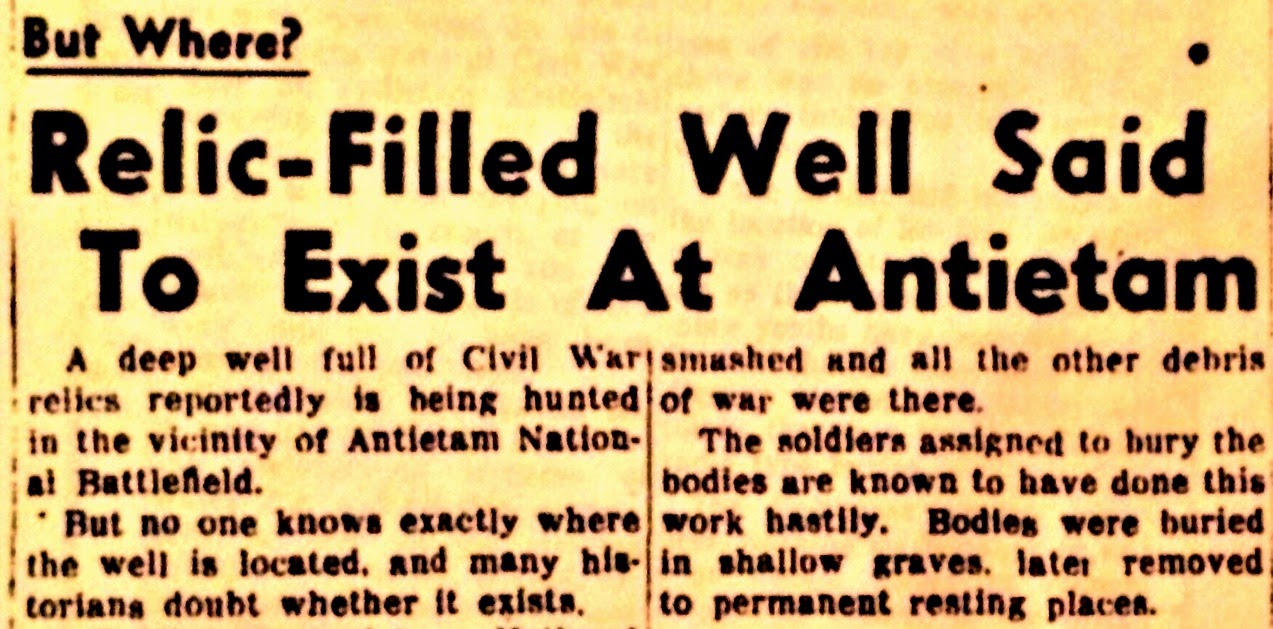
In January 1952, the Hagerstown Morning Herald reported about a mysterious relic-filled well at Antietam.
But the whopper of all Antietam relic tales may be the story of the "long lost fabled well." In 1952, the Hagerstown Daily Mail reported that a deep well filled with relics was being hunted somewhere near the battlefield. Who was searching and what did they know? Apparently, no one was talking much about this murky tale.

 "... no one knows exactly where the well is located," the newspaper reported, "and many historians doubt whether it exists." As the story goes, soldiers, eager to be done with battlefield clean-up, filled a well with the dead as well as debris that included ammunition and then covered the hole with dirt.

"It was overlooked when the reburial work was done," the newspaper reported, "and in the course of years, it was covered with crops or grass so completely that the eye cannot detect the place where the well existed." The most likely site for the trash/treasure/burial ground reportedly was the Nicodemus Farm, near the Hagerstown Pike, or somewhere close to Burnside Bridge. But no major discovery apparently was made.

Seven years later, in October 1959, two brothers from Pennsylvania, two Baltimore youths and a Sharpsburg-area man named Fred Remsburg conducted separate, and apparently unsuccessful, searches for the relic-filled glory hole. The brothers used a divining rod while the boys, hunting on Sundays, relied on a mysterious map found in a Baltimore library.  Remsburg gave up the hunt because he feared the 4- to 5-foot hole he had dug during his search would collapse.

It sounds like this relic-filled well story simply doesn't hold water.

In October 1959, the Hagerstown Daily Mail reported that Pennsylvania brothers may  have found
 the relic-filled well.

-- Have something to add (or correct) in this post? E-mail me here.


SOURCES:

Cumberland (Md.) Evening Times, Nov. 14, 1947
Cumberland (Md.) Sunday Times, July 23, 1933
Frederick (Md.) News, Sept. 29, 1913
Hagerstown (Md.) Daily Mail, Oct. 2, 1948
Hagerstown (Md.) Morning Herald, June 18, 1937
Hagerstown (Md.) Morning Herald, Jan. 22, 1952
Hagerstown (Md.) Daily Mail, Oct. 1, 1959
The Herald and Torch Light, Hagerstown, Md., May 11, 1895
The Herald and Torch Light, Hagerstown, Md., Sept 12, 1877

Sunday, July 20, 2014

'It was murder': A tour of Malvern Hill (Va.) battlefield

Rebels never got close to expertly placed Union artillery at the top of the Malvern Hill slope.

Like this blog on Facebook | Follow me on Twitter

On July 1, 1862,  Robert E. Lee attacked a position head-on that bristled with artillery ... and failed miserably. Troops mistakenly took a road leading away from the battlefield. A plan for a grand artillery bombardment never materialized. And Confederates, so successful in pushing the U.S. Army from Richmond in the previous Seven Days' battles, simply ran out of steam. "It wasn't war; it was murder," Confederate general D.H. Hill famously said after the Battle of Malvern Hill.

 (CLICK ON EACH IMAGE BELOW FOR FULL-SCREEN INTERACTIVE PANORAMA.)


The Union Army massed up to 36 cannon at the top of this plateau, only about 900 yards wide at its crest. Once Yankee cannoneers had silenced Rebel artillery, they turned their attention to masses of infantry moving up the gentle slope. (It's a misnomer to call it a hill.) Their work was effective and deadly.

"The battle-field, surveyed through the cold rain of Wednesday morning, presented scenes too shocking to be dwelt on without anguish," the Richmond (Va.) Examiner reported three days after the battle. "The woods and the field ... covered with our dead, in all the degrees of violent mutilation."  The Rebels suffered more than 2 1/2 times the casualties (5,600 to 2,100) as the Union army at Malvern Hill.

Even U.S. gunboats anchored in the nearby James River joined the fight, although their effect may have proved more damaging to their own troops; three soldiers in the 1st Connecticut Heavy Artillery were mortally wounded by fire from the gunboats.

The Examiner reported:

"To add to the horrors, if not the dangers, of the battle, the enemy's gunboats, from their position at Curl's Neck, two and a half miles distant, poured on the field continued broadsides from their immense rifle guns, Though it is questionable, as we have suggested, whether any serious loss was inflicted on us by the gunboats, the horrors of the fight were aggravated by the monster shells, which tore skrieking through the forests, and exploded with a concussion, which seemed to shake the solid earth itself. The moral effect on the Yankees of these terror-inspiring allies must have been very great; and in this, we believe, consisted their greatest damage to the army of the South."

The U.S. Army anchored its right in front of the home of Nathaniel West. The current structure, seen by panning to the left, was built in the early 20th century on the foundation of the original house. Although his house survived the fighting, Farmer West's field were ruined.

Wrote the Examiner reporter afterward:

Great numbers of horses were killed on both sides, and the sight of their disfigured carcasses and the stench proceeding from them added much to the loathsome horrors of the bloody field. The cornfields, but recently turned by the ploughshare, were furrowed and torn by the iron missiles. Thousands of round shot and unexploded shell lay upon the surface of the earth. Among the latter were many of the enormous shells thrown from the gunboats. They were eight inches in width by twenty-three in length. The ravages of these monsters were everywhere discernible through the forests. In some places long avenues were cut through the tree-tops, and here and there great trees, three and four feet in thickness, were burst open and split to very shreds.

The Union Army anchored its left flank here on Malvern Cliffs, which really is a large hill rather than a cliff. In 1862, this area was largely treeless and provided Yankee artillery and infantry a superb field of fire. Rebels from Georgia, North Carolina, Virginia and Louisiana negotiated a series of ravines and ridges as they approached this high ground near the James River.


"The last hill we passed over, the Yankee canister killed our men in large numbers," wrote Private Asa Winn of the 3rd Georgia Infantry. "We ran up [to] the top of the hill and poured volleys into them and would run back under the hill and load. ... Every time we would go to the top to fire, someone would fall." Winn, according to this letter from a comrade, survived the battle "without a scratch."


2nd Louisiana Private Edwin Jemison
 was born in Georgia.
 (Photo Library of Congress)
Among the Rebel casualties was Edwin Jemison, whose haunting image has been used in scores of  Civil War publications. His hands folded in front of him, the 2nd Louisiana private with the sad eyes and look of innocence was killed near here, likely a victim of Yankee artillery fire from the top of the slope.

Only 17 years old, he reportedly was decapitated.  None of the attacking Rebels, who used two small slave cabins in this field as cover, reached the line of Union artillery in the distance. (Remains of the historic trace to the cabins may be seen by panning to the right.)

"The long line of dead extended towards our right until lost in the woods and sloping ravines towards the river, and then extended forward, contracting from our left upon our center, until its apex reached halfway up [to] Crewe's quarters," wrote Major Joseph Brent. "Crewe's quarters" was a reference to the house owned by the farmer whose property a major portion of the battle was contested. (The Crew house was used as Union headquarters and a field hospital. 
The original building burned after the war and remains in private hands, although the property is targeted by the American Battlefield Trust.)


Lee planned for his artillery to bombard Union lines from two positions, including the one here. But the strategy failed because the Rebels couldn't mass enough cannons at either spot. Accurate Union fire from the plateau 1,500 yards away had a lot to do with that.


Confederates poured from these these woods, moving up the slope of Malvern Hill to attack the Yankees, whose artillery often fired into the treetops.

"As we came fully in sight of the Federal batteries, not 400 yards in our front, the open space behind them became black with troops, thousands of whom issued from the woods in their rear," wrote Sergeant James J. Hutchinson of the 5th Alabama. "It was madness to go on, but our men moved steadily forward till within 250 yards, when the order was given to fire, and they immediately without orders, dropped to the ground and began loading and firing as fast as possible."

Depressions left for gravesites of two Rebel soldiers can still be seen in the woods across the road.


In the clearing at left, Confederates attacked the right flank of the Union army, whose position proved impregnable. Ruins of the Willis parsonage, which burned in 1988, are in the right background. Rebels formed on this property for their assault. "I must confess that I slept through most of the uproar of this battle -- slept the sleep of the thoroughly tired out," a Maine soldier wrote years later, "and I understand that all that could of the army did so, too."

-- Have something to add (or correct) in this post? E-mail me here.

Saturday, July 06, 2013

Antietam photo journal: Evidence of a family's pain

In a letter to his son Louis, Daniel Tarbox Sr. noted the circumstances of the 
death of Daniel Jr. at Antietam. (CLICK ON IMAGE TO ENLARGE.)
 Richard and Joyce Arnold, descendants of  Pvt. Daniel Tarbox of 
the 11th Connecticut,  have preserved many of the letters Daniel
 wrote home during the Civil War. Richard holds an image
of Daniel as a youngster.  (CLICK ON IMAGE TO ENLARGE.)


Twelve days after 18-year-old Daniel Tarbox suffered a mortal gunshot wound through the bowels at the Battle of Antietam, Daniel Sr. worried about how to arrange for the return of his son's body home to Brooklyn, Conn.  "Geo. Preston ... buried Daniel near the hospital in Middletown, [Md.]" Daniel Sr. wrote to his son, Louis, on Sept. 29, 1862, "and placed a board at the head of his grave so that he might be found at any time (bearing his name, etc.) Capt. John Kies writes from Sharpsburg [and] says he died next day after he was shot -- but we have no particulars yet. We are very anxious that his remains be brought home, but how to bring so desirable a thing about is the question.

Daniel Tarbox, 18, was shot through the bowels at Antietam. 
He died Sept. 18, 1862, a day after the battle.  
(Photo courtesy of Scott Hann)

"I have no idea what  the expense will be," added Daniel Sr., "but be it what it may I want his body if it is possible to get. The cheapest kind of metallic coffin will do providing it is air tight. Contrive some plan to get his body home without delay. He [Daniel] has always intended to keep funds enough by him to pay his expenses home, but George says he has nothing left but his pipe & tobacco and a pocket knife -- I think his money was concealed in his clothes."

As they awaited news of Daniel's fate, the last two weeks of September 1862 must have been excruciatingly painful for the Tarbox family, which had qualms about Daniel Jr. serving in the Union army in the first place. On Sept. 21, 11th Connecticut Capt. John Kies wrote a letter to Daniel Sr. informing him of his son's death at Antietam, but that note may have arrived in Brooklyn days after the family read the dreadful news in newspaper accounts. (Kies wrote a similar letter to the mother of Private Fennimore Weeks, who was killed at Antietam.) Louis, who lived in New Brunswick, N.J., saw Daniel's name among those killed at Antietam in a list published in the New York Tribune on Sept. 25. Daniel's name also was listed among the dead in a lengthy list of Connecticut casualties printed in the Hartford Courant on Sept. 23.

Thankfully, much of the historical record of the demise of 11th Connecticut private survives. His descendants have preserved many of the letters Daniel wrote home during the Civil War as well as Louis' letter to his father after Antietam  inquiring about his half-brother's fate and the note Kies wrote to Daniel Sr. informing him of  his son's death.

 In the end, Louis followed through on the wishes of his father, who insisted later in the letter to his son that "no matter what the expenses are, bring his [Daniel's] body home." Louis arranged to have his half-brother's body disinterred in Maryland and paid for the zinc coffin for Daniel to be transported in back to Brooklyn. It cost him $30, according to a receipt that has survived 150-plus years and remains in possession of Tarbox's descendants. Sometime in early October 1862, Louis accompanied the body back to Connecticut, where Daniel was buried in South Cemetery in Brooklyn. "Father and brothers," it notes on his memorial marker, "all a long farewell!"

Eight days after Antietam, Louis Tarbox saw his half-brother Daniel's name published 
in the New York Tribune among those killed in action. "I have every reason to believe
the list is true," Louis wrote his father in this letter, dated Sept. 25, 1862.
In this envelope addressed to Daniel Tarbox's father ...

.... this letter from 11th Connecticut Capt. John Kies, dated Sept. 21, 1862, informed 
him of the death of his son. "I did not see Daniel after he was taken 
from the field," Kies wrote.  (CLICK ON IMAGES TO ENLARGE.)

Louis Tarbox received this receipt for the cost of disinterring his half-brother's body
 and the purchase  of a zinc coffin to transport him in back to Brooklyn, Conn.
(CLICK ON IMAGE TO ENLARGE.)
Pennies, Lincoln side up, on gravestone of Daniel Tarbox in South Cemetery in Brooklyn, Conn.

Close-up of Tarbox's memorial in Brooklyn, Conn. Daniel "fell wounded while defending the bridge
at the battle of  Antietam, Md.," it notes.


Saturday, June 29, 2013

Antietam: Accounting for Connecticut's dead

19-year-old Robert Boyle, a private in the 8th Connecticut, is buried in Suffield, Conn.
Only 19 years old, Robert Boyle was one of many teenagers from Connecticut who died of wounds suffered at the Battle of Antietam. A private in the 8th Connecticut, Robert was shot in the head and died Oct. 24, 1862, more than a month after the battle. Boyle was the eldest of eight children of Richard and Mary Boyle of Suffield, Conn. While searching recently for the grave of another 8th Connecticut soldier, I found Boyle's grave in Old Saint Patrick Cemetery in Suffield. For the most comprehensive Connecticut Antietam death list anywhere, download my Excel spreadsheet. It includes soldier's name, regiment, company, family status, burial site (if known) and more.

Saturday, June 22, 2013

Antietam: New book coming on battle (mine!)

Connecticut Yankees at Antietam is due out in early August.
Roger Spear's great-great grandfather, Richard Jobes, was severely 
wounded at the Battle of Antietam. Jobes, who survived the war, is 
buried in Zion Hill Cemetery in Suffield, Conn.
One of the best parts about writing a book on Antietam was meeting descendants of those men (and a woman) who were there. Connecticut Yankees at Antietam (History Press), due out in early August, couldn't have been written without the help of folks such as Roger Spear and Evelyn Larson, who supplied terrific information about their ancestors. Corporal Richard  Jobes of Suffield, Spear's great-great grandfather, suffered a severe wound in John Otto's 40-acre cornfield; Private Robert Hubbard of Middletown, Larson's ancestor, was killed by friendly fire on William Roulette's farm. My book, which you can pre-order on amazon.com and at the Barnes & Noble site, doesn't delve into the strategy and tactics of the bloodiest day in American history. Rather, it's focused on  the stories of people, some whom died or suffered terrible battlefield wounds at Antietam. Tom Brokaw called those who grew up during the Depression and fought World War II America's "greatest generation." The men and women who helped restore the Union are at least their equals.

Sunday, June 09, 2013

Antietam panorama: Pvt. John Bingham's Connecticut grave

                                                Click on image for full-screen panorama.

Sixteen-year-old Wells Bingham lost track of his brother as they made their way into John Otto's cornfield during the Battle of Antietam. Usually on the right side of Company H of the 16th Connecticut, John mistakenly was on its left, out of Wells' sight. He never saw John alive again. The 17-year-old private was killed in the cornfield, one of 43 men in the regiment who were KIA. John's body was returned to Connecticut, where he was buried in First Church Cemetery in East Haddam, Conn. John's brother, Eliphalet, who died in Virginia in 1864, is buried to his right. Both gravesites were decorated with American flags when I made a quick stop to shoot this interactive panorama on Saturday afternoon. Click here to download my updated Excel spreadsheet of Connecticut Antietam deaths. It includes family information and much more.

Pvt. John Bingham, 17, was killed at the Battle of Antietam. He is buried in
 East Haddam, Conn. The gravestone mistakenly notes his age as 18.

Saturday, June 08, 2013

Antietam panorama: William Roulette farm house

                                                   Click on image for full-screen panorama.

Here's another view of William Roulette's farm house and spring house on the Antietam battlefield. It's a slightly different view from this one that I also took on a spectacularly sunny morning in early May. To the far left, the stone Observation Tower at the end of Bloody Lane can barely be seen. For all my interactive Antietam panoramas, click here. Below is a photo of 14th Connecticut veterans and their families gathered in front of Roulette's farm house during a reunion in 1894. The scene today has changed little since then or, for that matter, since 1862.

Connecticut Antietam veterans posed for this William Tipton image
 during a reunion at the battlefield in 1894. (CLICK ON IMAGE TO ENLARGE.)

Friday, May 03, 2013

Antietam photo journal: Fear, dread and pain

A close-up of a wounded soldier on Irish Brigade monument at Antietam.
Detail of a flag-bearer, who marches into battle near Bloody Lane.

\
The Irish Brigade monument at Antietam is located
near Bloody Lane and the stone Observation Tower.
The monument was dedicated in 1997.
One soldier attempts to help a wounded comrade, whose dazed expression clearly indicates a rebel bullet had found its mark. Looking skyward, another man screams out in agony, one of many victims of the  madness.  Two of their comrades share a sense of dread while a flag-bearer stares straight ahead, a mix of determination and fear on his face, as he gallops toward Bloody Lane. Amazingly lifelike, the bronze bas-relief figures are the work of sculptor Ron Tunison, who created them for the beautiful Irish Brigade monument at Antietam. The monument was dedicated in 1997, but until earlier this week, I had never examined it closely. Big mistake. It's easily one of the more impressive monuments on the battlefield, rivaling the much older 15th Massachusetts monument in the West Woods. Largely made up of Irishmen from New York, Massachusetts and  Pennsylvania, the brigade was commanded by Irish-born Gen. Thomas Meagher, a wildly interesting character who survived the Civil War but drowned in the Missouri River in 1867. According to Meagher, he was knocked out of the fight at Antietam because his horse was shot out from under him. Others claim the fall was caused because the general hit the bottle quite heavily that day. Meagher's image in bronze, also created by Tunison, appears on the reverse of the monument. Before the Irish Brigade went into action at Antietam, it received absolution near William Roulette's cornfield from Father William Corby, who twice served as president of Notre Dame after the war. For the 113 soldiers in the brigade who were killed that day, Corby's effort may have been worthwhile.

These soldiers appear to dread going into battle.
The bas-relief figures on the Irish Brigade monument were created by Ron Tunison.
An anguished soldier cries out after being wounded.

Saturday, March 30, 2013

Antietam: Send in the Marines!

Pretty hard to believe the Marines once used Antietam as a training ground. This clip is from the Hartford Courant on Aug. 4, 1924.

Saturday, January 12, 2013

Antietam: Gardner image of Burnside Bridge

Burnside Bridge in 1862. (Photo: Connecticut State Library)
I found this image of Burnside Bridge, taken in September 1862 by Alexander Gardner after the Battle of Antietam, in a massive book of several thousand images from the Matthew Brady Collection in the Connecticut State Library. I'm not an expert on Gardner images, but I don't believe this one has been widely published. There are seven individuals on the bridge, probably all soldiers. The book was donated to the Connecticut State Library in the 1940s.

According to a old donation slip, the original plates for these images are housed elsewhere, perhaps in Springfield, Mass., or Washington today. The Antietam images in the book, most of which are familiar to students of the Civil War, are nonetheless fascinating because of their clarity. The paper at right, found inside the album and dated March 16, 1944, details how the Connecticut State Library acquired the images. Click on that image to enlarge it.

Saturday, January 05, 2013

Antietam: The Biscoe brothers' battlefield images

This 1884 image by the Biscoe brothers shows Dunker Church at Antietam.
The post-Civil War house at left has long since been torn down.
(Photo:Southern Methodist University, Central University Libraries, DeGolyer Library)
The time and date each Biscoe image was taken appears below the photo in their
 album. This image shows the Philip Pry house, General George McClellan's headquarters
 at Antietam. (Photo: Southern Methodist University, Central University Libraries, DeGolyer Library)
 A man, perhaps one of the Biscoe brothers, may barely be seen near the fence 
in Bloody Lane. This image was taken at 6:20 p.m. on Aug. 6, 1884.
(Photo: Southern Methodist University, Central University Libraries, DeGolyer Library)
While surfing online recently, I stumbled upon a group of Antietam photographs that I never knew existed. In August 1884, brothers T. Dwight and Walter Biscoe took a trip through Virginia, West Virginia, Maryland and Pennsylvania. Along the way, they took photos of cemeteries, off-the-beaten path sites and Civil War battlefields, including many  images of Antietam.

A professor at Marietta College in Ohio, Dwight Biscoe was a huge photography buff. Like his brother, Walter was a graduate of Amherst (Mass.) College; he was employed as a New York state librarian. (Quick aside: 16th Connecticut captain Newton Manross, killed at Antietam, was an associate professor at Amherst College before he enlisted.)

The Biscoe brothers’ 129-photo album is part of the collection at the DeGolyer Library at Southern Methodist University, about three miles from where I used to live in Dallas in the early 1990s. If I only knew then …

Of the Antietam images, I especially like the one of Dunker Church (above), which includes a post-Civil War house next to the famous battlefield landmark, and a unique view from the hillside above Burnside Bridge. Here’s a link to the SMU site -- digitized, higher-quality Biscoe brothers' photos may be viewed there -- and a link to the Flickr stream of Biscoe images.

This Biscoe brothers' image shows the D.R. Miller farmhouse and a family on the front porch.
The Miller's cornfield was scene of savage fighting on the morning of  Sept. 17, 1862.
(Photo: Southern Methodist University, Central University Libraries, DeGolyer Library)