Showing posts with label condolence. Show all posts

Saturday, August 18, 2018

Condolences to 'Stumpy': Sergeant Dunn's death at Franklin

Markers for unknown Mississippians in McGavock Confederate Cemetery in Franklin, Tenn. Perhaps
33rd Mississippi Sergeant Mathew A. Dunn rests beneath one of them. (CLICK ON IMAGES TO ENLARGE.)
Like this blog on Facebook | Read more condolence letters here.

The casualty lists from the Battle of Franklin tell us nearly 10,000 soldiers were killed, wounded and missing. But we can only guess the number of hearts broken in Northern and Southern families because of the carnage in Tennessee on Nov. 30, 1864. The family of 33rd Mississippi Sergeant Mathew Andrew Dunn undoubtedly was among those who were shattered.

Four months before his death at Franklin, Mathew aimed to prepare his wife Virginia -- he affectionately called her "Stumpy" -- for awful possibilities. "Oh my love," he wrote from Atlanta,  "if I could only See you and our dear little ones again what a pleasure it would be. But God only knows whether I will have that privilege or not. I want you to try and raise them up right. Train them while they are young.

"And if I am not Spared to See you I hope we will meet in a happier world. ... if I am killed I hope that I am prepared to go."


Route of attack of Featherston's Brigade, which included Mathew Dunn's 33rd Mississippi, is at far right. 
(Map by Hal Jespersen, www.cwmaps.com | CLICK ON MAP TO ENLARGE.)

On Jan. 11, 1865, Major C.P. Neilson provided details of  Dunn's death in Tennessee to "Stumpy," who lived in the hamlet of Liberty, Miss. After emerging through dense woods, Winfield S. Featherston's Brigade advanced toward Union breastworks. Ordered to charge, the 33rd Mississippi and six other regiments in the brigade fought their way near Federal lines, Neilson wrote, with hand-to-hand fighting briefly breaking out. But "... we were compelled to give way," the major recalled, "and fell back some two or three hundred yards and there remained until next morning."

Grave of unknown Mississippi soldier
at McGavock Confederate Cemetery.
Is this Mathew A. Dunn's gravesite?
Wounded four times, Dunn was believed to have been killed instantly. Later that night, Neilson discovered the 30-year-old father of two children lying on his back. "He appeared," the major wrote, "to be peacefully sleeping with a smile." Neilson informed Mrs. Dunn of her husband injuries -- he was struck by a bullet "directly in the front, just below the breast bone" and also suffered wounds in the right side, right cheek and left hand.

Neilson found Dunn's Bible on his chest, and planned to present the testament to "Stumpy" when he returned to Mississippi during the winter. Because he had duties elsewhere on the battlefield, Neilson left Dunn's body where he lay, but said the sergeant was decently buried later by friends and comrades. The soldier's knapsack and blanket had been stolen, Neilson noted, by "inhuman robbers of the dead." Another soldier in the 33rd Mississippi preserved a lock of Dunn's hair for his widow.

"It would certainly be a consolation to you to have received some last message from your loving one," added the officer, "but the unexpected mess of the battle and the circumstances of his death precluded the possibility of such a thing."

Concluded Neilson:
"You have two strong sources of consolation Mrs. Dunn. That your husband died as he had lived, a true Christian, and his death was such as becomes the true soldier on the battle field with his face to the foe and followed by love and regrets of all his comrades. Your loss is great and deeply so. I sympathize with you but you 'mourn not as one without hope.' '' 
Nearly three months after the battle, 33rd Mississippi Private John Cain Wilkinson, Dunn's messmate, also wrote his widow. Virginia's husband was among nine soldiers in Company K of the 33rd Mississippi, the Amite County Defenders, to die of wounds suffered at Franklin. The condolence letter -- dated Feb. 15, 1865, and presented in its entirety below -- is remarkable for its eloquence.

"I am incompetent to write a eulogy upon such a character," wrote the 40-year-old Wilkinson, who became a pastor at the Plymouth Primitive Baptist Church in Liberty after the war. To the contrary, the Mississippian's powerful words resonate through time.


McGavock Cemetery, where nearly 1,300 Confederate dead from the Battle of Franklin are buried.
Hamburg, Edgefield District, S.C.
February 15, 1865

Mrs. M.A. Dunn

My Dear Friend, I seat myself with a heart filed with sorrow to pen you a few lines to let you know that I do truly mourn and sympathize with you on account of you great irreparable loss.

Post-war image of
John C. Wilkinson
(Courtesy Pat Ezell)
On the 22nd____, I received the sad and heartrending intelligence that Mr. M. A. Dunn and L.L. Anderson of my mess and seven others of our Co. were killed at the Battle of Franklin, Tennessee on the 30th of November 1864.

Mr. Dunn and I were only slightly acquainted when our Co. organized, but before leaving our beloved homes, we agreed to be members of the same family in Camp and drew our first rations together and continued so until I was wounded in May last.

And to me, he proved to be a true friend under all circumstances, in sickness, in health, in trials, and under all the hardships we had to undergo, he was always a patient and cheerful friend.

I am incompetent to write a eulogy upon such a character, and will only say to you that M. A. Dunn was free from the influence of the many vices and evils so common in Camp which entice so many from the path of rectitude.

But he did by a well ordered walk and godly conversation make manifest to his comrades that he was a devoted Christian, true gentleman and patriotic soldier.

Being kind and obliging, he enjoyed the good will and confidence of all who had the pleasure of being acquainted with him.

Mississippi section of McGavock Confederate Cemetery in Franklin, Tenn.
Sergeant Mathew A. Dunn may be buried here beneath a marker
designated  "Unknown." He originally was buried on the battlefield.
By this sad bereavement our Co. lost one of its first members, Amite County a good citizen, Ebenezar a worthy member, and you and your dear little ones, a kind and dearly beloved husband and father.

Dear Friend, though I join you in shedding a tear of grief, let us not mourn as those who are without hope, for we feel assured that our loss is his Eternal gain, that his freed spirit is now singing praises to our Blessed Savior in the Paradis above where all is joy and peace.

Oh, that we could truly adopt the language of Paul under this heavy affliction - "And we know that all things work together for good to them that love God, to them who are the called according to his purpose." Then, how consoling would be the language of our Saviour, "Let not your heart be troubled. Ye believe in God believe also in me. In my Father's house are many mansions: if it were not so, I would have told you. I go to prepare a place for you. And if I go to prepare a place for you, I will come again and receive you unto myself, that where I am there you may be also. Peace I leave with you, my peace I give unto you, not as the world giveth, give I unto you. Let not your heart be troubled, neither let it be afraid. For because I live, ye shall live also." Then, my afflicted Sister, be admonished by the poorest of the poor to look to the fountain whence cometh all our help and strength; Jesus alone can comfort you in all your trails.

"For the eyes of the Lord are over the righteous, his ears are open unto their prayers." We have the promise of the comforter, and Paul says, "Likewise, the spirit also helpeth our infirmities for we know not what we should pray for as we ought, but the Spirit itself maketh intercession for us with groaning which cannot be uttered."

And to give us full assurance, our Blessed savior informs us that He maketh intercession for the Saints, that according to the will of God.

Close-up of the Mississippi monument at McGavock Confederate Cemetery.
And so, there remaineth therefore a rest to the people of God, and we have so many sweet and precious promises. Let us therefore come boldly into the throne of grace, that we may obtain mercy and find grace to help in each time of need.

I know that the ties of nature are such that you cannot refrain from weeping and though your dear husband cannot return to you, yet you have hope that you may go where he is, and join him in singing a song of deliverance.

And may God on tender mercy remember you and your dear Little Ones. May He lead, rule, guide, and direct you safely through this life, giving you that sweet consolation which He alone can give. And finally, through the merits of his dear Son, crown you His (with your dear husband) in his kingdom above where "God will wipe away all tears from your eyes; and there shall be no more death, neither shall there be any more pain, but where all is Joy and Peace is the desire of one who wished you well.

Sign on entrance gate to McGavock Confederate Cemetery.
You have no doubt seen a list of the killed, wounded and missing at the Battle of Franklin, Tenn. on the 30th November 1864. And many more must have fallen at the Battle of Nashville on the 15th of December from which I have no news from my company.

When I left Camp I left six messmates whom I loved, four of them, J.P. and C.C. Lea, L.L Anderson, and M. A. Dunn have poured out their life's blood in defense of their country. R.S. Capell is severely wounded and my dear son, W.H.W. reported captured. Truly, we have cause to mourn but I desire not to mourner.

Not wishing to weary you with my imperfection, I close; when at the throne of grace, remember me and mine and believe me to be your friend in deep affliction.

John C. Wilkinson

-- Have something to add (or correct) in this post? E-mail me here.


SOURCES

-- 33rd Mississippi Infanty web site, "To Live and Die in Dixie. We Are a Band of Brothers," accessed Aug. 18, 2018.
-- Pat Ezell genealogical research on John Cain Wilkinson.
-- The Ohio State University, eHistory, accessed Aug. 18, 2018.

Tuesday, July 10, 2018

Captain to mother: 'Corpse will be sent to you ... by express.'

4th Vermont soldiers in Camp Griffin, Va., where Private Benjamin Stafford "breathed his last."
(George Harper Houghton | Library of Congress)

Like this blog on Facebook | Read more condolence notes here.

In the middle of a letter to widow Laura Stafford regarding the rapidly declining health of her youngest child, a 4th Vermont private, the soldier's commanding officer received breaking news.

Marker for Benjamin Stafford and his
mother and father in Tabor Cemetery
in Mount Tabor, Vt. (Find A Grave)
"While I have been writing the last few words of the previous sentence," Captain John E. Pratt of Company A wrote from Camp Griffin, Va., "one of my officers informed me that Benjamin  had breathed his last." The cause of death was typhoid fever, a "very severe case." The date and time: Feb. 2, 1862, at 2 p.m.

The next day, Pratt planned to send the 25-year-old soldier's body from Washington via express to Vermont for burial. On March 17, 1862, the Rutland (Vt.) Daily Herald, under the headline "Tribute to a Faithful Soldier," printed an excerpt from Pratt's condolence letter to Mrs. Stafford.

"While you have lost a true and faithful son," the officer's short note read, "I have lost a noble soldier. No man in his company was more beloved by the officers, no man more cheerful and ready to do his duty."

Deep into the winter of 1862, Benjamin's remains arrived in Vermont, where he was buried in Tabor Cemetery in Mount Tabor.

(National Archives via fold3.com.)

North Dorset

Camp Griffin, Va.
Feb. 2, 1862

Mrs. Stafford

It is with feelings of great sadness that I now find myself obliged to write you of the severe illness of your son Benjamin Stafford. I am informed by the surgeons that it is impossible for him to live but a very short time. The disease is typhoid fever, a very severe case. I visited him at the hospital last evening. I found him eating his supper ...

(National Archives via fold3.com)
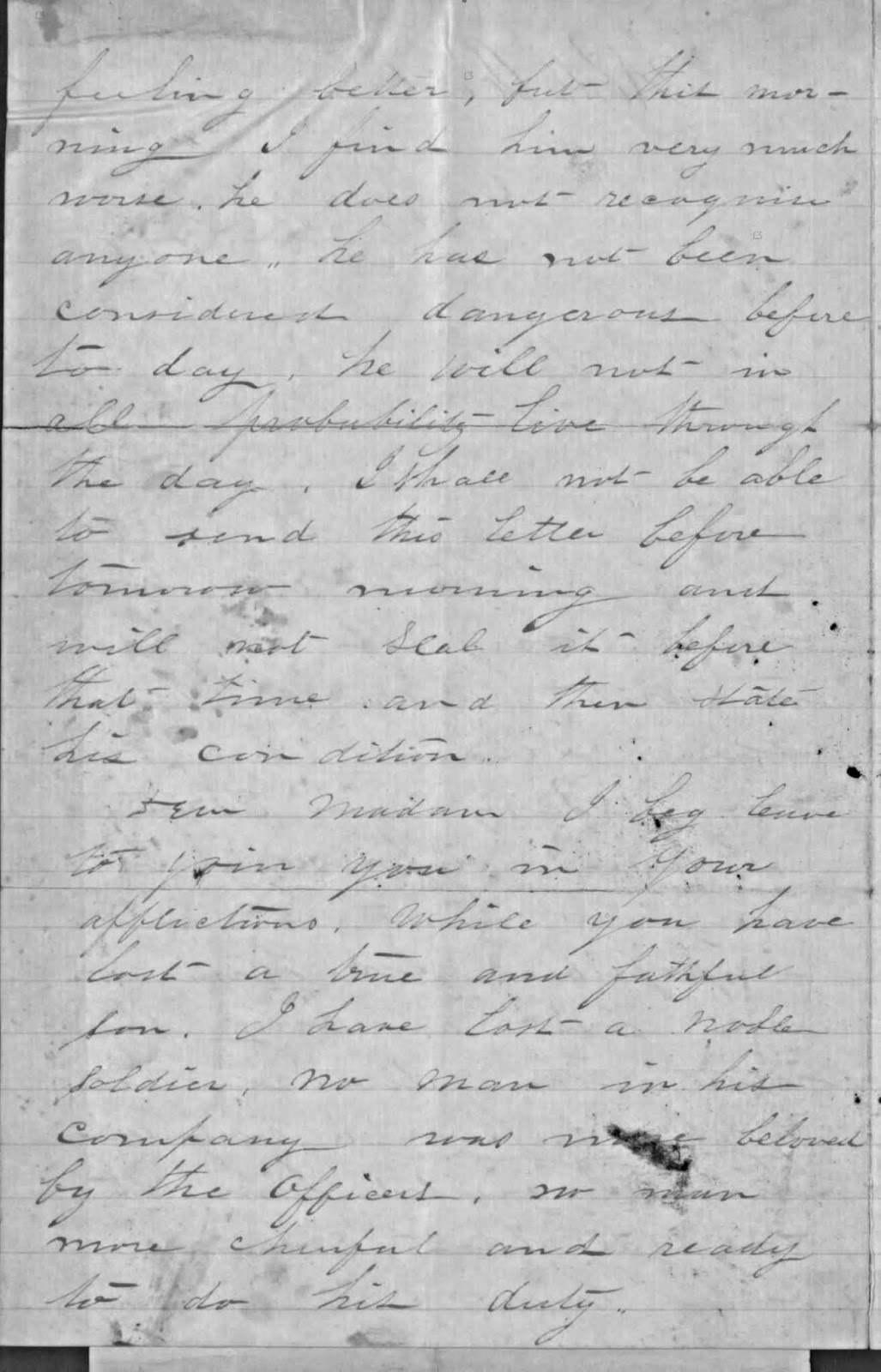
... feeling better, but this morning I find him very much worse. He does not recognize anyone. He has not been considered dangerous before to-day. He will not in all probability live through the day. I shall not be able to send this letter before tomorrow morning and will not seal it before that time and then state his condition.

Dear madam I beg leave to join you in your affliction. While you have lost a true and faithful son, I have lost a noble soldier. No man in his company was more beloved by the officers, no man more cheerful and ready to do his duty ...

(National Archives via fold3.com)
...I never had an occasion to reprove him. No better soldier ever left the green hills of Vermont to fight the battles of his country. He has also been noticed and excused from duty as a mark of merit for the neatness of his person and equipment by the commander of the regiment. His death will be deeply felt by his comrades who all respect and love him.

While I have been writing the last few words of the previous sentence one of my officers informed me that Benjamin had breathed his last. May God sustain you through this hour of affliction. The corpse will be sent to you at North Dorset by express. ...

(National Archives via fold3.com)
... I shall have it sent from Washington tomorrow. You will please write in regards to the disposition of his effects. He probably has more money by him and there will more due him from government. Any assistance that I can lend you, you will inform me and it shall be done.

Benjamin died Sunday 2 o'clock P.M. Feb 2nd.

I remain very truly Obt.

J.E. Pratt
Capt - Co. A. 4th Vt.Regt.


-- Have something to add (or correct) in this post? E-mail me here.


SOURCE:

-- Benjamin Stafford pension file (WC10792), National Archives & Records Service, Washington, D.C. via fold3.com.

Saturday, July 07, 2018

Chaplain to private's widow: '...you have a house in Heaven'

(National Archives via fold3.com)
Like this blog on Facebook | Read more condolence notes here.

Mortally wounded in the bowels during a skirmish near Kingston, Ga., on May 19, 1864, 77th Pennsylvania Private David Neely died the next day with 74 cents, a receipt and a "discharge" in his pocketbook. If it were indeed an army discharge document, the soldier's death must have been especially heart-breaking for Neely's family in Landisburg, Pa., near the state capital of Harrisburg.

Shortly after David died in Erwin Hospital, a 21st Kentucky chaplain offered condolences (above and below) to the soldier's 45-year-old widow, Elizabeth. "Madam it becomes my painful duty to announce ...," M.H.B. Burket's short note began on U.S. Christian Commission stationery.

In addition to his wife of 14 years, Neely left behind three children: Sarah, 13; John, 12; and William, 9. A wooden headboard with Neely's name, company and regiment etched on it was placed atop his grave in the regimental cemetery. But the soldier's final resting place today is unknown.


Kingston, Ga., May 20, 1864
Mrs. Elizabeth Neely

Madam it becomes my painful duty to announce to you the death of your husband David Neely private in Co. A 77 Reg. Pa. Vol. On yesterday while skirmishing with the enemy near this place and driving him howling before us your companion was shot through the bowels and died this morning in Erwin hospital. I find in his pocket book 74 cents, his discharge and one receipt from H.P. Lightner for $200. I also find on his person one pocket knife, pocket handkerchief and three letters on business -- all of which I will hand over to the surgeon of his Regt. to be sent to you. I had no acquaintance with the deceased but I entered ...

(National Archives via fold3.com)
... the hospital this morning and found your husband dying. I interogated him as to the relations he sustained to the army. After he died I examined his person and found as above stated. All I can say by way of consoling you is this: God who hears the young ravens cry will be to you the "Widow's God and to your children the orphans father. If you will trust his promises and after the toils of life are ended and your trust is stayed in God through his son Jesus you have a house in Heaven, where friends will never more be parted by cruel war.

Respectfully

M.H.B. Burket
Chaplain 21st Regt. KY Vet. Vol. In., 2nd Brig, 1st Div 4th A.G. D.C

-- Have something to add (or correct) in this post? E-mail me here.


SOURCE:

-- David Neely widow's pension file (WC48480), National Archives & Records Service, Washington, D.C. via fold3.com.

Saturday, June 30, 2018

Letters to Mrs. Donley: 'They told me that he was no more'

65th Illinois Corporal James Elliot Donley may be buried with other unknowns
at Nashville National Cemetery. (Find A Grave | Click on images to enlarge.)

Like this blog on Facebook | Read more condolence notes here.

On the day wave after wave of Confederates crashed into Union earthworks at Franklin, Tenn., 65th Illinois Sergeant George Haywood wrote a letter with terrifying news to the mother of a soldier in his regiment. Four days earlier, as John Schofield's Army of the Ohio headed north toward Nashville, Corporal James Elliot Donley was among 55 casualties in the 65th Illinois at the Battle of Columbia (Tenn.).

"Whilst under heavy fire of shot & shell on the 26th," Haywood informed Eliza Donley in the letter dated Nov. 30, 1864,  "James was shot in the leg by a shell cutting it off between the foot & knee. He bore it bravely like a good soldier as he is." (See transcript below.)

Maddeningly for Eliza Donley, the orderly sergeant had no news of her son's ultimate fate. Was the wound mortal? Was James alive in a hospital? Or could he be in enemy hands? 

A mother of three other children, Eliza had already endured trying times. In 1861, she was granted a divorce from her husband, James Sr., a man "guilty of habitual drunkenness for a space of two years."

Sgt. George Haywood wrote a short letter to Eliza Donley while he was in a battle line at Franklin 
on Nov. 30. 1864. (CLICK TO ENLARGE | Map by Hal Jespersen, www.cwmaps.com)

In agonizing limbo, perhaps for weeks, Eliza received a heartbreaking note after Christmas 1864. Following a resounding victory at Nashville on Dec. 15-16, the United States Army chased John Bell Hood's depleted Army of Tennessee south toward Alabama. In a letter to Eliza from Columbia on Dec. 27, Haywood wrote:
"I found three of our company who were left here when your son was. I asked them about your son & they told me that he was no more, I was surprised and sorry to hear it. I did not expect that he would die but he did."
After the war, 65th Illinois Private Alexander Henderson claimed Donley died "almost immediately" after both his legs had been severed by enemy artillery. As the U.S. Army headed north toward Nashville, he noted, soldiers left James' body behind enemy lines.

Struggling to support her family on $1.50-a-week wages she earned as a seamstress, Eliza filed for a dependent's pension. As required, Mrs. Donley provided evidence she relied financially on James, who before he enlisted gave her money he earned working for a local farmer. A "frugal, careful, industrious woman," Mrs. Donley also provided in her pension claim James' war-time letters in which he noted sending his mother his army wages. The government approved Eliza's claim at the standard $8 a month.

In a massive effort shortly after the war, the federal government disinterred remains of Union soldiers from battlefields, hospital sites, church graveyards and elsewhere for re-burial in newly created national cemeteries. If James' remains were recovered, he may have been buried in an unknown grave at Nashville National Cemetery.

LETTERS TO MRS. DONLEY: "He bore it bravely like a good soldier"


(National Archives via fold3.com)
In line of battle near Franklin, Tenn., Nov. 30, 1864

Mrs. E. Donley

Madam

I take this first opportunity of informing you of the fate of your son James. Whilst under heavy fire of shot & shell on the 26th James was shot in the leg by a shell cutting it off between the foot & knee. He bore it bravely like a good soldier as he is. We were driven from the field and out of 19 men in the company 7 were wounded & one killed. It left us so small that we could not bring them off. Besides were we exposed to a murderous fire of shot, shell & musketry. This was near to ...

(National Archives via fold3.com)
... Columbia, Tenn. We have been driven from there to here since and expect to fall back to Nashville, Tenn. I have his pocket book and (indecipherable) in money. The money I send enclosed. It was his wish that it should be sent home. One of our sergeants has got his watch. He does not know yet what is best for him to do with it. Should like to know your wishes in regards to the pocket book & watch.

I am madam your most respectful & obedient servant

George W. Heywood
O.S. Company G, 65th Reg. Vol. Inf.

Charles Liber
204 S. 5th St.
14 Cedar & Mulberry, St. Louis, Mo.

(National Archives via fold3.com)

Columbia, Tenn.
Dec. 27, 1864

Dear madam,

Your letter to me and also one from your pastor were received some time ago. We were on the march then toward this place and I have not had the opportunity to write before. I went to the hospital as soon as I got here. I found three of our company who were left here when your son was. I asked them about your son & they told me that he was no more, I was surprised and sorry to hear it. I did not expect that he would die but he did. He died that night about midnight. ...

(National Archives via fold3.com)
... I have not yet learned yet where (he) is buried but when we get settled here I will try. I know none of the particulars of his death. I have his watch and pocket book which I will send as soon as I can. I shall have to wait until I get to Nashville I think as there are no Express office here.

I remain with much sympathy for your loss. Yours respectfully

George W. Heywood
First Sergt. Co. G 65. Ills Infty.

 Have something to add (or correct) in this post? E-mail me here.


SOURCE:

— James Donley pension file (WC83877), National Archives & Records Service, Washington, D.C. via fold3.com.

Saturday, December 09, 2017

A private's death in 'desperate' Fredericksburg street fighting

On Jan. 3, 1863, an illustration by Alfred Waud of Union soldiers engaged in street fighting
in Fredericksburg appeared in Harper's Weekly. (CLICK ON IMAGE TO ENLARGE.)
GOOGLE STREET VIEW 
Present-day view of the 20th Massachusetts' route of advance up 
Hawke Street. Heavy fighting took place at this intersection on Dec. 11, 1862.

Like this blog on Facebook | Read more condolence notes here.

After a Union artillery bombardment of Fredericksburg, the 20th Massachusetts crossed the Rappahannock River in pontoons, joining other Federal regiments in the beleaguered Virginia town. The date was Dec. 11, 1862, a day that began with the temperature in the 20s but warmed to the low 50s by afternoon. This late-fall day would prove especially deadly for the 20th Massachusetts — the Harvard Regiment — a mix of bluebloods and commoners from the Boston area.

"He was killed instantly by a musket ball,"
20th Massachusetts Lieutenant Henry Ropes
(above) wrote of Private John Donnelly.
In the vicious street fighting that ensued, the 20th Massachusetts suffered more than 100 casualties in the 335-man regiment. Among them was Irish-born Private John Donnelly of Company K, who was shot through the head and "instantly killed," according to one of his commanding officers. Leaving County Tipperary in Ireland, John had immigrated to America with his parents James and Ellen aboard the Ocean Monarch in 1847.

Nine days after Donnelly's death, 20th Massachusetts Lieutenant Henry Ropes wrote a short condolence note to the 28-year-old private's father. (See below.) In a "desperate fight in the streets of Fredericksburg," John died "a true soldier's death," noted Ropes, who added Donnelly was buried near where he fell by his friends in the regiment.

For reasons unclear, Ellen Donnelly apparently did not begin the process of obtaining a mother's pension until after the war. A "common laborer" in his mid-60s at the time of his son's death, James Donnelly was "infirm and feeble" and unable to financially support his family.  To buttress Mrs. Donnelly's claim for a pension, local residents provided testimony of her dependence on John, an unmarried laborer.

"I was with [John] once in the later part of the year 1860," one of them recalled, "and saw him buy a barrel of flour at the store of Mr. Seaver in Roxbury, pay for it and heard him direct for it to be sent to his mother's house." Another local resident noted: "I have also at various times seen him give his mother money to buy clothing and provisions."

Ellen Donnelly's claim was eventually approved at the standard rate of $8 a month. The final resting place of her son is unknown.


SOURCE:

-- John Donnelly pension file, National Archives and Records Service, Washington, D.C., via fold3.com.

(National Archives via fold3.com)
Camp 20th Mass. V
Near Falmouth, Va.
Dec. 20th 1862

My dear sir,

It becomes my painful duty to inform you of the death of your son John Donnelly, a private in my company.

He was instantly killed by a musket ball which passed through his head during the desperate fight in the streets of Fredericksburg, Va., on the afternoon of the 11th inst.

He must have instantly died without suffering. His body was buried near the spot where he fell by his friends ...

(National Archives via fold3.com)
... and the place marked by a headboard bearing his name, company & regt.

Your son was a brave and faithful soldier and fell bravely fighting with his regt. A true soldier's death. Please accept my dear sir my sincere sympathy for you & for your family in this deep affliction and believe me.

Your obt. servt.

Henry Ropes
Lt. Comdg Co. K
20th Mass. Vols

Mr. James Donnelly


Have something to add (or correct) in this post? E-mail me here.

Read more Civil War condolence notes on my blog here.


Friday, December 08, 2017

A holiday message home: John Roach is in a 'dying state'

(National Archives via fold3.com)
Like this blog on Facebook | Read  more condolence notes here.

After John Roach was seriously wounded in the Irish Brigade's attack on Marye's Heights at Fredericksburg on Dec. 13, 1862, the 28th Massachusetts corporal was transferred to Douglas Hospital in Washington -- one of many military hospitals in and around the capital. In grave condition, the 33-year-old laborer from Shirley, Mass., arrived at the hospital on Christmas Day. Unable to write and eager to alert his family back home, Roach had another man, perhaps a hospital steward, write the heart-rending note above to his brother-in-law.

Whether Roach's wife Margaret received the news before John died on New Year's Day 1863 is unknown. Cause of his death: Gunshot wounds. The Roaches had four children: Julia, 8;  Honora, 6; Mary, 4; and William, 1. The letter was discovered in the pension file paperwork of Dennis O'Neill, who became guardian of Roach's children after his sister Margaret died in early 1864.


Douglas Hospital
Dec. 27th 1862

Mr. Denis O. Neill

I write in haste to inform you of the arrival of Mr. John Roach on Xmas day. He requests me ask you to let his dear wife & family know his condition; he was dangerously wounded in the late battle of Fredericksburg, Va., and is now in a dying state. After receiving all the rites of the Church he is unable to say much. Thank God he appears to have excellent dispositions and received all necessary care. Sincerely wishing you all the blessings of this holy season. I remain yours.

Respectfully.

K.M. Collete

John Roach's final resting place is unknown.


An undated photo of Douglas Hospital in Washington, where Corporal John Roach died 
on Jan. 1, 1863. (U.S. Military Institute)
Another war-time view of Douglas Hospital in Washington. (Library of Congress)

Have something to add (or correct) in this post? E-mail me here.


SOURCE:

--John Roach pension file, National Archives and Records Administration, Washington, D.C., via fold3.com.

Monday, November 27, 2017

Pain on train: 'James Johnson your husband is ded and buried'

The cars on Private James Johnson's train, perhaps one much like this one, plummeted into a ravine.
(Library of Congress)
Like this blog on Facebook | Read more condolence notes here.

Eight months after James Johnson survived a hellish assault on Marye’s Heights at Fredericksburg, the 11th New Hampshire private found himself on detached duty more than 600 miles west. On Sunday night, Aug. 16, 1863, Johnson and other soldiers were traveling by train through Indiana. Their destination was Covington, Ky.

Shortly after the fast-moving train had passed the hamlet of Shoals, Ind., the cars somehow ran off the tracks, violently tossing Johnson and other soldiers to the ground. Some soldiers, including men in the 51st Pennsylvania, had been riding atop the train cars, a dangerous practice in the daytime let alone at night. Many were asleep.

"The train was midway on the bridge when the first car left the iron, and the three cars in the rear followed, cutting the ties and bridge timbers nearly off," the 51st Pennsylvania historian wrote. "When about one hundred and fifty or two hundred yards past the bridge, one car that had been running on the edge of the bank, rolled down the embankment, stopping the whole train with a crash. Five cars were frightfully piled upon each other, two of which were reared like a combed roof." The bridge spanned a ravine and a deep stream.

According to a Philadelphia newspaper correspondent, "the accident threw horses and negroes pell-mell into one end [of a railroad car], but none were hurt, though they scratched their wooly heads with astonishments at this unexpected deliverance."

Riding ahead of Johnson, 11th New Hampshire Private Peter K. Proctor waited for his car to stop before he leaped from the train to see if anyone had been injured. He found Johnson, a 36-year-old laborer fom Enfield, N.H., on his back, barely alive.

“He had his leage all smashed up about half way down from his knee,” Proctor wrote to the soldier’s wife, Joann, “and his head was hert verrey bad so that the blood was coming out of his ear.” (See Proctor letter and complete transcript below.)

It was obvious Johnson was a hopeless case – he lived for about 20 more minutes. “I spoke to him,” Proctor explained to Johnson's widow, “but he did not no me or eny one elce.”

James Johnson survived the 11th New Hampshire's attack at Marye's Heights at Fredericksburg.
Eight months later, he was killed in a train accident in Indiana.
The wreck also claimed the life of a 51st Pennsylvania private, and a dozen or so other soldiers were injured. It was astonishing that more had not been killed -- some soldiers landed on the tops of trees while others went tumbling into the ravine. Others had to be cut out of the train.  Most of the soldiers on the train, veterans of Antietam and the siege of Vicksburg, remained remarkably calm.

"Old railroaders, who had been in numberless smashes, said they never saw such a wreck," the newspaper correspondent reported.

In the aftermath of the accident, the 51st Pennsylania regimental historian wrote, no one seemed to notice the bloodied Johnson as he lay sprawled on a stretcher. "...but as he was there a stranger," he recalled, "it is safe to say that the poor fellow had to be buried by the railroad company, as no one appeared to take any notice of him only through curiosity.

"Although it seems inhuman to neglect a fellow comrade, yet when we consider all the ghastly sights of a battle-field, on which a true soldier is compelled to look, they cannot do otherwise than blunt the finer feelings, and an expression of sympathy rarely gets utterance."

In the letter to Johnson's widow, however, Proctor said  he carried his comrade's body to the nearest village, where he found a box for a makeshift coffin. To dig Johnson’s grave, he enlisted the aid of soldiers in the 51st Pennsylvania, who had buried their comrade earlier. But before the Pennsylvanians could finish the sad task, the train was ready to roll to Covington. A war needed to be fought, and there was no time for them to bury James Johnson.

“We carried him back to the villadge and the citterzins said that they would burrey him in good shape and so I left him in there care,” explained Proctor. On James' body, he had found $1.10, postage stamps, a chunk of tobacco, two pipes, a small knife, two letters from Mrs. Johnson and an image, presumably of Joann.

Proctor vowed to tear up James' letters to his wife, “for they are of no consequence  to send back to you,” he wrote to Widow Johnson. He also promised to send her what little money James had as well as a precious memento of the father of her four young children: a lock of his hair.

SOURCES

-- James Johnson's widow's pension file, National Archives and Records Administration, Washington, D.C., via fold3.com.
-- Parker, Thoimas H., History of the 51st Regiment P.V. and V.V., Philadelphia, King & Baird Printers, 1869.
-- Philadelphia Press, Aug. 20, 1863.


'THE CITTEZINS SAID THAT THEY WOULD BURREY HIM'


National Archives via fold3.com.
(CLICK ON IMAGES TO ENLARGE.)
Covington, Ky, Aug. 19 / 63

Mrs. Johnson:

I sit down this afternoon to write a few lines to you and that of a bad kind of news; I am sorry to say it althoe it must be so. James Johnson your husband is ded and buried. He was killed on the road to Covington. We had passed the village of Shoals when the (indecipherable) of the cars gave away and cars was all smashed up and we was going like lightning speade; I was in the car ahead of James. I got out as quick as I could and went back and the first I saw was James. He laid on his back about ded. He had his leage all smashed up about half way down from his knee and his head was hert verrey bad so that the blood was coming out of his ear. I think that was what killed him. I think he must af been on top of the cars. I spoke to him but he did not no me or eny one elce. He lived about 20 minutes after I found him. I laid him out that knight an a (indecipherable) which it happened in the knight about 11 o’clock last Sunday.

I carried him back to the villadg and got a box and put him in and then got a detail out of the 51 Penn. Rigament to burrey him for I was ...

National Archives via fold3.com.
... all alone. None of our rigament was with me. They dug a grave near the villadge where they buried a man that was killed out of the Penn. Rigament the same night; they dug on one other coffin and gave it up for we had not time to dig one other grave for the cars was reddey to go again. We carried him back to the villadge and the citterzins said that they would burrey him in good shape and so I left him in there care. I took his thinges out of his pocket. He had one dollar and 10 cents in money your picture I suppose it must be and som postage stamps and a peace of tobacco and 2 letters that he got from you. The letters I will tore up for they are of no consequence to send back to you. He had 2 pipes in his pocket and a jack knife. I will do with them just what you wish me to do. I cutt of a lock of his hair for you. I will send that and the money to you. I will close now after telling you the whole perticulars and hope I shall hear from you in regard to him.

Yours in haste.

P. K. Proctor

John Johnson is sick and in the hospittle in this cittey but I do not no where to find him as yet. James was killed on the way from (indecipherable) to Covington where we are now. I was not hurt. ...


National Archives via fold3.com

... but we had a narrow escape. We had 10 wounded and 2 killed with James and (indecipherable).

Read more condolence letters on my blog here.
Have something to add (or correct) in this post? E-mail me here.

Saturday, October 07, 2017

A last supper, then 'dread realities of war' for brothers

       PANORAMA: Antietam National Cemetery. Ephraim Eager's remains may lie here.
                                     (Click at upper right for full-screen experience.)

 Like this blog on Facebook | Follow me on Twitter

Shortly before two momentous battles, Private James H. Eager of the 5th Pennsylvania Reserves enjoyed supper with his older brother in the camp of the 19th Indiana. A sergeant in the Hoosier State regiment in the Iron Brigade, Ephraim Eager moved west in 1857, leaving behind his sisters, brother and widowed mother in Lewistown, Pa.  In Pennsylvania, the Eager boys had worked as printers at a newspaper published by their brother-in-law.

This tattered newspaper obituary for Ephraim Eager
 was marked "B" in the pension claim file of his mother.
Elizabeth Eager was granted a Civil War pension at the standard
 rate of $8 a month. (National Archives via fold3.com)
The chance meeting in mid-September 1862 was the last time James saw Ephraim alive.

On Sept. 14,  1862, the Federals forced the Confederates from the passes at South Mountain, a prelude to much more severe fighting three days later by the banks of Antietam Creek. "We drove the enemy from one of the best and strongest positions they ever occupied," James wrote to his mother about his first battle. "Families were robbed of fathers and brothers on that day." At Turner's Gap, Ephraim led his battle-hardened company against troops from Georgia and Alabama.

At the "desperate fight" at Antietam,  the "dread realities of war," James wrote, "were brought to our own door."

In the brutal, back-and-forth fighting near the Hagerstown Pike, Ephraim fell with a bullet wound in his stomach while leading Company A, the Union Guards. Carried from the field by comrades, he died a short time later and was "decently buried by the boys of his company." In battle nearby, James narrowly escaped being maimed himself when a bullet passed over his shoulder and struck Private Henry Couts standing behind him above the eye, killing him.

Eager was "killed almost
 instantly,"  wrote 19th Indiana
 Captain Alonzo Makepeace,
 shown in a post-war image.
(ancestry.com)
"We fell back, and the rebels, thinking we were whipped, advanced with a cheer," James wrote Oct. 6 from a camp near Sharpsburg, "but were driven back by a flank movement. You would be surprised to hear them cheer. It resembles a lot of school girls at recess. It is far different from the manly voice of the men of the north."

Only 25, Ephraim "fell in the cause of his country," the Lewistown (Pa.) Gazette lamented, "gallantly fighting for those rights handed down to us by our revolutionary fathers." In Eager's adopted state of Indiana, the Anderson Union also offered an impressive tribute.

"Among those who have fallen victims to this wicked rebellion," it said, "we know of no one who was more generally regretted, and whose death cast a deeper gloom upon society, than our dear friend Ephraim B. Eager."

"He was a young man of much promise and high social qualities," the Union noted in a finishing touch in the obituary, "kind and generous in his nature, had gained the friendship of a large circle, and was respected by all.

Ephraim Eager's marker in
Lind Memorial Cemetery
in Lewiston, Pa.
(Find A Grave)
"But he's dead -- and over his green tomb shall ever wave the emblem of fadeless recollection. He sleeps for the flag, and may its stars shed their tears over his loyal soul forever."

A little more than a month after Ephraim's death, Captain Alonzo Makepeace of the 19th Indiana wrote a brief note to Eager's sister, Marion Shaw. Ephraim was "killed almost instantly while behaving handsomely in command of the Co.," he explained. His marked grave had been visited by his brother, the officer wrote, and "all regret his death."

Ephraim has a marker in Lind Memorial Cemetery in Lewistown, Pa., but it is not known if he is actually buried there.

NOTE TO SERGEANT EAGER'S SISTER: 'KILLED ALMOST INSTANTLY'


National Archives via fold3.com

EPHRAIM EAGER'S 1860 LETTER TO HIS MOTHER


Eager lived in Anderson, Ind., which he described in a letter to his mother Elizabeth in January 1860 as a "rather sickly place" because of the "great many deaths" that had occured there that winter. Of his marriage possibilities, he told his mother, "No prospects of your prodigal getting married – haven’t thought of it yet." This letter was found with his mother Elizabeth's claim for a Civil War pension.

National Archives vis fold3.com
Anderson, Monday morning, Jan. 10, 1860

Dear Mother,


This morning I again assume my seat to write to you. I have been well since you heard from me last. Christmas and New Year’s passed off very quietly in Anderson [Ind.], but not so with it in Lewistown [Pa.] I suppose. I rec’d one very nice gift from a lady friend. It was a gold pencil and pen – cost about eight dollars. There has been a great many deaths in Anderson this winter – rather a sickly place. No prospects of your prodigal getting married – haven’t thought of it yet. I enclose ten dollars $10, which I should have done New Year’s day had it been convenient. Please answer immediately on receipt of this that I may know you rec’d it.

Your affectionate son,

E.B. Eager

Have something to add (or correct) in this post? E-mail me here.
For more Civil War condolence letters on my blog, go here.

SOURCES AND NOTE:

-- Ephraim B. Eager pension file, National Archives & Records Administration, Washington, D.C., via fold3.com.
-- Lewistown (Pa.) Gazette, Oct. 1, 1862 and Oct. 15, 1862.
-- Eager's obituary in the Anderson (Ind.) Union was reprinted in a Lewistown newspaper on an unknown date.

Thursday, October 05, 2017

Antietam soldier snapshot: Carried off by a 'very bad fever'

Gravestone for 57th New York Private Henry F. Bugbee at Antietam National Cemetery.
(Find A Grave)
 Like this blog on Facebook | Read more condolence notes here.

As he lay dying in a tent in Frederick, Md., 57th New York Private Henry F. Bugbee wanted a "few lines" written to his wife back home in Hyde Park, N.Y. Wounded by a gunshot during an attack at Bloody Lane at Antietam on Sept. 17, 1862, the father of four young children was sent to a field hospital before be was admitted Oct. 6 to Camp A, a tent hospital in a field about a mile and a half west of Frederick. Throughout the town, the Union army medical staff had set up makeshift hospitals in churches, schools, an old army barracks, private homes, a butcher shop and elsewhere.

By Oct. 19, 1862, Bugbee's condition had worsened significantly, and the 31-year-old soldier died at about 6 that night.  He was "wounded in the left leg," wardmaster L.F. Buck of Ward H wrote in a short condolence note to Bugbee's wife, Sarah, "but catch'd a very bad fever to it, which carried him of (sic)."

Bugbee left only meager effects: less than a dollar, "several likenesses" and letters, all of which Buck noted were "under the care of the clerk of this hospital." Whether the "likenesses," perhaps photographs of Henry's wife and children, were returned to the family is unknown.

Shortly after her husband's death, Sarah applied for a widow's pension. Government assistance, approved at a rate of $8 a month, was discontinued when she remarried in November 1865. The Bugbee children -- Sarah, 8; Isabella, 6; Phillip, 4; and Oliver, 1 -- were entitled to receive a pension until each turned 16. (For an excellent explanation of Civil War pensions, go here.)

After the war, Henry's remains were disinterred in Frederick and re-buried in Sharpsburg, Md., at the national cemetery in Lot F, Section 25, Grave No. 270.

CONDOLENCE NOTE TO SARAH BUGBEE: 'IT IS MY SAD DUTY ...'


Page 1: National Archives via fold3.com.
(CLICK ON IMAGES TO ENLARGE.)
Page 2: National Archives via fold3.com.

Have something to add (or correct) in this post? E-mail me here.
For more Civil War condolence letters on my blog, go here.


SOURCE:

-- Henry F. Bugbee widow's pension file, National Archives & Records Administration, Washington, D.C., via fold3.com.

Wednesday, October 04, 2017

Note from Antietam: 'You must be prepared for bad news'

Union surgeon Anson Hurd cares for wounded at the Otho J. Smith farm, near the 
Antietam battlefield. 108th Corporal Richard Morrell died there on or about Oct. 4, 1862.
(Library of Congress collection)
                  An Alexander Gardner photograph of the Otho J. Smith farm hospital.
       (HOVER ABOVE  FOR "NOW" PHOTO | Then: LOC collection | Now: John Banks.)

 Like this blog on Facebook | Read more condolence notes here.

When Richard Henry Morrell went into battle at Antietam the morning of Sept. 17, 1862,  he bore immense responsibility. The 45-year old shoemaker had a family that included his wife, Margaret, and 10 children -- four boys and six girls -- ranging in age from 11 months to 17 years. The Morrells had emigrated from England in the 1850s, settling in Rochester, N.Y.

"(He) is well cared for, but the Doct is much concerned about him,"
 S.D. Porter wrote of Richard Morrell, seriously wounded at
the Battle of Antietam. (National Archives via fold3.com)
CLICK ON IMAGE TO ENLARGE.
Despite his family obligations, Morrell enlisted in the 108th New York as a private in July 1862 -- he was promoted to corporal later that month. Less than two months later, he marched through a farmer William Roulette's field with rest of the 108th New York en route to an assault on the Rebels' position in a sunken farm lane.

Sometime during the attack on Bloody Lane, a bullet or piece or artillery shell tore into Morrell's arm, which required two amputations. He was taken to General William French's division hospital at Otho J. Smith's farm, less than a mile from the battlefield.

While Morrell recuperated there, a man from Rochester visited with the grievously injured soldier, whom he noted was in dire condition. "[He] is well cared for, but the Doct is much concerned about him," S.D. Porrter wrote Sept. 28 in the one-page note, presumably to Margaret. "He may recover, but you must be prepared for bad news."

The bad news came in a short note to Morrell's wife dated Oct. 14, 1862, from Bolivar Heights, Va., and signed by two 108th New York officers:
"Dear Madam, I take this opportunity to inform you of the death of your husband. He died on or about the 4th day of this month after having his arm amputated twice. Once at the elbow and again at the shoulder. He seemed to be getting along well when lockjaw set in and after intense suffering [of] three days died. His remains were neatly draped and he was buried at Sharpsburg, Maryland. His personal effects I will forward to you by Express tomorrow. Anything further in regard to him will be cheerfully furnished by your obdt. svt. and sympathy in affliction."
Although Morrell's final resting place is unknown, he may be buried among the thousands of other Union soldiers at Antietam National Cemetery.

LETTER TO THE WIDOW: "HIS REMAINS WERE NEATLY DRAPED"


PAGE 1: National Archives via fold3.com
CLICK ON IMAGES TO ENLARGE.
PAGE 2: National Archives via fold3.com

Have something to add (or correct) in this post? E-mail me here.


SOURCES:

-- Richard Morrell widow's pension file, National Archives & Records Administration, Washington, D.C., via fold3.com.