Showing posts with label Alexander Gardner. Show all posts

Saturday, February 16, 2019

Bob Zeller laser-focused on Maryland Campaign photography

Bob Zeller, who lives in North Carolina with his wife Ann, with a portion of his Civil War photo collection.
(CLICK ON ALL IMAGES TO ENLARGE.)
Like this blog on Facebook | Read more Q&As on my blog here.

A former print reporter, Bob Zeller still may have a little newspaper ink flowing through his veins. He may also have Antietam in his DNA. Zeller, co-founder and president of The Center for Civil War Photography, has one of the world's more impressive collections of images from the 1862 Maryland Campaign.

Zeller's connections to Antietam are deep: He was raised in the Church of the Brethren, the Dunkers. When he was 10 in 1962, he even attended the re-dedication of Dunker Church at Antietam.  His uncle, Rev. Harry K. Zeller, Jr., a leading Brethren pastor, gave the sermon at the service. Zeller's grandmother's great uncle was Samuel Poffenberger, who owned an historic battlefield farm.

Zeller, one of the country’s leading authorities on Civil War imagery, is author of several ground-breaking books in the field, including The Blue and Gray in Black and White: A History of Civil War Photography. The Washington, D.C. native pioneered the modern presentation of stereoscopic Civil War photography with The Civil War in Depth, the first 3-D photo history of​ the war, and The Civil War in Depth Volume II.  His latest book, Fighting the Second Civil War (2017) is a history of battlefield preservation. (Full disclosure: I was an editor for the book. I also am a CCWP board member.)

In this Q&A, Zeller reveals how he got started collecting Antietam images, the story of  his greatest photo find, what he'd like to ask famed Civil War photographer Alexander Gardner and more.


In 39 years of collecting, Bob Zeller has acquired 21 large plates and 67 stereo views or half-stereo prints
 of the 1862 Maryland Campaign.
A simple question: Why do you collect Antietam images?

Zeller: My personal Antietam connections drew me to it. My middle name, Otho, probably originated from Otho J. Smith, who owned the farm where Alexander Gardner photographed a Confederate field hospital. And for many years, our family owned a cabin on Red Hill overlooking the battlefield.

Dunker Church during its reconstruction in the early 1960s. Bob Zeller 
attended its rededication in 1962, when he was 10.
 (National Park Service collection)
When I began collecting in 1980, I was a newspaper journalist, and my interest was in the documentary record of the battle – the photographs by Alexander Gardner, the newspapers of September 1862 and soldier letters. The first great series of American war photographs are Gardner’s Antietam photos and arguably the best newspaper story from the war was George Smalley’s dramatic account of the battle in the New York Tribune on Sept. 19, 1862. After acquiring a lot of 13 Gardner Antietam images in 1984, I began to focus more on the photography and decided to try to acquire vintage albumen prints of all of Gardner’s images from the Maryland Campaign – about 85 stereo images and about 35 large plate, 7x9 images. In 39 years, I have assembled 21 large plates and 67 stereo views or half-stereo prints. The stereo views of Antietam are among history’s first numbered, collectable cards. So, I literally have a checklist for them, like I had for baseball cards as a kid.


Antietam stereo views in Bob Zeller's collection. 
How did you start?

Zeller: In the late 1970s, ads for Civil War antique dealers began showing up in my Civil War Times Illustrated, including one for D. Mark Katz, who was a dealer of Civil War photography. I made an appointment to visit him at his home at Lake Heritage in Gettysburg on Oct. 28, 1980. That visit was a life-changing revelation. His living room was like a museum of Civil War photography. He had a portfolio filing cabinet that contained Gardner’s two-volume Sketch Book of the Civil War and Barnard’s Photographic Views of Sherman’s Campaign. On the wall above his couch was a beautifully framed copy of the Sketch Book print of a Signal Corp officer at Antietam, peering through a telescope toward the battlefield from a signal station that had been on our own Red Hill.

But my jaw hit the floor when he pulled out a stereo view of Bloody Lane on the Antietam battlefield. I was familiar with the photo but had never seen it like this. The card looked older than any stereo card I had ever seen. I couldn’t believe it. How could I not know about this? My first antique was a stereo viewer, for crying out loud, which I bought more than 15 years earlier at about age 12. I’d collected several dozen old stereo views over the years, somehow never encountering a stereo view from the Civil War. I had no firm understanding that they even existed. “Where have these been all my life?” I wondered. I was a bit angry about it. Had I known years earlier, I could have been looking for them. I felt I was late to the game. In fact, I had arrived at a good time, with more vintage material than ever coming out of the woodwork and showing up in dealer catalogs or at shows. Katz was pompous and had little regard for stereo views. On the back of the Bloody Lane he had written the price -- $40 – in blue ink. I bought it, of course. And I was captivated.


In 1993, Zeller purchased images of George McClellan's staff (upper and lower right) on the
 Antietam battlefield during President Lincoln's October 1862 visit. "It was a thrill of a lifetime," he says.
What's your favorite Antietam image, and why is it so special to you?

Zeller: That’s a tough one, because there are about a dozen that are really special, some because of the story behind finding and acquiring them. I made a major discovery in 1993 of three previously unknown large plate images by Gardner from Antietam, and I’d have to say that two of those excite me the most. One is a gorgeous, likely one-of-a-kind mounted large plate print in mint condition showing Burnside Bridge. The other is a group photo of Union General George McClellan’s staff having a cocktail party on the battlefield during the visit of President Lincoln. It’s just an amazing image. It was a private photo – never offered for sale in Gardner’s catalog – showing the officers drinking. A companion image of the same group, taken at the same time, shows no partying whatsoever. That one was offered for sale to the public. I never expected to find Gardner Antietam images that were unknown in our time. It was a thrill of a lifetime. And the incredible drinking scene in this image made the find that much more exciting.


Zeller's prints of images of Union Signal Corps at Elk Ridge, also known as Red Hill. The image at right
has a rough history. (CLICK ON IMAGE TO ENLARGE.)
Every collector also has a favorite story about a purchase -- a great find at a flea market, an unexpected discovery in an attic. Tell us about yours.

Zeller: My greatest find as a collector started with a disaster. In 1984, I acquired a mounted print of a Signal Corps detachment at their signal station on Elk Ridge, or Red Hill. It was special because we owned land just down the road on Red Hill from where the photo was taken. And the print was special, too, because it was on a mount that that had a printed title as well as “Gardner, Photographer” at lower left and “M.B. Brady, Publisher” at lower right. This dated the print to 1862, within weeks of the battle, because Gardner and Brady split around the end of 1862 or beginning of 1863. But this print was also in pretty rough condition, so I decided to get it restored and mailed it to dealer/appraiser Cliff Krainik in December 1992. He soon called with bad news. “Your print was basically destroyed in the mail,” he said.

Back then, dealers mailed out illustrated catalogs every so often and it was first come, first served. The moment the catalog arrived in the mail, I’d tear through it. If I found something I wanted, I frantically dialed the dealer’s number, hoping it wasn’t already sold. Those moments as the phone rang felt about the same as the last 10 seconds of a crucial eBay auction today. Anyway, just days before the mail disaster, I had received longtime dealer Len Rosa’s Christmas season catalog, and one item was a Gardner large plate photo of the Middle Bridge on one of those Gardner/Brady mounts. I already owned the image, so I didn’t go after it. But after the disaster, I suddenly wanted that boring photo in the worst way because I would at least have a print on one of those rare Gardner/Brady 1862 mounts. Fortunately, Len still had the image available, so I bought it. “Don’t mail it,” I told him. “I’m coming to Gettysburg on Jan. 2 and I’ll pick it up from you in person.”

Front cover of Alexander Gardner's "Incidents of The War," purchased by Bob Zeller in 1993. 
Rarely had I been as excited about a trip as the one to Gettysburg on Jan. 2, 1993. It was my first opportunity to go to a Civil War memorabilia show since our recent move from California to North Carolina. It ended up being my single most amazing and memorable day as a collector. The day was cold, but clear and sunny, and Len said he’d meet me in front of the Gettysburg Hotel to give me my print of Antietam bridge.

I told Len I was buying it because this other print showing the Signal Corps detachment had been destroyed. He said, “I think I might have that Signal Corps print. I have a portfolio of prints like these at home. I’ll run home and get them.” When he returned, he was carrying a large portfolio cover with “Incidents of the War” hand-stamped in gold letters. I knew that was a Gardner title and that the cover itself was extraordinary.

Inside, disbound but clearly once bound into the book, were eight more prints. As I looked at them one by one, I realized I was seeing Antietam images I had never seen before. The fourth or fifth image was a mint condition copy of the photo I had lost – the Signal Corps detachment! I bought it on the spot.

I was still a casual hobbyist then, at least in my willingness to spend money, and even buying the Signal Corps image was a bit of a stretch. So, I didn’t buy anything else immediately. But over the course of the next few days, I bought six more plates from Len and the cover. Three of the photos were previously unknown and I pitched the story to the Associated Press, which published a national story on the find in 1993.

That day in Gettysburg was insane. At The Horse Soldier, I found two stereo views at bargain prices, including the famous three Rebel prisoners. I left town with a pit of anxiety gnawing at my stomach, because I knew I had to have other photos from that portfolio but that it would cost far beyond what I had ever spent. I told my wife as much. She was fully supportive, as she always has been.


A stack of Antietam stereo views in Bob Zeller's collection. 
Every collector seems to have a "one that got away story." What's yours?

Zeller: The “one that got away” is part of the same story. I ultimately purchased seven of the nine prints, as well as the “Incidents of the War” cover. I did not buy two of the prints. I already had a nice vintage copy of one. But I did not have the other – a large plate of a forge scene at a Union camp at Antietam. I have never again seen a copy of that print for sale. It remains a box unchecked on my checklist of Antietam images. In hindsight, I should have bought the entire portfolio from Len right there in front of the Gettysburg Hotel. I could not imagine walking away from the treasure like that today.

But as I said, I was just a hobbyist then. The discovery, however, was the first in a series of events in the 1990s that transformed my professional career. In 1994, I convinced the Southeast Museum of Photography in Daytona Beach, Fla., to do an exhibition of my Gardner Antietam photo collection, which happened the following year.

Bob Zeller is a co-founder of 
The Center For Civil War Photography.
Go here for information on the CCWP
In 1997, Chronicle Books of San Francisco published my first book – The Civil War in Depth: History in 3-D. It was the first book devoted to the amazing 3-D photos of the war. In 1999, while relaxing with a beer at O’Rorke’s in Gettysburg with wet plate photographer Rob Gibson and the late Al Benson, a Confederate reenactor, we hatched the idea of starting a Center for Civil War Photography to display images and teach about the photography of the war.

In 2001, with a push from our other co-founders, Garry Adelman and Chuck Morrongiello, we incorporated the Center and I became president. Since then, we have thrived as a small-but-vibrant, non-profit educational organization. We have created custom 3-D Civil War visual presentations for numerous organizations, including the Smithsonian Institution. We have preserved images digitally by providing the funds to scan them at the Library of Congress, which puts the scans online for all to see and share. And this fall, we’ll hold our 19th annual Image of War seminar in Richmond. It’s amazing to think that all this evolved from a decision many years ago: “I think I’ll collect Gardner’s photos of Antietam.”


Alexander Gardner
Finally, if you could go back in time and ask Alexander Gardner one question about his Antietam images, what would it be and why?

Zeller: I would ask Gardner the one question designed to open his personal treasure chest of memories: “What was it like to photograph the Antietam battlefield?” I’d want to know about it all, so I am certain that first questions would lead to more: Where did he watch the battle from? How did he gain access to the battlefield? In what order did he take the photos? What were his emotions while taking the images? Did he realize he was making photo history? Who was with him? And that would just be for starters.

Have something to add (or correct) in this post? E-mail me here.


Saturday, September 22, 2018

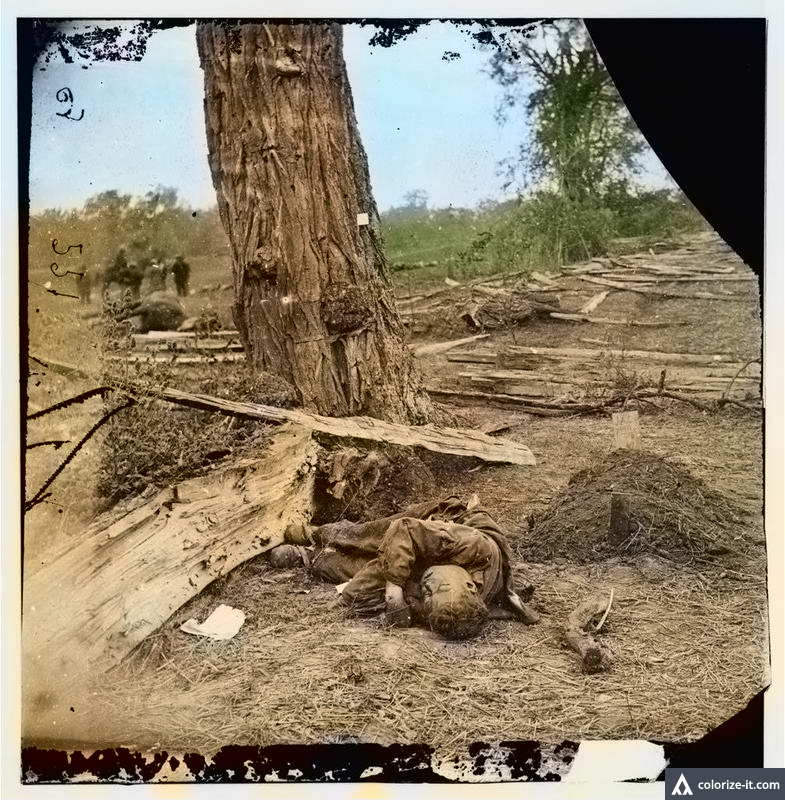
Antietam in color: Breathing life into 1862 battlefield images

Body of unknown Confederate next to grave of Michigan Lieutenant John Clark. (Library of Congress)
CLICK ON ALL IMAGES TO ENLARGE | COLORIZED BY ALGORITHMIA
Confederate dead near Dunker Church and West Woods. (Library of Congress
Like this blog on Facebook | Algorithmia colorization site.

Because of the limitations of the medium during the Civil War, photography wasn't produced in color. To add realism, soldier portraits sometimes were hand-colored or tinted by specialists, with varying results. Some battlefield photographs by Alexander Gardner -- whose images of Antietam dead fascinated, and horrified, the public 156 years ago -- were hand-colored. As seen in these two Antietam stereoviews from Center For Civil War Photography president Bob Zeller's collection, the results were less than spectacular.

Hand-colored Alexander Gardner stereoview view of Union burial crew at Antietam.
(Bob Zeller collection)
Colorized image by Alexander Gardner of Joseph Sherrick farm at Antietam.
(Bob Zeller collection) 
Unlike the cumbersome 19th-century process, colorization of black-and-white images is only a click away for us today. Using the Algorithmia site, I colorized Antietam images by Gardner and James Gibson, all available for your inspection in black and white in jpg. and tif formats on the fine Library of Congress web site.

Crude, crass ... or captivating? Let me know what you think.

James Gibson view of Middle Bridge from bluff above Antietam Creek. (Library of Congress)
Burnside Bridge, heavily contested on morning, early afternoon of Sept. 17, 1862. (Library of Congress)
Fallen Confederates arranged for burial. (Library of Congress)
Confederate dead along Hagerstown Pike. (Library of Congress)
Another view of Confederate dead along Hagerstown Pike ...  (Library of Congress)
... and more Confederate dead, also along Hagerstown Pike. (Library of Congress)
Confederate dead on the southern end of the battlefield. (Library of Congress)
Fallen Confederate in a ditch. (Library of Congress)
A Union soldier poses near Burnside Bridge by the graves of his comrades. (Library of Congress)

-- Have something to add (or correct) in this post? E-mail me here.

Wednesday, July 05, 2017

'Bloodstains' and earthworks: Living with history underfoot

Dave and Laura Rowland at the now-capped well where a Confederate soldier is believed to have 
been  killed by a Union artillery shell that crashed through their house, killing two other soldiers.
(CLICK ON ALL IMAGES TO ENLARGE.)
In a small front room in the Rowlands' house, the floorboards have dark stains. Is it blood? 
Laura Van Alstyne Rowland talks about the history of her house.

 Like this blog on Facebook.

Near Laura and Dave Rowland's cozy house on East Main Street in Sharpsburg, Md., Civil War history abounds.

The national cemetery -- the bucolic, eternal resting place for scores of Union soldiers killed in the fields and woodlots at Antietam -- is a five-minute walk away. Mount Calvary Lutheran Church once stood across the street -- its belfry was an observation point for Confederates and its sanctuary a makeshift hospital for the Federals’ V Corps. In the fall of 1862, 20 paces or so from the Rowlands' front door, Alexander Gardner captured that battle-scarred church and houses in the village of Sharpsburg beyond it in a well-known photograph. (See a Then & Now of the church on my Civil War photography blog here.)

A close-up of the dark stains on the floor.

But Laura and Dave – you can also call him  “Bear” -- don’t even have to leave the house they rent to step back into time.

During the Battle of Antietam on Sept. 17, 1862, a Union artillery shell crashed through their house, killing three Confederate soldiers, longtime battlefield chronicler O.T. Reilly wrote in 1906. One victim apparently was in the backyard, where he was drawing water from the well. The demise of the other victims came in the kitchen, where one of them was found clutching a bunch of onions.

That soldier was "literally torn to pieces," Reilly wrote in The Battlefield of Antietam. "There have been Union soldiers who visited the battlefield since the battle who remembered seeing the sight just mentioned."

On Saturday afternoon, Laura moved pieces of furniture and lifted a braided rug to reveal possible evidence of the long-ago tragedy: massive, dark stains on the polished, brown floorboards. Is it really blood? Perhaps we'll leave the definitive answer for a future episode of Forensic Files.

In the video above, Laura, who had an ancestor killed at Gettysburg, talks about the “bloodstains” and history of the beautiful house, used as a hospital at Antietam. The residence, built in the late 18th century, is known locally as the Mary Hill House.

        GOOGLE STREET VIEW: The Rowlands' house was built in the late-18th century.
                                         (Click at upper right to explore the area.)


Dan Goldstein talks about Union earthworks behind his house.

Remains of Union earthworks in Dan Goldstein's neighborhood.
War-time Mineral Springs Road winds through the Estates of Chancellorsville neighborhood.
Dan Goldstein, whose ancestors fought for the Confederacy, lives with Civil War history in his backyard – literally. When the Union army was flanked by Stonewall Jackson during the Battle of Chancellorsville on May 2, 1863, panicked Federals fell back toward Mineral Springs Road, where the Yankees dug in for an expected assault. The remains of the XI Corps’ long-ago earthworks may be found in the fringe of woods behind Goldstein’s two-year-old house, about 25 yards from the end of his driveway.

In a nod to the neighborhood's history, 
street names are Civil War-related.
On a sultry Monday afternoon, the former director of development for the Fredericksburg (Va.) Area Museum pointed out remains of earthworks as we walked on the war-time road that winds through woods behind houses in the recently developed Estates of Chancellorsville neighborhood. Goldstein also showed me where earthworks were recently destroyed, a victim of a developer who paved a street called Second Corps Drive right through them. A historic easement wasn't good enough to save a chunk of history.

Goldstein has mixed feelings about living in the Estates, where many of the streets have Civil War-related names (“Fifth Corps Lane,” “Irish Brigade Court,” “General Sykes Circle”). Adjacent to the Chancellorsville battlefield, the neighborhood of upscale houses with spacious lots is a nice place to raise a family. On the other hand, battlefield land -- once National Park Service property -- was carved up to create the community that, according to its web site, “greets you with a stone entry feature and dual carriageway entrance lined with distinctive, period split-rail fencing.”

As our walk in the woods neared an end, Goldstein and I wondered about the Union soldiers' state of mind as they hurriedly built the defenses in early May 1863. "They must have been terrified," said Goldstein, who talks about the remains of the earthworks in his backyard in the video above. (Note: The reference in the video to "late May" should be "early May." We blame the heat.)

Have something to add (or correct) in this post? E-mail me here.

Wednesday, March 08, 2017

'No end to the things': Fabulous Gettysburg bullet find in 1910

              Widow Lydia Leister's house, George Meade's headquarters at Gettysburg.
        HOVER OVER IMAGE | Then: Alexander Gardner, LOC | Now: Google Street View

Like this blog on Facebook

While digging up Taneytown Road near General George Meade's old Gettysburg headquarters, workers made an amazing find in the spring of 1910: hundreds of bullets from the Civil War. It was the first big relic find on the battlefield in years, according to a local newspaper.

"The plough was turning up the road at a lively rate when the first were seen," the Gettysburg Times reported on May 14, 1910. "A hurried search was made and heaps of thirty or forty were found. There seemed to be no end to the things and before the time for quitting work came almost 850 had been found."

Nothing to sneeze at: A bullet story from the
  Oakland Tribune on March 22, 1915.
The newspaper speculated the ammunition was discarded by soldiers in the Pennsylvania Reserves after they were issued new ammo, or the bullets may have simply fallen from an ammo crate like this one. Or perhaps the little lumps of lead were placed there by someone with an ulterior motive.

"Some have even been so unkind to intimate that they may have been planted," the Times noted, "to accommodate the wishes of the tourist trade for that kind of relic to take home."

In any case, the relics were quickly snapped up by road workers. "One man had half a bucket full of the leaden things," the newspaper noted, "while others managed to get large shares of the bullets."

My all-time favorite Gettysburg "bullet" find story -- pardon the awful pun -- is nothing to sneeze at. During the battle, 6th North Carolina Sergeant Calvin Cook was shot in the head. He survived, but the wound he suffered at Gettysburg troubled him for decades. In the winter of 1915, nearly 53 years after the battle, the veteran from Catawba County, N.C., had a sneezing fit.

"... he 'blew' his nose with uncommon vigor and out rolled his souvenir of the greatest battle of the Civil War," a March 1915 story in the Oakland Tribune  noted under the headline "Vet Sneezes Out Gettysburg Bullet." The story, originally reported in North Carolina newspapers, was picked up by other newspapers in the United States.

“He always thought that it was a piece of shell that struck and cut him,” the Hickory (N.C.) Mercury reported in February 1915. “He had no idea it was a ball. The wound soon seemed to get well. He did not realize there was anything in there, but he could not breathe through one of his nostrils. Saturday, January 23, he blew his nose and a small minnie ball fell out of it on the floor. "

Cook's nasal trouble disappeared when the "bullet" -- perhaps really a large piece of buckshot -- rolled out.

Believe it or not.

-- See large-format Then & Now of Meade's headquarters here.

Wednesday, October 26, 2016

Gettysburg Then & Now: Evergreen Cemetery gateway

 
Like this blog on Facebook.

Walk through this gateway into an outdoor museum. Among the notables buried here at Evergreen Cemetery in Gettysburg are 20-year-old Jennie Wade, the only town citizen killed during the battle, and crusty War of 1812 veteran John Burns, who famously took his musket into action to fight the Rebs on July 1, 1863, the first day of the battle. Wounded during the fighting, Burns crawled to the safety of a nearby house.

      Click here for a larger presentation of Then & Now images for desktop and tablet.
Figure of an angel atop Jennie Wade's gravestone in Evergreen Cemetery.
Wade was the only Gettysburg citizen killed during the battle.
On the front of her gravestone, the circumstances of Wade's death are noted.
Another view of the angel atop Jennie Wade's grave.
Flowers and a small flag left by visitors at Wade's grave.

Wednesday, October 05, 2016

Antietam hospital scene: 'Hold my hand till I die'

        (HOVER OVER IMAGE | Then: Library of Congress collection | Now: John Banks.)

Like this blog on Facebook
 | Follow me on Twitter

In 1862, this farm was owned by Dr. Otho J. Smith, whose property was used as a hospital for Union and Confederate wounded after the Battle of Antietam. On or about Sept. 20, 1862, Alexander Gardner shot four photographs at the farm, about a mile from the battlefield (see Google Earth view below), while wounded soldiers occupied Smith's barn and outbuildings. (See hereherehere and here.) Other wounded were cared for in makeshift tents covered with straw.

Elizabeth Harris, wife of a Philadelphia physician, and another nurse, Maria Hall, aided the wounded on Smith's farm, the division hospital for Union General William French. Harris described a heart-rending scene:
"... then came on to French's Division hospital, where were one thousand of our wounded, and a number of Confederates. The first night we slept in our ambulance; no room in the small house, the only dwelling near, could be procured. The next day was the Sabbath. The sun shone brightly; the bees and the birds were joyous and busy; a beautiful landscape spread out before us, and we knew the Lord of the Sabbath looked down upon us. But, with all these above and around us, we could see only our suffering, uncomplaining soldiers, mutilated, bleeding, dying. Almost every hour I witnessed the going out of some young life. No words can describe the wonderful endurance -- not a murmur, not a word of complaint or regret.
"Many such expressions as the following have been heard: 'Yes, I have struck my last blow for my country; whether I have served my country well others may judge. I know I love her more than life.' The lip quivered with emotion, and the face was full of meaning, as he added, 'I am done with all this, and must meet eternity. I have thought too little of the future. I had a praying mother. O that I might meet her!' Another, a mere youth, with full, round face and mild blue eyes, said, 'Hold my hand till I die. I am trying to think of my Saviour; but think of my mother and father; their hearts will break.' "
Smith's farmhouse, barn and outbuildings were torn down about the turn of the 20th century. My friend Richard Clem, a Washington County (Md.) historian, told me that on sunny days, he saw broken glass from old medicine bottles glistening in this field -- further evidence of the farm's long-ago use as a hospital.

Cropped enlargements of the original Gardner image reveal interesting details:


Split-rail fences -- including a broken section ...


... a massive hay stack and a soldier apparently staring at Gardner and his camera ...


... and one of several tents covered with straw, a temporary shelter for wounded soldiers. Who knows what suffering took place there?

         Alexander Gardner shot image from approximately upper left of dark-green field.


SOURCE:

-- Moore, Frank, Women of The War, Their Heroism and Self-Sacrifice, Hartford: S.S. Scranton & Co., 1866.

Monday, September 26, 2016

Antietam: A little-known tragedy at David Reel's barn

                                     (Click at upper right for full-screen experience.)

      Top above: Interactive panorama of old Reel farm, barn. Above: Google Earth view.

Like this blog on Facebook | Follow me on Twitter

Thousands of tragedies played out during the Battle of Antietam. One that receives little attention occurred on David Reel's farm on a ridge behind Robert E. Lee's lines. Confederates used Reel's property as a staging area, and as wounded came streaming from the West Woods and elsewhere, the farmer's bank barn became a makeshift field hospital. One scene in particular stood out for a Sharpsburg man named John Philemon Smith:
"While staying at Mr. Reels I saw a number of wounded and dead Confederates brought into the yard; some were having their limbs amputated, others horribly mangled were dying. One man in particular I shall never forget. His entire abdomen had been torn and mangled with a piece of exploded shell. He uttered piercing and heart rendering cries and besought those who stood by for God's sake to kill him and thus end his sufferings. Death came to his relief in a short time and he was hastily buried in a shallow grave dug in the orchard nearby." 
But sometime during the battle, an even greater horror occurred. Federal artillery struck the barn, setting it afire and burning to death some of the wounded. When local boys went through the ruins of the barn, they found lumps of lead ... and bones of human beings in the ashes. It's not known how many Confederate soldiers died in the barn fire.

"The fire of the Federal Batteries on this point was terrific," H.W. Addison, a captain in the 7th South Carolina of Kershaw's Brigade recalled decades after the battle. "I finallly got off some hundred of yards toward the Town," added Addison, "I looked back, and saw that the Barn or building had been fired, and suppose some of our wounded were burned to death."

During a visit to the farm on the 154th anniversary of the battle, the scene was quite different. Chickens clucked in the barn, and cows nervously stirred in a nearby field. I stepped through muck to find the general area where Alexander Gardner set up his camera to record an image of the burned-out shell of the barn on Sept. 21 or 22, 1862.

There wasn't another soul in sight.

      Visit my Civil War Then & Now blog for a larger presentations for desktop.


An image of the Reel barn taken from a similar vantage point as Alexander Gardner's 1862 image.
(CLICK ON IMAGES TO ENLARGE.)
Two outer stone walls appear to be all that remains of the war-time barn.
A close-up of an outer stone wall.
Lower level of the barn. Was this hell on Sept. 17, 1862?
A view of the length of the barn. The old Reel farm property is owned by the Civil War Trust.
SOURCES:

-- Buchanan, Jim, Walking the West Woods blog. (Buchanan cites H.W. Addison's 1898 letter to Ezra Carman, who wrote a detailed study of the battle, as source for the description of the shelling of the Reel farm and barn. Accessed Sept. 25, 2016.)

--Nelson, John H, As Grain Falls Before The Reaper, The Federal Hospital Sites And Identified Federal Casualties at Antietam, Privately published CDHagerstown, Md., 2004. (Nelson's terrific work is the source for the quote from John Philemon Smith. He cites the source as the Smith file in the Antietam National Battlefield Visitor's Center Library.)

--Reilly, Oliver T., The Battlefield of Antietam, Hagerstown Bookbinding and Printing Co., Hagerstown, Md., 1906.

Saturday, April 30, 2016

Then & Now: Union burial crew on Miller Farm at Antietam

Like this blog on Facebook.

Once the Battle of Antietam was over on Sept. 17, 1862, the Union army faced the enormous task of burying the dead. Understandably, they focused mostly on their own dead before turning to those of the enemy, which crossed the Potomac River into Virginia on the night of September 18.

The task was onerous.

"The Rebs pretended to bury their dead," 124th Pennsylvania Sergeant Charles Broomhall  noted in his diary on September 19, "but they buried so some said 500. There were a great many left unburied and where they were exposed to the sun they were as black as darkies."

A bucket on the unusual 90th Pennsylvania monument on
Cornfield Avenue at Antietam. The monument is a
replacement for the original that was dismantled
 in 1930.  Read more about the monument here.
Wrote George Noyes, a member of Union General Abner Doubleday's staff:
Can it be that these are the bodies of our late antagonists? Their faces are so absolutely black that I said to myself at first, this must have been a negro regiment. Their eyes are protruding from the sockets; their heads, hands, and limbs are swollen to twice their natural size. Ah! there is little left to awaken our sympathy, for all those vestiges of our common humanity which touch the sympathetic chord are now quite blotted out.
To produce the image above, Alexander Gardner persuaded a five-man Union burial crew to halt interring Rebel dead on David R. Miller's farm for perhaps as long as 15-20 minutes, certainly no small task given the bodies had lain on the field for two days. Some burial crews resorted to drinking copious amounts of alcohol because the smell of the bodies was so terrible. This Gardner image, of course, was first expertly dissected by William Frassanito in his ground-breaking 1978 book, Antietam: The  Photographic Legacy of America's Bloodiest Day.

I've passed the Gardner photo site just off Cornfield Avenue scores of times over the years, rarely stopping long enough to ponder it. On a Then & Now photography mission during my Civil War Power Tour this week, I aimed to duplicate Gardner's 1862 image with a tool Alexander would have loved: my iPhone 6. At the far right rock outcropping, approximately where the burial crew member stood in 1862, I also examined the unusual 90th Pennsylvania monument, a re-creation of the original stack of muskets that was dismantled in 1930. Three simple words on the monument bucket aptly describe the fighting on the Miller Farm:

A Hot Place.

For all the Then & Now images on my blog, go here.

SOURCE:

124th Pennsylvania Sergeant Charles Broomhall diary, Brian Downey's Antietam on the Web, accessed April 30, 2016.

Thursday, March 24, 2016

What HS students wrote about Gardner's Antietam photo

A fallen Confederate on Antietam battlefield.
(Alexander Gardner/Library of Congress)

Like this blog on Facebook | Follow me on Twitter

Stripped of his dignity, the fallen Rebel soldier in a tattered uniform lay in a ditch on the battlefield, perhaps hundreds of miles from home. Days after the Battle of Antietam, Alexander Gardner captured an image of the unknown young man, who likely awaited a haphazard burial in a trench with the bodies of other comrades. If anything, the photograph is one of the greatest anti-war statements possible.

A month ago, I downloaded a high-resolution TIFF version of Gardner's image from the Library of Congress web site and posted enlargements, some of which revealed details not readily apparent in the original. Blood on the poor soul's forehead, a blanket or bedroll and even scraps of paper with writing are easily seen. Perhaps further examination of that writing could lead to an identification of the soldier, who can't be more than 22 or 23 years old.

One of the more popular posts on my blog, it drew powerful reactions on my Civil War Facebook page and in the comments section below the entry. One commenter took issue with my original headline, writing the soldier "was fighting for a cause he believed in and paid the ultimate price. He is more than a 'dead Rebel.'  Shame on you." Point well taken -- the headline was changed. Another commenter wrote: "I guess I will never truly grasp war & why it is done. ... War. Awful. Hurts my soul. Too many forgotten unknown."

Rotated 180 degrees, this is a close-up of the face
of the soldier in Gardner's image.
The post and accompanying photos even inspired high school teachers Alan McCauley and Pete Yaeger to ask students in their Civil War class at Pius XI Catholic High School in Milwaukee for their reaction. (My reaction? It's great the Civil War is still taught in at least one high school and kudos to Yaeger and McCauley.) Here's what their students wrote:

+ After seeing and reading the information under the photos, it's very hard to see something so clear from so long ago. It's amazing how it is possible, but in this case, gruesome. I personally did not want to look at or analyze into the photos.... but they were an eye opener that bodies were just left on the battlefields as is. I couldn't imagine what was going through the soldier's mind as he laid there dying."

+ "Those pictures provide a reality to the Civil War. The fallen soldier shows how brutal battles are and how costly each battle is. We see evidence of a life outside the war and know the young man probably had a family he was never able to return to. These pictures are the sad truth behind the stories."

+ "I found the image very shocking... To anyone else this picture shows either a dead brother, father, or family member. I can only see the death of war which has changed our thinking. We have experienced so much death that we won't all feel sympathy for the soldier. We would acknowledge just like the title 'another one' out of so many fallen here's one more. It's the reaction we now have to shootings when on the news 'another one', we have grown used to them too much now."

+ "I thought that this is a very good perspective of the Confederates and their losses. It really humanizes the war because it puts a face to match up with the massive amounts of dead from the Civil War. While it may be hard to look at, photos like this one could potentially serve as a deterrent for future wars and educate people as to why war is a monstrous creation of man."


 Words are tantalizingly out of focus on these scraps of paper that lay
 in the brush near the soldier's head. 
+ "The photograph of the dead Confederate soldier brings to life the brutality of the Civil War. The dead man is no longer just a number on a casualty list, but someone with his own story, someone who died fighting for a cause for which he believed. Although, we may never know his name or his true story, his sacrifice will always be remembered."

+ "I think the photograph really portrays the individuality that was lost when each soldier, either Union or Confederate, died. You look at this photo and feel sad for the soldier and wonder what he left behind. Did he have a tight-knit family, or maybe even a child or two? It really helps show the impact of the brutality of the Civil War on the individual families."

+ "Now days we have become desensitized to dead humans. It looks like any other dead body. Now, you search Isis online and videos pop up of guys getting their heads sawed off or kids being burned alive. This black and white photograph really isn't jarring once you've seen a kid get murdered in front of his parents because he missed the evening prayer."

Sunday, March 20, 2016

Antietam: Details in Gardner's iconic image of fallen Rebels

Alexander Gardner/Library of Congress
Like this blog on Facebook.

Taken by Alexander Gardner on Sept. 19, 1862, two days after the Battle of Antietam, this photograph of  bodies of Confederates gathered for burial is an iconic Civil War image. The renowned photographer took another, similar shot of  fallen Rebels near Dunker Church as well as a photograph that focused on the battle-damaged church itself. All these photographs were dissected by William Frassanito in his terrific 1978 book, Antietam: The Photographic Legacy of America's Bloodiest Day, and each is available to examine today in high-resolution, TIFF format.on the Library of Congress web site.

The image above has been reproduced countless times in books, magazines, newspapers and online. It also appears on an interpretative marker near the battlefield Visitors' Center, yards from where Gardner set up his camera to shoot the photograph more than 153 years ago. You can even view an impressive, colorized version of one of the images here.

But have you really seen the iconic image at the top of this post? Cropped enlargements of it offer interesting perspectives and perhaps details you have never noticed ...


... this blurry enlargement includes the figures of two horses and at least two people (near entrance and side entrance) at the Dunker Church, which was used as a makeshift field hospital. Easily seen in this enlargement is damage to the small, white-washed brick building, which was struck by artillery and "perfectly riddled" by bullets. "I visited the little church in the edge of the wood but it's nothing but a wreck," 5th Maine Captain Clark Edwards wrote a month after the battle.

Two days after Antietam, Captain George Noyes, a member of General Abner Doubleday's staff, wrote a seering description of the scene at the church:
"A few severely wounded rebels were stretched on the benches, one of whom was raving in agony. Surgical aid and proper attendance had already been furnished, and we did not join the throng of curious visitors within. Out in the grove behind the little church the dead had already been collected in groups ready for burial, some of them wearing our uniform, but the large majority dressed in gray. No matter in what direction we turned it was all the same shocking picture, awakening awe rather than pity, be-numbing the senses rather than touching the heart, glazing the eye with horror rather than filling it with tears."  


... this enlargement shows broken fence rails and the heavily contested West Woods beyond. The post-and-rail fences along Hagerstown Pike were well constructed, according to the 106th Pennsylvania regimental historian, who wrote:  "... there was a fence on each side of the pike, a strong post and six-railed fence, that the One Hundred and Sixth Regiment had to climb and the mounted officers ride some distance to the right to get through an opening."

Portions of the fence, a frequent target for bullet-hunting souvenir seekers after the battle, survived into the early 20th century.  "The old post and race fence that has been standing along the pike north of the Dunkard Church for nearly a half century, and which was marked with hundreds of bullets, has been torn away on the west side," noted Antietam guide O.T. Reilly wrote in the Shepherdstown (W.Va.) Register on May 20, 1909. "It had been hunted over by thousands of persons in hope of finding bullets. A number of panels still stand on the east side, and we hope they will be left for a while yet to show to visitors." (Hat tip: Rare Images of Antietam by Stephen Recker.)


... a dead horse and torn, bloated bodies near a Confederate artillery limber chest ...


... and another dead horse, its hind leg awkwardly in the air, appears in the right background of the damaged negative of this version of Gardner's image. ...


... while in this close-up a fallen Confederate shows us the ugliness of war. Unburied for two days, this soldier's body is bloated as decomposition has begun. The eight dead Confederate soldiers in Gardner's image were likely buried haphazardly in a trench by Union soldiers, who buried their own dead first. After the war, they may have been disinterred and reburied in a Confederate cemetery in Hagerstown, Md., or Shepherdstown, W.Va. ...


... another close-up of fallen Confederate, his trousers perhaps opened by the expansion of gases within his decomposing body. Noyes also described the shocking sight of  Rebel dead near the Hagerstown Pike:
"Their faces are so absolutely black that I said to myself at first, this must be a black regiment. Their eyes are protruding from their sockets; their heads, hands, and limbs are swollen to twice their natural size. Ah! there is little left to awaken our sympathy, for all the vestiges of our common humanity which touch the sympathetic chord are now quite blotted out."

... and in the foreground of the original image is this incongruity: a pair of easily overlooked shoes yards from the bodies.