Showing posts with label Nathan Bedford Forrest. Show all posts

Monday, March 23, 2026

'Gobbling up': What happened to 22nd Wisconsin at Brentwood, Tennessee?

22nd Wisconsin soldiers (Wisconsin Historical Society)

                                   Like this blog on Facebook | My YouTube videos

We often make the short trip from our little Nashville enclave to Brentwood — for groceries, for chicken tenders at Waldo’s, for the tuna fish sandwich at my favorite deli. It’s an easy, familiar drive.

But lately, after some deep dives into old newspaper accounts of the long-forgotten Battle of Brentwood, fought March 25, 1863, I won’t be making that trip quite the same way. I’ll be thinking about the 22nd Wisconsin soldiers who were captured there — on ground now buried beneath subdivisions and shopping centers. They had been guarding a depot, while two miles south, comrades held a stockade and a railroad bridge near the Little Harpeth River.

A lone historical marker on the heavily
developed Brentwood battlefield.

It’s almost impossible to picture the Brentwood battlefield now, with traffic humming and parking lots filling and emptying, while virtually nothing along Franklin Road hints at what happened here. Only one out-of-the-way historical marker, roughly 10 yards from a service station, commemorates the battlefield. 

Yet the soldiers left us something better than markers or monuments: their words.

“One of the best camping grounds that the 22nd has had the good fortune to encamp on,” a soldier in the 22nd Wisconsin — signing his letter “Goldower” — wrote home in early March 1863 about the small Union garrison at Brentwood. His account appeared in a Racine newspaper, offering a glimpse of life before the battle.

Another soldier in Company F wrote home: “Do not feel alarmed about us, as we have a good stockade to rally on and plenty of cold lead for the rebels.”

But neither cold lead nor the Brentwood stockade protected the 22nd Wisconsin, whose Middle Tennessee experience can best be termed a nightmare. At the Battle of Thompson’s Station on March 5, 1863, Nathan Bedford Forrest captured dozens of 22nd Wisconsin soldiers (and other Midwesterners); at Brentwood, “The Wizard” finished the job. Few U.S. soldiers were killed or wounded, but more than 300 became POWs. 

“Gobbling up,” a Wisconsin soldier wrote of the Brentwood mass capture — words we could use today about real estate developers and Middle Tennessee land.

1863 map of Brentwood stockade that guarded a railroad bridge at the Little Harpeth River.
(Library of Congress via Wikipedia)

“Dear Brother,” paroled Private Edward Pullan of Company E wrote, “I write you to let you know I am still in the land of the living.” He went on to tell a harrowing tale of quietly cooking breakfast when the Rebels attacked. 

“We had barely formed line of battle, with skirmishers thrown out in front, when the rebels, in overwhelming numbers … pounced upon us,” Pullan wrote. I'll always wonder if this occurred near where my favorite oil change place now stands. 

In “dilapidated” Columbia, Tennessee, en route to Libby prison in Richmond, Pullan described sleeping among the “filth and vermin” in the courthouse and complained of “blistered feet, tired limbs and empty stomachs.”

Others told similar stories.

“We have seen hardships enough ... to make a young man old," wrote Private Webster C. Pope, then about 19 and another parolee. He described being marched after his capture by the Rebels — “miserable sneaking whelps,” he called them — “across lots and every other way, half the time on the double quick.” He’d be amazed at all the tony Brentwood neighborhoods he’d pass on his way over that ground today. 

The Brentwood stockade is believed to have stood in the middle distance at right,
beyond the railroad track.

But at least there was one ray of sunshine for Pope, who died of disease in April 1864.

“Through the kindness of a Union woman I got a cup of milk and some warm corn bread for supper,” he wrote.

In another letter to his family, Pullan — who said imprisonment turned him into "skin and bones" — vowed to get even. 

"I want to see you all in a few days," he wrote, "and then I am ready to fight those villanous rebels to the death."

"I know," he continued, "just how to hate them."

The obscure Brentwood battlefield 
was long ago lost to development.

Others focused on the embarrassment of the Brentwood surrender. 

“Mother, it was not my wish to surrender at Brentwood,” wrote paroled prisoner Claron I. Miltimore, an adjutant, adding: “We would rather die than surrender.” He also concluded: “I am somewhat wiser in the war question than I was a month ago.”

For some, the aftermath of Brentwood proved even more tragic.

One 22nd Wisconsin soldier pounded his loaded musket against a tree in indignation over the surrender; it discharged into his thigh, and he later died in a Nashville hospital. “Another Brave Boy Gone,” read the headline in a Wisconsin paper atop the story of death of John D. Morgan of Company F.

Others, though, were simply grateful to have survived.  

"Free! Free!" adjutant William Bones wrote after weeks of capitivity by "Jeff Davis' rebel horde." "Thank God we are free once more." 

Chaplain Caleb D. Pillsbury made a circuitous journey across the Confederacy before his release in Vicksburg, Mississippi. He seemed resigned to it. "War is war," wrote Pillsbury, who had no complaints about his treatment in captivity.  

By June, capture, parole and death were apparently distant, ugly memories for at least one soldier in the 22nd Wisconsin. For him, music had replaced mayhem.

“Having lost our instruments at Brentwood, Tenn., when captured, a subscription is being taken up for a new set,” he wrote, “and we shall again have fine music to enhance the pleasure of these fine evenings.”

Perhaps he played a tuba where the cooks now fry tenders at Waldo's.


SOURCES
  • Janesville Weekly Gazette, April 21, 24, 1863 
  • The Beloit [Wis.] Free Press, April 23, 1863
  • The Manitowoc [Wis.] Pilot, April 3, 1863
  • The Milwaukee Daily, June 13, 1863 
  • The Racine [Wis.] Advocate, March 4 and 18, 1863 
  • The Weekly Racine Advocate, April 8, April 27, May 20, 1863

Monday, July 17, 2023

Tales from the road: Adventures in Old Johnsonville with Mrs. B

A rare selfie with Mrs. B at a Civil War site.

Like this blog on Facebook | Follow me on Twitter | My YouTube videos

On Sunday afternoon, following a short but interesting visit to the Patsy Cline plane crash site, I hoodwinked Mrs. B into a trip to Johnsonsville (Tenn.) State Historic Park. On Nov. 4-5, 1864, Nathan Bedford Forrest — “The Wizard of the Saddle” — opened up with his cannons from the opposite side of the Tennessee River on the U.S. Army depot in Johnsonville, leading to the destruction of hundreds of thousands of dollars’ worth of supplies.

Nathan Bedford Forrest
U.S. Army soldiers, fearing the Rebs would cross the river and capture supplies, transport boats, steamboats and the like, set fire to most of the goods. What an inferno that must have been.

Bring your imagination to Old Johnsonville: When the Tennessee Valley Authority dammed the Tennessee River in the 1940s, creating vast Kentucky Lake, the place disappeared for good.

While Mrs. B sat in the air-conditioned comfort of our car, I explored the grounds, inspected replica soldier quarters, read every historical marker in sight, wondered what the two dudes by the lake were catching and tried to envision where “The Wizard” placed his guns. (Now under water, I’m told.) 

Energized, I somehow coaxed Mrs. B from the car for a selfie by a cannon. We were about the only people in the park on this steamy day, so naturally both of us had dark thoughts. (We watch too many episodes of  Dateline.)

A stop at the Upper Redoubt, a fort constructed after the battle by the 12th and 13th U.S. Colored Troops, served as the pièce de résistance of my self-guided tour.

“You’re going to go up there?” Mrs. B said somewhat incredulously while staring at a steep hillside.

Just say no to relic hunting here.
OMG! We’ve been married for 31 years! Don’t you know that, of course, I’m going to go “up there”?

As excited as a puppy with a chew toy, I walked the grounds of the fort.

“I’m not going there,” Mrs. B said later. “Could be bugs and poison ivy.”

Whatever.

The stay at Johnsonville State Historic Park culminated with a brief visit with a friendly docent at the visitors’ center. After I told him about Mrs. B relaxing in the air-conditioned comfort of our car a mere 15 yards away, he suggested she come inside and watch the Johnsonville movie. I didn’t think that was a good idea.

My stay ended there following a discussion about Lynyrd Skynyrd.

Let’s keep history alive.

  • For many more stories like this, consider purchasing my recently released book, A Civil War Road Trip Of Lifetime. Email me at jbankstx@comcast.net for details about how to get an autographed copy.

Above and below: Impressive earthworks at the Upper Redoubt.


Thursday, July 14, 2022

Faceoff: 'Sledge of Nashville' vs. 'Wizard of the Saddle'


Like this blog on Facebook | Follow me on Twitter | My YouTube videos

At the excellent Tennessee State Museum in Nashville, Union General George Thomas, a Virginian and West Pointer who remained loyal to the United States, faces off against Rebel cavalry commander Nathan Bedford Forrest, a post-war KKK member and notorious slave trader. The life-sized painting of Thomas is something to behold. In July 2021, the bronze bust of Forrest was removed from the Tennessee State Capitol. The removal of Forrest followed years of protests and pressure by activists. In the summer of 2020, Gov. Bill Lee declared it was time for the bust to go. 

— Have something to add (or correct) in this post? E-mail me here.

Friday, March 11, 2022

All about Roderick, KIA horse of 'The Wizard of the Saddle'

In 2008, Thompson's Station dedicated a statue to Roderick on the battlefield.

Like this blog on Facebook | Follow me on Twitter 

On March 5, 1956, the Nashville Banner devoted a full page (below) to a poem about Roderick, the favorite mount of Confederate General Nathan Bedford Forrest, the notorious slave trader (see below), reputed cavalry genius, and post-war KKK member. At the Battle of Thompson’s Station (Tenn.) on March 5, 1863, Roderick, a chestnut gelding, was killed. Forrest, "The Wizard of the Saddle," is said to have wept over his beloved horse. 

"The Wizard"
Now I’m no poetry expert, but “The General’s Mount” has several cringeworthy stanzas such as this:

“From mouths and nostrils
Sponged his wounds
Applied a stinging ointment
They washed his knees
And hocks And pasterns
It’s Roderick!
The General’s mount!
Bring the water bucket to him”

To this day, Roderick lives on in the imaginations of a few historians, horse lovers, and strange people like me. In 2008, Thompson’s Station dedicated a statue of Roderick on the ground where Forrest’s soldiers formed for their attack. Let’s just say the sculptor took a few liberties — hey, that statue is not a gelding!

In 2009, Thompson’s Station awarded the Roderick Award of Courage to a girl who performed the Heimlich maneuver to save her grandma from choking to death on a piece of chicken. But the town discontinued the award after only one honoree.

Let's keep history alive. 😆

An ad for Forrest's slave trading business in the Memphis Daily Appeal on Nov. 29, 1859.

 — Have something to add (or correct) in this post? E-mail me here.

Saturday, January 29, 2022

A 'hidden' fort and spring, a mule park and a stud's grave

The "hidden" site of a Union Army on a hill in Franklin, Tenn.

Like this blog on Facebook | Follow me on Twitter 

A CIVIL WAR TRAVELOGUE: Saturday's excursion with history-minded pal Jack included visits to "hidden" Union Army sites and a little-known battlefield where a horse that sired more than 2,000 foals was buried. This type of information doesn't appear on all those other Civil War blogs. 😐

Let's start with a "hidden" site of a redan, a small, Union Army-built fort atop a hill along the Franklin Pike (State Route 31), about a mile north of the Franklin (Tenn.) square. Nathan Bedford Forrest, the notorious slave trader and cavalry genius, roamed this area, so the redan probably eased the minds of Union Army commanders. 

According to this map by a Civil War vet,
the Union Army parked mules on 
the west side of Franklin Pike.
(See more here.)
Two intriguing, old maps mark the location of the fort, which I visited for the first time earlier this week. One also shows where the U.S. Army parked its mules nearby, which I can't wait to tell Mrs. B, who surely will want to visit. The Union Army sure did a lot of mule parking, by the way.

No historical marker denotes the site of the fort, which must be rectified. According to a local historian, a house once stood at the crest of the hill and the many depressions in the ground below it may be the work of a farmer rather than Yankee soldiers.

Bundled to withstand the 25-degree temperature, Jack and I walked the ground and wondered what Civil War treasure might be unearthed beneath it. Spotted: One prancing deer, one pile of bricks and one child's outdoor playset that I don't think dated to 1864.

Tipped off by a knowledgeable source about a nearby "hidden" spring used by Union soldiers, we navigated through briars and who-knows-what else to find The Spot near the railroad track. (The line follows the same path as the wartime Nashville & Decatur Railroad.) Trees, fallen limbs, mud and a lack of courage prevented an up-close inspection. Does that make us "spring chickens"?
 
"Is that gurgling over there?" I said, pointing to the spring between the "V" in a fallen tree. "Maybe," said Jack, leery of getting closer. But I think he might have been humoring me. 

A "hidden" spring used by Union Army soldiers.
One of the war's largest cavalry battles was fought here on Dec. 17, 1864.

Next we headed across the pike to The Park at Harlindales Farm, roughly 200 acres of open space in exploding Franklin. The former breeding farm for Tennessee Walking Horses includes walking and hiking trails, a dog park and the Tractor Supply Co. Arena, where they hold polo matches and horse shows. 

Midnight Sun, superstar
On Dec. 17, 1864, in the aftermath of the Battle of Nashville, the rain-soaked and weary rearguard of John Bell Hood (aka "Old Woodenhead") clashed with Federal soldiers on this ground in one of the war's largest cavalry battles. Good luck finding the fine Civil War Trails marker that tells the story of a fight only nerds diehards seem to know anything about.

Steps from the CWT marker rest the earthly remains of walking horse superstar Midnight Sun, a black stallion said to be "as powerful as the sun and as black as midnight." Powerful with the ladies, too—this "sire of sires" may have fathered as many as 2,600 foals, which must be some sort of world record. Naturally, someone built a statue to Midnight Sun after his death in 1965.  

Whew! I'm exhausted. Until next time ... let's keep history alive. 👊

The grave of Midnight Sun, a black stallion that didn't have a lot of free time.

 — Have something to add (or correct) in this post? E-mail me here.

Sunday, January 23, 2022

Big Johnny's burgers, the KKK and a battle at Anthony's Hill

John Nelson stands near a wartime roadbed on core Anthony's Hill battlefield,
property his family has owned since 1869. (CLICK ON ALL IMAGES TO ENLARGE.)
Like this blog on Facebook | Follow me on Twitter 

A CIVIL WAR TRAVELOGUE: As I drive Mrs. B's SUV south on Columbia Pike in Franklin, co-pilot Jack—my hypnotist pal—raises a cup of joe as a salute to a "lost" wartime battlefield wall. Then, as we cruise through nearby Spring Hill, Jack wonders if the Hardee's hamburger joint was named for Confederate Lt. General William Hardee, something only Civil War nerds (or crazy people like us) do. 

Our destination: Pulaski, Tenn., about an hour's drive on State Route 31. 

We enjoyed a visit to Lynnville's Soda Pop Junction,
home of Big Johnny's burgers.
In Lynnville, torched by Yankees during the war, I order two massive Big Johnny's burgers at the oh-so-cool Soda Pop Junction and fried pies (apple and cherry) steps away at the Lynnville Fried Pie Factory. Evidently still hungry, Jack buys another treat, a "cupcake bomb" or something, which seems ominous. 

Then we're off to Richland Creek for a visit to the little-known battlefield where General John Bell Hood's Army of Tennessee fought in the aftermath of its catastrophic, mid-December 1864 defeat at Nashville. The gallant JBH—known by some misguided historians as "Old Woodenhead," which doesn't seem flattering at all—sure mastered retreatin' back in the day.

While cars whiz past us as we stand on a bridge over Richland Creek, Jack gets nervous but somehow finds the courage to read an account of the Christmas Eve 1864 cavalry battle—a fight that involved 6,000 Yankees, 3,000 Rebels and 20 cannon.  

No historical sign marks the Richland Creek battleground, and I'm almost positive the occupants of every vehicle that passes us wonder why two old dudes are outside in the cold—it's 27 degrees!—examining a book about Old Woodenhead's retreat. (Watch video.)

Richland Creek, where the armies fought on Christmas Eve 1864.
At Richland Creek, Union cavalry advanced on this ground toward the camera position.
At the Battle of Richland Creek, Confederate placed artillery somewhere in the left distance.

As we zoom to Pulaski, birthplace of the Klan, I consume the Big Johnny's burger, worrying if the delicious 1/3-pounder with tomato and the huge onion could cause my demise—and if it does, will Jack return the vehicle to Mrs. B? (Warning to Jack: If she finds a single, solitary gum wrapper left in the car, you will experience a wrath from hell.)

The tiny Sam Davis Memorial Museum.
Naturally, before we arrive in Pulaski, we pull off to the side of the busy road to read a weathered, state historical marker about some maneuverings by John Schofield—the U.S. Army general who flummoxed Hood at Spring Hill in November 1864. This shows we are:

A.) Nuts
B.) Devoid of common sense
C.) Must get out more
D.) All of the above

Few stop at this dangerous spot since the installation of the sign in, like, 1947. (For the historical record, Mrs. B votes for "B.")

On a ridge overlooking Pulaski, within site of the fabulous Giles County Courthouse in the square, we inspect the exterior of the Sam Davis Memorial Museum on the site where the U.S. Army hanged the 21-year-old Confederate spy in 1863. It may be the smallest musuem you'll ever see. 

Now I'm not naming names, but someone in our party—perhaps miffed the little place is closed on a Saturday—calls it a "munchkin museum," a description that I don't think appears in any Giles County visitors brochures. Meanwhile, I tap into my inner Mathew Brady for a photo of a large icicle hanging from the side of the architectural wonder.

The Giles County Courthouse serves as backdrop for the Sam Davis monument in
the square in Pulaski, Tenn. (CLICK ON IMAGES TO ENLARGE.)
A statue of Sam Davis, the "Boy Hero of the Confederacy," in Pulaski's square.

A close-up of plaque on the Sam Davis monument.

The blank historical marker
on the building where
the KKK was founded
on Christmas Eve 1865.
After we park at the county courthouse, Jack marches off to check out some historical plaque, leaving me to wander about the square, where I examine the statue of spy Sam Davis—the "Boy Hero of the Confederacy.". 

Down the street, around the corner from a psychiatrist's office, stands the building where a small group of Confederate veterans founded the Klan on Christmas Eve 1865. In 1989, the bronze historical marker on its brick exterior was removed, flipped around with the words denoting its KKK association facing the building, and welded back into place. The owners of the building—an office for attorneys today—didn't want it to become some weird place of worship for disgraceful Klan supporters.

With time to kill, we head on down the road to check out where Union scouts disguised as Confederates captured Davis while he dozed under a plum tree. You can't make this stuff up. Then we reverse course for the real reason I stole borrowed Mrs' B's vehicle. In journalism school at West Virginia University long ago, I learned this is called "burying the lede."

The view from where Forrest's artillery shelled the U.S. Army at the Battle of Anthony's Hill.
The bed of a wartime road on the Anthony's Hill battlefield.

On this deep-blue sky afternoon a few miles south of Pulaski, we meet John Nelson, the no-B.S. owner of a core section of the Anthony's Hill battlefield. After confirming our Civil War bonafides, the 83-year-old descendant of slaves shows us about his wooded, hilly property. Every time he walks the ground, owned by his family since 1869, Nelson thinks about the sacrifices his ancestors made to maintain it. Many of his kin rest in a cemetery across the road.

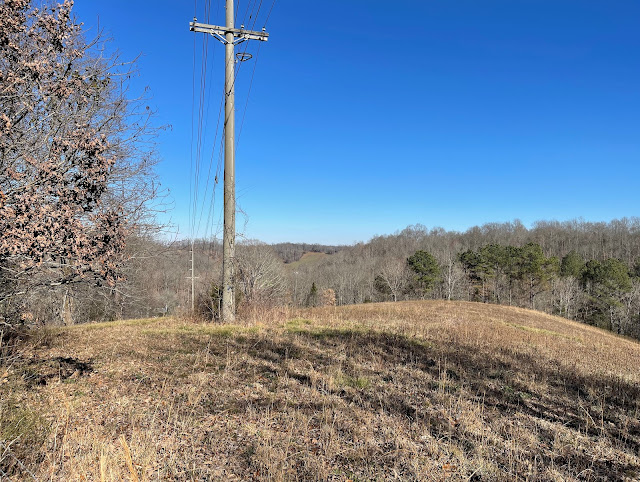
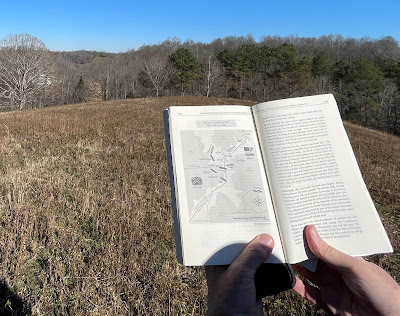
Using an Anthony's Hill map from Mud, Blood & Cold Steel
by Mark Zimmerman, Jack Richards and I explored 
the little-known battlefield near Pulaski, Tenn.
At Anthony's Hill on Christmas Day 1864, Nathan Bedford Forrest—the notorious slave trader and cavalry genius—ambushed Union soldiers under Major General James Wilson. The weather was bleak, with rain mixed with snow, and freezing temperatures. 

Nearly continous fighting for more than a week had left both sides exhausted. Many of the Rebels went shoeless. Casualties numbered roughly 200 on both sides combined. A mortal wound took Christian Brenner, a private in the 5th Iowa Cavalry, from his wife Sarah Jane and their only child, 5-year-old Mary Charity. 

"So broken is the ground at this point, and so densely wooded, that there was no difficulty in effectually concealing troops," Confederate General Edward Wathall wrote of Anthony's Hill—one of the final fights for Hood's rearguard as his battered army lumbered toward Alabama.

Behind his house, near a coop of clucking chickens, Nelson points out ground where Forrest deployed artillery to shell the U.S. Army. To take in the magnificent view of the valley below, I crawl underneath barbed wire with the aid of another tramper. With a battlefield map in hand, Jack joins me.

Later, Nelson points out other landmarks—the wartime roadbed that slices through the heart of this hallowed ground, the site of the church used by Forrest as a hospital, the cemetery where Confederate dead from the battle rest. Instincts tell me there is a great story to tell about Nelson, Forrest and this long-forgotten battlefield.

Until then, we'll see you down the road. As always, let's keep history alive.👊👊 

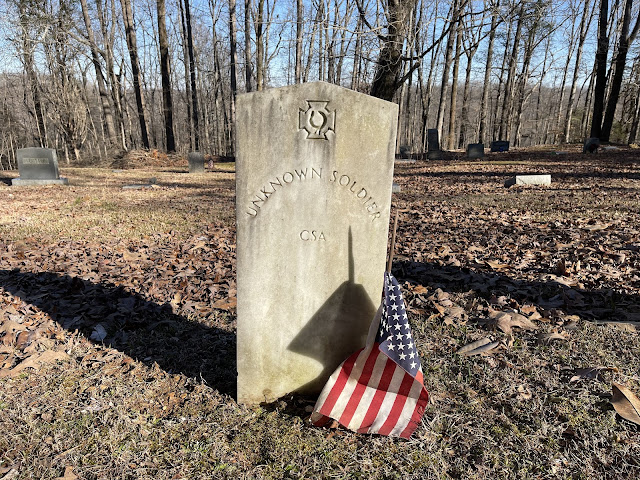
Grave of a Confederate soldier who fell at Anthony's Hill.

 — Have something to add (or correct) in this post? E-mail me here.

SOURCE
  • Christian Brenner pension file, National Archives and Records Service, Washington D.C. via fold3.com (WC71703)
  • Zimmerman, Mark, Mud, Blood & Cold Steel: The Retreat from Nashville December 1864, Nashville: Zimco Publications LLC, 2020.

Sunday, December 19, 2021

Where Forrest whipped out a pistol on another Rebel general

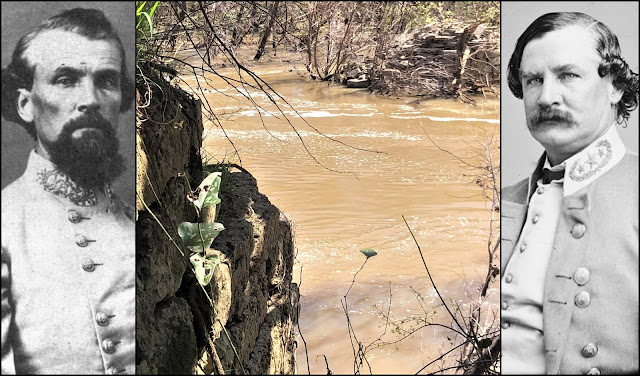
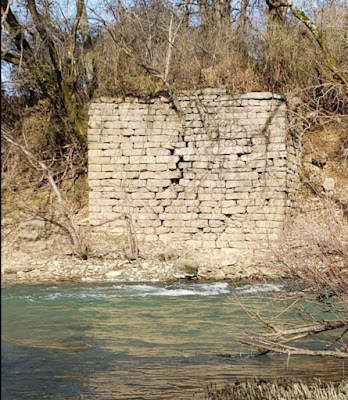
Nathan B. Forrest confronted Frank Cheatham at the Duck River on Dec. 18, 1864. 
Above, looking south at the stone abutments for the bridge that once spanned the river
-- the Yankees destroyed it in 1862. (CLICK ON IMAGES TO ENLARGE.)


Like this blog on Facebook | Follow me on Twitter

Nothing quite says “holiday spirit” like a visit to the place where bad-ass Nathan B. Forrest threatened another Rebel commander with a pistol. So, I slide down a muddy slope for a close-up view of the Duck River at Columbia, Tenn.—ho, ho, ho, this is the 157th anniversary of the bedraggled Army of Tennessee’s crossing here on a pontoon bridge in the aftermath of its two-day butt-kicking from George Thomas’ United States Army at Nashville.

View of the bridge abutment looking north.
(Photo courtesy Neal Pulley)
Scene on Dec. 18, 1864: Ornery Forrest, the notorious slave trader who mortally wounded a Confederate officer in Columbia during an 1863 confrontation, tells General Frank Cheatham he’s taking his cavalry boys over the Duck River pontoon bridge first. Cheatham: Like hell you are. Forrest being Forrest, he whips out a pistol and says: “If you are a better man than I am, General Cheatham, your troops can cross ahead of mine.”
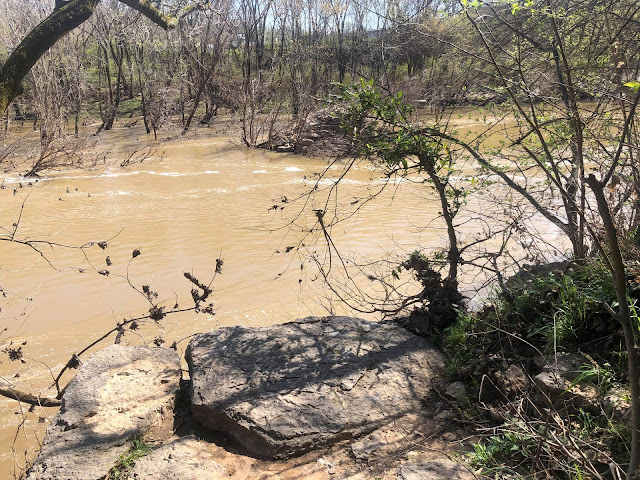
Cheatham—whose horse Old Isham was buried in Coffee County (Tenn.) where they don’t even have a Starbucks—says something to the effect of, “I am not afraid of any man in the Confederacy!” General Stephen Lee, wounded in the foot by shell fragments the day before, climbs from his ambulance and calms the generals, who apparently apologize. Did they hug this one out? Did they chuckle over the "Dust-up  at the Duck"? Who crossed the river first? Who knows?

What’s undeniable is, if I slip into the rain-swollen Duck, Mrs. B becomes a widow and my girls lose a papa. I stay long enough to examine the stone abutment of the bridge that stood here until the Yankees destroyed it in 1862.

Ho, ho, ho, indeed.

Another view looking south at stone abutments.

— Have something to add (or correct) in this post? E-mail me here.


SOURCE

Monday, April 12, 2021

Horsin' around with nags of Frank Cheatham and the 'Wizard'

The grave of Old Isham, Confederate General Frank Cheatham's horse. 
(Cheatham photo: Library of Congress)

Like this blog on Facebook
 | Follow me on Twitter

WARNING! This post includes horse puns that may make you wince ... or worse. Some dialogue may be fabricated. Kernels of history, however, are included. 


Confession: I recently became obsessed with the ties between Civil War horses and their riders. 

“So stop horsin’ around then,” my wife told me, evidently reading my mind. “I don’t want to be a nag, but you really need to get out of the house, drive into the middle of nowhere, and visit the grave of Old Isham, the wartime horse of Frank Cheatham, the hard-drinking Confederate general who was no friend of the incompetent Braxton Bragg. Besides, I have a friend coming over.”

Your tour guide at the grave of Old Isham in
rural Coffee County, Tenn.
Stunned by my wife’s Civil War knowledge, I took her up on the suggestion demand. So I trotted to my 2015 Altima — the one with the below-par horsepower — for a ride to rural Coffee County, about an hour from Nashville. "What an idea!" I said with a smile. "Thanks, Mrs. B, you’re no nag at all."

Feeling my oats, I reached speeds as high as 55 mph on Interstate 24 East, zooming past the exit for Stones River battlefield in overdeveloped Murfreesboro and three or four or 25 Cracker Barrel restaurants.  At the Beechgrove/Bell Buckle exit, I debated whether to go left or right.

Go right and I could visit the area where British military observer Sir Arthur Freemantle witnessed the worst of America in 1863: a speech by an Arkansas politician at the Grand Review of the Army of Tennessee.

The mouthy pol had a "vulgar appearance," wrote the Brit, and delivered a "long and uninteresting political oration, and ended by announcing himself as a candidate for re-election. This speech seemed to me (and to others) particularly ill-timed, out of place, and ridiculous, addressed as it was to soldiers in front of the enemy. But this was one of the results of universal suffrage."

Old Isham's grave in a beautiful valley near unincorporated Beechgrove, Tenn.

My other alternative with a right turn was a visit to Bell Buckle, hometown of former Hee Haw star Molly Bee and the Moon Pie Capital of Tennessee. Bleh, moon pies always give me a stomach ache.

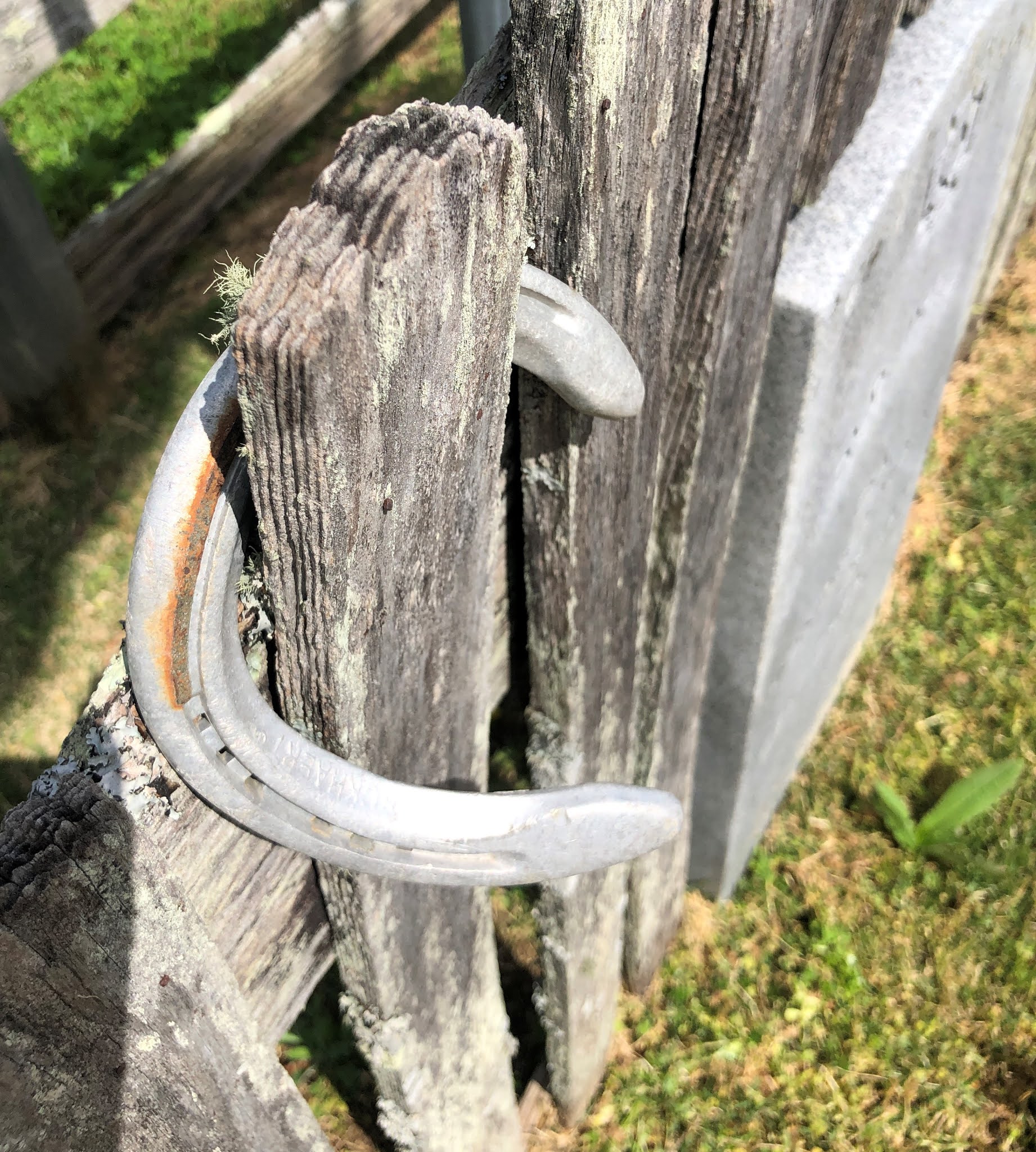
A horseshoe on a fence near
Old Isham's grave.
But I lean left, so that's the direction I headed ...and promptly got lost. Then I got angry when a guy tailgated me on a two-lane road. “Get off your high horse!” I screamed, eyes fixed straight ahead, arms firmly gripping the steering wheel, and all my windows rolled up.

Sweating profusely, I zigzagged through unfamiliar territory. (By the way, I didn’t spot one Starbucks in Coffee County. Weird.) Finally, I came to a “T” and correctly made a right on French Brantley Road, slowly driving past a small general store and a pig farm.

By the side of a lonely country road — aren’t they all? — I at last found the grave of Old Isham, who died in 1884, age 23 or 24. Master Frank died two years later, age 65. What a great place for a horse to rest for eternity: a gorgeous valley, swaths of green, a mansion atop a hill in the distance, and a few cows, some eyeing me warily. It was only marred by the name of the place: Starr Trek Farm. Ugh, I hate William Shatner commercials.

Old Isham’s neatly tended grave was bordered by a modest, wood fence adorned with small Confederate flags. Probably placed there by colt followers. (Sorry.) On a fence behind the grave marker, someone placed a horseshoe, a neat touch. I shot a panorama, took the requisite selfies, and silently thanked my wife for the spur-of-the-moment idea.

A bronze statue of Roderick, the favorite horse of Nathan Bedford Forrest.


Suitably inspired, I hoofed it over to Thompson's Station days later to check out the statue honoring Confederate General Nathan Bedford Forrest’s favorite mount, Roderick. (True story: At the H Clark Distillery in Thompson's Station, the experience manager told me that cows love their bourbon mash. “They come running for it," she said. "Then they just lay in the field, chilling.” Neigggh, you say? Hey, it's on my blog right here.)

Nathan Bedford Forrest,
the "Wizard of the Saddle."
(Library of Congress)
At the Battle of Thompson’s Station (Tenn.) on March 5, 1863, Roderick was wounded three times before he was guided to safety by the general’s 17-year-old son. Eager to return to the "Wizard of the Saddle," however, the chestnut gelding leaped over several fences, suffering a fatal bullet wound in the process. Forrest -- the notorious slave trader/cavalry genius -- supposedly wept beside the dying animal, who was buried on the battlefield.

If not for the roar of the crazy traffic on Columbia Pike (State Rt. 31), construction equipment, convenience store, and other modern development/schlock, heck, you're back in 1863 in Thompson's Station. I know that might, ahem, stirrup trouble with the pro-development crowd.

The bronze statue of Roderick stands roughly 200 yards from the circa-1820 Spencer Buford Mansion on Columbia Pike. The place has some very weird modern additions that ruined its historic integrity and forced its removal from the National Register of Historic Places. Sort of like sticking McDonald's hamburger wrappers on a work of art. 

Roderick’s remains may rest today somewhere near the statue, perhaps where an upscale development named after the horse will be built. I imagine that could provide fodder for future conversations: "Honey, the workers were digging in our flower garden, and they found this huge skull.”

"What?"

Ok, enough schtick. Let's keep history alive. 


-- Have something to add (or correct) in this post? Email me here.


SOURCE: 

-- Freemantle, Arthur James Lyon, Three Months In The Southern States: April-June, 1863, Published by John Bradburn, New York, 1864.

Thursday, October 15, 2020

What caught my eye at Brice's Cross Roads (Miss.) battlefield

At Brice's Cross Roads, an impressive monument honors both armies.
(CLICK ON ALL IMAGES TO ENLARGE.)

Like this blog on Facebook | Follow me on Twitter

On June 10, 1864, cavalry commander Nathan Bedford Forrest, a military genius but a loathsome human being, whipped a numerically superior force at the Battle of Brice's Cross Roads. Confederates inflicted 2,610 casualties (vs. roughly 500 of their own), captured 200 supply wagons and more than a dozen artillery pieces, and added the lead bullet point to Forrest's impressive Civil War resume. The U.S. Army wasn't blessed with anyone with the high military IQ of the "Wizard of the Saddle" -- nearly its entire supply train was parked in a field within easy range of Confederate gunners. 

Brice's Cross Roads scouting report: Fine interpretive markers but empty boxes for pamphlets. (Remarkably did not see mentions of "hail of fire" or "storm of lead.") Good walking trails. Battlefield visitors: Two. Hello waves by locals: Many. Rural Mississipians score high on "Blogger Friendliness Meter." Wildlife spotted: One dead armadillo, clawed feet pointing to the heavens.  

Here's what else caught my eye:


A MARKER NEAR THE CROSSROADS with the obligatory "battle-scarred" and "blood-stained floors" references. 


A MASS GRAVE for Confederate soldiers in Old Bethany Cemetery, near the crossroads. 


THESE WEATHER-WORN (AND PERHAPS BATTLE-SCARRED) GRAVESTONES in the cemetery, where fighting swirled, causing havoc in the then 11-year-old burial ground.  


FOUR GREAT WORDS ... on this stone on a ledge of the memorial for Reverend Samuel Agnew, whose church was destroyed during the battle. 


THE VIEW FROM LOG CABIN RIDGE. From here, on an oppressively hot late-spring day, Forrest's artillery shelled Yankees as they crossed the narrow bridge across Tishomingo Creek, yards ahead of the car about to cross the modern span in the near distance. 


A STATE HISTORICAL MARKER spelling out the awful result for the U.S. Army.


A FIELD where most of the 250-wagon U.S. supply train was parked. When the Federals retreated  across the rain-swollen creek, the wagons clogged the bridge, causing massive panic among the troops. "It was like a scene from Dante's Inferno," a Federal veteran recalled decades later. 


SHIMMERING LIGHT on Tishomingo Creek, near site of the bridge Union soldiers crossed in a panic. In 1953, locals discovered human remains in the creekbed -- probably from a Federal soldier -- along with a pocket watch and rusted remains of an army canteen. He was re-buried in Bethany Cemetery.  


WOODS ALONG THE CREEK, where frightened Yankees fled during the Confederate onslaught.


A LIGHT-BLUE CLUNKER beyond the historical marker denoting the Confederates' second battle line.


WELL-EARNED RECOGNITION for the 55th and 59th U.S. Colored Troops, who helped buy time for their retreating comrades. 


A WARNING that makes sense.


AND A MESSAGE WE ALL CAN EMBRACE NOWADAYS ...

Life. Enjoy the journey.

Always.

-- Have something to add, correct? E-mail me at jbankstx@comcast.net


SOURCE:

-- Vicksburg (Miss.) Evening Post, Oct. 22, 1906.