Showing posts with label Tennessee. Show all posts

Sunday, March 22, 2026

Then & Now in Columbia, Tennessee: Where the armies slept


Beechlawn Then & Now: The mansion stands on Pulaski Pike, south of Columbia, Tennessee.
The sketch was drawn by 7th Minnesota Chaplain Elijah Edwards, who stayed at Beechlawn.

                                   Like this blog on Facebook | My YouTube videos

Just before dark in December 1864, in the aftermath of the Battle of Nashville, Union soldiers rode up to a house on Pulaski Pike (present-day U.S. Route 31) south of Columbia and asked for shelter.

Among them was Elijah Evan Edwards, the 33-year-old chaplain in the 7th Minnesota Infantry. He recorded the experience in his diary and even sketched the house they made a temporary home: Beechlawn.

Chaplain Elijah Edwards
(Battle of Nashville
Trust)
Inside was the wife of a Confederate officer — her husband, Major Amos Wiley Warfield, apparently was off somewhere with John Bell Hood’s ragtag Army of Tennessee, retreating toward Alabama. She let them in.

"We accepted her hospitality as cheerfully as it was offered, posted a guard on the outside, and took our station within, where, for the first time in our campaigning, we were treated to the complete luxuries of civilized entertainment," Edwards wrote. 

Beechlawn had already served as headquarters for Hood during his advance on Nashville. Soon, Union General Andrew J. Smith would sleep here too.

Inside the circa 1853 home, a wounded Confederate told Edwards that Hood was a “butcher,” driving his men into slaughter at the Battle of Franklin. He had one leg left.

“[H]e could neither fight nor run away,” Edwards wrote. His war was over.

Here is the excerpt of Edwards' diary, as posted by the Huntsville [Ala.] Historical Review (April 1, 1973, Volume 3, No. 2).


Toward evening we reached Columbia and crossed the Duck River on a pontoon bridge. This is (at the present) a deep and rapid stream with high banks, and we had some difficulty in crossing. Columbia is an old town with a rather dilapidated appearance. There were many ornamental trees shading the streets, the most conspicuous being the holly and mimosa.

John Bell Hood made Beechlawn
his headquarters in the lead-up
to the Battle of Nashville.
As it was getting near evening, we began to look out for a camping place. All the dwellings in the town seemed to be inhabited, and we proceeded some distance into the country, hoping to find a deserted mansion like the one in which we had dined. But finding none, we drew up in front of a palatial brick home, the windows of which were already lighted, and applied for shelter. 

The tenant proved to be the wife of a Confederate Major Warfield, supposed to be somewhere in Hood’s scattered army. She received us most graciously, not only giving permission for us to remain, but cordially inviting us, assuring us that our presence would be a protection from the stragglers and robbers that were prowling in bands over the country.

We accepted her hospitality as cheerfully as it was offered, posted a guard on the outside, and took our station within, where, for the first time in our campaigning, we were treated to the complete luxuries of civilized entertainment. However, owing to the hard conditions of the war, the larder of our hostess was incomplete, we contributed liberally of our own, and spent a delightful evening in conversation.

U.S. Gen. Andrew J. Smith
slept in the Warfield mansion.
Facing page 41 is a hasty sketch of the Warfield Mansion. It has been well preserved from the fate that has been measured out to so many Southern homes, probably from the fact that, from its commodiousness, it has been generally selected as a headquarters for both armies. Thus, Hood, in his advance on Nashville, and retreat as well, made it his headquarters, and on the 24th Gen. A. J. Smith pillowed his weary head in the best bedroom.

Lastly came our squad of surgeons and chaplains. The building was thus protected from pillagers and from the torch. It has been used also in a small way as a hospital.

We found here a badly wounded Confederate soldier. He was quite friendly and communicative, and criticized his late commander Hood most unsparingly, pronouncing him a butcher for driving his men into the shambles at Franklin, where they were slaughtered like so many dumb animals. He believed for himself that the time for fighting was over. It certainly was for him, he musingly remarked, since he had but one leg left and could neither fight nor run away. He was a lieutenant.

There was a sick and badly disabled Confederate soldier in one of the outer buildings, that had been used as negro quarters (sic), whose feet were badly frozen. He told me that many of Hood’s soldiers were absolutely barefooted—and that, too, at a time when the temperature, a very unusual thing in the South, marked as low as 10 above zero. (I do not recall any such frosty weather as that, but can testify that while we were at Nashville it was frequently several degrees below freezing.) We left the Warfield home quite early this morning, with friendly adieus to the lady hostess and kind words to the wounded soldiers.

Wednesday, January 21, 2026

Letters from Triune: 'No wish ... is too cruel for a traitor'

Photo illustration of newspaper clippings of accounts from wartime Triune.

                                      Like this blog on Facebook | Watch my Triune video

Third in an occasional series.

Writing from the Triune Hills in Middle Tennessee, "Harry D" of Battery C of the 1st Ohio Light Artillery opens with a moment of rare calm. Sundays along the Harpeth River, he says, can be almost peaceful — no inspections, no bustle — just enough quiet for soldiers to sit with a shingle or tin plate on their knees and write home. 
The Ashtabula (Ohio) Weekly Telegraph
published the letter from Harry D, either
Harry Dinhanan or Harry Dingman of
the 1st Ohio Light Artillery.

Harry D — probably Harry Dinhanan or Harry Dingman — also fumes over Northern politics, especially the nomination of Copperhead Democrats like Clement Vallandigham, reserving some of the letter’s harshest language for anyone he sees as disloyal to the Union. Soldiers, he warns, will remember — and vote. Loyalty, he makes clear, is the one unforgivable line to cross, and the army’s patience for traitors, whether in gray or in civvies, is long gone.

"No wish, however malignant, is too cruel for a traitor," Harry D writes in the letter published in the Ashtabula (Ohio) Weekly Telegraph on June 27, 1863. 

My recent visits to Triune — where the Union army built a network of redoubts, earthworks and rifle pits a 20-minute drive from Franklin, Tenn. — inspired this "Letters From Triune" series.

Union army-built earthworks at Triune, Tennessee


ARMY CORRESPONDENCE

Southwick's Battery, At the Triune Hills, June 14th, 1863

READERS OF THE TELEGRAPH: We have all heard of a "quiet on the Potomac," and many comments have been made upon it, by unthinking, misinformed, people. Here on the Harpeth there is not so much of quiet, although to day matters have assumed a Sabbath day quietude; not even an inspection to mar the tranquility of repose and season of reflection.

And better than all, these Sunday resting spells give the soldier an opportunity to write letters. Look which ever way you will there sits your lad with a shingle on his knee, perhaps an upturned plate, busily chalking down the talk on paper to the dear one perhaps, the one above all price inestimable. Or it may be to a mother whose all of hope and joy he is, and whose loss to her would make her evening of life a chilling blank, a woeful chaos of grief. 

On the face of another scribe you may note the glow of strong manly devotion for the wife in the far off northern home, and the tenderness and truth of filial love on the open page of still another face. Such is the study of faces, the lesson to be learned from the tablet of each one's heart is more difficult to get. Our private opinion is that many little romances could be read from the heart histories of these letter writers and receivers.

Clement Vallandigham
(Library of Congress)

Those readers of the Ashtabula Telegraph who feel an interest in the members of Southwick's Battery could not much better please them than by writing letters. Of course they should be kind and encouraging ones, not hissing with copperhead politics, or fault with the Administration, or any thing in the least degree tainted with treason. We're sure such will not come from Ashtabula, Lake, or Geauga counties, to this army. But in this day of our Nation's calamity, such strange things happen. We are never sure where the serpent will spring from.  

There is the envenomed hiss of corrupt politics on the winds that blow from the North as well as from the Sunny South land. And the keenest sting of all to us from Ohio is the recent nomination of [Clement] Vallandigham and [George] Pugh, by the Democratic party, or better named the snakes from the vomit of hell, sick by a surfeit of treason. Excuse such harsh terms; you would, if you could know how the soldiers in this army feel towards enemies at home. But friends if we are rightly informed, soldiers will vote, and woe betide any blasted home rebel who may be a nominee for office. He might as well crawl away into the inlet to perdition and draw the hole in after his nasty carcass, eternally hiding the filthy thing from the face of earth. No wish, however malignant, is too cruel for a traitor.

Be we ever so merciful to other evil doers, and forgiving to those who wroug us many wise else than by treason, we would even pray for the total and immediate extermination ot traitors from this Free America, that is to be. In this Battery, a unanimity of loyal sentiment and patriotic principle is our platform of politics.

While officers of regiments with which we come in contact show a disregard for the sacred cause of liberty, by fawning about traitors in women's garb, that attract [unreadable] by the witchery of womanly prettiness; the officers of our battery pass them by in silent contempt and perhaps regret, that the sweet creatures were not favor of Union. We feel an honest pride in such officers and in there [sic] example to us is invaluable.

An aerial view of the site of one of the three United States Army redoubts at Triune.

Here at Triune are fields so large that divisions can drill together, and Captain [Daniel K.] Southwick takes the three batteries of his command and drills them together. It is a splendid and exciting spectacle to witness. The command consists of our battery in the 2ud Brigade, the 4th Michigan in the 1st, and Co. I, 4th Regulars, in the 3d Brigade. 

To say that the Captain can handle the three Batteries and do it well is but giving him the due meed of praise; and he would not have been appointed chief of Artillery in the 3d Division if his military abilities were not of a high order. 

We are encamped in a beautiful grove of noble trees, on a slight eminence; the infantry being costly placed in regular rows of tents just down the slope of the hill and on the plain below. Setting under the wing of these lofty maples at night, and looking at the brightly illuminated city of tents, reminds us of a city lit up for the reception of some idol of the people, or for some festive sports.

Apart from all there is in war to sadden us, we have much to make us happy, if we only let contentment be our rule of life. As the eye turns involuntary upward at these silent preachers of the grove pointing Heavenward, the heart grows heavy with a sense of woe; — grows weary of a war we could not shun with honor. And as the sweet and ever present beauties in nations ministry, lead us homeward through the pleasant meads of memory and imagination; the fire of patriotic ardor is newly kindled in our souls.

We are ready for the bloody work of war, and when it comes to us, you will not be ashamed of Battery C.

Yours truly, Harry D

Tuesday, January 20, 2026

Letters From Triune: Tennessean grapples with 'monster Secesh'

Photo illustration of newspaper clippings of accounts from wartime Triune.

                                    Like this blog on Facebook | Watch my Triune video

Second in an occasional series.

My recent visits to Triune — where the Union army built a network of redoubts, earthworks and rifle pits 20 minutes east of Franklin, Tenn. — inspired this "Letters From Triune" series. 

The writer, an East Tennessee private who signed the letter “S.K.H.,” had to scout for months just to reach Federal lines. Writing as a common soldier, he believed a man risking his life for a pittance deserved as much respect as any general.

From Triune, his thoughts turned home. Loyal East Tennessee families, he wrote, were trapped behind Confederate lines, facing violence or slow starvation as rebels seized corn, wheat and bacon to feed their own ranks first. 

The letter, published in The Nashville Daily Union on April 26, 1863, closes with loyalty tempered by frustration and a clear sense of what mattered to him. Above all, he supported preserving the Union — even if that meant slavery remained. 

“We say give us the Government of our fathers and let the negro slide,” "S.K.H." wrote.

Earthworks at Triune, a Union Army complex near Franklin, Tennessee.


TRIUNE, April 21, 1863 | Mr. EDITOR: Dear Sir,

Allow me to write a short article for your most excellent paper, which has more, character in our camps than any other sheet. I claim no position in the army higher than a private, yet I know what East Tennesseans have suffered; having had to scout for four months before I could reach the Federal army. And I think a private soldier, if he demeans himself aright, deserves as much respect as a Major General. The one exposes his life for big pay, the other for a mere pitance; at least the private can claim as much unbought patriotism as the officer, and that is all that should command respect in a war like the present one. 

We, as East Tennesseans, are peculiarly situated. Our homes are in the hands of a bloody and cruel enemy. We know not how soon the fiends incarnate may murder our fathers, and brothers, and even our mothers and sisters, that we have left behind us. They have murdered the kind mother while attempting to save her beloved son, and why will they not do the same thing again? Let man commit murder once, and he can commit the same crime a second time with more ease. But if they do not abuse the persons of our friends, they will take their corn, wheat, and bacon, those things they must have, or perish, and leave them in a state of complete destitution--a condition more deplorable than death itself. 

Remains of Union earthworks at Triune
This is no overstrained picture, for the rebels are now in a starving condition, and every man of sense knows they will let their enemies suffer before they will suffer themselves. How much the poor soldier, cut off from all communication with his home, fears that his wife and little ones will suffer for the want of food, and how it gladens his heart to hear, through some poor refugee who may have made his escape, his friends still live, and have the common comforts of life. 

Our only hope is that the Government will immediately relieve our portion of the State. Oh! what hours of anxiety to the poor refugee soldier. We are all waiting to see if the authorities intend to send us back in the direction of our homes. If those who command us only knew how it would gladen our hearts, they would say, Go, join Gen. BURNSIDE, penetrate East Tennessee, whip the rebels, and liberate your homes.

I sometimes think that we as soldiers have been treated badly, yet I am not disposed to complain. When this rebellion first broke out, every public journal praised the noble hearted East Tennesseans, who, in spite of all opposition, held The Star-Spangled Banner aloft, and claimed that they were loyal. And those in power told us to hold out for a short time, and we will come, to your relief, if we have to come through a wall of living fire.

A road leading to one of the three redoubts at Triune

But how is it today? Two long years have passed away — and our people are still pressed beneath a despotism more cruel than that of Austria or Turkey. Rebel Middle and West Tennessce have been redeemed, at least to a great measure. The Government has spread the broad wing protection over the disloyal portion of the State; yet our people, who have ever been loyal, are left to grapple with the monster Secesh. 

We don't like to grim fight over Middle Tennessee soil, while the rebels are insulting friends and insulting our people. All we ask is, let us try our sabres with the traitors about Greenville, Knoxville and Chattanooga. If we fall in the contest, history's page will give us a spot upon which we will live, and in the agonies of death we will have this consolation, that we died trying to do our duty. 

But, on the other band, if we should be successful, no pen can tell the joy we will bring to our friends at home. And none can paint the visions of horror that will flit across the minds of the secesh that are there. They will have to cry out, let rocks and| mountains fall on us, and hide us from the wrath of the coming Yankees. We are for supporting the Administration at all hazards, as the only chance to save the Government; and if we have to give up the Union, or the institution of slavery, we say give us the Government of our fathers and let the negro slide.

No more at present, but remain yours, truly, S.K.H.

Friday, November 14, 2025

Can these cabins for enslaved linked to a Rebel general be saved?

A slave cabin in "The Quarters," near downtown Columbia, Tenn. It is one of four.

                                        Like this blog on Facebook | My YouTube videos

A version of this column originally appeared in Civil War Times in 2024.

On a cloudless, deep-blue afternoon, I drive 45 miles south of Nashville to Columbia for a visit with one of my favorite people, Campbell Ridley. He’s an 80-year-old semi-retired farmer, U.S. Army veteran, rock-and-roll devotee and storyteller with a wit as sharp as the tip of a new bayonet.

Gideon Pillow,
circa 1870.
“How are you feeling?” I ask moments after stepping into his farm office.

Aside from mourning the recent death of Barney — his nine-year-old barn cat — Ridley says he feels fine, a state he attributes to “clean living and cheap beer.” He’s wearing tan Carhartts, brown work boots, a blue-checkered shirt, and, appropriately, a ballcap that reads “Life Is Good.”

Ridley’s roots run deep in Maury County, once one of the wealthiest counties in the state before the Civil War. He’s the great-great-grandnephew of Gideon Pillow, the Confederate brigadier general, Mexican War veteran, lawyer, politician and before the war one of the county’s foremost slaveholders. Ridley’s paternal great-grandfather, a leading citizen who farmed with mules, earned the nickname “Mule King” — fitting enough in Columbia, long known as the “Mule Capital of the World.”

When I need a history fix and a good laugh, I visit Ridley. We’ve sat together inside magnificent St. John’s Church — the slave-constructed plantation church built under the direction of Leonidas Polk and his brothers. It stands roughly a mile and a half southwest along Mount Pleasant Pike, just across from the field where the Episcopalian bishop and future Confederate lieutenant general once lived in a mansion called Ashwood Hall. There, we’ve admired the two massive gingko trees Polk imported from Japan and poked around the brick remnants of the kitchen of the mansion, destroyed by fire in 1874 and never rebuilt.

Irish visitor Liam McAlister, Campbell Ridley and I during a recent visit to "The Quarters."

'The Quarters' on Gideon Pillow plantation: Time capsules in Maury County, Tennessee

Today, though, we’re exploring far humbler construction. Near Ridley’s office and the east fork of Greenlick Creek stand four ramshackle cabins for the enslaved. “The Quarters,” he calls the property. His daughter, who lives in New Mexico, owns it along with a friend.

“I’ll take care of this until she puts me in a nursing home,” he says, half-joking.

Campbell Ridley explores a
cabin for the enslaved in
 "The Quarters."
In a way, these cabins are as much a part of Ridley as the land he has farmed for decades. As late as the 1990s, he tells me, these structures served as homes for poor Black farmhands and others — many of whom worked for the Ridleys.

“The woman who raised me lived here,” he says as we step inside one of the rickety cabins. Her name was Katie, a “wonderful” lady with a gift for frying chicken. The Ridley family employed her for more than three decades.

At the next cabin, ancient white paint clings to exposed exterior logs. Four modern wooden posts prop up the porch overhang above two large, well-worn walkway stones. On an exterior wall, a half-dozen old hangers dangle from a rusty nail. Above us, a corrugated-tin roof keeps nature at bay.

“That’s been there as long as I can remember,” Ridley says.

These antebellum cabins stand in stark contrast to Clifton Place, the brick manor house on the hill about 750 yards away. In the late-fall sunlight, the mansion almost seems to glow. Through the trees along the road to Ridley’s office, its imposing Ionic columns and limestone porch come into view.

From 1839 until the early Civil War years — when the U.S. Army confiscated the property — Clifton Place served as the centerpiece of Pillow’s vast plantation. The enslaved who lived in cabins at “The Quarters” produced his wealth by planting and harvesting cotton, hemp, corn and other crops and tending his cattle, sheep and hogs.

As one of Tennessee’s leading citizens, Pillow moved in elite circles. He counted James K. Polk, the 11th U.S. president, among his friends. After Polk left the presidency in 1849, he dined at Clifton Place with Pillow and his wife, Mary. Pillow dabbled in national politics himself, opposing secession at first in 1861 before relenting.

As a military man, however, Pillow consistently disappointed. During the Mexican War, he irritated superiors — including Winfield Scott — with his relentless self-promotion. No surprise, perhaps, given the massive painting of a heroic Pillow in uniform that greeted visitors in the entrance hall at Clifton Place.

In the Civil War, Pillow abandoned his post at Fort Donelson in February 1862, slipping away under cover of darkness before Ulysses Grant accepted the Confederates’ surrender. At Stones River nearly 10 months later, he led a brigade with mixed results. True or not, a story of the 55-year-old officer cowering behind a tree during the fight has stained his record ever since.

Scott — overall commander of the U.S. Army when the war broke out — certainly wasn’t a fan. In his 1864 memoirs, “Old Fuss and Feathers” described Pillow as “amiable, and possessed of some acuteness, but the only person I have ever known who was wholly indifferent in the choice between truth and falsehood, honesty and dishonesty… habitually boastful… at the total sacrifice of moral character.”

Inside cabins for the enslaved: A window into the past (Video)

Apparently used to keep the weather out, ancient newspapers cling to the walls of a slave cabin.

As we move from cabin to cabin (see video), Ridley reflects only briefly on his ancestor and the enslaved people who toiled for him.

“Just part of history,” he says.

We step gingerly into a cabin once home to field slaves. More than a year ago, Ridley had brush cleared from around these structures, making access easier. Each cabin is roughly 15 by 15 feet, with a small loft reached by a rickety ladder. Each has a post–Civil War room added to the rear. I’ve visited the site half a dozen times, yet I always see something new.

Ridley shines a flashlight beam onto a fireplace, revealing bricks and small dirt piles in an otherwise barren room. Fragments of newspaper — used as insulation by post-war inhabitants — speckle the walls. A dour-looking baseball player stares out from a March 1937 sports page. Beneath my feet, a decrepit floor, victimized by time and weather, crunches softly.

An interior view of one of the four remaining 
slave cabins that were occupied well
into the 20th century.
In another cabin, we find more traces of the 20th century: a swinging blade, peeling wallpaper decorated with blue-and-aqua flowers, a chipped ax handle, a single clothes hook on a door. Pasted to a back wall is a fragment of The New York Times from decades ago.

“Life in America,” the partial headline reads.

From the era of slavery, though, there is nothing visible: no pottery fragments, no glass shards, no etchings on the walls, no privy to mine for clues. Much is left to imagination.

So I wonder: Who were these men, women, and children?

What treatment did they receive from Pillow?

What were their names?

The 1870 census offers hints. “Sarah” and “Randall,” listed as farmhands for the Pillow family, appear in deeds from as far back as the 1840s.

I wonder what became of the people enslaved at Clifton Place. Are they buried in the cemetery in the woods at the base of Ginger Hill — the remote graveyard Ridley showed me months ago? Or in the rear section of St. John’s Church Cemetery, away from the graves of white parishioners? Or perhaps in one of the countless family plots scattered across the county.

And I wonder what will become of these cabins near the east fork of Greenlick Creek. Ridley wants to save them, but doing so would require expertise and probably hundreds of thousands of dollars.

What might a professional archaeologist uncover here?

'The most complete 19th-century plantation complex anywhere'

I also wonder about the future of Clifton Place, where Ridley’s paternal grandfather lived until 1949. The family held onto it for years afterward.

“I watched television in there for the first time in my life,” Ridley says, recalling family gatherings under 16-foot-high ceilings in the 12-room Greek Revival mansion.

In 1972, a Kentucky Fried Chicken magnate named John R. Neal bought the property from the Ridley family. He and his wife, Linda, attempted a restoration, but the project proved daunting. “We saw the white columns, the Gone With the Wind atmosphere,” she told a reporter in 1986. “We didn’t see the cracks, the structural problems.”

A view of the long-unoccupied Clifton Place
estate of Gideon Pillow. This is private
property. Do not trespass.
The estate includes the original detached kitchen, carriage house, ice house, law office, spring house, blacksmith shop and quarters for “house” slaves. Inside the Pillow-era smokehouse stand the original poplar chopping block and “ham logs” — hollowed poplar logs once used for salting hams. The smoky aroma still lingers.

A researcher once called Clifton Place “the most complete 19th-century plantation complex anywhere.”

Neal died in 2018, but his family still owns the property. The mansion, however, has stood unoccupied — and inaccessible to the public — for more than a decade. Like the nearby slave cabins, it could vanish without major preservation efforts.

Time may not be on our side. Across Mount Pleasant Pike from Clifton Place, developers plan a massive subdivision: “Seven hundred fifty houses on 450 acres,” Ridley says.

Oh my. What will I see here a decade from now?

Places like these don’t disappear all at once — they vanish slowly, board by board, memory by memory, until all that’s left is what someone bothered to write down. I suppose that’s why I keep returning to them. To witness what remains. And to remember what shouldn’t be forgotten.


SOURCES

— Scott, Winfield, Memoirs of Lieut.-General Scott, New York, Sheldon and Company, 1864, Vol. II

The Tennesseean, Aug. 10, 1986, Page 113

Tuesday, November 04, 2025

Video: Explore Fort Granger in Franklin, Tennessee


Sparing no effort, the U.S. Army outfitted Fort Granger with powerful siege guns, field artillery, a powder magazine for 1,200 artillery rounds and a storehouse for 70,000 rations. “The strongest and finest fortifications in the department of the Cumberland,” an observer wrote. Union bigwigs named the fort for Maj. Gen. Gordon Granger, a career U.S. Army officer, who, in 1863, delighted visitors by firing two shots from its monster Parrot gun into a tree a mile away.

Monday, March 24, 2025

Tales from the road: A soldier's death near Cotton Grove Road

The Battle of Salem Cemetery resulted in few casualties.

                                     Like this blog on Facebook | My YouTube videos

To reach the Salem Cemetery battlefield near Jackson, Tennessee, I hang a left on Cotton Grove Road, into an area first settled in 1819. This swath of rolling land probably doesn’t look much different than it did in 1821, the year they began planting cotton seeds in its loamy soil. I pass the Fraternal Order of Police gun range and a Woodmen of the World memorial for a man named E.E. Brooks before parking in a small gravel lot beside a state historical marker.

Adam Huntsman's grave
in Old Salem Cemetery.

“No metal detectors,” reads a sign just steps from a cannon and a covered wayside exhibit.

Among those who rest in remote Old Salem Cemetery, the second-oldest burial ground in Madison County, are Susan H. Person — who, according to her broken tombstone, “departed this life Oct. 27, 1842” — and a colorful, one-legged politician and lawyer named Adam Huntsman, who sent Davy Crockett packing for Texas after defeating him in a congressional election in 1835.

After stepping from my SUV, I wonder: How did this battlefield almost become an industrial solar farm?

Gloomy-gray skies threaten rain, but they’re mostly bluffing. So, too, was Nathan Bedford Forrest on Dec. 19, 1862, when “The Wizard of the Saddle” sent his soldiers barreling into Midwesterners in and around the cemetery. The frigid, unforgiving night before the fighting, Union soldiers spied the campfires of Forrest’s men off in the distance — a large brown-and-white historical sign marks that area — so their commander forbade fires.

“Mortified,” wrote Col. Adolph Engelmann of the 43rd Illinois, a Bavarian-born Mexican War veteran, reflecting later on his order.

The Confederate cavalry’s attack — a feint by Forrest, who had more important business elsewhere — came at daybreak the next morning.

“With loud cheers they charged upon my center,” Engelmann wrote. “As they approached they were received by a well-directed fire, some of the foremost horses falling and obstructing the road. Those immediately behind came to a halt, while half a dozen riderless horses rushed madly through our lines.”

The broken grave of Susan H. Person in Old Salem Cemetery.

After the four-hour fight, Engelmann’s outnumbered soldiers retreated toward Jackson. The Battle of Salem Cemetery, of course, was no Antietam, Gettysburg or Cold Harbor. Casualties numbered perhaps 20 killed, wounded or missing on the Confederate side. The U.S. Army, meanwhile, suffered six wounded and two killed. But mothers and fathers — from Tennessee and Mississippi to Illinois and beyond — mourned just the same.

Private Adam Kehl of Company A, 11th Illinois Cavalry — a blacksmith before the war — was among those killed that wintry day. The unmarried son of Rosina and Sebastian Kehl, who hailed from Hesse, Germany, Adam had paid for his parents’ passage from the Old Country. A bullet to the chest sent him to his grave before they arrived in America.

“They came to the United States with the expectation of receiving assistance from their … son,” a family friend noted.

I don’t know where Private Kehl rests today. Perhaps he lies in the national cemetery in Nashville — the U.S. government recovered thousands of Union remains after the war. Or perhaps his bones lie in an unmarked grave in a field or stand of woods near Cotton Grove Road.

A grave for an unknown Confederate soldier in Old Salem Cemetery.

SOURCES

— Adam Kehl mother’s pension file, National Archives via fold3.com (WC140043)
Official Records, Volume X Chapter 32, Pages 555-556

Sunday, March 09, 2025

Tales from the road: I scored Lincoln bust, battlefield horsehoe

Glenn (left), a distant relative of Robert E. Lee, and Charles, the propietor of an
 antiques store in Eagleville, Tennessee.

                                       Like this blog on Facebook | My YouTube videos

At 8:35 on a sun-kissed Saturday morning, I plop my heinie into the shotgun seat of battlefield tramping pal Jack's fancy SUV for our ride into the Civil War wilds of Middle Tennessee. We're rambling southeast to Shelbyville and points unknown.

Pal Jack holds my Lincoln bust.
At our first stop, an Eagleville antiques store that once served as a combo bank/dental office, we meet a retired railroad worker named Glenn, a distant relative of “Marble Man” Robert E. Lee, and the proprietor named Charles, a former Bible salesman and a friend of country star Marty Stuart who charms me into forking over 40 bucks for a circa-1940s typewriter and another 40 smackers for a plaster bust of Abraham Lincoln that is sure to cause a rupture in my solid-gold, 32-year marriage to Mrs. B. (Apologies to all English teachers for the length of the preceding sentence.)

While I suffer from buyer's remorse on our way to Shelbyville — site of a major cavalry battle on June 27, 1863 — we pass the delightfully named Morning Glory Catfish restaurant and a creamery where they serve midnight chocolate ice cream that’ll put a smile on your mug. Then, as we enter unincorporated Rover (population 357 hearty souls), master of historical trivia Jack poses a question. 

“Do you know the name of President Lincoln's dog?”

“I have no idea.”

“Fido.” (Amazingly spot-on!)

Fired bullet unearthed at Liberty Gap.
In Shelbyville — described by Union soldiers as “Little Boston” for its Unionist leanings — we don’t find the cavalry battle site. But we admire a Ms. PacMan video game ($2,200) in a collectibles shop and the dazzling inventory next door in the baseball card/sports store. (My gosh, they even have a Stan Musial glove in its original box.)

Back on the Civil War trails, we stop along the Liberty Pike, a few miles from magical Bell Buckle, where we meet my new pals Chuck and Perry next to their green pickup. 

With permission, they hunt for battle relics on farms at Liberty Gap, where the armies clashed in an unheralded Tullahoma Campaign battle from June 24-26, 1863. It's hallowed ground, unmarked and largely forgotten — one of those 10,000 places deep-voiced historian David McCullough told us about on Ken Burns' epic “Civil War” doc decades ago.

Under a cloudless, deep-blue sky, Perry and Chuck have had a good day. They show off their finds: bullets, a horseshoe and other detritus of war. 

Later, these good-hearted souls hand some of their haul to Jack and me. The horseshoe is destined for a place of honor in my office shelf; the bullets — one dropped and two fired — will go to our young friend Taylor, whose great-great-great-grandfather fought at Liberty Gap.

“Maybe his grandpappy fired one of 'em,” Perry tells us.

Battlefield horseshoe
Soon, we head deeper into the Civil War wilds. 

In Chapel Hill, we briefly visit the site of the birth of Nathan Bedford Forrest, “The Wizard Of The Saddle” himself. Then we venture on narrow, snaky back roads — passed a drooping “God, Guns And Trump” sign, empty fields and rickety barns — before arriving at the boyhood home of “The Wizard.” A locked gate prevents our entry to the site, but does it really matter?

If we set aside the near-removal of my fingertips on Jack’s car window (long story), we’ve made excellent memories overall. At a small, off-the-beaten path farm cemetery, a final stop, daffodils poke through the sod and an American flag flaps in a gentle breeze. In the back of my ride rests a rusty typewriter and Honest Abe, comfortably under wraps. At my feet sits an old horseshoe. It’s all plenty good enough.

Monument denoting birthplace of Nathan Bedford Forrest in Chapel Hill, Tennessee.

Friday, February 28, 2025

Tales from the road: A massacre site at Sinking Cane

The long-abandoned home of William and Cynthia Officer.

                                      Like this blog on Facebook | My YouTube videos

Following a dandy visit to a train depot/museum where host Dale regaled us with tales about a ghost named “Whistling Willie,” we depart Monterey, the town where a massive mural proclaims the “hilltops touch the sky.” Our next stop out here in the chilly wilds of the Middle Tennessee is an abandoned plantation house, the site of a long-ago massacre. “Sinking Cane,” some call the sparsely populated area deep in the woods outside of Monterey.

Guide Craig Capps, a Tennessee law
 enforcement officer, at the Officers' house,
site of an 1864 massacre.
At the home of William and Cynthia Officer on March 12, 1864, United States soldiers serving under 5th Tennessee Cavalry Colonel William Stokes shot and killed six Confederates. The Union men gunned down the suspected guerrillas in the kitchen and finished one off outside, near a fence post, with a volley of lead. You can inspect that bullet-riddled relic for yourself in the museum in Livingston, 20 miles north as the crow flies.

“You ought not to do this,” that poor Rebel soldier supposedly said before his execution in the Officers’ yard. “I have never done anything but my sworn duty.” Mrs. Officer herself suffered a bullet wound during the massacre — collateral damage from Upper Cumberland warfare that still resides in the shadows of history. The Officers’ own son, John, a Rebel soldier visiting his momma and papa, somehow escaped the massacre.

Stokes, who died in 1897, didn’t go down in history as a glorious figure. It is said that decades after the war, children spat ice cream on his gravestone in Alexandria, an hour’s drive west. Of course, I’m a firm believer in this old journalism maxim: “If your mother tells you she loves you, get another source.” So let’s reserve judgment on that ice cream spitting story.

This wallpaper capivated me.
Guide Craig Capps in the room where U.S. cavalrymen are said to have shot the Confederates.

Unoccupied for years, the Officers’ house must have impressed visitors during its heyday. But, oh my, how this once-mighty place has tumbled from its pedestal. Outside, stucco clings precariously to wooden siding while ancient outbuildings barely hold on to life.

Inside, leaves lay scattered about. Steps from an open door, a rust-coated stove sparks images of bacon sizzling and eggs cooking in pans on frosty winter mornings. On display in Dale’s museum/train depot over in Monterey, you’ll find a cedar baby cradle from the Officers’ house — one of the few relics remaining from its 19th-century days.

An ancient stove
“Look up there,” says guide Craig, pointing to floral wallpaper in an upstairs room. “That’s original.” The shades of pink charm at least one visitor.

Near a fireplace, one of several original to the house, Craig tells of the Saturday morning massacre of 1864.

​ “Stokes’ soldiers burst through that door right there,” he says. We five visitors gaze toward an entryway, apparently nailed shut.

For a few moments, I imagine shots reverberating in this confined space, boots stomping, gun smoke drifting, sickening screams of anguish and blood pouring from bullet wounds onto a wooden floor.

Later, we bound along a deeply rutted, serpentine backroad — past decrepit barns, a satellite dish or three and a sign that reads “Christ Over Politics — until we reach a cemetery near the edge of a wood. Those six Confederates who Stokes’ soldiers killed rest here in a common grave under markers adorned with Rebel battle flags. 

A few steps away, near remains from a recent snowstorm, stands Cynthia Officer’s broken tombstone. In the far distance, beyond a large field of stubble, snow coats wooded hillsides.

“What a place to spend eternity,” I say to no one in particular. The 21st century (thankfully) seems so far away.

The massacre victims rest in a common grave in a cemetery near the Officers' house.


Like this story? Check out many more in my book, A Civil War Road Trip Of A Lifetime. Email me at jbankstx@comcast.net for details on how to get an autographed copy.

Tuesday, December 03, 2024

Tales from the road: Jimmy Gentry and the horrors of Dachau

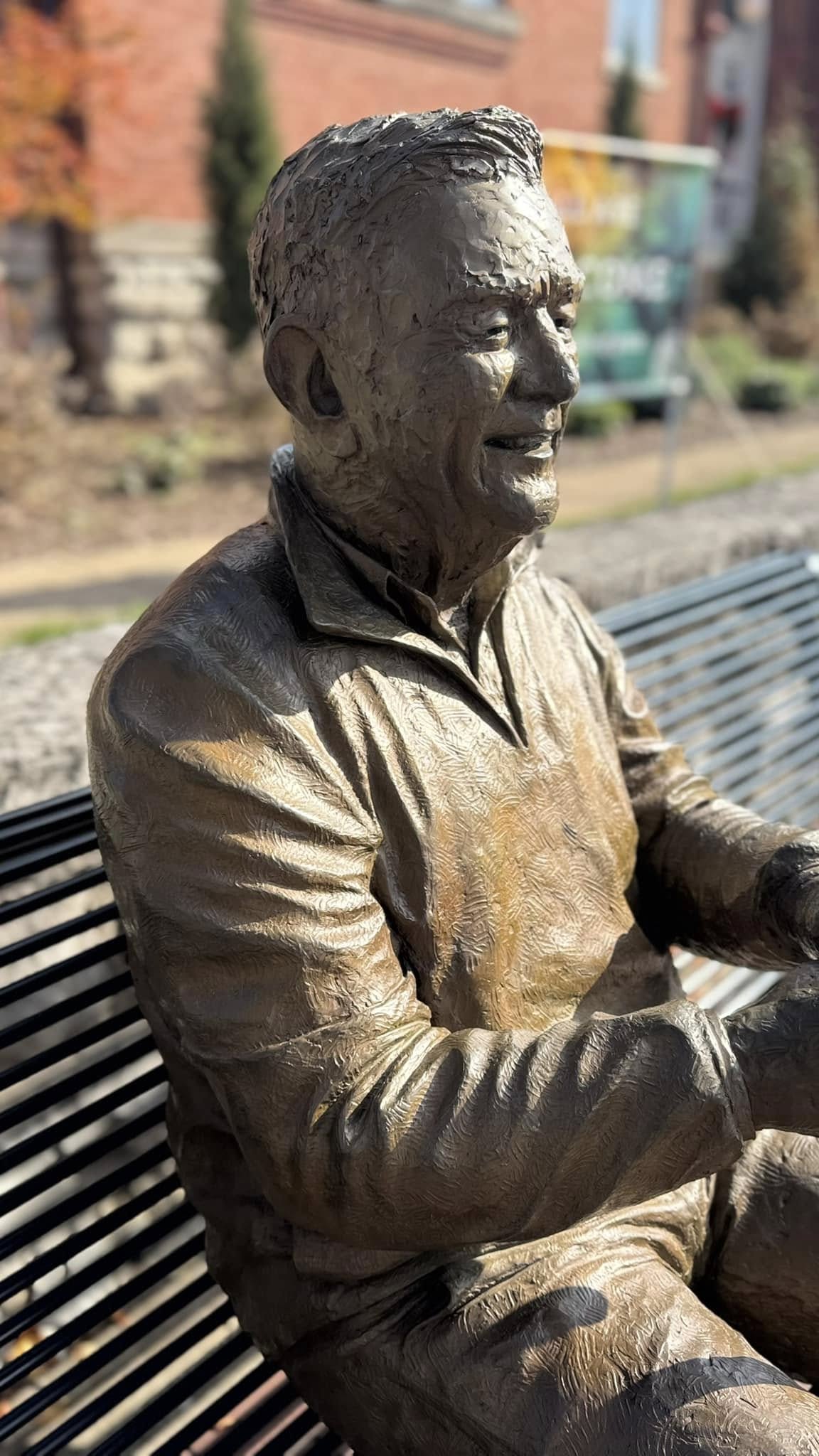
Jimmy Gentry statue near a church in Franklin, Tennessee.

                                        Like this blog on Facebook | My YouTube videos

There’s no better way to explore a battlefield — or a town, for that matter — than by walking. And so on Sunday morning, after yet another visit to the Franklin (Tenn.) battlefield, I strolled into town, destination unknown.

Smiling Jimmy Gentry
caught my eye.
At the excellent Triple Crown Bakery, I bought a bunch of goodies that put a smile on my mug. Nearby, I added a jar of local honey. And while returning to “Murray” — Mrs. B’s nickname for her mighty Murano — I happened upon a bronze statue of man sitting on a bench outside a church. The smile on the work of art lights up this little corner of bustling Franklin.

Steps away, I examined a historical marker.

“This statue is in the likeness of Franklin, Tn native and U.S. Army veteran Jimmy Gentry as he reflects on the rock wall and the memories of waiting there for the bus that would take him and many others off to war to fight for our country,” it reads. “These empty seats are in honor of all the heroes who fought for our nation, many of whom never returned.”

I vaguely remember a friend talking about Jimmy, who died in 2022, age 97. So I did some digging. My God, what a life this World War II veteran led. In 1945, he helped liberate Dachau, the German concentration camp near Munich.

True story: In 1992, while on our honeymoon in Germany, Mrs. B and I stopped in Munich. After a night of beer drinking and frivolity in a pub, we asked a white-haired gentleman traveling alone on the bus with our large group if he wanted to visit Dachau with us the next day.

“No,” Bill told us, “I was there in 1945.”

He had helped liberate Dachau, too. The experience haunted him.

A historical marker near the Gentry statue.
In an interview with Nashville PBS several years ago, Jimmy Gentry told of his mind-numbing experience at that place of evil.

“Off in the distance I saw boxcars lined up with hundreds of dead bodies inside. They looked starved and tortured,” said Gentry, who survived the Battle of the Bulge in 1944. “I asked another soldier, ‘Who are these people?’ He said, ‘They are Jews.'"

“No one told us what we would find. No one explained what our mission was. We saw a wall and that was the entrance to a prison camp like I have never seen.” “I can't understand it,” Gentry added. “Not then, not now."

What an experience. What a walk. We thank you for your service, Jimmy. And you, too, Bill, wherever you may be.

Friday, November 15, 2024

Tales from the road: 'Andrew Johnson is the old traitor'

The house in Greenville, Tennessee, where Andrew Johnson lived before and after his presidency.

                                   Like this blog on Facebook | My YouTube videos

On Tuesday, I visited Greeneville, Tennessee for a morning of almost 100 percent Andrew Johnson immersion — touring the 17th president’s homes, inspecting his tailor’s shop, paying respects at his grave on Signal Hill and even “voting” in his impeachment trial at the small but interesting visitors center.

A painting of Johnson -- saved
from destruction during the
Civil War -- hangs in the house.
At the front desk at the VC, I peppered the cheery National Park Service ranger with questions about Johnson and whether it’s allowed to launch my 250-gram mini-drone at the nearby national cemetery where the president rests. (No, but that was swell.)

“Would you like to visit Johnson’s house?” she asked. The ticket for entry was well within my ballpark — free — so I got mine for the 11 a.m. tour and strolled around a corner.

At Johnson’s house — the one where he lived before and after his presidency — I met two Englishmen from London on an epic two-week Revolutionary War/Civil War sojourn. I’d have offered to show them around the country, but Mrs. B required my return to Nashville by Wednesday.

During the tour, the excellent NPS ranger dished on slave-holding Johnson’s complicated life and legacy. Sidenote: He lived and worked in a downstairs bedroom/office, separately from his wife, Eliza.

My ears perked up when the ranger told our small group about Rebel soldiers evicting Eliza and the rest of the family from the house in 1861 while Andrew was elsewhere. During the war, Confederates trashed the place. Some even left graffiti on the wall of a second-floor bedroom.

“Andrew Johnson the old traitor,” one of them wrote. (The graffiti is protected by Plexiglas.)

Anywho, the tour was superb. So was my aptly named “Awesome Chicken” sandwich at the Tannery Downtown on East Depot Street.

Greeneville, I shall return.

Graffiti left in the Johnson house by Confederate soldiers.
At the Andrew Johnson National Historic Site visitors center, you can cast your vote
for -- or against -- President Johnson's impeachment, just as lawmakers did in 1868.

Sunday, November 03, 2024

Tales from the road: A hanging, 'Rebel gold' on Roper's Knob

Ben Nance of the State of Tennessee Archaeology Department explains how Civil War soldiers
used a flag to signal each other. The U.S. Army had a signal station on Roper’s Knob.
(CLICK ON ALL  IMAGES TO ENLARGE.)

                                     Like this blog on Facebook | My YouTube videos

On a whim on New Year’s Day 2023, two bleary-eyed history-minded pals and I ascended to the summit of “Roper’s Knob” north of downtown Franklin, Tenn., only to discover the real Roper’s Knob stood way over yonder.

“I think we’re on the wrong knob,” one of us geniuses remarked about the embarrassing sojourn. Blame New Year’s Eve champagne.

An illustration of the U.S. blockhouse that
stood on this site at Roper’s Knob.
Thankfully, on this sun-splashed Saturday morning, our party of five Civil War adventurers had a qualified human being — Ben Nance, a 36-year employee of the State of Tennessee Archaeology Department — to guide us about the real Roper’s Knob.

In 1863 atop the 350-foot-high knob, the United States Army constructed a fort, blockhouse, earthworks, magazine, signal station, rifle pits and more. Four cannon protected the stronghold, which a New York Herald correspondent called "impregnable" in the summer of 1863. The Confederates (smartly) never attacked Roper's Knob.

“Five thousand men worked in shifts to construct it,” Nance explained to us trampers. Roper’s Knob is one of those “hidden” Middle Tennessee Civil War gems we history aficionados relish exploring.

On our way up the steep, osage orange-strewn trail to the summit, Nance took us to the remains deep in the woods of a circa-1829 stone house where mid-30ish Agnes Roper hanged herself in 1840. A 22nd Wisconsin chaplain referenced Agnes' hanging in a letter published in a Wisconsin newspaper in the summer of 1863, although he probably was mistaken about the location of the tragedy.

Remains of house where
Agnes Roper lived.
"One of our fortifications occupies a spot, according to [a] report, [that] was previously rendered historic," Caleb Dudley Pillsbury wrote in a letter published in The Racine (Wis.) Advocate on July 8, 1863. "It is called 'Roper's Knob' and rises very abruptly to a hight [sic] of no less than two hundred feet, in the midst of a valley some six miles in diameter. On the summit there is still standing a large peach tree, now well laden with ripening fruit, on which, Mrs. Roper committed suicide by hanging herself.   

"This knob seems to have been planted here in view of this unholy rebellion for the purpose of commanding this valley; and the Rebs will find that it produces fruit of a more solid character than peaches should they venture too near. The view of the surrounding country from the summit of this knob is most beautiful, and [a] more desirable location for a camp in these sweltering days could hardly be found."

Closer to the summit, Nance showed us the trace of the road the Union Army used to haul cannons, ordnance, supplies and more to the summit. But what really piqued my interest was the tale about Roper’s Knob "Rebel gold."

Ben Nance of the State of Tennessee Archaeology Department inspects a stone outcropping for carvings.
ABOVE AND BELOW: Carvings on an outcropping at Roper’s Knob.

“Have you ever seen strange symbols carved in the rocks on Roper’s Knob?” a caller asked Nance years ago.

Knob visitors have carved their names on rock outcroppings between the fort and surrounding rifle pits, but Nance has never spied “strange symbols” that the caller said represented the Order of the Golden Circle. According to the man, that secret organization supposedly hid Confederate gold, silver, weapons and other valuables in a secret chamber on the knob. Outlaws Frank and Jesse James are said to have had a role in stashing the treasure. 

My gawd, Mrs. B and I are going to skip watching football on fall weekends and spend much more time exploring Roper’s Knob.

Another carving on Roper's Knob.
While my thoughts drifted to launching my 250-gram drone, Nance pointed out at the summit the locations of the blockhouse — it was manned by 60 soldiers — and depressions in the ground for the fort cisterns. Years ago, he and his archaeology team unearthed a friction primer wire for a cannon, a flashlight and Thermos at the sites. Over the years, relic hunters have unearthed scores of artifacts on the knob. (Illegal now!)

“I’d love to get ground penetrating radar up here,” Nance said.

Heck, I’d love to find a map for that Rebel “treasure.”

Now who has a contact at the Order of the Golden Circle?

Earthworks on Roper’s Knob.


SOURCES
  • New York Daily Herald, June 12, 1863
  • The Racine (Wis.) Advocate, July 8, 1863