Showing posts with label Frank Cheatham. Show all posts

Sunday, December 19, 2021

Where Forrest whipped out a pistol on another Rebel general

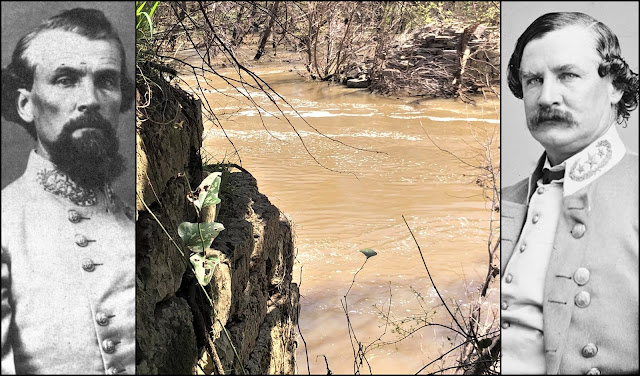
Nathan B. Forrest confronted Frank Cheatham at the Duck River on Dec. 18, 1864. 
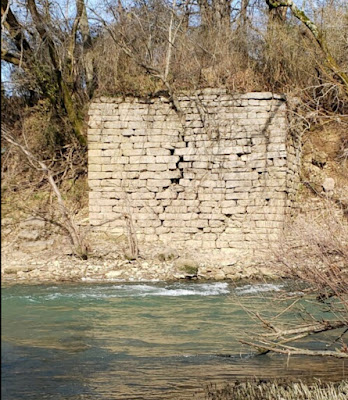
Above, looking south at the stone abutments for the bridge that once spanned the river
-- the Yankees destroyed it in 1862. (CLICK ON IMAGES TO ENLARGE.)


Like this blog on Facebook | Follow me on Twitter

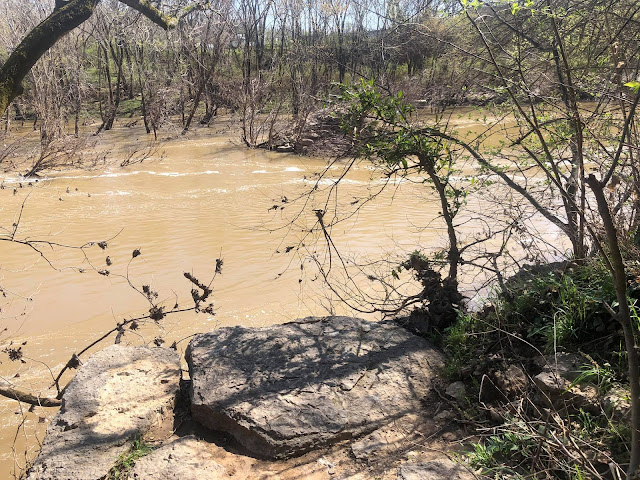
Nothing quite says “holiday spirit” like a visit to the place where bad-ass Nathan B. Forrest threatened another Rebel commander with a pistol. So, I slide down a muddy slope for a close-up view of the Duck River at Columbia, Tenn.—ho, ho, ho, this is the 157th anniversary of the bedraggled Army of Tennessee’s crossing here on a pontoon bridge in the aftermath of its two-day butt-kicking from George Thomas’ United States Army at Nashville.

View of the bridge abutment looking north.
(Photo courtesy Neal Pulley)
Scene on Dec. 18, 1864: Ornery Forrest, the notorious slave trader who mortally wounded a Confederate officer in Columbia during an 1863 confrontation, tells General Frank Cheatham he’s taking his cavalry boys over the Duck River pontoon bridge first. Cheatham: Like hell you are. Forrest being Forrest, he whips out a pistol and says: “If you are a better man than I am, General Cheatham, your troops can cross ahead of mine.”

Cheatham—whose horse Old Isham was buried in Coffee County (Tenn.) where they don’t even have a Starbucks—says something to the effect of, “I am not afraid of any man in the Confederacy!” General Stephen Lee, wounded in the foot by shell fragments the day before, climbs from his ambulance and calms the generals, who apparently apologize. Did they hug this one out? Did they chuckle over the "Dust-up  at the Duck"? Who crossed the river first? Who knows?

What’s undeniable is, if I slip into the rain-swollen Duck, Mrs. B becomes a widow and my girls lose a papa. I stay long enough to examine the stone abutment of the bridge that stood here until the Yankees destroyed it in 1862.

Ho, ho, ho, indeed.

Another view looking south at stone abutments.

 Have something to add (or correct) in this post? E-mail me here.


SOURCE

Monday, April 12, 2021

Horsin' around with nags of Frank Cheatham and the 'Wizard'

The grave of Old Isham, Confederate General Frank Cheatham's horse. 
(Cheatham photo: Library of Congress)

Like this blog on Facebook
 | Follow me on Twitter

WARNING! This post includes horse puns that may make you wince ... or worse. Some dialogue may be fabricated. Kernels of history, however, are included. 


Confession: I recently became obsessed with the ties between Civil War horses and their riders. 

“So stop horsin’ around then,” my wife told me, evidently reading my mind. “I don’t want to be a nag, but you really need to get out of the house, drive into the middle of nowhere, and visit the grave of Old Isham, the wartime horse of Frank Cheatham, the hard-drinking Confederate general who was no friend of the incompetent Braxton Bragg. Besides, I have a friend coming over.”

Your tour guide at the grave of Old Isham in
rural Coffee County, Tenn.
Stunned by my wife’s Civil War knowledge, I took her up on the suggestion demand. So I trotted to my 2015 Altima — the one with the below-par horsepower — for a ride to rural Coffee County, about an hour from Nashville. "What an idea!" I said with a smile. "Thanks, Mrs. B, you’re no nag at all."

Feeling my oats, I reached speeds as high as 55 mph on Interstate 24 East, zooming past the exit for Stones River battlefield in overdeveloped Murfreesboro and three or four or 25 Cracker Barrel restaurants.  At the Beechgrove/Bell Buckle exit, I debated whether to go left or right.

Go right and I could visit the area where British military observer Sir Arthur Freemantle witnessed the worst of America in 1863: a speech by an Arkansas politician at the Grand Review of the Army of Tennessee.

The mouthy pol had a "vulgar appearance," wrote the Brit, and delivered a "long and uninteresting political oration, and ended by announcing himself as a candidate for re-election. This speech seemed to me (and to others) particularly ill-timed, out of place, and ridiculous, addressed as it was to soldiers in front of the enemy. But this was one of the results of universal suffrage."

Old Isham's grave in a beautiful valley near unincorporated Beechgrove, Tenn.

My other alternative with a right turn was a visit to Bell Buckle, hometown of former Hee Haw star Molly Bee and the Moon Pie Capital of Tennessee. Bleh, moon pies always give me a stomach ache.

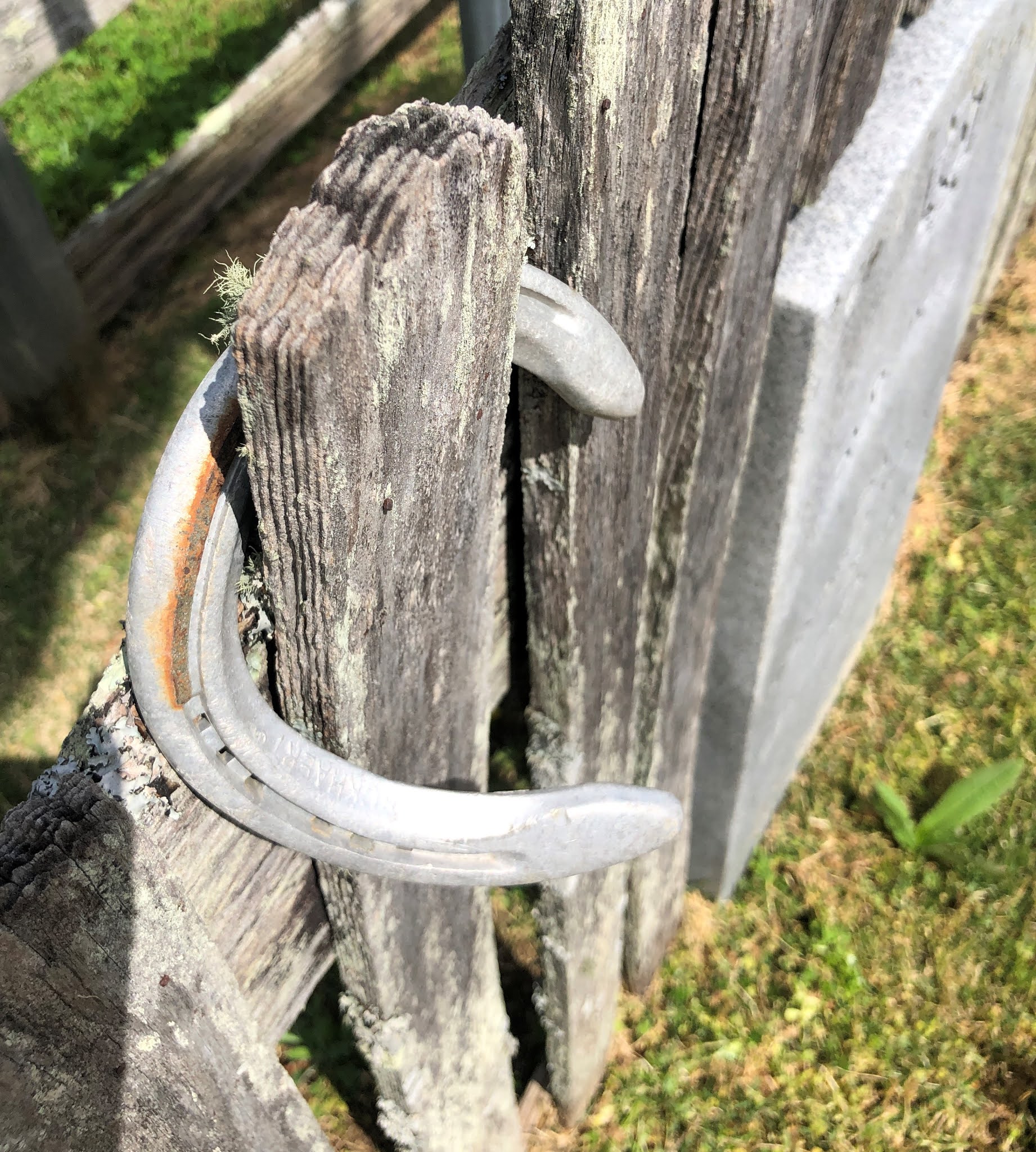
A horseshoe on a fence near
Old Isham's grave.
But I lean left, so that's the direction I headed ...and promptly got lost. Then I got angry when a guy tailgated me on a two-lane road. “Get off your high horse!” I screamed, eyes fixed straight ahead, arms firmly gripping the steering wheel, and all my windows rolled up.

Sweating profusely, I zigzagged through unfamiliar territory. (By the way, I didn’t spot one Starbucks in Coffee County. Weird.) Finally, I came to a “T” and correctly made a right on French Brantley Road, slowly driving past a small general store and a pig farm.

By the side of a lonely country road — aren’t they all? — I at last found the grave of Old Isham, who died in 1884, age 23 or 24. Master Frank died two years later, age 65. What a great place for a horse to rest for eternity: a gorgeous valley, swaths of green, a mansion atop a hill in the distance, and a few cows, some eyeing me warily. It was only marred by the name of the place: Starr Trek Farm. Ugh, I hate William Shatner commercials.

Old Isham’s neatly tended grave was bordered by a modest, wood fence adorned with small Confederate flags. Probably placed there by colt followers. (Sorry.) On a fence behind the grave marker, someone placed a horseshoe, a neat touch. I shot a panorama, took the requisite selfies, and silently thanked my wife for the spur-of-the-moment idea.

A bronze statue of Roderick, the favorite horse of Nathan Bedford Forrest.


Suitably inspired, I hoofed it over to Thompson's Station days later to check out the statue honoring Confederate General Nathan Bedford Forrest’s favorite mount, Roderick. (True story: At the H Clark Distillery in Thompson's Station, the experience manager told me that cows love their bourbon mash. “They come running for it," she said. "Then they just lay in the field, chilling.” Neigggh, you say? Hey, it's on my blog right here.)

Nathan Bedford Forrest,
the "Wizard of the Saddle."
(Library of Congress)
At the Battle of Thompson’s Station (Tenn.) on March 5, 1863, Roderick was wounded three times before he was guided to safety by the general’s 17-year-old son. Eager to return to the "Wizard of the Saddle," however, the chestnut gelding leaped over several fences, suffering a fatal bullet wound in the process. Forrest -- the notorious slave trader/cavalry genius -- supposedly wept beside the dying animal, who was buried on the battlefield.

If not for the roar of the crazy traffic on Columbia Pike (State Rt. 31), construction equipment, convenience store, and other modern development/schlock, heck, you're back in 1863 in Thompson's Station. I know that might, ahem, stirrup trouble with the pro-development crowd.

The bronze statue of Roderick stands roughly 200 yards from the circa-1820 Spencer Buford Mansion on Columbia Pike. The place has some very weird modern additions that ruined its historic integrity and forced its removal from the National Register of Historic Places. Sort of like sticking McDonald's hamburger wrappers on a work of art. 

Roderick’s remains may rest today somewhere near the statue, perhaps where an upscale development named after the horse will be built. I imagine that could provide fodder for future conversations: "Honey, the workers were digging in our flower garden, and they found this huge skull.”

"What?"

Ok, enough schtick. Let's keep history alive. 


-- Have something to add (or correct) in this post? Email me here.


SOURCE: 

-- Freemantle, Arthur James Lyon, Three Months In The Southern States: April-June, 1863, Published by John Bradburn, New York, 1864.
Tuesday, June 12, 2018

'Garden of Eden' to Arkansas: Patrick Cleburne's final ride

Killed at the Battle of Franklin, Confederate General Patrick Cleburne was buried at a cemetery
behind St. John's Church near Columbia, Tenn.  The Irish-born officer's remains were disinterred  
and re-buried in Arkansas in 1870. (CLICK ON ALL IMAGES TO ENLARGE.)

Like this blog on Facebook | Follow me on Twitter | My YouTube videos

For nearly six years, Confederate General Patrick Cleburne's remains rested among the oaks and magnolias in a church cemetery near Columbia, Tenn. A comrade of the Irish-born officer called the spot as "beautiful as the Garden of Eden — seemingly a fit place for pure spirits to dwell, and for the haunts of angels."

In late April 1870, a delegation from Arkansas arrived at St. John's Church Cemetery for the disinterment of Cleburne's body for reburial in his adopted state. The division commander had been killed during a charge against Union breastworks at Franklin on Nov. 30, 1864 — one of six Confederate generals to die of wounds suffered in the battle. Two of them — Otho Strahl and Hiram B. Granbury — also rested at the cemetery with Cleburne before they also were removed and re-buried elsewhere.

The delegation found Cleburne buried in a gray uniform in a "good state of preservation," according to a local newspaper, but the "coffin was very much decayed, and not a particle of flesh was remaining on the skeleton."

       PANORAMA: Patrick Cleburne was buried at left, by the trees nearest the church.
                                    (Click at upper right for full-screen experience.)
Until 1870, Cleburne was buried in the cemetery behind historic St. John's Church, built from 1839-1842.
Historical sign and Civil War Trails marker in front of St. John's Church.

On April 28, while en route to Helena, Ark., Cleburne's hometown, the group stopped at the train depot in Memphis for a procession through the city with his remains. If anyone doubted the popularity of the "Stonewall Jackson of the West," those doubts were erased that spring afternoon. While a band played a funeral march, Cleburne devotees placed the coffin containing "Arkansas' greatest soldier" in a hearse for a procession called "perhaps the finest ever witnessed in the city."

"The cosmopolitanism of an interior city was never more thoroughly illustrated than in the conduct of Memphis ... when its whole population went forth to tender a deserved tribute of respect to the memories and virtues of a great soldier," the local newspaper said, omitting any reference to its Black population.

"Helena and Memphis, Arkansas and Tennessee, yesterday wept side by side over Cleburne's bier," the Daily Appeal wrote, "and if Helena did not claim the body of the illustrious soldier, that it may find its final resting place within the city which was his home, Helena would concede to Memphis the trust of giving worthy sepulture to the most famous of all citizen soldiery of Arkansas."

War-time image of Confederate
 president Jefferson Davis, 

who was in the procession with
Patrick Cleburne's remains

in Memphis in 1870.
.
Through the heart of Memphis, the city's leading citizens — politicians, lawyers, merchants and others — joined the procession with Cleburne's hearse. Members of the city fire department, Confederate veterans' organizations, the Irish Literary Society, Fenian Brotherhood and Hibernian Mutual Relief Society also attended the solemn event. In an open carriage sat the most notable attendees, including ex-Confederate generals Frank Cheatham and Gideon Pillow and the former president of the Confederacy himself, 61-year-old Jefferson Davis.

His head uncovered, Davis stood at attention "straight as an Indian" as he watched Cleburne's coffin carried from the depot to the hearse. "The whole history of the past ten years," a reporter noted, "ran like a flash of lightning over Mr. Davis' expressive face. There was an intensity of feeling and thought written upon the strongly marked lineaments of his eloquent features that unfolded the profoundest emotions."

Added the reporter about Davis:
There were tears in his eyes and his face expressed sympathies, emotions and strong memories, seemingly shared by none of those who sat beside him. As a statesman and soldier — we read it there — Mr. Davis was relentless in direct paths of duty. The duty of the hour often drew a veil over the heart and the inner man, while the fate of an empire was dependent on his words and acts [and] was rarely revealed to the outer world. His heart was on his lips yesterday, and there was the tenderness of woman's love in his soulful eyes when Cleburne's encoffined body was borne into his presence."
Other ex-Confederates and a few U.S. soldiers followed the hearse, decorated with black plumes, crepe and green ribbon. Cleburne's remains lay in a "handsome metallic case, the lid of which was closely screwed down so that even a glance at the remains through the glass was impossible." A large cross wreath and white flowers rested atop his coffin.

Grave marker for Patrick
 Cleburne at Confederate Cemetery
 in Helena, Ark.
(Find A Grave)
A reporter found a crowd "composed of every nationality, all anxious to pay the last tribute of respect to the departed hero," an Arkansas newspaper noted. "The whole white population shared in the imposing demonstration. The streets along the line of march were thronged with people.

"Balconies and windows were everywhere filled with people who watched the hearse and its multitude of silent followers with eager interest," it added. "The bells were tolled, and skillful musicians burdened the air with mournful melody."

Street cars became hopelessly stuck along the route because of the huge crowd. "There were countless vehicles," the newspaper reported, "in which were seated the matrons and youth and beauty of the city."

After the procession ended, pallbearers removed Cleburne's coffin from the hearse and placed it aboard the steamer George W. Cheek, docked in the Mississippi River. Before the vessel departed for the trip downriver to Helena, hundreds of Cleburne's former army comrades crowded to view the coffin that contained "the sacred dust" of the beloved Confederate general.

 "At Helena the same ceremonies will be gone through with," the Arkansas newspaper noted, "when all that is left of the immortal Cleburne will be conveyed to their final resting place.

"Peace to his ashes."

 — Have something to add (or correct) in this post? E-mail me here.


SOURCES
  • Memphis Daily Appeal, April 29, 1870
  • The Southern Standard, Arkadelphia, Ark., May 14, 1870
  • Public Ledger, Memphis, Tenn., May 3, 1870
  • The Herald and Mail, Columbia, Tenn., April 28, 1870