Showing posts with label Columbia. Show all posts

Sunday, March 22, 2026

Then & Now in Columbia, Tennessee: Where the armies slept


Beechlawn Then & Now: The mansion stands on Pulaski Pike, south of Columbia, Tennessee.
The sketch was drawn by 7th Minnesota Chaplain Elijah Edwards, who stayed at Beechlawn.

                                   Like this blog on Facebook | My YouTube videos

Just before dark in December 1864, in the aftermath of the Battle of Nashville, Union soldiers rode up to a house on Pulaski Pike (present-day U.S. Route 31) south of Columbia and asked for shelter.

Among them was Elijah Evan Edwards, the 33-year-old chaplain in the 7th Minnesota Infantry. He recorded the experience in his diary and even sketched the house they made a temporary home: Beechlawn.

Chaplain Elijah Edwards
(Battle of Nashville
Trust)
Inside was the wife of a Confederate officer — her husband, Major Amos Wiley Warfield, apparently was off somewhere with John Bell Hood’s ragtag Army of Tennessee, retreating toward Alabama. She let them in.

"We accepted her hospitality as cheerfully as it was offered, posted a guard on the outside, and took our station within, where, for the first time in our campaigning, we were treated to the complete luxuries of civilized entertainment," Edwards wrote. 

Beechlawn had already served as headquarters for Hood during his advance on Nashville. Soon, Union General Andrew J. Smith would sleep here too.

Inside the circa 1853 home, a wounded Confederate told Edwards that Hood was a “butcher,” driving his men into slaughter at the Battle of Franklin. He had one leg left.

“[H]e could neither fight nor run away,” Edwards wrote. His war was over.

Here is the excerpt of Edwards' diary, as posted by the Huntsville [Ala.] Historical Review (April 1, 1973, Volume 3, No. 2).


Toward evening we reached Columbia and crossed the Duck River on a pontoon bridge. This is (at the present) a deep and rapid stream with high banks, and we had some difficulty in crossing. Columbia is an old town with a rather dilapidated appearance. There were many ornamental trees shading the streets, the most conspicuous being the holly and mimosa.

John Bell Hood made Beechlawn
his headquarters in the lead-up
to the Battle of Nashville.
As it was getting near evening, we began to look out for a camping place. All the dwellings in the town seemed to be inhabited, and we proceeded some distance into the country, hoping to find a deserted mansion like the one in which we had dined. But finding none, we drew up in front of a palatial brick home, the windows of which were already lighted, and applied for shelter. 

The tenant proved to be the wife of a Confederate Major Warfield, supposed to be somewhere in Hood’s scattered army. She received us most graciously, not only giving permission for us to remain, but cordially inviting us, assuring us that our presence would be a protection from the stragglers and robbers that were prowling in bands over the country.

We accepted her hospitality as cheerfully as it was offered, posted a guard on the outside, and took our station within, where, for the first time in our campaigning, we were treated to the complete luxuries of civilized entertainment. However, owing to the hard conditions of the war, the larder of our hostess was incomplete, we contributed liberally of our own, and spent a delightful evening in conversation.

U.S. Gen. Andrew J. Smith
slept in the Warfield mansion.
Facing page 41 is a hasty sketch of the Warfield Mansion. It has been well preserved from the fate that has been measured out to so many Southern homes, probably from the fact that, from its commodiousness, it has been generally selected as a headquarters for both armies. Thus, Hood, in his advance on Nashville, and retreat as well, made it his headquarters, and on the 24th Gen. A. J. Smith pillowed his weary head in the best bedroom.

Lastly came our squad of surgeons and chaplains. The building was thus protected from pillagers and from the torch. It has been used also in a small way as a hospital.

We found here a badly wounded Confederate soldier. He was quite friendly and communicative, and criticized his late commander Hood most unsparingly, pronouncing him a butcher for driving his men into the shambles at Franklin, where they were slaughtered like so many dumb animals. He believed for himself that the time for fighting was over. It certainly was for him, he musingly remarked, since he had but one leg left and could neither fight nor run away. He was a lieutenant.

There was a sick and badly disabled Confederate soldier in one of the outer buildings, that had been used as negro quarters (sic), whose feet were badly frozen. He told me that many of Hood’s soldiers were absolutely barefooted—and that, too, at a time when the temperature, a very unusual thing in the South, marked as low as 10 above zero. (I do not recall any such frosty weather as that, but can testify that while we were at Nashville it was frequently several degrees below freezing.) We left the Warfield home quite early this morning, with friendly adieus to the lady hostess and kind words to the wounded soldiers.

Friday, November 14, 2025

Can these cabins for enslaved linked to a Rebel general be saved?

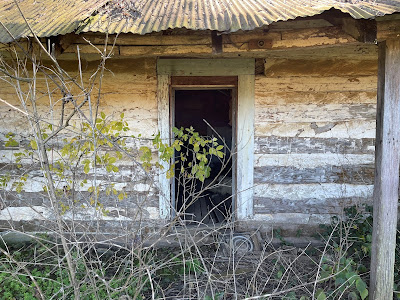
A slave cabin in "The Quarters," near downtown Columbia, Tenn. It is one of four.

                                        Like this blog on Facebook | My YouTube videos

A version of this column originally appeared in Civil War Times in 2024.

On a cloudless, deep-blue afternoon, I drive 45 miles south of Nashville to Columbia for a visit with one of my favorite people, Campbell Ridley. He’s an 80-year-old semi-retired farmer, U.S. Army veteran, rock-and-roll devotee and storyteller with a wit as sharp as the tip of a new bayonet.

Gideon Pillow,
circa 1870.
“How are you feeling?” I ask moments after stepping into his farm office.

Aside from mourning the recent death of Barney — his nine-year-old barn cat — Ridley says he feels fine, a state he attributes to “clean living and cheap beer.” He’s wearing tan Carhartts, brown work boots, a blue-checkered shirt, and, appropriately, a ballcap that reads “Life Is Good.”

Ridley’s roots run deep in Maury County, once one of the wealthiest counties in the state before the Civil War. He’s the great-great-grandnephew of Gideon Pillow, the Confederate brigadier general, Mexican War veteran, lawyer, politician and before the war one of the county’s foremost slaveholders. Ridley’s paternal great-grandfather, a leading citizen who farmed with mules, earned the nickname “Mule King” — fitting enough in Columbia, long known as the “Mule Capital of the World.”

When I need a history fix and a good laugh, I visit Ridley. We’ve sat together inside magnificent St. John’s Church — the slave-constructed plantation church built under the direction of Leonidas Polk and his brothers. It stands roughly a mile and a half southwest along Mount Pleasant Pike, just across from the field where the Episcopalian bishop and future Confederate lieutenant general once lived in a mansion called Ashwood Hall. There, we’ve admired the two massive gingko trees Polk imported from Japan and poked around the brick remnants of the kitchen of the mansion, destroyed by fire in 1874 and never rebuilt.

Irish visitor Liam McAlister, Campbell Ridley and I during a recent visit to "The Quarters."

'The Quarters' on Gideon Pillow plantation: Time capsules in Maury County, Tennessee

Today, though, we’re exploring far humbler construction. Near Ridley’s office and the east fork of Greenlick Creek stand four ramshackle cabins for the enslaved. “The Quarters,” he calls the property. His daughter, who lives in New Mexico, owns it along with a friend.

“I’ll take care of this until she puts me in a nursing home,” he says, half-joking.

Campbell Ridley explores a
cabin for the enslaved in
 "The Quarters."
In a way, these cabins are as much a part of Ridley as the land he has farmed for decades. As late as the 1990s, he tells me, these structures served as homes for poor Black farmhands and others — many of whom worked for the Ridleys.

“The woman who raised me lived here,” he says as we step inside one of the rickety cabins. Her name was Katie, a “wonderful” lady with a gift for frying chicken. The Ridley family employed her for more than three decades.

At the next cabin, ancient white paint clings to exposed exterior logs. Four modern wooden posts prop up the porch overhang above two large, well-worn walkway stones. On an exterior wall, a half-dozen old hangers dangle from a rusty nail. Above us, a corrugated-tin roof keeps nature at bay.

“That’s been there as long as I can remember,” Ridley says.

These antebellum cabins stand in stark contrast to Clifton Place, the brick manor house on the hill about 750 yards away. In the late-fall sunlight, the mansion almost seems to glow. Through the trees along the road to Ridley’s office, its imposing Ionic columns and limestone porch come into view.

From 1839 until the early Civil War years — when the U.S. Army confiscated the property — Clifton Place served as the centerpiece of Pillow’s vast plantation. The enslaved who lived in cabins at “The Quarters” produced his wealth by planting and harvesting cotton, hemp, corn and other crops and tending his cattle, sheep and hogs.

As one of Tennessee’s leading citizens, Pillow moved in elite circles. He counted James K. Polk, the 11th U.S. president, among his friends. After Polk left the presidency in 1849, he dined at Clifton Place with Pillow and his wife, Mary. Pillow dabbled in national politics himself, opposing secession at first in 1861 before relenting.

As a military man, however, Pillow consistently disappointed. During the Mexican War, he irritated superiors — including Winfield Scott — with his relentless self-promotion. No surprise, perhaps, given the massive painting of a heroic Pillow in uniform that greeted visitors in the entrance hall at Clifton Place.

In the Civil War, Pillow abandoned his post at Fort Donelson in February 1862, slipping away under cover of darkness before Ulysses Grant accepted the Confederates’ surrender. At Stones River nearly 10 months later, he led a brigade with mixed results. True or not, a story of the 55-year-old officer cowering behind a tree during the fight has stained his record ever since.

Scott — overall commander of the U.S. Army when the war broke out — certainly wasn’t a fan. In his 1864 memoirs, “Old Fuss and Feathers” described Pillow as “amiable, and possessed of some acuteness, but the only person I have ever known who was wholly indifferent in the choice between truth and falsehood, honesty and dishonesty… habitually boastful… at the total sacrifice of moral character.”

Inside cabins for the enslaved: A window into the past (Video)

Apparently used to keep the weather out, ancient newspapers cling to the walls of a slave cabin.

As we move from cabin to cabin (see video), Ridley reflects only briefly on his ancestor and the enslaved people who toiled for him.

“Just part of history,” he says.

We step gingerly into a cabin once home to field slaves. More than a year ago, Ridley had brush cleared from around these structures, making access easier. Each cabin is roughly 15 by 15 feet, with a small loft reached by a rickety ladder. Each has a post–Civil War room added to the rear. I’ve visited the site half a dozen times, yet I always see something new.

Ridley shines a flashlight beam onto a fireplace, revealing bricks and small dirt piles in an otherwise barren room. Fragments of newspaper — used as insulation by post-war inhabitants — speckle the walls. A dour-looking baseball player stares out from a March 1937 sports page. Beneath my feet, a decrepit floor, victimized by time and weather, crunches softly.

An interior view of one of the four remaining 
slave cabins that were occupied well
into the 20th century.
In another cabin, we find more traces of the 20th century: a swinging blade, peeling wallpaper decorated with blue-and-aqua flowers, a chipped ax handle, a single clothes hook on a door. Pasted to a back wall is a fragment of The New York Times from decades ago.

“Life in America,” the partial headline reads.

From the era of slavery, though, there is nothing visible: no pottery fragments, no glass shards, no etchings on the walls, no privy to mine for clues. Much is left to imagination.

So I wonder: Who were these men, women, and children?

What treatment did they receive from Pillow?

What were their names?

The 1870 census offers hints. “Sarah” and “Randall,” listed as farmhands for the Pillow family, appear in deeds from as far back as the 1840s.

I wonder what became of the people enslaved at Clifton Place. Are they buried in the cemetery in the woods at the base of Ginger Hill — the remote graveyard Ridley showed me months ago? Or in the rear section of St. John’s Church Cemetery, away from the graves of white parishioners? Or perhaps in one of the countless family plots scattered across the county.

And I wonder what will become of these cabins near the east fork of Greenlick Creek. Ridley wants to save them, but doing so would require expertise and probably hundreds of thousands of dollars.

What might a professional archaeologist uncover here?

'The most complete 19th-century plantation complex anywhere'

I also wonder about the future of Clifton Place, where Ridley’s paternal grandfather lived until 1949. The family held onto it for years afterward.

“I watched television in there for the first time in my life,” Ridley says, recalling family gatherings under 16-foot-high ceilings in the 12-room Greek Revival mansion.

In 1972, a Kentucky Fried Chicken magnate named John R. Neal bought the property from the Ridley family. He and his wife, Linda, attempted a restoration, but the project proved daunting. “We saw the white columns, the Gone With the Wind atmosphere,” she told a reporter in 1986. “We didn’t see the cracks, the structural problems.”

A view of the long-unoccupied Clifton Place
estate of Gideon Pillow. This is private
property. Do not trespass.
The estate includes the original detached kitchen, carriage house, ice house, law office, spring house, blacksmith shop and quarters for “house” slaves. Inside the Pillow-era smokehouse stand the original poplar chopping block and “ham logs” — hollowed poplar logs once used for salting hams. The smoky aroma still lingers.

A researcher once called Clifton Place “the most complete 19th-century plantation complex anywhere.”

Neal died in 2018, but his family still owns the property. The mansion, however, has stood unoccupied — and inaccessible to the public — for more than a decade. Like the nearby slave cabins, it could vanish without major preservation efforts.

Time may not be on our side. Across Mount Pleasant Pike from Clifton Place, developers plan a massive subdivision: “Seven hundred fifty houses on 450 acres,” Ridley says.

Oh my. What will I see here a decade from now?

Places like these don’t disappear all at once — they vanish slowly, board by board, memory by memory, until all that’s left is what someone bothered to write down. I suppose that’s why I keep returning to them. To witness what remains. And to remember what shouldn’t be forgotten.


SOURCES

— Scott, Winfield, Memoirs of Lieut.-General Scott, New York, Sheldon and Company, 1864, Vol. II

— The Tennesseean, Aug. 10, 1986, Page 113

Sunday, July 21, 2024

Tales from the road: Cockfighting, cats and mansion exploring

Bethel Place in Columbia, Tenn.

                                      Like this blog on Facebook | My YouTube videos

Saturday’s history adventure begins in the farm office of my early 80ish pal Campbell Ridley, a quasi-town historian of Columbia, Tenn., aficiando of Arby’s jamocha milkshakes and master of playful cats named Marco and Polo.

Ridley, a descendant of Confederate Brig. Gen. Gideon Pillow, has a delightful sense of humor that he deploys liberally with friends, family and assorted hangers-on. Exhibit 1: A sign that greets visitors on a wall in his farm office.

Original blue poplar floors in the mansion
“Life’s journey is not to arrive at the grave safely in a well preserved body,” it reads, “but rather to skid in sideways, totally worn out, shouting, ‘Holy shit, what a ride!’”

I vote yes!

Over the past several years out here in Civil War history-rich Maury County, roughly 50 miles south of downtown Nashville, I have explored with Ridley the remains of Ashwood Hall, the mansion of Confederate Gen. Leonidas Polk and his brother that fire destroyed in 1874; walked gingerly through slave cabins on his daughter’s property; examined weed-choked graves at an off-the-beaten path cemetery at the base of Ginger Hill and breathed in the awesome aroma in the ancient smokehouse at Pillow’s Clifton Place plantation.

A cockfighting chair
On this fabulous afternoon, we make our way in Ridley’s truck to Bethel Place, the circa-1845 Greek Revival-style mansion of Gideon Pillow’s youngest brother, Jerome Bonaparte Pillow. Ridley’s first cousin, Eva James, has called it home for the past 60 years. She lives here with her husband, Don.

Inside, I marvel at the original walnut doors and blue poplar floors, outsized paintings of family members and massive mirrors. The 14-foot high ceilings spark a discussion of the ungodly sum it must cost to heat/cool this huge home. The place even has an elevator, added long ago by Eva James' father.

But the piece de resistance of my inside tour is a mundane piece of brown furniture in the parlor.

“This,” Ridley says, “is a cockfighting chair.”

Folks sat in the chair, flipped down the tray and placed their bets on it on the fighting fowl — an activity unfamiliar to me growing up in gritty Mount Lebanon, Pa.

Outside, I marvel at the Ionic columns — yup, they’re original, too — and the antebellum stone wall, the handiwork of Jerome Pillow’s slaves. Naturally, I send a drone up in the air to take in the Pillow era outbuildings — the kitchen, law office and smokehouse — as well as the mansion from 250-plus feet.

A drone view of Bethel Place shows (clockwise from left) the law office, smokehouse, kitchen
 and mansion.

Attached to a stone pillar, a metal ring intrigues us. Did Gideon Pillow — a goat of the Rebels’ defeat at Fort Donelson in February 1862 — tie up his horse at this spot while visiting Jerome? I wonder where the armies skirmished near Bethel Place, a few miles from the Columbia square.

Back at the farm office, Ridley HQ, my tour guide whips out his phone to show off a video of Marco and Polo scrapping like professional wrestlers.

What a great day.

Let’s keep history and catfighting — but not cockfighting — alive. 👊

Marco ... or is this Polo?
Polo ... or is this Marco?

Friday, February 18, 2022

Oh my, those great pies at Katiepie's in Columbia, Tennessee

Katiepie's blueberry pie. Yum.

Pal Campbell Ridley enjoyed a slice
of coconut pie at Katiepie's.
On my Civil War travels, I have eaten at some fine places — Dan’s Taphouse in Boonsboro, Md.; Bonnie’s at The Red Byrd in Keedysville, Md.; Slick Pig Barbecue in Murfreesboro, Tenn,; Hagy’s Catfish Hotel in Shiloh, Tenn., and some barbecue place near Cold Harbor, Va., that I didn’t write down in a notebook. But few match the food at Katiepie’s Country Kitchen in Columbia, Tenn. It’s where the locals eat. ALWAYS eat where the locals do.

During a recent breakfast at Katiepie’s with my friend Campbell Ridley, I watched him eat a slice of coconut pie to die for. He also got a large hunk of a blueberry pie to go. Oh, my. (Ridley, a farmer, is a descendant of Confederate General Gideon Pillow. Read about him in my Civil War Times column.)

I once walked into Katiepie’s for breakfast at 1:53 p.m. — it closes at 2. Still got served, and fast. Banks Civil War blog rating: ★ ★★★ ★

Sunday, December 19, 2021

Where Forrest whipped out a pistol on another Rebel general

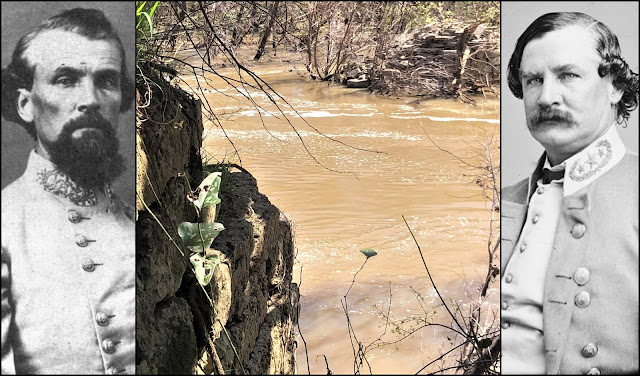
Nathan B. Forrest confronted Frank Cheatham at the Duck River on Dec. 18, 1864. 
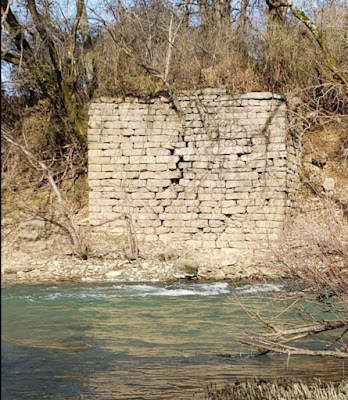
Above, looking south at the stone abutments for the bridge that once spanned the river
-- the Yankees destroyed it in 1862. (CLICK ON IMAGES TO ENLARGE.)


Like this blog on Facebook | Follow me on Twitter

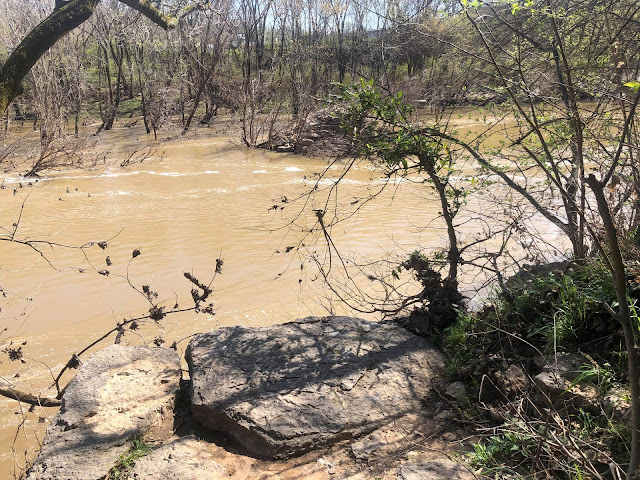
Nothing quite says “holiday spirit” like a visit to the place where bad-ass Nathan B. Forrest threatened another Rebel commander with a pistol. So, I slide down a muddy slope for a close-up view of the Duck River at Columbia, Tenn.—ho, ho, ho, this is the 157th anniversary of the bedraggled Army of Tennessee’s crossing here on a pontoon bridge in the aftermath of its two-day butt-kicking from George Thomas’ United States Army at Nashville.

View of the bridge abutment looking north.
(Photo courtesy Neal Pulley)
Scene on Dec. 18, 1864: Ornery Forrest, the notorious slave trader who mortally wounded a Confederate officer in Columbia during an 1863 confrontation, tells General Frank Cheatham he’s taking his cavalry boys over the Duck River pontoon bridge first. Cheatham: Like hell you are. Forrest being Forrest, he whips out a pistol and says: “If you are a better man than I am, General Cheatham, your troops can cross ahead of mine.”

Cheatham—whose horse Old Isham was buried in Coffee County (Tenn.) where they don’t even have a Starbucks—says something to the effect of, “I am not afraid of any man in the Confederacy!” General Stephen Lee, wounded in the foot by shell fragments the day before, climbs from his ambulance and calms the generals, who apparently apologize. Did they hug this one out? Did they chuckle over the "Dust-up  at the Duck"? Who crossed the river first? Who knows?

What’s undeniable is, if I slip into the rain-swollen Duck, Mrs. B becomes a widow and my girls lose a papa. I stay long enough to examine the stone abutment of the bridge that stood here until the Yankees destroyed it in 1862.

Ho, ho, ho, indeed.

Another view looking south at stone abutments.

— Have something to add (or correct) in this post? E-mail me here.


SOURCE

Sunday, November 14, 2021

An NFL captain's roundabout connection to a Rebel general

Farmer Campbell Ridley stands near a slave cabin where sharecropper Katy Yokley,
great-grandmother of NFL standout Dont'a Hightower, lived.

Like this blog on Facebook | Follow me on Twitter

While a barn cat named Barnee roamed his workshop, farmer Campbell Ridley and I swapped Civil War stories, discussed cracklings, chitlins and bean planting, and reminisced about recent visits to his Columbia, Tenn., farm. Then we and two historians walked 75 yards or so to examine rare, historic treasure with a roundabout connection to an NFL standout.

On Campbell's property, near a small bridge over the East Fork of Green Lick Creek, stand four slave cabins — survivors on the remarkably intact plantation of Confederate Brigadier General Gideon Pillow, a wealthy planter and a Ridley ancestor. (Private property. Read more here.)

Within site of Pillow's mansion called Clifton Place, we explored inside one of the cabins — gingerly stepping on the creaky wooden floor, picking through artifacts, and wondering about the lives of the enslaved. The visit to "The Quarters," slave row, was fascinating ... and humbling.

Turn up the volume high for optimal experience.
Rachael Finch, senior director of preservation and education at the Heritage Foundation
 of Williamson County, explores the inside of a slave cabin 
— one
of four standing on farmer Campbell Ridley's property.
A brick fireplace in one of the cabins.
Ancient logs of the slave cabin where sharecropper Katy Yokley lived. She was
NFL star Dont'a Hightower's great-grandmother.

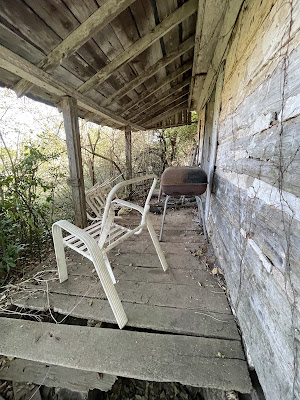
Long after the Civil War, a sharecropper named Katy Yokley lived in another one of the small dwellings. Abandoned today and nearly obscured by trees and undergrowth, the slave cabin was partially encased decades ago with cinder blocks. On the decrepit porch stood two plastic chairs, an old grill, and a wooden rocker—I wonder if it belonged to Ms. Katy. Outside, we examined the ancient, log walls.

The porch of the slave cabin where NFL standout
Dont'a Hightower's great-grandmother 
lived. The home is abandoned.
“Katy raised me,” said Ridley, whose family has lived in the area for generations. Then he dropped another gem: Ms. Yokley, long gone, also was the great-grandmother of Dont’a Hightower, the New England Patriots' linebacker and team captain, who starred at Alabama. He’s from Lewisburg, Tenn. Hightower’s dad recently visited the cabin.

Now this is a connection worth exploring further.

If he were alive today, Gideon Johnson Pillow would post a daily selfie to Facebook, craft look-at-me entries on his blog about his Corvette collection, flood Instagram with images of his circa-1840, 12-room, Greek Revival-style mansion, and tweet thousands of times about his hemp crop, which made him one of Tennessee's wealthiest men.

On Clifton Place tours on YouTube — the planter would be an influencer, of course — Pillow surely would brag about the full-length painting in the foyer of ... Gideon Pillow in a military uniform. (Hmmm, whom does this remind us of...?  😄)

The scouting report on Pillow from my historian friends Tom Price and Rachael Finch was not kind.

"Huge chip on his shoulder."

"Vain." 

A painting of Gideon Pillow at the Tennessee State
 Museum in Nashville.
"Would knock down whoever he needed to to get what he wanted." 

"Anything he posted to Instagram would be perfectly curated," which is probably the first time those nine words were typed referencing any Civil War general. 

Pillow's contemporaries also were scornful. In mid-February 1862, Ulysses Grant threw massive shade Pillow's way while discussing terms of surrender of the Confederate garrison at Fort Donelson with Rebel General Simon Bolivar Buckner, his old friend. The previous night, Pillow — whom Grant knew from the Mexican War — escaped across the Cumberland River in a small boat.

Buckner: “He thought you’d rather get ahold of him than any other man in the Southern Confederacy.”

Grant: "Oh, if I had got him, I’d let him go. He will do more good commanding you fellows.”

In his 1864 memoirs, Winfield "Old Fuss and Feathers" Scott — commanding general of the U.S. Army when the Civil War broke out — described Pillow as "amiable, and possessed of some acuteness, but the only person I have ever known who was wholly indifferent in the choice between truth and falsehood, honesty and dishonesty; ever as ready to attain an end by the one as the other, and habitually boastful of acts of cleverness at the total sacrifice of moral character."

Not a ringing endorsement.

At Fort Donelson (Feb. 13-16, 1862) and Stones River (Dec. 31, 1862-Jan. 2, 1863), Pillow’s generalship was underwhelming at best. After Stones River, he spent much of the rest of the war  recruiting.

Clifton Place, the circa-1840 mansion built for Gideon Pillow. I took this mansion
image during an escorted visit in February 2021.
The brick stable (foreground) at Gideon Pillow's plantation. The 12-room Clifton Place mansion
 appears in the left background. PRIVATE PROPERTY: Do not trespass.

Like most wealthy men in the South, Pillow owned slaves. Seventy toiled at his plantation, about a day's ride from Columbia back in the day. Ten or so served their master's domestic needs (cooking, cleaning, caring for children), and were housed in crude cabins near Clifton Place. The rest, who lived on slave row, worked the fields. Enslaved labor made Pillow a millionaire.

The exterior of one of the four surviving slave cabins.
Befitting his personality, Pillow spared little expense to create a showplace plantation. He added flourishes such as a brick stable and detached law office. The slave cabins we examined included brick fireplaces, an extravagance not seen at most other plantations, according to Finch. 

"He wanted everyone to know he had money," she said.

For Pillow, the effort to impress was partly to keep up with the Joneses... or Polks, in his case. Just down Mount Pleasant Pike were the impressive plantations of the Polk brothers — Ashwood Hall, perhaps the most fabulous plantation mansion in Tennessee, was originally built for Leonidas Polk, who also became a Confederate general. ("The Fighting Bishop" lived until June 14, 1864, when he was nearly sliced in two by Yankee artillery at Pine Mountain, Ga.)

Pillow, who went bankrupt after the war, died in 1878. If he were able to post, blog or tweet today, he could brag about something else — the state of his plantation complex.  

"One of the most intact ... in Middle Tennessee," Finch said of the private property. 


-- Have something to add (or correct) in this post? Email me here.


SOURCE
  • Hamilton, James. The Battle of Fort Donelson. T. Yoseloff, South Brunswick, N.J., 1968. 

Tuesday, October 26, 2021

An afternoon at Davis Ford, where Hood crossed Duck River


On Saturday afternoon, I visited super-remote Davis Ford, roughly five miles from Columbia, Tenn., where 25,000 of John Bell Hood’s Army of Tennessee soldiers crossed the Duck River on Nov. 29, 1864. My guide was local expert Neal Pulley, who's deep into research for a book on the Battle of Columbia. Among the soldiers to cross the Duck long ago was Sam Watkins, who wrote the classic Civil War memoir, Co. Aytch. Earlier this year, I visited with Watkins' great-granddaughter, Ruth Hill. (Turn up volume for optimal experience. Problematic WiFi connectiion.)

Friday, September 24, 2021

A visit to 'The Quarters,' cabins of Gideon Pillow's enslaved

Farmer Campbell Ridley explores one of the slave cabins on his property.
The exterior of a log slave cabin.

Like this blog on Facebook | Follow me on Twitter

Gideon Pillow
Steps from the east fork of Green Lick Creek in Columbia, Tenn., stand log cabins where the enslaved of Gideon Pillow lived. A wealthy politician, lawyer, speculator and underwhelming Confederate major general, Pillow resided at Clifton Place, a magnificent mansion that still stands astride Mount Pleasant Pike. 

On Thursday afternoon, farmer and friend Campbell Ridley—a Pillow descendant—showed me and Cliff Roberts of the General Barton & Stovall History/Heritage Association the interior of one of the slave cabins, tucked on his property behind trees, brush and weeds. We didn’t go inside another slave cabin, but examined its brick chimney and deteriorating porch.

Pillow was one of the wealthiest men in Maury County—one of the wealthiest counties in the country before the Civil War. Much of that wealth was accumulated because of those who toiled for him—the enslaved who lived in these cabins.

Ridley, whose family has farmed in the area for generations, has long called these structures “The Quarters.” In addition to slaves, the cabins housed workers on the farm into the 20th century. Ridley also farms the land where Ashwood Hall—one of the most magnificent residences in Tennessee—once stood. The fabulous plantation mansion, owned by Leonidas Polk, “The Fighting Bishop” of the Confederacy, and later his brother, was destroyed in an 1874 fire. I wrote about it for Civil War Times magazine. 

Farmer Campbell Ridley slips inside the door.
Ridley examines the interior of a cabin, once occupied by slaves and later by workers
on his family farm.
Evidence of a fireplace in the cabin.
The deteriorating porch on another cabin.
The original, brick chimney.

-- Have something to add (or correct) in this post? Email me here.

Sunday, July 11, 2021

A visit with great granddaughter of Sam Watkins of Co. Aytch

Ruth Hill McAllister at the grave of Sam Watkins, her great grandfather.

Like this blog on Facebook | Follow me on Twitter

Confession: I have not read Company Aytch, Confederate soldier Sam Watkins’ classic memoir, which puts me in a minority among my Civil War friends, acquaintances and hangers-on, according to an informal poll. I promise to rectify that, especially now that I have a copy of the latest version, signed by Watkins' great granddaughter herself.

This image of Sam Watkins hangs in Ruth Hill McAllister's
house. Watkins died in 1901.
On a steamy Tennessee afternoon, Ruth Hill McAllister and I meet in-person for the first time, at Zion Presbyterian Church Cemetery in Columbia, where the remains of her famous ancestor rest along with his wife, Jennie. Clearly, Watkins – one of the “stars” of Ken Burns’ 1990 Civil War documentary – is not forgotten. Atop the 1st Tennessee veteran’s gray-granite marker sit tokens of remembrance left by visitors: pennies, nickels, dimes — even a pen knife, which seems a bit odd. 

Behind us stands Zion Presbyterian Church, Watkins’ longtime place of worship built, in part, by slaves. And steps from his grave stands one of those ubiquitous (and addictive) Civil War Trails tablets. It includes this quote from Company Aytch: 

"America has no north, no south, no east, no west. The sun rises over the hills and sets over the mountains, the compass just points up and down, and we can laugh now at the absurd notion of there being a north and a south. We are one and undivided." 

Too bad today's America is not "one and undivided." But that’s a discussion for another day. Ruth, as sweet a lady as you’ll ever meet, invites me to her 19th-century house. There, I enjoy two slices of McAllister's freshly baked banana coffee cake with sweet tea, bond with her rambunctious but friendly dog and chat about one of the Civil War’s more fascinating characters. 

Visitors leave tokens of remembrance on Sam Watkins' gravestone in Columbia, Tenn.
Zion Presbyterian Church, which Sam Watkins attended, still holds services.

Thirty-one years ago — yikes! — Ruth's family sat glued to the TV for Burns' mini-series, which may have shaded the truth a bit (see: "Gettysburg/Confederates shoes story") but opened the eyes of millions to America's greatest conflict. (Lord, I can't get enough of former newspaperman Charles McDowell's Watkins voiceover.)

An ancient family Bible includes a list of Watkins births.
“My parents just hoped to live long enough to see the special,” Ruth tells me. (They did.) "We felt honored Sam was a part of it."

Watkins, who died in 1901, never dominated family discussions while McAllister was growing up. But her father had a habit of writing down notes from conversations with his mother — Watkins' daughter, Ruth's grandmother — about him on the backs of envelopes. Some of those scribblings are stuffed in the nooks and crannies of McAllister's beautiful house. (Ruth also has the ancient, Sam Watkins-signed family Bible, a neat relic to examine.)

Samuel Rush Watkins, who was promoted from private to corporal in 1864, seemed to be everywhere in the Western Theater — battles at Shiloh, Perryville, Murfreesboro/Stones River, Nashville and elsewhere. But it’s his folksy, often-eloquent writing (and razor-sharp sense of humor) that leaves me slightly in awe. A few Watkins-isms: 

  • "A soldier's life is not a pleasant one. It is always, at best, one of privations and hardships. The emotions of patriotism and pleasure hardly counterbalance the toil and suffering that he has to undergo in order to enjoy his patriotism and pleasure. Dying on the field of battle and glory is about the easiest duty a soldier has to undergo."
  • A close-up of Sam Watkins' gravestone -- and metal CSA
    marker next to it -- in Zion Presbyterian Church Cemetery
    in Columbia, Tenn.
    "I always shoot at privates. It was they who did the shooting and killing, and if I could kill or wound a private, why, my chances were so much the better. I always looked upon officers as harmless personages."
  • "General [Braxton] Bragg was a disciplinarian shooter of men, and a whipper of deserters. But he was not any part of a General. As a General he was a perfect failure."
  • "The lice and the camp itch were the greatest luxuries enjoyed by the private soldier. Ah, reader, they were luxuries that were appreciated. A good scratching was ecstasy. It was bliss."
  • "The majority of Southern soldiers are today the most loyal to the Union. Many disown the Southern cause and have buried in forgetfulness all memory of the war."
Initially published in 1882, Company Aytch sold for $1.25 in hardback, 75 cents in paperback. Watkins even gave away some of the 1,500-book printing run as wedding gifts. He intended to re-publish the book, marking up a first edition with changes, corrections and additions in a "sometimes indecipherable scrawl," according to McAllister. But her great grandfather never did publish another edition.

Ruth Hill McAllister gave me a copy
of Company Aytch. Signed it, too.
That marked-up treasure remained with Ruth's Uncle Paul for decades. Immediately after his death in 1997, however, no one could find it. Her cousin Jenny eventually discovered the pencil-smudged, brittle copy in a box. Later, when Jenny asked Ruth if she were interested in buying it from her, McAllister was "delighted" and paid a "handsome price." It's now in a bank vault.

The latest edition, the only authorized one that includes Watkins' changes, corrections and additions, was published in 2011, with Ruth's impetus. "It is my sincere hope," McAllister writes in the introduction to that edition, "that historians and other readers will find it of some interest and benefit." Before my departure, Ruth gives me a copy as a gift.

Now if you will please excuse me, I have some reading to do.

-- Have something to add (or correct) in this post? Email me here.

Sunday, March 14, 2021

Wedding crasher? These 1863 nuptials went off without a hitch

Confederate Brigadier General Frank Crawford Armstrong, shown in a wartime image before
he lost most of his hair, married a 19-year-old at Rally Hill in Columbia, Tenn.,
on April 27, 1863. (Armstrong photo: Alabama State Archives)

Like this blog on Facebook
 | Follow me on Twitter

At a Tennessee mansion on the evening of  April 27, 1863, a Yankee-turned-Rebel officer married the great-niece of a U.S. president in a ceremony attended by the Confederacy's most notorious womanizer. Thankfully, the nuptials turned out to be more Gone With The Wind than Wedding Crashers.

Rally Hill, a circa-1830s house in Columbia, was site for the union of 27-year-old ladies man Frank Crawford Armstrong, a brigadier general in the Confederate cavalry, to 19-year-old Maria Polk Walker. The impressive, brick manor was the home of James Walker, the teenager's grandfather and brother-in-law of 11th president James Polk, who briefly lived nearby decades earlier. (The prez — Maria's great-uncle — died in Nashville in 1849.) Maria, also known as Mary, was the daughter of a Confederate officer.

Historical marker in front of the privately owned mansion
 on West 8th Street in Columbia, Tenn.
Armstrong, who was born in the Choctaw Agency in Indian Territory in 1835, began the war leading a company of Union cavalry at the First Battle of Bull Run on July 21, 1861. He resigned his commission less than three weeks later to join the Confederacy. Because his resignation did not go into effect until Aug. 13, 1861, he technically was on both sides simultaneously. Crazy.

I admired Rally Hill from afar — damn, I wish Vince Vaughn had joined me. My oh-so-brief search of the grounds turned up no beer cans or kegs, champagne glasses, stale cake, fancy napkins that most guys despise or other refuse from the long-ago wedding reception. An intimidating iron gate prevented an up-close inspection of the privately owned, 6,000-square-foot-plus residence on West 8th Street. (It sold for $740K in May 2020.) The mansion stands about 150 yards from St. Peter's Episcopal Church, where Patrick Cleburne's remains briefly rested in 1870. (A long story.)

Armstrong not only had a way with women; he received an A+ rating as a military man from at least one Confederate sympathizer: "... the finest cavalry officer in our service," "J.P.P" wrote to a Memphis newspaper following the Confederates' raid in late August 1862 at Middleburg, Tenn. 

"[Armstrong] handles cavalry on the field as well as [Pierre] Beauregard handles infantry," continued "J.P.P," perhaps a Confederate soldier or an extremely close Armstrong relative. "His men are devoted to him beyond anything I ever heard of. On the field he is cool and collected, and moves his men about as Morphy moves his chessmen. Take my word for it, Frank Armstrong, brigadier general of cavalry, is one of the greatest captains of this war, and with opportunity, will place himself with Stonewall Jackson, or in front of him."

Now that's an endorsement! 😏

The back side of the mansion. No refuse from the long-ago wedding was discovered.

Maria — whom I suspect may have been camera shy — was enamored with Armstrong, too. She met him in the fall of 1862 while on a trip in the Deep South with her uncle, Colonel Sam Walker. Maria's father, Joseph, was a colonel in the 2nd Tennessee. After the couple were engaged, Maria returned to Tennessee. But she "became greatly impaired from the shock" of reports of Armstrong's supposed wounding or demise while he was off killin' and fightin' in Mississippi and elsewhere. (He was fine.) So, Maria begged to be allowed to travel south to marry the former Yankee.

Earl Van Dorn, womanizer.
(Photographic History of
the Civil War in Ten Volumes,
Volumn 2
)
"This her father would not consent to," according to a Walker family genealogy, "but later when word came that General Armstrong's Brigade would be camped near Columbia, where Colonel [Joseph] Walker's parents lived, he gave his consent for Maria to go through the lines and be married at his mother's home. It was a long and hard trip made overland in any and all kind of conveyances, through Federal and Confederate lines."

Roughly 200 guests attended the Walker-Armstrong military wedding, including at least two Confederate generals: notorious slave trader/cavalry genius Nathan Bedford Forrest and Earl Van Dorn, the rascal who had only 10 days to live. On May 7, 1863, the 42-year-old general was shot and killed by a 51-year-old Spring Hill, Tenn., physician/politician/farmer whose 25-year-old wife apparently was having an affair with the married father of five children. He cheated on Caroline Van Dorn with other women, too. (I wonder if the Armstrong-Walker wedding invitations came with a warning to female guests: Expect unwanted attention from Van Dorn. Known as "terror of ugly husbands and nervous papas.")

Follicly challenged
Frank Armstrong
later in life. He died in Maine
 in 1909.
(Find A Grave)
Cavalry officers at the Gone With The Wind-like affair wore their full, gray military duds, complete with yellow trimmings. "Almost every gentlemen present was in uniform," according to an account. Maria was given away by her grandfather, who weeks earlier had celebrated his 50th wedding anniversary. Wedding attendants were staff officers of Armstrong and Van Dorn, who pushed for Frank's promotion from colonel to brigadier general in 1863. (Sadly, Rhett Butler apparently skipped this event.) One guest described the contrast between the bride, a brunette, and "the blonde appearance of her handsome husband." (Later in life, Armstrong, was, ah, follicly challenged.)

News of the nuptials didn't exactly travel at warp speed to the Confederate capital. On June 26, 1863, the Richmond (Va.) Enquirer reported: "The dashing and gallant Brigadier General Frank C. Armstrong, who ever since the opening of the war, has been playing the deuces with ladies' hearts, was married in Columbia, Tenn...."

Immediately after the wedding, officiated by the St. Peter's Episcopal Church reverend, a brigade band played a "familiar air." You-know-who probably tuned them out if that was Home, Sweet Home.

"It was by far the largest body of cavalry ever seen together at that time," the guest recalled of the wedding,"and was a very impressive and imposing function."

No word if Earl Van Dorn got handsy with any of the female attendees.

-- Have something to add (or correct) in this post? E-mail me here.


SOURCES