Beechlawn Then & Now: The mansion stands on Pulaski Pike, south of Columbia, Tennessee. The sketch was drawn by 7th Minnesota Chaplain Elijah Edwards, who stayed at Beechlawn.
Just before dark in December 1864, in the aftermath of the Battle of Nashville, Union soldiers rode up to a house on Pulaski Pike (present-day U.S. Route 31) south of Columbia and asked for shelter.
Among them was Elijah Evan Edwards, the 33-year-old chaplain in the 7th Minnesota Infantry. He recorded the experience in his diary and even sketched the house they made a temporary home: Beechlawn.
Chaplain Elijah Edwards (Battle of Nashville Trust)
Inside was the wife of a Confederate officer — her husband, Major Amos Wiley Warfield, apparently was off somewhere with John Bell Hood’s ragtag Army of Tennessee, retreating toward Alabama. She let them in.
"We accepted her hospitality as cheerfully as it was offered, posted a guard on the outside, and took our station within, where, for the first time in our campaigning, we were treated to the complete luxuries of civilized entertainment," Edwards wrote.
Beechlawn had already served as headquarters for Hood during his advance on Nashville. Soon, Union General Andrew J. Smith would sleep here too.
Inside the circa 1853 home, a wounded Confederate told Edwards that Hood was a “butcher,” driving his men into slaughter at the Battle of Franklin. He had one leg left.
“[H]e could neither fight nor run away,” Edwards wrote.
His war was over.
Here is the excerpt of Edwards' diary, as posted by the Huntsville [Ala.] Historical Review (April 1, 1973, Volume 3, No. 2).
Toward evening we reached Columbia and crossed the Duck River on a pontoon bridge. This is (at the present) a deep and rapid stream with high banks, and we had some difficulty in crossing.
Columbia is an old town with a rather dilapidated appearance. There were many ornamental trees shading the streets, the most conspicuous being the holly and mimosa.
John Bell Hood made Beechlawn his headquarters in the lead-up to the Battle of Nashville.
As it was getting near evening, we began to look out for a camping place. All the dwellings in the town seemed to be inhabited, and we proceeded some distance into the country, hoping to find a deserted mansion like the one in which we had dined. But finding none, we drew up in front of a palatial brick home, the windows of which were already lighted, and applied for shelter.
The tenant proved to be the wife of a Confederate Major Warfield, supposed to be somewhere in Hood’s scattered army. She received us most graciously, not only giving permission for us to remain, but cordially inviting us, assuring us that our presence would be a protection from the stragglers and robbers that were prowling in bands over the country.
We accepted her hospitality as cheerfully as it was offered, posted a guard on the outside, and took our station within, where, for the first time in our campaigning, we were treated to the complete luxuries of civilized entertainment.
However, owing to the hard conditions of the war, the larder of our hostess was incomplete, we contributed liberally of our own, and spent a delightful evening in conversation.
U.S. Gen. Andrew J. Smith slept in the Warfield mansion.
Facing page 41 is a hasty sketch of the Warfield Mansion. It has been well preserved from the fate that has been measured out to so many Southern homes, probably from the fact that, from its commodiousness, it has been generally selected as a headquarters for both armies.
Thus, Hood, in his advance on Nashville, and retreat as well, made it his headquarters, and on the 24th Gen. A. J. Smith pillowed his weary head in the best bedroom.
Lastly came our squad of surgeons and chaplains. The building was thus protected from pillagers and from the torch. It has been used also in a small way as a hospital.
We found here a badly wounded Confederate soldier. He was quite friendly and communicative, and criticized his late commander Hood most unsparingly, pronouncing him a butcher for driving his men into the shambles at Franklin, where they were slaughtered like so many dumb animals.
He believed for himself that the time for fighting was over. It certainly was for him, he musingly remarked, since he had but one leg left and could neither fight nor run away. He was a lieutenant.
There was a sick and badly disabled Confederate soldier in one of the outer buildings, that had been used as negro quarters (sic), whose feet were badly frozen. He told me that many of Hood’s soldiers were absolutely barefooted—and that, too, at a time when the temperature, a very unusual thing in the South, marked as low as 10 above zero.
(I do not recall any such frosty weather as that, but can testify that while we were at Nashville it was frequently several degrees below freezing.) We left the Warfield home quite early this morning, with friendly adieus to the lady hostess and kind words to the wounded soldiers.
The letter below, published in the Vermont Phoenix on Jan. 13, 1865, comes from a 7th Minnesota soldier who signs himself simply as "Edward," writing from Cumberland Hospital in Nashville. He wastes no time easing his mother’s fears: Yes, he was wounded in the Battle of Nashville, but it was a minor head wound and he’s recovering well. He knows she will have already seen newspaper reports of the fighting and possibly casualty lists, and he gently prepares her for the hardest news of all — the death of his close friend and comrade, 27-year-old Fred H. Fessenden.
Edward's letter appeared in the Vermont Phoenix of Brattleboro on Jan. 13, 1865.
Edward then launches into a vivid, boots-on-the-ground account of the battle. On Thursday, Dec. 15, 1864, his regiment advanced under heavy artillery fire and spent hours lying flat on their stomachs while shells screamed overhead. When the order finally came to charge, they surged forward and captured the Confederate works in minutes. In the chaos, Edward saw their brigade commander Sylvester Hill killed instantly, with Fred catching him as he fell during the attack at Redoubt No. 3, south of today's downtown Nashville.
Even in victory, death was everywhere, and the fighting didn’t slow down. The next day was even worse.
Early Friday morning, Edward and Fred — "a fearless soldier of Jesus," according to an inscription on a CDV of him (below) — lay near each other before the final assault near Shy's Hill, calmly eating hardtack and talking, unaware of how little time they had left. During the charge, Edward was struck in the head and knocked down. Within minutes, Fred — after hearing that Edward had been wounded — was shot in the temple and killed.
Between personal moments, Edward paints an unforgettable picture of the battle itself: charging across open fields under devastating fire, lying exposed between opposing artillery batteries, watching enemy lines crumble and finally storming breastworks bristling with cannon firing grape and canister at close range. He admits he cannot understand how anyone survived that final charge, yet survive they did — capturing guns, prisoners and a decisive victory for the Union, though at enormous cost.
So, who was Edward and what became of him? And why did this letter appear in a Vermont newspaper? Five soldiers named Edward — their surnames were Camirand, Wright, Klappenbach, Lightbourne and Schuetz — served in Company H with Fred H. Fessenden, who rests in Nashville National Cemetery. One of them probably is our letter writer.
You will doubtless be anxious to hear from me, for long before this reaches you, you will have heard of this hard fought battle and glorious victory won near Nashville last Thursday and Friday and perhaps will see my name among wounded and the name of Fred H. Fessenden on the list of killed. To commence I will say I am slightly wounded in the head and am feeling very comfortable now, and if I do not get cold in my wound, I think I shall soon be able to return to my the regiment and to duty again.
7th Minnesota battle flag
About ten o'clock last Wednesday night we received orders to be up at four o'clock and ready to march at six o'clock in the morning and move upon the enemy's works. We did so. But as I cannot write you a long letter now, I will send you this morning's paper which gives an account of our work. The correspondent must have been with the 4th corps most of the time I think, for he does not tell half what we (Gen. A. J. Smith's command) did.
Our regiment got into action about noon on Thursday, when we drove the rebs some two miles; then we saw they had two lines of breast-works with several cannons and a large force behind them. The artillery fire from both sides now was most rapid and deafening. Our infantry line of battle now double-quicked across an open field to the foot of the hill on which the rebel battery was planted and about 40 rods from their works. Here we lay down. flat on our stomachs two hours, while our batteries tried to shell the rebs out of their works.
A wartime illustration depicts the Union attack on Redoubt No. 3 at Nashville and the moment Col. Sylvester Hill (on horseback) was struck by Confederate fire. Below, Redoubt No. 3 today.
Rebels retreat like a 'flock of frightened sheep'
About 5 p.m. the order was given to fix bayonets and charge upon their works. With a shout and yell, we rushed up the hill, and in less than five minutes the works were ours. I cannot describe the scene that followed, as I scaled the walls of the rebel fort, Col. Hill commanding our brigade rode past me shouting to the men to cease firing and form a new line of battle. Just then a ball came whizzing over head and struck Col. Hill in the face, killing him instantly. Fred Fessenden caught him as he fell from his horse.
Colonel Sylvester Hill, killed at Nashville.
I immediately informed Col. [William] Marshall of it. He said "Is that so ? then I have command of the brigade now." The excitement of the hour was so great that no one stopped to obey the order to cease firing but all rushed on and on, driving the rebs before us like a flock of frightened sheep, until we had captured the second and third line of breastworks with several cannon, and twelve hundred prisoners.
It was now night and darkness closed our work for that day. We formed three lines of battle and lay down on our arms in the rebel camp. We cooked our supper on the fire that the rebs built to get their supper by, and I slept on some straw that the rebs slept on the night before. About ten o'clock that night our regimental Postmaster brought us a mail. I received two letters which I was very glad to get, and it's the last mail I have received.
Next morning about one hour before daylight we were routed up and marched about a mile where we lay in line of battle until 8 o'clock. While there we cooked our breakfast. At 8 o'clock the order to advance was given. We had to march through a thick lot of brush and then emerged into an open wheat field where the rebs had a full view of us, and they improved the time by opening upon us a hot and rapid fire of shot and shell. We double-quicked towards them across the wheat field and found they were intrenched behind a strong line of breastworks. We lay down in a ravine in a corn field about an hour, while our batteries which had got into position poured their shells upon the rebels. The firing from the batteries on both sides now was the most rapid and deafening I ever heard. [The] Tupelo [Miss.] battle I thought was dreadful. But that was small compared to this.
'We had a full view of the rebel works'
We lay just about half way between the rebel batteries and our own; the shot and shell whizzed over us, sometimes bursting close to us, throwing the mud all over us, and now and then wounding some of us as we lay there hugging the ground. You can imagine it was anything but agreeable. I was glad when the order came to advance again.
We marched a little to the right and then forward about forty rods on to a little rising ground and lay down behind a rail fence. Here we had a full view of the rebel works, which were not more than eighty rods in front of us. We lay flat on the ground behind the fence and watched the movements of the enemy and the effects of our shells as they burst behind their works and among the rebs. We could see the rebs as they massed their forces on our right and then on our left as occasion required.
Minnesota monument on Shy's Hill, from which the Confederates retreated "pell mell" on Dec. 16, 1864, according to letter writer Edward.
Once they sent a heavy force up a hill in front of our right, but less than half an hour we heard a tremendous volley of musketry firing and then a cheering, and very soon we saw our extreme right had flanked that force and they were rushing back down the hill pell mell, in the most demoralized condition. While we were lying behind the fence I indulged in considerable sharp shooting. We could see the rebel sharpshooters posted behind some trees firing at us every time any one raised a little from the ground, and I with several others of our company tried our best to drive them off or stop their work. One especially I fired at several times, and after the last charge was made he was found dead by the tree.
About four o'clock p.m. the order was given along the whole line to charge upon the breast-works. We all jumped up and with a yell and cheer we rushed towards them. Not till then did we think there was half as large a force of rebels there. Directly in front of our regiment the rebs had a battery of four guns which they had kept silent until the charge was made, and we had no idea they were there until they opened on us a most murdering fire of grape and cannister while thousands of muskets sent a tornado shower of bullets at our advancing columns, but it did not check the line in the least although I cannot imagine how it was possible for a single man to reach the breastworks alive.
'How dearly we paid for it'
Private Fred H. Fessenden, killed at the Battle of Nashville. "A fearless soldier of Jesus," reads an inscription on this CDV. (Minnesota Historical Society)
But in less than ten minutes our flag was upon their works, and our boys were behind their intrenchments; our regiment captured the four cannon that played upon me so fearfully, (with their old rage of treason and rebellion) and over a thousand prisoners. The works along the whole line were carried and the victory won. But how dearly we paid for it. The loss of killed and wounded will tell.Just as we commenced the charge, I was struck on the left side of my head by a bullet, which knocked me down, stunning me for a few seconds. I soon rallied, however, and told my Lieut. I was wounded. He helped me to take off my haversack, canteen and rubber blanket. (It was raining hard at the time) and told me to crawl to the rear if I could, my head face and whiskers were covered with blood by that time. I crawled back a few rods and lay down where I was not so much exposed to the storm of lead that was pouring upon us.
As I grew weak and faint from the loss of blood, I fell back a little further to a running brook where I could drink some water and bathe my wound. I lay there about an hour when two of my comrades came after me and helped me into a house which was near by, and about nine o'clock in the evening the surgeon got round to dress my wound. Over one hundred wounded were brought into that house that night. Soon after I was taken to the house my Lieut. came in and found me laying on a matress in the parlor. He said he got through without a scratch and 29 of our company with him, some five or six were missing and among that number was Fred. Fessenden, and he asked me if I had seen anything of him. I told him I had not. Soon afterwards one of our boys came in to tell me that Fred. was killed.
7th Minnesota soldier Fred Fessenden: 'Tell my friends I die trusting in God'
He said that when we had nearly reached the breastworks some of the boys told Fred that Ed was wounded. He asked if I was badly wounded, and they told him they thought I was. Just then a ball struck him in the temple and he sung out "Good bye" and fell dead upon the field. Soon after we left camp on Thursday morning and as we were forming in line of battle, Fred said to me, "Well, Edward, if I fall in the battle, tell my friends I die trusting in God." How little we knew that within 36 hours he would be called to be with his Saviour, whom he loved. He died about 4 o'clock Friday afternoon, Dec. 16th, 1864, and probably in less than five minutes after I was wounded. When I fell he was about six feet from me, but such was the excitement at that time he did not notice me. Just before the charge was ordered, we were lying down near each other eating our dinner of hardtack, and talking in the best of spirits.
Fred was a good soldier, ever ready to do his duty, and always in the front rank and at his post in time of danger. He could always be depended upon. He was recently offered a promotion, but declined to accept it, preferring to serve as a private the rest of his time. But now he is promoted to higher and more noble employment than earth can give, and although I shall miss him very much, I feel that what is my loss is his infinite gain.
General George Thomas
Fred's body, with all the others who were killed in our regiment, were brought to the house in which I lay, and were all laid out in a row in the front yard. By order of Gen. [George] Thomas they were to be taken to the cemetery in the city and buried; each grave will have a head board, with name, company and regiment upon it. As soon as I am able, I shall try to find his grave.
I lay in the house near the battle-field until Sunday afternoon, when most all the wounded who could ride in hacks were taken to this hospital. As I rode out of the yard I saw the row of dead, and was told which was Fred's body. He had his overcoat on, and his cap lay on his face. The boys said he looked very natural. I wanted to go to it, but the hack could not get nearer than two or three rods.
I would like to write considerable more, but must stop and write to Jennie. I wrote this lying on my back, as I must keep my head as quiet as possible. Now, mother, don't worry about me, for I am in one of the best hospitals in the country, and am doing as well as I can expect. May God sustain you in this sad hour, and bring us all at last to our Heavenly home, is the sincere prayer of your bereaved, sympathizing and affectionate son, EDWARD.
On Dec. 22, 1864—a week after Day 1 of the Battle of Nashville—The Iowa Transcript, a Toledo, Iowa newspaper, published this account from "T.W.C.," perhaps a nurse or someone associated with the care of soldiers. The U.S. Army had occupied Nashville since early 1862.
As a major battle loomed miles away against John Bell Hood's Army of Tennessee, "T.W.C." offered a snapshot of frantic military preparations and more:
On the 29th of Oct., at this place by order of surgeon of Hospital 15, where I am now I was granted the pleasure of a short furlough for the purpose of recruiting my health and visiting my friends, many of whom I had not seen for a long time. My health recovered somewhat, and visit made, which was very agreeable, I then returned to Nashville where I found grand change in things since I was here before. It is not only a change to Nashville but to me quite a change. When I arrived in sight of the place the first thing I heard was a very heavy outburst of canonading which sounded very familiar although I don't exactly admire the reality of it. Old Hood and his army are in our front and well intrenched some three miles south between us and Murfreesboro, and everything in the city looks as if something was going to be done soon. The streets are a living mass of mules, dragontrains, battery wagons, infantry and cavalry, but they are all moving to the front, therefore I don't apprehend any danger in Nashville. A soldier just came up from the front says that old Hood and his ragged butternuts were coming to town to night. I told him that I could not see it in that light but if they do come to town he will come over more dead Yankee soldiers than he has live rebels in his own ranks.
This place cannot nor never will be evacuated. Its importance as a base of supplies is great. There was some fighting on our left yesterday and some skirmish firing today. They are cleaning out all the hospitals here and sick and wounded are being sent north as fast as possible; this also indicates an early engagement. Five days rations was issued to the troops here last night and that looks like fighting. Our army are in good condition and high spirits. I have seen and talked with a great many men and officers who were in the fight at Franklin, 23 miles from here, and they all agree that our loss in the fight was not less than twenty-five hundred, which would be five times as many as was at first reported. This is too often the case, that our losses are underrated.
Everyday we see in the newspapers our loss very slight, only one killed, five or seven wounded. Everyday the sunlight of some happy home is forever extinguished, a breach made in some family circle, a bright jewel stolen from the treasury of some fond mothers love, yes, every hour some one falls at his post of duty and is thrown from the ramparts of time into eternity. Only one, the careless reader scans the word without a pang. Only one? Who is this only one? Perhaps a boy in years, a mothers darling, a youth whose happy laugh was but yesterday as the gush of a summer rill in a bower of roses, whose young life was the happiness of an aged mother's declining years or [unreadable] was one just entering manhoods years, hopeful and generous, whose brow was crowned with fresh laurels, and whose path was strewn with flowers, whose great soul panted to do great and noble deeds in his country's defense, but that lion heart is still now. Victory will never light that bright eye or flush the bronzed cheek with joy again.
From your friend,
TWC
-- Have something to add (or correct) in this post? Email me here.
The Battle of Nashville Trust recently acquired digitized copies of a remarkable set of images taken of the battlefield in 1899 by Albert Kern, a Dayton, Ohio, attorney and photography hobbyist. Nashville was one of many battlefield stops Kern made between 1890 and 1910. It's neat to see these photos of what the battlefield may have looked like in 1864, because pitiless developers have devoured much of it in the past 30-40 years.
While dodging traffic and drawing incredulous looks from drivers, I shot a "Now" version of Kern's 1899 image on Hillsboro Pike looking south toward Redoubt No. 5, one of five earthen-and-log forts constructed by John Bell Hood's Army of Tennessee in the countryside south of Nashville prior to the Dec. 15-16, 1864, battle. Above is a rough but representative "Then & Now" showing the significant changes at the site over the past century. (Here's a larger version on my Then & Now blog.)
For a spot-on "Now" version, according to a fellow Battle of Nashville Trust board member, I needed to stand at the McDonald's a little farther north on Hillsboro Pike. (Ugh, I hate their Big Macs.) Urban clutter from that spot would have prevented a decent "Now" shot. Besides, I had a construction nail in my shoe and desperately wanted to avoid tetanus.
The historical marker on Hillsboro Pike for Redoubt No. 5.
According to a source, remains of Redoubt No. 5 may be found behind the condos complex on the hill in the distance. (Pssst: Don't tell Mrs. B. or my insurance agent, but months ago I shot a photo of the historical marker along Hillsboro Pike denoting Redoubt No. 5 while driving my car.)
There's not much good about this section of Hillsboro Pike—well, maybe except for the Shake Shack that serves an awesome strawberry shake topped with whipped cream 😅 and a Whole Foods market that sells a lot of swell but overpriced fruit and vegetables. As you can see below in the Google Street View, an apartment complex and a church occupy ground along the pike that once was a cornfield and pasture.
Bleh.
I zoomed in on the "Then" image by Kern hoping to find a stray musket or perhaps an artillery shell left over from the battle. Alas, no relics were found. But I discovered neat details: a dry-stack wall (some survive in the Nashville area); a small bridge over Sugartree Creek; and in the field at right, a residence and outbuildings. I'll check out deed/property records from the period.
Dry-stack walls in Nashville along Granny White Pike, similar to what once lined Hillsboro Pike.
According to Jim Kay of the Battle of Nashville Trust, the property to the left of the pike was the Felix Compton farm—Colonel Bill Shy of the 20th Tennessee was taken there after he was killed nearby at Compton's Hill, now known as Shy's Hill, on Day 2 of the battle. (Smart people from the University of Vanderbilt recently used ground-penetrating radar to examine that site.)
While I head over to Shake Shack, check out my posts on visits to what remains of Redoubts 3 and 4. And here's my Rambling column in Civil War Times magazine on Nashville hallowed ground today, what I like to call a "battlefield of the mind."
As always, let's keep history—and strawberry milkshakes topped with whipped cream—alive.
A cropped enlargment of Albert Kern's 1899 Kern photo shows dry-stack walls and a bridge on Hillsboro Pike. The historic road looks much different today.
A residence and outbuildings appear on the right side of Hillsboro Pike in this cropped enlargement of Albert Kern's 1899 image. (CLICK ON IMAGES TO ENLARGE.)
-- Have something to add (or correct) in this post? Email me here.
In December 1864, John Bell Hood's Army of Tennessee constructed five redoubts — log-and-earthen forts — in the countryside south of Nashville. On Dec. 15 — Day 1 of the Battle of Nashville — the U.S. Army routed the Rebels, who abandoned these makeshift fortifications. The beleaguered Confederates retreated roughly three miles south as a cannon ball flies, anchoring their extreme left on Shy's Hill, near present-day Harding Place Road. (Worth a visit!) The next day, the U.S. Army again routed Hood's army, which skedaddled to Alabama. (Go to the Battle of Nashville Trust site to see what remains from Redoubts 1 and 3.)
Marker at the site. (Click on image to enlarge.)
In the video, check out the remains of Redoubt No. 4, overrun in the 1980s by an upscale housing development. Somehow soldiers created this defensive work out of frozen ground. Amazing. The Tennessee Historical Society preserved the site, located in a cul de sac on Foster Hill Road.
A reader of my Civil War Facebook page remembers this ground as cow pasture in 1969. Decades ago, he said he found in front of the works a chunk of a three-inch Hotchkiss shell, one of scores fired on this position by Federal artillery roughly a mile away. Above, from my collection, check out the back end of a Hotchkiss shell and a canister ball discovered at the site.
-- Have something to add (or correct) in this post? Email me here.
From left, Vanderbilt research analyst Natalie Robbins, students Jordan Rhym and Alyssa Bolster, geospatial librarian Stacy Curry-Johnson, and professor Brandon Hulette pose with a ground-penetrating radar machine at Shy's Hill. (CLICK ON IMAGES TO ENLARGE.)
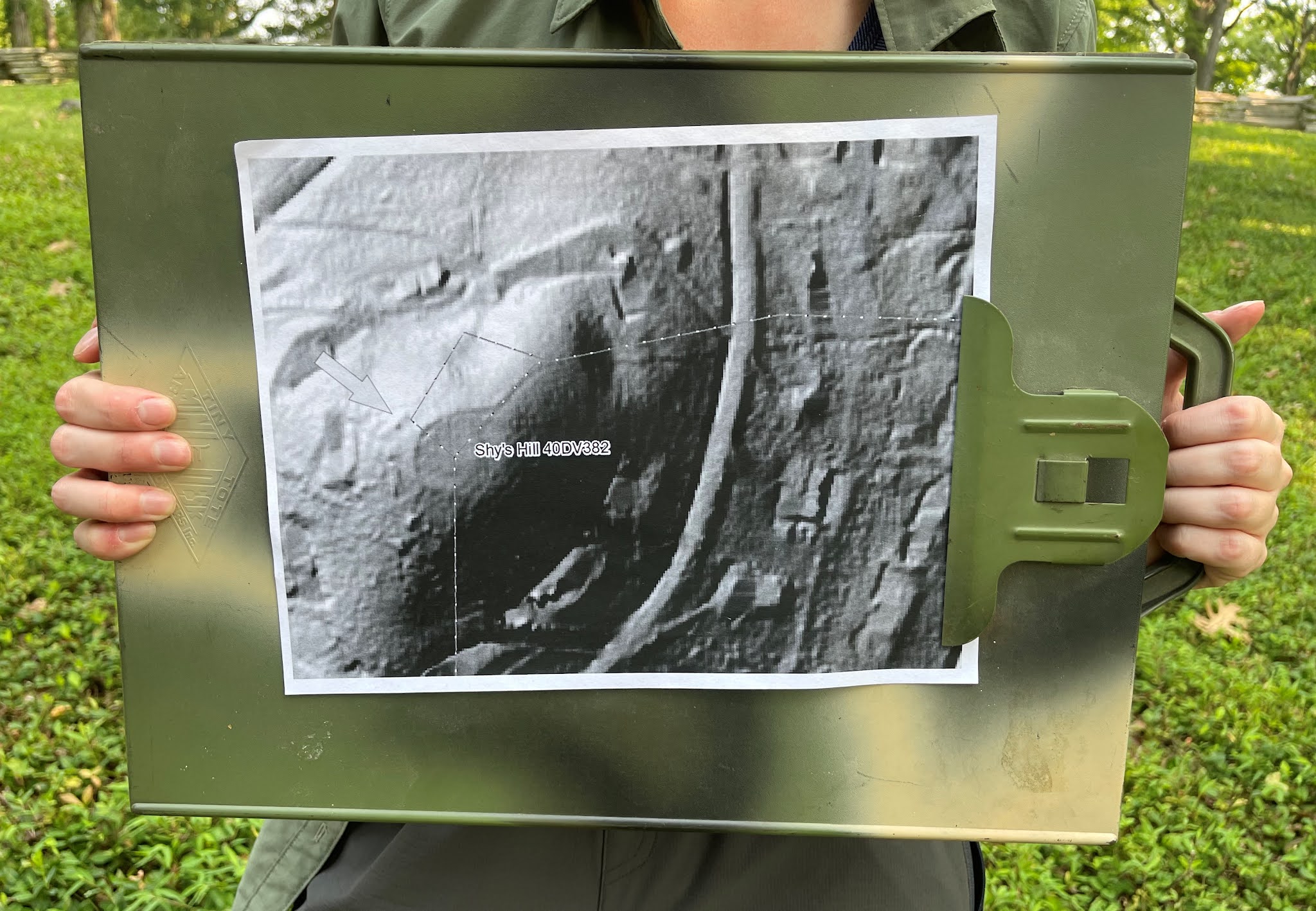
On a hazy Thursday morning at Shy's Hill in Nashville —ugh, Oregon wildfires — I did what comes naturally for me: Watch other people work. Military science professor Brandon Hulette, research analyst Natalie Robbins, geospatial data and systems librarian Stacy Curry-Johnson, and students Jordan Rhym and Alyssa Bolster -- all from Vanderbilt University -- manuevered a $13,000 ground-penetrating radar machine over four sites on the hallowed ground south of downtown. Robbins calls her team "spatial specialists," which sort of makes my head spin.
The ground-penetrating radar provides an "image" of the subsurface like this one, held by Vanderbilt research analyst Natalie Robbins.
The specialists' mission: Use the GPR to determine what, if anything, might lie beneath the ground near the crest of Shy's Hill, unsuccessfully defended by the Army of Tennessee on Dec. 16, 1864 — Day 2 of the Battle of Nashville. Data from the GPR will be downloaded to create "images" of the subsurface. (They remind me of sonograms.) Could the GPR reveal remains of Confederate trenches? Human remains? Perhaps a stash of 500 beer can tabs from a long-ago bash? I'll report back in this space about findings.
Much of Shy's Hill was carved up more than 60 years ago by residential developers -- the very top of the hill was sliced off in the 1950s for a water tank, making it nine or 10 feet shorter than in 1864. This opening sentence from a feature story in a 1959 edition of the Nashville Tennessean makes my heart hurt: "Today Shy's Hill has been stormed, captured and occupied by building contractors and home owners. A phalanx of bulldozers led the way, and handsome brick houses now line the streets which circle the knob, halfway to the crest."
Bleh.
A small section of the hill -- the extreme left of the Confederates' line on Day 2 of the battle -- is preserved and maintained by the Battle of Nashville Trust. (Full disclosure: I am a board member.) The next time you're in Nashville, put it on your must-see list, because it's worth the hike up the steep, rugged trail to the top.
In the video below, Hulette explains the team's Shy's Hill mission:
-- Have something to add (or correct) in this post? Email me here.
On Dec. 17, 1864, the retreating Army of Tennessee — battered the day before at Nashville — dashed past these apartments, scattered managers in the leasing office, knocked two kids off their scooters, and wrecked several parked cars during a stand against Yankee cavalrymen, who had earlier quenched their thirst with 10 12-packs of Bud purchased across the road at a convenience store. Federal losses: 22 killed and wounded and more than 60 captured. Confederate losses: Roughly 250 captured and unknown number killed and wounded.
Thankfully, the Civil War Trails sign was not damaged in this hour-long brawl.
John Bell Hood’s boys continued their retreat southward after this fight, also known as the Battle of Holly Tree Gap or The Duel at the Apartments.
Let’s keep history alive. (Sort of. ) 😏
-- Have something to add (or correct) in this post? Email me here.
In this video shot for the Center For Civil War Photography, I stopped along Granny White Pike, where severe fighting occurred during Day 2 of the Battle of Nashville on Dec. 16, 1864. Unsurprisingly, this hallowed ground looks nothing like its 19th-century appearance. It was here in 1906 that artist Howard Pyle did his homework for his epic Nashville battle painting that hangs today in the Minnesota State Capitol Building in St. Paul. Please excuse my slothful appearance -- sometimes chasing history can be grueling.
Howard Pyle's epic painting of Minnesota troops fighting at the Battle of Nashville hangs in the Minnesota State Capitol Building in St. Paul. Photo courtesy of Betsy Haag of the 5th Minnesota Research Group on Facebook.
ABOVE: A document in Valentine Rau's widow's pension file notes his date of death and more. BELOW: A note to Rau's widow on reverse of above document. (National Archives via fold3.com.)
Here's how these two documents in the National Archives can open the door to the story of this Battle of Nashville casualty:
On Dec. 16, 1864, 72nd Ohio Private Valentine Rau of Company C was wounded on the second (and final) day of the battle. The 26-year-old soldier, a native of Germany, was shot in the right side, according to Document 1 (above top). We can presume Valentine was originally treated at a hospital in Nashville -- war-time records can identify which one -- and then sent to Jefferson General Hospital in Jeffersonville, Ind.
A brief search online reveals much information (including an illustration) about Jefferson General Hospital. Built to replace another hospital at nearby Camp Joe Holt, it was one of the largest U.S. Army hospitals of the war. Jefferson General Hospital consisted of 27 buildings, each 175 x 20 feet. Each ward had four large cast-iron stoves. Inside the perimeter was a chapel with reading rooms, a post office, a drug and instrument house, and a "dead house" -- a morgue for temporary keeping of the dead.
Jefferson General Hospital was one of the largest U.S. Army hospitals during the war. (Wikimapia.org.)
By February 1865, Rau -- whose name apparently was anglicized in these documents to "Rowe" -- had taken a turn for the worse. He died on Feb. 8, 1865. L.G. Olmstead filled out the front of Document 1, noting Rau died in the morning in Ward 1 and that the soldier's wife, Susan, lived in Sandusky, Ohio. On the reverse of the document, E.S Ballard wrote to Rau's widow:
"I send this to give you information concerning the death of Mr. Valentine Rowe. But as I am informed that the particulars have already been written by his lady nurse I will not multiply the words."
(The identity of Ballard could be revealed with further research.)
A quick search online reveals Olmstead was a Presbyterian minister of some renown in Indiana. Document 2 (shown) -- the reverse of Document 1 -- also included the name "C.W. Fitch," another chaplain.
According "Baird's History of Clark County, Indiana," published in 1909: Fitch and Olmstead were "men of great heart as well as brain. Chaplain Olmstead being a great lover of flowers was responsible for adding materially to the beauty and attractiveness of the grounds [of Jefferson Hospital] by planting many trees and flower beds to cheer the homesick sufferers."
According to Document 1, Rau's funeral was held at 3 p.m. on Feb. 8, 1865. He was buried nearby, probably at a hospital cemetery -- further research could uncover where. According to Find A Grave -- an excellent online research tool -- Rau's remains rest today in the national cemetery in New Albany, Ind.
Information in these documents -- "bread crumbs," I call them -- could lead to much more about the life and death of Valentine Rau. For example:
Because we have his wife's name, more info on the Rau family could easily be found on ancestry.com. Perhaps even an image of the couple.
A deeper dive of the county history could uncover an image of Olmstead. (Obscure county, town, etc. history are digitized on archive.org, a fabulous resource.)
Records from the hospital where Rau was treated could lead to the identity of the "lady nurse" who treated him and more.
The identity of Rau's regiment could open many doors -- exactly where the regiment fought at Nashville, for example. A speech about the regiment, given in 1875 by a 72nd Ohio officer, is available online here. Perhaps he mentioned Rau.
Information available on the Internet -- thanks, Al Gore! -- makes the searching/digging infinitely easier than it was decades ago. Enjoy the "digging."
-- Have something to add (or correct) in this post? E-mail me here.
SOURCES
-- Documents from Rau widow’s pension file, National Archives via fold3.com, a pay site.
A war-time image of 5th Minnesota officer Thomas Parke Gere and the restored 4th Mississippi flag he captured at the Battle of Nashville. It's in the Mississippi Department of Archives and History collection. (CLICK ON IMAGES TO ENLARGE.)
Supremely confident but not cocky, 22-year-old U.S. Army officer Thomas Gere bounds past grim-faced paper-pushers at the War Department, the gloomy brick building a two-minute walk from the White House. The date is Feb. 22, 1865, a bright, chilly day a little more than two months after George "Pap" Thomas' Army of the Cumberland bludgeoned John Bell Hood's tattered Army of Tennessee at Nashville.
Fourteen other bronze-faced U.S. Army soldiers join Gere, a lieutenant and adjutant in the 5th Minnesota. Each is based in Tennessee, at least one had served in the Mexican War, and all but two captured an enemy flag at the Battle of Nashville (Dec. 15-16, 1864).
Eagerly anticipating the day's event, the soldiers push through a massive, green leather door and file into the War Department's large reception room. Members of Congress, foreign dignitaries, and other guests — roughly 100 in all — stand in a horseshoe formation steps from the men. Displays of upright muskets near the walls give the setting a distinct martial air.
Conversations abruptly stop when a short, square-shouldered man enters the room. Standing between the two groups, 50-year-old Edwin Stanton — Abraham Lincoln's Secretary of War — reads Special Field Orders No. 38, issued two weeks earlier by Thomas. Go to Washington, the "Sledge of Nashville" ordered, for a special ceremony in honor of your capture of Rebel flags.
War-time image of Edwin Stanton, Lincoln's Secretary of War. (Library of Congress)
Then the bearded and bespectacledStanton reads aloud the names of the soldiers:
Corporal J.W. Parks, 11th Missouri.
Private W. May, 32nd Iowa.
Private G. Stokes, 122nd Illinois ...
Finally, he summons Gere, the soldier in charge of the detachment from Tennessee. Holding his tattered Battle of Nashville trophy, the young officer eyes his impressive audience.
"Mr. Secretary,” Gere begins, “I have the honor and pleasure to present to you the colors of the 4th Mississippi Infantry, C. S. A.”
How Gere "captured" the flag was a combination of guts, valor of subordinates ... and a lot of luck.
An illustration of Fort Ridgley, in Minnesota Territory, as it appeared in 1862.
Thomas Parke Gere's introduction to warfare came as a teenager in Minnesota Territory — Indian country.
In August 1862, Gere temporarily took over command of Fort Ridgley from John S. Marsh, who apparently drowned after he was wounded in battle against Indians. Marsh had left the small outpost with roughly 50 other soldiers from Company B of the 5th Minnesota to investigate an attack at the Lower Sioux Agency, where eastern Sioux murdered white settlers. Barely a quarter of the soldiers returned from the mission.
A circa-1863 photo of Thomas Gere.
"The Indians are killing the settlers and plundering the country," Gere wrote Minnesota Gov. Alexander Ramsey. "Send reinforcements without delay." The second lieutenant in Company B was four months shy of his 20th birthday.
Mature well beyond his years, Gere wrote a letter weeks later to Marsh's brother regarding the recovery of John's remains. "[The body] had caught in the roots of an old tree" along the bank of the Yellow Medicine River, he told Captain Josiah F. Marsh. "He was recognized by his uniform. The body was in a remarkable state of preservation. His right arm was lying across his breast; the left was behind his body.
"You are aware that Lieutenant [James G.] McGrew and myself have made every effort to have a proper search made long before this but were unsuccessful until now," continued Gere. "It is a great relief to know that he is at last found."
Later that year, companies B, C and D of the 5th Minnesota joined the rest of the regiment in the South. In May 1863, Gere and his comrades were marching and fighting in Mississippi during the Vickburg Campaign. In Nathaniel Banks' 1864 Red River Campaign in Louisiana, the 5th Minnesota guarded supply trains, served as a rear guard, and fought in such godforsaken places as Yellow Bayou, Campti, and Sabine Cross Roads. Later, this Swiss Army knife of a regiment served in Alabama and Arkansas.
"Composed of hardy frontier citizens, long accustomed to hardship and privation, probably no finer organization has ever been sent into the field," a Minnesota newspaper wrote when most of the regiment was furloughed in July 1864.
Five months later, the 5th Minnesota would face its supreme test of the war.
In the cavernous room at the War Department, Gere emphasizes his capture of the 4th Mississippi colors was a team effort.
"[It] was due, and should be credited, to the valor of the soldiers of [Lucius] Hubbard's Brigade, [John] McArthur's Division of A. J. Smith's detachment," the slender, earnest-looking officer tells the dignitaries. "It was the result of the final charge upon the enemy's works by that invincible command in the second day's battle. Every soldier who participated in that assault shares the credit of the captured colors."
8th Wisconsin Lieutenant William Sargent was killed at Nashville on Dec. 16, 1864. This is Sargent's marker in Janesville, Wis. (Find A Grave)
At about 3:30 p.m. on Dec. 16, 1864 — Day 2 of the battle — three brigades from Smith's division were among Federal forces that attacked Confederate works at Compton Hill (Shy's Hill), the extreme left flank of Hood's army. (See map above.) Under relentless fire, the 5th Minnesota and the rest of Hubbard's brigade advanced through a muddy cornfield toward a line of Confederates behind a stone wall protected by abatis and a ditch.
Still reeling from their Day 1 whipping and overwhelmed by a numerically superior U.S. Army, the exhausted and hungry Rebels fled; hundreds became prisoners. ".. the most complete rout of the enemy that I have ever witnessed," Gere tells his War Department audience.
When he reached the Rebel works on the east side of Granny White Pike, Gere's horse wouldn't cross the abatis and stone wall. While Federals advanced to his right, he spotted the 4th Mississippi flag-bearer fleeing to the Union rear without his colors. Gere couldn't reach the flag, so he ordered the soldier to leap back over the wall and hand him the prized war trophy. Perhaps the officer's waving of a loaded revolver compelled him to deliver it ASAP.
In a short entry in his war-time diary, Gere offered further glimpses of the hellish experience:
"... Fearful charge, hundreds fell, but we captured the works with prisoners by thousands 'Twas a fiery ordeal -- I can not attempt to describe it here. The enemy fled and we pursued; a glorious victory."
The 5th Minnesota suffered dozens of casualties in its deadliest battle of the war. Among those killed were Private Lysias Raymond, the married father of girls 1 and 4 years old; Irish-born Patrick Byrnes, whose mother was a widow; and one of Gere's favorites, William Sargent, a 24-year-old lieutenant in the 8th Wisconsin. "Words can not express our sorrow!" he wrote about the death of the English-born officer, who was shot through the heart.
"The fighting was the heaviest in our front," Gere continued in his diary. "It was indeed a desperate thing to go through that storm of grape, canister and musket balls -- we who got through wonder how we escaped! Our feelings can not be described! But we won the victory!"
"I was lucky enough," added Gere, who was wounded slightly in the right wrist on Day 1, "to get the battle flag of the Fourth Mississippi regiment in the charge."
ABOVE AND BELOW: Present-day view of terrain where 5th Minnesota advanced on Dec. 16, 1864. It's in a residential area off Granny White Pike in Nashville.
The spotlight doesn't shine only on Gere in Washington. After he tells his Battle of Nashville story, the other soldiers recounts the capture of their flags. Not all the stories teem with extraordinary heroism.
On Dec. 16, Corporal Frank Carr of the 114th Ohio recaptured a Federal cavalry guidon. He got stuck in abatis when his regiment was forced to retreat. "A fellow came up and asked me to surrender," Carr tells Stanton. "I wouldn't do it, but put on my bayonet and was going to stand a fight when the fellow ran and dropped his flag."
Also on Day 2, Private Wilbur F. Moore captured the colors from a Confederate battery. "The color-bearer was in a small line of rebels," he recalls, "and was trying to climb the hills. I shed my knapsack to go out for him, and captured him and a captain of the same regiment, too."
Each soldier at the ceremony hands his trophy to a Mexican War veteran, who places the flag atop the display of muskets. "... when the last silken standard had been placed there," according to a post-war account, "the effect was brilliant and thrilling. The varied hues of the rainbow lighted up the sombre apartment in a blaze of color."
Clearly impressed with the soldiers, Stanton shakes each man's hand. Then he briefly expresses appreciation.
“In behalf of the Government of the United States I return to you its thanks," he tells the soldiers, "and the
thanks of the people, for your noble gallantry. Accept also the gratitude of the
department for yourselves and companions in arms."
The government grants each soldier a 30-day furlough and advances a month's pay. They later receive another award from a grateful government: a Medal of Honor.
Before they depart the War Department, Gere and his Tennessee detachment salute Stanton. The man who managed the U.S. war machine waves back ... and weeps.
— Have something to add (or correct) in this post? E-mail me here.
SOURCES AND NOTES
Chatfield (Minn.) Democrat, Oct. 4, 1862
Chicago Tribune, Aug. 25, 1862
Janesville (Wis.) Weekly Gazette, Dec. 22, 186.
New York Daily Herald, Feb. 23, 1865
The Bravest 500 of '61, Their Noble Deeds Described by Themselves, compiled by Theo F. Rodenbough, New York: G.W. Dillingham Publishers, 1891
The Goodhue Volunteer, Red Wing, Minn., July 6, 1864
** Collins, who was present at the ceremony in Washington on Feb. 22, 1864, received the Medal of Honor for capturing a flag on Christmas Eve 1864 at Richland Creek, Tenn., during Hood's retreat.
— Sergeant Alfred Ransbottom of the 97th Ohio attended the Washington ceremony. Ransbottom was honored for "extraordinary heroism" on Nov. 30, 1864, at the Battle of Franklin, where he captured an enemy flag.
Close-up of Medal of Honor awarded to Wilbur F. Moore of the 117th Illinois. (Library of Congress)