Showing posts with label Campbell Ridley. Show all posts

Friday, November 14, 2025

Can these cabins for enslaved linked to a Rebel general be saved?

A slave cabin in "The Quarters," near downtown Columbia, Tenn. It is one of four.

                                        Like this blog on Facebook | My YouTube videos

A version of this column originally appeared in Civil War Times in 2024.

On a cloudless, deep-blue afternoon, I drive 45 miles south of Nashville to Columbia for a visit with one of my favorite people, Campbell Ridley. He’s an 80-year-old semi-retired farmer, U.S. Army veteran, rock-and-roll devotee and storyteller with a wit as sharp as the tip of a new bayonet.

Gideon Pillow,
circa 1870.
“How are you feeling?” I ask moments after stepping into his farm office.

Aside from mourning the recent death of Barney — his nine-year-old barn cat — Ridley says he feels fine, a state he attributes to “clean living and cheap beer.” He’s wearing tan Carhartts, brown work boots, a blue-checkered shirt, and, appropriately, a ballcap that reads “Life Is Good.”

Ridley’s roots run deep in Maury County, once one of the wealthiest counties in the state before the Civil War. He’s the great-great-grandnephew of Gideon Pillow, the Confederate brigadier general, Mexican War veteran, lawyer, politician and before the war one of the county’s foremost slaveholders. Ridley’s paternal great-grandfather, a leading citizen who farmed with mules, earned the nickname “Mule King” — fitting enough in Columbia, long known as the “Mule Capital of the World.”

When I need a history fix and a good laugh, I visit Ridley. We’ve sat together inside magnificent St. John’s Church — the slave-constructed plantation church built under the direction of Leonidas Polk and his brothers. It stands roughly a mile and a half southwest along Mount Pleasant Pike, just across from the field where the Episcopalian bishop and future Confederate lieutenant general once lived in a mansion called Ashwood Hall. There, we’ve admired the two massive gingko trees Polk imported from Japan and poked around the brick remnants of the kitchen of the mansion, destroyed by fire in 1874 and never rebuilt.

Irish visitor Liam McAlister, Campbell Ridley and I during a recent visit to "The Quarters."

'The Quarters' on Gideon Pillow plantation: Time capsules in Maury County, Tennessee

Today, though, we’re exploring far humbler construction. Near Ridley’s office and the east fork of Greenlick Creek stand four ramshackle cabins for the enslaved. “The Quarters,” he calls the property. His daughter, who lives in New Mexico, owns it along with a friend.

“I’ll take care of this until she puts me in a nursing home,” he says, half-joking.

Campbell Ridley explores a
cabin for the enslaved in
 "The Quarters."
In a way, these cabins are as much a part of Ridley as the land he has farmed for decades. As late as the 1990s, he tells me, these structures served as homes for poor Black farmhands and others — many of whom worked for the Ridleys.

“The woman who raised me lived here,” he says as we step inside one of the rickety cabins. Her name was Katie, a “wonderful” lady with a gift for frying chicken. The Ridley family employed her for more than three decades.

At the next cabin, ancient white paint clings to exposed exterior logs. Four modern wooden posts prop up the porch overhang above two large, well-worn walkway stones. On an exterior wall, a half-dozen old hangers dangle from a rusty nail. Above us, a corrugated-tin roof keeps nature at bay.

“That’s been there as long as I can remember,” Ridley says.

These antebellum cabins stand in stark contrast to Clifton Place, the brick manor house on the hill about 750 yards away. In the late-fall sunlight, the mansion almost seems to glow. Through the trees along the road to Ridley’s office, its imposing Ionic columns and limestone porch come into view.

From 1839 until the early Civil War years — when the U.S. Army confiscated the property — Clifton Place served as the centerpiece of Pillow’s vast plantation. The enslaved who lived in cabins at “The Quarters” produced his wealth by planting and harvesting cotton, hemp, corn and other crops and tending his cattle, sheep and hogs.

As one of Tennessee’s leading citizens, Pillow moved in elite circles. He counted James K. Polk, the 11th U.S. president, among his friends. After Polk left the presidency in 1849, he dined at Clifton Place with Pillow and his wife, Mary. Pillow dabbled in national politics himself, opposing secession at first in 1861 before relenting.

As a military man, however, Pillow consistently disappointed. During the Mexican War, he irritated superiors — including Winfield Scott — with his relentless self-promotion. No surprise, perhaps, given the massive painting of a heroic Pillow in uniform that greeted visitors in the entrance hall at Clifton Place.

In the Civil War, Pillow abandoned his post at Fort Donelson in February 1862, slipping away under cover of darkness before Ulysses Grant accepted the Confederates’ surrender. At Stones River nearly 10 months later, he led a brigade with mixed results. True or not, a story of the 55-year-old officer cowering behind a tree during the fight has stained his record ever since.

Scott — overall commander of the U.S. Army when the war broke out — certainly wasn’t a fan. In his 1864 memoirs, “Old Fuss and Feathers” described Pillow as “amiable, and possessed of some acuteness, but the only person I have ever known who was wholly indifferent in the choice between truth and falsehood, honesty and dishonesty… habitually boastful… at the total sacrifice of moral character.”

Inside cabins for the enslaved: A window into the past (Video)

Apparently used to keep the weather out, ancient newspapers cling to the walls of a slave cabin.

As we move from cabin to cabin (see video), Ridley reflects only briefly on his ancestor and the enslaved people who toiled for him.

“Just part of history,” he says.

We step gingerly into a cabin once home to field slaves. More than a year ago, Ridley had brush cleared from around these structures, making access easier. Each cabin is roughly 15 by 15 feet, with a small loft reached by a rickety ladder. Each has a post–Civil War room added to the rear. I’ve visited the site half a dozen times, yet I always see something new.

Ridley shines a flashlight beam onto a fireplace, revealing bricks and small dirt piles in an otherwise barren room. Fragments of newspaper — used as insulation by post-war inhabitants — speckle the walls. A dour-looking baseball player stares out from a March 1937 sports page. Beneath my feet, a decrepit floor, victimized by time and weather, crunches softly.

An interior view of one of the four remaining 
slave cabins that were occupied well
into the 20th century.
In another cabin, we find more traces of the 20th century: a swinging blade, peeling wallpaper decorated with blue-and-aqua flowers, a chipped ax handle, a single clothes hook on a door. Pasted to a back wall is a fragment of The New York Times from decades ago.

“Life in America,” the partial headline reads.

From the era of slavery, though, there is nothing visible: no pottery fragments, no glass shards, no etchings on the walls, no privy to mine for clues. Much is left to imagination.

So I wonder: Who were these men, women, and children?

What treatment did they receive from Pillow?

What were their names?

The 1870 census offers hints. “Sarah” and “Randall,” listed as farmhands for the Pillow family, appear in deeds from as far back as the 1840s.

I wonder what became of the people enslaved at Clifton Place. Are they buried in the cemetery in the woods at the base of Ginger Hill — the remote graveyard Ridley showed me months ago? Or in the rear section of St. John’s Church Cemetery, away from the graves of white parishioners? Or perhaps in one of the countless family plots scattered across the county.

And I wonder what will become of these cabins near the east fork of Greenlick Creek. Ridley wants to save them, but doing so would require expertise and probably hundreds of thousands of dollars.

What might a professional archaeologist uncover here?

'The most complete 19th-century plantation complex anywhere'

I also wonder about the future of Clifton Place, where Ridley’s paternal grandfather lived until 1949. The family held onto it for years afterward.

“I watched television in there for the first time in my life,” Ridley says, recalling family gatherings under 16-foot-high ceilings in the 12-room Greek Revival mansion.

In 1972, a Kentucky Fried Chicken magnate named John R. Neal bought the property from the Ridley family. He and his wife, Linda, attempted a restoration, but the project proved daunting. “We saw the white columns, the Gone With the Wind atmosphere,” she told a reporter in 1986. “We didn’t see the cracks, the structural problems.”

A view of the long-unoccupied Clifton Place
estate of Gideon Pillow. This is private
property. Do not trespass.
The estate includes the original detached kitchen, carriage house, ice house, law office, spring house, blacksmith shop and quarters for “house” slaves. Inside the Pillow-era smokehouse stand the original poplar chopping block and “ham logs” — hollowed poplar logs once used for salting hams. The smoky aroma still lingers.

A researcher once called Clifton Place “the most complete 19th-century plantation complex anywhere.”

Neal died in 2018, but his family still owns the property. The mansion, however, has stood unoccupied — and inaccessible to the public — for more than a decade. Like the nearby slave cabins, it could vanish without major preservation efforts.

Time may not be on our side. Across Mount Pleasant Pike from Clifton Place, developers plan a massive subdivision: “Seven hundred fifty houses on 450 acres,” Ridley says.

Oh my. What will I see here a decade from now?

Places like these don’t disappear all at once — they vanish slowly, board by board, memory by memory, until all that’s left is what someone bothered to write down. I suppose that’s why I keep returning to them. To witness what remains. And to remember what shouldn’t be forgotten.


SOURCES

— Scott, Winfield, Memoirs of Lieut.-General Scott, New York, Sheldon and Company, 1864, Vol. II

— The Tennesseean, Aug. 10, 1986, Page 113

Sunday, July 21, 2024

Tales from the road: Cockfighting, cats and mansion exploring

Bethel Place in Columbia, Tenn.

                                      Like this blog on Facebook | My YouTube videos

Saturday’s history adventure begins in the farm office of my early 80ish pal Campbell Ridley, a quasi-town historian of Columbia, Tenn., aficiando of Arby’s jamocha milkshakes and master of playful cats named Marco and Polo.

Ridley, a descendant of Confederate Brig. Gen. Gideon Pillow, has a delightful sense of humor that he deploys liberally with friends, family and assorted hangers-on. Exhibit 1: A sign that greets visitors on a wall in his farm office.

Original blue poplar floors in the mansion
“Life’s journey is not to arrive at the grave safely in a well preserved body,” it reads, “but rather to skid in sideways, totally worn out, shouting, ‘Holy shit, what a ride!’”

I vote yes!

Over the past several years out here in Civil War history-rich Maury County, roughly 50 miles south of downtown Nashville, I have explored with Ridley the remains of Ashwood Hall, the mansion of Confederate Gen. Leonidas Polk and his brother that fire destroyed in 1874; walked gingerly through slave cabins on his daughter’s property; examined weed-choked graves at an off-the-beaten path cemetery at the base of Ginger Hill and breathed in the awesome aroma in the ancient smokehouse at Pillow’s Clifton Place plantation.

A cockfighting chair
On this fabulous afternoon, we make our way in Ridley’s truck to Bethel Place, the circa-1845 Greek Revival-style mansion of Gideon Pillow’s youngest brother, Jerome Bonaparte Pillow. Ridley’s first cousin, Eva James, has called it home for the past 60 years. She lives here with her husband, Don.

Inside, I marvel at the original walnut doors and blue poplar floors, outsized paintings of family members and massive mirrors. The 14-foot high ceilings spark a discussion of the ungodly sum it must cost to heat/cool this huge home. The place even has an elevator, added long ago by Eva James' father.

But the piece de resistance of my inside tour is a mundane piece of brown furniture in the parlor.

“This,” Ridley says, “is a cockfighting chair.”

Folks sat in the chair, flipped down the tray and placed their bets on it on the fighting fowl — an activity unfamiliar to me growing up in gritty Mount Lebanon, Pa.

Outside, I marvel at the Ionic columns — yup, they’re original, too — and the antebellum stone wall, the handiwork of Jerome Pillow’s slaves. Naturally, I send a drone up in the air to take in the Pillow era outbuildings — the kitchen, law office and smokehouse — as well as the mansion from 250-plus feet.

A drone view of Bethel Place shows (clockwise from left) the law office, smokehouse, kitchen
 and mansion.

Attached to a stone pillar, a metal ring intrigues us. Did Gideon Pillow — a goat of the Rebels’ defeat at Fort Donelson in February 1862 — tie up his horse at this spot while visiting Jerome? I wonder where the armies skirmished near Bethel Place, a few miles from the Columbia square.

Back at the farm office, Ridley HQ, my tour guide whips out his phone to show off a video of Marco and Polo scrapping like professional wrestlers.

What a great day.

Let’s keep history and catfighting — but not cockfighting — alive. 👊

Marco ... or is this Polo?
Polo ... or is this Marco?

Saturday, January 28, 2023

An ancient graveyard in Tennessee at the base of Ginger Hill

The grave of Amy Campbell near Columbia, Tenn.

Like this blog on Facebook | Follow me on Twitter | My YouTube videos

After our exploration of slave cabins, farmer Campbell Ridley drives us in his pickup truck roughly a mile to a clearing and then parks. To our left are woods and remains of an old pond. To our right, at the base of a low hill, are another stretch of woods near a creek.

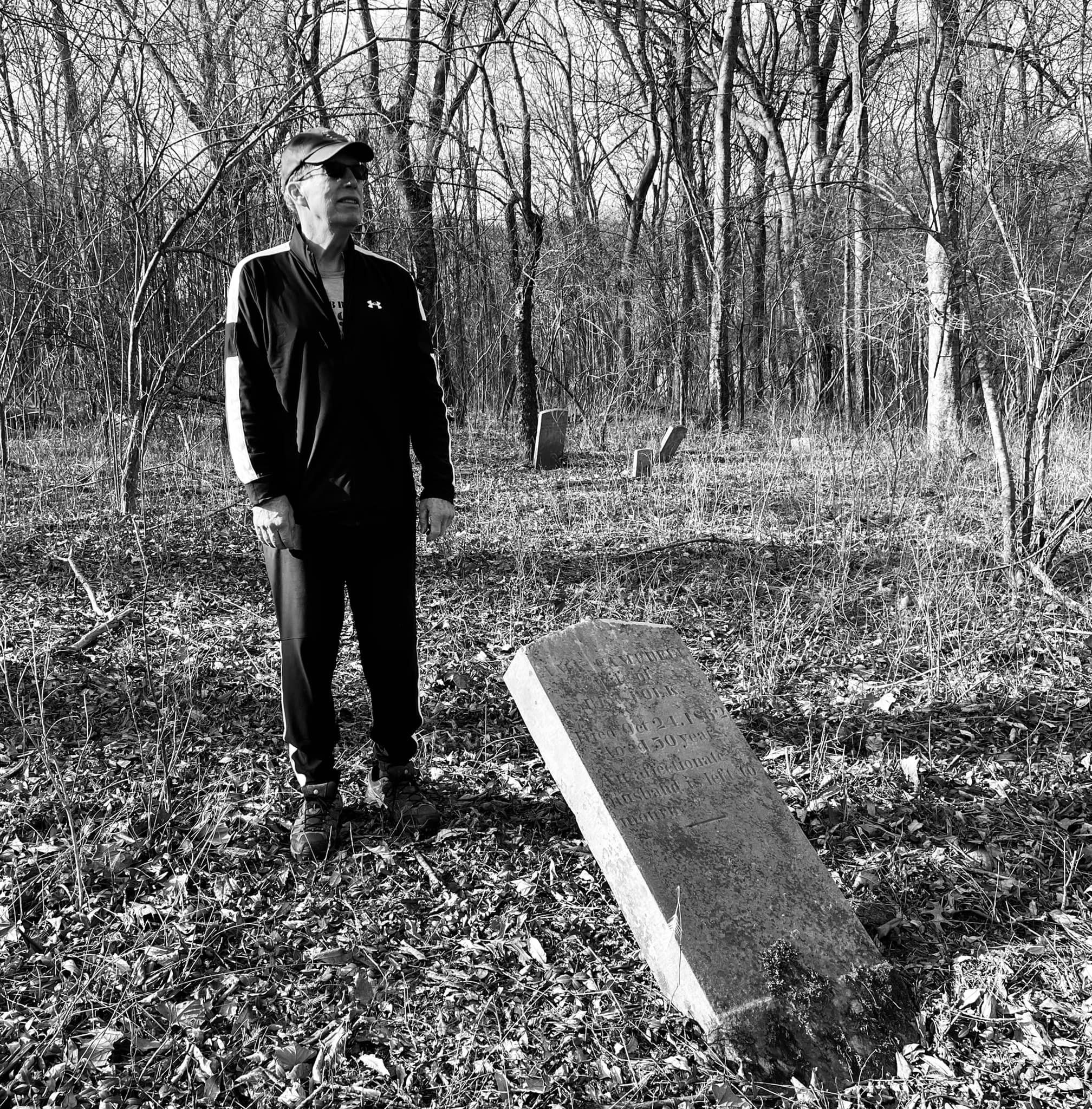
Campbell Ridley, a direct descendant of
 Confederate Brigadier General Gideon Pillow,
stands in a remote cemetery in the woods.

“Used to play out here when I was a kid,” says Ridley, the 80-year-old direct descendant of Confederate Brigadier General Gideon Pillow.

We walk a path a short distance into the woods. A carpet of brown leaves and twigs crunches beneath our feet. Then we find what we came for. Scattered in woods are gravestones and footstones in a remote, unmarked cemetery.

Graves of the enslaved, formerly enslaved and their kin, we believe.

“Amy Campbell. Wife of Ben Polk,” reads the inscription on a marker, tilted toward a deep-blue sky. “Died Oct. 24, 1862. An affectionate husband is left to mourn.” “B.W.L.,” reads the inscription on another stone. It lay flat in the Middle Tennessee earth.

Ragged footstones — or are they ancient headstones? — peek from a covering of leaves. The ground has subsided in places, perhaps the signs of old burials. After a short visit, we depart. Our destination is an impressive, brick plantation house nearby.

“They used to call the hill back there Ginger Hill,” Ridley tells us.

We all wonder about the forgotten place we leave behind.

Who else lies buried in the woods near the base of Ginger Hill?

To be continued.

Gravestone of Daniel Webb, aged 15.
Campbell Ridley in the graveyard near the base of Ginger Hill.
The gravestone of Willie Pillow, who died in 1887, a little more than a year old.
A gravestone inscribed with "B.D.L."
A close-up of Amy Campbell's grave.

— Have something to add (or correct) in this post? E-mail me here.

Sunday, January 22, 2023

Exploring slave cabins with a descendant of a slave owner

A slave cabin — one of four — on the old plantation of Confederate General Gideon Pillow
 in Maury County, Tennessee. (CLICK ON IMAGES TO ENLARGE.)

Like this blog on Facebook | Follow me on Twitter | My YouTube videos

We focus the narrow beams of light from our flashlights on the walls of the abandoned cabin, hoping to find a date on newspapers used as insulation by its long-ago occupants.

Bathed in red light, my friend Campbell Ridley —
a direct descendant of Confederate Brigadier General
Gideon Pillow — sits in an abandoned
slave cabin on his property.
The light reveals a photo of a dour baseball player and partial headlines. “Johnstown police battle strikers,” reads one. “Pirates win fifth straight,” reads another. “Look here,” I tell my fellow explorers, “there’s a date: June 18, 1937.”

But this decrepit cabin — one of four standing near the east fork of Greenlick Creek in Maury County, Tennessee — far pre-dates the 20th century.

Before the Civil War, slaves of Gideon Pillow occupied these log structures. In nearby fields, they toiled for the wealthy politician, lawyer, and speculator. Clifton Place, Pillow’s magnificent mansion, stands unoccupied nearby on a hill astride Mount Pleasant Pike. During the war, the slave owner served, inauspiciously, as a brigadier general in the Confederate Army.

Long-ago occupants pasted newspapers on
the walls as insulation.
We’re here on this brisk Saturday morning at the invitation of direct Pillow descendant Campbell Ridley, a farmer whose family has lived in the area for seven generations. 

Months ago, 80-year-old Ridley had trees and brush cleared from around three of the cabins on his property. The interiors were cleared of trash and made more safe. 

After the war, sharecroppers occupied the structures on the ground Ridley calls “The Quarters.” Their last occupants left in the 1990s. Our focus is on those who first lived here. We have many questions.

Who were they and what lives did they lead?

How did Pillow treat them?

What became of his slaves?

And, perhaps most importantly, can these remarkable time capsules be preserved and interpreted for future generations?

Let’s keep history alive. 👊

The brick fireplace to a slave cabin
The exterior of a slave cabin near Columbia, Tenn.
We explored three of the four remaining slave cabins.
A fragment remains from The New York Times on a ceiling in the cabin. The newspaper
was used as insulation. 
Jack Richards examines the fragments of newspaper clippings on a cabin wall.
Newspaper clippings -- some ancient, others not -- on a cabin wall.
Newspaper clippings, apparently World War II era, are pastered to a wall.
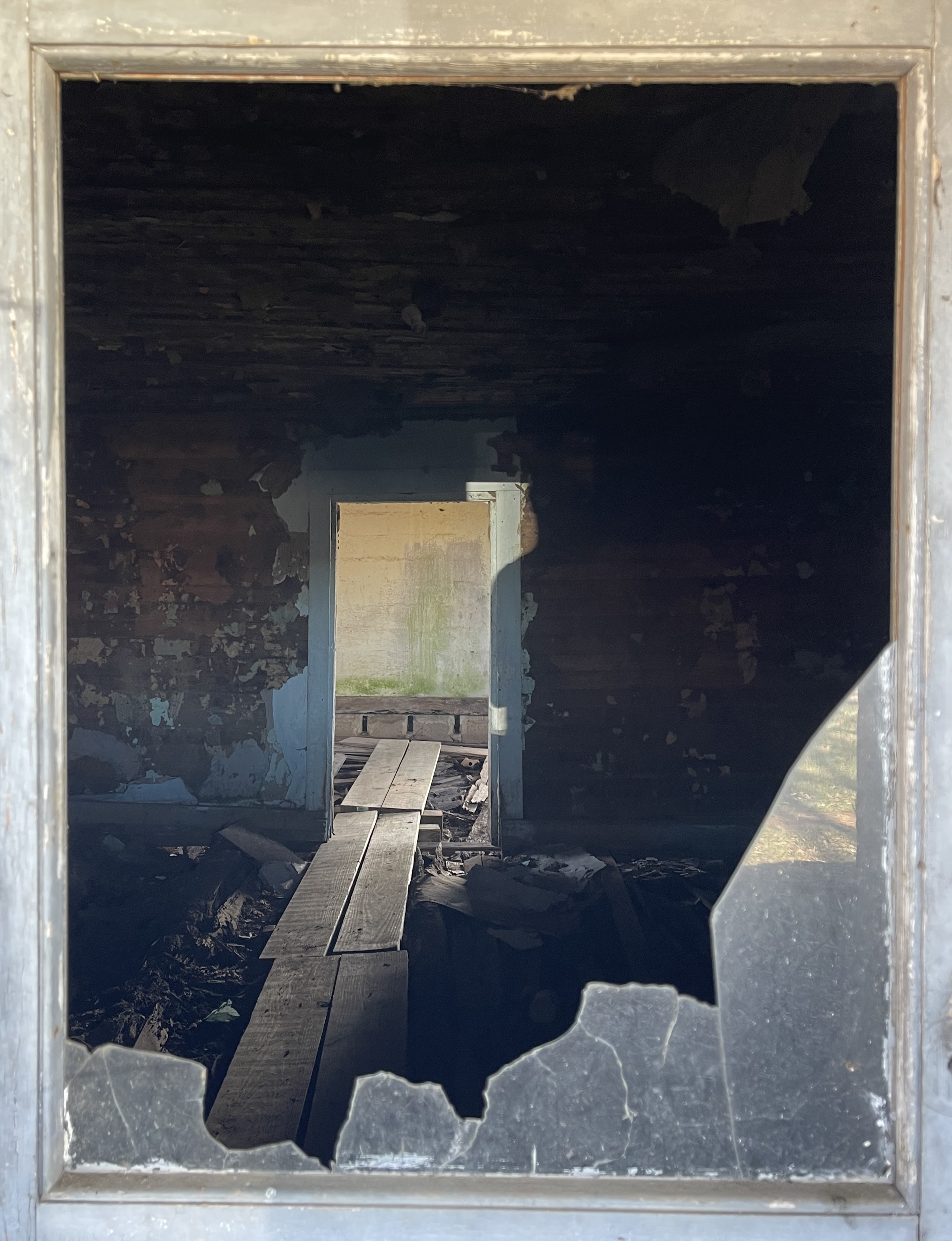
A view of the interior through a broken window on a front door.
A fireplace in the interior of a slave cabin.
The remains of an outhouse behind a slave cabin. It's not wartime.

— Have something to add (or correct) in this post? E-mail me here.

Friday, September 24, 2021

A visit to 'The Quarters,' cabins of Gideon Pillow's enslaved

Farmer Campbell Ridley explores one of the slave cabins on his property.
The exterior of a log slave cabin.

Like this blog on Facebook | Follow me on Twitter

Gideon Pillow
Steps from the east fork of Green Lick Creek in Columbia, Tenn., stand log cabins where the enslaved of Gideon Pillow lived. A wealthy politician, lawyer, speculator and underwhelming Confederate major general, Pillow resided at Clifton Place, a magnificent mansion that still stands astride Mount Pleasant Pike. 

On Thursday afternoon, farmer and friend Campbell Ridley—a Pillow descendant—showed me and Cliff Roberts of the General Barton & Stovall History/Heritage Association the interior of one of the slave cabins, tucked on his property behind trees, brush and weeds. We didn’t go inside another slave cabin, but examined its brick chimney and deteriorating porch.

Pillow was one of the wealthiest men in Maury County—one of the wealthiest counties in the country before the Civil War. Much of that wealth was accumulated because of those who toiled for him—the enslaved who lived in these cabins.

Ridley, whose family has farmed in the area for generations, has long called these structures “The Quarters.” In addition to slaves, the cabins housed workers on the farm into the 20th century. Ridley also farms the land where Ashwood Hall—one of the most magnificent residences in Tennessee—once stood. The fabulous plantation mansion, owned by Leonidas Polk, “The Fighting Bishop” of the Confederacy, and later his brother, was destroyed in an 1874 fire. I wrote about it for Civil War Times magazine. 

Farmer Campbell Ridley slips inside the door.
Ridley examines the interior of a cabin, once occupied by slaves and later by workers
on his family farm.
Evidence of a fireplace in the cabin.
The deteriorating porch on another cabin.
The original, brick chimney.

-- Have something to add (or correct) in this post? Email me here.