|
| Confederate Major General Earl Van Dorn was murdered in Martin Cheairs' mansion in Spring Hill, Tenn. |
Like this blog on Facebook | Read more Q&As on my blog here.
What a pity Bridget Smith was not alive in 1863 to report about Earl Van Dorn. Surely, then,
all the secrets of notorious Confederate major general long ago would have been revealed. From her 21st-century perch, the dogged researcher shined a light into the dark corners of Van Dorn's sordid life in her 2015 historical novel,
Where Elephants Fought. Let the cockroaches scatter!
 |
Author Bridget Smith and friends at the Holly Springs Depot
in Mississippi, where Earl Van Dorn captured precious supplies
of Ulysses Grant's army on Dec. 20, 1862. It was the military
highlight of the general's career. |
The general's real-life story, as Smith notes, has a little bit of everything -- "sex, murder, escape, lies, an illegitimate baby ..."
But Van Dorn's murder is no whodunit. Fact: On the morning of May 7, 1863, Dr. George Peters entered the back room of Martin Cheairs' mansion in Spring Hill, Tenn. -- the general's headquarters -- and fired a pistol ball into Van Dorn's brain, killing him. This ugly tale is more of a "
WHY did he do it?"
The commonly held view is that the married Van Dorn -- who couldn't keep his eyes (or hands) off the ladies -- was murdered by Peters because he was having an affair with the doctor's beautiful wife, 25-year-old Jessie. The affair part is undoubtedly true.
But Smith's research points to Van Dorn's seduction of a 15-year-old girl as Dr. Peters' real motivation for murder in the mansion in Spring Hill. Brace yourself for those salacious details below.
By now you're probably saying to yourself, "Dang, this could be a movie!" As a matter of fact, that's what Smith is planning. She recently
started a KickStarter campaign to raise $100,000 to bring this crazy story to a big screen.
Smith, who's also writing a non-fiction companion to
Where Elephants Fought, answered my questions about her obsession with the general (a "quintessential Southern gentleman"), the movie ("big dreams") and more. Appropriately, the Tennessee native provided the answers from her adopted state of Mississippi, where this story began for
Van Dorn, an
1860s "frat boy."
 |
White Hall, the mansion in Spring Hill, Tenn., where Earl Van Dorn's affair with Jessie Peters reportedly
began. (Read my Civil War Times column on the mansions connected to the Van Dorn story.) |
Why do you have the fascination with Earl Van Dorn?
Smith: First, he’s got all the trappings of a modern movie star -- a handsome face, light wavy hair, sparkling blue eyes, and naughty ways – so, who wouldn’t be fascinated, right? But it’s his dichotomous nature that most interests me, because so many aspects of his personality sharply contradict his genteel origins. For instance, he is in every way the quintessential Southern gentleman, yet his conduct is often anything but gentlemanly! Though educated at West Point, he quotes Shakespeare and Byron more often than Napoleon; yet, his desire for glory and fame on the battlefield nearly consumes him at times.
 |
Earl Van Dorn, shown as a civilian, was
a "quintessential Southern gentleman,"
Bridget Smith notes, "yet his conduct is
often anything but gentlemanly!" |
Although married, he seems to care very little for his wife and even less for the institution of marriage; yet, during his years in Texas, when he wasn’t dodging Comanche arrows, he was carrying on with a pretty laundress named Martha. The result of this long-term relationship: three little Van Dorns (And yes, Martha gave each child their daddy’s last name). So here lies the quandary -- if he had no respect for his own wife, why did he hook up with another woman for a long period of time and have not one, but
three children with her? Not to sound cliché, but he did understand how that kept happening, didn’t he?
And dare I even mention the many torrid love affairs — specifically the fatal one, the one that resulted in a murder so clouded by lies and corruption that it took over 150 years to uncover just enough of the truth to finally answer the question, “Why did the doctor shoot the general?” As for the rest of the story, well, we may never know the truth. I guess that’s why I find him so fascinating.
Tell us something we don’t know about him.
 |
Bridget Smith on Van Dorn
(shown in Confederate uniform):
"Here was a man I’d love
to have a drink with." |
Smith: If you delve into a person’s background long enough, you will usually find that one puzzle piece that helps explain the why’s and how’s of that person -- why he acted this way -- why he said those things. When I first began to study Earl Van Dorn, it was not in those well-known military records that I found the answers to some of his peculiar ways, but in the personal memoirs and letters of friends and family that put that last brush stroke on a very colorful portrait. Some of the more interesting details about Van Dorn include his hobbies and passions. For instance, the talented Earl was an accomplished artist, a lover of classical literature and music, an entertaining orator, and overall life of the party. He sketched and painted, wrote romantic poetry, and was known to stand atop a dinner table to recite some great Shakespearean soliloquy. He even sang and danced and played the piano. He had a true appreciation of all things rare and beautiful in life.
But what I found even more interesting was how deeply he cared for his sisters, and they for him. Some might say this affection was the result of Mrs. Van Dorn’s death when young Earl was only 9 years old, leaving his older sisters to act as surrogates. But this affection runs much deeper than typical sibling love and is quite prevalent in letters written throughout the Civil War. In their letters, the Van Dorn sisters shower their younger brother with all sorts of flattery and compliments. They even offer their undying support in situations in which Van Dorn is quite obviously in the wrong.
Years after his murder, his sister Emily wrote a book in his defense -- a book aptly titled,
A Soldier’s Honor. She lined the pages with glowing praises and loving sketches of the general -- all from his comrades in arms. And after pouring over my research of the general, I came to the conclusion that here was a man I’d love to have a drink with. He was talented and refined, a lover of women, a loyal friend, and a brave soldier. He was more than just “the terror of ugly husbands and nervous papas.” Indeed. Never judge a book by its cover.
 |
| Murder room: A desk like the one Van Dorn sat at the day he was killed in Martin Cheairs' mansion. |
OK, why did Dr. George Peters really murder Van Dorn?
Smith: Wow, that’s a loaded question (no pun intended). I think the best way to answer that is to ask why the doctor was
never charged with the murder. I mean, Dr. Peters confesses to the crime, offers up a voluntary statement in which he lines out the exact details of a calculated and well-planned murder, details the days leading up to the murder, and even provides information about his escape and subsequent capture behind enemy lines. Now, let me stress this one more time: Dr. Peters voluntarily confessed to the cold-blooded murder of a Confederate general during the height of the Civil War and was never charged with a crime. Scratching your head, aren’t you?
Well, it’s that statement alone that never set well with me either, and it’s that lack of punishment that convinced me there was more to the story – a much more serious reason for the murder. Regardless of Dr. Peters' claims that Van Dorn had “violated the sanctity of [his] home,” and regardless of Van Dorn’s woeful reputation at the time, the fact is Dr. Peters still committed murder, and murder was a crime that carried with it a very specific punishment – death. I mean, let’s be realistic here. We’re talking the 1860s. Not to mention Peters really ticked off Van Dorn’s men, especially the Texas Cavalry. Now who in their right mind would do that? And most importantly, who would do it and live? I can’t think of anyone. So, why did the doctor go unpunished? That’s when I began to dig and realized just how much was missing from the story. That’s when I began to take note each time I read the words “Clara,” and “the Doctor’s daughter.”
 |
Shown late in life, Jessie Peters, third wife of Dr. George Peters (right), had an affair with
Earl Van Dorn. But author Bridget Smith believes the doctor's real motivation for murdering Van Dorn
was the general's seduction of Clara Peters (center), George's daughter by his second wife.
(Images courtesy Bridget Smith) |
The first mention of the daughter occurs in a “Card” published by Van Dorn’s staff officers in which is stated, “General Van Dorn had never seen the daughter of his murderer but once… .” Let me add that the sentence finishes with, “…while his acquaintance with his wife was such to convince his staff officers … that there was no Improper Intimacy….” Note the structure of that statement: Clara, the daughter, is mentioned
before Mrs. Peters, the wife – the wife, and purported
reason for the murder. Then there’s perhaps my most prized piece of evidence: a letter written in July 1863, in which the writer (a close family friend of the Peters family) states, “that it was not on account of his wife but the seduction of his daughter Clara that Dr. Peters shot General Van Dorn.”
Now, top that with St. Louis convent records, and diaries and letters mentioning Clara’s unusual behavior (and unfortunate weight gain) written in the summer of 1864, and
Voila! I give you part of the smoking gun. Another interesting fact involves Dr. Peters’ comments to his captors upon his capture in November 1863, in which he readily admits having caught Jessie in previous scandals – yet he had not killed those seducers. So the question remains, why did he decide to murder Van Dorn if Jessie was unfaithful on the daily? An even clearer picture of the motive emerges through a series of tragedies within the Peters family involving divorce, suicide, babies out of wedlock, nunneries, blank death certificates, falsified tombstones, and more!
Whew. Might I suggest you read the book at this point?
 |
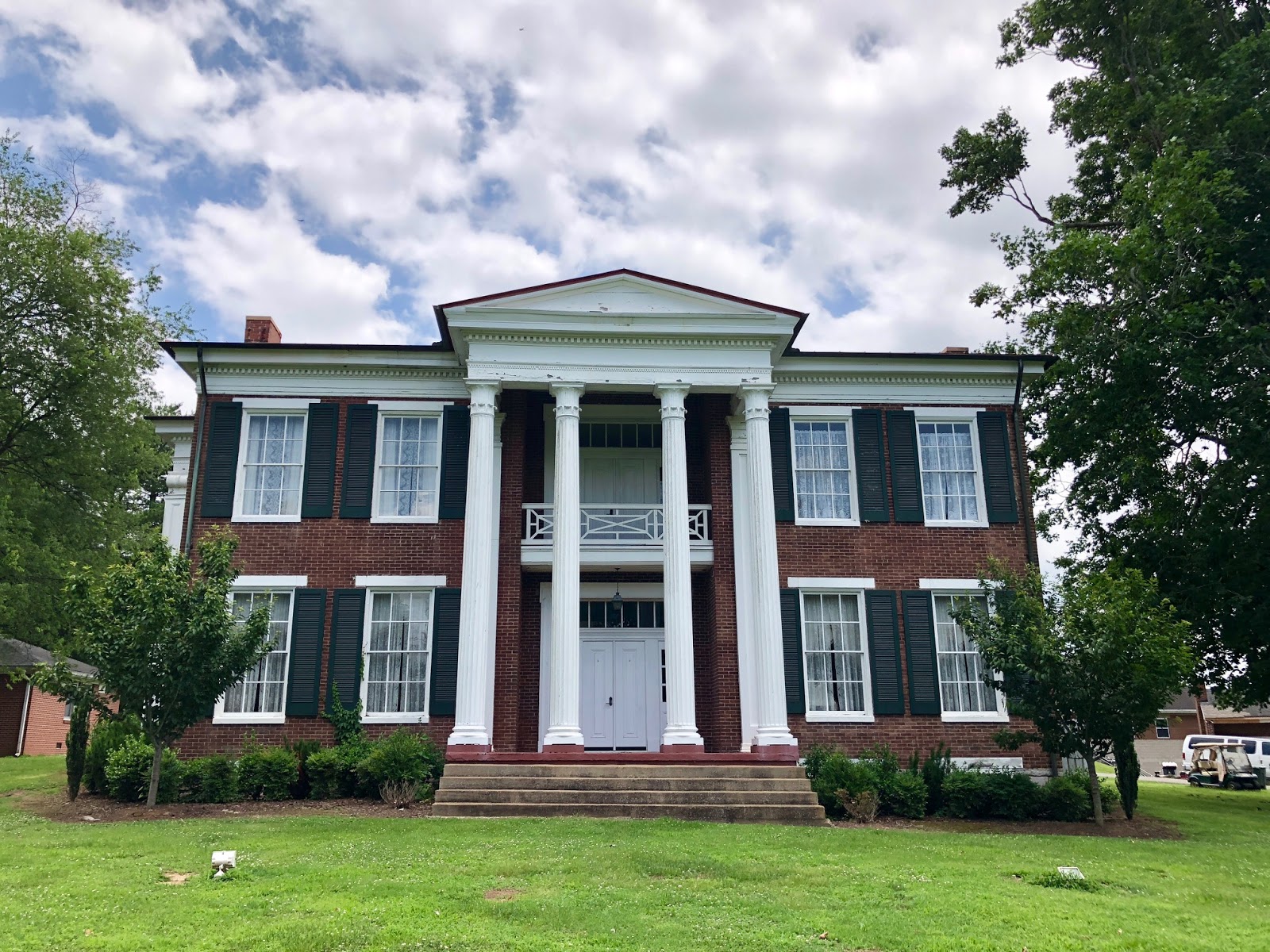
| The murder mansion in Spring Hill., Tenn., commonly known as Ferguson Hall today. |
Why do a movie on Earl Van Dorn?
Smith: Why would anyone
not do a movie about General Van Dorn! I can’t think of another story more fitting of the phrase “the truth is stranger than fiction” than that of General Van Dorn and the Peters clan. Honestly, where can you find sex, murder, escape, lies, an illegitimate baby, a suicide, handsome Confederate generals, beautiful Southern belles, soldiers and battles -- all taking place in the antebellum South amid sprawling plantations and mansions. And where do you find a true story that was hidden away for over 150 years out of respect for a young girl who suffered her sins and became a nun for the rest of her life?
Where Elephants Fought is that story – and more. My dream is to see this tragic tale played out on the big screen! Along with my co-writer/producer Britton Webb, we are working hard to make that happen. Our initial plan is to produce a short film that we will submit to several film festivals, and from there our hope is to get to work on the feature film. Big dreams – but a story like this only comes around once in a lifetime.
 |
View from the second floor of Ferguson Hall, the murder mansion in Spring Hill, Tenn. This was
Earl Van Dorn's headquarters in the spring of 1863. |
If you could ask Earl Van Dorn one question, what would it be, and why?
Smith: Ok, you and I talked about this one, and I had several questions I wanted to ask, of course. But, I have to agree with you, if I could ask General Van Dorn just one question, it would definitely have to do with those last tense moments in his office. That’s the million dollar question! Since there were no witnesses and the only statement given was from the killer’s own mouth, I think so much of the mystery could be resolved just knowing that final conversation. Dr. Peters’ voluntary statement just seems so unrealistic, so out of character for both men involved, that it’s hard to imagine what really occurred. It’s hard to imagine a confrontation like Dr. Peters describes in this statement given May 23, 1863, at Union headquarters in Nashville:
“…I came upon the creature, about half-past two o’clock at night, where I expected to find him. He readily acknowledged my right to kill him, and I fully intended to do so, - gave him a few moments to make certain declarations, - in which he intended to exonerate my wife from dishonor and to inculpate himself completely, - and upon his agreeing to make certain acknowledgements over his own signature, I agreed to give his life to his wife and children…I then ordered him off, and we parted about three o’clock.”
Now who would ever believe that General Van Dorn would give in to such demands -- not to mention, that Dr. Peters would spare his life? Are we to believe that two hotheads in a very volatile situation are going to just shake on it and part ways? But don’t answer just yet. The situation gets even more unbelievable as Peters continues:
 |
Human blood on the floor of the Van Dorn's murder room.
Is it Van Dorn's? (Read my Civil War Times column here.) |
“…I called upon him and notified him that I was ready to receive that written acknowledgement, - when he attempted to evade it by springing a discussion as to its propriety. I unhesitatingly told him I would give him one half-hour, and further told him that he knew what the consequence would be in case of a refusal to comply. I then went up through the village to communicate to a friend these facts…I returned to Van Dorn’s headquarters, and found him engaged in writing. He stopped and read to me what he had written...I then denounced him for his bad faith...I answered…’if you don’t comply with my demands I will instantly blow your brains out.’ I immediately drew my pistol, aiming to shoot him in the forehead, when, by a convulsive movement of his head, he received the shot in the left side of his head just above the ear, killing him instantly.”
Yep, that last bit is true – the part about killing him instantly. But the rest leaves room for doubt. It hardly seems plausible that Dr. Peters let Van Dorn off the hook
two times, but I digress. (Makes for some pretty good fiction, doesn’t it?) Nope, this was a well-planned statement much like the murder was a well-planned assassination. I do believe Peters just got lucky when he caught Van Dorn alone in his office, and even luckier when he got him to write a pass, and way lucky when he was able to sneak behind him and shoot him in the back of the head. But realistically speaking, this was just a well-orchestrated killing. After all, Dr. Peters did have an escape route prepared. Whatever the case, Dr. Peters beat Van Dorn in a simple game of wits – albeit, shooting him from behind was the work of a coward.
If only those walls could talk…
-- Have something to add (or correct) in this post? E-mail me here.