Showing posts with label Bristol. Show all posts

Sunday, March 09, 2014

Crumbling history: Monument to captain killed at Antietam

Captain Newton Manross was killed by artillery fire in Otto's cornfield at Antietam.
This monument to Manross was placed in Forestville Cemetery in Bristol, Conn., by survivors 
of Company K of the 16th Connecticut.
Manross was only 37 years old when he was killed.
(Photo: Amherst College Archives & Special Collections)
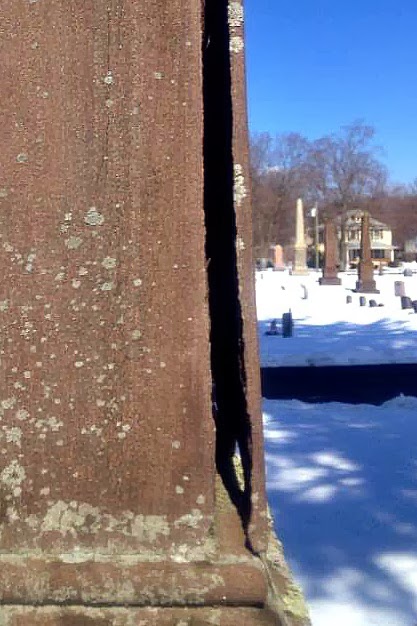
I periodically have provided updates on the poor condition of a monument to 16th Connecticut Captain Newton Manross, who was killed at the Battle of Antietam. The 37-year-old soldier's body was returned in September 1862 to his hometown of Bristol, Conn., where he was buried in Forestville Cemetery, not far from the house where he was grew up. After the Civil War, survivors of Manross' Company K dedicated a monument in the cemetery in memory of their captain, a professor at Amherst (Mass.) College when the war broke out. Harsh winters have taken their toll on the obelisk, which is made of brownstone, a soft stone often prone to erosion. Water gets in cracks, freezes and expands ... and well, the damage is done. A huge section of the back of the monument has been cracked for at least two years, but the damage I saw this morning looks worse than ever. It won't take much for that large section to fall off -- damage that I suspect could be irreparable. Lichen also must be removed from the monument. Perhaps an intelligent blog reader has an idea or two for how we can repair this important piece of Civil War history. E-mail me at jbankstx@comcast.net. I'll talk about Manross and his monument at my "Connecticut Yankees at Antietam" talk at the Bristol Historical Society on Thursday, March 20 at 7 p.m. Admission is free for members, $5 for non-members.

Above and below: A massive crack on the back of the Manross monument.

Saturday, November 09, 2013

Antietam: Windows to history in Bristol, Conn.

These two Civil War-related windows were added to my collection Saturday.
Here are your odd Civil War-related relics of the day: A pair of original windows from 16th Connecticut Captain Newton Manross' boyhood home in Bristol, Conn. Ken Hintz, the owner of the house since 1974, gave me the windows -- they were stored in his barn for years -- during a visit this afternoon. The original part of Hintz's house dates to 1746. Manross, 37, was killed at the Battle of Antietam on Sept. 17, 1862. I gave Ken the Manross placard below to place in front of his house.

Monday, November 04, 2013

Antietam: A tour of house where Newton Manross grew up

16th Connecticut Captain Newton Manross, who was killed at the Battle of Antietam,
grew up in this house in Bristol, Conn. Ken Hintz bought the house on 

Washington Street in 1974. (CLICK ON IMAGES TO ENLARGE.)
The exterior of the house looks much like it did when Manross lived here.
The tin roof on the house is original, according to Hintz, who had it painted red.
A wartime image of Newton Manross, captain of
Company K in the 16th Connecticut.
The beautiful wood floors in the house where 16th Connecticut Captain Newton Manross grew up in Bristol, Conn., are original but have settled in places over time. Put a marble on the floor of one side of a room and it might quickly roll to the other, Ken Hintz said with a chuckle during an impromptu guided tour of his house for me and Civil War author Stephen Recker on Saturday afternoon. Hintz and his wife bought the historic property on Washington Street in 1974, adding over the years modern amenities such as a clay tennis court and a swimming pool as they raised their family. But the Greek Revival house, part of which dates to 1746, still has many of its original features, including a bee-hive oven, stone fireplaces and even a a tin roof that is now painted bright red.

Newton was one of nine children of well-known Bristol clockmaker Elisha Manross and his wife, Maria. (Two of
Manross' brothers, John and Eli, also served in the Union army.) Newton, who graduated from Yale with a degree in geology in 1850, was quite inquisitive even as a youth. Taking refuge from the rain during a fishing trip near his home, he discovered what he thought was a white stone on the floor of cavern. Upon closer inspection, the "stone" proved to be a skull of an Indian. Manross returned the next day, unearthed the entire skeleton of the Indian and took the skull to his father's shop, where it was used as a grotesque holder for small parts for clock movements.

A 37-year-old professor at Amherst College in Massachusetts, Manross enlisted in the Union army on July 22, 1862, excitedly telling his wife Charlotte "you can better afford to have a country without a husband than a husband without a country."  A little more than a month later, he was commissioned captain of Company K of the 16th Connecticut, comprised mostly of men from prosperous Hartford County towns. So well-respected was Manross that he was referred to as “the father of the company” by one soldier.  Another soldier recalled how Manross earned the respect of his men by carrying the muskets of three soldiers (and a drum) while on the march from Washington to Maryland.

Sadly, Manross was killed by cannon fire at Antietam, the first battle of the war for the 16th Connecticut. (See my interactive panorama of where Manross fell at Antietam here.) His death had a profound effect on the men in his regiment. “The loss of our Captain was keenly felt by every member of the Company, for he not only recruited the men, mostly from the town of Bristol, Conn., but he cared for his men constantly,” wrote Pvt. George Robbins of the 16th Connecticut. “They felt for him almost a filial affection.” Manross is buried near his mother, father and wife in Forestville Cemetery in Bristol, about a mile and a half from his boyhood home.

Ken Hintz owns a clock that was made by Elisha Manross, Newton Manross' father.
Elisha was a well-known clockmaker in Bristol, Conn.

Tuesday, September 17, 2013

Antietam: Remembering the fallen

Henry Aldrich, a private in the 16th Connecticut, is buried in 
Antietam National Cemetery.
Henry Aldrich, a 41-year-old blacksmith from Bristol, Conn., was killed at the Battle of Antietam 151 years ago today. He left behind a wife and four children. Aldrich, killed in John Otto's cornfield, is buried in the Connecticut section of Antietam National Cemetery. More than 200 men and boys from the state were killed or died from effects of wounds suffered at Antietam. Here's my downloadable Excel spreadsheet of Connecticut Antietam deaths. It includes regiment, hometown, place of burial, family information and more.

Wednesday, September 26, 2012

Antietam death: 16th Connecticut Corporal Henry Evans

Henry Evans of Avon, Conn., was killed at the Battle of Antietam. 
This is a previously unpublished photo of the 21-year-old soldier.  
Like this blog on Facebook.

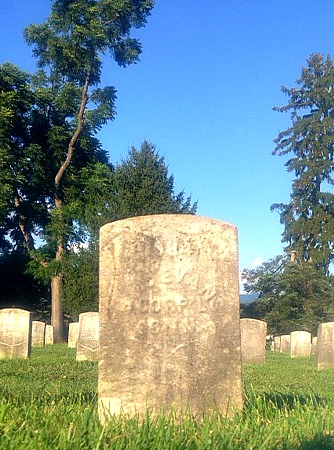
He's buried under a weather-worn, slate-gray tombstone, No. 1,084, just to the left of Private Henry Aldrich of Bristol, on the peaceful, beautiful grounds of Antietam National Cemetery in Sharpsburg, Md. Like many soldiers in the 16th Connecticut, 21-year-old Henry D. Evans was killed in the infamous 40-acre cornfield during the Battle of Antietam on the afternoon of Sept. 17, 1862. For nearly 150 years, the young corporal has largely been anonymous, just another name on a long list of Connecticut dead from the bloodiest day in American history.

Corporal Henry Evans' gravestone in 
Antietam National Cemetery.
But thanks to a lifelong resident of Avon, Conn., a previously unpublished image of the soldier who marched off to war in the summer of 1862 is now available. And thanks to information gleaned from widow's pension records, the 1860 census and other sources, we can shine a light on Evans' short life.

A laborer from Avon, a small farming community near the Farmington River, Henry married 23-year-old Mary Ann Richards of nearby Wethersfield on Aug. 21, 1861, about four months after the first shots of the Civil War were fired at Fort Sumter. Their union produced a daughter, Florence, on Jan. 31, 1862. As talk of war swirled in New England that summer, Henry pondered an agonizing question: Should he  fight to help save the Union or remain with his family?

Evans chose war, joining at least a dozen other men from his town in the 16th Connecticut. No doubt the offer of a $50 bounty from Avon, equivalent to 40 times the average man's daily wage, was a huge enticement.

Mustering into Company I of the the 16th Connecticut as a corporal on Aug. 24, 1862,  Evans was one of about 100 men from Avon to join the cause. At least 20 men from the town died during the Civil War, including Edgar Woodford, a 38-year-old quartermaster sergeant in the 7th Connecticut; Wallace Woodford, a 22-year-old private in the 16th Connecticut; and brothers James and John Willard. It was a horrible toll on a community whose population was slightly more than 1,000 people in 1860.

A memorial marker for Henry Evans in 
West Avon (Conn.) Cemetery is an effigy grave. Henry is 
actually buried at the national cemetery
 in Sharpsburg, Md.
For Evans and the men in his regiment, late summer 1862 was a blur.

After organizing and basic training in a camp near Hartford, the 16th Connecticut received a rousing send-off in the city on Aug. 29 on its way to New York, the first leg of a journey that would take them to the front lines. For Henry and his comrades, the trip down the Connecticut River aboard the steamers City of Hartford and George C Collins must have been thrilling.

"...at every village and hamlet the people line the banks, waving their flags and cheering us on the voyage," Private William Relyea of Company D noted. "The boys forgot their disciplinary troubles in flirting with the girls and answering the greetings of grey-haired sires on the banks, but darkness put the end to this sport, and preparations began to pass the night in quiet sleep. There were a few youngsters who kept up a wild roistering far into the night." (1)

On Aug. 30, the regiment arrived in New York and then traveled by steamer to Elizabeth, N.J. Henry and his comrades took a circuitous route to Washington via train, traveling through Reading, Harrisburg and York in Pennsylvania and to Baltimore before finally arriving in the capital. "We were a very dirty lot when we arrived in Washington, " Relyea noted. (2)

Henry Evans' commander, Company I captain 
John Drake of Hartford, was also killed at 
Antietam. Three other 16th Connecticut captains
 were killed or mortally wounded at Antietam. 
(Connecticut State Library archives)
During a short stay in Washington, perhaps Henry visited the White House grounds or the still-under-construction Washington Monument and Capitol building, as many soldiers in the regiment did. On Sept. 7, the 16th Connecticut was again on the move, leaving Fort Ward outside Washington and joining the Army of the Potomac that was marching into Maryland to stop Robert E. Lee.

On the morning of Sept. 17,  Evans and the 16th Connecticut were positioned in a farm field near Antietam Creek, a couple miles from the village of Sharpsburg. Elements of  the Ninth Corps finally fought their way across a small stone-arch bridge, later famously called Burnside Bridge, and the 16th Connecticut crossed the creek upstream by early afternoon.

"We were marched into a piece of woods and formed a line of battle," Private Wells Bingham of Company H wrote to his father after the battle. "From there we were marched up onto a high hill. All this time the battle was going on only a short distance from us. We had a chance to witness some of the most splendid firing with artillery. We could see the shells and shot strike around the rebbel battery. It took but a short time for our battery to silence theirs." (3)

In a letter published in the Hartford Courant on 
Sept. 30, 1862,16th Connecticut adjutant 
John Burnham noted the location of the 
regiment's dead at Antietam. Henry Evans
was buried with other soldiers from Company I.

As the 16th Connecticut marched into a field of tall corn late that Wednesday afternoon, the untested regiment  was smashed on two sides by veterans of A.P. Hill's division. Company I suffered terribly, with Captain John Drake of Hartford and two sergeants killed. Privates Wallace Woodford, Frank Alford, Charles Parker, Robert Hawley and Newton Evans -- all from Avon -- were wounded. Corporal Henry D. Evans, the father of an 8 1/2-month-old daughter,  was killed.

Because of the remarkable efforts of regiment adjutant John Burnham, an unsung hero of Antietam, the dead of the 16th Connecticut were buried in marked graves on the Otto farm two days after the battle, each soldier's name carved in a wooden headboard. Evans was buried with his comrades from Company I: privates Stephen Twiss, Augustus Truesdell, Stephen Himes, James Grugan and sergeants Orville Campbell and Thomas McCarty. "The collection of the bodies was conducted under my own personal supervision," Burnham noted, "and after the men had reported them all picked up I examined the whole field myself, so that I am confident none were left on the ground." (4)

More than 400 miles away in Avon, Mary Ann Evans soon received word of her husband's death. Although Henry was buried in a well-marked grave, she did not or could not arrange for the return of his remains to Avon,  perhaps because she did not have the financial means. In the years after the battle, Henry's body was disinterred from the field and re-buried in the national cemetery in Sharpsburg.

Six days after Mary Ann Evans' death, her daughter wrote this note to the Board of Pensions. 
Florence Post's mother never remarried after her father was killed at the 
Battle of Antietam 57 years earlier.

On Christmas Eve 1863, more than a year after her husband was killed, Mary Ann applied for a widow's pension from the government. Her application approved, she soon received $8 a month (and $2 a month for Florence) from Uncle Sam. Mary Ann received that widow's pension until Dec. 6, 1919, when she died at 2:30 p.m. in Colorado Springs, Colo. The cause of death was apoplexy and old age. She was 81. (5)

She had never remarried.

(1) "16th Connecticut Volunteer Infantry, Sergeant William H. Relyea," John Michael Priest Editor-in-Chief, Burd Street Press, 2002, Page 8.
(2) Ibid, Page 9.
(3) 16th Connecticut private Wells Bingham letter to his father, Elisha, Sept. 20, 1862, Antietam National Battlefield research library
(4) Hartford Courant, Sept. 30, 1862, Page 7
(5) Widow's pension documents, Henry Evans and Mary Ann Evans

In an undated photo, Henry Evans' wife, Mary Ann, holds
 their only child, Florence.

Monday, September 03, 2012

Antietam: If you're in Connecticut ...

Sunrise at Antietam.

As the 150th anniversary of the battle approaches on Sept. 17, there are several Antietam-related events scheduled here in Connecticut:

Saturday, Sept. 8: Avon, noon:  I will speak at the Avon Free Library about 10 Connecticut soldiers who were killed or mortally wounded at Antietam. Captain Samuel Brown as well as this soldier, this one, this one and six others are part of my program. Mingle with re-enactors at noon, hear my talk at 1 p.m. and then take a trip across the street at 2 p.m. to West Avon Cemetery, where I'll talk about four soldiers from Avon who died during the Civil War. Here's more info.

Monday, Sept. 17, West Cemetery, Bristol, 6 p.m.: Remembering Bristol’s Civil War Soldiers," a program commemorating the 150th anniversary of the battle. Limited seating available. Bring a chair if you desire. Rain date is Sept. 25. A descendant of 16th Connecticut captain Newton Manross, who was killed at Antietam, will place a wreath at the Civil War monument during the ceremony.

Saturday, Sept. 29- Sun., Sept. 30, Wickham Park, Manchester, 10 a.m.: "CONNECTICUT TO ARMS": Join the Connecticut Civil War Commemoration, its many partner organizations and re-enactors from across New England for the next big Civil War encampment.

LIKE THIS BLOG ON FACEBOOK! It could change your life!
FACES OF THE CIVIL WAR: Stories and photos of common soldiers who served during the war.
MORE ON 16TH CONNECTICUT SOLDIERS: Tales of the men in the hard-luck regiment.
MORE ON ANTIETAM: Read my extensive thread on the battle and the men who fought in it.

Thursday, July 12, 2012

Antietam: Revisiting Newton Manross' monument


Newton Manross was killed at Antietam. I got pricked
 by the sword in the photo.  (Photo: Bristol Historical Society)
Curious about the condition of the monument for Civil War soldier Newton Manross, I stopped by Forestville Cemetery in Bristol, Conn., tonight on my way home from work and shot the video above. Sadly, the tall brownstone memorial to the 16th Connecticut captain who was killed at Antietam remains in poor shape. If repairs are not made soon to the monument placed by the survivors of Manross' Company K, the damage may be irreversible and too costly to fix.

To stir up publicity several months ago, I contacted the Bristol Press, which made brief mention in a column (no longer available online), and twice left messages with the woman in state government who handles such matters, but she didn't return my calls. In tough economic times, it's probably difficult to justify spending thousands of dollars to repair a monument for a soldier who was killed nearly 150 years ago. Perhaps there's another way. I'm up for your ideas. E-mail me here or hit the comments section below.

When he enlisted in the Union army on July 22, 1862, Manross told his wife:  "You can better afford to have a country without a husband than a husband without a country." Terrific quote from a great man who deserves to be remembered.

In this photo taken in 1887, Civil War veterans from the Manross G.A.R. post gather by the
Newton Manross monument in Forestville Cemetery in Bristol, Conn. The monument was

placed there by survivors of Company K of the 16th Connecticut.
(Photo courtesy Bristol Historical Society via Tom LaPorte; CLICK IMAGE TO ENLARGE.)

Thursday, May 31, 2012

Faces of the Civil War: John Manross

Brothers Eli and John Manross of Bristol, Conn. Their older brother, Newton,
  also served during the Civil War.  (Photo courtesy Bristol Public Library)

John Manross' brother, Newton, was killed at Antietam, a cannonball tearing off his left arm and exposing the beating heart of the 16th Connecticut captain to a private who never forgot the gruesome sight.

Another brother, Eli, a sergeant in the 5th Connecticut, suffered a wound during the Union army's disastrous defeat at Chancellorsville in May 1863 but survived the war.

For the youngest of eight brothers in the prominent family from Bristol, Conn., however, the Civil War was a different kind of hell.

Thirty-seven-year-old  Newton Manross, a captain in
 the 16th Connecticut, was killed at Antietam on
Sept. 17, 1862.
The rebellion apparently drove John Manross insane, finally killing him nearly seven months after Lee surrendered to Grant at Appomattox.

If you want to research Civil War soldiers, pension records are invaluable. Often a trove of legal documents and letters that can piece together a soldier's life and death, they are available at the National Archives in Washington and through web sites such as fold.com.

In the pension records for 15th Massachusetts private Justus Wellington, I discovered an affidavit from his sister noting that the young soldier lost all the money he intended to send home to his financially-strapped family when he swam the Potomac River under fire from rebels during the Battle of Ball's Bluff. A shoemaker from West Brookfield, Mass., Wellington was killed at Antietam.

In pension records for 16th Connecticut private Henry Aldrich, also killed at Antietam, I found the heart-rending letter his wife wrote to the pension board requesting that her oldest son be discharged from the army to support her and three young children back home in Bristol. "Relieve a Mothers hart and yo shall have a Mothers blessing," Sarah Aldrich pleaded.

The 48-page widow's pension file for John Manross -- a man once described as a "noted hunter" and a "famous ball player" (1) -- tells a similar, sad tale.

John was the son of  Maria and Elisha Manross, a War of 1812 veteran and a well-known clockmaker in Bristol, a manufacturing town about 20 miles southwest of Hartford. Employed in his father's clock-making business before the Civil War, John married a Maine woman, 21-year-old Lena Gale, on Nov. 12, 1860 in Farmington, Conn. The couple had one child, a girl named Juanita, who was born on Jan. 29, 1862.

John Manross' army disability discharge from Knight Hospital in New Haven, Conn. He was 
unfit for the Veterans Reserve Corps because of "insanity, disease contracted while in line of duty."

John, who stood 5-9 and had a dark complexion, blue eyes and dark hair, enlisted in the Union army on Jan. 28, 1864, mustering into Company B of the 2nd Connecticut Heavy Artillery as a private the same day. (Eli and Newton enlisted in the summer of 1861 and 1862, respectively.)

Army life was a lousy experience for John almost from the start of his service. Sometime in early February 1864, he suffered in the barracks instead of on the battlefield when the top berth of a bunk and several soldiers fell on him, causing a severe head injury. Later that year, perhaps about the time of the momentous Battle of Cold Harbor near the Confederate capital of Richmond in June, Manross was a very sick man. The frequent marching of the Army of the Potomac and exposure to the elements wore down the young soldier.

Eli Manross' grave in Forestville Cemetery in Bristol, Conn.
"By reason of exposure and fatigue consequent upon the discharge of his duties he contracted a cold and fever which confined him in hospital for a long time," noted Captain William Lewis of Manross' Company B. "...he attempted to return to duty but was prevented by the state of his health and in my opinion his constitution was broken down and he (was) rendered unfit for any sort of labor." (2)

Manross eventually was sent to Knight Hospital in New Haven, Conn., a facility set up soon after the Civil War began to handle the massive number of war casualties. He was treated there for consumption, known  as tuberculosis today, and for "insanity," thought by doctors of the time to have been caused by fever.

On Jan. 31, 1865, Manross, a shell of the man who entered the service about a year earlier, was discharged from the hospital and the army because of "insanity and disease contracted while in the line of duty."

"Not fit for V.R. (Veterans Reserve) Corps," the discharge for disability document matter-of-factly noted. "Disability total. His friends are able and willing to take charge of him." How John's condition affected his marriage is unknown, but it undoubtedly did not make life easy for the couple. Lena's name is not mentioned in the discharge for disability document.

In a John Banks' blog tradition, I placed this penny on Newton Manross' grave today.
Nearly seven months after the Civil War ended, John Manross, a "faithful soldier" with "good habits," died in his hometown of Bristol. The physician who treated him had no doubt about the cause of death. "Have been acquainted with him for some fourteen years," Dr. Frank Whittemore noted, "and had no symptoms of insanity until he returned from the army (and) consider cause of disease fatigue consequent with army life." (3)

John Manross was only 28 years old.

Soon after her husband died, Lena Manross applied for a widow's pension, and in late 1865, she was granted $8 a month; an additional $2 a month was added for Juanita. Lena, who never remarried, lived out her days in Rhode Island. By the time she died at age 87 in 1926, her Civil War widow's pension paid her $50 a month.

John Manross is buried under a plain, gray marker in Bristol's Forestville Cemetery, not far from the shop where he and his brothers worked on their father's clocks and the house where the family once lived. Several paces to the left of John's marker are the final resting places for Newton and Eli.

(1) Commemorative Biographical Record of Hartford County, J.H. Beers & Co., 1901, Page 355
(2) Widow's pension file affidavit, Oct. 16, 1865.
(3) Widow's pension file affidavit, May 30, 1867

John Manross is buried in Forestville Cemetery in Bristol, a few steps from his brother, Newton,
who was killed at Antietam.

Saturday, April 07, 2012

Antietam: Captain Newton Manross' sword, pistol

Close-ups of sword Newton Manross, captain of Company K of the 16th Connecticut, carried at
Antietam when he was killed on Sept. 17, 1862.  The grip of the sword is shark skin,
according to  Bristol historian Tom LaPorte. The sword is in the Memorial Military Museum
 at the Bristol (Conn.) Historical Society.
"Brilliant."

"Gallant"

A seldom-seen civilian view of Newton Manross.
(Bristol Public Library History Room collection)
"Heroic."

"Brave and intelligent."

Such praise from Civil War soldiers about dead comrades is common in letters, diaries and post-war assessments that I have read during the past year.

Were most of these dead men really gallant and heroic?

The love, respect and admiration soldiers in the 16th Connecticut and others had for Captain Newton Manross --a brilliant professor-turned-soldier killed during the regiment's first fight of the Civil War -- seem especially genuine.

By all accounts, this man was special.

Two weeks ago, I told the story of  Manross and his gruesome death at Antietam on Sept. 17, 1862. A Yale graduate and world traveler, Manross was acting professor of chemistry and philosophy at Amherst (Mass.) College when he recruited a company of men, mostly from Bristol, and enlisted in the Union army on July 22, 1862. Upon joining the cause, he told his wife: "You can better afford to have a country without a husband than a husband without a country." (I love that quote.)

Nearly two months later, the 37-year-old son of a clockmaker was dead, his left arm torn apart by artillery fire.

George Robbins of Farmington was an 18-year-old private in the 16th Connecticut who served under Manross in Company K at Antietam. In a letter to his sister written six days after the battle, Robbins described the confusing fight in farmer John Otto's 40-acre cornfield.

Framed copy of  an albumen of Newton Manross, who holds
 the sword shown above and below, at Bristol Historical Society.
"Before we got into position, we were under fire of the enemy three times," he wrote. "We were taken into a cornfield where we could not see anything. Our captain was killed by a grape shot when we first went into the field." (1)

More than five decades later, the memory of Manross still tugged at Robbins.

"The loss of our Captain was keenly felt by every member of the Company, for he not only recruited the men, mostly from the town of Bristol, Connecticut, but cared for his men constantly," Robbins wrote in 1918 in an amazingly detailed account of his Civil War service. "They felt for him almost a filial affection. He cheered us when tired and depressed with words of encouragement not only once but many times on that trying march from Washington, when slender boys were ready to drop by the wayside, he helping to carry their loads.

"I recall one instance near the close of an intensely hot day when we were all about at the limit of endurance he voluntarily carried the muskets of three boys, added to which was a drum. He was a superb specimen of manhood, toughened by his travels in many lands. ..." (2)

After Manross' death, his successor told the colonel of the 16th Connecticut:  "Those boys care for Manross's old shoes more than for the best man in the regiment." (3)

And then there's this from fellow Amherst professor B. Silliman:

"Had he lived -- but what need is there for conjecture now? The world will never know its loss; but his friends will never forget theirs." (4)

Your humble blogger with Newton Manross' sword.
With those stories in mind, I was especially eager today to visit the Bristol Historical Society. In a glass case in the terrific Memorial Military Museum collection in the former Bristol High School, the sword and pistol that Manross carried at Antietam are kept in a glass case. Bristol Historical Society first vice president Carol Denehy and Bristol historian Tom LaPorte were kind enough to let me inspect the Manross mementos up close. (Too close at one point, when I was accidentally stuck by the sword. Yikes!)

Part of the historical society's collection for years, the sword has a sharkskin grip and is inscribed on the hilt in ornate script:  "Presented to Capt. N.S. Manross by his friends in Bristol."  The weapon was made in nearby Collinsville by the Collinsville Company, which supplied John Brown with pikes that the abolitionist had hoped to use to incite a slave rebellion at Harpers Ferry in 1859.  The .32-caliber pistol still appears to be in working order.

This little gem of a museum, which includes many other Civil War relics, is at 98 Summer Street in Bristol, Conn. It's open Wednesday (10 a.m.-2 p.m.) , Saturday (noon-4 p.m.) or by appointment. For more information, call 860-583-6309 or 860-583-5466. Admission is free, but donations are accepted. If you're a history buff, it's absolutely worth your time.

(1) George Robbins letter to his sister, Sept. 23, 1862, Connecticut Historical Society Civil War Manuscripts Project

(2) "Some Recollections of a Private in the War of the Rebellion," George Robbins, 1918, Connecticut Historical Society Civil War Manuscripts Project

(3) The Military and Civil History of Connecticut During the War of 1861-65, William Augustus Croffut, John Moses Morris, 1869, Page 282-83

(4) Ibid, Page 283

Carol Denehy, Bristol Historical Society first vice president, and her son, Tim at the museum.
Carol's husband, Jack,
started the terrific Memorial Military Museum at the Bristol Historical Society.
.32-caliber pinfire pistol that Manross carried at Antietam. Below: Close-up of  the barrel.

Wednesday, April 04, 2012

Brothers: Connecticut's Civil War sacrifice (Cont.)

The marker for Willis and Henry Way in West Cemetery in Bristol, Conn. The brothers died
in prisoner-of-war camps in the South in 1864.
Decades of wear fail to obscure the words at the top of the Way's memorial stone:
"Gone, but not forgotten."
Willis Way's name appears at the top of the deteriorating
Bristol Civil War memorial in West Cemetery.
The brothers from Connecticut each died in prisoner-of-war camps in the Deep South in 1864, hundreds of miles from home. Although Henry and Willis Way have a marker in West Cemetery in Bristol, just down the hill from the deteriorating town Civil War memorial, it's unlikely anyone is buried under their white marble stone.

Privates in the hard-luck 16th Connecticut, the Ways were captured at Plymouth, N.C., on April 20, 1864, along with most of the rest of the regiment. Sent south to the notorious prisoner-of -war camp at Andersonville, Ga., Henry died of chronic diarrhea there on Aug. 18, 1864. Only 19 years old, he is buried in Grave No. 6138 at Andersonville National Cemetery, one of nearly 13,000 Union soldiers who died in the camp in southwestern Georgia. Willis also was sent to Andersonville and later transfered to a camp in Florence, S.C., where he died on Sept. 20, 1864. Only 23 years old, he, like many Union prisoners of war, is likely buried in the South, probably under a headstone marked "Unknown." (Tragedy struck the family again in 1880, when the Way's brother, Francis, died in a railroad accident. He was 28.)
In this photo I shot two weeks ago, the American flag
was in tatters by the deteriorating
Bristol
Civil War memorial in West Cemetery. Not good.

It's a fine topic for a future post.

Sons of Alfred and Esther Way of Bristol, Henry and Willis each served in Company K of the 16th Connecticut under its remarkable captain, Newton Manross of Bristol.

Many who survived the hell of Andersonville, such as 16th Connecticut private Wallace Woodford of Avon, were broken men after their release. Emaciated and unable to eat, Woodford -- who told friends "words could not describe the horrors" of being a POW -- died in January in Avon on Jan. 10, 1865, one month after he was paroled.

I hope to uncover much more about the the Ways, one of 15 sets of brothers from Connecticut that I have found who died during the Civil War. On Sunday, I told the tale of the Hollister brothers from Chatham, who died of typhoid fever in Falmouth, Va., 30 minutes apart two days before Christmas in 1862. Two weeks ago, I visited a cemetery in Glastonbury, where brothers William (mortally wounded at Antietam) and John Porter (killed near Petersburg) are buried. And in late November, I shared brief stories of eight other sets of brothers from the state who perished during the war.

If you have photos of the Ways or know of other sets of brothers from Connecticut who died during the Civil War, drop me a line. I have a major project I am interested in pursuing on the topic.
According to the 1860 U.S. census, Alfred and Esther Way had four children
 living at home in Bristol, Conn.,  including Willis and Henry.

Tuesday, March 27, 2012

Manross monument: Then and (sadly) now

Top: In a photo taken in 1887, Civil War veterans from the Newton Manross  G.A.R. post
 gather at the monument for Manross, a captain in the 16th Connecticut who was killed
at Antietam. Below: The monument in Forestville Cemetery in Bristol, Conn.,  from approximately
 the same angle today.   (Top photo courtesy Bristol Historical Society via Tom LaPorte)

By all accounts, Captain Newton Manross of the 16th Connecticut Infantry was a brilliant man.

Newton Manross as a civilian.
(Image courtesy Tom LaPorte)
A day after he graduated from Yale in 1850 with a degree in geology, Manross sailed for Europe, where he earned a Ph.D. in chemistry from the University of Gottingen in Germany in 1852.  He later traveled extensively in South America, visiting Trinidad, Panama and Mexico and exploring for coal, iron and other minerals. An outstanding scientist, his work appeared in the prestigious American Journal of Science.

Shortly after Manross was named professor of chemistry and philosophy at Amherst (Mass.) College, he joined the Union army on July 22, 1862, telling his wife Charlotte "you can better afford to have a country without a husband than a husband without a country." Less than two months later, the 37-year-old citizen-soldier once described as a "man of exceptional learning and scholarship" was dead, killed by a cannon ball at the Battle of Antietam on Sept. 17, 1862.

From a prominent Bristol, Conn., family, Manross was buried in Forestville Cemetery in his hometown. After the Civil War, survivors of Manross' Company K of the 16th Connecticut placed an 8-foot brownstone monument in their captain's honor near his gravestone. Sadly, that monument is deteriorating, worn by the elements of 100-plus New England winters. In addition to several prominent cracks, the backside of the monument is separating from the main portion. One good smack could easily send that piece crashing to the ground.

Newton Manross deserves better. Perhaps this post will spur an effort to repair a monument for an exceptional man who died for his country nearly 150 years ago. (For more on the Manross monument, check out my video below.)


A professor before the Civil War, Manross was killed by artillery fire at Antietam.
Can these prominent cracks in the Newton Manross monument be repaired?
Survivors of Newton Manross' Company K of the 16th Connecticut placed this monument
in Forestville Cemetery in Bristol in honor of their "gallant and beloved captain."

Saturday, March 24, 2012

Faces of the Civil War: Captain Newton Manross

"A man of exceptional learning and scholarship," Newton Manross, a 37-year-old captain
in the 16th Connecticut, was killed at Antietam. (Photo: Bristol Historical Society)
Like this blog on Facebook | Follow me on Twitter

Even decades after the Civil War, the memory of the gruesome death of Newton Manross -- a brilliant, bookish globetrotter from Bristol -- was seared into the brains of two Connecticut soldiers.

A 37-year-old professor, Manross enlisted in the Union army on July 22, 1862, telling his wife Charlotte "you can better afford to have a country without a husband than a husband without a country." (1) On Aug. 24, he was commissioned captain of Company K of the 16th Connecticut, comprised of men from Hartford County towns such as Canton, Avon, Glastonbury, Granby and Bristol.

Manross was among the many 16th Connecticut 
casualties at Antietam listed in the 
Hartford Daily Courant on Sept. 23, 1862.
Less than a month later, Manross and the  16th Connecticut -- many of the men had never trained extensively with their weapons -- were thrown into the bloody chaos of the Battle of Antietam. As Manross led his company into action into a 40-acre cornfield that terrible Wednesday afternoon, he was blasted in the left shoulder by grapeshot.

"I often think of that day, Sept. 17, 1862, and helping Captain Manross into the fence corner," Lester Taylor, a private in Company H of the 16th Connecticut, wrote 39 years after the battle. "I could look down inside of him and see his heart beat, his left shoulder all shot off.

"When I first saw him, he was trying to get up," Taylor added, "so I went to him and helped him to his feet, being assisted by George Walbridge of H Company.  ... we helped him a little way to the left and laid him down. The only thing I remember him saying was: 'I am bleeding inwardly.' " (2)

Jasper Hamilton Bidwell, a private in the 16th Connecticut from Canton, recalled in 1909 a dazed and bleeding Manross resting on his right elbow, his head up.  After he gave the captain water, Bidwell heard Manross moan, "My poor wife!" Although accounts from the period differ, Manross likely died shortly after receiving the terrible wound. (3)

Among four captains in the 16th Connecticut killed or mortally wounded at Antietam, Manross was anything but your typical citizen-soldier.

Survivors of Company K of the 16th Connecticut placed 
a memorial  for Captain Newton Manross near his grave 
at Forestville Cemetery  in Bristol, Conn.
One of nine children of prominent Bristol clockmaker Elisha Manross and his wife Maria, Newton was inquisitive even as a teenager. Taking refuge from the rain during a fishing trip near his home, Manross discovered what he thought was a white stone on the floor of cavern. Upon closer inspection, the "stone" proved to be a skull of an Indian. Manross returned the next day, unearthed the entire skeleton of the Indian and took the skull to his father's shop, where it was used as a grotesque holder for small parts for clock movements. (4)

Highly educated, Manross graduated from Yale in 1850 with a degree in geology. He received his Ph.D. from the University of Gottingen in Germany in 1852 and spent time in Europe exploring mines. Especially interested in mining engineering, he traveled the world in the decade before the Civil War, analyzing rocks and minerals in such far-flung places as Trinidad, Panama and Mexico.

Described as "a man of exceptional learning and scholarship," Manross received a patent in 1859 for a valve to retard and arrest the flow of gasses, and was so well regarded that his work frequently appeared in the prestigious American Journal of Science. (His obituary also appeared in the Journal in 1862.)

In 1861, before he enlisted in the Union army, Manross was named of acting professor of chemistry and philosophy at Amherst (Mass.) College. But like his brothers, Eli and John, he couldn't ignore the call of his country. (Eli, a sergeant in 5th Connecticut, was wounded at Chancellorsville in 1863; John, a private in the 2nd Connecticut Heavy Artillery, was discharged from the army because of  insanity and disease in 1865.)

Newton Manross' occupation was listed as mechanic in the 1860 U.S. census. His family
 apparently employed three servants. (CLICK TO ENLARGE.)
"He was a man of great promise in science and rare nobility of character," an 1873 history of Amherst College noted about Newton Manross.  "A great favorite with officers and students, he stood up boldly for the Christian faith, and used all his influence for the highest good of the students and the prosperity of the Institution."

Manross clearly left a lasting impression on Bristol, a manufacturing town 20 miles southwest of Hartford.

Manross was killed near the 16th Connecticut monument at Antietam.
The regiment suffered 43 killed, 161 wounded and 204 captured
or missing in its first battle of the Civil War.
Nearly thirty years after Antietam, the Bristol Herald published a long, glowing front-page article about its favorite son under a headline that read: "Soldier, Scholar and Gentleman in All Positions in Life." The article included an account of how Manross helped rescue his stranded party in the South American interior by making a boat from trees and floating upriver to the coast. (5)

On May 9, 1902, a crowd that included many veterans of the 16th Connecticut and Manross' only child gathered for a maple tree-planting ceremony in the captain's honor in the Forestville section of Bristol, where he had lived and gone to grammar school. After schoolchildren sang "The Gladness of Nature" and the superintendent of schools gave a "brief but interesting" speech, an old soldier delivered an address in honor of his long-dead friend. (6)

"From this little district school to the great institution of learning with which he was connected he kept in mind the resolve to benefit the world by his life and example," said 65-year-old William Relyea, a private in the 16th Connecticut. "...Captain Manross' mind grew stronger and his mind was a delight to all who knew him.

"Such a man we honor here today by planting a tree in his memory," Relyea added. "He was a man beloved by all us soldiers in the Sixteenth. The day when he marched into camp at the head of his band of sturdy Bristol boys he put new life into the old Sixteenth, for they had realized they had not only a man of deep learning among them, but one who was patriotic and sincere to all."

Newton and Charlotte Manross are buried side-by-side in Forestville Cemetery in Bristol, not far from the house where he grew up. Several paces away, a monument in his memory was placed by survivors of Manross' Company K.

A contemporary marker replaced an older gravestone for Manross and his wife, Charlotte, who
died in 1874. "You can better afford to have a country without a husband," he told
his wife after he enlisted in 1862, "than a husband without a country."
In this photo taken in 1887, Civil War veterans from the Manross G.A.R. post gather by the
Newton Manross monument in Forestville Cemetery in Bristol, Conn. The monument was

placed there by survivors of Company K of the 16th Connecticut.
(Photo courtesy Bristol Historical Society via Tom LaPorte; CLICK IMAGE TO ENLARGE.)

-- Have something to add (or correct) in this post? E-mail me here.


SOURCES

(1) History of the Sixteenth Connecticut Volunteers, B.F. Blakeslee, Hartford, The Case, Lockwood & Brainard Co., 1875, Page 20.
(2) George Whitney Collection, Connecticut State Library.
(3) George Whitney Collection, Connecticut State Library.
(4) "Bristol, Connecticut, In The Olden Time New Cambridge, Which Includes Forestville," Hartford Printing Company, 1907, Pages 13-14.
(5) Bristol Herald, Aug, 11, 1892, Page 1.
(6) Hartford Courant, May 10, 1902, Page 15.