Showing posts with label Forestville Cemetery. Show all posts

Sunday, March 09, 2014

Crumbling history: Monument to captain killed at Antietam

Captain Newton Manross was killed by artillery fire in Otto's cornfield at Antietam.
This monument to Manross was placed in Forestville Cemetery in Bristol, Conn., by survivors 
of Company K of the 16th Connecticut.
Manross was only 37 years old when he was killed.
(Photo: Amherst College Archives & Special Collections)
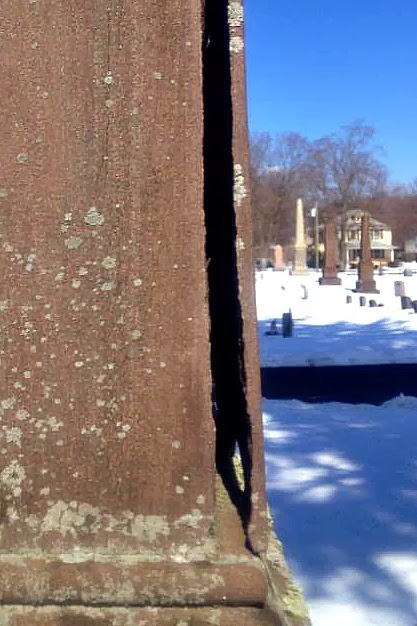
I periodically have provided updates on the poor condition of a monument to 16th Connecticut Captain Newton Manross, who was killed at the Battle of Antietam. The 37-year-old soldier's body was returned in September 1862 to his hometown of Bristol, Conn., where he was buried in Forestville Cemetery, not far from the house where he was grew up. After the Civil War, survivors of Manross' Company K dedicated a monument in the cemetery in memory of their captain, a professor at Amherst (Mass.) College when the war broke out. Harsh winters have taken their toll on the obelisk, which is made of brownstone, a soft stone often prone to erosion. Water gets in cracks, freezes and expands ... and well, the damage is done. A huge section of the back of the monument has been cracked for at least two years, but the damage I saw this morning looks worse than ever. It won't take much for that large section to fall off -- damage that I suspect could be irreparable. Lichen also must be removed from the monument. Perhaps an intelligent blog reader has an idea or two for how we can repair this important piece of Civil War history. E-mail me at jbankstx@comcast.net. I'll talk about Manross and his monument at my "Connecticut Yankees at Antietam" talk at the Bristol Historical Society on Thursday, March 20 at 7 p.m. Admission is free for members, $5 for non-members.

Above and below: A massive crack on the back of the Manross monument.

Saturday, July 14, 2012

Faces of the Civil War: Private Gideon S. Barnes

A private in the 16th Connecticut from Burlington, Conn., 
Gideon Barnes was wounded at Antietam.  He died two months later.
(Photo courtesy Lester Larrabee)

Unlike many Civil War soldiers who died far from home, Gideon S. Barnes spent the final days of his life in his home state, where he suffered an agonizing death.

A laborer from Burlington, Conn., Barnes had been married for a little more than six years to a woman named Lydia Ann Hall (they had no children) when he made a life-changing decision to enlist in the Union army on July 26, 1862. Nearly a month later, he was mustered into the 16th Connecticut Infantry's Company K, commanded by well-respected Captain Newton Manross of Bristol, Conn.
Gideon Barnes was among the many 
16th Connecticut  Antietam casualties 
listed in the Hartford Courant
on Sept. 23, 1862, six days after the battle.

Events moved swiftly for Barnes and the 16th Connecticut.

After organizing near Hartford, the regiment was sent to Washington in late August, where it was attached to the Ninth Corps of the Army of the Potomac. The 700-plus barely trained soldiers of the regiment found themselves on the front lines at the Battle of Antietam on Sept. 17, 1862.

As the 16th Connecticut was routed late that Wednesday afternoon in farmer John Otto's 40-acre cornfield, Barnes took a bullet in the left thigh and was carried from the field. Timothy Robinson, a 2nd lieutenant in Company K, recalled that Barnes was shot "through the leg above the knee, which disabled him from service, and he went home on a furlough." (1)

By Oct. 9, 1862, Barnes had arrived back in Connecticut, along with four other soldiers wounded at Antietam, to continue his recuperation in Burlington at the home of his father, Sherman, a War of 1812 veteran, who enjoyed making telescopes. Barnes' grandfather, Joel, served in the militia during the  Revolutionary War. (Interestingly, Sherman suffered a broken thigh bone when the breech of his cannon exploded when it was fired during an 1838 Fourth of July celebration in the Whigville section of Burlington. (2) The wound never healed properly, according to a Barnes descendant.)

Gideon Barnes' wife received an 
$8-a-month pension
from the government after his death.
Gideon Barnes never recovered from his wound, and exactly two months after Antietam, the 32-year-old soldier died. In an affidavit supporting Lydia Ann's widow's pension claim, the Bristol physician who treated Barnes noted a grisly combination of factors that caused his demise.

"Wounds and injuries received in the battle of Antietam by rifle ball through the thick portion of the thigh causing explosive separation with sloughing," Dr. T.W. Camp noted. "This in connection with an uncontrollable camp diarrhea accompanied with delirium and typhoid fever were more than sufficient to cause death." (3)

Twenty-four-year-old Lydia Ann applied for a widow’s pension shortly after Gideon’s death, eventually receiving $8 a month from Uncle Sam. On Oct. 1, 1865, she married a clockmaker from Bristol named Valentine Atkins, who died in 1895. Financially supported only by her son-in-law and meager income from a rental property, Lydia applied for the restoration of her Civil War widow’s pension in 1901, and at the time of her death on Feb. 26, 1918, she was receiving $25 a month. (4)

Gideon Barnes is buried under a plain, gray state-issued marker in Bristol's Forestville Cemetery, 25 feet across the cemetery road from the gravestone of Manross, who was killed at Antietam when his arm was blown off by artillery fire, exposing his beating heart.

(1) Widow's pension affidavit, Timothy Robinson, Aug. 14, 1863
(2) 1838 diary of Leavett Mills, Whigville, Conn.
(3) Widow's pension affidavit, Dr. T.W. Camp, Oct. 3, 1863
(4) Lydia Barnes' widow's pension file

Gideon S. Barnes' gravestone in Forestville Cemetery in Bristol, Conn.
Gideon Barnes' name appears on the Burlington (Conn.) Civil War memorial, which honors the
 88 town residents or natives who served during the war. A star next to a name denotes those who 
died in service in the Union army.  (Visit ctmonuments.net for more on Connecticut war memorials.)


Thursday, July 12, 2012

Antietam: Revisiting Newton Manross' monument


Newton Manross was killed at Antietam. I got pricked
 by the sword in the photo.  (Photo: Bristol Historical Society)
Curious about the condition of the monument for Civil War soldier Newton Manross, I stopped by Forestville Cemetery in Bristol, Conn., tonight on my way home from work and shot the video above. Sadly, the tall brownstone memorial to the 16th Connecticut captain who was killed at Antietam remains in poor shape. If repairs are not made soon to the monument placed by the survivors of Manross' Company K, the damage may be irreversible and too costly to fix.

To stir up publicity several months ago, I contacted the Bristol Press, which made brief mention in a column (no longer available online), and twice left messages with the woman in state government who handles such matters, but she didn't return my calls. In tough economic times, it's probably difficult to justify spending thousands of dollars to repair a monument for a soldier who was killed nearly 150 years ago. Perhaps there's another way. I'm up for your ideas. E-mail me here or hit the comments section below.

When he enlisted in the Union army on July 22, 1862, Manross told his wife:  "You can better afford to have a country without a husband than a husband without a country." Terrific quote from a great man who deserves to be remembered.

In this photo taken in 1887, Civil War veterans from the Manross G.A.R. post gather by the
Newton Manross monument in Forestville Cemetery in Bristol, Conn. The monument was

placed there by survivors of Company K of the 16th Connecticut.
(Photo courtesy Bristol Historical Society via Tom LaPorte; CLICK IMAGE TO ENLARGE.)

Tuesday, March 27, 2012

Manross monument: Then and (sadly) now

Top: In a photo taken in 1887, Civil War veterans from the Newton Manross  G.A.R. post
 gather at the monument for Manross, a captain in the 16th Connecticut who was killed
at Antietam. Below: The monument in Forestville Cemetery in Bristol, Conn.,  from approximately
 the same angle today.   (Top photo courtesy Bristol Historical Society via Tom LaPorte)

By all accounts, Captain Newton Manross of the 16th Connecticut Infantry was a brilliant man.

Newton Manross as a civilian.
(Image courtesy Tom LaPorte)
A day after he graduated from Yale in 1850 with a degree in geology, Manross sailed for Europe, where he earned a Ph.D. in chemistry from the University of Gottingen in Germany in 1852.  He later traveled extensively in South America, visiting Trinidad, Panama and Mexico and exploring for coal, iron and other minerals. An outstanding scientist, his work appeared in the prestigious American Journal of Science.

Shortly after Manross was named professor of chemistry and philosophy at Amherst (Mass.) College, he joined the Union army on July 22, 1862, telling his wife Charlotte "you can better afford to have a country without a husband than a husband without a country." Less than two months later, the 37-year-old citizen-soldier once described as a "man of exceptional learning and scholarship" was dead, killed by a cannon ball at the Battle of Antietam on Sept. 17, 1862.

From a prominent Bristol, Conn., family, Manross was buried in Forestville Cemetery in his hometown. After the Civil War, survivors of Manross' Company K of the 16th Connecticut placed an 8-foot brownstone monument in their captain's honor near his gravestone. Sadly, that monument is deteriorating, worn by the elements of 100-plus New England winters. In addition to several prominent cracks, the backside of the monument is separating from the main portion. One good smack could easily send that piece crashing to the ground.

Newton Manross deserves better. Perhaps this post will spur an effort to repair a monument for an exceptional man who died for his country nearly 150 years ago. (For more on the Manross monument, check out my video below.)


A professor before the Civil War, Manross was killed by artillery fire at Antietam.
Can these prominent cracks in the Newton Manross monument be repaired?
Survivors of Newton Manross' Company K of the 16th Connecticut placed this monument
in Forestville Cemetery in Bristol in honor of their "gallant and beloved captain."

Saturday, March 24, 2012

Faces of the Civil War: Captain Newton Manross

"A man of exceptional learning and scholarship," Newton Manross, a 37-year-old captain
in the 16th Connecticut, was killed at Antietam. (Photo: Bristol Historical Society)
Like this blog on Facebook | Follow me on Twitter

Even decades after the Civil War, the memory of the gruesome death of Newton Manross -- a brilliant, bookish globetrotter from Bristol -- was seared into the brains of two Connecticut soldiers.

A 37-year-old professor, Manross enlisted in the Union army on July 22, 1862, telling his wife Charlotte "you can better afford to have a country without a husband than a husband without a country." (1) On Aug. 24, he was commissioned captain of Company K of the 16th Connecticut, comprised of men from Hartford County towns such as Canton, Avon, Glastonbury, Granby and Bristol.

Manross was among the many 16th Connecticut 
casualties at Antietam listed in the 
Hartford Daily Courant on Sept. 23, 1862.
Less than a month later, Manross and the  16th Connecticut -- many of the men had never trained extensively with their weapons -- were thrown into the bloody chaos of the Battle of Antietam. As Manross led his company into action into a 40-acre cornfield that terrible Wednesday afternoon, he was blasted in the left shoulder by grapeshot.

"I often think of that day, Sept. 17, 1862, and helping Captain Manross into the fence corner," Lester Taylor, a private in Company H of the 16th Connecticut, wrote 39 years after the battle. "I could look down inside of him and see his heart beat, his left shoulder all shot off.

"When I first saw him, he was trying to get up," Taylor added, "so I went to him and helped him to his feet, being assisted by George Walbridge of H Company.  ... we helped him a little way to the left and laid him down. The only thing I remember him saying was: 'I am bleeding inwardly.' " (2)

Jasper Hamilton Bidwell, a private in the 16th Connecticut from Canton, recalled in 1909 a dazed and bleeding Manross resting on his right elbow, his head up.  After he gave the captain water, Bidwell heard Manross moan, "My poor wife!" Although accounts from the period differ, Manross likely died shortly after receiving the terrible wound. (3)

Among four captains in the 16th Connecticut killed or mortally wounded at Antietam, Manross was anything but your typical citizen-soldier.

Survivors of Company K of the 16th Connecticut placed 
a memorial  for Captain Newton Manross near his grave 
at Forestville Cemetery  in Bristol, Conn.
One of nine children of prominent Bristol clockmaker Elisha Manross and his wife Maria, Newton was inquisitive even as a teenager. Taking refuge from the rain during a fishing trip near his home, Manross discovered what he thought was a white stone on the floor of cavern. Upon closer inspection, the "stone" proved to be a skull of an Indian. Manross returned the next day, unearthed the entire skeleton of the Indian and took the skull to his father's shop, where it was used as a grotesque holder for small parts for clock movements. (4)

Highly educated, Manross graduated from Yale in 1850 with a degree in geology. He received his Ph.D. from the University of Gottingen in Germany in 1852 and spent time in Europe exploring mines. Especially interested in mining engineering, he traveled the world in the decade before the Civil War, analyzing rocks and minerals in such far-flung places as Trinidad, Panama and Mexico.

Described as "a man of exceptional learning and scholarship," Manross received a patent in 1859 for a valve to retard and arrest the flow of gasses, and was so well regarded that his work frequently appeared in the prestigious American Journal of Science. (His obituary also appeared in the Journal in 1862.)

In 1861, before he enlisted in the Union army, Manross was named of acting professor of chemistry and philosophy at Amherst (Mass.) College. But like his brothers, Eli and John, he couldn't ignore the call of his country. (Eli, a sergeant in 5th Connecticut, was wounded at Chancellorsville in 1863; John, a private in the 2nd Connecticut Heavy Artillery, was discharged from the army because of  insanity and disease in 1865.)

Newton Manross' occupation was listed as mechanic in the 1860 U.S. census. His family
 apparently employed three servants. (CLICK TO ENLARGE.)
"He was a man of great promise in science and rare nobility of character," an 1873 history of Amherst College noted about Newton Manross.  "A great favorite with officers and students, he stood up boldly for the Christian faith, and used all his influence for the highest good of the students and the prosperity of the Institution."

Manross clearly left a lasting impression on Bristol, a manufacturing town 20 miles southwest of Hartford.

Manross was killed near the 16th Connecticut monument at Antietam.
The regiment suffered 43 killed, 161 wounded and 204 captured
or missing in its first battle of the Civil War.
Nearly thirty years after Antietam, the Bristol Herald published a long, glowing front-page article about its favorite son under a headline that read: "Soldier, Scholar and Gentleman in All Positions in Life." The article included an account of how Manross helped rescue his stranded party in the South American interior by making a boat from trees and floating upriver to the coast. (5)

On May 9, 1902, a crowd that included many veterans of the 16th Connecticut and Manross' only child gathered for a maple tree-planting ceremony in the captain's honor in the Forestville section of Bristol, where he had lived and gone to grammar school. After schoolchildren sang "The Gladness of Nature" and the superintendent of schools gave a "brief but interesting" speech, an old soldier delivered an address in honor of his long-dead friend. (6)

"From this little district school to the great institution of learning with which he was connected he kept in mind the resolve to benefit the world by his life and example," said 65-year-old William Relyea, a private in the 16th Connecticut. "...Captain Manross' mind grew stronger and his mind was a delight to all who knew him.

"Such a man we honor here today by planting a tree in his memory," Relyea added. "He was a man beloved by all us soldiers in the Sixteenth. The day when he marched into camp at the head of his band of sturdy Bristol boys he put new life into the old Sixteenth, for they had realized they had not only a man of deep learning among them, but one who was patriotic and sincere to all."

Newton and Charlotte Manross are buried side-by-side in Forestville Cemetery in Bristol, not far from the house where he grew up. Several paces away, a monument in his memory was placed by survivors of Manross' Company K.

A contemporary marker replaced an older gravestone for Manross and his wife, Charlotte, who
died in 1874. "You can better afford to have a country without a husband," he told
his wife after he enlisted in 1862, "than a husband without a country."
In this photo taken in 1887, Civil War veterans from the Manross G.A.R. post gather by the
Newton Manross monument in Forestville Cemetery in Bristol, Conn. The monument was

placed there by survivors of Company K of the 16th Connecticut.
(Photo courtesy Bristol Historical Society via Tom LaPorte; CLICK IMAGE TO ENLARGE.)

-- Have something to add (or correct) in this post? E-mail me here.


SOURCES

(1) History of the Sixteenth Connecticut Volunteers, B.F. Blakeslee, Hartford, The Case, Lockwood & Brainard Co., 1875, Page 20.
(2) George Whitney Collection, Connecticut State Library.
(3) George Whitney Collection, Connecticut State Library.
(4) "Bristol, Connecticut, In The Olden Time New Cambridge, Which Includes Forestville," Hartford Printing Company, 1907, Pages 13-14.
(5) Bristol Herald, Aug, 11, 1892, Page 1.
(6) Hartford Courant, May 10, 1902, Page 15.