Showing posts with label Captain Newton Manross. Show all posts

Wednesday, November 13, 2024

Tales from the road: A visit to boyhood home of KIA soldier

Ken Hintz at the boyhood home of 16th Connecticut Captain Newton Manross.

                                      Like this blog on Facebook | My YouTube videos

The beautiful wood floors in the house where 16th Connecticut Captain Newton Manross grew up in Bristol, Conn., are original but have settled in places over time.

“Put a marble on the floor of one side of a room and it might roll to the other,” the owner of the house, Ken Hintz, told me with a chuckle during an impromptu guided tour years ago.

Captain Newton Manross of the 
16th Connecticut suffered a 
mortal wound in the 40-Acre Cornfield
at Antietam.
Hintz and his wife bought the historic property on Washington Street in 1974, adding over the years modern amenities such as a clay tennis court and a swimming pool as they raised their family. But the Greek Revival house, part of which dates to 1746, still has many of its original features, including a bee-hive oven, stone fireplaces and even a tin roof painted bright red.

Manross was one of nine children of well-known Bristol clockmaker Elisha Manross and his wife, Maria. (Two of Manross' brothers, John and Eli, also served in the Union Army.) Newton was a brilliant man, graduating from Yale with a degree in geology in 1850, and a world traveler. A 37-year-old professor at Amherst College in Massachusetts, Manross enlisted in the United States Army on July 22, 1862, excitedly telling his wife Charlotte, "You can better afford to have a country without a husband than a husband without a country." (Love that!)

A little more than a month later, Manross was commissioned captain of Company K of the 16th Connecticut, composed mostly of men from prosperous Hartford County towns. “The father of the company,” one soldier called him. Another recalled how Manross earned the respect of his men by carrying the muskets of three soldiers (and a drum) while on the march from Washington to Maryland.

That's me with window frames from the 
boyhood home of Newton Manross.
In the 40-Acre Cornfield at the Battle of Antietam on Sept. 17, 1862 — the first battle of the war for his regiment — Manross was killed by cannon fire. His death had a profound effect on his comrades.

“The loss of our Captain was keenly felt by every member of the Company, for he not only recruited the men, mostly from the town of Bristol, Conn., but he cared for his men constantly,” wrote Pvt. George Robbins of the 16th Connecticut. “They felt for him almost a filial affection.”

Manross was buried in Forestville Cemetery in Bristol, about a mile and a half from his boyhood home.

“Come out back,” Hintz said during our visit. “I have something you might be interested in.” He took me to a barn-like structure and pointed to the floor at two ancient window frames — original to the house, he said.

“Would you like to have these?”

“Of course,” I told Hintz, who died in June 2024.

One of the treasures I gave away. The other remains in the garage, near the hunks of “witness trees” from the battles of Champion Hill and Nashville. Mrs. B insists they remain there, but despite their out-of-the-way location, neither the window frame nor the other “stuff” are ever far from my mind. 

Neither is one of my heroes, Newton Manross. Nor Ken Hintz, too.

Thursday, November 01, 2018

A walk in Antietam's 40-Acre Cornfield, where stories linger


Like this blog on Facebook | Save Historic Antietam Foundation

Under a blue sky and billowy gray and white clouds, a lone Antietam battlefield visitor walks to the crest of the hill, stands for a minute next to a tall, granite monument and stares into a rolling field. A fall chill invigorates in the 40-Acre Cornfield this morning. In the distance, silent sentinels stand guard while a large bird circles... circles ... circles until it finally drifts away. Few visit this ground on the battlefield's southern end, a pity because stories linger here like mist over nearby Antietam Creek.

Mortally wounded Newton Manross, a captain in the 16th Connecticut, was found in this field, his chest and shoulder carved open by artillery on Sept. 17, 1862.

Here's how to contribute to the
Save Historic Antietam Foundation:
Donate | Mission | More
Seriously wounded Private Henry Adams, Manross' comrade, lay in this field for more than 40 hours before he was discovered. "Why did I not die?" he wondered years later.

On a slope steps from the 16th Connecticut monument, Samuel Brown's body was discovered, riddled with bullets. The 16th Connecticut captain was a school teacher in civilian life.

Somewhere in this field, Bridgeman J. Hollister, a 16th Connecticut private, was shot through the throat as he helped carry a comrade away from hell. He died eight days later.

Visit this place for the gorgeous scenery and solitude. And visit it for the stories, too.
16th Connecticut monument in the 40-Acre Cornfield.

-- Have something to add (or correct) in this post? E-mail me here.

Friday, August 07, 2015

Letter from Antietam: 'Nothing but murder to place us there'

Walter Smith (upper right) and fellow veterans recounted their Antietam experiences in the
Hartford Daily Times on Sept. 17, 1915. Read my blog post on that here.
His teeth broken by a spent ball and weakened from loss of blood, Walter Smith, a 19-year-old private in the 16th Connecticut, jotted down a 700-word letter to his father a day after his regiment was thrashed at the Battle of Antietam.

Walter Smith in 1915.
"In a few minutes the Rebels jumped on to us when we were ordered to fire which we did," he hurriedly wrote on Sept. 18, 1862, from a hospital near the battlefield. "The Rebs gave us a regular hail of musket balls cutting us all to pieces. It was awful."

Orderly Sergeant Wadsworth Washburn, from Walter's hometown of Berlin, Conn., was killed instantly, Smith explained to his father, and found lying under a tree with the body of Sergeant Edward Parmalee. An aspiring dentist from Hartford, Parmalee was engaged to Washburn's sister. Private Charles Penfield, also from Berlin, lay with a shattered leg in a hospital, perhaps at the German Reformed Church on Main Street in Sharpsburg, where he died on Nov. 26.

Several other soldiers from Berlin survived the battle, wrote Smith, who bitterly noted that it was "criminal carelessness" on someone's part to order the 16th Connecticut into the battle, its first of the war. Confused during the chaos that Wednesday afternoon in the infamous 40-Acre Cornfield, the regiment suffered 75 killed or mortally wounded.  Another 16th Connecticut veteran noted, "Some of the boys got frightened and crawled down under the rocks and behind trees to protect themself [sic]."

"We stood no chance at all," wrote Smith, "and it was nothing but murder to place us there."

Smith was captured with most of the rest of his regiment at Plymouth, N.C, on April 20, 1864. Sent to Andersonville with about 300 others in the 16th Connecticut, he was paroled on Dec. 10, 1864, and survived the war. Smith died on Sept. 13, 1932, four days before the 70th anniversary of Antietam. He was 89 years old.

Here's a complete transcription of Walter's Antietam letter, obtained recently from a Smith descendant:
                                                                                   
                                                                           X X X 


6 miles from Boonsboro, Md.

Dear Father,

Thanks to  kind providence, I am at last permitted to write to you. I know you have been anxious to hear from me, but I have not had any time to drop a line since we left Arlington Hights [sic]. Since then we have been on forced marches for a week and a half, chasing after [Stonewall] Jackson.

16th Connecticut Captain Newton Manross 
was killed by a solid shot that took off his
 shoulder, Smith wrote to his father.
We came up with him the day before yesterday, and yesterday we had one of the toughest battles of the war.

Our regiment was ordered up to the front with most of the others, among them the 8th and 11 C.V. We were under fire from Rebel batteries almost all day. We were supporting some of our own batteries most of the time.

At 3 o'clock the fire of the artillery was tremendous, such as I never had conception of; shells burst in every direction, tearing trees and dirt and little pieces flying all around us.

About this time, we were ordered to advance in a cornfield between the two batteries, for what reason none of us could tell, as the Rebs were pouring a perfect storm of shell and grape across there; but we went on and did not halt until we were right before a Rebel battery when we were told Capt. [Newton] Manross (Bristol) was killed by solid shot taking off his shoulder and killing him instantly.

We were concealed from the battery by the corn, and were ordered to lie down and be ready to fire. In a few minutes the Rebels jumped on to us when we were ordered to fire which we did. The Rebs gave us a regular hail of musket balls cutting us all to pieces. It was awful.

I was struck in the mouth by a spent ball, cutting my lips and breaking two of my under teeth. With that exception, I escaped unhurt and am all right now, excepting that I am rather weak from loss of blood, as it bled rather freely. I have just bought an old hen and am having it cooked. The bully 16th is very badly cut up, as I believe they could not muster 600 men this morning.

                                       
        16th Connecticut lay in this hollow in the 40-Acre Cornfield before going into battle.
               (CLICK ON IMAGES FOR FULL-SCREEN INTERACTIVE PANORAMA.)


Lieutenant [George] Cook is all right without a scratch. Lieutenant [Henry] Beach was wounded in the shoulder but not seriously. Charlie Roys is all right; also, Henry Savage. Wadsworth Washburn has not been heard from, nor Ed Parmalee, and may have been taken prisoners. (Both found instantly killed and found lying under a tree together.)

A son of a minister,
 Sergeant Wadsworth Washburn was killed
 at Antietam.
(Connecticut State Library)
Charlie Penfield was reported to be lying wounded in one of the hospitals. ... Ed Moore, of Kensington, was wounded in the shoulder but is doing well in one of the hospitals.

H. Belden, O. Belden, M. McCrum, G. Welch, N. Baldwin are all right. W. Andrus, R. Barton and H. Tibbals were left behind sick, and the rest I have not heard from but may be well.

Where the blame lies for ordering us up there, I do not know; but I do know that was criminal carelessness some where, as we stood no chance at all, and it was nothing but murder to place us there.

I am at a hospital now writing on a drumhead on borrowed paper, as mine was all spoiled in my pocket.

I shall probably join the regiment again in a day or two, as soon as I get strong enough. The Rebels broke our center where we were yesterday , but it was closed again and we were reinforced last night with eighty thousand men, and I hope we shall be able to capture Jackson's whole army as he is almost entirely surrounded, when I shall hope we come home. I wish you could write to me often. I have received but one letter from Mother and she said that she had not received any from me. I do not know what to make of it as I wrote to her very soon after we came to Arlington Hights. Write me often and tell me what is going on.

Please excuse my bad writing as I have to write in a great hurry.

Yours truly,

Walter

Sunday, March 09, 2014

Crumbling history: Monument to captain killed at Antietam

Captain Newton Manross was killed by artillery fire in Otto's cornfield at Antietam.
This monument to Manross was placed in Forestville Cemetery in Bristol, Conn., by survivors 
of Company K of the 16th Connecticut.
Manross was only 37 years old when he was killed.
(Photo: Amherst College Archives & Special Collections)
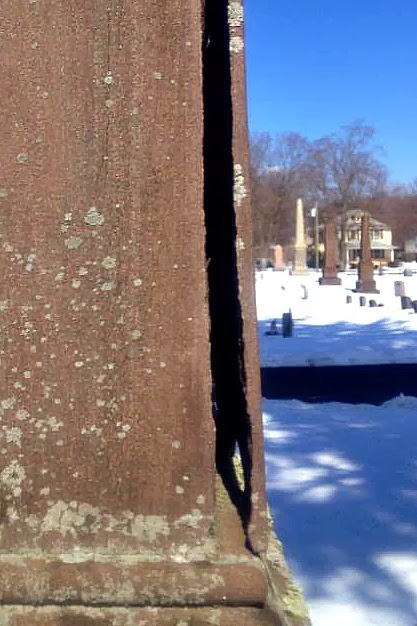
I periodically have provided updates on the poor condition of a monument to 16th Connecticut Captain Newton Manross, who was killed at the Battle of Antietam. The 37-year-old soldier's body was returned in September 1862 to his hometown of Bristol, Conn., where he was buried in Forestville Cemetery, not far from the house where he was grew up. After the Civil War, survivors of Manross' Company K dedicated a monument in the cemetery in memory of their captain, a professor at Amherst (Mass.) College when the war broke out. Harsh winters have taken their toll on the obelisk, which is made of brownstone, a soft stone often prone to erosion. Water gets in cracks, freezes and expands ... and well, the damage is done. A huge section of the back of the monument has been cracked for at least two years, but the damage I saw this morning looks worse than ever. It won't take much for that large section to fall off -- damage that I suspect could be irreparable. Lichen also must be removed from the monument. Perhaps an intelligent blog reader has an idea or two for how we can repair this important piece of Civil War history. E-mail me at jbankstx@comcast.net. I'll talk about Manross and his monument at my "Connecticut Yankees at Antietam" talk at the Bristol Historical Society on Thursday, March 20 at 7 p.m. Admission is free for members, $5 for non-members.

Above and below: A massive crack on the back of the Manross monument.

Saturday, November 09, 2013

Antietam: Windows to history in Bristol, Conn.

These two Civil War-related windows were added to my collection Saturday.
Here are your odd Civil War-related relics of the day: A pair of original windows from 16th Connecticut Captain Newton Manross' boyhood home in Bristol, Conn. Ken Hintz, the owner of the house since 1974, gave me the windows -- they were stored in his barn for years -- during a visit this afternoon. The original part of Hintz's house dates to 1746. Manross, 37, was killed at the Battle of Antietam on Sept. 17, 1862. I gave Ken the Manross placard below to place in front of his house.

Monday, November 04, 2013

Antietam: A tour of house where Newton Manross grew up

16th Connecticut Captain Newton Manross, who was killed at the Battle of Antietam,
grew up in this house in Bristol, Conn. Ken Hintz bought the house on 

Washington Street in 1974. (CLICK ON IMAGES TO ENLARGE.)
The exterior of the house looks much like it did when Manross lived here.
The tin roof on the house is original, according to Hintz, who had it painted red.
A wartime image of Newton Manross, captain of
Company K in the 16th Connecticut.
The beautiful wood floors in the house where 16th Connecticut Captain Newton Manross grew up in Bristol, Conn., are original but have settled in places over time. Put a marble on the floor of one side of a room and it might quickly roll to the other, Ken Hintz said with a chuckle during an impromptu guided tour of his house for me and Civil War author Stephen Recker on Saturday afternoon. Hintz and his wife bought the historic property on Washington Street in 1974, adding over the years modern amenities such as a clay tennis court and a swimming pool as they raised their family. But the Greek Revival house, part of which dates to 1746, still has many of its original features, including a bee-hive oven, stone fireplaces and even a a tin roof that is now painted bright red.

Newton was one of nine children of well-known Bristol clockmaker Elisha Manross and his wife, Maria. (Two of
Manross' brothers, John and Eli, also served in the Union army.) Newton, who graduated from Yale with a degree in geology in 1850, was quite inquisitive even as a youth. Taking refuge from the rain during a fishing trip near his home, he discovered what he thought was a white stone on the floor of cavern. Upon closer inspection, the "stone" proved to be a skull of an Indian. Manross returned the next day, unearthed the entire skeleton of the Indian and took the skull to his father's shop, where it was used as a grotesque holder for small parts for clock movements.

A 37-year-old professor at Amherst College in Massachusetts, Manross enlisted in the Union army on July 22, 1862, excitedly telling his wife Charlotte "you can better afford to have a country without a husband than a husband without a country."  A little more than a month later, he was commissioned captain of Company K of the 16th Connecticut, comprised mostly of men from prosperous Hartford County towns. So well-respected was Manross that he was referred to as “the father of the company” by one soldier.  Another soldier recalled how Manross earned the respect of his men by carrying the muskets of three soldiers (and a drum) while on the march from Washington to Maryland.

Sadly, Manross was killed by cannon fire at Antietam, the first battle of the war for the 16th Connecticut. (See my interactive panorama of where Manross fell at Antietam here.) His death had a profound effect on the men in his regiment. “The loss of our Captain was keenly felt by every member of the Company, for he not only recruited the men, mostly from the town of Bristol, Conn., but he cared for his men constantly,” wrote Pvt. George Robbins of the 16th Connecticut. “They felt for him almost a filial affection.” Manross is buried near his mother, father and wife in Forestville Cemetery in Bristol, about a mile and a half from his boyhood home.

Ken Hintz owns a clock that was made by Elisha Manross, Newton Manross' father.
Elisha was a well-known clockmaker in Bristol, Conn.

Thursday, February 14, 2013

Antietam: Where Connecticut soldiers met their demise

MARVIN WAIT, 8th CONNECTICUT LIEUTENANT:
From Norwich, he was mortally wounded  near Harpers Ferry Road during the Ninth Corps' attack.
(CLICK ON IMAGE TO ENLARGE.)
Nineteen-year-old Marvin Wait's refusal to leave the battlefield after initially being wounded at the Battle of Antietam  may have cost him his life. "If Lieutenant Wait had left the battle of his own accord when first hit in the arm, all would have been well," 8th Connecticut Captain Charles Coit wrote after the battle, "but he bravely stood to encourage his men still further by his own example, and at last nobly fell pierced by bullet after bullet."  The last words of the 8th Connecticut lieutenant to a private who helped carry him to the rear were: "Are we whipping them?" (1) With the aid of Antietam battlefield guide Bill Sagle on Sunday, I photographed the placard of Wait near the 8th Connecticut monument. As noted in this post, on Sunday and Monday I photographed the placards of Connecticut soldiers who were killed or mortally wounded at Antietam near where the men met their demise. The weather was cooperative, allowing for a pretty cool presentation. My second-favorite image is the one below of 16th Connecticut captain Newton Manross, who was killed by cannon fire in farmer John Otto's 40-acre cornfield. Before he enlisted in the Union army, Manross told his wife: "You can better afford to have a country without a husband than a husband without a country.." That's great stuff.
(1) Memorial of Marvin Wait, Jacob Eaton, 1863
NEWTON MANROSS: 16th CONNECTICUT CAPTAIN:
From Bristol, he was struck and killed by cannon fire on John Otto's farm.
(CLICK ON IMAGE TO ENLARGE.)
GIDEON BARNES: 16th CONNECTICUT PRIVATE:
Mortally wounded at Antietam, he died at his father's house in Burlington, Conn.
(CLICK ON IMAGE TO ENLARGE.)
DANIEL TARBOX; 11th CONNECTICUT CAPTAIN:
From Brooklyn, Conn., he was killed in a field near Burnside Bridge.
(CLICK ON IMAGE TO ENLARGE.)
HENRY BARNETT: 16th CONNECTICUT PRIVATE:
From Suffield, Conn., his body was found after the battle by a pile of  fence rails.
(CLICK ON IMAGE TO ENLARGE.)
SAMUEL BROWN, 16th CONNECTICUT CAPTAIN:
Brown's body was found stripped of his outer clothes and shoes. He was from South Danvers, Mass.
(CLICK ON IMAGE TO ENLARGE.)

Tuesday, November 27, 2012

Antietam: Seeking the elusive story of Captain John Drake

Captain John Drake of the 16th Connecticut was killed at the Battle of Antietam
on Sept. 17, 1862. (Photo Connecticut State Library archives)
Of the four Connecticut regiments that fought at the Battle of Antietam, I find the story of the 16th to be the most compelling -- and heart-rending. Fighting in its first battle of the Civil War, the ill-trained regiment was cut to pieces at Antietam, where four of its captains were killed or mortally wounded. While I have been able to dig up information on Frederick Barber of Company H, Newton Manross of Company K and Samuel Brown of Company D, an in-depth story of Captain John Drake of Company I proves elusive.

Drake's grave in Hartford's Spring Grove Cemetery. 
Antietam  is barely legible on the marker. 
(Photo courtesy Mary Falvey)

Born in New Hampshire, Drake spent part of his life in Cincinnati before moving to Hartford. On June 23, 1860, he married Anna Very, who worked for many years as a book keeper at Phoenix National Bank in Hartford. Like many men who served in the Union army -- including Captain Edwin Lee of the 14th Connecticut -- Drake was employed at the Colt Arms factory in Hartford. He was "much interested in the religious work of Warburton Chapel,"  which served immigrant families on Temple Street in Hartford. (1) After President Lincoln called for 300,000 volunteers in July 1862, Drake enlisted on Aug. 8 and helped raise a company, which was mustered into the Union army on Aug. 24, 1862. Not quite a month later, Drake was dead, killed in farmer John Otto's cornfield.

"Captain Drake was the most gentlemanly man in the regiment," Surgeon Nathan Mayer noted. "He was the very soul of courtesy and unaffected dignity of deportment. He always had a quiet care for his men, when they were sick, and was a marked favorite with them, as well as with comrades in the line." (2)

Regiment adjutant John Burnham, Antietam's unsung hero, supervised the burial of 16th Connecticut soldiers, ensuring that the graves of soldiers such as Drake could be found later. Along with the bodies of Brown and 16th Connecticut privates William Nichols and Seth Franklin Prior, Drake's remains were returned to Hartford by undertaker William Roberts on Oct. 10, 1862. Advertising his ghastly services in the Hartford Courant, Roberts made a good living retrieving bodies of soldiers throughout the South during the Civil War. Drake had a military funeral in Hartford, where he was buried in Spring Grove Cemetery.

If you can help me find out more about Drake, send me an e-mail at jbankstx@comcast.net.

(1) George Q. Whitney Collection, Connecticut State Library, Biographical Sketches of 16th Connecticut soldiers
(2)  History of the Sixteenth Connecticut Volunteers, B.F. Blakeslee, Hartford, The Case, Lockwood & Brainard Co., 1875

Monday, September 17, 2012

Antietam: Evening with Newton Manross' sword

When she and her sister were growing up in Bristol, Conn., Marcia Eveland remembers fooling around with the presentation sword of her great-great-great uncle Newton Spaulding Manross, a captain in the 16th Connecticut Infantry.
Newton Manross with the sword given to him by
 the citizens of Bristol, Conn.
(Photo courtesy Bristol Historical Society)

"My sister and I didn't know what it was, and it was in the attic, so we played with it," Eveland said. "And I told my sister ghost stories about the sword floating up in the air and coming to cut off her head!"

Today, the beautiful sword, made in Collinsville, Conn., is a family treasure.

The captain of Company K, Manross was killed at the Battle of Antietam 150 years ago today, cut down by grapeshot in farmer John Otto's 40-acre cornfield. During a ceremony honoring Bristol's Civil War soldiers at West Cemetery on Monday evening, Eveland honored her ancestor by placing his sword next to a wreath at the town's Civil War memorial.

"Our family has always cherished the fact that he was our uncle," Eveland said.

Before he marched off to fight the Civil War, Manross was given the sword by the citizens of Bristol. A brilliant man, Manross was acting professor of chemistry and philosophy at Amherst (Mass.) College when he joined the Union army. He told his wife upon enlisting, "You can better afford to have a country without a husband than a husband without a country." I never get tired of that quote.

Although I have never played with the Manross sword, I was accidentally jabbed with it when I first perused it in April. It was an honor.

Marcia Eveland holds the sword of her great-great-great uncle Newton Manross, a captain
 in the 16th Connecticut, who was killed at the Battle of Antietam on Sept. 17, 1862. 
8th Connecticut re-enactor Chris Matt solemnly stands by the Civil War memorial 
at West Cemetery in Bristol, Conn., on Monday.  Newton Manross' sword and scabbard
were placed next to the wreath by his great-great-great niece, Marcia Eveland.

Saturday, August 11, 2012

Antietam: A penny for your thoughts

Gravestone of 16th Connecticut captain Newton Manross in Forestville Cemetery in Bristol.
A professor before the war, Manross told his wife upon enlisting: "You can better afford to have
 a country without a husband than a husband without a country." (CLICK HERE FOR STORY.)
Gravestone of William Sweet, a 20-year-old private in the 8th Connecticut, at Carey Cemetery
in rural Canterbury, Conn. Three other soldiers killed at Antietam -- Sergeant Charles Lewis of the
8th Connecticut, Private Dwight Carey of the 8th Connecticut  and Private Charles Morse
of the 11th Connecticut -- are also buried at Carey Cemetery.  (CLICK HERE FOR STORY.)
Gravestone of Daniel Tarbox, a private in the 11th Connecticut. Buried in South Cemetery
in Brooklyn, Conn., Tarbox was mortally wounded at Antietam at the assault on Burnside Bridge.
Only 18 years old, he died the day after the battle.  (CLICK HERE FOR STORY.)
Two pennies on the gravestone of brothers Francis and Frederick Hollister of the 14th Connecticut.
The Hollisters, who lost their blankets at Antietam, died within a half-hour of each other a little
 more than three months later, at Falmouth, Va. They are buried together in Union Hill Cemetery 
in East Hampton, Conn. (CLICK HERE FOR THE STORY.)
Gravestone of 16th Connecticut private Thomas DeMars of Cromwell, Conn. Killed at Antietam, 
he is buried at Kelsey Cemetery in Cromwell. He was only 19 years old.

For the past 15 months, I have traveled throughout Connecticut -- from Brooklyn in the east to Bristol in the west -- visiting the graves of solders with a connection to the Battle of Antietam. It's not hard to find them. Scores of men and boys from Connecticut were killed or mortally wounded in the fields and woodlots outside Sharpsburg, Md., on Sept. 17, 1862 -- the bloodiest day in American history. Each time I visit a cemetery, I place a penny, Lincoln side up, on the soldier's gravestone. I figure that's a neat way to honor those who made the ultimate sacrifice nearly 150 years ago. As the 150th anniversary of Antietam nears, perhaps you'll want to do the same in a cemetery near you. (Lincoln side up, of course.)

Thursday, July 12, 2012

Antietam: Revisiting Newton Manross' monument


Newton Manross was killed at Antietam. I got pricked
 by the sword in the photo.  (Photo: Bristol Historical Society)
Curious about the condition of the monument for Civil War soldier Newton Manross, I stopped by Forestville Cemetery in Bristol, Conn., tonight on my way home from work and shot the video above. Sadly, the tall brownstone memorial to the 16th Connecticut captain who was killed at Antietam remains in poor shape. If repairs are not made soon to the monument placed by the survivors of Manross' Company K, the damage may be irreversible and too costly to fix.

To stir up publicity several months ago, I contacted the Bristol Press, which made brief mention in a column (no longer available online), and twice left messages with the woman in state government who handles such matters, but she didn't return my calls. In tough economic times, it's probably difficult to justify spending thousands of dollars to repair a monument for a soldier who was killed nearly 150 years ago. Perhaps there's another way. I'm up for your ideas. E-mail me here or hit the comments section below.

When he enlisted in the Union army on July 22, 1862, Manross told his wife:  "You can better afford to have a country without a husband than a husband without a country." Terrific quote from a great man who deserves to be remembered.

In this photo taken in 1887, Civil War veterans from the Manross G.A.R. post gather by the
Newton Manross monument in Forestville Cemetery in Bristol, Conn. The monument was

placed there by survivors of Company K of the 16th Connecticut.
(Photo courtesy Bristol Historical Society via Tom LaPorte; CLICK IMAGE TO ENLARGE.)

Saturday, May 05, 2012

Antietam, more: Share Civil War photos, stories

Holding a Bowie knife,  Wiley S. Boon is the only Confederate soldier in this collage.
A private in the 35th North Carolina, he was killed at Malvern Hill on July 1, 1862.
I told his story here.
Stories of the other soldiers featured are on my Faces of the Civil War thread.

From Captain Newton Manross of the 16th Connecticut  (killed at Antietam) to Lieutenant Perkins Bartholomew of the 14th Connecticut (mortally wounded at Boydton Plank Road) to Paymaster Robert Gillette (killed at Fort Fisher), the stories of more than 30 Civil War soldiers are told on the Faces of the Civil War thread on my blog. Some of the photos that accompany the stories are from my collection of hard images; others are supplied by readers. If you have a photo and story of a Civil War soldier that you would like to share, please e-mail me here. I am especially interested in Connecticut soldiers who fought at Antietam.

8th Connecticut monument at Antietam National Battlefield.

Saturday, April 07, 2012

Antietam: Captain Newton Manross' sword, pistol

Close-ups of sword Newton Manross, captain of Company K of the 16th Connecticut, carried at
Antietam when he was killed on Sept. 17, 1862.  The grip of the sword is shark skin,
according to  Bristol historian Tom LaPorte. The sword is in the Memorial Military Museum
 at the Bristol (Conn.) Historical Society.
"Brilliant."

"Gallant"

A seldom-seen civilian view of Newton Manross.
(Bristol Public Library History Room collection)
"Heroic."

"Brave and intelligent."

Such praise from Civil War soldiers about dead comrades is common in letters, diaries and post-war assessments that I have read during the past year.

Were most of these dead men really gallant and heroic?

The love, respect and admiration soldiers in the 16th Connecticut and others had for Captain Newton Manross --a brilliant professor-turned-soldier killed during the regiment's first fight of the Civil War -- seem especially genuine.

By all accounts, this man was special.

Two weeks ago, I told the story of  Manross and his gruesome death at Antietam on Sept. 17, 1862. A Yale graduate and world traveler, Manross was acting professor of chemistry and philosophy at Amherst (Mass.) College when he recruited a company of men, mostly from Bristol, and enlisted in the Union army on July 22, 1862. Upon joining the cause, he told his wife: "You can better afford to have a country without a husband than a husband without a country." (I love that quote.)

Nearly two months later, the 37-year-old son of a clockmaker was dead, his left arm torn apart by artillery fire.

George Robbins of Farmington was an 18-year-old private in the 16th Connecticut who served under Manross in Company K at Antietam. In a letter to his sister written six days after the battle, Robbins described the confusing fight in farmer John Otto's 40-acre cornfield.

Framed copy of  an albumen of Newton Manross, who holds
 the sword shown above and below, at Bristol Historical Society.
"Before we got into position, we were under fire of the enemy three times," he wrote. "We were taken into a cornfield where we could not see anything. Our captain was killed by a grape shot when we first went into the field." (1)

More than five decades later, the memory of Manross still tugged at Robbins.

"The loss of our Captain was keenly felt by every member of the Company, for he not only recruited the men, mostly from the town of Bristol, Connecticut, but cared for his men constantly," Robbins wrote in 1918 in an amazingly detailed account of his Civil War service. "They felt for him almost a filial affection. He cheered us when tired and depressed with words of encouragement not only once but many times on that trying march from Washington, when slender boys were ready to drop by the wayside, he helping to carry their loads.

"I recall one instance near the close of an intensely hot day when we were all about at the limit of endurance he voluntarily carried the muskets of three boys, added to which was a drum. He was a superb specimen of manhood, toughened by his travels in many lands. ..." (2)

After Manross' death, his successor told the colonel of the 16th Connecticut:  "Those boys care for Manross's old shoes more than for the best man in the regiment." (3)

And then there's this from fellow Amherst professor B. Silliman:

"Had he lived -- but what need is there for conjecture now? The world will never know its loss; but his friends will never forget theirs." (4)

Your humble blogger with Newton Manross' sword.
With those stories in mind, I was especially eager today to visit the Bristol Historical Society. In a glass case in the terrific Memorial Military Museum collection in the former Bristol High School, the sword and pistol that Manross carried at Antietam are kept in a glass case. Bristol Historical Society first vice president Carol Denehy and Bristol historian Tom LaPorte were kind enough to let me inspect the Manross mementos up close. (Too close at one point, when I was accidentally stuck by the sword. Yikes!)

Part of the historical society's collection for years, the sword has a sharkskin grip and is inscribed on the hilt in ornate script:  "Presented to Capt. N.S. Manross by his friends in Bristol."  The weapon was made in nearby Collinsville by the Collinsville Company, which supplied John Brown with pikes that the abolitionist had hoped to use to incite a slave rebellion at Harpers Ferry in 1859.  The .32-caliber pistol still appears to be in working order.

This little gem of a museum, which includes many other Civil War relics, is at 98 Summer Street in Bristol, Conn. It's open Wednesday (10 a.m.-2 p.m.) , Saturday (noon-4 p.m.) or by appointment. For more information, call 860-583-6309 or 860-583-5466. Admission is free, but donations are accepted. If you're a history buff, it's absolutely worth your time.

(1) George Robbins letter to his sister, Sept. 23, 1862, Connecticut Historical Society Civil War Manuscripts Project

(2) "Some Recollections of a Private in the War of the Rebellion," George Robbins, 1918, Connecticut Historical Society Civil War Manuscripts Project

(3) The Military and Civil History of Connecticut During the War of 1861-65, William Augustus Croffut, John Moses Morris, 1869, Page 282-83

(4) Ibid, Page 283

Carol Denehy, Bristol Historical Society first vice president, and her son, Tim at the museum.
Carol's husband, Jack,
started the terrific Memorial Military Museum at the Bristol Historical Society.
.32-caliber pinfire pistol that Manross carried at Antietam. Below: Close-up of  the barrel.

Tuesday, March 27, 2012

Manross monument: Then and (sadly) now

Top: In a photo taken in 1887, Civil War veterans from the Newton Manross  G.A.R. post
 gather at the monument for Manross, a captain in the 16th Connecticut who was killed
at Antietam. Below: The monument in Forestville Cemetery in Bristol, Conn.,  from approximately
 the same angle today.   (Top photo courtesy Bristol Historical Society via Tom LaPorte)

By all accounts, Captain Newton Manross of the 16th Connecticut Infantry was a brilliant man.

Newton Manross as a civilian.
(Image courtesy Tom LaPorte)
A day after he graduated from Yale in 1850 with a degree in geology, Manross sailed for Europe, where he earned a Ph.D. in chemistry from the University of Gottingen in Germany in 1852.  He later traveled extensively in South America, visiting Trinidad, Panama and Mexico and exploring for coal, iron and other minerals. An outstanding scientist, his work appeared in the prestigious American Journal of Science.

Shortly after Manross was named professor of chemistry and philosophy at Amherst (Mass.) College, he joined the Union army on July 22, 1862, telling his wife Charlotte "you can better afford to have a country without a husband than a husband without a country." Less than two months later, the 37-year-old citizen-soldier once described as a "man of exceptional learning and scholarship" was dead, killed by a cannon ball at the Battle of Antietam on Sept. 17, 1862.

From a prominent Bristol, Conn., family, Manross was buried in Forestville Cemetery in his hometown. After the Civil War, survivors of Manross' Company K of the 16th Connecticut placed an 8-foot brownstone monument in their captain's honor near his gravestone. Sadly, that monument is deteriorating, worn by the elements of 100-plus New England winters. In addition to several prominent cracks, the backside of the monument is separating from the main portion. One good smack could easily send that piece crashing to the ground.

Newton Manross deserves better. Perhaps this post will spur an effort to repair a monument for an exceptional man who died for his country nearly 150 years ago. (For more on the Manross monument, check out my video below.)


A professor before the Civil War, Manross was killed by artillery fire at Antietam.
Can these prominent cracks in the Newton Manross monument be repaired?
Survivors of Newton Manross' Company K of the 16th Connecticut placed this monument
in Forestville Cemetery in Bristol in honor of their "gallant and beloved captain."