Showing posts with label Avon. Show all posts

Friday, November 06, 2015

Meet "Hidden History of Connecticut Union Soldiers" author


I will speak at the Avon (Conn.) Free Public Library on Saturday, Nov. 14 at 1 p.m. about my newly released book, "Hidden History of Connecticut Union Soldiers." Stop by and say hello. Copies of the book will be available for purchase. (Even Mrs. Banks will attend!)

Monday, November 17, 2014

Wounded at Antietam, Franklin Alford crawled from field

Franklin Alford was a private in Company I of the 16th Connecticut.  
(Connecticut State Library archives)
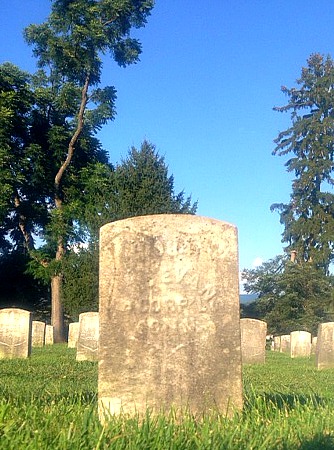
Franklin Alford is buried with his wife, Lucy, in Avon (Conn.) Cemetery. I placed a penny
 on his grave,  Lincoln side up, during a recent visit. 
Private Franklin Mills Alford of Avon, Conn., among more than 200 casualties in the 16th Connecticut at Antietam,  was more fortunate than many of his wounded comrades in the battle. While privates Henry Adams, Bela Burr, Francis Burr and others in the regiment lay in no-man's in John Otto's cornfield for 40 hours, the 21-year-old Alford, wounded in the right leg, crawled from the field with the aid of comrade after he lay unconscious for a period of time. Two other soldiers from Alford's hometown, Corporal Henry Evans, the father of an  8 1/2-month-old daughter, and Robert Hawley, the father of six children, died as a result of wounds suffered at Antietam on Sept. 17, 1862.

For Franklin, one of eight children of Daniel and Emira Alford, the Civil War was nearly over. He was discharged for disability on Feb. 2, 1863, returning to Avon, a farming community along the Farmington River, 10 miles from Hartford. During the last two years of the war, he made bayonets for the Union army. After the war, he was commissioned a lieutenant in the Connecticut militia, served as tax collector in his hometown and was fond of fishing as well as hunting with his dog. He was a frequent attendee at veterans' events and traveled to Antietam in October 1894 for the unveiling of the 16th Connecticut monument there. When Alford died on March 11, 1908, he left behind a wife named Lucy, two married daughters and six grandchildren.

For more stories of soldiers in the hard-luck 16th Connecticut, check out my talk on Saturday, Nov. 22 at 1 p.m. at the Avon (Conn.) Free Public Library. Here's the trailer:

Wednesday, September 26, 2012

Antietam death: 16th Connecticut Corporal Henry Evans

Henry Evans of Avon, Conn., was killed at the Battle of Antietam. 
This is a previously unpublished photo of the 21-year-old soldier.  
Like this blog on Facebook.

He's buried under a weather-worn, slate-gray tombstone, No. 1,084, just to the left of Private Henry Aldrich of Bristol, on the peaceful, beautiful grounds of Antietam National Cemetery in Sharpsburg, Md. Like many soldiers in the 16th Connecticut, 21-year-old Henry D. Evans was killed in the infamous 40-acre cornfield during the Battle of Antietam on the afternoon of Sept. 17, 1862. For nearly 150 years, the young corporal has largely been anonymous, just another name on a long list of Connecticut dead from the bloodiest day in American history.

Corporal Henry Evans' gravestone in 
Antietam National Cemetery.
But thanks to a lifelong resident of Avon, Conn., a previously unpublished image of the soldier who marched off to war in the summer of 1862 is now available. And thanks to information gleaned from widow's pension records, the 1860 census and other sources, we can shine a light on Evans' short life.

A laborer from Avon, a small farming community near the Farmington River, Henry married 23-year-old Mary Ann Richards of nearby Wethersfield on Aug. 21, 1861, about four months after the first shots of the Civil War were fired at Fort Sumter. Their union produced a daughter, Florence, on Jan. 31, 1862. As talk of war swirled in New England that summer, Henry pondered an agonizing question: Should he  fight to help save the Union or remain with his family?

Evans chose war, joining at least a dozen other men from his town in the 16th Connecticut. No doubt the offer of a $50 bounty from Avon, equivalent to 40 times the average man's daily wage, was a huge enticement.

Mustering into Company I of the the 16th Connecticut as a corporal on Aug. 24, 1862,  Evans was one of about 100 men from Avon to join the cause. At least 20 men from the town died during the Civil War, including Edgar Woodford, a 38-year-old quartermaster sergeant in the 7th ConnecticutWallace Woodford, a 22-year-old private in the 16th Connecticut; and brothers James and John Willard. It was a horrible toll on a community whose population was slightly more than 1,000 people in 1860.

A memorial marker for Henry Evans in 
West Avon (Conn.) Cemetery is an effigy grave. Henry is 
actually buried at the national cemetery
 in Sharpsburg, Md.
For Evans and the men in his regiment, late summer 1862 was a blur.

After organizing and basic training in a camp near Hartford, the 16th Connecticut received a rousing send-off in the city on Aug. 29 on its way to New York, the first leg of a journey that would take them to the front lines. For Henry and his comrades, the trip down the Connecticut River aboard the steamers City of Hartford and George C Collins must have been thrilling.

"...at every village and hamlet the people line the banks, waving their flags and cheering us on the voyage," Private William Relyea of Company D noted. "The boys forgot their disciplinary troubles in flirting with the girls and answering the greetings of grey-haired sires on the banks, but darkness put the end to this sport, and preparations began to pass the night in quiet sleep. There were a few youngsters who kept up a wild roistering far into the night." (1)

On Aug. 30, the regiment arrived in New York and then traveled by steamer to Elizabeth, N.J. Henry and his comrades took a circuitous route to Washington via train, traveling through Reading, Harrisburg and York in Pennsylvania and to Baltimore before finally arriving in the capital. "We were a very dirty lot when we arrived in Washington, " Relyea noted. (2)

Henry Evans' commander, Company I captain 
John Drake of Hartford, was also killed at 
Antietam. Three other 16th Connecticut captains
 were killed or mortally wounded at Antietam. 
(Connecticut State Library archives)
During a short stay in Washington, perhaps Henry visited the White House grounds or the still-under-construction Washington Monument and Capitol building, as many soldiers in the regiment did. On Sept. 7, the 16th Connecticut was again on the move, leaving Fort Ward outside Washington and joining the Army of the Potomac that was marching into Maryland to stop Robert E. Lee.

On the morning of Sept. 17,  Evans and the 16th Connecticut were positioned in a farm field near Antietam Creek, a couple miles from the village of Sharpsburg. Elements of  the Ninth Corps finally fought their way across a small stone-arch bridge, later famously called Burnside Bridge, and the 16th Connecticut crossed the creek upstream by early afternoon.

"We were marched into a piece of woods and formed a line of battle," Private Wells Bingham of Company H wrote to his father after the battle. "From there we were marched up onto a high hill. All this time the battle was going on only a short distance from us. We had a chance to witness some of the most splendid firing with artillery. We could see the shells and shot strike around the rebbel battery. It took but a short time for our battery to silence theirs." (3)

In a letter published in the Hartford Courant on 
Sept. 30, 1862,16th Connecticut adjutant 
John Burnham noted the location of the 
regiment's dead at Antietam. Henry Evans
was buried with other soldiers from Company I.

As the 16th Connecticut marched into a field of tall corn late that Wednesday afternoon, the untested regiment  was smashed on two sides by veterans of A.P. Hill's division. Company I suffered terribly, with Captain John Drake of Hartford and two sergeants killed. Privates Wallace Woodford, Frank Alford, Charles Parker, Robert Hawley and Newton Evans -- all from Avon -- were wounded. Corporal Henry D. Evans, the father of an 8 1/2-month-old daughter,  was killed.

Because of the remarkable efforts of regiment adjutant John Burnham, an unsung hero of Antietam, the dead of the 16th Connecticut were buried in marked graves on the Otto farm two days after the battle, each soldier's name carved in a wooden headboard. Evans was buried with his comrades from Company I: privates Stephen Twiss, Augustus Truesdell, Stephen Himes, James Grugan and sergeants Orville Campbell and Thomas McCarty. "The collection of the bodies was conducted under my own personal supervision," Burnham noted, "and after the men had reported them all picked up I examined the whole field myself, so that I am confident none were left on the ground." (4)

More than 400 miles away in Avon, Mary Ann Evans soon received word of her husband's death. Although Henry was buried in a well-marked grave, she did not or could not arrange for the return of his remains to Avon,  perhaps because she did not have the financial means. In the years after the battle, Henry's body was disinterred from the field and re-buried in the national cemetery in Sharpsburg.

Six days after Mary Ann Evans' death, her daughter wrote this note to the Board of Pensions. 
Florence Post's mother never remarried after her father was killed at the 
Battle of Antietam 57 years earlier.

On Christmas Eve 1863, more than a year after her husband was killed, Mary Ann applied for a widow's pension from the government. Her application approved, she soon received $8 a month (and $2 a month for Florence) from Uncle Sam. Mary Ann received that widow's pension until Dec. 6, 1919, when she died at 2:30 p.m. in Colorado Springs, Colo. The cause of death was apoplexy and old age. She was 81. (5)

She had never remarried.

(1) "16th Connecticut Volunteer Infantry, Sergeant William H. Relyea," John Michael Priest Editor-in-Chief, Burd Street Press, 2002, Page 8.
(2) Ibid, Page 9.
(3) 16th Connecticut private Wells Bingham letter to his father, Elisha, Sept. 20, 1862, Antietam National Battlefield research library
(4) Hartford Courant, Sept. 30, 1862, Page 7
(5) Widow's pension documents, Henry Evans and Mary Ann Evans

In an undated photo, Henry Evans' wife, Mary Ann, holds
 their only child, Florence.

Monday, September 03, 2012

Antietam: If you're in Connecticut ...

Sunrise at Antietam.

As the 150th anniversary of the battle approaches on Sept. 17, there are several Antietam-related events scheduled here in Connecticut:

Saturday, Sept. 8: Avon, noon:  I will speak at the Avon Free Library about 10 Connecticut soldiers who were killed or mortally wounded at Antietam. Captain Samuel Brown as well as this soldier, this one, this one and six others are part of my program. Mingle with re-enactors at noon, hear my talk at 1 p.m. and then take a trip across the street at 2 p.m. to West Avon Cemetery, where I'll talk about four soldiers from Avon who died during the Civil War. Here's more info.

Monday, Sept. 17, West Cemetery, Bristol, 6 p.m.: Remembering Bristol’s Civil War Soldiers," a program commemorating the 150th anniversary of the battle. Limited seating available. Bring a chair if you desire. Rain date is Sept. 25. A descendant of 16th Connecticut captain Newton Manross, who was killed at Antietam, will place a wreath at the Civil War monument during the ceremony.

Saturday, Sept. 29- Sun., Sept. 30, Wickham Park, Manchester, 10 a.m.: "CONNECTICUT TO ARMS": Join the Connecticut Civil War Commemoration, its many partner organizations and re-enactors from across New England for the next big Civil War encampment.

LIKE THIS BLOG ON FACEBOOK! It could change your life!
FACES OF THE CIVIL WAR: Stories and photos of common soldiers who served during the war.
MORE ON 16TH CONNECTICUT SOLDIERS: Tales of the men in the hard-luck regiment.
MORE ON ANTIETAM: Read my extensive thread on the battle and the men who fought in it.

Saturday, September 01, 2012

Where does Avon's Edgar Woodford rest?

A quartermaster sergeant in the 7th Connecticut, Edgar Woodford of Avon, Conn.,
died in Jacksonville, Fla., on Oct. 6, 1862. This carte-de-visite is in my collection.
On a late spring day in 1913, nearly 51 years after Edgar Maurice Woodford was first laid to rest 1,100 miles from his home in Avon, Conn., a memorial service was held in a small cemetery next to a Congregational church near where he grew up.

"On yonder brownstone monument is inscribed the name Edgar M. Woodford," noted Dr. Edward Kellogg in his speech as he pointed to an 8-foot high monument near the middle of the cemetery. "Doubtless most persons of the present generation supposed the soldier's body lies beneath, but that is not the fact." (1)

Etched on that brownstone in the cemetery near the beautiful, whitewashed West Avon Congregational Church are the barest of facts of Woodford's life and death:
    Com. Serg. 7th Conn. Vol.   
    DIED
     in the service of his country at Jacksonville, Florida  
    Oct. 6, 1862. Age 38

    So who was Edgar M. Woodford and how did the 7th Connecticut quartermaster sergeant die?

    And where is he really buried?

    There's a brownstone memorial for Edgar Woodford and another marker (right) with his name on
    it at West Avon (Conn.) Cemetery, but the 7th Connecticut soldier isn't buried there.

    A farmer, self-taught civil engineer and surveyor, Woodford was a leading member of the prosperous community of Avon, about 10 miles northwest of Hartford. "He was a man of marked abilities in many directions and those who remember him will bear witness that he filled an important place in the activities and life of the community," Kellogg gushed in that long-ago speech.

    On Sept. 7, 1843, Woodford married the daughter of a preacher, Mary Elizabeth Kellogg of Somers, Conn., and by 1860, the couple had three children: Mary, 13; Edgar, 11; and Anna, 9. In the 1860 Federal census, Woodford's occupation was listed as "peddlar" and his property was valued at $5,000, an indication the family certainly was well off.

    Before the Civil War, Woodford was the captain of a local militia company, and Kellogg remembered as a youth watching him drill his men on the town green in East Avon. An ardent abolitionist, Woodford was "highly indignant, as were many others," Kellogg noted, "because the government did not strike a death blow to slavery and thus crush the rebellion also" in 1861. (3)

    In the summer of 1862, as war fever gripped New England, Woodford decided to leave behind his three children and wife of nearly 19 years to join the Union army. Recruited by old friend Colonel Joseph Hawley of Hartford, he enlisted on Aug.7, 1862 as a private and mustered into Company K of the 7th Connecticut. During his last Sunday in Avon, Woodford attended morning and afternoon church with his family. And after attending a town meeting the next day in East Avon, he bade his family and friends farewell and marched off to war.

    An accomplished surveyor, Woodford contributed to the making of this 1855 map 
    of Hartford County. (Map courtesy of Avon Free Public Library)
    By August 1862, the 7th Connecticut was an experienced fighting unit. Organized Sept. 13, 1861, it was deployed as a part of the "Anaconda Plan," General-in-Chief Winfield Scott's grand and often-derided scheme to strangle the South by blockading its ports and conquering key military targets. Along with the 6th Connecticut, the regiment captured Fort Walker and Fort Beauregard in South Carolina, along the Atlantic coast, in early November 1861. From December to April 10, 1862, the two regiments helped lay siege to massive Fort Pulaski in Georgia, near the mouth of the Savannah River. The fort eventually was captured with minimal Union losses.

    Two months later, at James Island, near Secessionville, S.C., the 7th Connecticut was less fortunate. Attempting to capture Charleston by land for the only time of the war, the Union army was whipped; the 7th Connecticut was especially hard hit, suffering nine men killed. 69 wounded and four missing. In early July 1862, the regiment retreated to sandy, swampy and mosquito-infested Hilton Head, S.C.

    Finally joining the regiment  in Hilton Head in early September, Woodford quickly benefited from his friendship with Hawley. On Sept. 21, 1862, he was promoted to quartermaster sergeant. Nine days later, the 7th Connecticut and Woodford sailed to Florida aboard the steamship Ben De Ford -- he shared the stateroom with Hawley at the colonel's invitation -- and a date with destiny.

    By comparison to Shiloh, Antietam and Gettysburg, the Battle of St. John's Bluff, near Jacksonville, was a very minor event. On a high bluff overlooking the St. John's River, Southern engineers placed a series of gun batteries, making it a formidable position. But blasted by Federal gunboats on Oct. 1 and pressured on two sides by the Union army, including the 7th Connecticut, the rebels surprisingly abandoned the outpost under the cover of darkness on Oct. 3, 1862.

    Anchored in the St. John's River, the Ben De Ford took on Union sick and wounded the next day -- as many as 46 soldiers, according to one account. Woodford helped, pulling aboard many of the wounded using a swinging rope ladder, a difficult challenge for even a younger man aboard a rocking ship.
    "He was a man of most exemplary character and habits," Colonel Joseph Hawley wrote 
    of Edgar Woodford on July 20, 1863.  (CLICK ON IMAGE TO ENLARGE.)


    "It was not Mr. Woodford's duty nor was he asked to carry these men," Kellogg said, "but his great heart of helpfulness to others impelled him to do so and not withstanding his recent life and avocations had unfitted him for great muscular effort, he did carry some of these men up the side of that ship and the violent exertion raised a rupture of a large internal blood vessel..." (4)

    In agony, Woodford slipped in and out of consciousness while doctors tried to save his life. But as Hawley wiped sweat from his friend's brow, the father of three slipped away to meet his maker the morning of  Oct. 6, 1862. "I have no fear for myself, but oh! My dear wife and children," he said as he died (5). Describing the cause of death as "congestive fever," Hawley believed his friend "undoubtedly overextended himself in caring for the sick men and the stores of the regiment." (6)

    Hawley saw to it that Woodford was buried in a well-marked grave in a small cemetery behind St. John's Episcopal Church in Jacksonville. A group of soldiers from the Ben De Ford fired a volley over the grave, and Hawley even sent a map of the grave site and cemetery to Mary Woodford.

    Sadly, however, the Woodfords were unable to retrieve the soldier's body and return him to Connecticut. In a massive effort shortly after the Civil War, the Federal government exhumed the bodies of Union soldiers throughout the South and reburied them in newly established national cemeteries. Edgar Woodford's body probably was removed to a national cemetery in Beaufort, S.C., where today he rests under a grave marked "Unknown."

    Postscript: In June 1913, Woodford's grandchildren sought the aid of the Federal government to find the final resting place of their grandfather.

    The effort proved fruitless.

    "An earnest search has been made through the records of those cemeteries to which the body would, most likely, be taken," the superintendent of Andersonville (Ga.) National Cemetery wrote, "but no information as to the location of the body has been found."

    (1) Hartford Courant, June 11, 1913, Page 11
    (2) Ibid
    (3) Ibid
    (4) Ibid
    (5) Ibid
    (6) Widow's pension file affidavit, Joseph Hawley, July 20, 1863.

    According to this document, Edgar Woodford's  grandchildren inquired about finding their 
    grandfather's grave in 1913. Originally buried in St. John's Episopal Cemetery in Jacksonville, 
    his remains probably were moved to a national cemetery in Beaufort, S.C., after the Civil War.


    Tuesday, May 22, 2012

    Austin Fuller: 'Expired suddenly ... expectedly'

    Austin Fuller, a private in Company C in the 16th Connecticut, died at home in 
    Farmington, Conn. on Jan. 8, 1865. He is buried in Greenwood Cemetery in nearby Avon, Conn.

    On a late December day in 1864, 23-year-old Austin Fuller, a private in the 16th Connecticut Infantry, received what should have been a welcome gift: a 30-day furlough.

    On a typical army furlough, Fuller probably would have enjoyed a visit with his wife, Martha Jane, whom he married in September 1859 when the couple were in their late teens. If it were Fuller's first visit back to Farmington since the Battle of Antietam more than two years earlier, he could have recounted the awful details of a fight that cost his regiment 43 dead and 161 wounded.

    After he was exchanged along with other sick and injured 
    soldiers,  Austin Fuller received a 30-day furlough in late 
    December 1864.  According to this furlough document, he was 
    expected to return to his regiment on Jan. 25, 1865, 
    "or be considered a deserter."
    Perhaps Fuller, a wood turner before the Civil War, could have reconnected with family and friends who worked at his trade in Farmington, a manufacturing town of nearly 3,200 about 10 miles southwest of  Hartford.

    Or maybe he could have simply relaxed in his home state until he was expected to report back to his regiment on Jan. 25, 1865 -- "or be considered a deserter," according to the furlough document.

    But Fuller's return to Connecticut was anything but a normal army furlough.

    On April 20, 1864, the 5-foot-8 soldier with a light complexion, blue eyes and brown hair was among hundreds of soldiers in the 16th Connecticut who were captured at Plymouth, N.C., and sent to prisoner-of-war camps in the South. Fuller eventually arrived at Andersonville, the Civil War's most notorious POW camp, where Wallace Woodford of nearby Avon and scores of other Union men from Connecticut suffered from starvation and disease. Henry Way of Bristol, a 19-year-old private in Company K of the 16th Connecticut, was one of 13,000 Union soldiers who died in the squalid camp in southwestern Georgia.

    In his excellent book on his imprisonment published in 1865, Robert H. Kellogg, a private in Company A in the 16th Connecticut, described the camp's terrible, crowded conditions.

    Martha Jane Fuller received an $8-a-month
    widow's pension commencing Jan. 8, 1865.
    "I ... wished that the President, under whose banner we had fought, could look in upon our sufferings, for surely the sight would move him to help us, if anything could be done," Kellogg wrote. "Live worms crawled upon the bacon that was given us to eat. 'It is all right,' we said; 'we are nothing but Yankee prisoners, or, as the rebels usually speak of us, 'damned Yankees.' " (1)

    When Fuller left Andersonville and was exchanged along with other sick and wounded soldiers in December 1864, he was a shell of the man who enlisted in the Union army on Aug. 7, 1862. In fact, after he finally arrived in Farmington the day after Christmas 1864, he "was taken immediately to his bed, which he never left." (2).

    "I was called to attend him professionally and found him greatly emaciated with very severe cough and diarrhea, attended with fever and great prostration," Dr. William Sage recounted. (3)

    Never regaining his health, Fuller, his wife likely by his side, died on Jan. 8, 1865. He "expired very suddenly and expectedly," Sage recalled in February 1865, "very much as I am told many of the men died at Andersonville during the last summer." (4)

    After her husband was buried, a grieving Martha Jane Fuller filled out the paperwork necessary to obtain a widow's pension. After some wrangling with government bureacracy over such petty issues as her middle name, she was granted an $8-a-month pension, retroactive to the date of her husband's death.

    Austin Fuller's final resting place is in Greenwood Cemetery in Avon, just off a busy Route 177 that once was a rural farm road. Near the bottom of his weathered, gray tombstone are these words:
    The strife is ended
    And he is at rest
    (1) "Life And Death In Rebel Prisons," Robert H. Kellogg, 1865, Page 166 
    (2) Widow's pension document, Feb. 20, 1865
    (3) Ibid.
    (4) Ibid.

    Weathered U.S. flag at top of Austin Fuller's gravestone.
    Close-up of plastic Grand Army of the Republic (GAR) marker next to Fuller's gravestone.

    Tuesday, December 20, 2011

    History up close: In Willard brothers' footsteps

    Civil War soldiers John and James Willard lived in this house in Avon, Conn.
    I told the story last week of a woman from Avon, Conn., who honored Civil War soldier John Willard by putting a scoop of Connecticut dirt on his grave at the national cemetery in New Bern, N.C.

    The Willard house dates to 1760.  Middle: The well-worn
    front step  may be original to the house.  Bottom: 
    Revolutionary War-era  buttons recently  discovered
     on the property by a local relic hunter.
    Thanks to the generous current owners, I spent time this afternoon in the beautiful Avon house where John and his brother, James -- who also died during the Civil War -- lived with their mother. Jim and Maureen Dowse, who have lived in the 251-year-old house the past 10 years, also helped fill in gaps in the lives of both brothers and their family.

    Damaris Williard, the matriarch of the family, endured her share of tragedy before and during the Civil War. Her husband Julius, a physician, died in September 1854, seven years before the start of the rebellion. Her youngest son, James, was only 20 when he was killed during the 7th Connecticut's rare nightime attack on Fort Wagner, near Charleston, S.C., on July 11, 1863.  James, a private in Company A, was originally reported to have been missing and taken prisoner, but his body was never recovered. (1)

    Fifteen months later, Damaris lost her eldest son.

    Thirty-two-year-old John Willard was a wagoner in the 11th Connecticut, transporting ammunition, medicine, food and other supplies to help keep the Union army running. In late September and early October 1864, a yellow fever epidemic ripped through the Union army in New Bern, N.C., killing many soldiers -- including John. A farmer before the war, he died on Oct. 3, 1864, and was buried in New Bern. Sadly, his mother probably didn't have the means to return his body to Connecticut.

    Maureen Dowse obtained copies of some of the trove of documents on the Willard brothers at the Avon Free Public Library. They reveal a family probably not atypical of most during the Civil War.
    1860 census: Widow Damaris Willard lived with her sons, John (top) and James Willard (bottom).
    (CLICK IMAGE TO ENLARGE.)
    Fifty-four-year-old Widow Willard was dependent on John and James, so the enlistment of two sons in the army in 1861 undoubtedly was a hardship for her. But like any good sons, the brothers endeavored to help their mother while they were away at war. In notes to Damaris during the war, James wrote about sending money home and thoughts of not surviving the conflict: (2)
    • Jan. 14, 1862: "When we were at Hilton Island I sent fifteen dollars thinking you might need it."
    • June 10. 1862: "If I never get home, I wish you to have what property I have, and use what you need of that I send."
    • "I wish you to use what you want of the money that I send, and have sent, and if I never get home I wish you to have this, and what I have sent."
    • April 21, 1863: "I will send sixty dollars. Do what you think best with the money."
    In the spring of 1863, John Willard, a wagoner
    in the 11th Connecticut, sought a furlough to return home.

    (CLICK IMAGE TO ENLARGE.)
    John, whose 3-year-old son Frank died five months before the war, also longed for home and his wife, Cordelia. In fact, in the spring of 1863 while he was in New Bern, he requested a furlough because "he was anxious to return home."  (3) There is no record in the file I examined whether the furlough was granted.

    Because James left no widow or children, Damaris Willard applied for a Mother's Pension after his death, and Uncle Sam evidently provided her with an $8-a-month-pension for many years. Widow Willard was 89 years old when she died June 5, 1890. She is buried in West Avon Cemetery near her husband Julius and the memorial markers for her sons, whose remains were never returned to their native soil.

    (1) Hartford Courant, Oct. 20, 1864
    (2) Mother's Application for Pension document, Jan. 8, 1869.
    (3) Furlough document, April 19, 1863

    Damaris Willard's husband, Julius, died seven years before the start of the Civil War. Her sons,
    John and James, died during the conflict. Widow Willard lived in this house for many years.

    Saturday, October 22, 2011

    Avon's Wallace Woodford 'came home to die'

    Wallace Woodford, a 22-year-old private in the 16th Connecticut, is buried
     in West Avon (Conn.) Cemetery. He  died shortly after being released 
    from a POW camp in 1865.
    Wracked with pain, Wallace Woodford thrashed about as he tried to sleep, tormented by thoughts of his treatment by the Rebels. Woodford's parents desperately tried to nurse him back to health following his return home to Avon, Conn. on Jan 3, 1865, after eight months in Confederate prisoner-of-war camps. But the 22-year-old private in the 16th Connecticut Infantry was clearly a broken man.
    Wallace Woodford is buried in Avon, Conn. 
    His parents, Corydon and
     Sylvia,  are buried in the same plot.

    "He had been so long without proper nourishment that he was unable to eat even the most delicate morsels which his parents provided for him on his return," the Hartford Courant reported. "Continued hunger had destroyed his vitals. When asleep he would throw his arms about, thinking he was in Andersonville ... endeavoring to obtain food."

    Exhausted mentally and physically, Woodford found it difficult to talk about his imprisonment in Andersonville, the most notorious Civil War prisoner-of-war camp, and later at a stockade in Florence, S.C. "Words could not describe the horrors," he reportedly told his friends. (1)

    Unable to gain strength, Wallace Woodford, paroled by the Rebels on Dec. 10, 1864, died exactly a month later in his hometown, his parents Corydon and Sylvia likely by his side.

    For Woodford and other members of the 16th Connecticut, Andersonville was hell on earth. By August 1864, the camp in southwestern Georgia was home for 32,000 Union prisoners of war jammed on about 26 1/2 acres. POWs, who often drank from the polluted stream that ran through the camp, suffered from overexposure, malnutrition and disease.

    In his excellent book on his imprisonment published in 1865, Robert H. Kellogg, a private in Company A in the 16th, recounted the terrible, crowded conditions there.

    "I ... wished that the President, under whose banner we had fought, could look in upon our sufferings, for surely the sight would move him to help us, if anything could be done," Kellogg wrote. "Live worms crawled upon the bacon that was given us to eat. 'It is all right,' we said; 'we are nothing but Yankee prisoners, or, as the rebels usually speak of us, 'damned Yankees.' " (2)

    By August 1864, 32,000 Union soldiers were jammed into the 26 /1/2 acres
     of Andersonville prison. Wallace Woodford arrived at the camp in southwestern 
    Georgia sometime in the spring of 1864.  (Library of Congress photo)
    Nearly 13,000 Unions soldiers died at Andersonville during the camp's 15-month existence from February 1864 to April 1865. Near the end of the war, when Union General William Tecumseh Sherman marched through the state, many Andersonville prisoners were transferred to other camps in Georgia and South Carolina. (Private Van Buren Towle of the 1st Massachusetts Heavy Artillery, whose story I told in this post in May, also was imprisoned at Andersonville and Florence, S.C.)

    One of the hard-luck regiments of the Civil War, the 16th was sent into captivity April 20, 1864, when the hugely outnumbered Union garrison in Plymouth, N.C. surrendered. University of Akron professor Lesley Gordon has an excellent account of the regiment's surrender and capture here.

    Robert Kellogg (right) , a sergeant  in the  16th Connecticut,
      described the horrors of  Andersonville in a book
     published in 1865. 
     (Photo courtesy Connecticut History Online/
    Connecticut State Library.)
    Wallace Woodford enlisted in the Union army as a private on July 28, 1862, about a year after Bull Run, the first major battle of the war. Nearly a month later, he was mustered into Company I of the 16th Connecticut, one of about 1,000 soldiers from prosperous towns in Hartford County.

    Like most Civil War soldiers, young Wallace probably knew little of the rigors of army life before the war. In fact, before the 16th Connecticut shipped off for New York on Aug. 29, 1862, he probably had never traveled far from Avon, a small farming town of a little more than 1,000 people about 15 miles northwest of Hartford. (3)

    By the summer of 1862, the Union army had suffered a series of defeats around Richmond during McClellan's Peninsula campaign. It was obvious the war would not be over soon, but Woodford, like many men his age, probably was excited about his new adventure.

    Less than a month after it was mustered into the Union army, the barely trained 16th Connecticut was under fire, struggling to ford Antietam Creek about a mile upstream from the Rohrbach Bridge, during the Battle of Antietam. Later that afternoon on Sept. 17, 1862 -- the bloodiest day in American history -- it was positioned on the extreme left flank of the Union army, in the field of a farmer named John Otto.

    John Otto's 40-acre cornfield at Antietam, viewed from the Confederates' 
    vantage point. "We could not see the rebels, but could hear them and their
     bullets," a 16th Connecticut soldier wrote.  The 16th Connecticut monument, 
    dedicated in 1894,  is in the distance.
    Charles Clark, a sergeant in Company A of the 16th, described the fighting outside Sharpsburg, Md.

    "A piece of shell struck very near me," he wrote in an account published in the Hartford Courant on Sept. 25, 1862. "Our Chaplain had his clothes torn, our Surgeon's horse was wounded, and a private in Company I was hit in the left arm. About noon we advanced again, and were informed that our right was whipping out the rebels. In the middle of the afternoon, we went into the fight, and a terrible one it was, piles of our men were wounded. Our regiment was in a corn-field, where we could not see the rebels, but could hear them and their bullets."

    On Sept. 25, 1862, the Hartford Courant printed 
    a list of  16th Connecticut soldiers killed at 
    Antietam. Seven men from Woodford's Co. I were
     listed,  including Henry Evans of Avon, Conn. 
    Woodford was among the wounded.
    The 16th was thrashed that September afternoon, struck in the left flank by veterans of A.P. Hill's division who had just arrived on the field after a 17-mile march from Harpers Ferry, Va. Many of the Connecticut men broke and ran during the battle, a stigma the regiment never erased. Out of 779 men, the 16th Connecticut suffered 43 killed, 161 wounded -- losses of about 26 percent.

    At some point during the fighting at Antietam, Woodford was wounded and perhaps later treated at a field hospital at the Henry Rohrbach farm nearby. Seven members of Company I, including Corporal Henry D. Evans of Avon, were killed.

    Many men in the 16th Connecticut never got over Antietam or imprisonment in Andersonville.

    Wrote Lesley Gordon:
    An estimated three hundred members of the 16th Connecticut were imprisoned at Andersonville and nearly one third of them perished there. Even for those who survived and returned home, many found their health destroyed by their long captivity, and struggled to adapt to civilian life. It is unclear how many soldiers from the 16th Connecticut battled mental depression, but several spent their final years in the state’s Insane Asylum. (4)
    Sixteeen months after Antietam, Private Wallace C. Woodfoord's short life ended. Sometime during the middle of a New England winter, he was mourned and eulogized at West Avon Congregational Church. His body lies today in West Avon Cemetery beneath an 8-foot brownstone monument inscribed with these words:

    "8 months a sufferer in Rebel prisons. He came home to die."

    A closeup of Wallace Woodford's well-worn grave marker.
    (1) Hartford Courant, Jan. 12, 1865
    (2) "Life And Death In Rebel Prisons," Robert H. Kellogg, 1865, Page 166
    (3) U.S. census
    (4) “The ‘Rebs Took Us All”: The 16th Connecticut in War and Captivity, Lesley J. Gordon, 2009, University of Akron

    Sunday, June 26, 2011

    Civil War under my nose: Avon, Connecticut

    The 16th Connecticut, including 15 men from Avon, fought in this field on the Otto Farm  at
    Antietam on Sept. 17, 1862.  The 16th Connecticut monument is in the distance.
    
     Robert Hawley, a private in the 16th
    Connecticut  from Avon, Conn., was mortally
    wounded at Antietam. 
     This is
    his marker at West Avon Cemetery. 
    After walking a Civil War battlefield, I always come away with a renewed respect -- heck, make that awe -- for the common soldiers.

    How did they do it?

    What kind of courage did it take for soldiers to blast away at each other with rifled muskets from 75 yards?

    How could they march, sometimes barefoot, 10 or more miles in a woolen uniform on a hot summer day?

    What kind of fortitude did it take to subsist on green apples, hardtack and corn?

    Incredible.

    At the Battle of South Mountain, near Boonsboro, Md., on Sept. 14, 1862, soldiers killed and maimed each other fighting over tremendously difficult, rocky terrain. Three days later, at nearby Sharpsburg, Md., barely trained troops of the 16th Connecticut Infantry fought on terrain that, while not as imposing as South Mountain, was nonetheless trying. I've walked that same ground on a warm spring day, and it's a haul.
    Private Newton Evans of Avon, Conn., was
    wounded  at Antietam and later died at
    Andersonville prison in Georgia.

    The John Otto Farm at Antietam includes gulleys, ridges and  a 40-acre cornfield that was the scene of terror for the 16th Connecticut. After finally slugging their way across Antietam Creek at the Rohrbach Bridge, Union troops briefly re-grouped on the Otto property. As they pursued the Rebels on the afternoon of Sept. 17, 1862, the Federal army was in sight of the village of Sharpsburg. Robert E. Lee's Army of Northern Virginia was in desperate straits.

    Part of Ambrose Burnside's left flank in the Army of the Potomac at Antietam, the 16th Connecticut formed in Hartford on Aug. 24. 1862. It was comprised of men from towns in Hartford County, including the small farming community of Avon, where I live now. In 1860, 1,059 people lived in Avon, and at least 84 men from the town served in the Union army during the Civil War. (1)

    The 16th Connecticut, which included 15 men from Avon, was green. None of the Connecticut boys had even fired a weapon in battle before Antietam. Could they be counted on? Or would they, like some rookie soldiers in the 14th Connecticut in fighting at the Roulette Farm at Antietam, "shut their eyes" and fire their muskets in the air? (2)

    Corporal Henry Evans of Avon, Conn.,
    was killed at Antietam. This marker is in West
    Avon Cemetery, but Evans is actually buried
    in the national cemetery in Sharpsburg, Md.
    Before navigating a hill to reach the 40-acre cornfield on the Otto Farm, the 16th Connecticut came under heavy fire.

    "The air was filled with bullets and fiendish missiles," Bernard Blakeslee, a lieutenant in the 16th Connecticut from Hartford recounted in a memoir published 10 years after the war. "Hundreds of cannon were now aimed at us; grape and cannister, marbles and railroad iron were showered down like rain. The crest of the hill was a great protection to the Sixteenth, and only about a dozen were disabled. A battery was ordered up to engage the enemy, but it was whirled back in less than five minutes, losing every officer, seven men, and five horses. To see those men stand there and be shot down till they received orders to retire was a fearful sight." (3)

    Eventually, the 4th Rhode Island and the 16th Connecticut made their way up a ridge and reached the head-high corn in the 40-acre cornfield, where they were blasted in the left flank and scattered by troops from A.P. Hill's division, which had marched 17 miles from Harpers Ferry. Hill's division saved Lee at Antietam.
    Sign for second-most infamous
    cornfield at Antietam.

    "General Rodman observed that the rebels were about to flank us and get in our rear, and ordered the Fourth Rhode Island, and Sixteenth Connecticut to swing to the left that we might face them, but at that particular moment the rustling of cornstalks warned us that the rebels were on us," Blakeslee wrote. "Colonel Beach gave the order 'Attention!' While this order was being executed a terrible volley was fired into us. Volley after volley in quick succession was hurled into our midst. The Sixteenth sprang up and returned the fire with good effect; some fixed bayonets, advanced, and were captured. The most helpless confusion ensued. Our men fell by scores on every side." (4)

    Out of 779 engaged, the 16th Connecticut lost 43 killed, 161 wounded and 204 captured or missing. Corporal Henry D. Evans of Avon was killed and three of his fellow townsmen -- privates Newton Evans, Wallace Woodford and Robert Hawley were wounded. Hawley died eight days later. (Woodford and Evans later became prisoners of war; Evans died in Andersonvile on Sept. 9, 1864, and Woodford died at home on Jan 10, 1865)
    Wallace Woodford, a private from Avon in the 16th Connecticut,
    was  wounded at Antietam. As this marker in West Avon
    Cemetery notes, he was "eight months a sufferer
    in Rebel prisons." He died at home on  Jan. 10, 1865.

    Woodford is buried in West Avon Cemetery, about three miles from my house, under a large brownstone family memorial that notes he was "eight months a suffererer in Rebel prisons."

    There are markers for Evans and Hawley in the West Avon Cemetery, but neither is buried there. Evans' final resting place is the national cemetery in Sharpsburg, gravesite No. 1,084. Hawley's final resting place is unknown.

    (1) American Civil War Research Database.
    (2) Mr. Dunn's Experiences in the Army: The Civil War Letters of Samuel W. Fiske, Pages 8-9, edited by Stephen W. Sears, 1998.
    (3) History of the Sixteenth Connecticut Volunteers, B.F. Blakeslee, 1875
    (4) Ibid.
    Flags and Grand Army of the Republic markers by headstones in West Avon
    (Conn.) Cemetery. At least 84 men from Avon served in the Union army during the Civil War. 

    Thursday, December 13, 2007

    Welcome to Great White North!


    First major snowfall in Connecticut this season, and it's a big one. Forecasters are predicting up to 10 inches of the white stuff. Looks like we won't make the ESPN party tonight.