Showing posts with label Georgia. Show all posts

Tuesday, March 19, 2024

I nearly plunged into the stump of a battlefield 'witness tree'!

It took quite the effort for me to get this far. (Image courtesy Jonathan Perryman)

                                        Like this blog on Facebook | My YouTube videos

On Sunday afternoon, my friend Tony Patton — our excellent Resaca (Ga.) battlefield guide — made the grave error of pointing out to us the gigantic, lonely stump of a “witness tree” in a field where United States troops advanced during the mid-May 1864 fighting. So naturally, “The Irishman” and I had to see up close this marvel of nature. (Cóilín Ó Coigligh, who’s on a three-week tour of Western Theater sites, gets giddy around “witness trees,” too.)

A look into the black heart of the
Resaca (Ga.) battlefield "witness tree."
(Image courtesy Tony Patton)
According to Patton, a storm took down part of the gigantic red oak. “Then we could see that the inside was pretty rotten and dying off,” he told me. “Was just a matter of time before the whole thing went down.”

While my fellow battlefield trampers watched, I inelegantly made my way to the top of the four-foot high stump for a brief view of its rotten core. As this was St. Patrick’s Day, I had beginner’s luck, coming close but not plunging into the belly of the massive beast. If I had, I'm pretty sure there’d be no getting out and I would have missed the grilled lemon pepper trout dinner at my favorite Cracker Barrel in Chattanooga.

When I showed the photo at top to the disgusted Mrs. B at breakfast on Monday, she only mumbled a few words: “That’s your best side.”

Irishman Cóilín Ó Coigligh and I have a fondness for "witness trees."

Saturday, October 28, 2023

Tales from the road: A brief visit to a double-barreled cannon

The double-barreled cannon stands near the University of Georgia campus in Athens.

Like this blog on Facebook | My YouTube videos

Before the UAB-Georgia football game in September, my host Jonathan Perryman pointed out this double-barreled cannon near the University of Georgia campus, which is pretty nice for a community college. 

Per this historical marker in Athens, Ga.: “This cannon, the only known one of its kind, was designed by Mr. John Gilleland, a private in the ‘Mitchell Thunderbolts,’ an elite ‘home guard’ unit of business and professional men ineligible because of age or disability for service in the Confederate Army. 

 “It was intended to fire simultaneously two balls connected by a chain which would ‘mow down the enemy somewhat as a scythe cuts wheat.’” The double-barreled cannon, however, failed because of the difficulty of firing both barrels at the same instant. (Gilleland must have had ties to UGA engineering program.)

 Let’s keep history — and community colleges like the University of Georgia — alive. Also, Roll Tide.


That's me hanging out with the double-barreled wonder.


Monday, March 13, 2023

Exploring my 'Tunnel of Love' on a Georgia adventure

The light is thataway. 

Like this blog on Facebook | Follow me on Twitter | My YouTube videos

Nearly drained of all life after a long bike ride at Chickamauga battlefield and a short hike at the excellent Rocky Face Ridge Park, I venture to Tunnel Hill, Ga., to explore the old railroad tunnel made famous by Andrews Raiders on April 12, 1862, and by Fess Parker in the epic 1956 movie, “The Great Locomotive Chase.”

My main aim, of course, is to answer the age-old question: "Is there light at the end of the tunnel?"

The epic tunnel was completed in 1850.
For 10 bucks, you can take a self-guided of the Western & Atlantic railroad tunnel, an engineering marvel completed in 1850. As one walks through the darkened, nearly 500-yard passage, beams of light shine on interpretive markers while trickles of water drip from the walls and ceiling.

It’s a little creepy, and naturally once I find out that PARANORMAL ACTIVITY is known to occur in the tunnel, my mind starts to play tricks on me. The fact that I am alone and the very last, paying customer of the day probably has something to do with it.

After discovering actual light at the end of the tunnel, I retrace my steps. Along the way, I shoot several shadow images in the photographer’s delight. I love this historical treasure!

Back in the light of day, I spot the cheery museum docent in a golf cart heading my way. She is about to lock the gates and close the tunnel for the day. Overly excited, I pepper her with inane questions about PARANORMAL ACTIVITY in the tunnel and stare at her cool/distracting sunglasses with the heart-shaped lenses. The docent confirms the PARANORMAL ACTIVITY, but I suspect she is humoring me.

In the mid-1970s, long before the restoration of the tunnel, a reader on my Civil War Facebook page hunted dove in the fields next to the tracks at the tunnel. On several occasions, he explored the old tunnel, then blocked with mud several feet deep at both entrances.

"But the worst part was it was pitch black and every critter known to man lived in there," he writes. "But we went anyway. It was a test of youthful bravado."

Too bad I wasn't around for those visits.

While pulling out of the parking lot, bound for home and the loving arms of Mrs. B in Nashville, I spot the docent again.

“Hey, what’s the deal with General Hood’s amputated leg?” I shout like a professional reporter. “Is it buried out here?”

I probably shouldn’t be released into the “Civil War wild.”

Let there be light! Andrews Raiders passed through this tunnel in 1862.
I explored the length of the tunnel and examined its brickwork.

Visitors to the tunnel trigger beams of light, which allow for interesting photography.

 Have something to add (or correct) in this post? E-mail me here.

Thursday, May 26, 2022

'Where dreams come true': Reenacting on Georgia battlefield

Melea Medders Tennant and her family reacquired their hallowed ground. 

Like this blog on Facebook | Follow me on Twitter | My YouTube videos

So I attended the annual Battle of Resaca (Ga.) reenactment on the very ground fighting occurred in May 1864, and naturally Nashville-based Mrs. B gave me grief.

“I want my axle to come home with my car.”

We can trace Mrs. B’s angst to my recent adventure in rural Mississippi in her SUV — she calls it “Murray” — on roads that were, ah, a little suboptimal. Let it go, Mrs. B! Murray can take anything I dish out. Well, except for that ford on the Potomac River when I was following the September 1862 route of A.P. Hill to Antietam.

I passed on these Ulysses Grant cigars.
Anywho, the day at Resaca became sublime when I spotted my friend Melea Medders Tennant. The ground upon which the reenactment was held—hallowed ground—had been in her family for generations. Then it slipped away.

Months ago, Melea and her family banded together to reacquire the property, more than 400 acres in all. Her sister received the news of the deal closing as she arrived at Disney World and spotted the “Where Dreams Come True” sign. Melea and I hugged.

The rest of the day was kind of a blur. For a buck, I bought a bumper sticker reading “We Will No Longer Be Called Hillbilly Rednecks. We Will Henceforth Be Known As Appalachian Americans.” (Mrs. B refuses to let me stick it to Murray.) A sutler named Chuck, who was eating venison meatloaf, baked beans and mashed potatoes and sweating profusely, called Union Army renactors who skedaddled early “pansies.” I ran out of money and tried to score a free Sno-Cone at the cash-only stand on hallowed ground but struck out. Ugh. I’m a longtime journalist/freeloader, lady!

By the way, Mrs. B’s Murray made it home sort of OK.

Let’s keep history alive.

For more, read my book, coming soon. 👌

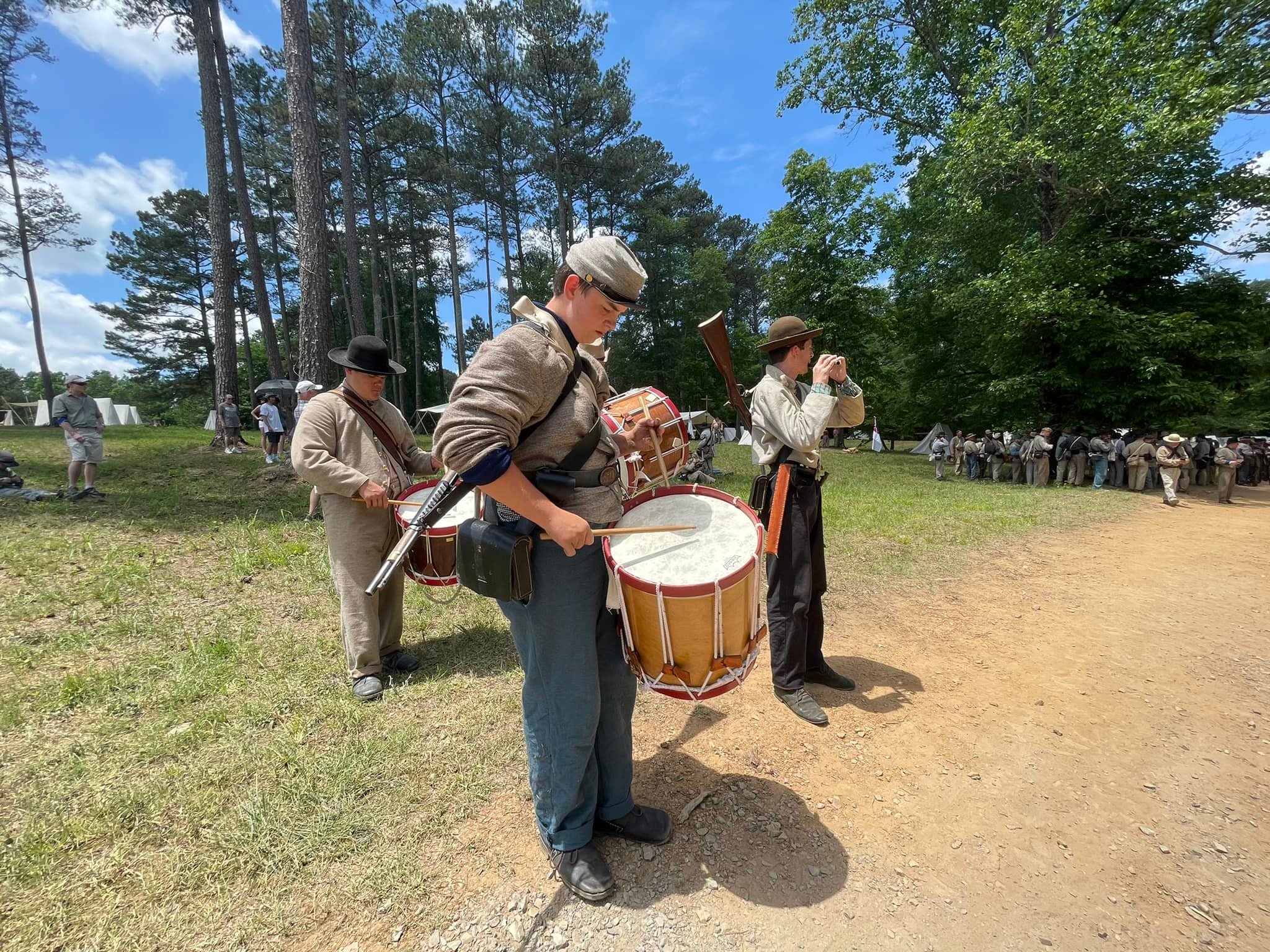
Rebel musicians in action.
The reenactment took place where the fighting did in May 1864.

 Have something to add (or correct) in this post? E-mail me here.

Tuesday, June 15, 2021

Bull's-eye: 'You damned Yankees have killed old General Polk'

A close-up of monument at the Leonidas Polk death site at Pine Mountain.
This 20-foot monument, dedicated in 1902, marks where Polk was killed.

Like this blog on Facebook | Follow me on Twitter

On a recent visit to the site where Leonidas Polk was killed in Kennesaw, Ga., I examined the monument to the slave-holding lieutenant general, inspected the remains of a four-gun Confederate battery position nearby, and shook my fist at a modern house, gazebo, and tennis court. (Georgia developers show little mercy for Civil War battlefields; the monument ground is private property.)

Leonidas Polk was killed at Pine Mountain
on June 14, 1864. (Alabama Department
of Archives and History
)
Then I listened, aghast, to a period preacher named "Archibald Everhart," who lost me roughly 10 seconds into his oration in front of the obelisk marking Polk's death at Pine Mountain: "Glory to the Southern saint ...." 

Oh, Lord.

On June 14, 1864, Polk -- "The Fighting Bishop" -- was nearly sliced in two by a well-aimed (or damned lucky) U.S. Army artillery round, rocking the Confederacy. "No event of a personal description -- saving the fate of Stonewall Jackson," a Southern newspaper wrote, "compares with it for painful interest and national calamity."

"Saddest event which has ever occurred in the [Army of Tennessee] since the death of Albert Sidney Johnston," wrote another. "You damned Yankees have killed old General Polk," a Confederate soldier reportedly wrote on a piece of paper attached to a ramrod next to a stump on Pine Mountain.

Polk, a West Point graduate and an Episcopal bishop before the war, had fought in nearly every major Western Theater battle. In his pocket when he died were a blood-stained prayer book and three copies of Balm for the Weary and Wounded -- each intended as a gift for generals John Bell Hood, Joseph Johnston, and William Hardee.  

Union newspapers weren't shy about speaking ill of the dead. Polk "has given no proofs of military prowess to especially endear him to the rebels," wrote the New York Observer. "In fact, he was a better bishop than a soldier. "

"... slavery was the poison that vitiated this man's life," wrote the Nashville Daily Union, throwing more gasoline on the Polk funeral pyre, "and led him to turn his back on the church ..."

I didn’t have time to find the position from which U.S. artillery fired the deadly shot, which you can read about here in a 2006 Civil War Times magazine feature. This was a full-circle visit for me: Polk’s Ashwood Hall mansion near Columbia, Tenn., was subject of my recently published CWT column. I'll post it when The Gods of Historynet make it available.

   GOOGLE STREET VIEW: Neighborhood where the Polk monument stands in clearing.

The Polk death site monument stands in a clearing on private property.
ABOVE AND BELOW: A gazebo peeks from behind the remains of a
 four-gun Confederate battery position near site of Leonidas Polk's death.


-- Have something to add (or correct) in this post? Email me here.


SOURCES

-- New York Observer, June 1864.

Tuesday, December 03, 2019

From Antietam to Shiloh, my 25 favorite 2019 photos


"The world is a book and those who do not travel read only a page."

 -- Saint Augustine


LOOKOUT MOUNTAIN, CHATTANOOGA, TENN: Reenactor Todd Watts of Nashville. 
ANTIETAM (MD.) BATTLEFIELD: 132nd Pennsylvania monument at Bloody Lane. 
ANTIETAM (MD.) BATTLEFIELD: Sunrise at the Samuel Mumma farm.
LEXINGTON, VA.: Lee Chapel, Washington and Lee campus. (READ POST.)
SHILOH (TENN.) BATTLEFIELD: Trapper Haskins, vintage baseball league player.
CHICKAMAUGA (GA.) BATTLEFIELD: Confederate Brigadier General Bushrod Johnson monument. 
ANTIETAM (MD.) BATTLEFIELD: Early morning at Dunker Church.
LOOKOUT MOUNTAIN, CHATTANOOGA, TENN.: Marker near the Cravens House, vortex of battle.
MISSIONARY RIDGE, CHATTANOOGA, TENN.: Witness tree.
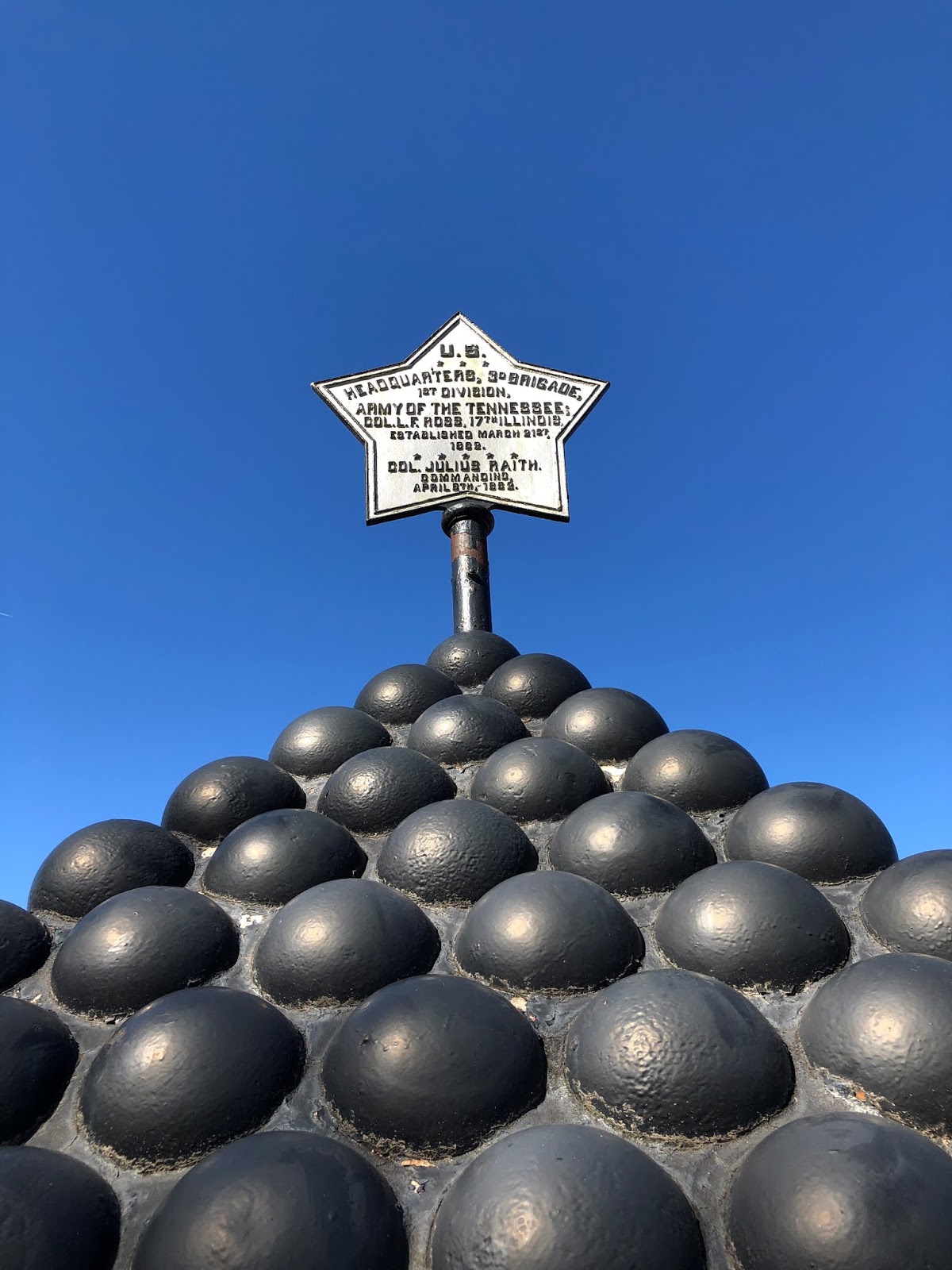
SHILOH (TENN.) BATTLEFIELD: Union brigade headquarters marker.
SAVANNAH, TENN.: Ulysses Grant headquarters site before the Battle of Shiloh.
ANDERSONVILLE, GA.: Site of  infamous deadline at the notorious POW camp. (READ POSTS.)
SHILOH (TENN.) BATTLEFIELD: Close-up of old, cast-iron marker for Confederate unit. (READ POST.)
ANTIETAM (MD.) BATTLEFIELD: William McKinley monument near Burnside Bridge.
CROSS KEYS (VA.) BATTLEFIELD: James Madison University professor Ken Rutherford,
a landmine explosion survivor. (READ MY CIVIL WAR TIMES COLUMN.)
RESACA, GA.: 83-year-old reenactor Jere McConnell. (READ MY CIVIL WAR TIMES COLUMN.)
SHELBYVILLE, TENN.: Bronze plaque on grave of Sumner Cunningham, founder and publisher 
of Confederate Veteran magazine, at Willow Mount Cemetery.  (READ POST.)
LEXINGTON, VA.: Lee Chapel on Washington and Lee campus. (READ POST.)
LEXINGTON, VA.: Stonewall Jackson statue at Virginia Military Institute.
SHILOH (TENN.) BATTLEFIELD: Monument for Union brigade headquarters. (READ POST.)
WHITES CREEK, TENN.: Tennessee Association of Vintage Baseball game. Love Norman Rockwell-like
quality of this image. League plays by Civil War-era rules. (READ MY AMERICA'S CIVIL WAR STORY.)
FORT PILLOW, TENN.: An attacking Confederate's view of the fort. (READ POST.)
ANTIETAM (MD.) BATTLEFIELD: 11th Connecticut monument near Burnside Bridge.
CORINTH, MISS.: Statue at contraband camp.
FRANKLIN, TENN.: Half-dozen red roses on grave of 16th South Carolina Private Hembry Chapman 
 at McGavock  Confederate Cemetery. Chapman, killed at the Battle of Franklin, was 17 or 18. 
His brother also is buried here. (CLICK ON ALL IMAGES TO ENLARGE.)

-- My favorite photos of 2017 and 2018
-- Have something to add (or correct) in this post? Email me here.

Wednesday, May 01, 2019

At cemetery in Resaca, Georgia, a detour into soul of South

Clad in Confederate gray, a drummer and fifer play Dixie. (CLICK ON IMAGES TO ENLARGE.)
Melea Medders Tennant holds a copy of an image of  Daniel, John and Pleasant Chitwood 
of Company A of the 23rd Georgia. Daniel is her great-great grandfather.  Company A was known
 as the "Bartow County Yankee Killers."
Like this blog on Facebook | Follow me on Twitter

My Sunday road trip plan is simple: Hike a trail at the Resaca battlefield in northwestern Georgia, then briefly visit the Confederate Cemetery nearby. Drive to another battleground. Return to Nashville. Instead, I take a 90-minute detour into the soul of the South.

A program for Confederate Memorial Day Observance
 at the Confederate Cemetery at Resaca, Ga.

A man in white shirt greets me shortly after I park my car near the cemetery. “Hello, handsome,” he says, surely in jest. In the gravel lot, 28th Georgia reenactors await instructions from their commander.  At the stone cemetery gateway, their comrade stands at attention, a Civil War-era replica musket by his side.

Big day, another reenactor tells me, it's Confederate Memorial Day Observance. “Are you going to stay for the ceremony?” he asks. “Oh, no, I need to head down the road to Chickamauga.” I tell him.

And so I begin my slow walk through the cemetery.

Under a canopy of tall trees, visitors find gravestones for the Confederate dead of Resaca. More than 450 soldiers, mostly unknowns, rest in the 2 1/2-acre grounds. A miniature Confederate flag adorns each grave. A large, white stone cross memorial atop a mound of earth serves as the cemetery centerpiece. “To the unknown dead,” read the words inscribed on the crossbar.

On a gray, granite memorial stone a few yards from the entrance, an etching of a photo of an angelic-looking young lady mesmerizes. Mary Green is buried elsewhere, but the spirit of the Resaca woman surely lingers on the grounds.

A memorial stone for Mary J. Green, the driving force behind the Resaca (Ga.) Confederate Cemetery.
Confederate reenactor Darrel Wilson stands watch near the cemetery entrance.
28th Georgia reenactors fire a salute in honor of Confederate dead.
Local United Daughters of the Confederacy president Melea Medders Tennant puts her hand over her heart
while a wreath is placed at the foot of the cemetery memorial.
Shortly after the war, Union dead from the Battle of Resaca on May 13-15, 1864, were removed and re-buried elsewhere. Confederate fallen lay neglected in makeshift graves throughout the battlefield -- in fields, in woods, on hillsides and even on the Green family's farm near the Conasauga River. Determined to give them a decent burial, Green and other family members formed an association that led to the creation of the cemetery in 1866. Mary's father, a railroad superintendent, donated the land.

Adorned with a Confederate flag, the grave of a known soldier 
from the 17th Alabama. Most of those buried in the cemetery
are unknowns from the Battle of Resaca.
By 1:45 p.m, a few dozen people, mostly locals, are gathered. A 30ish man with long hair sits on a low, stone wall bordering the cemetery. Pinned to his tan sport jacket are two Sons of Confederate Veterans ribbons. Others sit on small, white folding chairs near the cross memorial. One of them tells of his Confederate ancestor. Captured in Mississippi, he says, he joined the Federal army.

Promptly at 2 p.m., the ceremony begins. Eyes turn to three flags, the staff of each embedded in the ground. The Pledge of Allegiance is followed by a pledge of allegiance to the Georgia flag. Then comes an acknowledgment of another symbol: "I salute the Confederate flag with affection, reverence, and undying devotion to the cause for which it stands ..."

I listen intently to a few opening remarks by the great-great-granddaughter of a private in Company A of the 23rd Georgia, the "Bartow County Yankee Killers." Lifelong Resaca resident Melea Medders Tennant remembers the cemetery as a place for picnics. "Awe-inspiring," she calls it. Then the president of the local chapter of the United Daughters of the Confederacy glances at the stone archway at the front of the cemetery.

Sons of Confederate Veterans ribbons.
 "I always felt like I have stepped back in time," Tennant says, "when I go through that gate in the rock wall."

This sun-splashed Sunday is much like the long-ago cemetery dedication day. "What a beautiful day the Lord has made," says John Biddy, commander of the local Sons of Confederate Veterans chapter.

Steps from markers for unknowns, 28th Georgia reenactors fire three "honor volleys in memory of our Confederate veterans."

As a large wreath is placed at the foot of the memorial cross, Tennant puts her hand over her heart. A fifer, drummer and banjo player play Dixie. "Oh I wish I were in the land of cotton. Old times there are not forgotten," attendees sing.

A Baptist preacher gives a benediction, invoking Robert E. Lee and Gettysburg. Eager now to see more of the Resaca battlefield, I say good-bye to new acquaintances.

What an experience. What questions I have.

At the center of the cemetery, a memorial cross honors unknown Confederate dead.

-- Have something to add (or correct) in this post? E-mail me here.