Showing posts with label William Tipton. Show all posts

Sunday, February 11, 2018

View digitally restored Antietam monument photo from 1894

AFTER DIGITALLY RESTORED: An image of 16th Connecticut veterans at the dedication of their
monument at the 40-acre Cornfield at Antietam on Oct. 11, 1894.
 (SEE HOVER EFFECT AT BOTTOM OF POST.)
BEFORE RESTORATION: The original albumen is tattered and separated into two large pieces.
Like this blog on Facebook

On Oct. 11, 1894, 16th Connecticut veterans gathered in a rolling field at the south end of the Antietam battlefield for the dedication of a monument where the regiment had shed so much blood. A prominent inscription on the multi-colored granite obelisk told of the regiment's sacrifice in the notorious 40-Acre Cornfield on Sept. 17, 1862 -- the Nutmeggers' first battle of the war:

"Number engaged --779
Casualties
Killed 43
Wounded 161
Total 204"

Post-war image of  Frank Cheney,
 the former 16th Connecticut 
lieutenant colonel.
The afternoon was marked by speeches, of course, as well as by the invocation by former 16th Connecticut chaplain Charles Dixon, who recalled "noble men whose hearts glowed and burned with patriotic fire." But the most poignant event that day may have been the reading of a poem by 60-year-old Nathan Mayer -- the regiment's former surgeon -- which brought many of his comrades to tears.

At least two photographers were there to document the solemn event. Before the monument dedication -- one of four that early-fall day at Antietam for Connecticut regiments -- an unknown photographer shot an image of the monument blanketed by a massive American flag. Afterward, Gettysburg-based photographer William Tipton took several images, including the previously unpublished photo seen at the top of this post. The tattered and torn original -- digitally restored with the magic of Photoshop -- was found in a box with other family items by Willa Biewald, who has generously allowed me to dig into its secrets. (Hat tip: Matt Reardon, executive director of New England Civil War Museum.)

Unfortunately, there are no identifications on the front or reverse for the 28 people shown in the 13- x 16-inch albumen. The white-bearded gentleman to the immediate right of the monument almost certainly is former 16th Connecticut Lt. Colonel Frank Cheney, who suffered a severe wound to his left arm at Antietam and was discharged from the army on Christmas Eve 1862. A 62-year-old wealthy businessman and a beloved figure in the regiment, he contributed a large sum to pay for the land where the 16th Connecticut monument was located.

Here's how to contribute to the
Save Historic Antietam Foundation:
Donate | Mission | More
Further research surely will yield the names of some of the other veterans, several of whom hold canes, as well as the women who appear to the right of the monument. Those ladies, probably wives of veterans, may have traveled from the village of Sharpsburg, Md., to the dedication site in the carriage seen in the left background. Thanks to a complete list of the "excursionists" published in October 1894, we have a starting point for our investigation into the names of all subjects who appear in the photograph.

We do know with 100 percent certainty the photograph was taken by Tipton, whose name appears near the bottom left of the image. A meticulous record-keeper, Tipton compiled a catalogue of images he shot at Gettysburg and elsewhere in 1894. But the 16th Connecticut monument dedication photograph surprisingly does not appear in his 40-page booklet.

Perhaps by sharing this post with readers we'll soon know much more about this old image taken in the 40-acre Cornfield.

In the left background, a carriage used by some of the "excursionists" to get to the remote field. 
Photographer William Tipton included his name near the bottom of the image.
Among those who attended the dedication were four women, probably wives of 16th Connecticut veterans.
A photograph number and date the image was taken appear near the bottom right of the albumen.

HOVER ON IMAGE TO VIEW COMPARISON *


* Hover effect does not work on phones, tablets

-- Have something to add (or correct) in this post? E-mail me here.

Monday, July 31, 2017

Seldom-seen circa-1877 photo of Main Street in Sharpsburg

Left half of William Tipton stereoview of Sharpsburg, Md., shot from national cemetery lodge.
(American Antiquarian Society, Worcester, Mass.)
(CLICK ON IMAGE TO ENLARGE.)
Google Street View: A comparable present-day view from near ground level.

 Like this blog on Facebook.

A cropped enlargement may show the
belfry of the German Reformed Church
on Main Street. The building was
used as a makeshift hospital after the
Battle of Antietam.
Best known for his battlefield images at Gettysburg, William Tipton also photographed Antietam late in the 19th century. For example, see this image, probably taken in 1894, of the 16th Connecticut monument in The 40-Acre Cornfield. About 1877, Tipton photographed Burnside Bridge and a bullet-riddled Dunker Church as well as Antietam National Cemetery, which had been dedicated in 1867.

The Gettysburg-based photographer also shot an image of Main Street in Sharpsburg from near the top of the national cemetery lodge, probably during the circa-1877 visit. This seldom-seen view, shown at the top of this post in the left half of a stereoview, includes rich detail: an unpaved dirt road; seven recently planted trees outside the national cemetery fence; a field of corn by an old stone wall; and a barely visible church belfry, perhaps of the old German Reformed Church, which had been used a hospital after the battle in the fall of 1862. (Services are still held in the small, brick church on Main Street.) In the far left background, near the tree line, Robert E. Lee made his headquarters during the Battle of Antietam.  An ink inscription below the image, copyrighted in 1877, reads: “View of Sharpsburg, Md., near battle-field of Antietam, looking west.”

What else do you see in the images? E-mail me here, jump into the comments section below or add your two cents on my blog Facebook page.

The Tipton stereoview of Sharpsburg is in the vast holdings of the American Antiquarian Society in Worcester, Mass. The Society's impressive collection of hundreds of Civil War stereoviews, including rare battlefield images, may be viewed online here.

Ink inscription on stereoview notes it is a "View of Sharpsburg, Md., near battle-field of Antietam."
(CLICK ON IMAGE TO ENLARGE.)
Stone wall and cornfield on Main Street in Sharpsburg.
Recently planted trees near the national cemetery fence.

Have something to add (or correct) in this post? E-mail me here.

Saturday, July 29, 2017

Then & Now: General James Longstreet at Gettysburg

EARLY JULY 1888: JAMES LONGSTREET AT GETTYSBURG.
(CLICK ON IMAGES TO ENLARGE.)
 Like this blog on Facebook.

APRIL 28, 2017: PRESENT-DAY SCENE.
In July 1888, 25 years after the Battle of Gettysburg, former Confederate Lt. General James Longstreet posed on horseback with Daniel Butterfield (on second horse from right in top image), George Meade's former chief of staff, near the summit of Little Round Top. The 155th Pennsylvania monument appears in the right background. In late April 2017, I did my best to match the scene in the long-ago image by Gettysburg-based battlefield photographer William Tipton. Brush, trees and incompetence prevented me from producing a spot-on present-day photo.

Sometime after the 155th Pennsylvania monument was dedicated on Sept. 17, 1886, regiment veterans had a statue added to it. Read more about Longstreet's 1888 Gettysburg visit here on my blog.

Have something to add (or correct) in this post? E-mail me here.

For large-format Then & Now images, go to my blog here.


Tuesday, February 14, 2017

Gettysburg Then & Now: 9th Massachusetts monument

           HOVER OVER IMAGE | Then: William Tipton, June 1885  | Now: John Banks.

Like this blog on Facebook.

In June 1885, 9th Massachusetts veterans posed for an image at their monument at the base of Big Round Top. On a blustery Feb. 13, 2017, I aimed to mirror William Tipton's long-ago photo. He shot his image from a more elevated position, perhaps using a ladder. For a fine account of the 9th Massachusetts and its Gettysburg monument, check out Damian Shiels' excellent Irish in the American Civil War blog.

Click here to see large-format "Then & Now" images from Gettysburg and other Civil War battlefields.


Friday, February 03, 2017

'A sight for the gods': Wade Hampton's 1886 Gettysburg visit

In a cropped enlargement of the image below, Wade Hampton (center) joins veterans at a picnic 
near where they fought at Gettysburg on July 3, 1863. William Tipton shot the images July 7, 1886.
Gettysburg-based photographer William Tipton shot this image of Hampton and other vets.
(CLICK ON IMAGES TO ENLARGE.)

 Like this blog on Facebook | Follow me on Twitter

Twenty-three years after a Union cavalry officer slashed his head with a sabre in a farmer's field east of Gettysburg, 68-year-old Wade Hampton had a much less menacing encounter with his former enemies on the old battleground.

The reunion of cavalry troopers in Gettysburg
 on July 7, 1886, received extensive coverage
in the Philadelphia Times
and in other newspapers.
The picnic in a grove made for a remarkable scene: Hampton, the former Confederate cavalry general, enjoyed a meal of chicken, cold ham, beef, pickles, lemonade and milk with former U.S Army cavalrymen near East Cavalry Field, where the opposing forces attempted to kill each other on July 3, 1863. Nearly 100 ex-Confederate cavalrymen joined Hampton, who made the train trip to Gettysburg from Washington, where he served as a U.S. senator from South Carolina. 

Newspapers heralded the event on July 7, 1886, as “the most important and successful gathering that has taken place in Gettysburg since the war" and a "remarkable revival of old-time memories."

Notable for their absence were two generals who played huge roles during the cavalry fight about three miles east of town: Confederate J.E.B Stuart, who had been killed in 1864 near Richmond, and brash Union brigade commander George Armstrong Custer, who had been killed 10 years earlier in a battle against Lakota Sioux, Northern Cheyenne and Arapahoby at Little Big Horn. But their absences apparently didn’t detract from what the Philadelphia Times called “a genuine love-feast.”

Like former Confederate General James Longstreet two years later, Hampton was a star at this Gettysburg veterans’ reunion.

One of biggest slave holders in the South before the war, the senator had served with distinction under Robert E. Lee. The general's family suffered as thousands of others had during the war. Hampton's second-eldest son, Thomas, a 20-year-old lieutenant, was killed near Petersburg in 1864. Financially crippled by the war, Hampton lost a vast estate in Columbia, S.C., that the U.S. Army ransacked and destroyed by fire.

A cropped enlargement of the image below shows Hampton and other veterans on July 7, 1886.
On July 7, 1886, Hampton and cavalry veterans were photographed by William Tipton.
David McMurtrie Gregg is in the front row, left of Hampton, wearing a straw hat with a black band.
Unlike future Gettysburg reunions, simplicity marked this gathering. “There were no set speeches and no brass bands,” according to a New York World correspondent. “A company of militia came over from Hagerstown [Md.], but they did not come out to the cavalry battle field. The horsemen, therefore, attended to their business without fun or noise."

For four hours that Wednesday, the former Rebel cavalrymen and several hundred of their Union counterparts, including former General David Gregg, trekked over East Cavalry Field, pointing out key positions where they fought on a sultry summer day in 1863. Nearly 500 casualties resulted in about 40 minutes' fighting — a failed effort by Stuart to attack the rear of the U.S. Army.

While discussing strategy at the reunion, Union veterans had a "friendly dispute" over a supposed withdrawal of troops under Custer, and George Briggs — a former colonel in the 7th Michigan Cavalry — explained where his regiment made its "wonderful charge." Meanwhile, “General Hampton,” the Philadelphia Times noted, “was especially considerate in the indication of the lines on which General Stuart moved and where, within the timber, how his own command was placed.”

Hampton, who told old war stories, gestured to a fence and a clump of trees to show where he had suffered a sabre cut from an officer in the 7th Michigan on John Rummel's farm.

“I pulled my pistol and snapped it at him as I chased him toward the wood," the bewhiskered former general told a group of veterans from both armies. "Finding it had no loads in it, I threw it at him. I don’t wish him any harm now, but then I would have liked to have a swipe at him with my sabre.” (Later in the cavalry fight, shrapnel wounded Hampton in the hip. It remained in his body the rest of this life.)

In a cropped enlargement of the image below, Hampton tours the Gettysburg battlefield.
On July 7, 1886, William Tipton also shot this image of Wade Hampton in a buggy.

Before the highly anticipated visit, the Philadelphia Times declared “it will be a sight fit for the gods to see Wade Hampton and Gregg shake hands on the same battle-field where they sent their troopers against each other with most deadly intent.” 

While newspaper accounts did not mention whether the former adversaries indeed shook hands, Gregg — who commanded a division of cavalry in the fight on Rummel's farm — made his feelings plain.

“I don’t bear him any animosity,” the 53-year-old veteran said of the former plantation owner and slave holder, who was nearby, “but I would have liked to have got at him as I clubbed my pistol and threw it in his face. All the chambers were empty.

“I think even now,” Gregg said in jest, “that would have been a satisfaction.”

For a half-hour, Gregg and Hampton entertained each other with their views of the battle. 

"It was," the New York World noted, "a sight for reflection — this coming together of opposing commanders to find pleasure in marking for the future the successes and the defeats which are the monuments of our common valor."

Before he began his journey back to Washington, Hampton posed with other veterans for at least three photographs by Gettysburg-based battlefield photographer William Tipton. At 2 p.m., shortly after the picnic lunch ended, he bade his former comrades farewell.

It was an eventful day.

"The utmost feeling and courtesy," the Philadelphia Times reported, "prevailed among all who were present."

       East Cavalry Field, where Confederate and Union cavalry clashed on July 3, 1863.
ABOVE: East Cavalry Field, where Wade Hampton's troopers fought on July 3, 1863.
BELOW: Gregg Cavalry monument, where 1st Michigan Cavalry fought Jeb Stuart's cavalry.
Images courtesy Shelly Liebler.
                                      Google Map of East Cavalry Field, near Gettysburg.

 Have something to add (or correct) in this post? E-mail me here.


SOURCES

  • Gettysburg (Pa.) Compiler, July 13, 1886
  • New York World, July 8, 1886
  • Philadelphia Times, July 8, 1886

Monday, January 02, 2017

'No man ... more honored': Longstreet's 1888 Gettysburg visit

In an enlargement of the William Tipton image below, Civil War commanders (from left)
Joshua Chamberlain, Daniel Butterfield, James Longstreet and one-legged Dan Sickles pose in Gettysburg on July 3, 1888. Sickles lost his leg at Gettysburg on July 2, 1863.
Longstreet and his former Union adversaries in Gettysburg at the 1888 reunion.
(CLICK ON IMAGES TO ENLARGE.)
 
Like this blog on Facebook | Follow me on Twitter | My YouTube videos

A version of this feature story appeared in the January 2021 America's Civil War magazine.

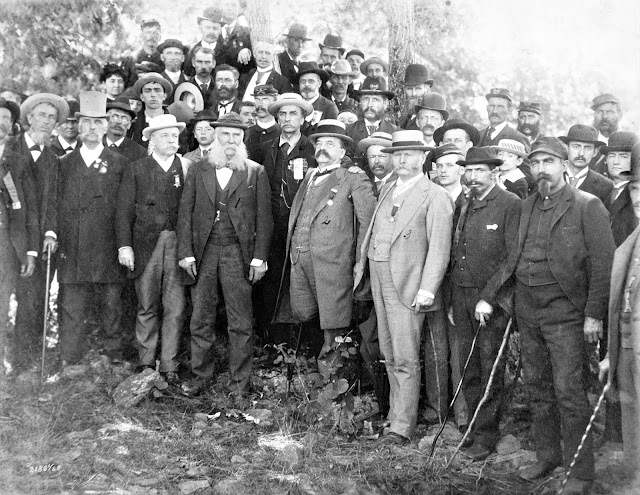
For sheer star power, no gathering of Union and Confederate veterans rivaled the Grand Reunion at Gettysburg in 1888. "There are so many Generals and other chieftains here," a newspaper marveled, "that a catalogue of them would be as long as Homer's list of ships." 

Former Army of the Potomac commanders Dan Sickles, Fitz-John Porter, Joshua Lawrence Chamberlain, Henry Slocum, Abner Doubleday and Francis Barlow, among other Union luminaries, joined ex-Army of Northern Virginia generals Wade Hampton, Fitzhugh Lee and John B. Gordon in Pennsylvania. 

But the most celebrated man at the event sported massive, white whiskers and a cleanly shaven chin: James Longstreet, who commanded the Confederates’ First Corps at Gettysburg on July 1-3, 1863. Nearly everywhere Robert E. Lee’s “Old War Horse” went he drew appreciative, and often awestruck, crowds.

"No man now in Gettysburg," a New York newspaper wrote, “is more honored nor more sought than he."

For Longstreet, the visit to Gettysburg — his first since he commanded troops there — stirred a wide range of emotions: anxiety, joy, excitement, gratitude, pride and sadness. Here's how those remarkable days unfolded during the summer of 1888.

Veterans with family members at the dedication of the 121st Pennsylvania monument 
at Gettysburg on July 4, 1888 -- one of many such gatherings in late June and early July
that year on the battlefield. (William Tipton photo | 
CLICK ON IMAGE TO ENLARGE.)

‘The sentiment which attracts … is powerful’

By 1888, James Longstreet proved more popular with Northerners than with White Southerners. 

After the war, he aligned himself with Republicans, the party of Abraham Lincoln, and supported his friend and former military rival, Ulysses Grant, as president. “Ole Pete” also served in the Republican administration of President Rutherford Hayes, a Union veteran who missed fighting against Longstreet's soldiers at Antietam because of a wound suffered days earlier at South Mountain. Meanwhile, Longstreet received scathing rebukes from Lost Cause devotees for his criticism of Lee’s soldiering at Gettysburg and other perceived failings.

Longstreet, who lived in semi-retirement on his farm in Gainesville, Georgia, arrived in Pennsylvania on June 30. On the train ride to Gettysburg, he sat near Gen. Hiram Berdan, whose two regiments of sharpshooters slowed the Confederates’ advance at Devil’s Den and the Peach Orchard on the battle’s second day. The men eagerly discussed the fighting during their journey. 
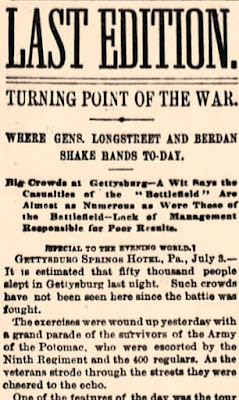
The press extensively covered
James Longstreet's visit to Gettysburg.
The 67-year-old general, who stood about 6-foot-2 and weighed more than 200 pounds, looked “enfeebled,” according to the New York Times. But another account called the broad-chested Longstreet  “vigorous” despite his age. 

In late June and the first days of July 1888, dozens of other trains packed with veterans unloaded at Gettysburg’s lone railroad depot for the Grand Reunion. “Most of the old soldiers went accompanied only by their memories,” according to an account, “but some took their wives and children with the intention of showing them the places in defense of which they fought so bravely.” 

Rooms in the town's few hotels became scarce, so organizers erected tents for veterans on East Cemetery Hill and elsewhere. At least 30,000 people — White veterans and civilians alike — attended each day of the three-day event organized by the Society of the Army of the Potomac, a Union veterans’ organization. One newspaper estimated attendance as high as 70,000 for a single day.

“Such crowds,” the New York Evening World wrote, “have not been seen here since the battle was fought.” (Black veterans did not officially serve in the Army of the Potomac as soldiers in 1863, and thus few, if any, African Americans are believed to have attended.) 

Unsurprisingly, the massive gathering — which included about 300 Confederate veterans — severely taxed resources in Gettysburg, population roughly 3,100. "The want of a head" in town, the Evening World reported, "has seriously interfered with the success of the reunion," while the New York Sun published a much more scathing Gettysburg critique: 
“The town is indeed a poor place for the accommodation of such crowds of visitors as come here. There is not a really good hotel in the village. … Carriages are needed to go from point to point, for the battlefield covers an area of twenty-five miles, and the people take full advantage of the crowds and gouge everyone who hires a buggy or a hack. The extortion is worse than that practiced by the St. Louis hotel people during the Democratic Convention. And yet, in spite of all these unpleasant things, the people come, for the sentiment which attracts is more powerful than the feeling of disgust created at the meanness of the people of the place." 
Despite less-than-ideal conditions, veterans — most in their early 50s — eagerly re-connected with former comrades. “The meeting of the survivors of the armies of Meade and Lee on the field of Gettysburg,” a Pennsylvania newspaper proclaimed, “is the greatest occasion of the kind known in our history, if not in the annals of nations.” 

Many veterans went souvenir-hunting for battle relics in fields and woodlots. Scores attended the dedication of more than two dozen battlefield monuments. At one of those events, a New Jersey veteran claimed he found in a rock crevice the cartridge box he had hidden during a retreat in July 1863. Two bullets remained in the bent and rusty relic, which he proudly took home. 

An 1880s view of Spangler's Spring, where some 
veterans partied at 1888 reunion. (William Tipton)


On East Cemetery Hill, four veterans of the Louisiana Tigers Brigade from New Orleans became the center of attention on ground where they made a desperate attack 25 years earlier. Pennsylvania veterans eagerly greeted the men, who wore blue, silk badges adorned with the letters “A.N.V.” for Army of Northern Virginia. 

“[S]uch a shaking of hands,” the New York Times reported, “was never before seen on East Cemetery Hill.”

In town, residents and others hawked everything from lemonade and badges to horse-and-buggy rides, available for from 50 cents to $2.50 an hour. At the Catholic church in Gettysburg, Irish Brigade veterans attended a special mass for the fallen in battle. Meanwhile, attendees enjoyed bands that played “Marching Through Georgia,” “John Brown’s Body” and “The Star-Spangled Banner." At night, electric lights mounted on a tall mast lit up Cemetery Hill, creating a dazzling scene. 

Many found time for carousing, too. At Spangler’s Spring, near Culp’s Hill, veterans partied hard after the reunion’s official end, drinking beer in “huge quantities.” 

Cordiality among the former enemies largely took precedence, although Union men groused that some Confederate veterans wore lapel pins adorned with a Rebel flag. “That was the flag of treason and rebellion in 1861,” Union Gen. John Gobin said in a speech, “and it is the flag of treason and rebellion in 1888.”

In a cropped enlargement of the William Tipton image below, Longstreet stands next to
 former Union general Henry W. Slocum. Who else do you recognize?
U.S. Army veterans and Longstreet on July 3, 1888. Dan Sickles, who lost a leg at Gettysburg,
stands next to Longstreet (right).  
(CLICK ON IMAGE TO ENLARGE.)

‘Old Pete’ and Sickles: ‘Friends in a moment’

Almost from the beginning, James Longstreet’s Gettysburg visit proved eventful and often surreal.

When word spread June 30 of Longstreet staying at the popular Katalysine Springs Hotel, about two miles from town, hundreds headed in that direction. But the general had already left for the dedication of Wisconsin Iron Brigade monuments in Herbst's Woods. There, “Old Pete” briefly met with Rufus Dawes, the Iron Brigade officer whose soldiers captured 200 Confederates nearby in the unfinished railroad cut west of town on July 1, 1863. 

“General,” Dawes said as he surveyed the area near the Chambersburg Pike, “it looks very different from the scene of 25 years ago.”

“Yes,” Longstreet said, “it reminds me of a camp meeting.”

Another U.S. Army veteran remarked to Longstreet that the battle might have ended quite differently had Confederate command listened to his advice. Then an attendee quizzed the general about Pickett’s Charge.

Were you really against it? the man wondered.

“Yes, sah,” Longstreet replied.

Asked if former Confederate Gen. Jubal Early — a high priest of the Lost Cause and a sharp critic of Longstreet — might attend the Grand Reunion, the general expressed his doubts. After all, the commander who ordered the sacking of nearby Chambersburg in 1864 probably would not have been well received on Pennsylvania soil.

Longstreet, though, rarely had a free moment at the reunion. Veterans of all stripes eagerly exchanged pleasantries and shook the hand of “Old Pete.” 

Later that day, Longstreet dined at his hotel with 68-year-old Daniel Sickles — the first meeting of the former enemies. As commander of the Third Corps at Gettysburg, the controversial Sickles lost his right leg to enemy artillery on the battle’s second day. 

“They were friends in a moment,” according to an account of their meeting, “and there was very little eaten at that table for 30 minutes as they talked about events a quarter century old.” While the old foes conversed, others in the room gawked and "let their dinner go almost untouched." 

40th New York veterans and two women in Devil's Den pose for a photo at a reunion
in Gettysburg, perhaps in 1888. (William Tipton | Library of Congress)


‘Something beyond description’ 

The pairing of Sickles, a cigar-smoking New Yorker, and Longstreet, a South Carolina-born part-time farmer, proved a hit. As a group of New York veterans marched through Gettysburg one morning, the two rode in a carriage behind them. 

"This was a meeting of blue and gray worth recording," a Philadelphia newspaper correspondent wrote, "and as they passed along the street that led to Seminary Hill and Seminary Ridge the enthusiasm of the crowd who recognized them was something beyond description."

With Sickles and other former Union bigwigs, Longstreet visited the notable battlefield sites — the Peach Orchard, Wheatfield, Devil's Den and Little Round Top, the “apple of Longstreet’s eye.” Little had changed, the general observed, since his soldiers' desperate assaults on the Round Tops on July 2, 1863, and, a day later, at the "Bloody Angle" during Pickett's Charge. While he toured the battlefield, Longstreet called the charge "a great mistake" and discussed strategy and tactics with former Union commanders.

When the general began a tour on horseback with former U.S. Army generals Daniel Butterfield, Berdan, and others, a large crowd gave the group three cheers. After they reached the summit of Little Round Top, word quickly traveled of Longstreet's presence. Union veterans gathered nearby for a monument dedication rushed toward their former adversary.

"Boys, here's Longstreet!" shouted the one-legged Sickles as he sat at the foot of a tree, "and he meets us once more on Round Top." Three rousing cheers from the crowd of about 100 "went surging through the shimmering air to the plain below." 

On July 1, Longstreet nearly broke down during a speech before an estimated 10,000 First Corps veterans in Reynolds Grove, near the monument to Union Gen. John Reynolds, who was killed on the first day of the battle. 

As he walked to the massive speakers' stand, Longstreet received a loud Rebel yell greeting, the Gettysburg Cornet Band played "Dixie" and veterans crowded around the commander. "General,” a one-legged Federal veteran told Longstreet, “I fought against you at Round Top. I lost a wing there, but I am proud to meet you here."

“Yes,” Longstreet replied as he grasped the man’s hand, “those were hot times then. But I’m all right now.” 

After Longstreet took his place on the stand, a former Federal officer shouted, "Comrades, you see on this platform one of the hardest hitters whoever fought against us. I propose we give three times three for General Longstreet, one of the best Union men now in the country!" 

The crowd erupted, surging toward the wooden stand and "showering God bless you's” on the teary-eyed general.

Moments later, though, the platform collapsed amid shrieks, falling two feet, but no one suffered a serious injury. Smiling, Longstreet bowed left and right. Then “Old Pete,” his voice shaking as he began his speech, told the veterans of his pride in commemorating the battle and of his eagnerness “to mingle with those brave men who know how to appreciate heroism which will give up life for country's sake." 

During his speech, Longstreet called the third day at Gettysburg the greatest battle ever fought. 

“But times have changed,” he said, according to the Times. “Twenty-five years have softened the usages of war. Those frowning heights have given over their savage tone, and our meetings for the exchange of blows and broken bones are left for more congenial days, for friendly greetings, and for covenants tranquil repose.

"The ladies are here to grace the serene occasion and quicken the sentiment that draws us nearer together,” he continued. “God bless them and help that they may dispel the delusions that come between the people and make the land as blithe as bride at the coming of the bridegroom.”

Longstreet appears in a cropped enlargement of the William Tipton image below.
In July 1888, Longstreet posed on horseback with Daniel Butterfield (on second horse from right),
 
George Meade's former chief of staff, near the summit of Little Round Top. The
 155th Pennsylvania monument appears in right background. BELOW: A present-day view.


'All were inspiring'

On July 2 at the national cemetery, the final resting place for more than 3,500 Federal soldiers, Longstreet shared the speaker’s rostrum with Sickles, Gordon, Barlow and other notables. Nearly 5,000 people crowded onto the hallowed ground where Abraham Lincoln had delivered the Gettysburg Address in November 1863. A New York Times reporter wrote about the remarkable scene:
"The actors were the very men who defended the ridge on whose slopes the cemetery lies against the repeated assaults led by the very men 25 years ago this very day who joined them here now in pledges of friendship, loyalty to a common flag and unity of devotion to a common country. All  place, scene, and the living figures of the men themselves  were inspiring."

A post-war photo of John Gordon,
who gave a speech at the
Gettysburg National Cemetery
at the 1888 reunion.
(The Cyclopaedia of American
biography)
Shortly after 5 p.m., Sickles gave a short speech.

“As Americans,” said the general, who became instrumental in preserving the battleground, “we may all claim a common share in the glories of this battlefield, memorable for so many brilliant feats of arms.” He later read a telegram from Pickett’s sickly widow, who offered “God’s blessing” to the throng. 

When Georgia governor John B. Gordon, a brigade commander at Gettysburg, received his introduction, a deafening roar greeted him.

“Hurrah!” and “Good!” the crowd shouted.

Longstreet spoke only a few sentences.

“I changed my suit of gray for a suit of blue so many years ago,” he said, further endearing himself to the Union vets, “that I have grown myself in my reconstructed suit of blue.”

At the dedication of the 95th Pennsylvania monument that day in the Wheatfield, though, the general’s actions spoke much louder than any words. Longstreet held the regiment’s tattered battle flag, pierced by 81 holes in fighting at Gettysburg, Antietam, Fredericksburg, Malvern Hill and elsewhere. 

Gently, James Longstreet pressed the flag to his lips … and wept.


Have something to add (or correct) in this post? E-mail me here.


SOURCES
  • Harrisburg (Pa.) Independent, July 2, 1888
  • Harrisburg (Pa.) Telegraph, July 5, 1888
  • New York Evening World, July 3, 1888
  • New York Sun, July 1, 1888
  • New York Times, July 2 and 3, 1888
  • New York Tribune, July 4, 1888
  • Philadelphia Inquirer, July 3, 1888
  • Philadelphia Times, July 3 and 5, 1888
  • The Times Picayune (New Orleans), July 3, 9 and 13, 1888

Sunday, June 15, 2014

Gettysburg: Michigan Cavalry Brigade monument dedication

Michigan Cavalry Brigade veterans and the governor of Michigan (center in top hat) at
 monument dedication.
(CLICK ON ALL IMAGES TO ENLARGE.)
Upon closer inspection, there are lots of neat details in this William Tipton image of the dedication of the Michigan Cavalry Brigade monument at East Cavalry Field at Gettysburg on June 12, 1889. While Michigan Gov. Cyrus Luce (large top hat) appears with veterans and presumably their family members in the center foreground, another group apparently listens to a speaker in the background at the monument. Judging from the man standing on two rocks in a large puddle in the left foreground (see enlargement below), it must have rained in Gettysburg recently. And how about the scowl on the face of the woman next to the governor? She didn't appear like she wanted to be there. Led by the boy general, George Custer, the Michiganders stopped Jeb Stuart's attempt to get around the right of the Union army here on July 3, 1863. Here's a thread of Tipton-related posts on my blog and here is my Tipton Pinterest page.

For Michigan veterans, a bushy moustache apparently was required.
The man in the bowler hat stands on two rocks to avoid stepping in a puddle. It rained in 
Gettysburg the day of the monument dedication for the Michigan Cavalry Brigade.

Wednesday, June 04, 2014

Gettysburg: 45th New York monument dedication

CLICK ON  IMAGES TO ENLARGE.
On Oct. 10, 1888, 45th New York veterans gathered for the dedication of their monument just north of Gettysburg, where they were overwhelmed 25 years earlier. Many in the all-German regiment were captured on July 1, 1863 and sent to prisoner-of-war camps in the South, including the most notorious one of all at Andersonville, Ga. Among the speakers that fall day was Christian Boehm, who as a 40-year-old corporal in Company I at Gettysburg eluded the Rebels and survived the battle unscathed. He re-enlisted in 1864 and served until the end of the war. 

"May this magnificent monument forever demonstrate to future generations that sons of the German nation fell here as heros and good patriots," said Boehm, who gave his speech entirely in German, "and that those who are born in a foreign country are capable to fulfill their duty to their adopted fatherland, and when necessary, bravely lay down their lives."  ...


... upon close inspection of the William Tipton photograph, a crescent moon, the symbol of the XI Corps, and two rifles adorn the monument for the 45th New York, also known as the 5th German Rifles. The large building in the background is Stevens Hall, built in 1868 and today used as a dormitory at Gettysburg College. ...


... As this enlargement of Tipton's image shows, one of the requirements for a Civil War veteran evidently was facial hair ... 


... often lots and lots of facial hair. In fact, it took a close examination ... 


... of the left background to find these young men, probably sons of veterans, who didn't require a good shave. (For more Tipton images, view my Pinterest page.)

Friday, May 16, 2014

Gettysburg: Tipton image of 12th N.J.monument dedication

June 30, 1888: 12th New Jersey monument dedication at Hancock Avenue in Gettysburg.
(CLICK ON IMAGE TO ENLARGE.)

Private William Hewitt, 12th New Jersey
(Author's collection)
Gettysburg-based photographer William Tipton, who also shot images of veterans at Antietam, photographed the 12th New Jersey monument dedication at Gettysburg shown above on June 30, 1888. An enlargement of the image (see below) reveals the words"12th Regt. N.J.V. Buck and Ball" on the sign on the tree in the background. The regiment was supplied with .69-caliber smoothbore muskets that fired a bullet and buckshot, devastating weapons at close range but poor weapons with which to hit a "Johnny" at long range. The "Buck and Ball" boys used those weapons to flush Rebels from the Bliss Farm on July 2, 1863 at Gettysburg.

Perhaps 12th New Jersey private William Hewitt, shown in the ambrotype at right, attended the Gettysburg event in 1888, although he may have received grief from his former comrades if he did. According to Hewitt's claim for a pension in 1876, he "was ruptured across the bowels" from carrying a heavy load to Gettysburg while on the march about July 1, 1863.. And in an amended claim in 1885, it was stated that Hewitt suffered from chronic diarrhea and piles that were contracted in July 1863, "the consequence of fatigue and overmarching" to Gettysburg. Hewitt missed the fighting.  He died at age 62 of a heart ailment on Aug. 24, 1894, in Clayton, N.J. and was buried in Park View Cemetery in Medford, N.J.


Veterans brought their wives and other family members to the dedication on June 30, 1888.

Follow my board of William Tipton Civil War Battlefield photos on Pinterest.

Wednesday, May 14, 2014

Gettysburg: Death of 17th Connecticut Lt. Colonel Fowler

Gettysburg photographer William Tipton shot this image of the dedication of the
 17th Connecticut monument on July 1, 1884.  (CLICK ON ALL IMAGES TO ENLARGE.)
An enlargement of  image above shows many attendees gathered under a canopy next to monument.
In this circa 1885 William Tipton image, William Henry Noble (second from left), a colonel  in the
 17th Connecticut, appears with Henry Allen (third from right), a veteran and chairman 
of the 17th Connecticut monument committee. Henrietta Noble, William's daughter, is at left next 
to Allen's wife. The other men are unidentified.
Like this blog on Facebook.

On July 1, 1884, 21 years after their lieutenant colonel was decapitated by enemy fire on the first day of the Battle of Gettysburg, 17th Connecticut veterans gathered with their families for their monument dedication yards from where the gruesome event occurred. Among the gray-haired veterans who sat beneath a canopy next to the monument on Barlow's Knoll were William Henry Noble, who had served as a 17th Connecticut colonel, and Connecticut governor Phineas Lounsbury, who served as a private in the regiment but had been discharged for disability in December 1862.

Lieutenant colonel Douglass Fowler was 
killed at Gettysburg on July 1, 1863.
Before the dedication, an American flag draped the white granite monument upon which were etched 35 names of 17th Connecticut soldiers who had died at Gettysburg. Near the top of the left front side appeared the name of Douglass Fowler, the 37-year-old officer from Norwalk, Conn., whose horrific death on the knoll had shocked his comrades decades earlier.

Directing his men while astride his white horse during the chaos of battle, Fowler was a prominent target as Rebels advanced through a strip of woods 100 yards or so in front of the regiment. (See interactive panoramas below.) "Soon after I had sent my wounded to the rear," Albert Peck, a 2nd lieutenant in the regiment, wrote 24 years after the battle, "the line officers gathered around Colonel Fowler and tried to persuade him to dismount during the battle, but he refused, fearing he might be deemed cowardly."

A short time later, the regiment was ordered to fall in, deploy for battle and charge.  "... our gallant boys advanced on the enemy with a will," Peck remembered. But as the Rebels closed on the outnumbered 17th Connecticut and the "din had reached the standard of a hell," according to a private, Fowler shouted a command and "the next instant he reeled from the saddle." (Hat tip to excellent 17th Connecticut blog.) Gunfire or canister sheered off the top of the lieutenant colonel's head, splattering his brains on his adjutant by his side.
On the 17th Connecticut monument on 
Barlow's Knoll, Douglas Fowler's name appears
 on a panel with seven other soldiers who died
 at Gettysburg. 

Decades after the battle, Edward Fowler, the officer's younger brother, wrote that an "unexploded cannester [sic] shot" struck Douglas and took his head off above the mouth, but he had not witnessed the terrible scene. A private in the 14th Connecticut, Edward had been discharged for disability in February 1863.

So intense was the fire on Barlow's Knoll that H. Whitney Chatfield, Fowler's adjutant, had a horse shot and killed from under him, bullet holes through his hat, haversack and the sleeve of his coat and his Revolutionary War-era sword shot apart. (Chatfield also did not survive the Civil War. He was killed at the Battle of Dunn's Lake in Florida on Feb. 5, 1865.)

"We were soon cut to pieces," Peck wrote, "and having no troops in our rear to support us, we fell back into the town." (Read 17th Connecticut Major Allen Brady's Gettysburg field report here, or if you have $16,000 to spare, purchase it here.)

Fowler's death compounded the tragedy for his family back in Connecticut. In 1855, Douglas' 23-year-old wife, Melissa Jane, died after the couple lost a daughter in infancy. Two of Fowler's brothers -- Henry and Richard -- also served as officers during the war. A lieutenant colonel in the 63rd New York, Henry suffered a severe wound at Antietam and was discharged from the army on July 4, 1863, a day after fighting at Gettysburg ended. Less than seven months before Gettysburg, on Dec. 13, 1862, 46-year-old Richard, a sergeant in the 27th Connecticut, was shot in the right leg and abdomen during a charge on Marye's Heights at the Battle of Fredericksburg. His leg was amputated and he died five days later.

Despite repeated recovery efforts by his comrades, Fowler's remains were never found. According to accounts, his body was stripped of clothes by the Rebels and probably tossed into a trench. He may be buried at the national cemetery in Gettysburg under a stone without a name.

In 1885, survivors of his regiment placed a wooden flagpole on Barlow's Knoll to mark the spot where the widower was killed. Replaced by a metal pole decades later, it stands as a silent reminder of a terrible death that occurred there in the summer of 1863.

Lieutenant colonel Douglas Fowler's body was not recovered and returned to Connecticut.
 Perhaps his  remains rest today in the national cemetery in Gettysburg.
                    BARLOW'S KNOLL: The Rebels advanced from right to left.
      BARLOW'S KNOLL: The 17th Connecticut monument appears at the extreme right. 
                                    (Click at upper right for full-screen experience.)                                 
17th Connecticut monument on Barlow's Knoll, also known as Blocher's Knoll. There also is 
a monument for the regiment near East Cemetery Hill.


-- Have something to add (or correct) in this post? E-mail me here.


SOURCES:

-- Edward Fowler letter to his niece, 1920s, Gettysburg National Military Park.
-- Paynton, W.W., "From Virginia to Gettysburg And Back," Chapter 1st, typewritten copy, Gettysburg National Military Park.
-- Albert Peck letter to comrade, April 2, 1887, typewritten copy, Gettysburg National Military Park.
-- Phoenix, Stephen Whitney, The Whitney Family of Connecticut, and Its Affiliations, Volume 2, New York, privately printed, 1878.