Dr. Mike Nickerson — president of the Shepherdstown Battlefield Preservation Association — discusses important recent preservation news about the West Virginia battlefield. Plus, "Dr. Mike" weighs in on the battle (Sept. 19-20, 1862) — the final engagement of the Maryland Campaign — and confirms a cannonball story.
Showing posts with label Battle of Shepherdstown. Show all posts
Showing posts with label Battle of Shepherdstown. Show all posts
Thursday, October 08, 2026

Thursday, December 12, 2024
Podcast: Dr. Mike Nickerson on Battle of Shepherdstown
Thursday, April 29, 2021
Communing with spirit of Civil War 'badass' in Shepherdstown
 |
| The day after the Battle of Shepherdstown (Va.), Lieutenant Lemuel Crocker climbed atop these bluffs to retrieve the bodies of three officers from his unit. (Crocker image courtesy Ronn Palm) |
Clem and I examined the old War Department tablets and much newer Civil War Trails marker, gazed at the Shepherdstown bluffs, and then peered into the kilns of the old cement mill along the Potomac, where 118th Pennsylvania soldiers became friendly artillery fire casualties on Sept. 20, 1862. Clem, a retired woodworker/relic hunter, often stared at the ground, wondering how many Union Minies and Confederate Gardners remain inches below.
 |
| At this cement mill kiln along the Potomac River, frightened 118th Pennsylvania soldiers hid from fire from both sides. Some were killed by friendly artillery fired from the Maryland side of the Potomac. |
For the May 2021 issue of America's Civil War magazine, Hartwig wrote an excellent account of Crocker's heroism at Shepherdstown. In one of the ballsiest moves of the war, the 33-year-old officer rescued wounded comrades and retrieved bodies of some of the unit's dead the day after the battle, disobeying orders. He had been in the U.S. Army less than a month.
Shepherdstown was a disaster for the "Corn Exchange Regiment" -- in their first battle of the war, the Pennsylvanians fought with defective 1853 pattern Enfields, which proved useless. Then "beaten, dismayed, wild with fright," some of them retreated pell mell under fire across a mill dam to the Maryland side of the Potomac. Others plunged to their deaths from the steep, craggy bluffs along the river on the Virginia side. A "sad and purposeless affair, with a most disastrous and fatal termination," a regimental historian called the battle.
 |
| Terrain and ruins of an old kiln on the West Virginia side of the Potomac River. |
In a letter to his parents (see below), published in the Buffalo (N.Y.) Advocate on Oct. 2, 1862, Crocker described his harrowing experience. "Almost a second Ball's Bluff," he called it, referencing a U.S. Army disaster on bluffs near Leesburg, Va., the previous year.
The next time you visit Antietam, check out Shepherdstown, too. Stare at those precipitous bluffs, gaze across the Potomac, examine the remains of the cement mill and mill dam ... and commune with the spirit of a Civil War badass.
(Hat tip to Jeffery Stocker, who pointed Hartwig to the Crocker letter. Note: In September 1862, Shepherdstown was part of Virginia. In the letter published in the Buffalo newspaper, Crocker noted its location as Maryland.)
 |
| Route 118th Pennsylvania took to bluffs at Shepherdstown on Sept. 20, 1862. |
An Incident of Noble Heroism.
We publish elsewhere a letter [see below] from Lieut Crocker, son of L. Crocker, Esq., of this city, detailing his story of the recent sad reverse of the Philadelphia Corn Exchange Regiment. Since the letter was in type, we find the following thrilling reference to Lieut. C. in a Philadelphia paper:
The regiment had reached the Maryland shore, at least that portion of it which the fortunes of the day had spared the fate of either death or wounding. The rebels still held the field where the deadly strife had raged. Our suffering heroes languished for help; they cried for water to quench their burning thirst, for bandages to bind up their bleeding wounds.
Without waiting for the formality of a flag of truce, Lieut. Lemuel L. Crocker forded the river in the face of rebel soldiery. He reached the other shore in safety, and in a few moments was ministering to the wants of his beloved comrades. A rebel officer passed the spot, and enquired of Lieut. Crocker the nature of his business, whether he came to surrender in a hopeless cause, etc. "I come," said he, "in the cause of humanity. If you are human, let my mission proceed."
The words touched the sympathies of the traitor, and, as if forgetting that he was a soldier in so wicked a cause, told our gallant Lieutenant that he would not be held as a prisoner, but that he might remain to take care of the wounded.
Lient. Crocker was in Company C and this act of heroism and daring forms one of the most cheering episodes of that fatal day.
Shepardstown, Md.
September 22, 1862.
Dear Parents:
I am here alive and safe. Our Regiment has been in a terrible battle -- almost a second "Ball's Bluff." We have lost nearly 300 killed, wounded and missing. Our Regiment has been in the advance of the army of McClellan for the last week. I have seen in the marches all the horrors of war -- the dead and dying lining the road-side and filling the barns.
 |
| An illustration in the 118th Pennsylvania regimental history of the mill dam and cement mill on the Virginia side of the Potomac River. Ruins of the mill remain. Many soldiers in the regiment retreated across the dam during the Battle of Shepherdstown. |
As we got to the river-side we had to go near a half a mile to a dam over which our men were attempting to cross; and to make this dam many a man lost his life, as the rebels were stationed on the bluff taking deliberate aim during the whole fight. I was cool and collected during my travel by the riverside; but when I reach this dam, I think my cheek blanched, for it seemed to me certain death to cross it, as the rebels had got into a large brick building below the dam, and the main body above on the bluff, picking off our poor fellows. But to stay was death probably, and a prison sure. So I hesitated but the instant, and crossed safely.
Berdan's Sharp Shooters were stationed on the opposite bank covering our retreat; and this is all that saved our Reg't, for they in a short time prevented a rebel in taking a risk of showing himself. After two hours, at the end of the dam there were about ten wounded and ten more whose courage had given out, and they must be got over. The Captain of Berdan's men and myself walked up and down the bank to try and induce them to come over. I then took off my coat and with Lieut. Marsh's revolver, covered by the Reg't, recrossed the river and brought over every man there, except those on the battle field.
The next day every effort was made by our officers of the Regiment and Brigade to get Maj. Gen. [Fitz John] Porter to send a Flag of Truce to bring off our wounded, and to bury the dead; but of no avail -- he would not do it. I stepped forward and volunteered, and with a volunteer force again crossed the Potomac, and had the satisfaction of bringing off every wounded man, and the dead bodies of our officers. The Brigadier general complimented me personally and that was another satisfaction.
Our Colonel is pretty badly wounded. My Company loses 28 killed, wounded and missing. But I assure you the 118th P. V. Reg't has made itself a name of which every man be proud who belongs to it. We are still in the advance doing picket duty. We are now numbered among the fighting regiments.
L. L. Crocker.
-- Have something to add (or correct) in this post? Email me here.
SOURCES:
- History of the Corn Exchange Regiment, 118th Pennsylvania Volunteers, from their first engagement at Antietam to Appomattox, By the Survivors' Association, Philadelphia, J.L. Smith Publisher, 1888.
- Inside the Army of the Potomac, The Civil War Experiences of Captain Francis Adams Donaldson, edited by J. Gregory Acken, Stackpole Books, 1998.
- The Advocate, Buffalo, N.Y., Oct. 2, 1862.
Saturday, June 11, 2016
'Shell and be damned': An officer's bravery at Shepherdstown
 |
| 118th Pennsylvania Lieutenant Lemuel Crocker disobeyed orders forbidding him to cross the Potomac to recover dead and aid wounded in his regiment after the Battle of Shepherdstown. (Image courtesy Ronn Palm/Museum of Civil War Images in Gettysburg) |
 |
| Route the 118th Pennsylvania took to the bluffs above the Potomac River at Shepherdstown, Va. |
"A cry of horror went up from our men, heard across the river," Captain Frank Donaldson wrote about the awful effect of the friendly fire during the Battle of Shepherdstown.
A day later, casualties of the 118th Pennsylvania, mostly solders from Philadelphia, were scattered across the Virginia side of the Potomac. "The silent forms of the dead, killed in the fight, were in plain view," a regimental historian wrote. "It was a sorrowful sight."
Lemuel Crocker, a tall, muscular 33-year-old lieutenant in the 118th Pennsylvania, aimed to do something about it.
Disobeying an order from Union V Corps commander Fitz John Porter forbidding his mercy mission, Crocker crossed the dam breast from Maryland to the Virginia side of the Potomac to aid the wounded and to retrieve the dead. In the army less than a month, Crocker, "absolutely covered with blood and dirt," was carrying a soldier to the river bank when he was approached by an orderly for Porter.
Return at once to Maryland, he told the lieutenant, or a battery would open fire to persuade him.
"Shell and be damned," replied Crocker, who continued his work.
In a detailed account published decades later, the 118th Pennsylvania's regimental historian recalled Crocker's heroism on Sept. 21, 1862:
 |
| Lemuel Crocker crossed from the Maryland side of the Potomac in the distance to aid comrades in the 118th Pennsylvania on the opposite shore. |
 |
| In their hasty retreat, some 118th Pennsylvania soldiers were severely injured -- and some were killed -- scrambling down these bluffs (above and below). |

He found the bodies of [Courtland] Saunders, [Joseph] Ricketts and [J. Mora] Moss, and Private [Edward] Mishaw, badly wounded but still alive. He was bearing them one by one upon his shoulders to the river bank when he was suddenly interrupted by an orderly from General Porter, who informed him that he was instructed to direct him to return at once or he would order a battery to shell him out. His reply was: 'Shell and be damned.' He didn't propose to return until the full purpose of his undertaking had been accomplished.
The orderly thus abruptly disposed of, he continued his operations, when he was again interrupted by an authority which, if it failed to command respect, could enforce obedience. He had carried all the bodies to the bank, and was returning for the wounded Mishaw, when a Confederate general -- whom Crocker always thought was Lee but in this he was mistaken -- accompanied by a numerous staff, came upon the ground. An aide de camp rode up, inquiring, with some asperity -- explaining that no flag of truce was in operation -- as to who and what was his purpose in being there and by whose authority.
Crocker's work, which he had conducted wholly himself, had put him in a sorry plight. He was of large frame, muscular and finely proportioned. He had carried the bodies over his left shoulder and was absolutely covered with blood and dirt, almost unrecognizable as a soldier, and his voice and form alone indicated his manhood. His reply was prompt and ingenuous: he had been refused permission to cross by his corps commander, to whom he had made his purpose known; the dead and wounded of the regiment that fought on that ground yesterday were of the blood of Philadelphia's best citizens and, regardless of the laws of war and the commands of his superiors, he was of opinion that humanity and decency demanded that they be properly cared for, which, no one else attempting, he had determined to risk the consequences and discharge the duty himself. The simplicity and earnestness of this reply prompted the further interrogation as to how long he had been in the service. "Twenty days," responded Crocker. The gentle "I thought so" from the lips of the veteran general showed that the ingenuousness and sincerity had wholly captured him. He bade him continue his labors until they were fully completed, pointed out a boat on the shore that he could utilize to ferry his precious freight across the stream, and surrounded the field with a cordon of cavalry patrols to protect him from further molestation or interruption.
(Click at upper right for full-screen experience.)
But Crocker had a host of troubles to face upon his return. He had openly violated the positive commands of his superior; he had been shamefully insulting to the messenger who bore his superior's instructions; and had acted in utter disregard of well-known laws governing armies confronting each other. Still, there was something about the whole affair so honest, so earnest, and so true, that there was a disposition to temporize with the stern demands of discipline. And he had fully accomplished his purpose -- all the bodies and the wounded man were safely landed on the Maryland side. However , he was promptly arrested.
 |
| V Corps commander Fitz John Porter reprimanded Lemuel Crocker but allowed him to return to duty. |
Colonel Barnes, who had watched him through all his operations, was the first of his superiors who was prompted to leniency, and he accompanied him to corps headquarters to intercede in his behalf. They were ushered into the presence of General Porter, who, shocked at such a wholesale accumulation of improprieties and angered to a high tension by such positive disobediences, proceeded, in short and telling phrases, to explain the law and regulations -- all of which, if Crocker didn't know before he started, he had had full opportunity to gather in during his experiences.
Then followed moments of painful silence, and the general inquired whether he had seen a gun which the regulars had left upon the other side the day before and, if so, what was the likelihood of its recovery. Crocker replied that he had not, but had noticed a caisson, and that he did not consider it likely it would ever come back. Returning to the subject, the general continued his reproof; but considering his inexperience, unquestioned courage and evident good intentions, he finally yielded, concluding that the reprimand was sufficient punishment and released him from arrest and restored him to duty.
POSTSCRIPT: Crocker, who later fought with the 118th Pennsylvania at Chancellorsville and Gettysburg, resigned his commission on Feb. 26, 1864, probably to care for his ill wife. After the war, he lived in Buffalo, where he was superintendent of the stock yards and worked in fertilizer and brewing businesses. "One of the most enterprising men in the city," Crocker died of a stroke at his home in Buffalo on March 27, 1885.
"He was a man of strict integrity, and great benevolence," The Buffalo Evening News wrote about the 56-year-old veteran, "and many a cattle dealer who has been at times pressed for funds will remember with gratitude his generous tenders of his assistance."
 |
| During the Battle of Shepherdstown, Federal artillery aimed at the Rebels from the Maryland side of the Potomac fell short, killing and wounding 118th Pennsylvania soldiers huddled in or near the arches of this lime kiln. |

-- Have something to add (or correct) in this post? E-mail me here.
Friday, October 09, 2015
Wading into history: A Shepherdstown battlefield tour
 |
| Taking the plunge on Sept. 19, 2015: Civil War enthusiasts cross the Potomac River at Boteler's Ford. |
(CLICK ON IMAGE FOR FULL-SCREEN INTERACTIVE EXPERIENCE.)
 |
| Antietam battlefield guide Jim Rosebrock (left) and your friendly blogger in the Potomac. |
Armed with an iPhone, determination and knowledge that the water was only waist-high at its greatest depth, I waded the Potomac River from Maryland to West Virginia at Boteler's Ford with nearly 40 other Civil War nuts. Clutching my phone like a thief grips a large bag of cash, I aimed to document the 250-yard crossing and subsequent tour of the seldom-visited Shepherdstown battlefield on the opposite bank. Our mission Sept. 19 was accomplished nearly flawlessly -- only two people slipped on the rocky river bottom and plunged into the clear, cold water. Meanwhile, I nervously shot photos while standing precariously in the middle of the Potomac.
 |
| A brief mention of Pack Horse Ford, also known as Boteler's Ford, on a historical sign on the West Virginia side of the Potomac. |
The next morning, two Federal brigades crossed the river, climbed the bluffs, ventured into the fields beyond them and were routed by the Rebels, who later picked off Yankees as they attempted to escape across the river back to Maryland. "The broad surface of the Potomac was blue with the floating bodies of our foe," Confederate General A.P. Hill wrote in his after-action report. "But few escaped to tell the tale.”
In its first battle of the war, the 118th Pennsylvania, the 767-man Corn Exchange regiment, suffered the worst: 64 killed, 124 wounded and 94 missing. It was a "sad and purposeless affair, with a most disastrous and fatal termination," a regimental historian later wrote. Total casualties for both sides at the Battle of Shepherdstown were more than 600, far less than the 23,000-plus at Antietam, but the Union army's pursuit of Lee was over.
 |
| Union pickets fire across the Potomac at Rebels on Virginia side in this sketch by Alfred Waud. The cement mill, a prominent landmark at the Battle of Shepherdstown, appears in distance. (Library of Congress) |
Two groups made the trip -- one led by Maryland Campaign expert Tom Clemens and another by young historian Kevin Pawlak, author of a recently released book on Shepherdstown's Civil War experience. The SBPA has been instrumental in helping preserve parts of the battlefield, much of which is privately owned, and an effort to incorporate it into Antietam National Battlefield is under consideration.
And so with an eye on what happened to the poor boys in the 118th Pennsylvania, off we went for a 3 1/2-hour journey back in time ...
'Peacefully picturesque'
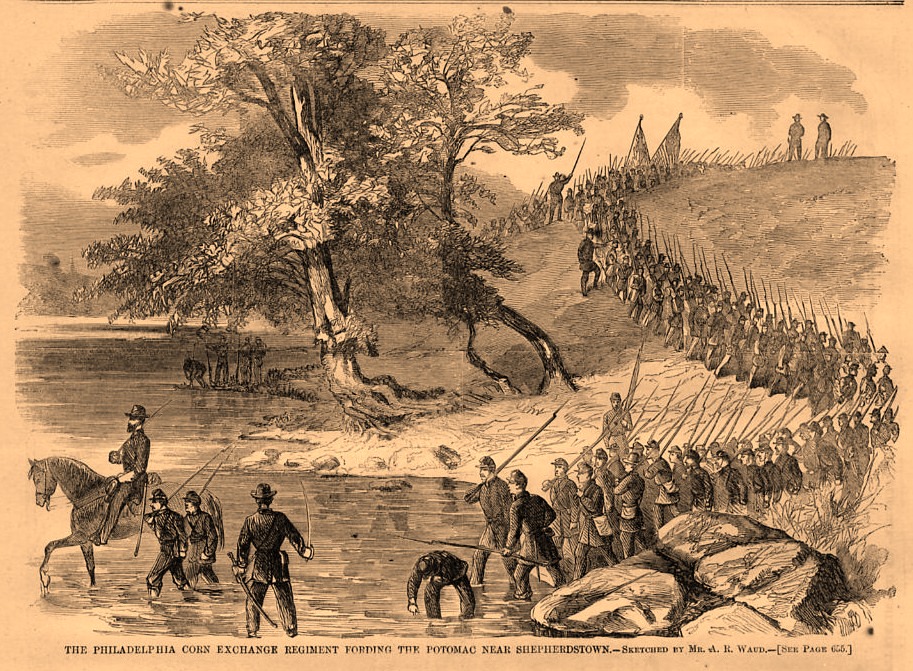 |
| In a Harpers Weekly illustration on Oct. 11, 1862, the 118th Pennsylvania prepares to cross Potomac. |
 |
| Recruiting poster for 118th Pennsylvania. It was also known as the Corn Exchange Regiment because a bounty for each soldier was provided by the Corn Exchange Association of Philadelphia. (Duke Libraries collection) |
To my knowledge, none of us carried a musket or other accoutrements, which surely made the crossing a challenge for Rebels and Yankees in 1862. After Antietam, Lee's army crossed Boteler's Ford at night, with the aid of torches. Try that sometime.
From the 118th Pennsylvania history: "Dew glistened on grass and leaf, and the old Potomac, calm and placid as if it had never known strife, visible for a considerable distance, swept on its course tranquilly. The landscape, varied with its valley and hillside, its meadows and woodlands, sprinkled with barn, house and garden, was peacefully picturesque in the refreshing sunlight of a soft September morning. There were no harbingers that by noon-day the regiment should suffer casualties, severer for a single combat than probably ever fell to the lot of soldiers, even in the heaviest battles of the war.
"An early breakfast was interrupted by orders to move. The meal completed, the brigade started in the direction of the river. With a few hurried personal preparations, some of the men removing their shoes and stockings, the column at 9 a.m. began the passage of the stream at Blackford's Ford. There was a good deal of pleasant shouting as the troops splashed through the stream, and roars of laughter greeted those who, less fortunate than their fellows, stumbled and fell headlong into the water."
A 'hot fire'
 |
| Confederates attacked toward the camera. |
(CLICK ON IMAGE FOR FULL-SCREEN INTERACTIVE EXPERIENCE.)
My take: In pursuit of the Rebels, the 118th Pennsylvania waded across the Potomac unmolested and then marched through a wooded ravine to a plateau above the river. We followed the route in another ravine, making our way past ruins of cement kilns and up the steep slope to a large field. I made a makeshift walking stick from a large tree branch to help navigate my way to the top. The ground atop the bluffs on which the 118th Pennsylvania fought is mostly woods today and was inaccessible during our tour. We were granted special access of the private property.
At Shepherdstown, the 118th Pennsylvania was plagued by poor leadership and bad luck. Outnumbered by the Rebels on the plateau above the river, most of the Union V Corps retreated back across the Potomac into Maryland. But the 118th Pennsylvania remained because its commander, Colonel Charles Prevost, thought an order to retreat had not come through the proper chain of command. In the thick of the fight, the regiment discovered that some of its newly issued Enfield rifles were defective. The spring of the hammer in some of the muskets did not explode the percussion caps. The rout was on.
From the 118th Pennsylvania regimental history: "The enemy had now succeeded in pressing as close to the front as fifty yards,| and the hot fire at such close range was increasing the casualties with frightful fatality. At the same moment he succeeded in developing a regiment across the ravine, completely covering the entire right. The two right companies, under the immediate supervision of the colonel, promptly changed direction by the right flank and gallantly checked the manoeuvre. This movement, mistaken by the hard-pressed centre for a withdrawal, induced it to break temporarily, and with the colors in the advance move in some disorder order to the rear. Colonel Prevost caught the disorder in time to promptly check it. Heroically seizing the standard from the hands of the color-sergeant and waving it defiantly, he brought the centre back again to the conflict and completely restored the alignment. He was still waving the flag in defiance at the enemy when a musket-ball shattered his shoulderblade and he was borne to the rear by Corporal Francis Daley, of Company E. The severity of his wound forced him to withdraw entirely from the action."
Terror on the bluffs
 |
| 118th Pennsylvania soldiers were seriously injured or killed when they scrambled down the jagged cliff. |
 |
| Captain Courtney O'Callaghan was seriously injured when he made his escape down a cliff. |
"The men poured like a cataract over the edge and down the declivity," a soldier in the 32nd Massachusetts remembered, "and so long as they stayed at its immediate base they were tolerably safe, but their assailants soon gained the edge of the bluff and lying flat, could pick off any who attempted to cross to the Maryland side, and many were killed or wounded or drowned before our eyes."
Here are two names to remember:
 |
| Musician Ephraim Layman's grave in Antietam National Cemetery. |
Private William Madison: Many of the fleeing Pennsylvanians attempted to escape to the Maryland side across a slippery, ramshackle 10-foot-wide dam-breast. Others were shot while they swam or waded across the Potomac. One who barely made his escape via the dam was 46-year-old Madison, who was peppered with five shots, including one that shattered his jaw.
"He vented his anger in a frightful howl," according to the 118th Pennsylvania regimental history, "and facing squarely about gave his enemies the last shot he ever fired in the army, for his wounds terminated his service, but not his life." Madison survived the war.
From the 118th Pennsylvania regimental history: "The greater part of the regiment made furiously for the ravine, down which they dashed precipitately. Since the march up, a tree, in a way never accounted for, had fallen across the path. This materially obstructed the retreat. Over and under it the now thoroughly demoralized crowd jostled and pushed each other, whilst, meanwhile, the enemy, having reached the edge of the bluff, poured upon them a fatal and disastrous plunging fire. The slaughter was fearful; men were shot as they climbed over the tree, and their bodies suspended from the branches were afterwards plainly visible from the other side of the river."
Death at the arches
 |
| Maryland Campaign expert Tom Clemens explains the significance of the cement kilns. |
 |
| Ruins of old cement kilns on West Virginia side of the Potomac. The first three arches are post-war. |
 |
| 118th Pennsylvania soldiers sought refuge in this arch after they were routed on the bluffs. |
 |
| 118th Pennsylvania soldiers were killed or seriously wounded by friendly artillery fire here. |
From 118th Pennsylvania regimental history: "At this moment a battery from the Maryland side opened heavily. The practice was shameful. The fuses, too short, sent the terrible missiles into the disorganized mass fleeing in disorder before the serious punishment of the enemy's musketry. It was a painful ordeal, to be met in their effort to escape an impending peril by another equally terrible. Shell after shell, as if directly aimed, went thundering into the arches, bursting and tearing to pieces ten or twelve of those who had crowded there for cover.
"A cry and wail of horror went up, plainly heard above the din and roar of battle. Waving handkerchiefs fixed to ramrods, they endeavored by their signals to warn the gunners to desist, but to no avail; the fatal work continued. Hoping for better treatment, numbers turned with their white insignia of truce towards the enemy and, again ascending to the hill-top, surrendered. The artillerists continued to pound away with an ardor indicative of satisfaction, until Captain B. F.Fisher and Lieutenant L. R. Fortescue, two officers of the Signal Corps, fortunately detected, with the aid of their long-range telescopes, the damage inflicted, when lengthened fuses and better practice brought their aim more directly towards the accomplishment of its intended purpose."
'Relentless, persecuting fire'
 |
| Ruins of cement mill office building. |
 |
| Another view of the ruins of a cement mill office building , which faces the Potomac River. |
 |
| Ruins of the main cement mill building, where 118th Pennsylvania soldiers sought refuge. Later, Rebels poured fire from this building into the Yankees, who attempted to flee across the Potomac. |
My take: Just off the River Road, we found ruins of the old cement mill, from which Rebels fired upon Yankees who attempted to escape across the river. After he somehow made it to the Maryland side of the river, 118th Pennsylvania Lieutenant J. Rudhall White was greatly relieved. "Thank God, I am over at last!" said White, a Virginia native. Suddenly, a bullet tore through his bowels, mortally wounding the 20-year-old soldier who began the war in the Rebel army. Perhaps the fatal shot came from one of the buildings above.
From 118th Pennsylvania regimental history: "An old abandoned mill stood upon the ford road, at the base of the cliff. It completely commanded the ford and the dam-breast. When the last of the fugitives had disappeared from the bluff, the enemy crowded the doors, windows and roof and poured their relentless, persecuting fire upon those who had taken to the water. Numbers, observing the telling effect of the fire upon those who had essayed to the venture of crossing, huddled together and crowded each other in the arches at the base of the bluff; whilst others, hoping to escape the fatal effect of the avenging bullets, took to deeper water and crossed where the stream was deep enough to cover the entire body and leave the head alone exposed."
My take: There are thousands of examples of heroism and courage during the Civil War. One of the lesser-known stories of valor involves Lemuel Crocker, a 33-year-old captain in the 118th Pennsylvania. A day after the battle, wounded and dead from the Corn Exchange regiment were scattered across the Virginia side of the Potomac. Crocker, who had served in the Union army for barely a month with the regiment, aimed to do something about it.
Disobeying an order from Union V Corps commander Fitz John Porter forbidding his mercy mission, Crocker crossed the dam from Maryland to the Virginia side of the Potomac to help his wounded comrades. One by one, Crocker, a large, muscular man, carried bodies of dead and wounded to the river bank, where an orderly for Porter told him he would be shelled by Federal artillery if he continued.
"Shell and be damned," replied Crocker, who continued his work. A Rebel officer allowed Crocker to retrieve other wounded and even pointed out a small boat in which he could take the soldiers back to the Maryland. Upon his return, Crocker was promptly arrested and reprimanded by Porter. Figuring a stern reprimand was enough punishment, the commander released Crocker for his "unquestioned courage" and allowed him to return to duty.
Like this Rebel soldier, Lemuel Crocker merits a statue somewhere for his heroism, too.
From the 118th Pennsylvania regimental history: "The fight was a sad and purposeless affair, with a most disastrous and fatal termination. Yet it secured for the regiment a reputation among its new associates for staying qualities which, maintaining it thoroughly, as it did, down to the very end, bore most excellent fruits.
"Experienced soldiers, jealous of their hard-earned glories, are prone, until their mettle is tested, to receive their inexperienced brethren with no boisterous, cheery demonstrations of hearty welcome. This treatment was more pronounced when the soldiers of 1862 joined the Army of the Potomac, as the impression was abroad that their enlistment was prompted solely by a moneyed consideration. Of course, this soon wore away, and the entire army was, as in the beginning, one harmonious whole
in feeling, sentiment and purpose.
"The 118th's reception in the brigade was not attended by any joyous, gladsome shouts, nor was it exempt from the intimation that its presence at the front was largely due to the paltry shekels. The stolid indifference it met at every hand during the few days previous to the fight was frequently accompanied with epithets apparently intended to be enduring : 'Here come the $200 boys from Philadelphia,' and others of like import. The affair at Shepherdstown, though, wiped everything out. That was a crucial test, and one which conquered the prejudices of men whose trials of battle fitted them to judge of the worth of their fellows. Opprobrious allusions were changed to plaudits, and, for months afterwards, the command was pointed out everywhere to strangers as 'the men who fought at Shepherdstown.' "
From 118th Pennsylvania regimental history: "An old abandoned mill stood upon the ford road, at the base of the cliff. It completely commanded the ford and the dam-breast. When the last of the fugitives had disappeared from the bluff, the enemy crowded the doors, windows and roof and poured their relentless, persecuting fire upon those who had taken to the water. Numbers, observing the telling effect of the fire upon those who had essayed to the venture of crossing, huddled together and crowded each other in the arches at the base of the bluff; whilst others, hoping to escape the fatal effect of the avenging bullets, took to deeper water and crossed where the stream was deep enough to cover the entire body and leave the head alone exposed."
'Shell and be damned'
 |
| A view of the Potomac River from Maryland side at Boteler's Ford, also known as Pack Horse Ford, among other names. |
Disobeying an order from Union V Corps commander Fitz John Porter forbidding his mercy mission, Crocker crossed the dam from Maryland to the Virginia side of the Potomac to help his wounded comrades. One by one, Crocker, a large, muscular man, carried bodies of dead and wounded to the river bank, where an orderly for Porter told him he would be shelled by Federal artillery if he continued.
"Shell and be damned," replied Crocker, who continued his work. A Rebel officer allowed Crocker to retrieve other wounded and even pointed out a small boat in which he could take the soldiers back to the Maryland. Upon his return, Crocker was promptly arrested and reprimanded by Porter. Figuring a stern reprimand was enough punishment, the commander released Crocker for his "unquestioned courage" and allowed him to return to duty.
Like this Rebel soldier, Lemuel Crocker merits a statue somewhere for his heroism, too.
 |
| Captain Lemuel Crocker: Disobeying orders, he aided wounded comrades on the Virginia side of the Potomac. (History of Corn Exchange Regiment, 118th Pennsylvania) |
"Experienced soldiers, jealous of their hard-earned glories, are prone, until their mettle is tested, to receive their inexperienced brethren with no boisterous, cheery demonstrations of hearty welcome. This treatment was more pronounced when the soldiers of 1862 joined the Army of the Potomac, as the impression was abroad that their enlistment was prompted solely by a moneyed consideration. Of course, this soon wore away, and the entire army was, as in the beginning, one harmonious whole
in feeling, sentiment and purpose.
"The 118th's reception in the brigade was not attended by any joyous, gladsome shouts, nor was it exempt from the intimation that its presence at the front was largely due to the paltry shekels. The stolid indifference it met at every hand during the few days previous to the fight was frequently accompanied with epithets apparently intended to be enduring : 'Here come the $200 boys from Philadelphia,' and others of like import. The affair at Shepherdstown, though, wiped everything out. That was a crucial test, and one which conquered the prejudices of men whose trials of battle fitted them to judge of the worth of their fellows. Opprobrious allusions were changed to plaudits, and, for months afterwards, the command was pointed out everywhere to strangers as 'the men who fought at Shepherdstown.' "
-- Have something to add (or correct) in this post? E-mail me here.
Subscribe to:
Posts (Atom)