Showing posts with label Mississippi. Show all posts

Wednesday, February 14, 2024

Tales from the road: Going 'nuclear' in Grand Gulf, Mississippi

Mac Drake bought a copy of my book, cementing his place among my favorite Mississippians.

                  Like this blog on Facebook | Follow me on Twitter | My YouTube videos

To get to remote and sleepy Grand Gulf, Miss., where Confederates beat back a determined attack by Ulysses Grant on April 29, 1863, I drive 10 miles below the speed limit on a curvy, two-lane road. After suffering the indignity of a speeding ticket during a Civil War sojourn in the wilds of South Carolina in early October, I’m not keen on breaking any more bad news to Mrs. B.

About two miles past the entrance to a nuclear power plant — the most powerful in the U.S., according to sources — I pull into the parking lot for the Grand Gulf Civil War museum. (Entry: five bucks.) It’s manned this afternoon by a gem of a human named Mac Drake, who regales me with nuclear power plant humor that we plan to keep just between us.

Sleepy Grand Gulf was engulfed by civil war, too.
“I like messing with people about the plant,” he tells me with a twinkle in his eye.

Drake is a descendant of a Confederate soldier named Henry H. Myers of the “Liberty Hall Volunteers” of the 4th Virginia, which saw hard fighting throughout the Eastern Theater — including at Sharpsburg (Antietam to us Northerners), Fredericksburg and Gettysburg. According to family lore, Robert E. Lee gifted a chair to Myers — it still remains with the Drakes.

The small but excellent Grand Gulf museum, roughly a half mile from the Mississippi River, is filled with historical treasure: a letter from George Washington, a bullet-riddled U.S. Army belt plate found by Burnside Bridge after Antietam and the usual assortment of artillery shells, muskets and Civil War accoutrements that Mrs. B will never let in our house.

A Mastadon leg bone. Hi ho!
“Hey, is that a Mastadon leg bone ?” I say to myself.

Sure enough, the remains of the prehistoric animal rest in all their glory in a display case.

Before departing, I try to persuade Mac to gift me one of the artillery shells, but he doesn’t bite. However, I strongarm him into purchasing a copy of my book and posing with it for a photo — acts that propel him to No. 2 on my ranking of Mississippians, just behind my “psychotic connection, Sid Champion V of Champion Hill battlefield renown, and Bud Hall. (They are co-No. 1s.)

What a great visit. Let’s keep history alive. 👊

Grand Gulf is the first Civil War-related site I've visited near a nuclear power plant.

Thursday, June 16, 2022

An adventure near the Big Black River in Mississippi

The muddy Big Black River.

Like this blog on Facebook | Follow me on Twitter | My YouTube videos

On a recent adventure with the inimitable Sid Champion V, we stopped to admire the mighty and muddy Big Black, near where Ulysses Grant pummeled John Pemberton on May 17, 1863. The Union victory led to the 47-day siege of Vicksburg. You can still see the foundation stones of a destroyed wartime bridge in the water.

Champion, as he often does, told a story. He was giving a Civil War tour here to a husband and wife. From a spot above the river, far from the slow-moving Big Black, the woman spotted an alligator, ran to car, and locked herself in.

“No alligator is gonna chase her up here!” Champion scoffed.

This backwoods adventure also included me shooting of a photo of a huge “witness tree” in someone’s front yard, examination of ground where Yankee artillery killed Confederate General Lloyd Tilghman, and a brief side trip to the restored wartime Coker house.

I think we also passed a chicken processing plant and talked about squirrel hunting and squirrel brains.

Let’s keep history alive. 👊 | For more, read my book, coming soon. 🙏

Witness tree on Smith Station Road.
Restored Coker house, a wartime residence.
Death site of Confederate General Lloyd Tilghman, killed May 16, 1863 at Champion Hill battle.


— Have something to add (or correct) in this post? E-mail me here.

Thursday, June 09, 2022

Meet the Mississippi museum owner who makes you think

Charles Pendleton opened his museum in May 2021.

Like this blog on Facebook | Follow me on Twitter | My YouTube videos

Meet Charles Pendleton, a 53-year-old Vicksburg, Mississippi-born owner of three oil change stations; former classic car collector; father of three (a registered nurse, attorney, and a Marine); and president of the remarkable Vicksburg Civil War Museum, where for the $7 entrance fee you can examine his collection of thousands of Civil War artifacts and stimulate your mind. It’s the only museum I’ve visited where you can get a scoop of Blue Bell Ice Cream (five bucks a cone) and listen to the blues played on a continuous loop.

A Battle of Chattanooga war log.
Pendleton, whose Civil War collecting began in 2018, may be a universe of one. I know of no other Black person who owns a Civil War museum. His opened in May 2021. The museum, at the corner of Washington and China streets, is housed in a former drugstore. Its owner displayed Civil War relics and sold “voodoo lotion” in the back. 

Pendleton’s wife runs the oil change business while he pursues his Civil War passion. Most of his collection he purchased at Civil War shows. “People know when I’m there, I’m there to spend money,” Pendleton said.

To your right, as you enter the museum, Pendleton displays copies of the letters of secession, word for word, for the 11 Confederate states. Turn left to see a collection of artillery shells. In the back, you’ll find a replica slave cabin and one of the most remarkable set of documents you’ll see anywhere: framed bills of sale for a young slave named Ella from 1848.

The Mississippi River cruise boats empty nearby, so Pendleton gets a steady flow of visitors—“100 to 150 a day,” he told me. As we chatted, a visitor from London offered Pendleton a museum review.

“Amazing job. Brilliant.”

For 90 minutes the next day, Pendleton and I discussed Civil War monuments and race. He asked hard, thought-provoking questions. I plan to visit with him again soon. Until then ...

Read more about Pendleton in my book, coming soon. 🙏

Pendleton's huge collection of artillery shells.
A display on slavery.

— Have something to add (or correct) in this post? E-mail me here.

Thursday, October 15, 2020

What caught my eye at Brice's Cross Roads (Miss.) battlefield

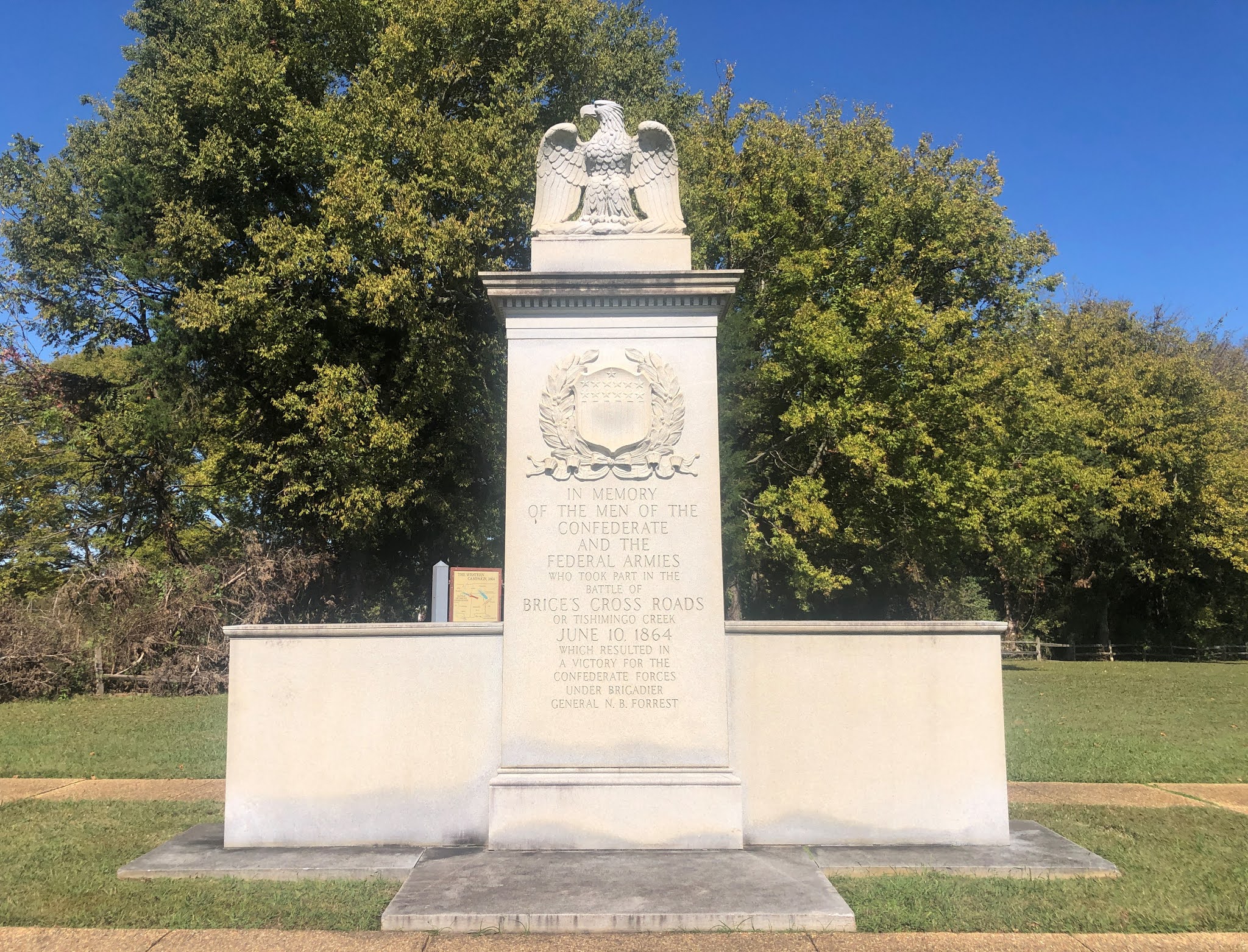
At Brice's Cross Roads, an impressive monument honors both armies.
(CLICK ON ALL IMAGES TO ENLARGE.)

Like this blog on Facebook | Follow me on Twitter

On June 10, 1864, cavalry commander Nathan Bedford Forrest, a military genius but a loathsome human being, whipped a numerically superior force at the Battle of Brice's Cross Roads. Confederates inflicted 2,610 casualties (vs. roughly 500 of their own), captured 200 supply wagons and more than a dozen artillery pieces, and added the lead bullet point to Forrest's impressive Civil War resume. The U.S. Army wasn't blessed with anyone with the high military IQ of the "Wizard of the Saddle" -- nearly its entire supply train was parked in a field within easy range of Confederate gunners. 

Brice's Cross Roads scouting report: Fine interpretive markers but empty boxes for pamphlets. (Remarkably did not see mentions of "hail of fire" or "storm of lead.") Good walking trails. Battlefield visitors: Two. Hello waves by locals: Many. Rural Mississipians score high on "Blogger Friendliness Meter." Wildlife spotted: One dead armadillo, clawed feet pointing to the heavens.  

Here's what else caught my eye:


A MARKER NEAR THE CROSSROADS with the obligatory "battle-scarred" and "blood-stained floors" references. 


A MASS GRAVE for Confederate soldiers in Old Bethany Cemetery, near the crossroads. 


THESE WEATHER-WORN (AND PERHAPS BATTLE-SCARRED) GRAVESTONES in the cemetery, where fighting swirled, causing havoc in the then 11-year-old burial ground.  


FOUR GREAT WORDS ... on this stone on a ledge of the memorial for Reverend Samuel Agnew, whose church was destroyed during the battle. 


THE VIEW FROM LOG CABIN RIDGE. From here, on an oppressively hot late-spring day, Forrest's artillery shelled Yankees as they crossed the narrow bridge across Tishomingo Creek, yards ahead of the car about to cross the modern span in the near distance. 


A STATE HISTORICAL MARKER spelling out the awful result for the U.S. Army.


A FIELD where most of the 250-wagon U.S. supply train was parked. When the Federals retreated  across the rain-swollen creek, the wagons clogged the bridge, causing massive panic among the troops. "It was like a scene from Dante's Inferno," a Federal veteran recalled decades later. 


SHIMMERING LIGHT on Tishomingo Creek, near site of the bridge Union soldiers crossed in a panic. In 1953, locals discovered human remains in the creekbed -- probably from a Federal soldier -- along with a pocket watch and rusted remains of an army canteen. He was re-buried in Bethany Cemetery.  


WOODS ALONG THE CREEK, where frightened Yankees fled during the Confederate onslaught.


A LIGHT-BLUE CLUNKER beyond the historical marker denoting the Confederates' second battle line.


WELL-EARNED RECOGNITION for the 55th and 59th U.S. Colored Troops, who helped buy time for their retreating comrades. 


A WARNING that makes sense.


AND A MESSAGE WE ALL CAN EMBRACE NOWADAYS ...

Life. Enjoy the journey.

Always.

-- Have something to add, correct? E-mail me at jbankstx@comcast.net


SOURCE:

-- Vicksburg (Miss.) Evening Post, Oct. 22, 1906.

Tuesday, September 08, 2020

In search of 'Old Brains': A Shiloh-to-Corinth (Miss.) round trip

Your dazed blogger at Shiloh following an awful bug attack.
Like this blog on Facebook | Follow me on Twitter

At the spring of 1862 Siege of Corinth (Miss.), his only field command of the war, Henry Halleck wasn't known for bold initiatives or lightning strikes. Plodding and overcautious, the 47-year-old Union commander took more than a month to conquer the strategic northern Mississippi town that eventually was abandoned by a vastly outnumbered enemy.

Mr. Bold, Henry Halleck, also known
as "Old Brains. (Library of Congress)
"Old Brains" had more than 100,000 troops! No wonder Abe Lincoln finally put this guy behind a desk for good.

"We have let them slip through our fingers," a Union soldier wrote about the Confederates' escape.

Bleh. Let's not be like "Old Brains."

On our Civil War journeys, let's emulate J.E.B. Stuart: Be bold, deliver a few great results, occasionally ride aimlessly through the countryside, and when appropriate, party like it's September 1862. (But when riding a bicycle, do not stick a plume feather in your helmet.)

Summoning my inner Stuart, I drove from Shiloh, Tenn., to Corinth, Miss., and back on Monday, following the serpentine road “Old Brains” himself may have taken. (And then I returned to Nashville. It's not called "Labor Day" for nothing.) It was stunning I made the roughly 40-mile Shiloh-to-Corinth round trip at all because a massive insect violently struck my helmet earlier, nearly knocking me from my road bike at Shiloh.

But I was uber-determined to visit the “Crossroads of the Confederacy," where Halleck set up shop after Pierre Gustave Toutant Beauregard abandoned it for good on May 30, 1862. Join me for the ride.


En route to Corinth, near the Shiloh battlefield, I found this. Damn, I'm a sucker for every historical marker -- especially ones nearly obscured by weeds ...


... And unsurprisingly, I also discovered a Civil War Trails marker near the site of Albert Sidney Johnston's last bivouac. (They. Are. Everywhere.) The next day, April 6, 1862, ASJ was mortally wounded at Shiloh. Shot behind the right knee, the 59-year-old commander bled to death in a ravine -- even though he had a tourniquet in his pocket. (Quick plug: Read my Civil War Times column about Shiloh battlefield markers -- including the one at Johnston's death site.) ...


Keeping an eye out for angry dogs, I slowly walked down the lane to the bivouac site. Hey, did Johnston's staff forget something? ...


Arrival!

Albert Sidney Johnston
Here's the story, according to info in the wayside exhibit: "This site was not marked by the Shiloh Battlefield Commission when Shiloh National Military Park was being developed. Only a small sign was placed on Highway 22 pointing to its location. Fortunately, there were local citizens who knew the location of this site.

"In 1862, James Wood (1831-1923) lived on the site of his Cotton Gin which was just north of the present restaurant at the intersection of Highway 22 and 142. Having learned that a battle was coming, he gathered his family and a few possessions, and late in the afternoon of April 5, 1862, headed southwest along the Corinth-Pittsburg Landing Road. This old road is still partially visible in the woods just north of this site.

"At this location, now marked, he found General Albert Sidney Johnston camped under a large Post Oak tree."

Over the years, Woods' relatives frequently pointed out the site to visitors. ...


... and sprinkled along Route 22, near the national military park, you'll find these fabulous, old cast-iron Shiloh historical tablets. The veterans themselves determined where most of these were placed. This one happens to be smack-dab in someone's front yard. ...


... and this one, which desperately needs TLC, denotes the position of a brigade of Johnston's Army of the Mississippi. Off to our main destination ...


"Corinth, Mississippi, to be Waterloo of the war," the New York Herald predicted in early April 1862," before the result of the Battle of Shiloh.

Well, Beauregard's boys held out much longer than expected -- thanks to Halleck's case of the slows  and some ingenious subterfuge that included Quaker guns in earthworks.

A few miles north of downtown Corinth, the National Park Service maintains a small site where you can view Confederate earthworks in the woods. Trust me. They are out there. Somewhere. ...


... and deep in those same woods, I also found this. Hmmm... not encouraging.


Finally, the Crossroads of the Confederacy! 

On my last visit to Corinth, I ignored this famous junction, visiting instead an indoor Civil War axe throwing venue on North Fillmore. ("Whether you want to channel your inner lumber jack or just try out a fun and competitive hobby," according to this tout, "axe throwing is a fun and unique sport that’s taking North America by storm.") Hmmm ... that wouldn't cut it for me this time.

Corinth was at the junction of two vital railroad lines, the Mobile & Ohio and Memphis & Charleston, hence the U.S. Army’s huge interest in occupation. Strange as it may seem, this humble town helped keep the Confederate Army fueled for fighting in the Western theater and beyond. "More important than Richmond," some big-wigs in the Federal command called Corinth.

There's a museum at the depot, but it was closed because of the holiday. Bummer.


... but there's still plenty to see near the railroad junction. Here's the site on Fillmore Street of long-gone Rose Cottage, where Johnston made his HQ and after Shiloh his body lay in state.


... and here's the beautiful, privately owned house down the street that Confederate general Leonidas Polk used as headquarters.


... and on Polk Street Street stands the old W.L. Duncan House, used by Beauregard as a headquarters and later by Union General William Rosecrans during the Battle of Corinth in early October 1862. (It's now a private dwelling.) Confederate Private Thomas Duncan wrote his war-time recollections here in his boyhood home, which once stood on Jackson Street. 


...and on Jackson Street, we find the outstanding Verandah-Curlee House, the exclamation point of my visit. OMG! OMG! Owned by the city and open for tours, it was used by Confederate generals John Bell Hood and Braxton Bragg as a headquarters and by "Old Brains" himself in 1862. Ah, I could feel my IQ rising as I soaked in this scene. The site of Ulysses Grant's HQ, now occupied by Corinth police headquarters, is directly across the street.

OK, we're done with ya, Corinth. Until next time ...


... and whoa! On the return trip to Shiloh, I was jolted by this unusual sight outside Larry DeBerry's Shiloh museum/shop.

OK, time's up. Thanks for riding along.

Let's keep history alive.

-- Have something to add, correct? E-mail me at jbankstx@comcast.net