Showing posts with label Lieutenant general Richard Stoddert Ewell. Show all posts

Saturday, December 21, 2019

Top 2019 posts: Skulls at Chickamauga to graves at Antietam

Confederates advance through the woods at Chickamauga. (Alfred Waud | Library of Congress)
Like this blog on Facebook | Follow me on Twitter | 2018 most popular

Three of my top-10 most popular blog posts in 2019 are about long-ago battlefield visits by a Philadelphia reporter named George Morgan.  Two are about one of the saddest places on Earth: Andersonville. In 2019, we surpassed 3.1 million page views all time on the blog and topped 7,100 followers on my Civil War Facebook page. Thanks for being part of our community.


1. Skulls, scarred trees: A reporter's 1882 visit to Chickamauga

"I saw a skull as yellow as the stones around ...," George Morgan wrote in a lengthy story about his visit to the battlefield in northwestern Georgia in the summer of 1882. "The round thing of bone, with unsightly sockets and the pitiful seeming of poor Yorick's skull, lay in a sort of hollow, with the green leaves of plantain for a pillow." Read more.


2. Bones, rusty gun barrels: 1881 tour of Seven Days battlefields

"He felt his spade grate against something hard and a moment later he cast up a skull. With more of a twitching of his fingers than Hamlet's first grave-digger felt, Swiffer stooped, scratched away the sand and disclosed a complete skeleton, which, from bits of blue and brass buttons about it, was pronounced to be that of a Federal soldier." Read more.


3. 'Find of a lifetime' at vanishing Stones River (Tenn.) battlefield

Sweating profusely in the early evening heat, Stan Hutson swung his Fisher F75 metal detector back and forth across the barren landscape. He had arrived at the construction site in Murfreesboro, Tenn. --- scene of opening action of the 1862 Battle of Stones River -- at 5 p.m., but in 90 minutes' hunting his finds included just two round balls, a 58-caliber Minie and camp lead. At about 6:30 p.m., Hutson heard a promising signal in his metal detector headphones. "I knew it was something good," he said." Read more.


4. 'Hidden' details in 1865 Bull Run monument dedication photos

The day was well documented photographically. At the Henry House Hill monument dedication, a photographer shot a series of images. At first glance, his two uncropped, glass-plate photographs in this post seem unremarkable. When we zoom in, however, fascinating details emerge. Arms folded almost defiantly, a soldier stands atop the mound of dirt next to a monument. Next to him is an imposing artillery shell. Read more.


5. Last days of Richard Ewell, who sparked Gettysburg furor

In the final days of his life, Richard Stoddert Ewell sensed something was terribly wrong. A "pall had fallen upon" his farmhouse in Spring Hill, Tenn., and "a feeling of depression ... was visible on every countenance." For nearly two weeks, his wife of nearly eight years took care of the former Confederate lieutenant general as he battled typhoid fever. But now she was nowhere to be found. Read more.


6. Now & Then: In their own words, POWs on Andersonville 'hell'

"... there never was such misery known since the world stood as there is on the streets in this den of Hell. There is no tounge or Pen that can discribe the situation of the sick Wounded & Rotten men in hear. God help the Prisoner for their life is a horable one especially those confined in hear" Read more.


7. In 10 images: A walk in Andersonville National Cemetery

At Andersonville National Cemetery, the rows of pearl-white tombstones are mind-numbing, almost impossible to process in just one visit. Nearly 13,000 Union soldiers who died at the prison camp a quarter-mile away rest in the red Georgia clay. Under a leaden sky, we examined the names on scores on the gravestones in the well-kept cemetery. The unknowns drew special attention. Read more.


8. In 15 images: A ballgame on hallowed ground at Shiloh

On a spring day in 1862, soldiers in opposing armies aimed to kill each other in farmer Joseph Duncan's field at Shiloh. On a Saturday in April, the 157th anniversary of the first day of the battle in southwestern Tennessee, opposing forces merely wanted to outscore each other on the same turf. At the invitation of the National Park Service, teams in the Tennessee Association of Vintage Base Ball played two games on the hallowed ground. Gods of sport smiled. Read more.


9.'Afraid of soldiers' ghosts?': A reporter's 1882 visit to Resaca

"In this way Guide Brown showed me the whole line of defense until we came to the thick timber on the western bank of the Conasauga, where the works end. Having seen this line and having visited several points occupied by the Union troops, we found ourselves almost at the end of our Resaca rope. A ruined house or so, with chimneys standing in the midst of rank weeds, particularly fine patches of Egyptian clover, to which now clung romantic interest, and a few forgotten graves in the woods ..." Read more.


10. Letter from Sharpsburg: 'Autumn sun kisses ... soldier-graves'

"In the orchard, back from the stream, I saw seventeen graves in a row, each with its little pine board, with names or initials, “Sept. 17,” etc, etc. How many tearful eyes, in far distant homes, have looked in imagination to those graves beneath the old apple trees! The rabbit skips around them, the quail pipes his melancholy notes from the fence side, and the Autumn sun kisses those soldier-graves, day after day, and yet no kindred sheds a tear upon them. Alas! the poor soldier." Read more.

-- Have something to add (or correct) in this post? Email me here.

Saturday, June 29, 2019

Last days of Richard Ewell, who sparked Gettysburg furor

A December 2009 image of the farmhouse in Spring Hill, Tenn., where Richard Ewell lived after 
the Civil War with his wife, Lizinka. The couple died here within days of each other in winter 1872.  (Hal Jespersen | Wikimedia Commons)

                                   Like this blog on Facebook | My YouTube videos

In the final days of his life, Confederate Lt. Gen. Richard Stoddert Ewell sensed something terribly wrong. A “pall had fallen upon” his farmhouse in Spring Hill, Tennessee, and “a feeling of depression … was visible on every countenance.” 

Known for enduring lasting criticism for failing to seize Cemetery Hill on the first day at Gettysburg, Ewell was now fighting a different battle. For nearly two weeks, his wife of almost eight years had cared for him as he battled pneumonia or a similar illness. But now she was nowhere to be found.

There was a reason for that. Days earlier, Lizinka Ewell had died of the same disease that was now killing “Old Bald Head.”

A historical marker in Spring Hill, Tenn.,
for the Ewell Farm, where Richard Ewell
died on Jan. 25, 1872. He was 54.
"His senses had become so keenly susceptible to everything transpiring around him," a Nashville newspaper reported, "that even the thoughts of his attendants seemed laid bare to his perception." Because of Ewell's precarious health, the family delayed revealing the news.

Lizinka, who, according to her obituary, "constantly cultivated ... and stored valuable information," was the general's first cousin and Russian-born daughter of the former U.S. minister to the Court of Tsar Alexander. She was 51.

And so a grieving Ewell ordered preparations for his own death. A will was made; so were arrangements for disposition of his property. After the war, the Virginia-reared Ewell had settled on a farm in Spring Hill, 35 miles south of Nashville, with Lizinka, a wealthy heiress. (Her first husband, James Percy Brown, a notorious philanderer, died in 1844.) The Ewells raised Jersey cattle and sheep, bred harness-racing horses and turned the farm into one of the area's most prosperous.

Headlines in the Nashville Tennessean on
Jan. 26, 1872, the day after
Richard Ewell's death.
"I understand from some of his neighbors that he has been remarkably successful in managing his freed men employees," a Spring Hill man wrote about Ewell in 1867. "He is very liberal and kind to them; at the same time he is firm in support of his rights, and this is the secret of his success. 

"By the way, " the man added, "he has the best crop of wheat that I have seen."

In spring 1870, the Ewell farm supplied the Maxwell House Hotel in Nashville with 100 pounds of butter a week. The general even became president of the Maury County Agricultural Society. "No man in Tennessee," an account noted, "ever exhibited more interest in improving the breeds of cattle and sheep."

Ewell wanted a simple funeral — no ostentation, no parade. Friends and comrades were to show their respect without fanfare. A plain headstone and footstone would do, he supposedly said, "like those over the graves of my father and my mother in Virginia."

"My rank while in the Confederate service might be inscribed upon one of the stones," the 54-year-old Confederate veteran reportedly told attendants at the farmhouse, "but I wish nothing in the inscription which will cast any reflection upon the Government of the United States." 

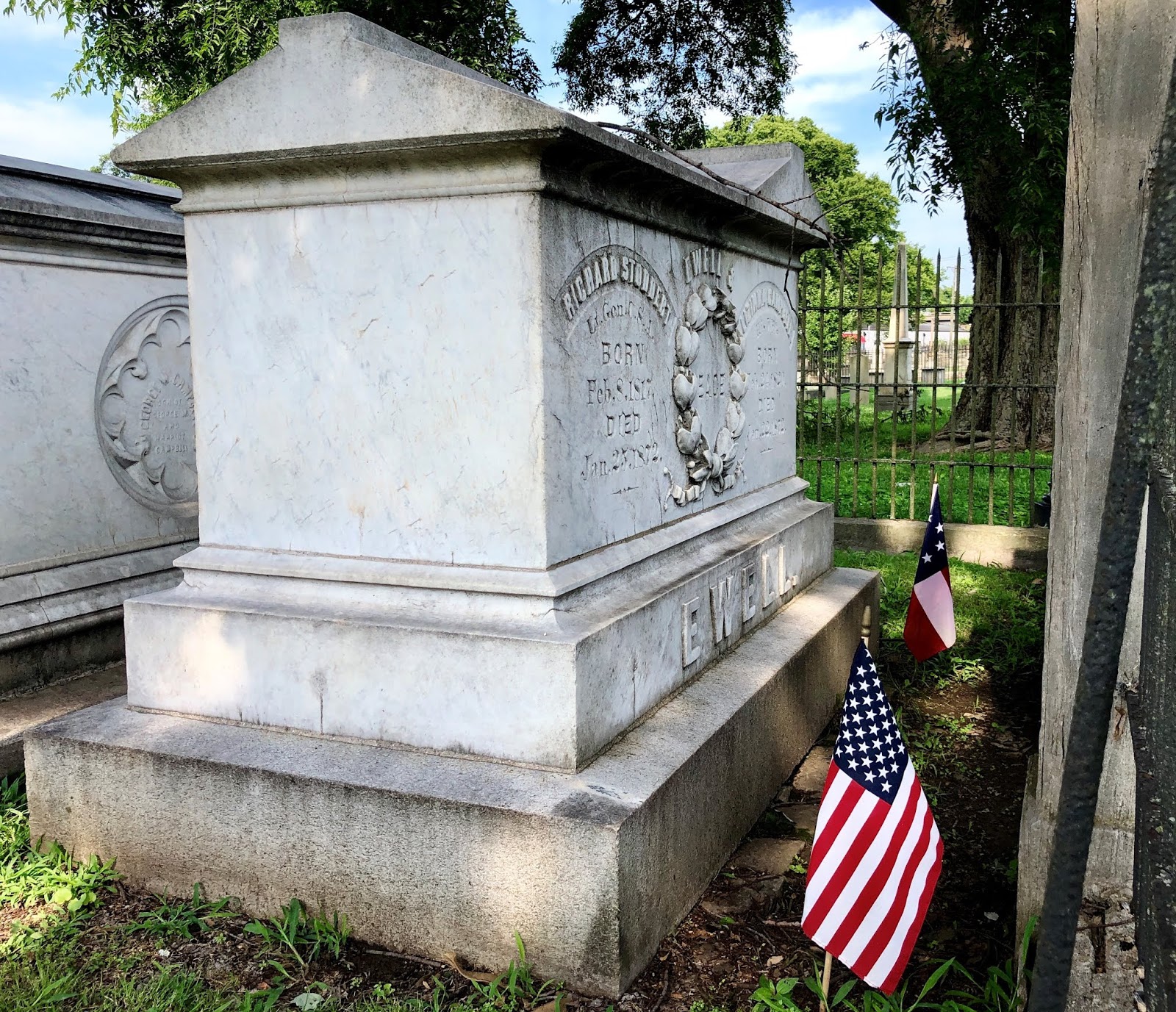
The Ewells, who died of illness in the winter 1872, were buried in Nashville City Cemetery,
near downtown. (CLICK ON ALL IMAGES TO ENLARGE.)

Barely able to speak, Ewell even mulled a possible cause of his death: exposure to cold because he wore a thin pair of Federal blue military pants purchased before the Civil War. "After all my fighting against the United States so long," said Ewell, who had lost his right leg at Brawner's Farm in August 1862, "it is strange that an old pair of infantry pantaloons should kill me at last."

Shortly before Ewell's death, attendants carried Lizinka's coffin to his room. Too weak to show much emotion, Ewell was raised from his pillow so he could view the shrouded remains. The general whispered he wanted to be buried next to his wife, whose picture dangled from his neck.

On the brink of death and unable to accept many visitors, Ewell signaled what he needed with gestures. The end came at 2:30 in the morning on Jan. 25, 1872.  "His countenance wore a look of placid resignation and was more life-like in expression after than a short time before his death," the Nashville Tennessean reported the next day.

Close-up of inscription on the grave marker for Richard Ewell
 and his wife Lizinka in Nashville City Cemetery.
Tennessee newspapers published extensive obituaries of Ewell, a U.S. officer during the war against Mexico, lauding him as  a "great Confederate commander." The Nashville Banner only briefly mentioned Gettysburg, noting — erroneously — that Ewell "took 5,000 prisoners and 5 or 6 guns" there.

At the funeral service at Christ Church in Nashville, where Ewell's wife had lived for decades, hundreds of mourners gathered. Tennessee Gov. John Brown attended as did former Confederate generals Lucius Polk, William Bate, William Hicks Jackson, Richard Lilley and Edmund Kirby Smith. An escorted hearse bore Ewell's remains a short distance to the city cemetery near old Fort Negley, key defense during the U.S. Army's' occupation. A stone carver inscribed Ewell's wartime affliation on an ornate marker: "Lt. Gen., C.S.A."

The controversy that had followed him since the first day at Gettysburg seemed absent from the somber procession. As he wished, Ewell was buried next to his wife.

"Before the fresh earth had time to settle on the grave of the wife of his bosom, the clods fell on his own coffin," a newspaper wrote in a lengthy tribute to the general. "The rays of the winter's sun that shimmered on the mound that marked her last resting-place cast their light in the newer-made grave, as if to welcome him once more to her side."

Richard Ewell wanted a plain headstone and footstone. He got a more elaborate marker.
Behind and iron fence, Richard and Lizinka Ewell rest for eternity.
 The couple died within days of each other.

-- Have something to add (or correct) in this post? E-mail me here.


SOURCES