"This," park guide Teri Surber said as we walked in the camp, "is the deadliest ground of the Civil War."
Showing posts with label Andersonville. Show all posts
Showing posts with label Andersonville. Show all posts
Saturday, March 26, 2022
A walk at Andersonville, the Civil War's deadliest ground

Wednesday, March 23, 2022
The spirits of Andersonville and '800 paces to hell'
 |
| Nancy Garrison poses near where U.S. prisoners disembarked at a railroad depot in 1864-65. (CLICK ON IMAGES TO ENLARGE.) |
“How many people live in Andersonville?” I ask.
“Well, about 230. Make that 229 since we just lost one.”
Business is slow Saturday, so we wave to strangers and swap stories while sitting on wooden chairs in front of her shop. My topics: Unimportant. Hers: Evolution, grandchildren, a local dude named Jimmy Carter, and the spirits of Andersonville.
“You oughta come back here in August when the ghosts come around,” she says, instantly grabbing my attention.
Nancy weaves a tale that includes shadows outside the window of her house and a spirit blowing in her face. Crazy talk, I’m thinking. But here, where nearly 13,000 Union soldiers died, who knows?
Up the road, in the center of the village, stands the controversial monument to Henry Wirz, the Andersonville camp commander. Wirz Street is beyond it.
Across from Nancy's shop, Yankee prisoners disembarked at the train depot for their slow walk to misery. On the road — Prison Way, they call it — her husband painted a path of footsteps of those unfortunates leading to the camp.
“Eight hundred paces to hell,” Nancy calls the route.
After our ghost talk, I bid Nancy goodbye. Seconds later, she flags me down and hands me a gift: two Andersonville magnets. A fitting end to a spirited afternoon.
 |
| The controversial Henry Wirz monument in Andersonville, Ga. |
 |
| Andersonville has a street named for the notorious Civil War camp commander. |
 |
| "800 paces to hell": Camp Sumter —Andersonville POW camp — is in the far distance. |
— Have something to add (or correct) in this post? E-mail me here.
Saturday, December 21, 2019
Top 2019 posts: Skulls at Chickamauga to graves at Antietam
 |
| Confederates advance through the woods at Chickamauga. (Alfred Waud | Library of Congress) |
1. Skulls, scarred trees: A reporter's 1882 visit to Chickamauga

2. Bones, rusty gun barrels: 1881 tour of Seven Days battlefields

3. 'Find of a lifetime' at vanishing Stones River (Tenn.) battlefield

4. 'Hidden' details in 1865 Bull Run monument dedication photos

5. Last days of Richard Ewell, who sparked Gettysburg furor

6. Now & Then: In their own words, POWs on Andersonville 'hell'

7. In 10 images: A walk in Andersonville National Cemetery

8. In 15 images: A ballgame on hallowed ground at Shiloh

9.'Afraid of soldiers' ghosts?': A reporter's 1882 visit to Resaca

10. Letter from Sharpsburg: 'Autumn sun kisses ... soldier-graves'

-- Have something to add (or correct) in this post? Email me here.
Friday, May 24, 2019
Captain Tim's souvenir from Andersonville 'prison pen'
 |
| 16th Connecticut Captain Timothy Robinson's Andersonville souvenir. (The piece of wood, not the banana.) Image courtesy Robinson descendant. |
 |
| Post-war image of Timothy Robinson. |
“Tim’s brother, Henry, was also in the 16th and both Robinsons were captured along with the rest of the regiment April 20, 1864, in Plymouth, N.C. Henry was wounded that day and being an enlisted man, he was sent to Andersonville. Tim, who was an officer and was treated better, ended up in Camp Sorgum, Columbia, S.C., from which he later escaped. But Henry died in Andersonville 4 months later and is buried there.
“Tim visited Andersonville at least once in his life and he was there for the October 1907 dedication ceremony honoring Connecticut war veterans who died at Andersonville.”
Known as "Captain Tim," Robinson served as president of the 16th Connecticut's regimental association for many years. Crippled by a cerebral hemorrhage, he died in Bristol, Conn., on Feb. 6, 1918. He was 83.
-- Have something to add (or correct) in this post? E-mail me here.
Friday, May 17, 2019
Andersonville's stream of death: 'Literally alive with ... filth'
 |
| A branch of Sweetwater Creek called the Stockade Branch flows through the 26.5-acre Andersonville site. Modern visitors also face challenges here. |
"In the center of the whole was a swamp, occupying about three or four acres of the narrowed limits, and a part of this marshy place had been used by the prisoners as a sink, and excrement covered the ground, the scent arising from which was suffocating. The ground allotted to our ninety was near the edge of this plague-spot and how we were to live through the warm summer weather in the midst of such fearful surroundings, was more than we cared to think of just then."An inadequate water supply and food rations, as well as unsanitary conditions, led to scurvy, diarrhea and dysentery, the chief causes of death at the camp.
 |
| A present-day view of the branch of Sweetwater Creek that flows through Andersonville POW camp. |
"The stream of water that passes through here runs from west to east, dividing the camp into two equal parts. The rebel camps are north and south of this stream, with breastworks and battery of artillery on each corner, south and east are the cook houses and west of all is the railroad depot, about three-fourths of a mile away. The rebels wash their clothing and themselves in this stream, horses and mules are driven into it to drink, buckets, tubs and kettles belonging to the rebel camp and cook houses are washed here, and all the filth of the camps thrown into it; and then it runs through to us. We have to use it, although it is literally alive with vermin and filth of all kinds."
-- Prison Diary of Michael Dougherty, Late Co. B, 13th., Pa., Cavalry.
 |
| "The volume [of water] was not sufficient to wash away the feces." |
A Story of Rebel Military Prisons, 1879
"On different battle fields I have witnessed many horrible sights, but none to compare with what I saw to-day-a man lying on the bank of the stream being eaten to death by maggots. They could be seen issuing from his eyes and mouth, and his body was eaten completely raw in several places. We could do nothing with him but let him alone to die a miserable death."
-- Private Samuel Elliot, Company A, 7th Pennsylvania Reserves
"The sinks over the lower portion of the stream were imperfect in their plan and structure, and excrements were in a large measure deposited so near the borders of the stream as not to be washed away, or else accumulated upon the low boggy ground. The volume was not sufficient to wash away the feces, and they accumulated in such quantities in the lower portion of the stream as to' form a mass of liquid excrement."
The Horrors of Andersonville Rebel Prison, 1891
"One side of the swamp was naturally used as a sink, the men usually going out some distance into the water. Under the summer sun this place early became corruption too vile for description, the men breeding disgusting life, so that the surface of the water moved as with a gentle breeze. The newcomers, on reaching this, would exclaim: "Is this hell?" yet they soon would become callous, and enter unmoved the horrible rottenness. The rebel authorities never removed any filth."
-- Diary of POW Prescott Tracy
 |
| Layout of Andersonville and immediate surroundings drawn by Union veteran Robert Knox Sneeden. He was imprisoned at Andersonville from February-December 1864. (Library of Congress) |
-- Have something to add (or correct) in this post? E-mail me here.
Monday, March 11, 2019
Andersonville anguish: 'Hand of God ... laid heavily upon me'
 |
| 16th Connecticut Private Emerson Nichols' gravestone at Andersonville (Ga.) National Cemetery. |
 |
| An angel figure hovers over bas-relief figures of Union prisoners on the huge plaque on the New York monument. (CLICK ON IMAGES TO ENLARGE) |
Throughout the vast, well-kept grounds, memorials honor Federal dead On a massive plaque on the New York monument, certainly a work of art, a glorious figure of an angel hovers over bas-relief figures of two prisoners — one looking hopeful, the other hopeless. "Death before dishonor," an inscription on the Iowa memorial reads. On the Illinois monument nearby, a statue of a doleful Union officer stands next to a slab of granite inscribed with that magnificent quote from Lincoln’s first inaugural address:
“The mystic chords of memory, stretching from every battle-field, and patriot grave, to every living heart and hearth-stone, all over this broad land, will yet swell the chorus of the Union, when again touched, as surely they will be, by the better angels of our nature.“The monument honoring the 258 Connecticut dead is beautiful in its simplicity: A 7-foot bronze figure of a young soldier, kepi in hand, stands atop a granite pedestal. ”Andersonville Boy,” as the statue is known, reminded me of one of the reasons for my trip: Emerson A. Nichols of Company G of the 16th Connecticut. A friend suggested I visit his grave.
 |
| "Andersonville Boy" is featured on the Connecticut monument at Andersonville (Ga.) National Cemetery. |
Emerson was only 16.
My God, 16 years old.
In a letter to the Pension Bureau in July 1865, Emerson’s mother Candace told of multiple family tragedies. Her husband William died in April 1861, shortly before the war began. In the previous six years, Candace said she had also lost another son and two grandchildren. A son-in-law, too. A Union soldier, he was shot and mortally wounded while on picket duty in Louisiana.
"I feel that the hand of God has been laid heavily upon me," the widow wrote.
Candace Nichols, whose pension request was approved at the standard $8 a month, died in 1904. Whether or not she ever visited her son's grave in Georgia is unknown.
MRS. NICHOLS' LETTER TO PENSION BUREAU: "I AM A POOR WIDOW"
 |
| National Archives via fold3.com. |
Mr. A. Johnson, Sir
May I ask one favor of you that is in regard to a pension that I made application for in April. It was sent back for want of evidence of my son's death, Emerson A. Nichols. He was a member of Co. G, 16 Regt C.V. He was taken prisoner in April 1864 at Plymouth [and] was taken to Andersonville with his Regt. except Co. K whitch was away at that time. Last Oct. I saw the chaplain of the 16th and he says the sutlers clerk gave a list of names of the dead and he was one of the number. He says he died the 8 of Aug. Edward Allen of this place helped carry Emerson out of the stockade and others took him away to the hospital. Edward says he don't think he lived to get there. He could not speak when he left him he was so near gone.

Mr. Albert Walker of Hartford Ct a member of the 16 Regt C.V. brought a list of the 16th that died there and the number of their graves. Emersons was among the number. He says their graves were all numbered where their name was known. I am a poor widow and this son I looked to for my support in part for I am not able to do but very little. I don't feel as though I should want help long. I feel that the hand of God has been laid heavily upon me for within the past 6 years I have buryed my husband, 2 sons, one son in law and 2 grand children. My son in law was buryed at Port Hudson. He was shot while on picket. I will not weary your patience any longer. I only ask your advise in regard to this pension.
Candace M. Nichols
-- Have something to add (or correct) in this post? E-mail me here.
Friday, February 08, 2019
Now & Then: In their own words, POWs on Andersonville 'hell'
 |
| The National Park Service has marked with stakes the wartime location of the infamous Andersonville deadline. (CLICK ON ALL IMAGES TO ENLARGE.) |
 |
| Andersonville diary of Samuel J. Gibson of the 103rd Pennsylvania. (Read it on Library of Congress site.) |
" ... there never was such misery known since the world stood as there is on the streets in this den of Hell. There is no tounge or Pen that can discribe the situation of the sick Wounded & Rotten men in hear," he wrote on Aug. 4, 1864, while a POW at Andersonville. "God help the Prisoner for their life is a horable one especially those confined in hear."
Coupled with photos (and a video) I shot at Andersonville, here are the words of Union survivors culled from diaries they kept there. The POW camp opened in February 1864 and closed in April 1865. (Click on link for diary source of each quote.)
 |
| A view of terrain POWs saw when they entered camp. |
-- Warren. L. Goss, 2nd Massachusetts Heavy Artillery
 |
| Water from Sweetwater Creek was used by POWs for bathing, washing clothes and sometimes for drinking. A source of disease, the water was often deadly to drink. Today, the NPS warns about other dangers. |
-- Samuel J. Gibson, 103rd Pennsylvania
 |
| A branch of Sweetwater Creek at the 26.5-acre prison site. |
-- Michael Dougherty, 13th Pennsylvania Cavalry
“In the center of the whole was a swamp, occupying about three or four acres of the narrowed limits, and a part of this marshy place had been used by the prisoners as a sink, and excrement covered the ground, the scent arising from which was suffocating. (Watch video above.) The ground allotted to our ninety was near the edge of this plague-spot, and how we were to live through the warm summer weather in the midst of such fearful surroundings, was more than we cared to think of just then.”
-- Robert Kellogg, 16th Connecticut
 |
| If a prisoner crossed the deadline -- a low rail fence used to keep POWs away from the stockade walls -- he could get shot by a guard. |
-- Albert Harry Shatzel, 1st Vermont Cavalry
 |
| Prisoners dug wells and escape tunnels in the camp. Is this the remains of one? |
-- George Hitchcock, 21st Massachusetts
 |
| Site of the Andersonville hospital, a short distance outside the prison stockade. |
-- John L. Ransom, 9th Michigan Cavalry
"This is the first Sabbath I ever spent in a Hospital. It has been very quiet but no attention has been paid to the sacredness of the day at all. I would so like to hear a good sermon from some good chaplin. I do so hope that there is an exchange of the sick on the way. If I could only get into one of our Hospitals I think there would be some chance of my geting well. Good speed the day when we may all arrive in our lines."
-- Charles Ross, 11th Vermont
(Click at upper right for full-screen experience.)
Have something to add (or correct) in this post? E-mail me here.
Sunday, November 19, 2017
'Remarkable': How 'Captain Tim' escaped from Rebels in 1864
 |
| Timothy Robinson's grave in West Cemetery in Bristol, Conn. |
 |
| 1894 image of 16th Connecticut Captain Timothy Robinson. (Connecticut State Library) CLICK ON IMAGES TO ENLARGE. |
On Halloween Night 1905, more than a dozen 16th Connecticut veterans gather at the home of Timothy and Sophia Robinson to celebrate the couple's golden wedding anniversary. It's a grand occasion, befitting for the old soldier and his wife, among the most respected citizens of Bristol, Connecticut.
 |
| This inscribed silver loving cup was given to the Robinsons by 16th Connecticut vets in 1905. (Courtesy Garth Gustafson) |
In a wonderful gesture, Cheney — one of the 16th Connecticut's more beloved figures — also presents Timothy and Sophia each a $20 gold coin. As long as they have the shiny gifts in the house, the 73-year-old veteran tells them, surely tongue in cheek, neither of them would be out of money. Robinson thanks Cheney and the group celebrates in "a sort of old time reunion."
The gray-haired 16th Connecticut veterans, each of whom had suffered significant hardships during the war, have plenty to discuss. Many of them had been captured at Plymouth, North Carolina in April 1864 and imprisoned at Andersonville, the deadliest of all Civil War POW camps. The captain's own brother, 19-year-old Henry, died there in the summer of 1864.
 |
| Henry Robinson, Timothy's 19-year-old brother, was captured at Plymouth, N.C., on April 20, 1864. He died at Andersonville. (Courtesy Garth Gustafson) |
But perhaps no man in the frame house on Wolcott Street that Tuesday night has a greater war story to tell than 71-year-old Timothy Robinson himself. His is a story of derring-do and survival behind enemy lines — a tale that included a goat, the kindness and bravery of escaped slaves, a failed attempt in a rowboat to reach a Union blockader off the coast of South Carolina and, ultimately, a successful escape from a Confederate POW camp.
By 1905, the two 16th Connecticut officers who shared in Robinson's amazing story had long since gone to their graves.
 |
| PRESENT DAY: Robinson's house on Wolcott Street, where the vets gathered Halloween Night 1905. |
 |
| Inscribed scabbard for sword presented in 1862 to Timothy Robinson. (Courtesy Garth Gustafson) |
When the Civil War erupted in April 1861, the E.N. Welch Clock Company employed Timothy Boardman Robinson as a machinist in the Forestville section of Bristol — an area that for decades had been hub of clockmaking in western Connecticut. In August 1862, he enlisted in the U.S Army, mustering into Company K of the 16th Connecticut as a 2nd lieutenant under the command of Captain Newton Manross, a Bristol native and an assistant professor at a college in Massachusetts. Before the two men marched off to war together, friends in Bristol presented each an inscribed sword and scabbard.
 |
| A war-time image of Timothy Robinson, who twice escaped from Rebel POW camps. |
Ushered to the war's backstage, the 16th Connecticut never saw major action again. And then came April 20, 1864 — another tragic day that defined the 16th Connecticut's Civil War experience. Nearly surrounded, the regiment and the rest of the Union garrison in Plymouth surrendered to Confederate forces under General Robert F. Hoke.
Forced by a Confederate to give up his prized sword and scabbard, Robinson — who had been promoted to captain in April 1863 — and other officers were inititally imprisoned at Camp Oglethorpe in Macon. Their captors sent enlisted men — including Timothy's brother, Henry, who suffered a wound at the Battle of Plymouth — to Andersonville.
When Sherman's march through Georgia in the fall of 1864 made prison camps in the state untenable, the Rebels transferred Robinson and other Federal POWs to a camp in Charleston, South Carolina. During a trip in early October from Charleston to Camp Sorghum in Columbia, South Carolina aboard a heavily guarded train, Robinson and 16th Connecticut captains Thomas Burke of Hartford and Charles Morse of New Hartford leaped from a boxcar and escaped. In the woods six days later, a hunter discovered the exhausted men, who had endured on a diet of parched corn. His dogs guarded the escapees while he sought help.
"Here again commenced a course of treatment which was made none the less revolting by the five months experience they had already endured," an account noted, "and thoughts of escape did not die out among them."
 |
| A late-19th century illustration of Camp Sorghum in Columbia, S.C. Robinson and two fellow 16th Connecticut POWs fled the camp in the fall of 1864. |
Returned to Camp Sorghum, Robinson, Burke and Alfred Dickerson, a 16th Connecticut captain from Hartford, didn't stay put for long. After collecting wood with many other officers near the lightly guarded camp, the three malnourished soldiers snuck into the woods, beyond reach of their captors. The date was Nov. 3, 1864. The escapees' audacious plan was to somehow follow the Congaree and Santee rivers downstream to the Atlantic Coast, a staggering distance of more than 175 miles. From there, well, who knew.
"The night was dreary and rainy and the roads were very muddy," an account of the escape noted, "but, emaciated as they were by over six months confinement and exhausted with the labors of the day and with anxiety, they resolutely pushed on all night and the next day, carefully avoiding the habitations of men, and finding their subsistence in the fields they passed through."
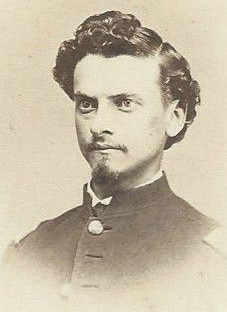 |
| A war-time image of 16th Connecticut Captain Alfred Dickerson, who died in 1868. He was only 27. |
Sleeping and cooking by day and traveling mostly at night to avoid detection by the enemy, the bedraggled band slowly made its way down the Congaree and Santee rivers. Camped near the river bank one day, the men heard loud voices.
"[W]e discovered a boat below us upon the river, being poled up the river by negroes," Dickerson recalled. "One of our party posted himself upon the bank of the river where he could hail the boat without discovering the presence of the rest of the party, and hailing down the negro in charge of the boat informed him that he was in want of provisions."
The man continued downriver, refusing to stop.
When a Union officer informed the Black man of his escape from a Rebel prison, he "immediately landed," Dickerson recalled, and stayed with the soldiers all day, "cooking rations and giving very valuable information." Directed by their newly-made Black friend, the soldiers stopped downriver that night at a farm, where they captured and killed a goat that supplied them with meat for the rest of their journey. Robinson and Burke each kept one of the animal's horns as a souvenir.
Several days later, the escapees met four other Black men, who gave the group "a large quantity of sweet potatoes, salt and meat." Upon parting with them, Dickerson remembered, "they bade us God speed and a safe journey. Elated and happy with our success, we kept steadily forward and soon after we landed to again consult the negroes who told us we were but five miles from a battery mounting two pieces, upon the right bank of the river, guarded by rebel soldiers.
"After receiving other information and provisions," Dickerson added, "we parted company with the last of our negro friends, and proceeded down the river, passed the battery in safety, and landing waited for darkness of the night to finish our journey to the coast. Thursday night, full of hope, we again took to our boats and meeting no interference, reached the coast safely."
More than a week after their journey had begun, the escapees finally had reached the mouth of the Santee River, which empties into the Atlantic. Miraculously undetected by the enemy, the group had passed two guarded bridges, two guarded ferrys and Battery Warren during their adventure.
But a huge challenge remained.
On the horizon, they spotted the spars of a ship, a Union blockader. Taking their best boat, three of the men rowed about eight miles from shore before a fast-approaching storm forced them to turn around.
Undaunted, Robinson, Dickerson and another fugitive made a second attempt at sunrise the next day, rowing their ramshackle vessel miles into the Atlantic. Stunned crew on the Union blockader Canandaigua spotted them. According to an account written years later:
"[W]hen all were safe upon the deck of the ship and under the protection of the Star-Spangled Banner," Dickerson wrote, "our hardships ended and pleasure took the sway. Our feeling of joy when safe in the protection of our Government can be conceived only by those who have been called upon to undergo similar privations and hardship, and who beheld the dawn of Freedom upon their toilsome efforts."
With their stunning great escape complete, Robinson, Burke and Dickerson received furloughs to return home.
Each of the Connecticut escapees survived the war, but neither Thomas Burke nor Alfred Dickerson lived to see the end of the century.
Only 27, Dickerson died on Oct. 24, 1868, of a "very malignant type of erysipelas." His death "brought deep sorrow not only into the circle of his own family friends," an account noted, "but also into a much larger circle of those who knew and loved him." He left behind a wife named Mary and a three-month old daughter named Alfreda.
Nearly 17 years later, on April 17, 1885, Burke — "a man of warm heart and unquestioned courage" — died of pneumonia at a hospital in Hartford, Conn. At the end of his life, he had suffered from financial hardship. "He had not the business turn that would give him success," the local newspaper reported in a front-page obituary, "and he saw hard days which he took quietly and without complaint."
A widower who had lost his wife in a boarding house in 1872, Burke received a funeral with military honors in Cedar Hill Cemetery in Hartford. He was only 50.
Active in veterans' organizations, Robinson — known as "Captain Tim" to family and friends — served as president of the 16th Connecticut's regimental association for many years. Crippled by a cerebral hemorrhage, he died in Bristol on Feb. 6, 1918. He was 83.
In an obituary, a Hartford newspaper called Robinson "the survivor of one of the remarkable escapes of the war."
POSTSCRIPT: After the war, Burke gave Robinson, an avid collector of Civil War relics, his horn from the goat the escapees had killed in November 1864. Along with his own horn, Captain Tim displayed the strange souvenirs in his den in Bristol.
According to a descendant, Robinson's personal papers, including many of his wartime letters and his map of the successful 1864 escape route, were destroyed in a house fire in Winsted, Conn., in the early 1970s.
After the Civil War, the scabbard from the sword presented to Robinson by friends in Bristol in 1862 was returned to him. But the sword, snatched by a Confederate at Plymouth, N.C., in the spring of 1864, remained missing,
By accident, a 16th Connecticut veteran learned Robinson's sword was in possession of O.P. Mills, a former Confederate infantry officer and successful cotton mill entrepreneur in Greenville, South Carolina. Robinson's friends attempted to acquire the sword from Mills, who refused to return it, keeping it as a war prize. When Mills died in 1915, the sword was still in his family's possession.
The current whereabouts of the prized weapon are unknown.
Have something to add (or correct) in this post? E-mail me here.
The man continued downriver, refusing to stop.
When a Union officer informed the Black man of his escape from a Rebel prison, he "immediately landed," Dickerson recalled, and stayed with the soldiers all day, "cooking rations and giving very valuable information." Directed by their newly-made Black friend, the soldiers stopped downriver that night at a farm, where they captured and killed a goat that supplied them with meat for the rest of their journey. Robinson and Burke each kept one of the animal's horns as a souvenir.
Several days later, the escapees met four other Black men, who gave the group "a large quantity of sweet potatoes, salt and meat." Upon parting with them, Dickerson remembered, "they bade us God speed and a safe journey. Elated and happy with our success, we kept steadily forward and soon after we landed to again consult the negroes who told us we were but five miles from a battery mounting two pieces, upon the right bank of the river, guarded by rebel soldiers.
 |
| 16th Connecticut Captain Thomas Burke, shown in a war-time image, died in 1887. He was 50. |
More than a week after their journey had begun, the escapees finally had reached the mouth of the Santee River, which empties into the Atlantic. Miraculously undetected by the enemy, the group had passed two guarded bridges, two guarded ferrys and Battery Warren during their adventure.
But a huge challenge remained.
On the horizon, they spotted the spars of a ship, a Union blockader. Taking their best boat, three of the men rowed about eight miles from shore before a fast-approaching storm forced them to turn around.
Undaunted, Robinson, Dickerson and another fugitive made a second attempt at sunrise the next day, rowing their ramshackle vessel miles into the Atlantic. Stunned crew on the Union blockader Canandaigua spotted them. According to an account written years later:
"To the officers and men it seemed as if the thunder of their own guns must have startled these fugitives from the caverns of the deep, so incredibly daring was the voyage upon the foaming sea with a boat so leaky and so frail, as hardly to withstand a zephyr, and orders were at once given to take it aboard and keep it as a token of what men would dare to do."Another boat was sent ashore to rescue the remaining five escapees. Crew handed the eight former POWs new uniforms. Their tattered rags ended up in the ocean.
"[W]hen all were safe upon the deck of the ship and under the protection of the Star-Spangled Banner," Dickerson wrote, "our hardships ended and pleasure took the sway. Our feeling of joy when safe in the protection of our Government can be conceived only by those who have been called upon to undergo similar privations and hardship, and who beheld the dawn of Freedom upon their toilsome efforts."
With their stunning great escape complete, Robinson, Burke and Dickerson received furloughs to return home.
 |
| Timothy Robinson, believed to be second from left in the front row, and other 16th Connecticut vets at the Bristol, Conn., grave of Newton Manross, the Company K captain who was killed at Antietam. The photograph was taken in June 1885. (Courtesy Bristol Public Library) |
Only 27, Dickerson died on Oct. 24, 1868, of a "very malignant type of erysipelas." His death "brought deep sorrow not only into the circle of his own family friends," an account noted, "but also into a much larger circle of those who knew and loved him." He left behind a wife named Mary and a three-month old daughter named Alfreda.
Nearly 17 years later, on April 17, 1885, Burke — "a man of warm heart and unquestioned courage" — died of pneumonia at a hospital in Hartford, Conn. At the end of his life, he had suffered from financial hardship. "He had not the business turn that would give him success," the local newspaper reported in a front-page obituary, "and he saw hard days which he took quietly and without complaint."
A widower who had lost his wife in a boarding house in 1872, Burke received a funeral with military honors in Cedar Hill Cemetery in Hartford. He was only 50.
Active in veterans' organizations, Robinson — known as "Captain Tim" to family and friends — served as president of the 16th Connecticut's regimental association for many years. Crippled by a cerebral hemorrhage, he died in Bristol on Feb. 6, 1918. He was 83.
In an obituary, a Hartford newspaper called Robinson "the survivor of one of the remarkable escapes of the war."
 |
| A war-time image of O.P. Mills. |
According to a descendant, Robinson's personal papers, including many of his wartime letters and his map of the successful 1864 escape route, were destroyed in a house fire in Winsted, Conn., in the early 1970s.
After the Civil War, the scabbard from the sword presented to Robinson by friends in Bristol in 1862 was returned to him. But the sword, snatched by a Confederate at Plymouth, N.C., in the spring of 1864, remained missing,
By accident, a 16th Connecticut veteran learned Robinson's sword was in possession of O.P. Mills, a former Confederate infantry officer and successful cotton mill entrepreneur in Greenville, South Carolina. Robinson's friends attempted to acquire the sword from Mills, who refused to return it, keeping it as a war prize. When Mills died in 1915, the sword was still in his family's possession.
The current whereabouts of the prized weapon are unknown.
 |
| Timothy Robinson's grave in West Cemetery in Bristol., Conn., is yards from the town's Civil War memorial and the Robinson family memorial (background and below). |
Have something to add (or correct) in this post? E-mail me here.
NOTES AND SOURCES
- Blakeslee, B.F, History of the Sixteenth Connecticut Volunteers, Hartford, Conn., The Case, Lockwood & Brainard Co., Printers, 1875
- Bristol (Conn.) Press, June 7, 1872
- Hartford Courant, April 18, 1885, Nov. 1, 1905, Feb. 8, 1918
- The Connecticut War Record, December 1864, Page 6. The letter writer signed his account of the escape "One of the Party." The man was undoubtedly Alfred Dickerson.
- The Soldiers' Record, Oct. 31, 1868
- Timothy Robinson descendant Garth Gustafson supplied information from his family's archives for this story.
Sunday, August 20, 2017
'Beyond belief': 1909 dedication of monument to Henry Wirz

 |
| Monument in memory of prison commandant Henry Wirz in Andersonville, Ga. |
On a wickedly hot late-spring day, nearly 3,000 people gathered in the center of sleepy Andersonville, Ga., for the dedication of the most controversial Civil War monument ever erected. In memory of Captain Henry Wirz — the long-dead commandant at the notorious POW camp located less than a mile away — the granite obelisk was the brainchild of the United Daughters of the Confederacy.
Reviled in the North and cast as a "martyr jailor" in the South, Wirz was in a white-hot spotlight on May 12, 1909, nearly 44 years after his hanging in Washington for "wanton cruelty" and murder of Union soldiers at Andersonville.
 |
| Andersonville prison commandant Henry Wirz was hanged in Washington on Nov. 10, 1865. |
Carefully crafted text — some would call it flat-out fraudulent — was also unveiled on panels on each of the four sides of the monument. "In memory of Captain Henry Wirz, C.S.A. born Zurich, Switzerland, 1822, sentenced to death and executed at Washington D.C. November 10, 1865," read one of them. "To rescue his name from the stigma attached to it by embittered prejudice this shaft is erected by the Georgia division, United Daughters of the Confederacy." Attendees couldn't miss Wirz's last name in large block letters near the base of the monument.
According to an Associated Press account of the dedication, "the national significance of these exercises was not lost" upon the huge crowd, which strained to hear some the speakers. Sprinkled among them were men and women from the North. Sadly, some of them had lost relatives at Andersonville — those soldiers may have been buried in the national cemetery just outside the boundary of the old camp.
"Those from beyond the Mason Dixon line looked on in silence," a newspaper reported. "while this tribute was paid to the memory of the prison commander."
At least two of the speakers told of a kindly Wirz — the same man who ran the prison camp where nearly 13,000 Union POWs died of disease, malnutrition, and other inhumane treatment. "Wirz was commanding many desperate men, some of them brave and good." Pleasant A. Stovall, editor of the Savannah (Ga.) Press, said under a canopy of U.S. and Confederate flags near the monument. "But others were recent arrivals from abroad, who barely spoke the English language, who were without understanding of the causes of the war, merely mercenaries. He was hampered at every step by the exigencies of his government."
 |
| The scene at Old Capitol Prison in Washington shortly before Henry Wirz was hanged on Nov. 10, 1865. This is one of at least five images of the hanging taken by Alexander Gardner. (Library of Congress Civil War collection) |
Another speaker said the Swiss-born Wirz once had traveled to Macon, Ga., seeking food and medicine for Union POWs at Andersonville. The Atlanta Constitution even quoted a former Andersonville guard, who was brought to tears when he heard of the unveiling of the monument to his former commanding officer. "He was unjustly executed," said R.L. Meadows, who added he would have given anything to have attended the dedication.
Unsurprisingly, Southern newspapers praised the effort to honor Wirz and burnish his reputation.
"No intelligent person at this day blames Captain Wirz [for Union deaths at Andersonville]," the Goldsboro (N.C.) Daily Argus wrote days after the dedication. "He was unjustly treated. He died a martyr to the cause he believed to be just, and the dedication of a monument to his memory, erected by the women of Georgia, is a well deserved tribute to his worth as a man and his courage and sincerity as a soldier."
Wrote the Richmond (Va.) Dispatch in an editorial:
"Oh, woman of the Southland," Pastor E.S. Holloway told the group, "build your monument to [Stonewall] Jackson because he had pure heart; to [Robert E.] Lee because when he laid down arms he said to his comrades, 'We have but one country now'; to Alexander Stevens, for a self-sacrificing life; but God forbid that a monument of shame be built to the butcher Wirz, and if it be built may the lightning of heaven strike it into a thousand pieces.'"
Less than a week before the dedication, Joseph Foraker, a former U.S. Senator from Ohio, expressed outrage over the monument. The Civil War veteran, who had enlisted in the Union Army when he was only 16, said he "would not shed any tears if some old indignant patriot were to place under that monument enough dynamite to blow it up."
In the days following the monument dedication, anger seemed to spike in Northern newspapers, which referred to Wirz as a "brute," "foreign prison-keeper," "murderer" and the "Andersonville monster."
"If Wirz deserves a monument," a New York World editorialist fumed, "there should be a public memorial to Mrs. [Mary] Surratt, whom the verdict of history has acquited of real criminal complicity in the assassination of Lincoln." An Ohio newspaper likened memorializing Wirz to "honoring Nero for burning Christians at the stake."
"It passes all understanding," another Ohio newspaper wrote, "how women could be the agents to pay for or erect a monument to such a man. There can be no palliation or defense for the damnable record of Andersonville. Its horrors make it a black page in history, a blot upon civilization."
An Ohio veteran said the monument was a "disgrace to the nation." Complained another vet: "The women of the south who got subscriptions for that monument are worse than the men of the south. No honest American can have a hand in such a proposition." Another old soldier said he wasn't in favor of blowing up the Wirz monument, preferring instead that it be destroyed by a lightning strike.
And in a scathing editorial, the Fort Wayne (Ind.) News said the monument was "beyond belief:"
"... Wirz was in nothing representative of the splendid and chivalric south. He was an alien, a hired mercenary, who as a soldier of fortune espoused the cause of the confederacy and, while braver and better men did battle for the principles they held sacred, he stayed behind and far from harm, and kept jail. And how he kept it! Hell's harshest story has not parallel to an iniquity that tongue and pen alike must fail to chronicle for very lack of power. Crowded in a malarious swamp, though healthful hills were close at hand, whole regiments of prisoners of an honorable war were held, the victims of starvation and disease ... "
Unsurprisingly, Southern newspapers praised the effort to honor Wirz and burnish his reputation.
 |
| Headlines in Atlanta Constitution on May 13, 1909. |
Wrote the Richmond (Va.) Dispatch in an editorial:
"Wirz is publicly honored in the South now less for what he did than for what was done to him. He was made the scapegoat for things not of his doing and this monument stands to embody the Southern sense of the great wrong put upon him by the United States. The angry and resentful mob loves a visible sacrifice. Wirz was a propitiatory offering to popular indignation over the sufferings of Northern soldiers in Southern prisons. But Wirz was in no way responsible for these sufferings. They were caused by grim conditions which the racked South was powerless to better, and which the deliberate policies of the North greatly aggravated."But Northerners, especially Union veterans, would have none of it. Well before the monument dedication, they were aghast about the effort to honor Wirz. At a gathering of former Union prisoners of war in Hartford, Conn., in April 1908, a pastor received applause after he excoriated the UDC's Wirz monument plan.
"Oh, woman of the Southland," Pastor E.S. Holloway told the group, "build your monument to [Stonewall] Jackson because he had pure heart; to [Robert E.] Lee because when he laid down arms he said to his comrades, 'We have but one country now'; to Alexander Stevens, for a self-sacrificing life; but God forbid that a monument of shame be built to the butcher Wirz, and if it be built may the lightning of heaven strike it into a thousand pieces.'"
 |
| Civil War veteran Joseph Foraker, a former U.S. Senator, was aghast by the monument to Henry Wirz. He would not shed a tear, he said, if an "old indignant patriot would blow it up." |
In the days following the monument dedication, anger seemed to spike in Northern newspapers, which referred to Wirz as a "brute," "foreign prison-keeper," "murderer" and the "Andersonville monster."
"If Wirz deserves a monument," a New York World editorialist fumed, "there should be a public memorial to Mrs. [Mary] Surratt, whom the verdict of history has acquited of real criminal complicity in the assassination of Lincoln." An Ohio newspaper likened memorializing Wirz to "honoring Nero for burning Christians at the stake."
"It passes all understanding," another Ohio newspaper wrote, "how women could be the agents to pay for or erect a monument to such a man. There can be no palliation or defense for the damnable record of Andersonville. Its horrors make it a black page in history, a blot upon civilization."
An Ohio veteran said the monument was a "disgrace to the nation." Complained another vet: "The women of the south who got subscriptions for that monument are worse than the men of the south. No honest American can have a hand in such a proposition." Another old soldier said he wasn't in favor of blowing up the Wirz monument, preferring instead that it be destroyed by a lightning strike.
And in a scathing editorial, the Fort Wayne (Ind.) News said the monument was "beyond belief:"
"... Wirz was in nothing representative of the splendid and chivalric south. He was an alien, a hired mercenary, who as a soldier of fortune espoused the cause of the confederacy and, while braver and better men did battle for the principles they held sacred, he stayed behind and far from harm, and kept jail. And how he kept it! Hell's harshest story has not parallel to an iniquity that tongue and pen alike must fail to chronicle for very lack of power. Crowded in a malarious swamp, though healthful hills were close at hand, whole regiments of prisoners of an honorable war were held, the victims of starvation and disease ... "
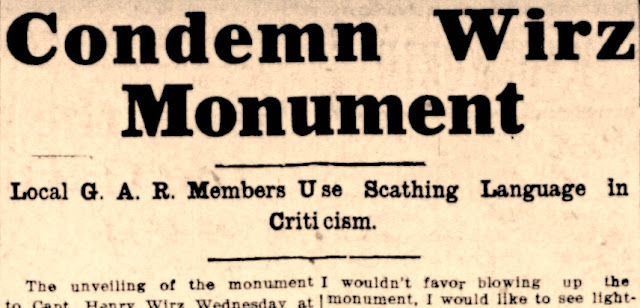 |
| Union veterans condemned the Wirz monument in Andersonville, Ga. |
In a speech to a high school graduating class in Akron, Ohio, days after the monument dedication, a Union veteran referred to Wirz as an "arch fiend," and "the tormentor and butcher of Andersonville prison, whose delight it was to starve our brave comrades."
In condemning the monument, an Ohio Grand Army of the Republic post urged national authorities to "take cognizance of the monument in order that such steps as may be necessary, lawful and proper be taken to wipe out this stain on American justice, to the end that our national government may not hereafter be held guilty of deliberate judicial murder in the case of Captain Wirz."
Perhaps channeling Foraker, another Union veteran got so fired up at a G.A.R. gathering in West Virginia that he offered a reward to anyone who would blow up the Wirz monument with dynamite. "His statements created a big sensation," The Washington Post reported, "and in a moment the convention was in an uproar, and several of the old soldiers offered their services to accomplish the destruction of the monument."
"No action, further than the sensational discussion," the newspaper reported, "was taken by the veterans."
Post-script: Andersonville, Ga., population about 230, is still the same sleepy town it was in 1909. The Wirz monument still stands on Church Street.
(To read more about Andersonville, go here.)
SOURCES
In condemning the monument, an Ohio Grand Army of the Republic post urged national authorities to "take cognizance of the monument in order that such steps as may be necessary, lawful and proper be taken to wipe out this stain on American justice, to the end that our national government may not hereafter be held guilty of deliberate judicial murder in the case of Captain Wirz."
Perhaps channeling Foraker, another Union veteran got so fired up at a G.A.R. gathering in West Virginia that he offered a reward to anyone who would blow up the Wirz monument with dynamite. "His statements created a big sensation," The Washington Post reported, "and in a moment the convention was in an uproar, and several of the old soldiers offered their services to accomplish the destruction of the monument."
"No action, further than the sensational discussion," the newspaper reported, "was taken by the veterans."
Post-script: Andersonville, Ga., population about 230, is still the same sleepy town it was in 1909. The Wirz monument still stands on Church Street.
(To read more about Andersonville, go here.)
Have something to add (or correct) in this post? E-mail me here.
SOURCES
- Clarion (Miss.) Ledger, May 13, 1909
- Daily Press, Newport News, Va., May 13, 1909
- Fort Wayne (Ind.) News, May 13, 1909
- Goldsboro (N.C.) Daily Argus, May 19, 1909
- Hartford (Conn.) Courant, April 18, 1908
- Mansfield (Ohio) Journal, May 15, 1909
- New York World, May 13, 1909
- The Akron (Ohio) Beacon Journal, May 6, 1909, May 13, 1909, May 29, 1909
- The Atlanta Constitution, May 13, 1909
- The Daily Republican, Monongahela, Pa., May 20, 1909
- The Salem (Ohio) News, May 13, 1909
- Washington Post, May 13 and 14, 1909
Subscribe to:
Posts (Atom)