In Episode 40 of "The Antietam And Beyond Podcast," Brian James Egen of The Henry Ford Museum in Dearborn and author/historian Jack Dempsey join co-hosts John Banks and Tom McMillan to talk all things Michigan at Antietam. That includes stories about U.S. Army generals Alpheus S. Williams and Israel B. Richardson, who suffered a mortal wound in the attack on Bloody Lane on Sept. 17, 1862. Plus, the Michiganders — co-authors of Michigan At Antietam — dish on their effort to place a Michigan monument on the battlefield.
Showing posts with label John Banks' Civil War blog. Civil War history. Show all posts
Showing posts with label John Banks' Civil War blog. Civil War history. Show all posts
Thursday, May 29, 2025

Tuesday, November 01, 2022
A spirited soldier image and the nighttime yips
 |
| A Yankee soldier with a little extra spirit? |
“Hello, John. Best of luck with the tintype,” Danny from Virginia wrote. “I’ve had it in my possession for probably 30 years with no issues. Not sure where I acquired it. It was never a problem until we moved into our 90-year-old home and my wife placed it with other military items.”
The “problem” started when Danny’s dog continually yipped in the middle of the night at the military display in the corner of their bedroom. The display included this photo.
The dog’s yipping made Danny’s wife nervous. So he placed the image in a shed. Near the shed one day, his wife felt something grab her, but no one was there.
“She got a little freaky about it,” Danny told me in a phone call.
Then she felt something grab her inside their house. Again, no one was there.
“You can stay here, but you cannot touch me, touch my dog or hurt us,” Danny’s frightened wife told the “spirit.”
By this time, Danny was flummoxed, too. So he put the image in his car. Then he placed it in his office. His wife has had no “spirited” encounters since.
Now I’m the caretaker of the image. This weekend, it goes to Daughter 1B for a test with her dog. Mrs. B is flummoxed now—with me.
Wish me luck. 😁
 |
| He spent the night with his pards. |
— Have something to add (or correct) in this post? E-mail me here.
Tuesday, March 21, 2017
Beyond Fredericksburg's Stone Wall: Life on hallowed ground
 |
| A rebuilt section of the Stone Wall in Fredericksburg, Va. |
On a chilly Fredericksburg morning, the sun struggles through a leaden sky as life stirs near the infamous Stone Wall and Marye’s Heights.
 |
| On Mercer Street, a flag of shamrocks hangs in celebration of St. Patrick's Day. |
On Mercer Street, a flag of shamrocks hangs in belated celebration of St. Patrick’s Day. A train whistle toots in the distance, an ambulance siren rises and fades, and the low rumble of traffic gathers. A man wrestles an unruly English Springer Spaniel on a short leash while balancing a cup of coffee in his free hand.
A child’s sled waits on a porch. A toppled basketball hoop lies on its side in a driveway, forgotten. A wind chime rings softly, barely announcing itself.
Along Littlepage Street, a large Irish flag sways from a porch, and, two days after the holiday, a triangular banner of three shamrocks still clings lazily to a house nearby. In the tiny front yard of another home, a small multicolored sign declares: “Welcome. Life is Simply Amazing.”
At the corner of Littlepage and Charlotte, the muffled sound of a choir seeps through the stained-glass windows of Fairview Baptist Church, where the marquee out front proclaims: “The Key to Heaven Was Hung on a Nail.”
The brick sanctuary was built in 1925, long after the Battle of Fredericksburg rocked this quiet town — long after the plain before Marye’s Heights became a killing field. Now, in the lingering chill of an ordinary morning, the living world goes about its rhythm atop the memory of what once happened here.
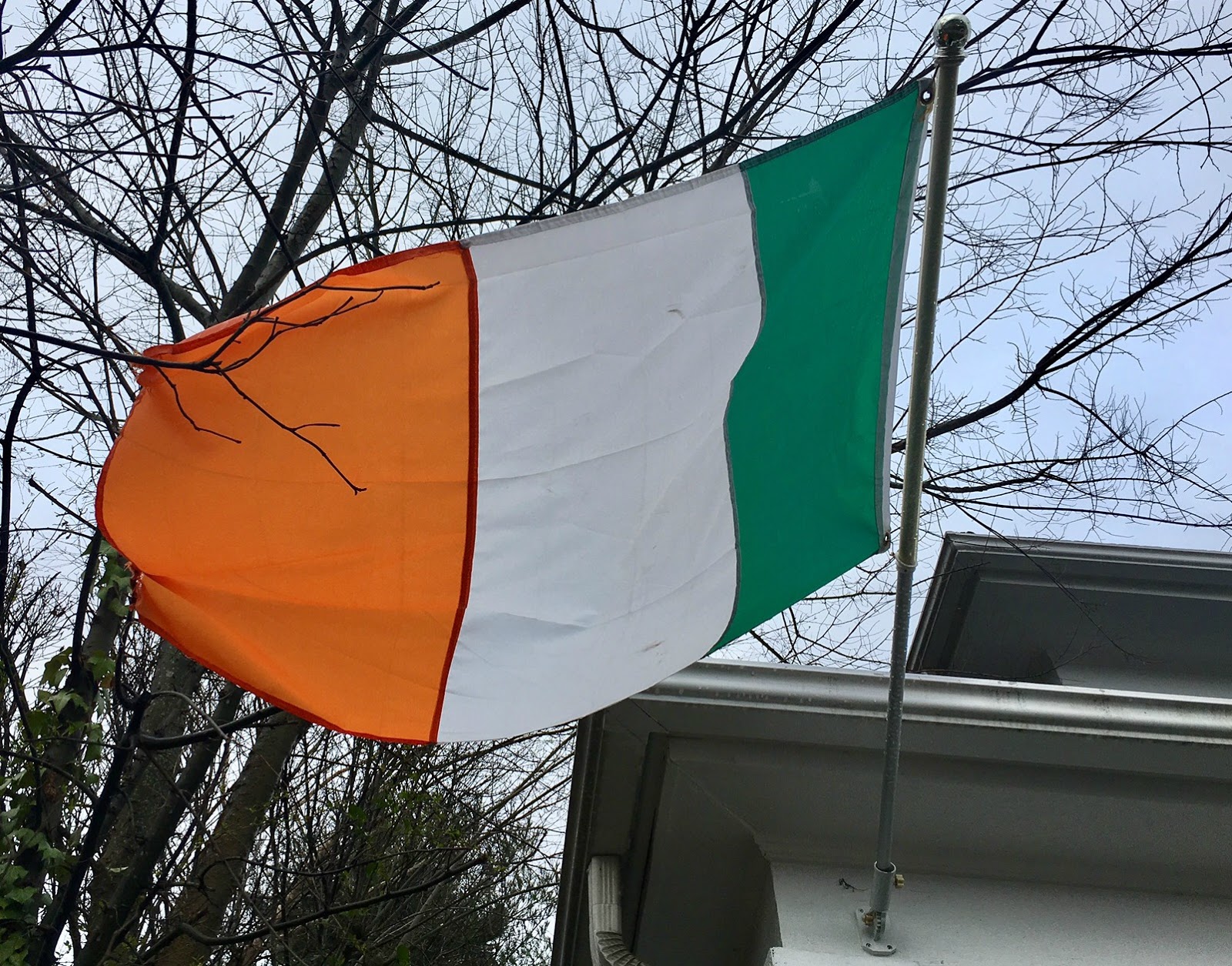 |
| Days after St. Patrick's Day, the national flag of Ireland sways from a house on Littlepage Street. |
 |
| Yards from the war-time Innis House near the Sunken Road, the present meets the past. |
 |
| "I found the brick house packed with men," a Union officer recalled about the Stratton house. (CLICK ON ALL IMAGES TO ENLARGE.) |
In 1862, a walker along the Sunken Road would have seen mostly open plain stretching beyond the old Telegraph Road — an expanse that offered little cover or mercy for Union soldiers. Just yards from the Sunken Road, Martha Stephens — a pipe-smoking woman with a notorious reputation — lived in a tiny clapboard house with her common-law husband. On what is now the corner of Littlepage and Mercer streets, 200 yards from Marye’s Heights, Allen Stratton lived in a two-story brick house, with his wheelwright shop nearby. A few scattered homes and outbuildings broke the emptiness.
On Dec. 13, 1862, wave after wave of U.S. Army soldiers surged across that open plain, leaving the pillaged town of Fredericksburg behind, driven into the teeth of a deadly, well-entrenched enemy on Marye’s Heights. The slaughter was inevitable. Eight thousand fell. Not a single Union soldier reached the Stone Wall. Among the dead and wounded were men of Thomas Meagher’s famed Irish Brigade, who charged forward with the battle cry “Faugh-a-Ballagh!”— “Clear the Way” — their courage swallowed by the merciless fire that awaited them.
 |
| A sign in a front yard on Mercer Street. |
When night fell and the temperature plummeted, it was clear the Confederates had secured a victory.
"[N]early 1,500 dead soldiers lay upon an area of two acres in front of our lines," James R. Hagood of the 1st North Carolina recalled. "Three or four times as many wounded howled in the darkness, a dismal concert for assistance which could not be rendered, or perished in the cold from neglect. The pickets of the enemy's army which were posted that night on the skirts of the town erected breastworks of the dead bodies and thus secured themselves from the bullets of the Confederate Sharpshooters."
"It was a night of dreadful suffering," the Union officer recalled. "Many died of wounds and exposure, and as fast as men died, they stiffened in the wintry air."
During a temporary truce, Union soldiers buried their dead on the plain. Soldiers interred more than 600 in one trench, 130 in another. After the war, many of those soldiers were re-buried in a terraced national cemetery on Marye's Heights, the very ground they aimed to conquer years earlier.
Beginning in the 1870s, development slowly transformed The Bloody Plain, and by the time the Fredericksburg battlefield became a national park in 1927, houses had begun to dot the area east of Marye's Heights. Today, it is a vibrant community — but one with a dark and violent past.
Here are snapshots of life on the killing field:
 |
| Josh Cameli is house manager at the Sunken Well Tavern, 175 yards from the Sunken Road. |
Dressed in his Sunday best, 81-year-old Wright Campbell slowly makes his way to Fairview Baptist Church. A lifelong Virginia resident, he is keenly aware of Civil War history in general and the Battle of Fredericksburg in particular.
Small talk quickly turns to the inevitable question: Is it eerie to live in the epicenter of death in this war-torn area?
“What acre does not have blood on it in Virginia?” he asks.
No state suffered more than Virginia during the Civil War. Campbell notes that residents of this neighborhood don’t dwell much on its deadly past.
Two women walking to the Baptist church nod in agreement. “It’s just a nice place to live,” says one, whose ex-husband’s ancestors fought for the Confederacy.
At the Sunken Well Tavern, on the corner of Littlepage and Hanover streets, 45-year-old manager Josh Cameli hustles from table to table. Business is brisk for breakfast. “Fly” by Sugar Ray hums in the background, modern art decorates the walls, and a stuffed lynx and fox face each other on a window shelf.
Well aware of the town’s bloody history, Cameli lives in a 19th-century building in Fredericksburg that used to be a carriage house, he says—making it unlikely that anything significant occurred there.
“Every year when reenactors come through,” he says, nodding toward the Sunken Road just 200 yards away, “I tell them there’s trouble up ahead.”
Occasionally, a descendant of a soldier who fought at Fredericksburg stops by for a meal and a conversation.
“One older gentleman came in and told me that when he walks here, he walks on the bones of his ancestor,” Cameli recalls. He appreciates the town’s history but doesn’t dwell on the battlefield.
 |
| Jacqueline Damm, shown near the Richard Kirkland monument near the Sunken Road, had a ghostly encounter while she lived on Williams Street in Fredericksburg. |
 |
| The view up Mercer Street. The Sunken Road is in the far distance. No Union soldier reached the Stone Wall during the Battle of Fredericksburg on Dec. 13, 1862. (CLICK ON ALL IMAGES TO ENLARGE.) |
Crossing the street near the Stratton house, where scores of dead and wounded lay in December 1862, a 60-year-old man makes his way home during a morning stroll.
"I used to go up to the national cemetery on Marye's Heights when I was a kid and watch the sun rise," says the lifelong Fredericksburg resident. "Nobody bothered you but the ghosts." The notion of the neighborhood as a killing ground, he says, seems odd now. To him, it's just home.
A young woman walking her dog nearby concurs. She has lived in the neighborhood four years, just blocks from the Stone Wall. Although she found a Civil War-era bottle and a Union button while digging in her back yard, the former journalist rarely thinks about the neighborhood's deadly past.
Thirty-year-old Jacqueline Damm, who has lived near the Stone Wall for several years, appreciates the town's history, especially during walks with her dog and frequent runs through the neighborhood. But she did have a disturbing encounter while she lived in a building on William Street in Fredericksburg. Several times, she insists, an apparition of a woman appeared. "The air felt different," she says, "it felt electric."
Sixty-seven-year-old James Freeman, a longtime neighborhood resident, knows the feeling. While emptying his truck in the driveway of the Stratton House, he recounts stories from his childhood. When he was 5, he swears he saw under his bed the ghost of Richard Kirkland, the South Carolina soldier who famously aided wounded Yankees near the Stone Wall. The look in his eyes suggests he isn't kidding.
Google Earth view of neighborhood east of Marye's Heights and the Sunken Road.
Several houses down Mercer Street from the Stratton House, 45-year-old James Tompkins sits on his small front porch, taking a drag on a cig. He's peppered with questions about the city's past.
"That's about as far as they got," Tompkins says of the U.S., pointing to the house next door. His small house is within sight of the Stone Wall, about 150 yards away.
Tompkins has a close association with the Civil War: An ancestor served in the Richmond Light Infantry Blues while another may have been the only commissioned female officer in the Confederate army, he says. "Captain" Sally Louisa Tompkins, promoted by Jefferson Davis for her service as a nurse, was a wealthy philanthropist who lived in Richmond.
A longtime relic hunter, Tompkins has even hunted in his "postage-stamp-sized" back yard, but has never found anything besides bits of glass. "I'd love to look under this foundation" for Civil War relics, he says of the post-war house he has lived in for four years. "Bet there is something there."
Over on the western side of Marye's Heights, Tompkins says he found 10- and 20-pound Parrott shells "just hanging in the roots of trees," possibly overshots from Union artillery on the other side of the Rapphannock River.
"Years ago, old-timers would find relics by just eyeballing them in the woods," he says. "But those guys wouldn't look for relics on the battlefields. That was hallowed ground. People kind of lost their sense of history now."
Not one to believe in ghosts, Tompkins has lived in the area his entire life. He appreciates the neighborhood and its history — and thinks many of his neighbors do, too.
"It's real quiet here," he says. "There not a lot of drunk college kids around. It's a good place to live.
"And it sure is more quiet than it was in December 1862."
SOURCES
"I used to go up to the national cemetery on Marye's Heights when I was a kid and watch the sun rise," says the lifelong Fredericksburg resident. "Nobody bothered you but the ghosts." The notion of the neighborhood as a killing ground, he says, seems odd now. To him, it's just home.
A young woman walking her dog nearby concurs. She has lived in the neighborhood four years, just blocks from the Stone Wall. Although she found a Civil War-era bottle and a Union button while digging in her back yard, the former journalist rarely thinks about the neighborhood's deadly past.
Thirty-year-old Jacqueline Damm, who has lived near the Stone Wall for several years, appreciates the town's history, especially during walks with her dog and frequent runs through the neighborhood. But she did have a disturbing encounter while she lived in a building on William Street in Fredericksburg. Several times, she insists, an apparition of a woman appeared. "The air felt different," she says, "it felt electric."
Sixty-seven-year-old James Freeman, a longtime neighborhood resident, knows the feeling. While emptying his truck in the driveway of the Stratton House, he recounts stories from his childhood. When he was 5, he swears he saw under his bed the ghost of Richard Kirkland, the South Carolina soldier who famously aided wounded Yankees near the Stone Wall. The look in his eyes suggests he isn't kidding.
Several houses down Mercer Street from the Stratton House, 45-year-old James Tompkins sits on his small front porch, taking a drag on a cig. He's peppered with questions about the city's past.
"That's about as far as they got," Tompkins says of the U.S., pointing to the house next door. His small house is within sight of the Stone Wall, about 150 yards away.
Tompkins has a close association with the Civil War: An ancestor served in the Richmond Light Infantry Blues while another may have been the only commissioned female officer in the Confederate army, he says. "Captain" Sally Louisa Tompkins, promoted by Jefferson Davis for her service as a nurse, was a wealthy philanthropist who lived in Richmond.
A longtime relic hunter, Tompkins has even hunted in his "postage-stamp-sized" back yard, but has never found anything besides bits of glass. "I'd love to look under this foundation" for Civil War relics, he says of the post-war house he has lived in for four years. "Bet there is something there."
Over on the western side of Marye's Heights, Tompkins says he found 10- and 20-pound Parrott shells "just hanging in the roots of trees," possibly overshots from Union artillery on the other side of the Rapphannock River.
"Years ago, old-timers would find relics by just eyeballing them in the woods," he says. "But those guys wouldn't look for relics on the battlefields. That was hallowed ground. People kind of lost their sense of history now."
Not one to believe in ghosts, Tompkins has lived in the area his entire life. He appreciates the neighborhood and its history — and thinks many of his neighbors do, too.
"It's real quiet here," he says. "There not a lot of drunk college kids around. It's a good place to live.
"And it sure is more quiet than it was in December 1862."
Have something to add (or correct) in this post? E-mail me here.
SOURCES
- The Century Illustrated Monthly Magazine, Vol. 32, Page 635, 1886
- Hagood, James R., Memoirs of the First South Carolina Regiment of Volunteer Infantry in the Confederate War for Independence from April 12, 1861 to April 10, 1865, manuscript, University of South Carolina Libraries Digital Collection
- Hat Tip: Mysteries and Conundrums: Exploring the Civil War-era landscape in the Fredericksburg and Spotsylvania region.
- Hat Tip: Clint Schemmer, Fredericksburg Free-Lance Star.
Saturday, July 13, 2013
John Brown's birthplace: Interactive panoramas, photos
 |
| John Brown, about 1856. |
"Move along, there's not much to see here," the little voice in my head said as I shot the interactive panoramas above this afternoon at the site of abolitionist leader John Brown's birthplace in Torrington, Conn. Well, Little Voice was correct.
Aside from a pile of rocks forming the outline of the house Brown was born in in 1800 and the remains of the foundation of an outbuilding, there definitely isn't much to see of the former home of one of the most polarizing figures in American history. Nearly two decades ago, there apparently was some sentiment to restore Brown's birthplace, which was destroyed by a chimney fire in 1918, but the effort never got off the ground.
"There's nothing to admire in John Brown,'' former John Brown Association president John Brooks, 96, told the Hartford Courant in 1995. "I wouldn't honor him. That guy got us into the Civil War. John Brown was born here, but that isn't anything we should be proud of. That scoundrel took the law into his own hands.'' The ruins of the house lay in a clearing off John Brown Road on the outskirts of Torrington.
 |
| John Brown was baptized in this church in Torrington, Conn. |
Tough talk from the fiery leader whose proclamation that he was "quite certain that the crimes of this guilty land can never be purged away but with blood" proved to be prophetic. While his 1859 effort may have been noble, Brown did indeed have a lot of scoundrel in him -- and a lot of blood on his hands. He and his band of merry men murdered five men with pro-slavery ties in Kansas in 1856.
Brown's birthplace is just one of many remnants of the abolitionist's life within a short distance of our house here in the miniature state of Connecticut. In Collinsville, Brown arranged to by pikes with which he hoped to incite the slave rebellion in Harpers Ferry. One of the pikes is on display at the Unionville (Conn.) Museum, a little more than a mile from our house. The Torrington church in which Brown was baptized still exists, although it was moved to its present location well after that blessed event.
 |
| A marker at the site includes an illustration of Brown's birthplace before it burned to the ground. CLICK ON IMAGE TO ENLARGE. |
 |
| This granite marker was placed at Brown's birthplace in 1932. CLICK ON IMAGE TO ENLARGE. |
 |
| Ruins of an outbuilding at Brown's birthplace in Torrington, Conn. CLICK ON IMAGE TO ENLARGE. |
 |
| A flower blooms near the ruins of Brown's birthplace. CLICK ON IMAGE TO ENLARGE. |
Monday, December 17, 2012
Antietam: Old national cemetery postcards
 |
| Entrance to Antietam National Cemetery. (CLICK ON IMAGE TO ENLARGE.) |
 |
| 1907 postcard of Antietam National Cemetery, with the soldier's monument, also known as "Old Simon," prominent in background. |
Saturday, October 13, 2012
Antietam: Connecticut veteran's battlefield souvenirs
 |
| Alonzo Case (bottom left) of Simsbury, Conn., was one of three Case brothers who served in the Union army. His younger brother, Oliver, was killed at Antietam. (Connecticut State Library collection) |
For the 54-year-old Case, who was a first sergeant in Company E of the 16th Connecticut, that battle anniversary reunion on Sept. 17, 1889, must have included a huge swing of emotions.
 |
| A long story touting the 16th Connecticut reunion at Antietam appeared in the Hartford Courant on Sept. 17, 1889, the 27th anniversary of the battle. |
"He was no doubt killed instantly, the bullet having passed through his head just about the top of his ears," Alonzo wrote after the war about his youngest brother, a private in the 8th Connecticut. (1) The Case brothers were from Simsbury, a farming community near the Farmington River, about 15 miles northwest of Hartford.
It was not unusual, of course, for Civil War veterans to grab something tangible from a battlefield to take back home. At the 1894 dedication of monuments for four Connecticut regiments that fought at Antietam, old solders scoured the field early that October morning.
"Many are early astir, taking a stroll over the fields, locating the place where they bivouaced, or charged, or lay through long hours of danger, when these hillsides were ploughed by cannon-shot and sown with musket-balls," an account noted. "Some find the place where, wounded, they lay through the whole day and night of the bloody strife. Some find bullets and other grim reminders of the past." (2)
Of course, we can only speculate why Alonzo Case wanted reminders of Antietam. Perhaps he suffered survivor's guilt and the souvenirs were reminders of Oliver's courage. The 8th Connecticut fought fearlessly at Antietam while many of the 16th Connecticut, which was routed, ran from the fight, a stigma the regiment carried throughout the war. Unless a written record is discovered, we'll probably never know.
Along with Alonzo's sword and well-worn Civil War kepi, the small battlefield souvenirs are now in the Simsbury Historical Society collection, silent reminders of the bloodiest day in American history.
(NOTE: Do you have a photo of Private Oliver Cromwell Case of the 8th Connecticut? If so, contact me here.)
(1) “Recollections of Camp and Prison Life”, Alonzo Grove Case, Company E, 16th Regiment Connecticut Volunteers, unpublished manuscript, Simsbury Historical Society collection
(2) "Souvenir Of Excursion To Antietam And Dedication of Monuments of the 8th, 11th, 14th and 16th Regiments of Connecticut Volunteers," October 1894, Page 9
 |
| At a reunion of 16th Connecticut veterans at Antietam in 1889, Alonzo Case took this piece from the "stone wall where the 16th Conn. received their terrible fire." Simsbury (Conn.) Historical Society collection |
 |
| Alonzo Case also took this piece of stone from the Dunker Church on the Antietam battlefield at the 1889 reunion of 16th Connecticut veterans. Simsbury (Conn.) Historical Society collection. |
Thursday, September 20, 2012
Antietam: An old soldier's smalltown triumph
 |
| A huge U.S. flag drapes the Civil War memorial in Unionville, Conn., before its unveiling on July 15, 1916. (Photos courtesy Unionville Museum) |
 |
| A crowd estimated at between 3,000 to 5,000 people turned out for a parade and the dedication of the memorial, according to an account in the Hartford Courant on July 16, 1915. |
 |
| Antietam veteran Nathaniel Hayden, a captain in the 16th Connecticut, was the chief donor for the memorial. The frail 80-year-old man was greeted by "great applause" after he was introduced at the dedication, according to the Hartford Courant. CLICK ON IMAGES TO ENLARGE. |
 |
| Captain Nathaniel Hayden's obituary in the Hartford Courant on Sept. 2, 1916. |
About 1,000 people in a mile-long parade wound their way to the small triangular green in front of the Congregational Church. The throng included 30 touring cars carrying members of the Burnside Grand Army of the Republic Post, schoolchildren, Boy Scouts, a man mounted on a gray horse dressed as a Tunxis Indian, the 25-piece Bristol Band and guests from nearby Hartford, Simsbury, Torrington and Southington.
In an apparent attempt to out-do each other, owners of local factories, which had suspended activities for the day, supplied brightly decorated floats. Riding on a float covered with flowers, young women from Charles W. House & Son carried white Japanese parasols while the young ladies of J. Broadbant & Son, dressed as Red Cross nurses, rode on a red, white and blue one trimmed with roses. (1)
After the parade ended in front of the church, an enterprising photographer climbed into the steeple to record the scene below. A large crowd, including men wearing straw hats, women in long dresses and frolicking children, had gathered for the dedication of a 40-foot memorial for the 100 Unionville men who served in the Union army during the Civil War.
Although the Hartford Courant reported it was "pathetic to see the weakness of declining health holding him back," 80-year-old Nathaniel Hayden must have been pleased as he surveyed the grand scene that Saturday afternoon. (2) After a chorus sang "Columbia, The Gem of the Ocean" and an invocation by a local reverend, the Civil War veteran was greeted with "great applause." (3)
A highly successful local businessman, Hayden provided the inspiration and much of cash for the monument, which was described on the cover of the dedication program as "the most beautiful G.A.R. monument in New England." One can only imagine the thoughts that went through his head as the enormous American flag was slowly removed from the granite monument to reveal these words on the front of the base:
Unionville honors the earth that wraps her heroes' clay.
 |
| Civil War memorial in Unionville, Conn. |
 |
| "The Most Beautiful G.A.R. monument in New England," the program for the event on July 15, 1916 declared. (Courtesy Unionville Museum) |
Men were cut to pieces by bullets and shell.
Dazed and bleeding soldiers skedaddled for the rear. Some 16th Connecticut soldiers deserted, two fleeing all the way to England.
Perhaps Hayden watched in horror as 16th Connecticut Captain Newton Manross of Company K was struck in the left shoulder by grapeshot, exposing the 37-year-old soldier's beating heart.
Or maybe he saw another 16th Connecticut captain, 26-year-old Samuel Brown of Company D, riddled with bullets and killed.
Perhaps he heard 16th Connecticut captain Frederick Barber of Company H cry out as he was hit in the right hip, "Oh, my God. I'm killed! Goodbye, boys. You've lost your captain. Farewell! Farewell!" (4) His entire right leg amputated a day after the battle, the 32-year-old soldier died on Sept. 20 at a field hospital.
A captain of Company G in the 16th Connecticut, Hayden also suffered at the Battle of Antietam. Struck by a bullet or piece or shell, the 26-year-old soldier was severely wounded in the left arm, below the elbow. Discharged for disability on Jan. 17, 1863, Hayden dealt with small bits of bone oozing from the wound as late as May 1863 and was scarred for the rest of his life. (4).
But overcoming obstacles was nothing new to Nathaniel Hayden. Born on May 10, 1836, in West Hartford, he was one of eight children of Ransom and Hannah Hayden, who died at 41 when Nathaniel was only 5 years old. By age 10, Hayden was earning his own living, once holding a job making whiplashes from sheepskin.
 |
| Advertisement in the Hartford Courant on July 28, 1862, seeking men to fight in the War of Rebellion. Nathaniel Hayden was listed as recruiting officer. |
He was hired, beating out six other boys for the position. (5)
A clerk in a Hartford dry goods store of Pease & Foster when the war broke out, Hayden enlisted in the Union army on July 11, 1862. After raising a company of men, mostly clerks from Hartford County, he was elected captain and mustered in on Aug. 24, 1862. "He was an officer of decided capability," the Hartford Courant reported four decades after the war, "and his loss was thoroughly regretted by the men" after Antietam.
After the Civil War, Hayden married Elizabeth Dodd of Jersey City, N.J., made a small fortune in the coal, feed and trucking business and dabbled in thoroughbred horse racing. Elizabeth enjoyed the ponies, too. When cars became fashionable, Hayden bought one, often taking his for long drives. Retiring in his early 50s, he frequently attended the many reunions of the 16th Connecticut Infantry, swapping old war stories but never partaking in a strong drink.
On Sept. 1, 1916, six weeks after the huge celebration in his adopted hometown, the 46-year resident of Unionville died at his home on Main Street. After a funeral service there, the Captain was buried in Greenwood Cemetery in Avon, a little more than a mile from the soldiers' memorial that he championed.
 |
| After the Civil War, Nathaniel Hayden lived in this house in Unionville, Conn., a short distance down the street from the Civil War memorial. It's now the Ahern Funeral Home. |
 |
| Nathaniel Hayden's gravestone in Greenwood Cemetery in Avon, Conn. |
(2) Hartford Courant, July 16, 1916, Page 7
(3) Hartford Courant, Sept. 2, 1916 Page 9
(4) 16th Connecticut private Wells Bingham's letter to his father, Sept. 20, 1862, Antietam National Battlefield research library.
(5) George Whitney Collection, Connecticut State Library.
(6) Ibid.
Subscribe to:
Posts (Atom)