Showing posts with label Hagerstown. Show all posts

Friday, May 12, 2017

Confederate surgeon John Gaines and a Gettysburg ledger

War-time and post-war image of Surgeon John Gaines.  (Boonsborough Museum of History)
 Like this blog on Facebook.

If you are a longtime reader of this blog, Civil War historian Richard E. Clem is a familiar face and byline. A lifelong resident of Hagerstown, Md., Clem and his brother have hunted for Civil War relics for more than 40 years in the Washington (Md.) County area and beyond. In this post, he tells the story of Confederate surgeon John Gaines and his medical ledger from Gettysburg. 

Richard E. Clem

By Richard E. Clem

The intent or purpose of army doctors and surgeons during the Civil War was not to abolish slavery or to preserve state’s rights. Their main objective often was to save the life of a fellow human being. Frequently working under the worst possible conditions, they removed bullets by the thousands and performed countless amputations to the point of physical and mental exhaustion. One of these self-sacrificing individuals who tested personal stamina and endurance at Antietam, Gettysburg and, finally, at Appomattox was Surgeon John Mutius Gaines of the Army of Northern Virginia.

The second son of Edwin Ruthven and Mary Slaughter (Jurey) Gaines, John was born on the old Locust Hill Plantation, Culpeper County, Va., on Sept. 1, 1837. From a wealthy family, Gaines attended private schools in the Culpeper area. In June 1859, he graduated from the University of Virginia and, later, from Jefferson Medical College in Philadelphia, known as the “West Point" of the medical schools.

His first practice opened in Alexandria, Va., where he rented a room at the Marshall House, site of the death of the Union’s first martyr, Colonel E. Elmer Ellsworth. When Virginia seceded from the Union, Ellsworth’s militia regiment, the famous Fire Zouaves, were sent to Alexandria to maintain peace. A Rebel flag flying over the Marshall House got Ellsworth’s attention, but after removing the offensive banner, he became a victim of a Southern landlord’s shotgun. In turn, one of the Zouaves instantly pulled a pistol, drew a bead on the assassin and evened the score with an ounce of lead. Dr. Gaines immediately appeared on the bloody scene, but it was too late – both men were dead. The killing of Ellsworth, a good friend of President Lincoln, fueled the fire for civil war.

Seeing the coming of the War Between the States and a great need for military doctors, John Gaines closed the door on his Alexandria office and joined the Confederate Medical Corps. Later, he was assigned as an assistant surgeon with the 8th Virginia Infantry, raised by Colonel Eppa Hunton in Leesburg, Va. The 8th Virginia Regimental history gives a description of the 24-year-old surgeon at the time he joined the army: “5 foot-11 inches tall, gray eyes, dark hair with a sandy complexion.”

Otho J. Smith's thatched roof barn was used as a hospital for wounded soldiers after
 the Battle of Antietam. After the war, Smith became Dr. John Gaines' father-in-law.
 (Alexander Gardner | Library of Congress
In early September 1862, following a decisive victory at Second Bull Run, the Confederacy made plans to carry the war onto the enemy’s turf. With this daring move,  the Southern leader, General Robert E. Lee, hoped to feed his Army of Northern Virginia on the North’s rich abundance, recruit sympathetic Marylanders and give the Old Dominion time to harvest what remained of her ravaged, trampled crops.

At the village of Sharpsburg, Md., the Army of the Potomac, commanded by General George B. McClellan, finally caught up with the “Gray Fox” and brought a sudden halt to the South’s Northern invasion. Fighting to a tactical standstill on Sept. 17, 1862, Lee, having no choice, left hundreds of casualties on the battlefield of Antietam. Reluctantly, the Rebels' battered forces crossed back over the Potomac River to Virginia – West Virginia today.

Cropped enlargement of the photo above shows a man,
 presumably a wounded solder, in a makeshift enclosure.
Following the battles of South Mountain and Antietam (called Battle of Sharpsburg by the South), Dr. John M. Gaines was left at Boonsboro to tend to the wounded of both sides. Founded in 1792 and originally spelled “Boonsborough,” this small community at the base of South Mountain and just east of Sharpsburg has changed little since the Civil War.

Considered a prisoner of war, John now faced some of the greatest challenges of his medical career. It is believed Dr. Gaines had been promoted by November 1862; his orders were now forwarded as “Surgeon Gaines” instead of assistant surgeon. Working through the aftermath of Antietam, the bloodiest day in American history, Gaines would have been well-experienced with the horrible ordeal of amputation. A curious spectator to the still-smoking Antietam battlefield witnessed and recorded one of these grueling operations: “Sept. 18, 1862 – Today I saw the leg above the knee taken off a large man. They first cut the flesh around where they intended to cut off and then took up the arteries and tied the ends of them. Then shoved the flesh up the bone 3 or 4 inches, and then sawed it off. Drew the flesh back. Closed it together, and the job was done.”

A local newspaper noted after Antietam that every church, house, barn and even hog pens from Boonsboro at South Mountain to the Potomac River were crammed with wounded soldiers, making southern Washington County “one vast hospital.” Dr. Otho Josiah Smith owned a large farm two miles northeast of Sharpsburg bordering on Antietam Creek. The barn on this property was used as a hospital for Union wounded, although makeshift tents nearby housed numerous fallen Confederates.

Approximately three days after the battle, a photo of Dr. O. J. Smith’s barn was taken by Alexander Gardner while it was used as a hospital.  Land records show Smith owned this farm in 1862, but he resided in and maintained a medical office in Boonsboro. There is no record to indicate Dr. Gaines operated at this barn, but because of their friendship, it is believed the surgeon from Virginia labored in Boonsboro directly alongside Dr. Smith.

These doctors had another common bond: Miss Helen Jeannette Smith, Dr. Smith’s only daughter. Evidently, Helen assisted Surgeon Gaines in his arduous tasks. In those surroundings of turmoil and pain near Boonsboro, love bloomed and flourished for the young army doctor and the daughter of a physician. Through a system of prisoner exchange, after six weeks of tending to the wounded at Boonsboro, John Gaines returned to the Confederate army, now attached to the 18th Virginia Infantry, Pickett’s Division, Longstreet’s Corps. For now, his affections for Miss Helen Smith would remain on hold.

        (HOVER OVER IMAGE | Then: Library of Congress collection | Now: John Banks.)
      Another Alexander Gardner image of O.J. Smith's farm near the Antietam battlefield.

Combining courage with determination, in June 1863, Bobby Lee once again decided to fight the war on Northern soil. This gallant attempt would extend deeper into Yankee territory than the first Confederate invasion, but it was a disastrous failure at a small crossroads town in Pennsylvania. While approaching Cemetery Ridge during Pickett’s Charge at Gettysburg, the 18th Virginia’s ragged battle flag was captured by the 59th New York Infantry. Flags can be replaced, but the loss of this pivotal battle more than any other weakened the Confederacy’s hope of becoming an independent nation.

With a taste of defeat strong as the smell of  gunpowder still hanging over the battlefield, on July 4, General Lee spoke in despair: “We must now return to Virginia. As many of our poor wounded as possible must be taken home.” The brilliant but now bewildered chief knew he must escort his embattled army 40-plus miles south to Williamsport and cross the Potomac again.

Led by General John D. Imboden, a 17-mile-long Rebel wagon train of suffering humanity finally reached Williamsport, Md. It was then discovered that, due to recent record-setting rainfall, the Potomac River was at flood stage. When the Confederate wagon train that included thousands of wounded entered the riverfront town (population 1,900 in 1863), Williamsport quickly became a giant hospital. After a stand-off of several days in Washington County between the weary armies, the Army of Northern Virginia quietly succeeded in crossing the still-receding Potomac on the night of July 14.

Left behind on the Maryland shore to look after hundreds of the remaining wounded, Dr. Gaines was appointed surgeon-in-charge. Captured, he and the rest of the injured soldiers were treated as mere POWs. History leaves no record what Surgeon Gaines must have witnessed those miserable, blood-soaked days following Gettysburg -- days when the fate of his Southern homeland hung in the balance.

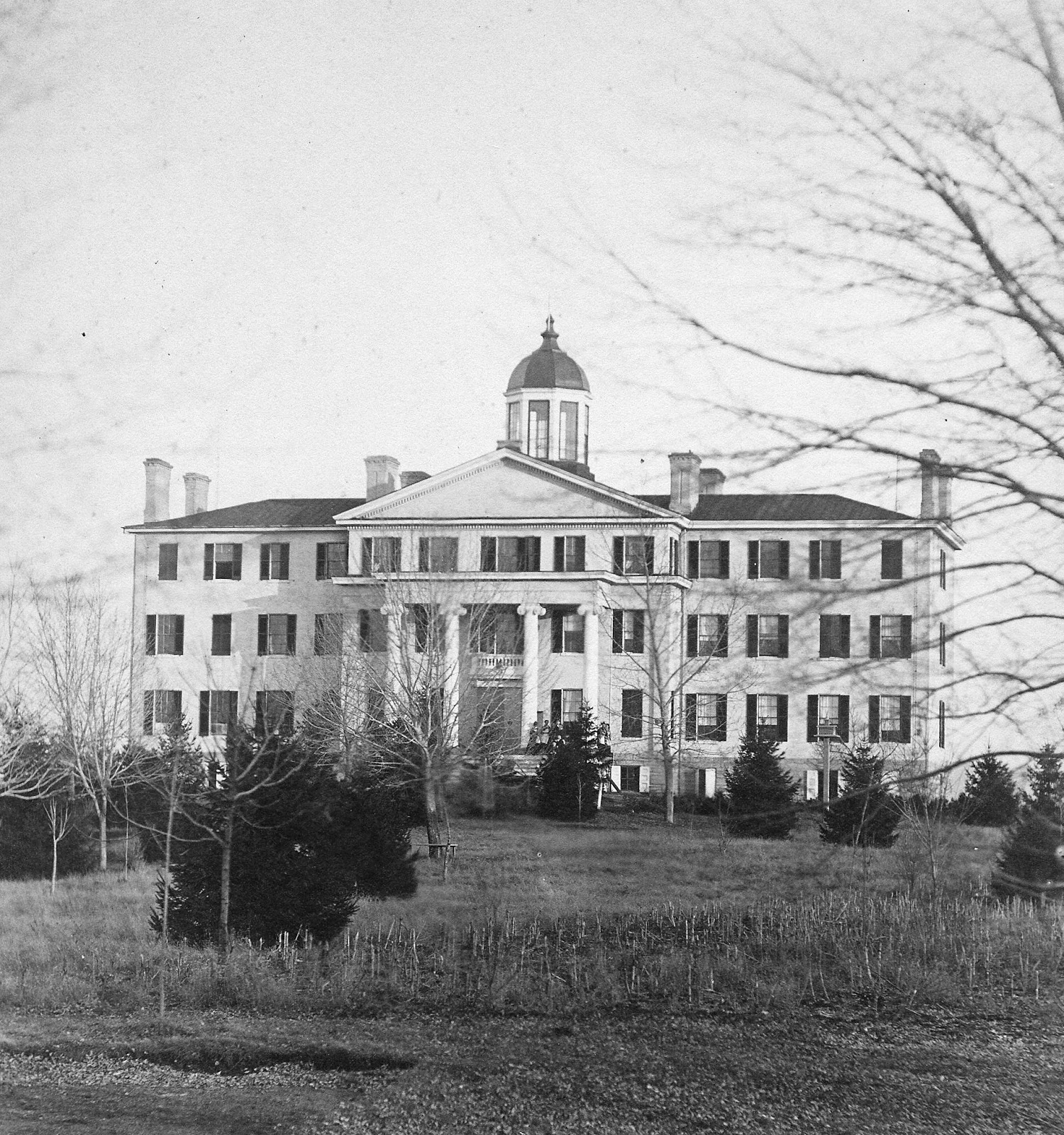
Hagerstown, Md.,  just north of Williamsport, was also in the path of both armies’ withdrawal from Gettysburg. Although many buildings in Hagerstown were converted into Union and Confederate hospitals, Kee Mar College, standing on the highest elevation in town, was strictly Confederate. Transferred from Williamsport to Kee Mar College, Dr. Gaines used his skill and experience to aid the sufferers at the all-female seminary. (Founded in 1851, Kee Mar College received several large additions and, starting in 1911, served as the Washington County Hospital. The outdated structure was later demolished and replaced by another medical facility.)

Gaines was later sent to Chester, Pa., near Philadelphia, where he tended to injured Confederates who were transferred earlier from Hagerstown. From Chester, he was shipped from one hospital to another, including Fort Delaware and Point Lookout, before he was exchanged at Fort Monroe, Va., on Dec. 12, 1863. Dr. Gaines’ service records are non-existent for the last year of the war, with the exception of a note that he “rejoined his old command at Petersburg” just before the Army of Northern Virginia’s surrender at Appomattox on April 9, 1865.

                   32 North Main Street in Boonsboro, Md., where Dr. John Gaines lived and
                                        worked after the Civil War. (Google Street View)

Nearly seven months after Appomattox, John Gaines returned to Washington County. The army doctor never forgot those warm September days of turmoil in 1862, or the sensitive, compassionate hands of a certain daughter of Dr. Otho J. Smith. In October 1865, Miss Helen Jeannette Smith of Boonsboro, Md., became the 25-year-old bride of Dr. John Mutius Gaines of Culpeper, Va.

Otho J. Smith's grave
 in Boonsboro (Md.) Town Cemetery.
(Photo: Richard E. Clem)
Soon after marriage, he went into the practice of medicine in Boonsboro with Dr. Smith. As a matter of fact, Gaines worked and resided with his new bride in the same two-story home of his father-in-law. Built in 1810, this beautiful, spacious, native limestone house still stands on North Main Street (Old National Road) in Boonsboro. Putting the Civil War behind him, life was good for John and Helen – maybe too good.

On June 14, 1868, less than two years after teaming with his son-in-law, Dr. Otho J. Smith passed away. Appointed executor of Smith’s vast estate, John Gaines was in the process of finishing some legal details when tragedy struck again. Only six months after her father’s death, 28-year-old Helen Jeannette Gaines died. The cause of death on Dec. 22, 1868, is unknown. It is only speculation, but perhaps the early passing of Helen came from contracting a disease while tending to wounded soldiers following Antietam. The doctor’s wife was interred in the Smith family plot in Boonsboro’s Town Cemetery, and the grief-stricken veteran continued his practice in Boonsboro.

Dr. John Gaines' house at 465 North Potomac Street in Hagerstown, Md. (Richard E. Clem)
Time truly heals all, and after two years of mourning and loneliness, Dr. Gaines married again in September 1870. His second marriage was to Susan M. Rench, daughter of Andrew Rench, an influential businessman and farmer in Washington County. While the couple resided in Boonsboro, Susan Gaines gave birth to daughters Mary, Jane, Sarah and a son, Edwin, who eventually married and settled on the Locust Hill plantation in Culpeper. There were no children from Gaines’ first marriage.

From 1866 until retiring in 1893, John M. Gaines was one of the most respected and trusted doctors in Washington County. His services extended over South Mountain into Frederick County. His practice grew to the point it became necessary to hire “two assistants in his office as well as to keep four of the best blooded driving horses – to take him back and forth through the county to his patients, and it often happened that he had tired all four of them.” One of John’s assistants in Boonsboro was his younger brother, Dr. James H. Gaines of Culpeper.

Planning ahead to retirement after practicing medicine in Boonsboro for 28 years, in 1890, the aging physician purchased a building lot on North Potomac Street in Hagerstown for $2,000. When construction began on the imposing three-story mansion, John personally “supervised and demanded work which did not meet his standards be done over.” In little over a year, the brick structure on a solid limestone foundation was finished. Shortly after completion of the beautiful home, the Gaines family took possession. In retirement years, the doctor’s interest turned from medicine to agriculture – he owned several farms in Washington County as well as the Locust Hill property in Virginia.

Circa-1910 image of Kee Mar College in Hagerstown, Md. The all-female college was used as a
 Confederate hospital following Gettysburg. Here, Surgeon Gaines labored and is believed to have
 compiled a list of Confederate wounded.  (Enoch Pratt Free Library, Baltimore)
While sorting through his extensive library around the turn of the century, Gaines found a misplaced list of wounded Confederate soldiers, some from his own state of Virginia. It appears the former army surgeon had started the list while caring for the wounded following the battle at Gettysburg, and at some point it had been stuck in his collection of medical books. The list of 214 is titled “Sick and Wounded Confederate Soldiers at Williamsport and Hagerstown.” The old ledger gives the soldier’s rank, state, date wounded and in some cases, date of death. The “original” document was sent to governor of Virginia, James Hoge Tyler (1898-1902), with an explanation by Dr. Gaines: “The list has never been published, and it will be read with interest, not only by the men who took part in the great struggle at Gettysburg, but by all old soldiers and by their children.”

44th Georgia Colonel Samuel Lumpkin
died of wounds suffered at Gettysburg.
His name appears in Dr. Gaines'
post-Gettysburg ledger. 
Additional research revealed two names on the list that deserve special attention. Near the end of the vintage record is found: “Colonel S. P. Lumpkin, 44th Georgia Regiment; Wounded July 1st.” Lumpkin, also a doctor before the war, came from a prestigious family in the Peach State. While commanding the 44th Georgia Infantry on July 1 at Gettysburg, Colonel Samuel Pittman Lumpkin lost his left leg to Union shrapnel and died on Sept. 18, 1863, at Kee Mar College. The colonel’s remains are interred in the Confederate section of Rose Hill Cemetery in Hagerstown.

Also near the bottom of the list is another noteworthy entry: “Major H. D. McDaniel, 11th Georgia Regiment; Wounded July 10th.” During the engagement in The Wheatfield at Gettysburg on July 2, McDaniel was shot and captured while leading the 11th Georgia, but escaped and eight days later was wounded again at Funkstown, Md. McDaniel is one of many soldiers who appear on the list as wounded July 10, 1863. The reason “July 10th” surfaces so often is because the Battle at Funkstown was fought that day during the Confederates’ retreat from Gettysburg. A total of 479 casualties remained at this small village a mile south of Hagerstown. Therefore, private homes in Hagerstown and Kee Mar College, with Surgeon Gaines in charge, would have received some of the overflow from Funkstown. Incidentally, Major Henry Dickerson McDaniel survived the war and 20 years later became the governor of Georgia (1883-1886). (To view “Gaines List,” go here.)

Grave of John Mutius Gaines in Rose Hill Cemetery in Hagerstown.
On March 27, 1915, John Mutius Gaines died at age 77. He "was a man of wonderful force of character and always devoted to duty,” an obituary in the Hagerstown newspaper noted. “It mattered not whether a peasant or prince, rich or poor, all received the same attention.”

General Stonewall Jackson once said: “Duty is ours, the consequences are God’s.” Dr. John Gaines made a similar statement: “Duty is the most important word in the English language.” The body of the surgeon from Virginia was laid to rest in Rose Hill Cemetery. Nine years later, on April 2, 1924, Susan Gaines passed away. She was placed at her husband’s side in Rose Hill, just yards from the grave of Colonel Sam Lumpkin.

Have something to add (or correct) in this post? E-mail me here.


SOURCES


-- Bailey, Ronald H., The Bloodiest Day: The Battle of Antietam, Time-Life Books, Alexandria, Va., 1984.
-- Cutter, William R., American Biography: A New Cyclopedia, New York, NY, 1916-33.
-- Douglas, Henry K., I Rode With Stonewall, The University of North Carolina, Chapel Hill, NC., 1940.
-- Divine, John E., 8th Virginia Infantry, H. E. Howard Inc., Lynchburg, Va., 1984.
-- Find A Grave Memorial.
-- French, Steve, Imboden’s Brigade in the Gettysburg Campaign, Morgan Messenger, Berkeley Springs, W.Va., 2008.
-- Gaines Family Bible, M. Carey, Philadelphia, Pa., 1816.
-- Keller, Roger, Roster of Civil War Soldiers from Washington County, Maryland, Genealogical Publishing Co., Baltimore, Md., 1993.
-- Morrow, Dale W., Washington County Maryland Cemetery Records – Volume II, Willow Bend Books, Westminster, Md., 1993.
-- Robertson, James I., 18th Virginia Infantry, H. E. Howard Inc., Lynchburg, Va., 1984.
-- Virginia Military Institute, Preston Library Records, Lexington, Va.

Saturday, November 28, 2015

One man's quest to discover story of Confederate Colonel Samuel Lumpkin, who was mortally wounded at Gettysburg

44th Georgia Colonel Samuel Lumpkin suffered a severe leg wound at Gettysburg on July 1, 1863.
Richard Clem, a longtime Civil War relic hunter from Hagerstown, Md., is a gifted historian and researcher. And he's also no stranger to this blog, having written pieces posted here, here and here. In this post, Clem recounts his quest to document the life of 44th Georgia Colonel Samuel Lumpkin, who was mortally wounded at Gettysburg on July 1, 1863. Sources and notes for this post may be found here.

By Richard Clem

Four years following the War Between the States, Maryland Governor Oden Bowie (1869 – 1872) appropriated $5,000 for a decent burial of incalculable number of  Rebel bodies still barely covered throughout Washington County. The governor’s compassionate act eventually led to the establishment of the Washington Confederate Cemetery. The three-acre site is located within the 110- acre interior of Rose Hill Cemetery in Hagerstown – a “cemetery within a cemetery.” Resting off duty for eternity in the hallowed ground are the remains of 2,138 unknown and 346 known Southern soldiers from the Maryland Campaign of 1862. These honored dead are mostly from the battles of South Mountain and Antietam -- or “Sharpsburg,” as folks in the South still call it. (1).

Marker in Washington Cemetery
 in Hagerstown, Md.
(Photo: Richard Clem)
A large cast-bronze plaque at the head of the Rebel burial grounds lists names and gives approximate location of the known dead. However, only two Confederate officers have individual ground-level gravestones: Colonel. Isaac E. Avery of North Carolina and Colonel. Samuel P. Lumpkin from Georgia. Colonel Avery’s stone was dedicated on Nov. 3, 2007. (2)

The legacy of Sam Lumpkin’s began in the spring 1984, when the author spoke to a trustee of Rose Hill Cemetery. Knowing my interest in the Civil War, he pointed to the Confederate area and asked, “Do you know that one of those soldiers in there has his own marker?” The only problem was he couldn’t remember where the stone was located or anything engraved on it. He went on to explain, “I haven’t seen it in years and it's probably growed over by now with grass.” (3)

So, on a hot July morning in 1984, equipped only with curiosity, I started searching the recently-mowed Washington Cemetery, determined to find the long-lost Rebel’s grave. Close to a half-hour passed when walking slowly up a slight grade, the morning sun reflected off something in the still dew-covered grass. Wiping perspiration from my blurred vision, the square corner of a flat stone came into view. This was it! Immediately, the work of ripping sod from the rectangular marker with bare hands began. In a matter of seconds, letters appeared: “COL. S. E. LUMKINS [sic], 44TH GEORGIE [sic] VOLS., DIED SEPT. 18TH 1863, AGED 29 YEARS” (4)

The first thing that caught my attention was the date -- “Sept 18th, 1863.” The battles at South Mountain and Antietam were fought in September 1862, one year earlier. Could the colonel from Georgia have been killed at Gettysburg, some 40 miles north of Hagerstown? Did his relatives know where he was buried? Who furnished or paid for the granite stone? Before Colonel Avery’s tombstone was installed, Lumpkin’s was the only one in Washington Confederate Cemetery. After decades of research to bring to life the Southern officer, the following account was written: (5)

Colonel Samuel Lumpkin's gravestone in Washington Cemetery in Hagerstown, Md.
His last name and regiment are misspelled on the marker.

(Photo: Ricard Clem)
Samuel Pittman Lumpkin was born Dec. 5, 1833, son of William and Susannah Edwards Lumpkin. William’s first marriage to Patsy Mickelborough produced five children. Patsy died from an unknown cause in 1814. William’s second wife, (married June 6, 1815), Susannah Edwards, gave birth to 16 children -- next to youngest being Samuel P. Lumpkin. Bill Lumpkin had four sons who gave their lives fighting for the Confederate’s noble cause. (6)

Sam’s father served in the Georgia House of Representatives and as trustee of Mercer University. The soldier from Georgia also had two cousins who were prominent in state politics and law in the 19th century. First, was Joseph Henry Lumpkin, the first Chief Justice of the Georgia Supreme Court, serving from 1845-1867. Joseph was also a founder of the Lumpkin Law School, a forerunner of the University of Georgia. Another cousin, a brother to Joseph, Wilson Lumpkin, served as Governor of Georgia between 1831-1835. Wilson’s daughter, Martha Lumpkin Compton, (1827-1917), had a small town in the Peach State named in her honor; however, the name “Marthasville” didn’t stick. Three years later, in 1843,  the little-known community was renamed “Atlanta.” Yes, the Confederate buried in Hagerstown came from a respected, prestigious family that helped shape early history of the Old South. But questions still remained: Was Colonel. Lumpkin killed during the War Between the States and why were his remains interred in Hagerstown instead of being returned to Georgia? (7)

Little is known of Samuel Lumpkin’s formative years or education, but around the age of 20, with an ambition of becoming a doctor, he enrolled in Jefferson Medical College in Philadelphia. After graduating in 1855, he returned to Georgia, setting up a medical practice in Watkinsville. Although Sam was born in Oglethorpe County, an 1860 census shows him living in Clarke County with John Calvin Johnson, wife Matilda, and two sons, James and John. The young physician inherited part of his father’s estate, but it's believed the Johnsons financially helped with his college education and provided him a home. Perhaps Sam’s relocation became necessary due to the number of brothers and sisters at home and there simply wasn’t enough room at the supper table. (8)

Doctor Sam must have thought the world of Matilda Johnson. On March 1, 1862, he appointed John Calvin Johnson, Clerk of Court for Clarke County, as executor of his last will and testament, leaving Matilda his entire estate. The registered will contained words of great praise and fondness for the 52-year-old woman, “For she has been to me a mother for several years past, both in affection and in every kindness that I could ask or she could anticipate, and because I believe if I were to die or be reduced to helpless suffering, she of all others would mostly deeply deplore my loss or be most willing to relieve my necessities.” Three days after signing the will on March 4, 1862, and with a War of Yankee Aggression rapidly expanding, the Clarke County physician enlisted to defend his beloved South from Northern invaders. (9)

Entering the service at Watkinsville, Lumpkin became captain of Company C, 44th Regiment, Georgia Volunteers. Company C consisted mostly of a militia unit “Johnson Guards,” named in honor of Lumpkin’s good friend, John Calvin Johnson. On April 4, the 44th Georgia was ordered to Goldsboro, N.C. Two months later, on May 27, 1862, the newly formed regiment headed north to defend the Confederate capital in Richmond, Sam left behind forever a lucrative medical practice, the Johnsons and a girl he was engaged to marry. It seems the doctor from Georgia was as committed to duty as a professor Thomas J. Jackson from Virginia, who wrote, “Through life let your principal object be the discharge of duty.” (10)

In spring 1862, Gen. George B. McClellan launched his Peninsula Campaign with intentions of bringing the war to a quick end by capturing Richmond. In the “Seven Day’s Fighting,” while taking a defensive stand against Union infantry at Mechanicsville, (June 26th) the 44th Georgia suffered tremendously. Total loss of Federal forces engaged was 361 while the 44th alone reported 335 casualties. Sam Lumpkin was promoted to lieutenant-colonel June 28, 1862. On July 1, 1862, only three days after moving up in rank, he was wounded at Malvern Hill. The injury wasn’t serious, resulting in a full recovery. Ironically, exactly one year to the very day -- July 1, 1863 -- Lumpkin would receive another wound. The only difference – this wound would prove to be fatal. The 44th Gerogia Infantry fought in every major engagement of the Army of Northern Virginia for the remainder of 1862, including Second Manassas, South Mountain, Antietam and Fredericksburg. (11)

               Approximate area where Lumpkin's 44th Georgia attacked at Malvern Hill.

Leading the regiment at Chancellorsville – May 3, 1863 – Lumpkin was “mentioned for gallantry.” For this courageous conduct, he received the rank of full colonel in command of the 44th Georgia Infantry. Although many historians consider Chancellorsville the South’s greatest victory, it resulted in the Confederacy’s greatest personal loss of the war when Gen. Stonewall Jackson was mortally wounded by his own men. (12)

Confident from the recent, brilliant victory at Chancellorsville, the Confederacy decided to become the aggressor, sidestepping the Union army defending Washington and once more carrying the war into Northern territory. In Pennsylvania – July 1, 1863 – General Robert E. Lee’s invading Army of Northern Virginia by chance encountered the newly appointed Major General George G. Meade’s numerically superior Army of the Potomac at a little town called Gettysburg. (13)

At the start of the Gettysburg Campaign, the 44th Georgia was attached to Dole’s Brigade (4th Georgia, 12th Georgia, 21st Georgia), Rodes’ Division, Ewell’s Corps. A brigade member recalled, “Continuing the march on the 25th we reached Carlisle on the 27th, and our brigade bivouacked on the campus of Dickinson College. We were within twenty miles of Harrisburg, the capital of Pennsylvania.” Ewell’s Corps received orders on June 30th to march immediately southward toward Cashtown to link up with Longstreet’s Corps. A major, imminent engagement at Gettysburg was about to make the printed pages of American history. (14)

Ewell’s forces quick-marched toward the sound of the guns and pending battlefield. A soldier in the gray columns remembered the morning of July 1, “Resuming the march the next morning we arrived at Middletown, when the head of the column was turned towards Gettysburg. When the brigade was in about seven miles of the place, the roar of cannon in front revealed to us the presence of the enemy.” Doles’ Brigade approached the smoking battlefield from the north along the Carlisle Pike (east of Oak Hill), just west of present Barlow’s Knoll. (15)

Colonel Samuel Lumpkin may have had his leg amputated at David Schriver's farm at Gettysburg.
(Photo: Richard Clem)

In his official Gettysburg report, Brigadier General George P. Doles noted, “The enemy’s cavalry appearing in force in front and on our left flank, skirmishers from the command were ordered to dislodge them.” Around 3:30 P.M., Southern infantry had driven Federal cavalry from the field, but found strong opposition between them and Gettysburg. Before Early’s Division arrived, Doles’ Brigade of 1,300 faced two enemy divisions (Howard’s Union XI Corps) of 5,500. With renewed hope, Doles wrote, “The brigade of Gen. Gordon of Maj.-Gen. Early’s Division, having made junction with our left, we moved forward to the attack.” With the combination of Doles and John B. Gordon’s Brigade (all Georgia) forcing the assault, the entire Federal defenses north of Gettysburg gave way. (16)

At Gettysburg, Colonel Lumpkin served in
the brigade of General George Doles.
Major William H. Peebles of the 44th Georgia described the action on the northern edge of town: “Had not our men been so nearly exhausted, we should doubtless have captured the greatest portion of the artillery and men; but only a few could not flee so rapidly as the main body fell into our hands. We then reformed and marching into the town of Gettysburg, the routed and fleeing enemy betaking himself to the hills south of the town.” Pressing on heels of the adversary, a retreat became a rout. The 44th Georgia was the first Confederate unit to enter Gettysburg – unfortunately, its courageous colonel was missing. Sam Lumpkin had fallen and was lying somewhere on the field among bloody humanity and battle debris. An officer in Doles’ Brigade wrote after the war, “While pursuing the routed Eleventh Corps on July 1 the brigade had the unpleasant experience of being mistaken for Union troops and were fired upon by our own artillery of which killed and wounded several men.” So, it's not impossible that Lumpkin may have been struck down by his own artillery. General Doles also reported the same incident of “friendly fire.” (17)

An official casualty list of Gettysburg wounded included: “Lumpkin, Samuel P. – Colonel 44th Regiment, Georgia Infantry – Wounded in leg – necessitating amputation and captured at Gettysburg, Pa. – July 1, 1863. Remarks: S.P. Lumpkin – Col. 44th Ga., Wounded 6 P.M., lost left leg.” (18)

Although Lumpkin’s leg may have been amputated on the field of battle, it's plausible to think Dr. Abner E. McGarity, surgeon of the 44th, performed the brutal operation at the Schriver farm. The wounded of Doles’ Brigade were hospitalized at David Schriver’s 150-acre farm located 2 ½ miles northwest of Gettysburg along the Mummasburg Pike. (19)

Doles held the Georgia officer in high esteem. “In the action of July 1st, Colonel Lumpkin fell, severely wounded (leg since amputated) while gallantly leading his regiment in a charge against the enemy,” he wrote. A veteran of the 44th receiving the news of his respected leader lamented, “There was no better, braver or cooler officer in the army than Colonel Lumpkin. Always at the front and always ready for duty, he had the confidence of his superior officers and the men he commanded.” The battle at Gettysburg continued two more days as a Confederate private observed, “There was an awful fight for three days. I don’t think we gained anything there.” (20)

On Independence Day – July 4, 1863 – the cannon finally fell silent at the crossroads community of 2,000 residents in Pennsylvania; the Confederate invasion of the North had been stopped. Now, in the path of the retreating Rebel army, Washington County, Md. waited in anxiety . . . and fear. After several days under record-setting rain, Lee’s embattled forces began filtering through Hagerstown and surrounding areas. By the thousands they come – some walking, some on horseback, some in wagons . . . all spattered with mud and blood. (21)

Standing on a high elevation at the eastern edge of Hagerstown was the Kee-Mar College. Established in 1851, the seminary for young ladies was converted into an improvised hospital. Other buildings in town were used as both Union and Confederate hospitals while the seminary was strictly Confederate. It was in this ladies seminary the incapacitated colonel would end his earthly trials.  (22)

Hagerstown Female Seminary,  circa 1860s.
Colonel Samuel Lumpkin died here as

 a  POW in September 1863.
(Image: Washington County Historical Society)
Some historians believe Colonel Lumpkin was transported from Gettysburg to Williamsport by Gen. John Imboden’s 17-mile long wagon train of  Confederate wounded. However, the wounded of Doles’ Brigade did not travel to Williamsport by Imboden’s “train of misery” – but by a shorter route. The greatest part of Lee’s army left Gettysburg to the east passing through Fairfield, Monterey Pass, and after crossing into Maryland, moved slowly down the Leitersburg Pike into Hagerstown. Ewell’s Corps, acting as rear guard for the Army of Northern Virginia, camped north and east of Hagerstown. At this time, the mangled, battle-torn colonel was carried inside the seminary hospital. Leaving town, Ewell’s legions trudged on to Williamsport, where on the night of July 14, they crossed the swollen Potomac River to the safety of Virginia soil. (23)

A letter dated “December 5, 1863,” mailed from 44th Georgia headquarters camped at Morton’s Ford, Va., gives solid evidence the wounded Lumpkin was left at Hagerstown – not Williamsport. The correspondence was sent to John Calvin Johnson, the executor of Sam Lumpkin’s estate, “Sir, I was sent from Gettysburg, Pa. in charge of the wounded of Doles’ Brig. and when we reached Hagerstown, I thought it advisable to leave Col. S.P. Lumpkin & Capt. Haygood. I then loaned Col. L. Fifty Dollars in the presence of Pvt. Montgomery whom I left as a nurse for him. Owing to the hurry of the occasion I took no showing for it.”

It is apparent the writer, Dr. Abner McGarity, is attempting to collect $50 he had loaned Colonel Lumpkin in Hagerstown – almost six months earlier. The communiqué continued, “Capt. Neary of our Regt. informs me that you are settling the Col’s business and that you have authorized him to sell his horse. The Capt. will have a surplus of the Col’s funds on hand and proposes to settle the fifty-dollars with me in the event that you will authorize him to do so. You will please do so by letter and I will give him my receipt.”

The note of request is signed, “Very Respectfully, A.E. McGarity, Surgeon 44th Ga.” This is the same Abner E. McGarity who was thought to have amputated Lumpkin’s leg at Gettysburg and nowhere does he mention “Williamsport” as to where the wounded colonel was taken. Dr. McGarity ended his message to Johnson with a post-script: “Capt. N. requested me to say to you that he had not sold Col. L’s horse yet but thought he would soon. A.E.M.” (24)

During the Gettysburg Campaign, Abner Embry McGarity served as assistant surgeon for the 44th Ga. According to comrades in the 44th, Dr. McGarity was, “… a good man, treated the sick and wounded under his charge humanely and kindly.” In the fall 1864, McGarity was transferred to the 61st Alabama Infantry. Capt. William J. Neary mentions that McGarity was quartermaster for the 44th Ga. and “…had the respect of all the officers and men of the Forty-fourth Georgia Regiment.” Also noted in the correspondence, Pvt. Montgomery was captured at Hagerstown, and exchanged later in 1863. He surrendered at Appomattox and was reported living after the war “somewhere in the West.” (25)

The Captain Haygood in McGarity’s writing was Capt. William B. Haygood, a member of Company C, 44th Georgia Regiment. Haygood lost an arm at Gettysburg and was captured at Hagerstown along with Colonel Lumpkin. He remained in prison for the duration of the war and died at an unknown date in DeKalb County, Ga. (26).

Colonel Samuel Pittman Lumpkin fought his final battle in September 1863 at the seminary hospital in Hagerstown and then slowly “crossed over the river.” The amputation, extreme loss of blood and typhoid fever all took their toll on the 29-year-old Rebel warrior. (27)

The mutilated, battle-scarred body was placed in the old Presbyterian Church graveyard on South Potomac Street in Hagerstown. Standing a few doors south of Washington County Free Library, the Presbyterian Church is known today as the Fundamental Baptist Church.

       Lumpkin's remains were originally buried at the Presbyterian Church cemetery on
     South Potomac Street in Hagerstown, Md. It's now the Fundamental Baptist Church.

In postwar years, a niece of Lumpkin’s wrote, “My father told me about my Uncle Samuel Lumpkin, and I have met one or two of his old comrades in arms. All bore testimony to his personal charm. He was a physician but choose rather to go into the regular army than as a surgeon. He was engaged to be married at the time of his death, and the family sent his personal belongings to the girl, with the exception of a small keepsake apiece. Grandfather had an embroidered vest of his with a small gold pin shaped like a sword and I remembered seeing the pin. It was stolen we thought.” (29)

In 1913, 48 years after the war, the Presbyterians planned to expand their church building. The new construction required removal of the graveyard adjacent to the sanctuary. More than likely, Lumpkin’s grave in the church cemetery had a marker of some sort, but unfortunately all stones were discarded or destroyed during the building project. Some marble tombstones were even laid face-down and used as a walk. In May 1913, the colonel’s skeletal remains were removed from the Presbyterian graveyard and appropriately re-interred in the Washington Confederate Cemetery several blocks below the church on South Potomac Street. As fate would have it, 1913 was the 50th Anniversary of the Battle of Gettysburg and thousands of veterans returned for a reunion and to camp on the old battlefield – the same year Colonel Lumpkin would find his final bivouac. Other remains were removed at this time from the church graveyard and re-interred in Rose Hill and other cemeteries in the Hagerstown area. (30)

Official dedication of the Washington Cemetery was held June 12, 1877. Guest speaker for the solemn occasion was Confederate Maj-Gen. Fitzhugh Lee – nephew of Gen. Robert E. Lee. On Sept. 3, 1961, Dwight D. Eisenhower, general and former President of the United States, re-dedicated the hallowed Confederate burial ground. Eisenhower traveled from his farm at Gettysburg to Hagerstown in an army helicopter. Undoubtedly, when “Ike” gave his re-dedication speech in 1961, Lumpkin’s gravestone was covered by a layer of sod and drew no attention. (31)

Former president Dwight Eisenhower attended the re-dedication ceremony at
 Washington Cemetery in Hagerstown, Md., on Sept. 3, 1961.

An early Board of Trustees for the Confederate cemetery paid by check – June 20, 1913 -- $3.25 to Rose Hill Cemetery for “reinterring body of Col. Lumpkins.” The following year -- Oct. 21, 1914 -- the manufacturing firm of C.E. Darner was paid $12 for providing and engraving the marble gravestone. A final cancelled check for $5 drawn on the Hagerstown Bank – Jan. 16, 1915 – shows the purchase of “flowers” for the grave to local florist, Henry A. Bester & Sons. (32)

A distant nephew of the colonel wrote an article titled “An Old Time Georgia Christmas.” The true account published in 1906 in Columbia, S.C., is based on the childhood plantation home of Samuel Lumpkin and how Christmas was celebrated at the time of the War Between the States. The writer remembered and mentions Colonel Lumpkin in the narrative, “Uncle Sam was as gentle as a woman, and as I know now, the sweetest one of the family. Uncle Sam died at Gettysburg.” (33)

Neither the Johnson nor Lumpkin families down in Georgia had any way of knowing the colonel was buried in Hagerstown. The only word they had received was he had “lost a leg at Gettysburg” and assumed he was dead. But far more than Colonel. Sam’s shattered leg was left behind in Pennsylvania. Buried deep in the blood-soaked fields of Gettysburg rested the Southern States last hope of becoming an independent nation. The seemingly endless struggle of civil war would continue two more costly years as dark days of despair and defeat increased for the Sons of the South. The time was drawing near when their ragged yet sacred banners of Stars & Bars would be folded with reluctance and patriotic pride . . . forever. (34).

(For notes and sources for this post, go here.)

Saturday, April 06, 2013

Etched in blood: The story of Col. Isaac Avery

Mortally wounded at Gettysburg on July 2, 1863, Col. Isaac Avery of the 6th North Carolina
scrawled these words in his own blood on a piece of paper before he died.
Last year, I shared stories here and here on my blog by my friend Richard E. Clem, whose tales of Civil War relic hunting in Maryland, Virginia and Pennsylvania captivated me and others at Connecticut Day at Antietam last spring. In addition to hunting for relics, Clem enjoys writing and researching Civil War stories. Here's a wonderfully written piece by Clem on a Confederate soldier who never returned home.


By Richard Clem

With trembling hands and blurred vision, the elderly, grief-stricken father read the heartrending dispatch:
                                           Morganton / 11 o’ clock / July 8, 1863
                                            My Dear Father: No letters or private
                                           telegrams arrived tonight, but news in
                                           the paper, announcing a victory for our
                                           army at Gettysburg contains very sad
                                           distressing news for our family. The
                                           papers state that Col. Avery of North
                                           Carolina was killed – it must be either
                                           Moulton or Isaac – one of your beloved
                                           sons has fallen I fear – William Avery  (1)
As fate would have it, three brothers, Col. Clarke Moulton Avery, Col. Isaac Erwin Avery and Lieut. Willoughby Francis Avery were struck down on the bloodstained field at Gettysburg. (2)  The one difference, Clarke Moulton and Willoughby would recover to fight again, but Isaac had fought his last battle and never would return to the Land of Cotton.

Richard Clem
Considering the date on the correspondence and time it took to reach North Carolina, the body of Col. Isaac Avery had been buried in a shallow grave overlooking the Potomac River at Williamsport, Md., about 40 miles south of Gettysburg. (3)

Isaac Erwin Avery was born Dec. 20, 1828, on the old Swan Ponds Plantation near Morganton in Burke County, N.C. Named after his father, he was the fourth child of 16 to Isaac Thomas Avery and Harriet Eloise Avery. Only 10 of the Avery’s children lived past childhood. Owning large tracts of land this influential, prestigious family of western North Carolina was extensively engaged in the fields of law, education and politics on local and state levels. (4)

After a year of study at the University of North Carolina, young Isaac was sent to manage another plantation owned by his father in Yancey County. With the coming of civil war and facing threat of an invasion from the North, Isaac put aside “planting the soil” and along with his younger brother, Alphonso, raised Company E, 6th North Carolina Infantry. Isaac was appointed captain of the newly formed regiment known locally as the Sixth North Carolina State Troops. (5)

In June 1862, as the War of Yankee Aggression pushed deeper into the South, Capt. Avery’s regiment was sent to defend Richmond. Here, during the Peninsula Campaign while driving the enemy from the steps of the Confederate capital, Capt. Isaac Avery shed his first patriotic blood at Gaine’s Mill, Seven Pines and Malvern Hill. (6)

Fighting with distinction at Antietam (Sept. 17, 1862), the 6th N.C. having suffered great losses in the ranks was earning the title, “The Bloody Sixth.” The recently promoted “Colonel” Avery, however, was recovering from wounds received in Virginia and escaped the “bloodiest single day of the Civil War.” (7)

The 6th N.C. Infantry was unique in being the only Confederate outfit to claim ownership of a “personalized” regimental belt buckle. These extremely rare waist belt plates contained the legend: 6th INF – N.C.S.T.” The raised letters represented: “Sixth Infantry – North Carolina State Troops.” Manufactured late 1861, in a small railway shop in Greensboro, the oval cast-brass plates were personally financed by the regiment’s first commander, Col. Charles F. Fisher. A Yankee bullet through the forehead at First Manassas put Col. Fisher in an early grave. (8)

A rare 6th North Carolina Infantry belt buckle.
(Photo courtesy Richard Clem)
In the battle at Chancellorsville (May 2, 1863) Gen. Robert F. Hoke leading a North Carolina brigade (6th N.C., 21st N.C., 57th N.C.) was struck down, leaving Col. Avery in command of the brigade. Although a decisive Confederate victory, this engagement cost the South perhaps its greatest single loss in the death of Gen. Thomas J. “Stonewall” Jackson.

Confident from the recent victory at Chancellorsville, Gen. Robert E. Lee decided once again to take the war into enemy territory. This campaign reached a sudden climax at a small crossroads village in Pennsylvania called Gettysburg. Fought between Gen. George G. Meade’s Army of the Potomac and Lee’s Army of Northern Virginia, the three days of bloody warfare (July 1-3, 1863) would be recorded on pages of history as the turning point in the War Between the States.

Coming from the direction of Harrisburg, Col. Avery’s Brigade (Ewell’s Corps – Early’s Division) missed the first day’s fighting at Gettysburg; however, as the sun set there were more than enough “Blue Coats” still standing.

Late afternoon July 2nd, Avery’s North Carolinians along with Gen. Harry Hays’ “Louisiana Tigers” on the right were ordered by Gen. Early to attack a massed Federal force on East Cemetery Hill. Defended by infantry and several artillery batteries, the Union held elevated heights were one of the most heavily fortified enemy positions on the field. (9)

The two brigades started their charge from a stream bed (Winebrenner’s Run) on the Henry Culp farm just southeast of Gettysburg. Climbing over rail fences and stone walls for almost a half-mile, the advancing forces topped a small rise that had been shielding them. Immediately, the Southerners were caught in a deadly artillery crossfire. A Federal gunner remembered the slaughter: “It was one solid crash, like a million trees falling at once.” (10)

In front of his troops mounted on a white horse, Col. Avery was hit by shrapnel or a musket ball at the base of the neck and knocked from the saddle. Appearing on the scene, Gen. John B. Gordon from Georgia would write years later: “Resting on his elbows, I could see the gallant young Avery in his bloody gray uniform among his brave North Carolinians.” Once the smoke settled over the field, the 6-foot-2 frame of the fallen Rebel officer was transported with care to the Culp farm. (11)

Bruce Avery, a descendant of the colonel, and his son, Christopher, 
visit Avery's grave in Washington Cemetery in Hagerstown, Md.
(Photo courtesy Richard Clem)
In the Culp’s beautiful two-story brick farmhouse, the mortally wounded Avery was made as comfortable as possible. (12)  All the skills of regimental surgeons Drs. William L. Reese and John G. Hardy proved to be in vain. Knowing the end was near, Isaac’s last thoughts were of his aging father home in Morganton. Paralyzed on the right side, he desperately tried to remove a piece of scrap paper from the pocket of his blood-soaked uniform. Becase Avery apparently was unable to speak, a comrade and close friend, Maj. Samuel McDowell Tate (6th N.C.) knelt by his side holding firm the coarse writing paper. The dying man slowly dipped a small stick or some unknown pointed object in his own life-giving substance and scribbled with his left hand: “Major, tell my father I died with my face to the enemy.” (13)

Shortly after scrawling the crimson-stained parchment the 35-year-old officer’s soul slipped into immortality. Col. A.C. Godwin (57th N.C.) took command of the brigade and later spoke of Avery with highest admiration: “In his death the country lost one of her truest and bravest sons, and the army one of its most gallant officers.” (14)  A member of Company E, 6th N.C. wrote home to Burke County: “Col. Avery he was wounded one Evening and died the next night I am very Sory that he got killed for I liked him beter than any body I was under but he is gone now he was acting brigadier general.” (15) This private’s grammar and spelling may not be perfect, but his heart and loyalty can not be questioned.

Col. Isaac Avery died on July 3, the same day his older brother, Col.Clarke Moulton (33rd N.C.), fell also with “... his face to the enemy” during Longstreet’s assault against Cemetery Ridge – better known as “Pickett’s Charge.” Clarke Moulton survived, only to be killed the next year in the Battle of the Wilderness. Lieut. Willoughby F. Avery (43rd N.C.), Isaac’s youngest brother, was also wounded on the first day at Gettysburg. (16)

Like other Southern officers during the Civil War, Col. Avery employed the services of a plantation slave. The main job of these black servants was to prepare meals for their masters and tend to their horses. As in some case,s a bond formed between Isaac and his servant, “Elijah.” (17)

Three days of deadly combat disastrously failed to drive the Union army from its strong defensive position on Cemetery Ridge. Lee then turned his face south toward Williamsport on the Potomac, where his seemingly invincible army crossed just nine days before. Now with regret the General spoke in despair: “We must now return to Virginia.” (18)  Early morning July 4, Independence Day 1863, under a steady rain, Elijah carefully loaded Avery’s body in a horse-drawn wagon determined to take “Marse Isaac” home to North Carolina. (19)

In advance of the Confederate exodus from Pennsylvania, slowly rolled a 17-mile-long mud-splattered wagon train filled with wounded, dying humanity. (20) One quartermaster wagon driven by a slave carried the lifeless form of what once was his master. Under command of Gen. John D. Imboden, the ambulance “train of misery” finally reached the small riverfront town of Williamsport where discovered the Potomac was at flood stage – too deep and treacherous for crossing. Rain plus intensive heat rapidly increased decomposition of the Confederate dead. A decaying corpse was not only offensive to human smell, but carried highly infectious diseases as cholera and typhoid fever. The undesirable situation of a pursuing victorious enemy and rebel bodies quickly deteriorating, Elijah reluctantly gave up the idea of returning the deceased colonel to Burke County. (21)

Sometime around July 7, the devoted slave buried Col. Avery’s earthly remains in the public Riverview Cemetery at Williamsport. In his “The Battle of Gettysburg,” W.C. Storrick mentions Avery was: “… buried under a pine tree in a small cemetery overlooking the Potomac River.” Today, local residents of Washington County are still being interred in the well-maintained Riverview Cemetery that contains graves dating to the Revolutionary War. (22)

In 1869, Governor of Maryland, Oden Bowie, (1869-1872) decided it was “… altogether fitting and proper” and overdue for a decent burial of the Confederate dead from battles of South Mountain, Antietam and Gettysburg now scattered in hastily-dug graves throughout Washington County. Bowie choose three men from Sharpsburg to physically search and compile a registry of all Confederate grave sites known to exist in the county and surrounding areas. The descriptive list would include the soldier’s name (if known) and a rough location of the grave. Three years later, approximately three acres of land at Rose Hill Cemetery in Hagerstown was purchased for re-interment of the “Rebel Bones.” The new site would be called the Washington Confederate Cemetery. The arduous task of exhuming and moving the Confederate remains to Hagerstown was completed by 1874. (23)

According to “Bowie’s List,” one Southern soldier re-interred at Washington Cemetery was recorded as originally: “Buried in the public graveyard at Williamsport.” Under ground for almost ten years the skeletal remains of this Rebel was exhumed and registered as: “Col. J.E. Ayer, 6th N.C.S.T., July 3, 1863.” Two mistakes are found in this entry. First, the letter “J” should be an “I” for Isaac. Second, “Ayer” should be spelled “Avery.” These two minor errors were common during the Civil War and are understandable when considering the marker at the grave site, more than likely made of wood, and after ten years would have been badly weather-beaten and barely legible .Remembering also, assuming Elijah crudly-carved the headboard, most slaves couldn’t read or write. Fortunately, in 1863, someone with foresight took time to place and inscribe a marker of some sort for Avery’s grave or otherwise Bowie’s workers would have had no idea it ever existed or who was buried there. (24)

At the head of Washington Cemetery a cast-bronze marker mounted on granite was erected in the late 1800s. This layout map contains 346 names of the “known” Rebel dead buried there arranged according to each soldier’s individual state.In the same sacred soil are 2,122 Southern soldiers listed simply – “unknown.”

One name found on the heavy plaque listed from North Carolina is: “Col. J.E. Ayer.” This would be Col. Isaac Erwin Avery. Military records prove there was “only one” colonel attached to the 6th North Carolina State Troops who, according to Bowie’s ledger,died on “July 3, 1863.” After studying all official documents and using the source of elimination, there can be no doubt -- the remains of the Confederate soldier resting in the North Carolina section of Washington Cemetery belong to Col. Avery. (25)

Three sons of Isaac Thomas Avery were killed during the Civil War while one died later from the results of injuries suffered during the conflict. Only Major Alphonso Avery survived the bloodshed to live to an old age. Over a period of time all bodies were brought home and buried in Morganton; however, as far as the family knew, Col. Avery was still beneath Yankee terrain somewhere in the North. (26)

Eventually, Elijah made it home to Swan Ponds Plantation with the Colonel’s sword and pocket watch. In sorrow with sympathy, the slave told the Averys he had buried Isaac on a bluff along the Potomac River at Williamsport -- whereever that may have been. Years passed as the elusive final resting place of the Colonel was mostly forgotten. On the last day of 1864, with the war still raging, Isaac Thomas Avery passed away. The sacrifice of three sons to the Southern cause was more than the broken heart of a 79-year-old grievous, caring father could endure. (27)

Around 1895, Alphonso Calhoun Avery, a North Carolina Supreme Court Judge, traveled to Williamsport with the object of locating the long-lost grave of Col. Avery. The Judge was the same younger brother of Isaac who helped organize Company E, 6th N.C. Regiment back in 1861. Judge Avery’s companion on the journey was Capt. J.A. McPherson of Fayetteville. The Captain had fought along side the Avery boys in Company E on various blood-contested fields. (28)
Col. Isaac Avery died on July 3, 1863 in Gettysburg. From Morganton, N.C., he is buried
in Washington Cemetery in Hagerstown, Md. (Photo courtesy Richard Clem)
Thirty years after the war, any trace of Avery’s first (original) grave had vanished. At least 20 years before Alphonso’s visit to Washington County, Gov. Bowie’s laborers had removed the Colonel’s remains from Riverview Cemetery and would have also removed any crude marker indicating the grave ever existed. Of course, Judge Avery had no knowledge of "Bowie’s List" or heard of a Confederate cemetery in Hagerstown, several miles north of Williamsport.

Only the Almighty knows how long the two North Carolinians spent “unsuccessfully” searching Riverview Cemetery overlooking the beautiful Potomac. Following distinguished service on the State Supreme Court bench, Alphonso Avery led the law school at Trinity College in Durham, which eventually became Duke University. It may also be noted Alphonso was a brother-in-law to the immortal Stonewall Jackson. The judge was married to Susan Morrison while the Southern  general was married to her older sister, Mary Anna Morrison. Alphonso Avery died in 1913, leaving Col. Avery’s final bivouac a dark mystery to the prominent family. Isaac’s original Gettysburg message in blood is preserved and remains protected in a historical archives in Raleigh, N.C.. (29)

In October 1905, President Theodore “Teddy” Roosevelt (1901-1909) delivered a speech in Raleigh at the unveiling of a statue of the Englishman, Sir Walter Raleigh, from which the state capital of North Carolina takes its name. According to the Atlanta Journal the President’s program contained words he struggled and choked to read from a slip of yellow-aged paper. And then with solemn reverence he gave the note to Lord James Bryce, Britain’s minister to the United States. Slowly studying the few words the minister then handed back the note and quietly confessed: “President Roosevelt, we have nothing to compare with this in the British Museum.” (30)

The short message that left both men speechless that day in Raleigh had been etched in human blood. Written over 40 years earlier, it said all that could ever be asked or all that could ever be expected from a soldier -- North or South: “Major, tell my father I died with my face to the enemy.”

SOURCES AND NOTES

1.   Letter of William Waightstill Avery to his father, Isaac Thomas Avery, July 8th 1863,
      Collection of Avery family papers, University of North Carolina, Chapel Hill, 1777-
      1890, 1906;  "Death Not Written in Blood," article published in The Atlanta Journal,                                                                  
      April 12th 1931.
2.    Ibid. pp. 5-6.
3.    Dictionary of North Carolina Biography, University of North Carolina Press;
       Wikipedia, the free encyclopedia; A Descriptive List of the Burial Places of the
       Remains of the Confederate Soldiers Who Fell in Washington and Frederick
       Counties, Published by direction of Oden Bowie, Governor of Maryland, 1869;
       Coco, Gregory A., Wasted Valor, Thomas Publications, Gettysburg, Pennsylvania,
       1990, p. 30.
4.    Avery family papers, pp. 5-6.
5.    Ibid. p.7.
6.    Dictionary of North Carolina Biography; Documenting the American South.
7.    Avery family papers, p.7.
8.    Mullinax, Steven E., Confederate Belt Buckles & Plates, O’Donnell Publications,
       Alexandria, Virginia, 1991, pp. 168-169; Phillips, Stanley S., Excavated Artifacts
       From Battlefields and Campsites of the Civil War – 1861-1865, Litho Crafters, Inc.,
       1974, p.27.
9.    Files of the Gettysburg National Military Park, East Cemetery Hill; Campbell, Eric
       A, A Field Made Glorious, Cemetery Hill: From Battlefield to Sacred Ground,
       Gettysburg Magazine, No. 15, pp. 114-115.
10. Gettysburg: The Confederate High Tide, Time Life Books, Alexandria, Va.,
1985, pp. 116-117.
11.  Gordon, John B., Reminiscences of the Civil War, Charles Scribner’s Sons, New
       York, 1903, p. 161.
12.  Coco, Gregory A., A Vast Sea of Misery: A History and Guide to the Union and
       Confederate Field Hospitals at Gettysburg July 1st – November 20th 1863,
       Thomas Publications, Gettysburg, Pennsylvania, 1988, p. 115.
13.  Article from Raleigh Observer, May 11 1894.
14.  Report of Col. A.C. Godwin, 57th North Carolina Infantry, June 3rd – August 1st
       1863, Gettysburg Campaign, p.3.
15.  Aftermath of Gettysburg: Letter of John J. English, Company E, 6th North Carolina
       Infantry, from near Hagerstown, Maryland, July 9th 1863, p.1.
16.  Avery family papers, pp.6-7.
17.  Wikipedia, the free encyclopedia, Isaac E. Avery, p.1; Documenting the American
       South, University of North Carolina Press, p.1.
18.  Battles and Leaders of the Civil War, Vol. III, Thomas Yoseloff, New York,
       1956, p.422.
19.  Wikipedia encyclopedia; Documenting the American South.
20.  Gettysburg: The Confederate High Tide, p. 150.
21.  Storrick, W.C., Gettysburg: The Place, the Battles, the Outcome, McFarland,
       Harrisburg, Pennsylvania, 1932, p.33.
22.  Ibid.
23.  Stotelmyer, Steven R., The Bivouacs of the Dead, Toomey Press, Baltimore,
       Md., 1992, pp.36-37.
24.  Governor Bowie’s List, p.53.
25.  Records of the Washington Confederate Cemetery, Hagerstown, Maryland;
       Bowie’s List; Joseph Coxon’s Map of 1888.
26.  Avery family papers, p.5.
27.  Ibid.
28.  Coco, Gregory A., On the Bloodstained Field II, Thomas Publications,
       Gettysburg, Pennsylvania, 1989, pp.113-114.
29.  Avery family papers.
30.  Death Not Written in Blood, Atlanta Journal.