Showing posts with label Bull Run. Show all posts

Friday, July 09, 2021

Interview: Laura DeMarco, 'Lost Civil War' author. Plus, a list!


Like this blog on Facebook | Follow me on Twitter


In a Zoom chat, author Laura DeMarco and I talked about her new book, Lost Civil War: The Disappearing Legacy of America's Greatest Conflict. The recently published book (Pavilion Books, 176 pages) is lavishly illustrated with period photos of battlefields and historic places. In our nearly 28-minute visit, we discussed a Gettysburg site few know about, Antietam's Dunker Church, and a fort in Louisiana that had ties to (gasp!) a cult. Heck, we even discussed the Cleveland Browns, who (sadly) may dominate the AFC North this season. That's a tough sentence for this longtime Steelers fan to write.

Here's more on DeMarco at her author page. Here's where you can purchase the book on Amazon.com. 

Below, Laura offers a list of sites she wishes had been preserved and/or properly memorialized. Plus, an outside-the-box bonus.

The 8th Vermont monument on the Cedar Creek battlefield.

SHENANDOAH VALLEY BATTLEFIELDS:
Some of the most important battlefields of the Civil War in Virginia are buried under asphalt and concrete. A drive down Interstate Highway 81 provides a tour of Shenandoah Valley Civil War battlefield sites — planned or not. The interstate travels through the valley for 150 miles, cutting through seven battlefields as it winds through the picturesque countryside, including: Second and Third Winchester, First and Second Kernstown, Cedar Creek, Fisher’s Hill, Tom’s Brook. and the New Market battlefields.

An August 1863 image of Camp Letterman. 
(Library of Congress)
CAMP LETTERMAN, NEAR GETTYSBURG:
Camp Letterman opened July 22, 1863. It was the first major war hospital located on a battlefield, not at a faraway city or barracks. Hundreds of tents were set up as the wards, and men from both sides filled the beds, another first. The hospital became home to more than 4,000 convalescing soldiers. Hundreds of convalescing men stayed behind in the hospital after the armies had moved on, until the last ones could be moved by train, or on their own, in January 1864. The hospital was closed that month, and for nearly a century its great significance was under-appreciated as development paved over Wolf’s farm. The site has been gradually taken over by sprawl, and even a mobile home park. In 2018, the Pennsylvania House of Representatives finally voted to honor the role Camp Letterman played in the Civil War and military medical history. A historical marker sits near Sheetz gas station No. 326.

Hard-to-get-to Fort St. Phillip in Louisiana. This is an 1898 addition to the fort. (NPS photo)

FORT ST. PHILLIP (LA.):
Founded by the Spanish in 1792, Fort St. Philip has the most fascinating history of any American fort. It was ruled by the Spanish, French, and United States, and was the location of a Civil War siege, a Civil Rights threat, and a cult. The remaining structures were severely damaged by hurricanes Katrina and Rita in 2005. Today, portions of the original masonry fort and rusty artillery remain abandoned and covered in overgrowth. The land is shrunk more and more by erosion each year. Fort St. Philip, which played such a vital role protecting New Orleans, is only accessible by boat or helicopter.

A stereoview of Marshall House in Alexandria, Va. (Library of Congress)

MARSHALL HOUSE (ALEXANDRIA, VA.):
One of the most significant deaths in the early days of the Civil War took place not on the battlefield, but in an inn. The Marshall House at 480 King Street in Alexandria, Va., was the site of the May 24, 1861, assassination of Col. Elmer E. Ellsworth, founder of the 11th New York Volunteer Infantry Regiment and close friend of President Abraham Lincoln.

It was a day that would live in infamy in the Civil War, energizing both Union and Rebel troops. The Marshall House was badly damaged in an 1873 arson, though it was rebuilt. The infamous location was demolished in 1950. But the controversy didn’t end with its removal. The Sons and Daughters of the Confederate Veterans hung a historic plaque on a new hotel on the site, The Monaco, that only mentioned Jackson, “the first martyr to the cause of Southern Independence” — not Ellsworth. The controversial sign was finally taken down in 2017 when Marriott purchased the property and renamed it The Alexandrian.

Brady, post-war
MATHEW BRADY'S FIRST BATTLE OF BULL RUN PHOTOS:
Perhaps the most famous lost photographs were from the early days of the war. Mathew Brady, new to his field operation, photographed the First Battle of Bull Run on July 21, 1861. One of the rare times he attempted shoot a battle in action, Brady arrived at Bull Run with a group of newspaper reporters and Union troops led by General Irvin McDowell a few days before the fighting. On July 21, he ventured onto the battlefield with a wagon and assistants. They got too close to the action, however, and when the Union soldiers retreated to Centreville, they abandoned their wagon and joined the exodus. No images of this seminal battle survive.


-- Have something to add (or correct) in this post? Email me here.

Saturday, March 09, 2019

'Hidden' details in 1865 Bull Run monument dedication photos

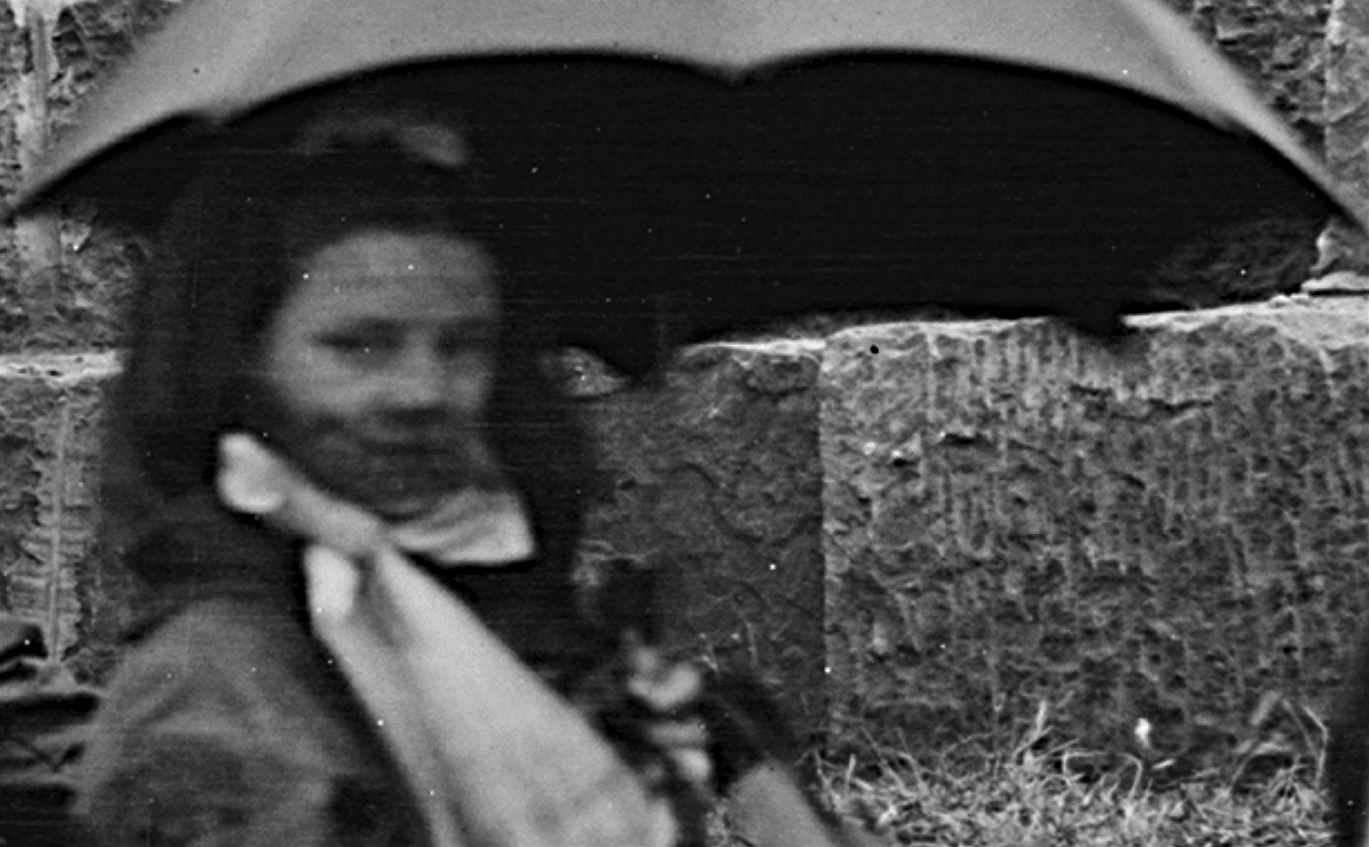
Shy or weather-wary? Or both? This woman had cover for her photo op at Bull Run on June 10, 1865.
(CLICK ON ALL IMAGES TO ENLARGE.)
In the uncropped, original image, civilians and soldiers gather at the monument at Henry House Hill.
(William Morris Smith | Library of Congress)

Like this blog on Facebook | Follow me on Twitter

At 6 a.m. on June 10, 1865, generals James Farnsworth, Montgomery Meigs, Samuel Heintzelman, Henry Benham and Orlando Wilcox boarded a westbound train in Washington with nearly 100 other passengers. The group's final destination was the Bull Run battlefield for the  dedication of  two monuments "in memory of the Patriots" who fell in United States Army defeats there in July 1861 and August 1862.

In this cropped enlargement
 from Photo No. 2 below,
  we find a young soldier,

 perhaps a teenager.
At Alexandria, 100 more "excursionists" boarded the train before the party continued on through Virginia countryside devastated by a civil war that ended two months earlier. 

"We watched carefully along the entire route for evidence of returning peace and prosperity in this part of the State," a New York Times correspondent wrote, "but the people will recover their wrecked fortunes slowly, for they have suffered with terrible severity."

At 8 a.m., 15 miles from Washington, the train reached Fairfax Station, the end of the line for the Orange & Alexandria Railroad. Most in the 200-person group then boarded ambulances, carriages and army wagons provided by the military for the final, 17-mile leg of the journey to the battlefield. In a stunningly long sentence no present-day English teacher would appreciate, The Times correspondent described the scene: 
"Our cavalcade, composed of some seventy-five carriages and ambulances, with a large number of equestrians, many of whom were ladies, who generally rode exceedingly well, caused quite an excitement among the inhabitants of the country, who are now at home in increased numbers, though the population is still as sparse as in some of the newest regions of the West, they were all at the roadside, and gazed with astonishment at so extensive and peaceful a demonstration."
Dedication day was a grand affair, with the usual speeches by politicians and military flourishes. At Henry House Hill, where the monument honoring the Union fallen of the July 21, 1861, battle was dedicated, a hymn was sung to the tune of "Old Hundred." The second stanza was especially noteworthy:

William Morris Smith photographed two monuments
at Bull Run on dedication day in June 1865.

(Library of Congress)
Here on Virginia's sacred soil. 
Where slavery bred and drove the gangs. 
The horrid serpent lay in coil --
Here Freedom's sons first felt her fangs.

After the dedication later that afternoon of the second monument, at Groveton, some went searching for battle relics. Pieces of artillery shells and broken muskets lay everywhere on the Second Bull Run battlefield. Shallow graves and human bones were found, too. 

"Many of the party gathered some relics from the field," The Times correspondent wrote, "while one person with eccentric taste, brought to the city part of a human skull, exhibiting the hole of a deadly bullet."

The day was also well documented photographically. At the Henry House Hill monument dedication, William Morris Smith shot a series of images. At first glance, Smith's two uncropped photographs in this post seem unremarkable. When we zoom in, however, fascinating details emerge.


SOURCE: The New York Times, June 13, 1865.


... a young lady, her face partially covered by a veil, holds an umbrella, protection from the sun ...


... men tower over this woman, who stares at the photographer. She appears ghost-like, a result of the limitations of the medium. ...


... this ornery-looking gentleman, perhaps in in late 50s or early 60s, sports an impressive top hat ...


... while this apparently unhappy lad, arms folded, shows little interest in holding the hand of the man (his father?) in front of him. Of course, he must have been pleased with that tremendous hat. ...


... a youthful-looking artilleryman stands next to the wooden fence near the monument ...


...which includes these massive, 100-pounder artillery shells. Were they live?

(Update from Civil War photo expert John Cummings: "Those shells were found to be live when the NPS restored the monument some years ago. They have some on display in the visitor center, in the hallway leading to the bookstore. The shells that are there now on the monument are reproductions.")


PHOTO NO. 2: THE  SOLDIERS ON HENRY HOUSE HILL

Union soldiers pose in front of the Bull Run monument on Henry House Hill in the uncropped version ...


... zooming into the original photo, we see a soldier standing ramrod straight and the inscription on the simple, red sandstone monument. It stands today yards from the rebuilt Henry House that was destroyed during the Civil War ...


... arms folded almost defiantly, this soldier stands atop the mound of dirt next to the 27-foot monument. And there's another one of those imposing artillery shells ...


... the detail is so impressive in the glass-plate image that we can easily see the hobnails on the leather, brogan-style shoes of this soldier, who's seated on the ground near the bottom right in the original photograph. These shoes were often fitted with metal in the heels to reduce wear ...


... did this black youth, dressed in military uniform, serve as a soldier, too?


... a 19th-century gang sign? Missing tips of  his digits because of a war wound? More likely this soldier merely has his fingers partly tucked inside his blouse ...


... were these bushy faced soldiers father and son? Gotta love these mugs.

What else do you see? E-mail me or add your comments to the post below or on my Civil War Facebook page. Find high-resolution versions of the original photographs in this post on the excellent Library of Congress web site here and here.


-- Have something to add, correct? E-mail me at jbankstx@comcast.net

Saturday, March 02, 2019

'A place full of pitiful memories': A reporter's 1881 Bull Run visit

Union soldiers at the dedication of a Federal war memorial on Henry House Hill in June 1865.
(Library of Congress | CLICK ON ALL IMAGES TO ENLARGE.)

Like this blog on Facebook | George Morgan's battlefield accounts

A hodge-podge of shopping malls, housing developments and industrial parks long ago overwhelmed suburban Washington. Ah, to have seen the landscape of rolling hills, woods, ravines and lush fields in the area as Philadelphia Times correspondent George Morgan did when he visited Bull Run, 30 miles west of the capital, in the summer of 1881.

"Riding north on the road to Sudley Springs one sees the clearly marked outlines of a fort in a cornfield, and, passing further, the eye is attracted by the beautiful line of the Blue Ridge far away to the northwest," Morgan wrote in a Page 1 story published in the Times on July 11, 1881. He described the immediate area near the Bull Run battlefield as a "pleasant country of farms."

In 1881-82, Morgan lived a charmed life as a reporter, touring Civil War battlefields at Franklin, Cold Harbor, Chickamauga, Lookout Mountain and elsewhere. The ugly effects of war -- bullet-scarred trees, earthworks and entrenchments -- were often evident. Morgan discovered evidence of the human toll, too. In the woods at Chickamauga, the reporter and his guide found a pair of skulls, undoubtedly victims of the September 1863 battle. Morgan's descriptive accounts of his battlefield trips were published in the Times and other U.S. newspapers, including The National Tribune, a popular publication for Civil War veterans.

Fortunately for Morgan, he had an excellent guide at Bull Run: the man who lived on Henry House Hill, the heart of the battlefield. A formerly enslaved man named Shedrick, who apparently witnessed Bull Run's aftermath, served as Morgan's driver. Here's the correspondent's complete Bull Run account, written nearly 20 years after the armies clashed there on July 21, 1861:


Special Correspondence of The Times

MANASSAS, Va. July 9

The lapse of twenty years has left the fields and wooded hills upon which the Battle of Bull Run was fought much as they were when on that hot Sunday in July, 1861, the young armies of the people for the first time joined in combat. At this spot this month twenty years ago the raw nucleus of the Grand Army of the Potomac fell upon the equally undisciplined enemy and forced him through thick woods, across ravines, on hillsides and into what promised to be utter rout, but accident of war turned the tide of battle and under vigorous counter-attack the assailants fled dismayed to the banks of the Potomac. What the writer wishes to set down in plain terms is the appearance of the battle-field now and the impression that the surroundings make upon an admirer of those who fought.

Bull Bun is best reached from Manassas village, a pretty place, which shelters snugly on level land a few hundred people, who, being at a point on the Virginia Midland Railroad, thirty miles west of Washington, take the trade of the country for a considerable distance around. Riding north on the road to Sudley Springs one sees the clearly marked outlines of a fort in a cornfield, and, passing further, the eye is attracted by the beautiful line of the Blue Ridge far away to the northwest. At the end of a six-mile trot through a pleasant country of farms, the most interesting part of the battlefield, Henry Hill, is reached.

The field's key-point


A war-time image of the ruins of the original Henry House.
(Library of Congress)

The Henry House stands upon Henry Hill, a flat, bare crest, the field's key-point, whence came the first great outburst of battle and across which forwards and backwards the contending lines surged from noon until the day was lost. The house is a pleasant structure, with marks of newness about it, and it is made inviting by a lawn in which there is a large elm and several small locust trees. The eye of the approaching visitor does not rest upon these trees, however, delightful as they appear, for the objects of prominence are a little God's-acre grove in front of the house and a rude monument in its rear.

"Coase I wuz heah just arter de fightin'," said Shedrick, the darkey driver, as we climbed the hillside road to the house; "'coase I wuz, en I seed moah dead uns stretched stiff in dat ar oat field ober dar den I eber seed afore nor sence. Dar's Mars Henry, he kin tell ye."

Under the elm sat an elderly gentleman bending over what I afterwards saw were Latin textbooks. His soft hand, heartily extended, pointed as a sure index to its owner as one concerned with the windrows of learning rather than with those long lines of fallen grain in the trail of the reaper which at that moment was seen swinging slowly down a distant Fairfax hill. From the warmth of his welcome Mr. [Hugh Fauntleroy] Henry, who is a professor in the Alexandria Academy, soon made his visitor feel in its fullness that which has been so much praised -- the hospitality of the old-time Virginian.

A glance from a hilltop

William Sherman
"Be so kind as to stand under this tree," he said; "this point is the best from which to study the battle-field. General [William] Sherman so regarded it when he called here some time ago. I was sitting in the place where you saw me reading to-day when I observed the General approaching across the field. He came to the house, and standing here pointed out with wonderful accuracy the various positions held during the battle. Sir, that ridge beyond the Bull Run stream is in Fairfax county. Look to the east. On this side of that Fairfax ridge lay the Federal army on the night before the battle. The country there was partly cultivated then as it is now, but, turning your eyes further to the north, you see a forest extending to the stream. Through that forest, now of larger growth, the Federals, who were to turn [Pierre] Beauregard's left, moved, cutting their road as they went, to Sudley Springs, which you see in the distance there to the north. Then crossing Bull Run they come down directly upon this point. There remain few evidences of that movement. The oak and pine stands as it did then.

Confederate Colonel Barnard Bee,
 mortally wounded at Bull Run.
"Now mark, sir! The Confederate Colonel [Nathan] Evans, 'Shanks,' as they called him, faced [Daniel] Tyler just down there at the stone bridge, on the Warrenton pike. Is it clear to you? Well, sir, Evans, suspecting something wrong, faced up stream and, with Colonels [Barnard] Bee and Barton, threw himself into that field just beyond the valley. You see that field now; it is still clear. To make a long story short, when the Federal attacking column, clumsily handled, struck Evans they thought Beauregard's whole army was in their front. If they had pushed forward they would have crushed Beauregard. No doubt about it. Evans, with a handful of men, held them for an hour and a half and, when he was forced back, he retreated to this plateau, where the fiercest fighting was done. The Confederates ran past this house towards General Jackson, who had just posted his brigade at that ridge a few hundred yards to the northeast of the house. Jackson's men were lying flat on the ground, but Jackson was on his horse. He sat there as still and steadfast as this monument. Now and then he waved his hand to his men, among whom shells were falling and around whose heads bullets were flying like bees in harvest time. A soldier of that brigade was here a few years ago and he told me that he thought it too hot to stay. He was slipping back, when Jackson, seeing him, lifted his hand. The fellow dropped into his place."

Where Jackson became 'Stonewall'


As he talked Mr. Henry led his visitor beyond the lawn into a field where grew long grass, daisies, dandelions, dock weeds, blue thistle and thickly-matted blackberry briars. Slightly in advance and at the further edge of the field was a line of young pines which have sprung up since the battle, making the field narrower now than it was then. Beyond this growth of small pines stretches a wide belt of oak timber, then standing. Eating blackberries as we walked along we came to a slight ridge near the woods. It needed no one to explain that this was where Jackson stood "like a stone wall." From this spot, where his horse's hoofs made their memorable mark, I could trace, by the red road-bed leading to Sudley Springs, one line of Federal approach, and immediately below, in the little valley of Young's Branch, I could see the Warrenton pike that brought Union help from the Stone bridge across Bull Run. Far away in beautiful undulations roll pleasant fields and sternly in the background still grow the very oaks that once were bruised and shattered in the shock of battle.

Battle-field fancies


A group of mostly civilians at the June 1865  dedication of the Federal war memorial at Bull Run.
(Library of Congress)

Standing where Jackson stood, it is easy to re-people this beautiful crest, and with slight effort fancy fills in the picture. Panting after a hot run of a mile and a half, Bee's men and Barton's huddle panic- stricken at the edge of the woods. The rebels are routed. The hard-worked men of the North, driving constantly forward, cross Warrenton road, push up the hill and reach the plateau. Their batteries sweep the crest and send death-dealing bolts, hissing hot, into the woods.

Bee is in sore extremity. His face is streaked with the smut of powder. His eyes are wild. His sword is in constant motion above his head. His voice is husky, for shouts of command long since gave place to whispers of entreaty. Over the field he comes in search of his badly-smitten runaways.

"General," he exclaims, reaching Jackson, "they are beating us back."

"Sir," replies Jackson, "we will give them the bayonet."

Again Bee's sword waves encouragement to his troops, and in a rain of bullets he runs forward, saying to some who are with him: "There is Jackson, standing like a stone wall!"

Instantly thereafter Bee smites his breast, and, stumbling, falls backward upon clump of briars. To and fro across his body fly the bits of lead, regiment meets regiment in fierce charge and the thick of the fight is on. A dozen rocks in the midst of a tangle of pine bush mark the spot where Bee died, and a few steps distant a similar mound designates the place of Barton's fall. One conviction forces itself upon the visitor who walks from point to point in this field -- that the people never have done justice to the heroism of the Union soldiers who through no fault of their own lost the battle here.

"May I ask what has become of the hall In your house?" said General Sherman to Mr, Henry. "The house had to be rebuilt," was the reply, " and it was remodeled."

"I thought so," said Sherman, with a grim smile.

"I was in that hall, but it got too hot for me."

It is not pleasant for the gentleman who, with an aged sister, made deaf by the battle and so remaining now, occupies the Henry mansion to tell of the fighting in and around the house. In the graveyard grove is a tombstone with the inscription:

JUDITH HENRY
Killed near this spot by the explosion of shells in her dwelling - during the battle on the 21st of July, 1861, When killed she was in her 85th year and confined to her bed by infirmities of age. Her husband, Dr, Isaac Henry, was a surgeon in the United States Navy, on board the frigate Constellation.

A cropped enlargement of the Henry House Hill photo from June 1865 reveals the inscription
 on the war memorial. (Library of Congress)

When the artillery began to rock the hill and shot came tearing through the house Mrs. Henry's invalid son took his mother in his arms and bore her across the field down the hill to a sheltered place. Two daughters of the house followed. When the tide of battle momentarily rolled away to the right the party returned to the house, but scarcely had they reached the lawn when a fiercer storm than ever circled around. Mrs. Henry was shot in several places, one of the daughters was made deaf for life and the terrible shock hastened the son's death.

Great locust trees that then stood around the lawn wore broken off and swept down, and from their stumps the lesser locusts now standing have grown. In a grove ot these trees, on a grass-covered mound in the rear of the house, is monument of rough red granite, whereupon are scratched the names of visiting veterans. The shaft is capped with shells, one of which was hurled by "Long Tom" from Fairfax Heights far across Bull Run. Though the monument was put up by Union soldiers the bones of five Confederates are buried beneath. Pushing aside some hollyhocks, now in flower around the mound, I was able to read the inscription:

In Memory of
The Patriots
Who Fell at Bull Run,
July 21, 1861

Down at the Bridge


A war-time image of the Stone House at Bull Run astride the Warrenton Turnpike.
(Library of Congress)
With taut reins Shedrick led his horses down the farm road leading from the plateau, and crossing Young's Branch, we emerged upon the Warrenton pike. The Stone House known to history still stands at the intersection of the Sudley Springs and Warrenton roads, and we drank from the same well whence thirsty hundreds drew refreshing draughts twenty years ago. From the Stone House along  the pike to the stone bridge across Bull Run it is a long mile, the road being up hill and down and twice crossing the rivulet.

"The Yankees retreated along this road after the fighting on the Henry farm, didn't they, Shedrick?"

"I's free to say, sir, dat day kind o' made fur de bridge."

"But didn't they run?"

"No, sah; when de rebels got de Union gemmon on the go back dey kind o' went along dis road toards de bridge. '

"But what's the difference between 'on the run and 'on the go back'?"

"Heap o' difference, sah, heap o' difference."

This cute distinction appeared to tickle Shedrick, who, at the time of the battle, was a slave and who, in his respect for the North, could not be induced to admit that those who set him free were driven in wild flight across the bridge now before our very eyes. Tho bridge looks old, but steadfast. A wall of stone is on either side and the road-bed on the bridge is of red clay, just as on the pike itself. The stream that passes under the bridge is now narrow and sluggish, but a rain storm sends the waters roaring down between the high walls of red rock and the dry undergrowth of summer in the run's race track is frequently submerged. To the east is Fairfax county, filled upon this side with fields and thick woods, in the depths of which the bones of men and horses are found to this day. To the west, along the road that took us thither, stretch the undulating lands of Prince William county. Things are somewhat desolate at the bridge, but it is a novelty to sit on the stone buttress and read of war's deadly doings while from the dank grass and dark water below the bull-frog mocks the drum.

Where the Porter trouble began


Union General Fitz-John Porter.
A year after the first battle the second battle of Bull Run was fought upon the same ground. But in the second battle the positions of the opposing forces were reversed. Henry Hill and the adjoining Bald Hill are the points from which the operations during the second battle can best be studied. Far to the west stretch the Bull Run Mountains and in the distance the Blue Ridge. Thoroughfare Gap, through which Jackson marched and in which Ricketts disputed Longstreet's passage, looks like a notch in a huge saw. Bones have been found within the last few years in the Gap, but it behooves the searcher for such uncanny relics to beware lest he himself be turned to bones, for in the Bull Run Mountains the rattlesnake lurks. There are slight traces of Jackson entrenchments on the Highlands near Groveton, and the unused railroad cut, in which there was such fierce fighting, remains today as it was in August, 1862.

The Fitz John Porter case has caused a number of army officers to visit the Henry House and some adjacent points recently, and not long ago General Warren passed several days in the vicinity preparing maps for use in the trial. The people of the vicinity are interested in the development of the case, almost all taking sides with Porter, who, as a Manassas man put it, "is merely the scapegoat of a lost battle."

A year or so ago Senator Don Cameron found himself at the Henry farm, and, having examined the two battlefields, he said to Mr. Henry: "What will you take for your property? I've a notion to buy it." The reply was that the spot was too dear to be bought: a place full of pitiful memories for the owner and of sad reflection for the friends of those whose gathered ashes rest at Arlington.

G.M

-- Have something to add (or correct) in this post? E-mail me here.