Showing posts with label Boonsboro. Show all posts

Monday, September 21, 2020

Appalachian Trail or towering achievement? It's not a close call

The original Washington Monument was built by Boonsboro, Md., citizens in 1827.

The spectacular view of the Hagerstown Valley from near the base of the monument.

Like this blog on Facebook | Follow me on Twitter

"Hiking the Appalachian Trail" has a whole different meaning for my wife and me than it might for most of you. Remember this guy?  For the Bankses, those four words are a euphemism for something (wink,wink) "sneaky" and always make us chuckle. And so when I had the choice over the weekend to turn right to hike the Appalachian Trail (wink, wink) or left to visit a really neat monument with a Civil War connection, well, it wasn't a close call.

For this blogger, the monument visit was the right call.
The tower at Washington Monument State Park in Maryland wins hands down!

Atop South Mountain, where the often-overlooked Civil War battle was fought Sept. 14, 1862, stands the country's first monument to our first president. On July 4, 1827, according to a period newspaper account, many of the 500 citizens of Boonsboro, Md., marched two miles up the mountain to construct a 15-foot, cannon-shaped stone monument to honor the guy with the wooden teeth. Upon completion later that day -- a towering achievement --  the Declaration of Independence was read and a salute was fired by three Revolutionary War veterans.  Later that year, workmen enlarged the monument, making it 30 feet high. (You can read much more about its history on this National Register of Historic Places Registration form.)

My takeaway: Sheesh, what a fabulous view of the Hagerstown Valley below. (Squint and you can see the Antietam battlefield.)

By the Civil War, the Washington Monument had been victimized by vandals and nature, turning it into a pile of rubble. During the Battle of Antietam in 1862, the Union Army used the site as a signal station, and it served the same purpose post-Gettysburg as Lee's Army of Northern Virginia  retreated back into Virginia.

The tower was rebuilt in 1882, but it eventually fell into disrepair again. It was rebuilt from 1934-36 by the Civilian Conservation Corps. The Washington Monument stands near the Appalachian Trail, where if you ever see a certain former South Carolina governor, tell him we said hello.

Also, don't feed the bears! (See below.) 

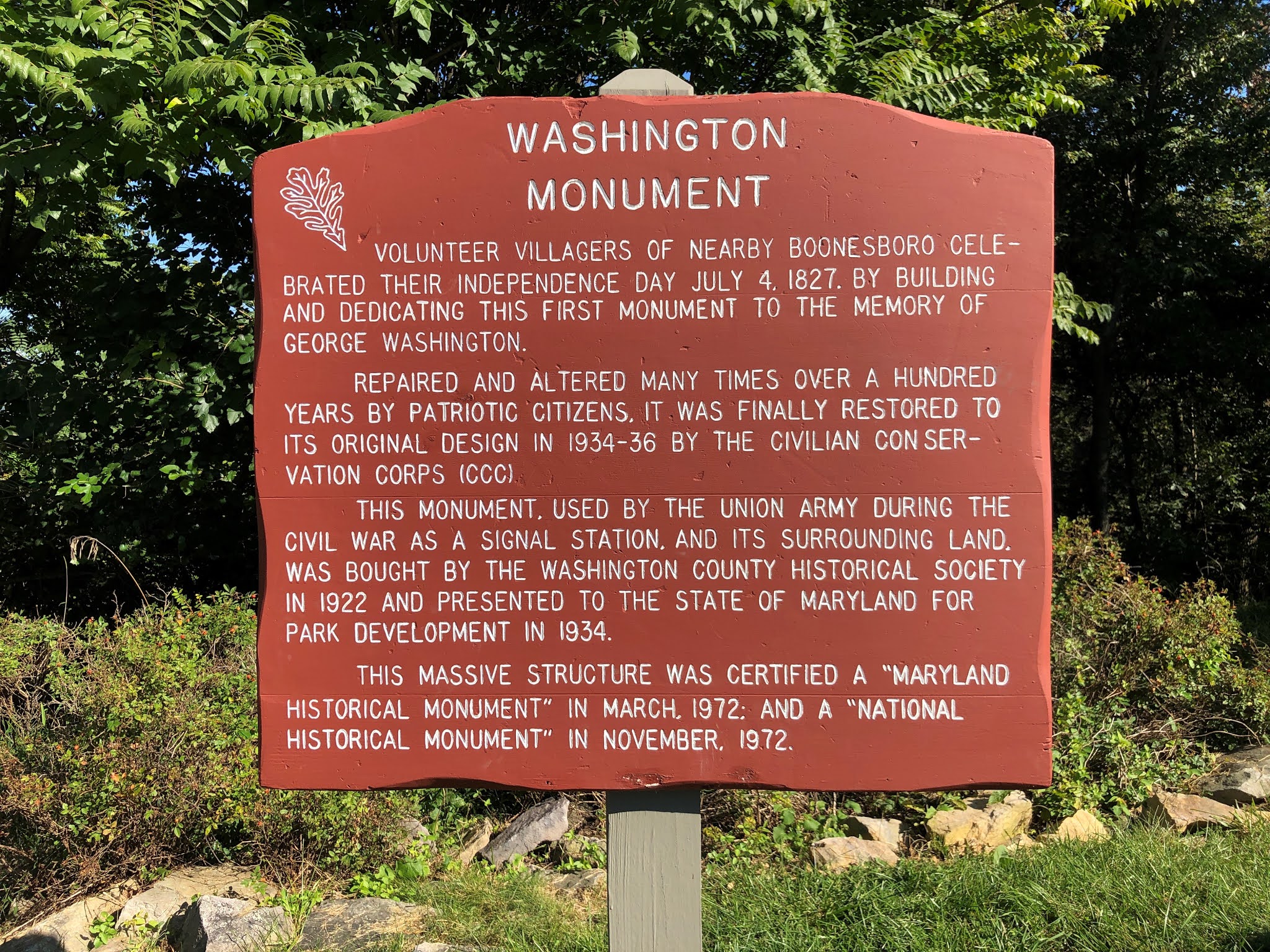
At the monument site, a brief history. 

Stairs lead to the top of the monument, but the interior is closed because of  you-know-what.
(CLICK ON ALL IMAGES TO ENLARGE.)


To the east of the monument, you can hike the Appalachian Trail if you dare.
In Washington Monument State Park, a sign warns about serving wild beasts.


-- Have something to add, correct? E-mail me at jbankstx@comcast.net

Tuesday, December 04, 2018

From Antietam to West Point: 18 of my favorite 2018 photos

FRANKLIN, TENN.:  Bullet-riddled Fountain Carter farm office interior, stark evidence 
of battle Nov. 30, 1864.  (CLICK ON ALL IMAGES TO ENLARGE.)
FRANKLIN, TENN.: Lighted inside on the anniversary of the battle, the bullet-riddled Carter outbuilding.
(SEE MORE.)
Like this blog on Facebook | Follow me on Twitter

From Antietam, Gettysburg, Brandy Station and South Mountain in the eastern theater to Nashville, Perryville, Shiloh, Franklin and Lookout Mountain in the western theater, I have been fortunate to walk many miles on hallowed ground in 2018. When I travel, I make good use of my iPhone 8S camera. (Remember: "Portrait" mode is your friend.) Here are 18 of my favorite photos this year.

ANTIETAM: 50th Pennsylvania monument on Rodman Avenue at sunrise.
(SEE MORE "MONUMENTAL" IMAGES FROM ANTIETAM.)
ANTIETAM: Irishmen Thomas Meagher in bas-relief on Irish Brigade monument.
NASHVILLE: The pedestal of the old Battle of Nashville monument, which was toppled in a storm in 1974.
(READ MORE.)
GETTYSBURG: Winfield Scott Hancock monument on East Cemetery Hill.
NASHVILLE: At Richland Country Club, massive Sharps carbine bullets serve as tee markers.
(READ MY BATTLE OF NASHVILLE STORY IN CIVIL WAR TIMES.)
ANTIETAM:  Sunlight squeezes through openings in William Roulette barn, a hospital during and after battle.
ANTIETAM: Sunrise at the Mississippi monument on Cornfield Avenue.
BOONSBORO, MD.: Miniature donkeys and a peacock greeted me at the crumbling house
 where a Union officer died from his Antietam wounds. (READ MORE)
ANTIETAM: Shadow of the old War Department tower at Bloody Lane.
(SEE/READ MORE.)
WEST POINT, N.Y.: Grave memorial for General John Buford, a hero of Gettysburg.
(READ/SEE MORE.)
FRANKLIN, TENN: Heavenly effect at South Carolina monument at McGavock Confederate Cemetery.
(SEE MORE.)
ANTIETAM: A figure of an eagle atop the 28th Ohio monument on Branch Avenue.
(SEE MORE "MONUMENTAL" IMAGES FROM ANTIETAM)
GETTYSBURG: Irish wolfhound on the tremendous Irish Brigade monument.
(SEE MORE.)
ANTIETAM: The 16th Connecticut monument in the 40-Acre Cornfield, the southern end of the battlefield.
FRANKLIN, TENN.:  Two markers for the same unknown soldier at McGavock Confederate Cemetery.
(SEE MORE.)
ANTIETAM: 124th Pennsylvania monument at sunset.

-- Have something to add (or correct) in this post? E-mail me here.

Saturday, February 17, 2018

Death spiral: A sad end for house where Antietam officer died

Boarded up and battered by time and nature, the circa-1850 Jacob A. Thomas house near Boonsboro, Md.
(CLICK ON ALL IMAGES TO ENLARGE.)
The summer kitchen and farmhouse have seen much better days.

Like this blog on Facebook

In its death throes, the circa-1850 red-brick house seems cloaked in sadness.

As if scooped out by a massive hand, gaping holes expose the heart of the abandoned, two-story structure on a knoll just off a Maryland country road. Tall weeds sprout from a pile of rubble — all that remains of what was once a splendid bay window. An ancient, well-worn set of stone steps stands orphaned after the collapse of a small wooden porch. A second-floor porch, once an eye-catching feature that mirrored others in the area, is nearly gone. Peeling green paint and graffiti scar the front door.

As if that weren’t warning enough, a small sign on the weather-beaten white transom cautions would-be intruders: Private Property — Keep Out.

Likely baked decades ago in a farmstead kiln, bricks litter the sloping front yard. Just steps from the back door, a wooden privy and summer kitchen slowly lose their fight for survival, while only yards away a beautifully restored post–Civil War barn stands in striking contrast.

The interior of the once-stately home may be seen through gaping holes.
(CLICK ON ALL IMAGES TO ENLARGE.)
A warning sign to trespassers on the weather-beaten and graffiti-marred front door.
Who trod on these well-worn -- and probably original -- steps?
A view of the once-splendid second-floor porch.
A close-up of outside brickwork reveals effects of time and neglect.

Time, nature and trespassers have conspired to wreak havoc inside the Greek Revival–style house. Debris spills from a first-floor fireplace — one of five in the once-stately home. 

A brown doorknob lies forgotten on the floor, perhaps pried loose by a vagrant. Boarded-up windows block what would have been a sweeping view of South Mountain. Wary of falling through rotted wood, two visitors gingerly climb the stairs, stepping carefully over rubble. Bricks choke the hearth of a bedroom fireplace. 

Nearby, a shaft of daylight reveals deep-blue walls in a small room. A gaping chasm where part of the second floor has collapsed halts further exploration. Briefly alone upstairs, one visitor closes his eyes and offers a silent prayer for a long-ago inhabitant of one of the bedrooms.

Debris litters the steps leading to the second floor.
(CLICK ON ALL IMAGES TO ENLARGE.)
Bricks and debris clutter a second-floor bedroom. Could this be where Wilder Dwight died?
Light streams into a second-floor bedroom, revealing the remains of a bed (left) near a wall.

In late-summer 1862, this was the home of Jacob and Sarah Thomas and their daughters, 23-year-old Annie and 17-year-old Eliza. In the vortex of the war in mid-September 1862, families such as the Thomases heard the boom of artillery and crackle of musketry as Union and Confederate armies clashed nearby at South Mountain and at Sharpsburg, near the banks of Antietam Creek.

Wounded at Antietam, Wilder Dwight 
died two days later in a bedroom at the
 Jacob A. Thomas house near Boonsboro, Md.
On the afternoon of September 18, war arrived on the doorstep of the "airy and comfortable" house of Mr.  Thomas, a wealthy farmer. A sense of urgency spurred a group of Massachusetts soldiers, who carried their grievously wounded commanding officer into one of the family's upstairs bedrooms. The lieutenant colonel, a Harvard-educated lawyer, had somehow endured a harrowing, three- or four-mile mile journey on a stretcher from the Antietam battlefield, where his left thigh had been shattered by a Rebel bullet. As he lay in agony near the Hagerstown Pike on the morning of September 17, he completed a note, stained with his blood, to his mother: "All is well with those that have faith."

As comrades lifted him into his bed at the Thomases' house, the soldier repeated, "Now, boys, steady and true! Steady and true!" Soon after soldiers left the bedroom, the wounded man summoned enough energy to tell them, "Wait a minute, boys; you've taken good care of me, and I thank you very much. God bless you!"

Thankfully, the beloved officer was in good hands -- unlike many of their neighbors, the Thomases were a staunch Union family. A devout man and member of the United Brethren Church, 46-year-old Jacob Thomas may have even tended to the spiritual needs of his important house guest.

Also shot in the left wrist, the officer -- who "seemed quiet" -- suffered intense pain in his wounded leg that afternoon. But 2nd Massachusetts Chaplain Alonzo Quint still expected he would live a few more days. Growing weaker, the officer sent a note to a surgeon. "They tell me," he said, "that I may recover. I do not believe it ... " He wondered if his brother, William, a colonel in the 70th New York, were near. Preparing for the worst, he also had a dispatch sent to his father back home in Brookline, Mass., urging him to quickly travel to the red-brick house near Boonsboro, Md.

Painting of Wilder Dwight, completed in 1863. 
(Harvard University Portrait Collection,
 Gift of the children of Mrs. William Dwight
 to Harvard College, 1884.)
The next morning, the ever-attentive Quint kept the blinds closed in the soldier's bedroom and allowed no one to enter. At about 10 a.m., the chaplain noticed his comrade was "considerably weaker." About two hours later, Quint was in the kitchen with Sarah Thomas, who was preparing a beef tea. Suddenly, the wounded soldier's servant alerted the chaplain, "The Colonel is wanting you quick, sir." Quint rushed to the bedroom and  "instantly saw a change" for the worse. Grabbing the wounded man's hand, he said a short prayer; the officer, who couldn't distinguish Quint's features, slowly moved his lips in prayer, too, concluding with an audible "Amen."

Pale and his eyes sunken, the lieutenant colonel slipped away at about 12:30 p.m. on Sept. 19, 1862. "Oh, my dear mother!" he said shortly before he died.

Wilder Dwight -- "the best man in the world," according to a 2nd Massachusetts comrade -- was only 29. He left behind his parents, William and Elizabeth; three brothers and scores of comrades and friends to mourn.

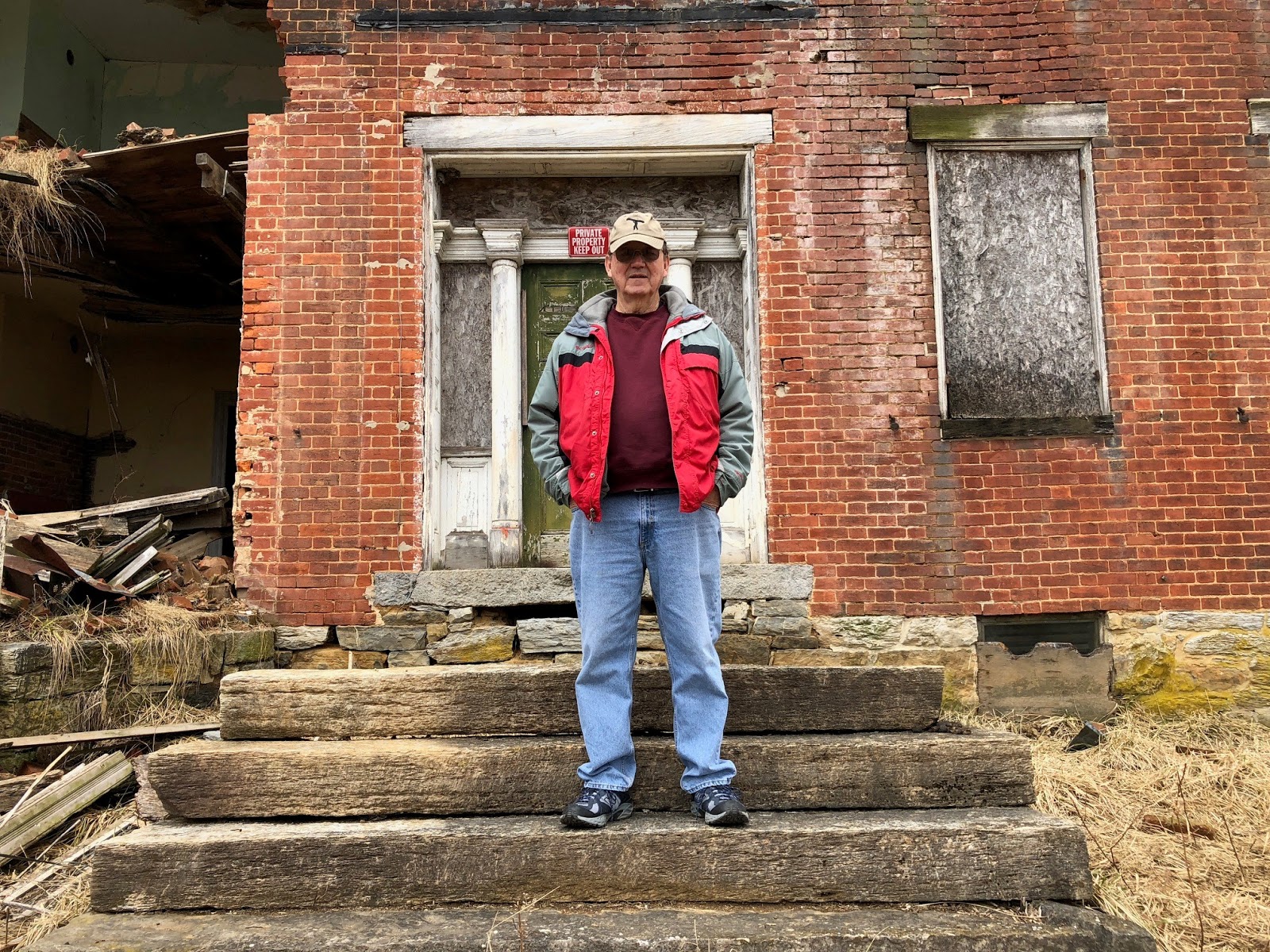
Art Williamson, the friendly owner of the old Jacob Thomas property, on the front steps
 of the crumbling farmhouse. (CLICK ON ALL IMAGES TO ENLARGE.)

Understandably, this Civil War story of the old house and the Massachusetts officer fascinates more than just its two visitors.

"If only I had known this history back then," says 76-year-old Art Williamson, who bought the Jacob Thomas house and surrounding property, including a barn, in 1986.

A peek inside the decrepit summer kitchen, 
which also pre-dates the Civil War.
A retired Bethlehem Steel employee, Williamson and his wife, Judy, originally intended to restore the farmhouse. A contractor gave the couple an estimate of what it would cost to make the place livable and to modernize it. But the price tag was exorbitant, Williamson says, so Art and Judy moved instead into a large house they had built nearby on the property. Even as long ago as 1978, the homestead was on life support. "... deteriorated seriously in recent years," a Maryland Historical Trust report noted then about the Thomas farm and other area properties.

In 1999-2000, Williamson did sink a considerable sum into renovating the circa-1870 barn on the farmstead. Justifiably proud of that fabulous structure, he also enjoys showing visitors about his farm, where he raises llamas, emus, toy donkeys and an assortment of goats. "It's my funny farm," Williamson says with a chuckle. On a recent morning, the gregarious man flaps his arms to shoo away two pesky llamas while an inquisitive donkey nudges a visitor.

Some think the Thomas house is haunted, says Williamson, who regrets that wayward youths have used it for parties and other mischief. As visitors inspect the back of the house, he tells the story of a local man who used a first-floor room for much more ceremonial purposes. His fiancee relished old houses, and so one day the man took her to the Thomas house, where he had a bottle of wine, two glasses and an engagement ring placed on a small table. He proposed right there. "How 'bout that?" says Williamson.

As the visitors leave the property, they try to imagine the terrible September day when Wilder Dwight was carried into this quiet western Maryland landscape. They are left with questions — some likely unanswerable. 

Could the house have been saved? In which room did Dwight die? What passed through his mind as his life slipped away? 

What did the Thomas family feel when the young officer breathed his last? 

As the car pulls onto the road, one thought lingers. A remarkable house is dying, and with it a small but powerful fragment of American history.

I thank my friend, longtime Washington County (Md.) resident Richard Clem, among the best Civil War detectives around, for his tremendous assistance on this story.

Donkeys and an emu approach a visitor on Art Williamson's "funny farm."

-- Have something to add (or correct) in this post? E-mail me here.


SOURCES

-- Dwight, Wilder and Dwight, Elizabeth Amelia, Life and Letters of Wilder Dwight, Lieut.-col. Second Mass. Inf. Vols, Boston, Ticknor and Fields, 1868.

-- Wilder Dwight battlefield letter to his mother, Sept. 17, 1862, Massachusetts Historical Society Collection.

Wednesday, September 23, 2015

Off the beaten path: Terrific museum in Boonsboro, Maryland

Top: A mummified human arm embedded with a minie ball to simulate a Civil War wound. 
Bottom, from left, a relic pyramid and an ambrotype of Confederate officer Henry Kyd Douglas, who
served under Stonewall Jackson. The arm is not believed to have come from a Civil War soldier. 

Like this blog on Facebook | Follow me on Twitter

A decade or so ago, when we still lived in Texas, I took my annual Civil War trip to Antietam. My "Power Tour" routine: Up at 5:30 a.m., drive the battlefield for several hours, lunch in nearby Shepherdstown, W.Va., walk the battlefield for hours in the afternoon, dinner and a cold beer or two at Captain Benders Tavern after dark in Sharpsburg and head back to my room at the excellent Jacob Rohrbach Inn, a short walk up Main Street.

But on this trip I was eager to see something different. I had read about a small, private museum in nearby Boonboro, Md., and its outstanding Civil War collection. So, one afternoon, I made the 6 1/2-mile drive from Sharpsburg up the old Boonsboro Pike (Route 34), past such familiar landmarks as the historic Philip Pry House, Bonnie's At The Red Byrd restaurant (eye-opening coffee!), the Crystal Grotto Caverns and Potomac Street Creamery. At Boonsboro, the quaint town at the foot of South Mountain, I made a left, drove several hundred yards down Main Street and parked in the tiny gravel lot between two buildings.

Boonsborough Museum of History owner/director Doug Bast with
  his assistants, Susan Fair and Jeff Brown.
A small sign out front of one of them noted I had arrived at my destination -- the Boonsborough Museum of History. The two-story museum building was unremarkable: white siding, shades drawn on the windows and a small porch with a deck painted gray. A large cannon tube, perhaps Revolutionary War vintage, lay on a wooden base on the porch, near the blue front door.

The museum was supposed to be open this day, but I was warned the owner's hours were "irregular."

I knocked on the door. No answer. I knocked again. Again, no answer.  After a pause of about 20 more seconds, I knocked one more time and a wiry, shirtless man wearing long pants and sporting a scruffy beard finally answered. The conversation went something like this:

Man: What do you want?

Me: I was hoping to see your Civil War museum. I've heard a lot about it.

Man: I'm not open today. Can't help you.

Me (pleading/whining): But I came all the way from Texas ...

Long, uncomfortable pause.

Man: Come on in, but I can only give you a quick tour.

                      A room of Civil War artifacts in the Boonsborough Museum of History.
                              (Click at upper right for full-screen interactive panorama.)

For the next two hours, museum owner/director Doug Bast (pronounced BOST) was an enthusiastic host, bounding from room to room showing off a remarkable, and often odd, collection that includes Ming Dynasty vases, Egyptian animal mummies, children's caskets, a gauntlet sword inlaid with pure gold, an African witch doctor’s knives and a beheading ax. Most of the rooms were filled floor to ceiling with artifacts ... and stuff.

But it was Bast's Civil War collection that I had come to see, and it was indeed fabulous -- a mixture of the macabre (a skull, perhaps of a Rebel) to the magnificent (an ambrotype of Henry Kyd Douglas, who served on Stonewall Jackson's staff) to the ultra-rare (slave collars). In a case in the front room on the first floor, there was a display of bullets carved by soldiers. One was of Lincoln in a stovepipe hat. In another case, there was a Confederate sniper rifle, a Gettysburg battlefield pickup.

A massive Confederate mortar shell.
A lifelong Boonsboro resident and passionate historian, Bast, 80, has been collecting historical items almost all his life. His family has deep roots in the area: Until it closed in 2011, a furniture store on Main Street in Boonsboro was run by the Bast family for more than 100 years.

The area is also rich in Civil War history. The Battle of South Mountain, fought three days before Antietam, took place near Boonsboro and the Old National Pike. Five days after Gettysburg, on July 8, 1863, Confederate cavalry clashed with Union cavalry and infantry in and near Boonsboro. During the Civil War, the town's churches and public buildings were used as makeshift hospitals for wounded soldiers. The remains of 16th Connecticut Captain Frederick Barber, who was mortally wounded at Antietam, were transported to Boonsboro en route back home to Connecticut.

On Sunday afternoon, I made my first stop at the museum since my long-ago visit. Because I had a long drive back to Connecticut, my stay lasted only about an hour, but it was well worth it. With Bast's eager assistant Jeff Brown as a guide, I checked out a framed letter by famed Civil War nurse Clara Barton, a rare image of Stonewall Jackson, a relic pyramid, a pike from John Brown's ill-fated raid at Harpers Ferry and a war log embedded with an artillery shell, among many other historical treasures and oddities.

On my way out the door, Bast handed me a gift. "Here," he said with a cackle, "is a Boonsboro bullet." I'll keep the minie ball prominently displayed, a nice reminder that I must make another side trip to this off-the-beaten path gem of a museum when I return to Antietam.

After taking the oath of allegiance to the Union in 1864, 10,000 Rebels are said to have kissed this Bible.
A human skull that, according to the card below it, was "found near Fort Fisher many years ago."
Fort Fisher, a massive Rebel fortress near Wilmington, N.C., was captured on Jan. 15, 1865.
A rare image of Stonewall Jackson, minus his famous beard. The photo at right shows Jackson's
 horse, "Little Sorrell," at the residence of Henry Kyd Douglas in Hagerstown, Md., in 1884.
A Confederate sniper rifle picked up after the Battle of Gettysburg.
An artillery shell embedded in a war log.
A rare Civil War-era slave collar.
According to the tag, this is a section of the oak tree under which Union General Jesse Reno 
died at Fox Gap after he was shot at the Battle of South Mountain on Sept. 14, 1862.