Showing posts with label 2nd Massachusetts. Show all posts

Saturday, February 17, 2018

Death spiral: A sad end for house where Antietam officer died

Boarded up and battered by time and nature, the circa-1850 Jacob A. Thomas house near Boonsboro, Md.
(CLICK ON ALL IMAGES TO ENLARGE.)
The summer kitchen and farmhouse have seen much better days.

Like this blog on Facebook

In its death throes, the circa-1850 red-brick house seems cloaked in sadness.

As if scooped out by a massive hand, gaping holes expose the heart of the abandoned, two-story structure on a knoll just off a Maryland country road. Tall weeds sprout from a pile of rubble — all that remains of what was once a splendid bay window. An ancient, well-worn set of stone steps stands orphaned after the collapse of a small wooden porch. A second-floor porch, once an eye-catching feature that mirrored others in the area, is nearly gone. Peeling green paint and graffiti scar the front door.

As if that weren’t warning enough, a small sign on the weather-beaten white transom cautions would-be intruders: Private Property — Keep Out.

Likely baked decades ago in a farmstead kiln, bricks litter the sloping front yard. Just steps from the back door, a wooden privy and summer kitchen slowly lose their fight for survival, while only yards away a beautifully restored post–Civil War barn stands in striking contrast.

The interior of the once-stately home may be seen through gaping holes.
(CLICK ON ALL IMAGES TO ENLARGE.)
A warning sign to trespassers on the weather-beaten and graffiti-marred front door.
Who trod on these well-worn -- and probably original -- steps?
A view of the once-splendid second-floor porch.
A close-up of outside brickwork reveals effects of time and neglect.

Time, nature and trespassers have conspired to wreak havoc inside the Greek Revival–style house. Debris spills from a first-floor fireplace — one of five in the once-stately home. 

A brown doorknob lies forgotten on the floor, perhaps pried loose by a vagrant. Boarded-up windows block what would have been a sweeping view of South Mountain. Wary of falling through rotted wood, two visitors gingerly climb the stairs, stepping carefully over rubble. Bricks choke the hearth of a bedroom fireplace. 

Nearby, a shaft of daylight reveals deep-blue walls in a small room. A gaping chasm where part of the second floor has collapsed halts further exploration. Briefly alone upstairs, one visitor closes his eyes and offers a silent prayer for a long-ago inhabitant of one of the bedrooms.

Debris litters the steps leading to the second floor.
(CLICK ON ALL IMAGES TO ENLARGE.)
Bricks and debris clutter a second-floor bedroom. Could this be where Wilder Dwight died?
Light streams into a second-floor bedroom, revealing the remains of a bed (left) near a wall.

In late-summer 1862, this was the home of Jacob and Sarah Thomas and their daughters, 23-year-old Annie and 17-year-old Eliza. In the vortex of the war in mid-September 1862, families such as the Thomases heard the boom of artillery and crackle of musketry as Union and Confederate armies clashed nearby at South Mountain and at Sharpsburg, near the banks of Antietam Creek.

Wounded at Antietam, Wilder Dwight 
died two days later in a bedroom at the
 Jacob A. Thomas house near Boonsboro, Md.
On the afternoon of September 18, war arrived on the doorstep of the "airy and comfortable" house of Mr.  Thomas, a wealthy farmer. A sense of urgency spurred a group of Massachusetts soldiers, who carried their grievously wounded commanding officer into one of the family's upstairs bedrooms. The lieutenant colonel, a Harvard-educated lawyer, had somehow endured a harrowing, three- or four-mile mile journey on a stretcher from the Antietam battlefield, where his left thigh had been shattered by a Rebel bullet. As he lay in agony near the Hagerstown Pike on the morning of September 17, he completed a note, stained with his blood, to his mother: "All is well with those that have faith."

As comrades lifted him into his bed at the Thomases' house, the soldier repeated, "Now, boys, steady and true! Steady and true!" Soon after soldiers left the bedroom, the wounded man summoned enough energy to tell them, "Wait a minute, boys; you've taken good care of me, and I thank you very much. God bless you!"

Thankfully, the beloved officer was in good hands -- unlike many of their neighbors, the Thomases were a staunch Union family. A devout man and member of the United Brethren Church, 46-year-old Jacob Thomas may have even tended to the spiritual needs of his important house guest.

Also shot in the left wrist, the officer -- who "seemed quiet" -- suffered intense pain in his wounded leg that afternoon. But 2nd Massachusetts Chaplain Alonzo Quint still expected he would live a few more days. Growing weaker, the officer sent a note to a surgeon. "They tell me," he said, "that I may recover. I do not believe it ... " He wondered if his brother, William, a colonel in the 70th New York, were near. Preparing for the worst, he also had a dispatch sent to his father back home in Brookline, Mass., urging him to quickly travel to the red-brick house near Boonsboro, Md.

Painting of Wilder Dwight, completed in 1863. 
(Harvard University Portrait Collection,
 Gift of the children of Mrs. William Dwight
 to Harvard College, 1884.)
The next morning, the ever-attentive Quint kept the blinds closed in the soldier's bedroom and allowed no one to enter. At about 10 a.m., the chaplain noticed his comrade was "considerably weaker." About two hours later, Quint was in the kitchen with Sarah Thomas, who was preparing a beef tea. Suddenly, the wounded soldier's servant alerted the chaplain, "The Colonel is wanting you quick, sir." Quint rushed to the bedroom and  "instantly saw a change" for the worse. Grabbing the wounded man's hand, he said a short prayer; the officer, who couldn't distinguish Quint's features, slowly moved his lips in prayer, too, concluding with an audible "Amen."

Pale and his eyes sunken, the lieutenant colonel slipped away at about 12:30 p.m. on Sept. 19, 1862. "Oh, my dear mother!" he said shortly before he died.

Wilder Dwight -- "the best man in the world," according to a 2nd Massachusetts comrade -- was only 29. He left behind his parents, William and Elizabeth; three brothers and scores of comrades and friends to mourn.

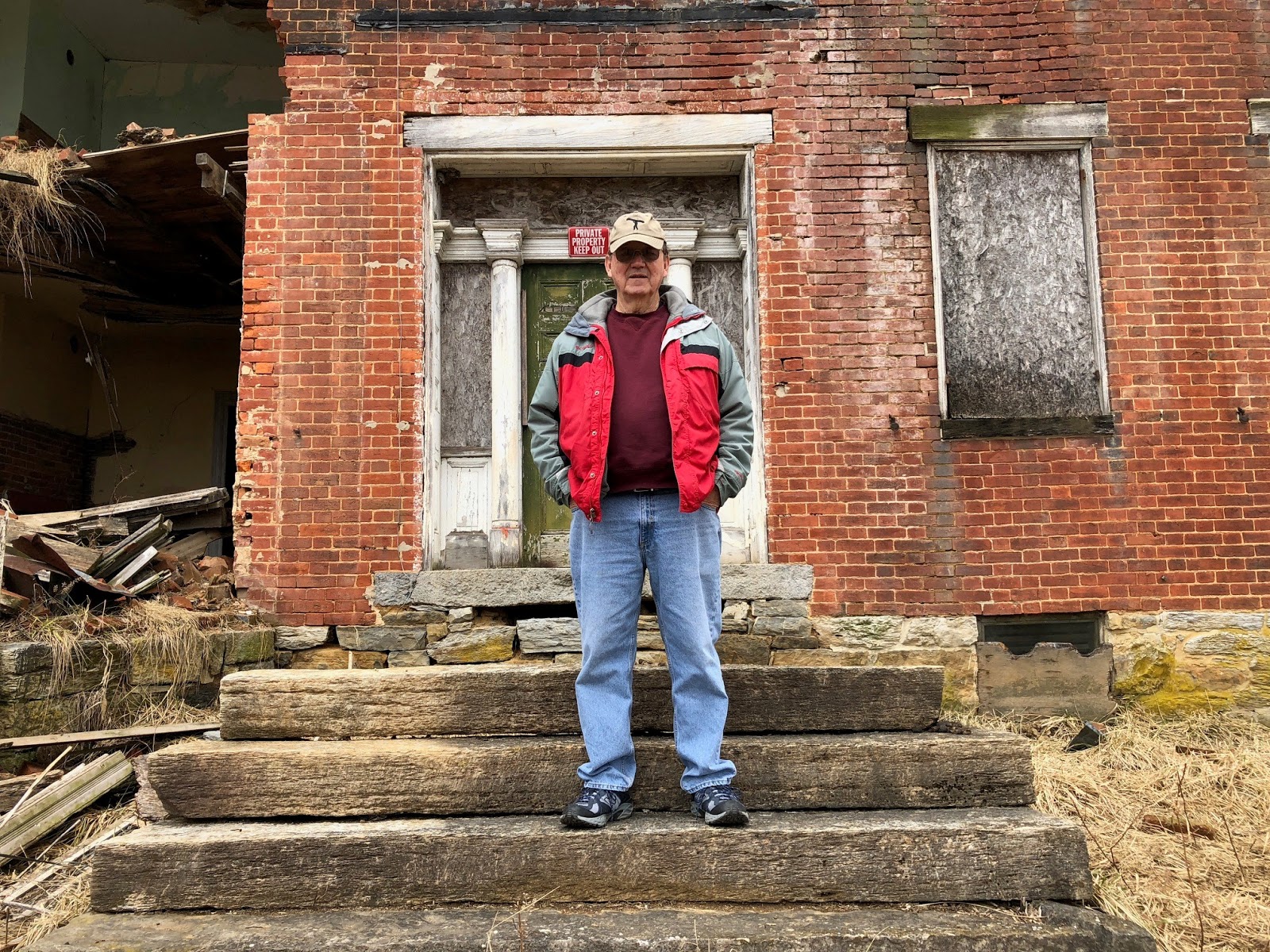
Art Williamson, the friendly owner of the old Jacob Thomas property, on the front steps
 of the crumbling farmhouse. (CLICK ON ALL IMAGES TO ENLARGE.)

Understandably, this Civil War story of the old house and the Massachusetts officer fascinates more than just its two visitors.

"If only I had known this history back then," says 76-year-old Art Williamson, who bought the Jacob Thomas house and surrounding property, including a barn, in 1986.

A peek inside the decrepit summer kitchen, 
which also pre-dates the Civil War.
A retired Bethlehem Steel employee, Williamson and his wife, Judy, originally intended to restore the farmhouse. A contractor gave the couple an estimate of what it would cost to make the place livable and to modernize it. But the price tag was exorbitant, Williamson says, so Art and Judy moved instead into a large house they had built nearby on the property. Even as long ago as 1978, the homestead was on life support. "... deteriorated seriously in recent years," a Maryland Historical Trust report noted then about the Thomas farm and other area properties.

In 1999-2000, Williamson did sink a considerable sum into renovating the circa-1870 barn on the farmstead. Justifiably proud of that fabulous structure, he also enjoys showing visitors about his farm, where he raises llamas, emus, toy donkeys and an assortment of goats. "It's my funny farm," Williamson says with a chuckle. On a recent morning, the gregarious man flaps his arms to shoo away two pesky llamas while an inquisitive donkey nudges a visitor.

Some think the Thomas house is haunted, says Williamson, who regrets that wayward youths have used it for parties and other mischief. As visitors inspect the back of the house, he tells the story of a local man who used a first-floor room for much more ceremonial purposes. His fiancee relished old houses, and so one day the man took her to the Thomas house, where he had a bottle of wine, two glasses and an engagement ring placed on a small table. He proposed right there. "How 'bout that?" says Williamson.

As the visitors leave the property, they try to imagine the terrible September day when Wilder Dwight was carried into this quiet western Maryland landscape. They are left with questions — some likely unanswerable. 

Could the house have been saved? In which room did Dwight die? What passed through his mind as his life slipped away? 

What did the Thomas family feel when the young officer breathed his last? 

As the car pulls onto the road, one thought lingers. A remarkable house is dying, and with it a small but powerful fragment of American history.

I thank my friend, longtime Washington County (Md.) resident Richard Clem, among the best Civil War detectives around, for his tremendous assistance on this story.

Donkeys and an emu approach a visitor on Art Williamson's "funny farm."

-- Have something to add (or correct) in this post? E-mail me here.


SOURCES

-- Dwight, Wilder and Dwight, Elizabeth Amelia, Life and Letters of Wilder Dwight, Lieut.-col. Second Mass. Inf. Vols, Boston, Ticknor and Fields, 1868.

-- Wilder Dwight battlefield letter to his mother, Sept. 17, 1862, Massachusetts Historical Society Collection.

Friday, January 19, 2018

History up close: Wilder Dwight's bloodstained Antietam note

Bloodstained battlefield note written by Wilder Dwight to his mother as he lay mortally wounded.
(Massachusetts Historical Society)
The second page of Wilder Dwight's blood-stained battlefield note to his mother. After he was wounded on
the morning of Sept. 17, 1862, he struggled to complete it. (Massachusetts Historical Society)

Like this blog on Facebook | Follow me on Twitter

In the last act of his short military career, Wilder Dwight implored his soldiers in the 2nd Massachusetts to keep their heads down as fighting raged near the Hagerstown Pike. Just before he was about to give further orders during the Battle of Antietam, a bullet struck him in the left hip, sending him crashing to the ground. "They have done for me," the 29-year-old lieutenant colonel said after he was shot.

Wilder Dwight
Also wounded in the left wrist,  Dwight complained of intense pain, but while his regiment fell back a short distance, he refused to be moved. The pain was simply too much to bear. As the fighting swirled near the Dunker Church, the Harvard-educated officer struggled to complete the short note he had begun to his mother earlier that misty morning of Sept. 17, 1862, well before the fighting reached a crescendo:

"Dearest Mother, — I am wounded so as to be helpless. Good by, if so it must be. I think I die in victory. God defend our country. I trust in God, and love you all to the last. Dearest love to father and all my dear brothers. Our troops have left the part of the field where I lay.

"Mother, yours,

"Wilder."

Across the opposite page, in much larger letters, he wrote:

"All is well with those that have faith."

The note was stained with his blood.

Finally rescued from the battlefield by comrades, Dwight died in private residence in Boonsboro, Md., two days after the battle.

At the Massachusetts Historical Society this afternoon, I examined for the first time Dwight's heart-rending note to his mother, Elizabeth. It was an extraordinary experience.

"All is well with those that have faith," grievously wounded Wilder Dwight concluded his note to his mother.
(Massachusetts Historical Society)


Have something to add (or correct) in this post? E-mail me here.


SOURCES


-- Life and Letters of Wilder Dwight, Lieut.-Col. Second Massaschusetts Infantry Volunteers, Boston, Ticknor and Fields, 1868.

Saturday, October 15, 2016

Antietam: Echoes from Susan Hoffman Farm hospital

Susan Hoffman farmhouse, built in 1840s. PLEASE NOTE: This is private property. Do not trespass.
(CLICK ON ALL IMAGES AND INTERACTIVE PANORAMAS TO ENLARGE)
    PANORAMA: Scores of wounded were treated here on Sept. 17, 1862, and afterward. 
 
Like this blog on Facebook | Follow me on Twitter

For many readers of The New York Times on Oct. 12, 1862, the death list of Union soldiers published on Page 1 must have rocked their souls. More than 300 men and boys in blue, according to the report that filled two full columns, had been buried or died at makeshift Federal hospitals near the Antietam battlefield.

On Oct. 21, 1862, The New York Times
published a lengthy list of soldiers
who had died at Antietam hospitals.
At George Line's farm
,  known as the "White House Hospital" because of Line's white-washed log cabin, the death toll was 156 soldiers — 101 Union and 55 Confederate. At the "Stone-House Hospital," Samuel Poffenberger's farm, the total number of deaths was listed as 37. At a hospital run by 12th Massachusetts surgeon John Hayward, 11 soldiers were buried "whose names could not be ascertained."

And at the "Hoffman Farm Hospital," the beautiful home of 56-year-old widow Susan Hoffman, 57 soldiers had died — mostly from General Edwin Sumner's II Corps that fought in David R. Miller's cornfield and in the East and West Woods. Among them, according to the Times report, were eight unknown soldiers, including a "large man" who wore a "red woolen shirt."

A  newspaper correspondent who happened upon Widow Hoffman's farm along the Keedysville Road the morning of Sept. 17 found an  "appalling sight."

"The wounded were lying in rows awaiting their turns at the surgeons' tables," Charles Carleton Coffin wrote. "The hospital stewards had a corps of men distributing straw over the field for their comfort."

                    Google Earth: Hoffman barn is the large building near center of image.

With a large farmhouse, barn and several other outbuildings and an ample water supply from a spring, Widow Hoffman's 284-acre farm was ideal for a military hospital. On Sept. 21, the U.S. Christian Commission established its headquarters at the farm, supplying a beleaguered Union medical staff with bandages, linens, medicine and the soldiers with Bibles and religious literature. Rev. Isaac O. Sloan, a member of the commission, described a harrowing scene:

Reverend Issac O. Sloan of the
U.S. Christian Commission
(University of North Dakota)
At the Hoffman Hospital there were at least fifteen hundred [wounded], and at the Stone House as many if not more. On Sunday succeeding the battle we established ourselves permanently at the Hoffman House, thinking it better to concentrate our energies upon one point. In every spot here -- the barn, the stable, carriage-house, sheds, straw stacks, orchards, and indeed everywhere --  were to be seen wounded and dying men. 
For the first few days, of course, all was bustle and confusion. Nothing scarcely could be thought of but affording relief to the sufferers. Prayer only could be made at the side of one drawing near to his end, or words of Scripture whispered into the ear of the moaning patient as we dressed his wound or gave him nourishment. We had scarcely a moment for sleep. Many incidents of thrilling interest occurred here. A great proportion of the sufferers were youths, ranging from sixteen up to twenty-one years. After a few days, when matters were somewhat systematized, we had religious services every evening, in the barn, in the dwelling-house, carriage-house, and wherever there was a large number collected.
On Sept. 17, 2016, the 154th anniversary of the battle, the owners of the farm gave me a tour of their circa-1840s brick farmhouse, the old slave quarters behind the house and a circa-1810 springhouse, perhaps the first dwelling on the property. Afterward, they graciously allowed me to examine the rest of the grounds.

I heard echoes of the past almost everywhere.

(PLEASE NOTE: This is private property. Do not trespass.)

Religious services were held in the farmhouse (above), carriage house and elsewhere on the farm.
                               PANORAMA: Springhouse, circa 1810, and farmhouse.

Nearly two weeks after the battle, about 200 wounded remained at the Hoffman farm hospital, reported a New York Times correspondent, who made special mention of a woman who comforted soldiers there. Helen Gilson, a 26-year-old nurse from Chelsea, Mass., arrived at Antietam the day after the battle.

Nurse Helen Gilson arrived
at Antietam the

 day after the battle.
(Photo: Our Army Nurses)
"She had been a very angel of goodness to the soldiers," the reporter wrote, "and her presence and conversation seem to inspire new life and courage wherever she goes." As she made her rounds one day, a wounded soldier asked Gilson if she would sing. She "instantly complied" with "inimitable spirit" with a rendition of The Star Spangled Banner.

"The effect on these wounded soldiers was almost inspiring," the reporter wrote. "They clapped their hands and manifested the greatest pleasure. One poor fellow, who had lost a hand, cried out: 'I cannot clap, Miss, but I can pound,' and sitting the action to the word, struck his wounded stump upon the floor where he was lying, with impassioned earnestness. Miss G. is neither over 30 nor very homely, and in these particulars does not come up to the required standard of army nurses."

While working for the U.S. Sanitary Commission in Fredericksburg, Va., in the spring of 1864, Gilson received praise from a doctor who met her there for the first time:
"One afternoon just before the evacuation of Fredericksburg, when the atmosphere of our rooms was close and foul and we were longing for a breath of our cooler Northern air, and the men were moaning in pain or restless with fever and our hearts were sick with pity for the sufferers, I heard a light step upon the stairs; and looking up I saw a young lady enter who brought with her such an atmosphere of calm and cheerful courage, so much freshness, such an expression of gentle womanly sympathy that her mere presence seemed to revive the drooping spirits of the men... "
Alarmed that ill and wounded black soldiers did not receive proper care at City Point, Va. in 1864, Gilson — who served as a nurse through the end of the war — went to their aid. "These stories of suffering reached Miss Gilson at a moment when the previous efforts of the campaign had nearly exhausted her strength," a post-war account noted, "But her duty seemed plain."

In 1866, Gilson married E. Hamilton Osgood in Chelsea. Apparently still sufferring the effects of malaria from the war, she died in childbirth on April 20, 1868. She was only 32.

Hundreds of wounded lay in and around the Hoffman barn.
                    PANORAMA: Barn, carriage shed and farmhouse date to the battle.

After advancing past the dead and wounded from both armies that covered David R. Miller's cornfield, the 1st Minnesota pushed into the West Woods. "At last we halted at the edge of a cornfield by a rail fence," Color Sergeant Samuel Bloomer of Company B wrote in his journal, "but still we were in the woods. Had not been at the fence more than 15 minutes before a most terrific fire was poured into the left of our brigade from the rear & front & which fire came quickly down the line to the right where we were."

Color Sergeant Samuel Bloomer of the
1st Minnesota was wounded in the West Woods.
(Minnesota Historical Society)
As Bloomer lay the flagstaff on the fence, a Rebel bullet tore into his right leg, leaving a ghastly wound just below the knee. Soon, his regiment  retreated, leaving behind the 26-year-old soldier from Stillwater, in the Minnesota Territory. Desperate to avoid being shot again, Bloomer crawled behind a large oak tree and dressed the wound, bathing it with water from his canteen.

"The advance of the secesh soon made their appearance &  passed by me but did not go a great ways further but formed their picket line about 40 rods in front of  me," Bloomer wrote. "Shortly their line came up & formed just where our line had stood, which left me about 40 rods in front of their line."

Captured by the Rebels, Bloomer lay on the field, "watching shells of both armies playing in or about there all day cutting off limbs of trees & tearing up the ground all around me, which made it a very dangerous place." After the war, Bloomer said several Rebels, including Sergeant William H. Andrews of the 1st Georgia, piled cord wood about him to prevent him from getting shot again.

The act of kindness may have saved Bloomer's life.

"I have no doubt," he recalled, "that more than 100 bullets struck that barricade that day."

Later, Stonewall Jackson himself rode by, asked Bloomer what regiment he belonged to and ordered his men to make him as comfortable as possible. That night, a North Carolina captain struck up a conversation with Bloomer, giving the Yankee a canteen of water that the officer later replenished. Perhaps their kindly treatment of him made up for the behavior earlier of another Confederate officer, who caused Bloomer to seethe when the man cursed him and called him a "nigger thief."

1902 newspaper image of Bloomer, 
whose right leg was amputated
in the Hoffman barn

(Walter Jorgenson's 1st Minnesota site)
"I had a revolver and short sword under by rubber blanket on which I lay," Bloomer said, "and in my rage I attempted to get at my revolver, intending to shoot that fellow. But he had his eyes on me and shouted, 'Disarm that man!' " Luckily for Bloomer, the Rebels didn't harm him, but they compelled him to part with his prized sword and two revolvers.

Until later the next day, Bloomer lay in the same spot, within sight of the bodies of his comrades. At about 6 p.m. on Sept. 18, Rebel soldiers took him on a  stretcher to a nearby barn "surrounded with straw stacks," perhaps on Alfred Poffenberger's farm, where the enemy kept more than 100 Union prisoners. Lee's army slipped across the Potomac River into Virginia that night, leaving the seriously wounded Bloomer and his comrades behind. 

"I for one," the Swiss-born soldier wrote in his journal, "slept but little last night for pain."

Early on the morning of Sept. 19, Union troops finally appeared, among them Bloomer's cousin, Adam Marty of Company B. About noon, comrades transported Bloomer by ambulance to the Hoffman farm, where he lay all night "with most dreadful pain." In and around the barn on a hill near the farmhouse, Bloomer saw "some 5 or 600 wounded soldiers."

At 8 a.m, the next morning — a "day that will long be remembered by me," he wrote — Bloomer found himself on an operating table in Hoffman's barn. Regimental surgeon Edwin Pugsley amputated the  sergeant's right leg above the knee. "And from then," Bloomer wrote, "the suffering commenced in earnest."

Less than three months after Antietam, Bloomer received a discharge from the United States Army. (He served briefly in the Veterans Reserve Corps as a lieutenant.) On Dec. 6, 1863, one year after his discharge, he married Matilda J. Burns, with whom he had four children.

A local newspaper trumpeted his return home.

"In the fierce struggle of Antietam, where so many brave hearts beat out their last pulses Sam lost one of his faithful legs and was forced to relinquish his glorious charge which he had so faithfully guarded to other hands," the Glencoe (Minn.) Register and Soldiers Budget reported on Jan. 10, 1863. "And so he is back again, a cripple for life ... his fund of good humor in no way diminished. Long may he live!"

After the war, Bloomer worked as prison guard, insurance agent and sewing machine salesman and served in the Grand Army of the Republic, a veterans' organization. Shortly after he caught Matilda with another man, the couple divorced in 1875. He re-married in 1882 and lived out his days in Stillwater, Minn. By the time he was 80, the old soldier who lost his leg in a barn near the Antietam battlefield could barely walk. Bloomer died on Oct. 4, 1917 at 81.

Diary of Hallowell Dunham, a private in the 19th Massachusetts, who died at the Hoffman farm.

Twelve days before Rebels routed his regiment at Antietam, 21-year-old Hallowell R. Dunham, a private in Company B of the 19th Massachusetts, wrote an entry in his leather-covered journal.
"Today is Sunday 7 a.m. but how different from our quiet New England Sunday. Nothing round me to remind one that it is God's day of rest. Much would I give if I could spend only one more Sabbath at home. But that cannot be. It may never be again. But I pray God that it may be. God help me to live so that if I never spend an earthly Sabbath at home with friends I love, that I may meet them in Heaven." 
Hallowell Dunham's leather-covered
 diary 
was discovered in the Hoffman barn. 
On the morning of Sept. 17, the youngest son of Marcia Dunham suffered a wound in the foot in the West Woods. Transported to the Hoffman farm, Dunham — known as "Hal" to his friends — died there on Oct. 2, perhaps from infection caused by the wound.

For Marcia Dunham, the mother of nine children, the death of her son was another cruel blow. Her husband, Julius, had died in 1841, and before and after Hallowell enlisted in the Union army on July 26, 1861, the 62-year-old woman relied on her son's financial support. A clerk before the war, Hallowell paid the rent for his mother, a boarder at the home of a 38-year-old farmer named William Hoar in Littleton, Mass.

"We well know that her said son contributed the greater part of his earnings for her support prior to his enlistment and that he left her an allotment of his pay and has regularly paid her board and for her clothing," an affidavit in Marcia's claim for her son's pension noted. Shortly after her son died, Marcia filed a claim, and she soon was granted a payment of $8 a month.

Old slave quarters behind the Hoffman farmhouse.
The Hoffman family's slaves lived in this small outbuilding in back of the farmhouse.
Interior of slave quarters, now used for storage.

By 1868, Benjamin Remick Sr. was a broken-down man, "afflicted with atony ... which approaches a general collapse of the whole mental and physical condition." Only 58, he was "prematurely old and infirm," a physician wrote, "so that he can do but little work at his usual trade" and was "unable to support himself or his family."

Perhaps it was no wonder. Six years earlier, the bootmaker from Milford, Mass., had suffered immense loss. 

At Antietam, his 22-year-old son, Benjamin Jr., a private in Company H of the 2nd Massachusetts, was killed instantly during brutal fighting in Miller's cornfield. He left behind an 18-year-old wife named Susan and a 1-year-old son, Nathaniel. Moments before Benjamin was killed, his younger brother, 17-year-old Prescott, suffered a severe wound. A bootmaker like his father, the private in Company G of the 2nd Massachusetts stood 5 feet tall and had hazel eyes, dark hair and a dark complexion.

2nd Massachusetts Private Prescott Remick's 
gravestone at Antietam National Cemetery.
"I noticed him in particular, as his position was very near my own," Lieutenant John F. George recalled about Prescott, "and I noticed with admiration the coolness and contempt of danger with which he performed his duty. He was shot (I think) in the shoulder while standing near his brother, who was killed almost immediately after. During the turmoil and confusion, I lost sight of him but, on making enquiries, ascertained that he had been sent to the rear."

On Sept. 24, a week after the battle, a Wisconsin soldier wrote to Benjamin Sr, about the condition of his son, who received care at the Hoffman farm, and broke grim news about Benjamin Jr.:
"Last Sunday on visiting the hospitals near the battlefield near Sharpsburgh, Md., I saw your son Prescott, who is wounded through the back. He suffered considerably  the next day (Monday) I saw him again, when I found him much more easy  having had the ball extracted. He requested me to write you, which I promised to do. He has the sad news to add to that of his fate  the death of his brother Benjamin  who was shot at his side just as he himself fell. I could not stay long with him. I am detailed to see to wounded and am permitted to travel at all times between Washington and the battle fields, and may meet him again. I will be happy to answer any enquiries you may make in regard to him as far as I know if you address me at 329 New York Avenue Washington. If I don't answer at once you may know that I am out on the field but on my return will attend to it.  
 Respectfully yours Wm. P. Taylor 2nd Wis. Vol.
Three days later, on Sept. 27, Prescott died. His remains were buried at a small cemetery at the Smoketown Hospital, a short distance from Hoffman's farm. A battlefield visitor, probably a soldier from Massachusetts, discovered Remick's grave there in the summer of 1863. In a lengthy letter rich with detail about Antietam, he wrote:
"The shade on this summer morning is calm, deep and holy. From the field there is the odor of clover blossoms. There is not wanting the hum of bees and the songs of birds to lend a charm to the hour. The paling is neatly whitewashed which surrounds the consecrated spot. There are a hundred and fifty-nine graves, each with its rounded, white headboard, and rude lettering, with name, company and regiment of the dead. A loving heart, a faithful hand has planted a rose bush above the dust of Prescott Remic, of Company G, 2nd Massachusetts. It is fresh and green; its roots are creeping down to the coffin lid, and will draw its nourishment from the mouldering form beneath. Another year and the crimson flower will bloom with rarest beauty and richest fragrance.
After the war, Prescott remains were disinterred from the Smoketown hospital cemetery and reburied in Antietam National Cemetery. His remains lie there today under grave marker No. 978.

The springhouse may be the original dwelling on the property.
A view of the springhouse from the second-floor porch.
Back of the two-story farmhouse. Amputated limbs were tossed from windows,
 according to family lore.
Sign on Keedysville Road noting historic significance of the Hoffman farm. Please note: This is
private property. Do not trespass.

— Have something to add (or correct) in this post? E-mail me here.


SOURCES:
  • 1860 U.S. Federal census
  • Antietam on the Web, accessed Oct. 14, 2016
  • Hallowell Dunham, Benjamin and Prescott Remick pension files, National Archives and Records Administration, Washington, D.C. via fold3.com
  • Confederate Veteran Magazine, April, 1909, Page 169
  • New York Times, Oct. 6 and 12, 1862
  • Find a Grave
  • Gallipolis (Ohio) Journal, Sept. 3, 1863. The Antietam account of Prescott Remick's grave came from this Ohio newspaper. The account evidently was printed in several U.S. newspapers in 1863
  • Gardner Holland, Mary A., Our Army Nurses, Boston, B. Wilkins & Co. Publishers, 1895
  • Moss, Rev. Lemuel, Annals of the U.S. Christian Commission, Philadelphia, J.P. Lippincott & Co., 1868
  • Nelson, John H, As Grain Falls Before The Reaper, The Federal Hospital Sites And Identified Federal Casualties at Antietam, Privately published CD, Hagerstown, Md., 2004. (Nelson's outstanding work is a terrific resource on Antietam hospitals.)
  • Samuel Bloomer's journal excerpts are from Walter Jorgenson's excellent 1st Minnesota web site.  The journal is part of the Minnesota Historical Society collection, which Jorgenson cites on his web site
  • The Century Magazine, "Antietam Scenes" by Charles Carleton Coffin, June 1886

Monday, August 15, 2016

Notes from Antietam battlefield: 'Good bye if so it must be'

Tintype of 7th Michigan Private Basil Leon DeShetler. (Image courtesy Jeff Makholm)

 Like this blog on Facebook | Follow me on Twitter | My YouTube videos

Amid the roar of artillery, thunderclap of thousands of muskets and cries of battle, four seriously wounded United States soldiers dashed off notes as they lay incapacitated on the Antietam battlefield. Each man suffered wounds within a short distance of each other that awful Wednesday morning of Sept. 17, 1862. None of them survived.

Two of the soldiers served with the veteran 7th Michigan — one a Methodist minister who had a wife named Lucinda and eight children; the other an unmarried officer who had been born in Clear Spring, Md., roughly 25 miles from the battlefield.

The other two soldiers served in Massachusetts regiments — one a farmer from Grafton, a town that suffered a horrendous toll at Antietam, while the other was a Class of 1855 law school graduate from Harvard and a former prisoner of war. Their veteran regiments — the 15th Massachusetts (Ball's Bluff, Fair Oaks, Malvern Hill) and 2nd Massachusetts (Cedar Mountain and Winchester) — had fought in Virginia during the first 15 months of the war. 

But Antietam was a much different, and much bloodier, battle than any of these four soldiers had experienced.

Mortally wounded at Antietam, Basil DeShetler
 was the married father of eight children.
(Image courtesy Jeff Makholm)
BEFORE THEY CROSSED ANTIETAM CREEK, 7th Michigan soldiers received 40 rounds of cartridges for their boxes and 20 more for their haversacks. "Any goodbyes were said and letters were sent home to our loved ones," a 7th Michigan soldier recalled about the night before the battle. "Prayer meetings were held throughout the army." 

After the Michigan soldiers advanced from the East Woods in line of battle with others in the II Corps, a small, whitewashed brick church came into view through the battle smoke. Then Rev. Basil Leon DeShetler of Company D crumpled to the ground with a wound to his right hip. 

A devout and patriotic man, the 7th Michigan private frequently dashed off short notes in his diary. In July 1862, he wrote this stirring entry in pen:
"I hope to hear a voice above the roar of cannon and the din of battle, full of sweetness and majesty, in which are blended the sympathy of man with the omnipotence of God saying to my poor soul, 'Thy sins are forgiven thee, be of good cheer.' The man who is willing that the Union should be divided by the sword of treason may have been born in America, but he cannot have an American heart..."
While he lay wounded at Antietam, the 32-year-old soldier grabbed a pencil and again opened his small pocket diary. "At sunrise in battle," he had scrawled earlier that day, but then added: "7 AM at which I am wounded. This is written on the spot wherein I lay. May God bless me and forgive all my sins, through Jesus Christ."

Taken to the Susan Hoffman farm hospital on the Keedysville Road, DeShetler died nearby at the tent hospital at Smoketown on Oct. 9, 1862. After the war, his body was recovered and re-buried at Antietam National Cemetery.

Basil DeShetler described himself as a "soldier of the cross" in his war-time diary.  
In this entry,  Basil DeShetler, a Methodist minister,  noted he was wounded 
at Antietam: "Bless me and forgive all my sins through Jesus Christ." The entry was made
the morning of Sept. 17, 1862, but was written on a page for 1861 in the diary.
(Diary images courtesy Jeff Makholm)

LIKE DeSHETLER, 7th Michigan Captain Allen Zacharias was from Monroe County, south of Detroit and west of Lake Erie, An 1860 University of Michigan graduate, he served as a professor and principal at the State Military Institute in Brandon, Miss., when the war began. One of seven brothers, three of whom served in the Union army, Zacharias enlisted in Company K of  the 7th Michigan as a 1st lieutenant on June 25, 1861. Nearly nine months later, he was promoted to captain.

7th Michigan Captain Allen Zacharias.
While at Fair Oaks, near Richmond, the 29-year-old Maryland-born officer wrote a note, dated June 28, 1862. It included details of his life and these 42 words:
"Friend, If you find my body lifeless upon the field, bury it decently, mark its resting place, and inform my friends in the regiment and my father. Do this and you shall be liberally rewarded and have the gratitude of my friends." 
When the 7th Michigan pushed toward the West Woods at Antietam with the 69th and 72nd Pennsylvania, it found disaster. In 30 minutes of savage fighting, Confederates routed General John Sedgwick's division, which also included the 15th Massachusetts. The 7th Michigan suffered 50 percent casualties in the nearly 300-man regiment, including Captain James Turrill and lieutenants John Clark and John P. Eberhard, who were killed.

Severely wounded in the spine and apparently unable to talk, Zacharias was found clutching a piece of paper in the West Woods by a soldier from Maine. Written in pencil on an old envelope, the heart-rending note to his family read:
"Dear Parents, Brothers and Sisters:  I am wounded, mortally I think. The fight rages around me.  I have done my duty, this is my consolation.  I hope to meet you all again.  I left not the line until nearly all had fallen and the colors gone.  I am getting weak, my arms are free, but my chest is all numb.  The enemy trotting over me, the numbness up to my heart.  Goodbye all.  Your son, Allen.
Tucked into his pocket diary was the note he had written at Fair Oaks regarding the disposition of his body should he be found dead. A private in the 4th Maine Battery sent to Zacharias' family the short Antietam battlefield note.

On Jan. 9, 1863, the Maryland Press, a Hagerstown newspaper, reported the death of Zacharias.

Initially, Zacharias was sent to a field hospital. "He was shot near the right shoulder blade, the ball striking the spinal chord, and passing near — perhaps entering the left lung," the Monroe Commerical reported on Oct. 2, 1862. "His legs were paralyzed, but he has had no fever — a favorable symptom. The surgeon could not yet tell the extent of the damage — it might be temporal and or it might be serious."

Later, the Michigan officer found himself recovering at the house of a well-to-do farmer and friend named Joseph B. Loose in nearby Hagerstown, where his father, sister and other family members visited him. But Zacharias never recovered, and he died there on New Year's Eve 1862. On Jan. 3, 1863, he was buried next to his mother in the German Reformed Church cemetery in Ida Center, Mich.

 Sergeant Jonathan Stow of the 15th Massachusetts had his leg amputated at the Hoffman farm.
(Photo courtesy Richard Gold)

PERHAPS AT THE SAME TIME Zacharias wrote the note to his family, a soldier in the 15th Massachusetts was jotting an entry in his diary as he lay in agony with a wound to his right leg in the West Woods. A 30-year-old sergeant, Jonathan P. Stow struggled to describe the scene:
Battle oh horrid battle. What sights I have seen now see around me. I am Wounded! And am afraid shall be again as shells fly past me every few seconds carrying away limbs from trees and scattering limbs around. Am in severe pain. Furies how the shells fly. I do sincerely hope shall not be wounded again. We drove them first till they got sheltered then we had a bad place. Oh I cannot write.
Stow received care from the Rebels, who abandoned him when they retreated into Virginia on the night of Sept. 18. Two days after the battle, he was found by Federal soldiers and transferred to the Hoffman farm, where he had his right leg amputated. In his diary, he continued to document his plight and the horror faced by other wounded Union soldiers:

Sept 18th – Thursday.  Misery. Acute, painful misery.  How I suffered last night.  It was the most painful of anything have experienced. My leg must be broken for I cannot help myself scarcely any. I remember talking and groaning all night. Many died in calling for help. Sergt. Johnson, who lies on the other side of the log is calling for water. Carried off the field at 10 AM by the Rebs who show much kindness but devote much time to plundering dead bodies of our men…Water very short. We suffer much.
15th Massachusetts Sergeant Jonathan Stow.
(Grafton, Mass., Historical Society)

Sept. 19th –Friday. Rained only a little. I had a rubber blanket and overcoat. Rebs retreat. Another painful night. Oh good God, a whole line of our skirmishers are coming…There are lots of us lain out…By and by our boys come along.  What lots of the 15th. Captain comes down to get the names and has coffee furnished us.—Twas the best cup I ever tasted. Dr. looks at my wounds and calls it a doubtful case. Get me on ambulance at 3 PM but do not get to the hospital till nearly dark.  Plenty of water  which gives us a chance to take down inflammation. Nurses worn out by fatigue. Placed on straw near the barn.

Sept. 22nd – Monday. Two men died last night…How painful my stump is.  I did not know was capable of enduring so much pain. How very meager are accommodations – no chamber pots & nobody to find or rig up one.  How ludicrous for 2 score amputated men to help themselves with diarrhea.

Sept. 23rd – Tuesday.  Oh what fearful long nights. What difficulties we have to contend…Relief can hardly be found. I have at length got my limb dressed by volunteer surgeon. But never was so exhausted for want of refreshment.
.
Sept. 28th – Sunday. Oh what lengths to the nights. The horrid smell from the mortifying limbs is nearly as bad as the whole we have to contend. Mrs. Lee and another lady are here daily dispensing cooked broths…They seem to employ  their whole time for us.  Move outdoors in the PM. Excessively hot.

Sept. 29th – Monday.  Slept little more comfortable last night. Got nice soups and nice light biscuit and tart also nice butter from Mrs. Lee. Also she gets me milk again this morning. How the quinine keeps me parched for water and so sleepy and foolish. Am much better off here than in barn.  10 AM my comrade died from the 18th Minn. Regt. I rec’d 4 letters from friends or home but am so boozy it takes the whole AM to read them.  Mr. Dr. Kelsey dressed my stump admirably and am quite comfortable if the quinine does not choke me to death. It is far more quiet here but begins to rain.

Later that night, however, Stow had an urgent telegram sent to his father back in Grafton: "Dangerously wounded at Hoffman's hospital near Sharpsburg," it read. "Come instantly."

Two days later, he died—one of 11 soldiers from Grafton to die of wounds suffered at Antietam. Stow's remains were sent home to be buried in the Old Oak Street Burial Ground.

15th Massachusetts Sergeant Jonathan Stow died at the Hoffman farm, a major 
Union hospital at Antietam. (Image courtesy Richard Gold) 
Wilder Dwight lay wounded near the Hagerstown Pike on the morning of Sept. 17, 1862.

ABOUT 2 1/2 HOURS BEFORE ALL HELL BROKE LOOSE for the U.S. Army in the West Woods, Wilder Dwight, a lieutenant colonel in the 2nd Massachusetts, jotted a short note to his mother.

"We are engaging the enemy and are drawn up in support of [General Joseph] Hooker who is now banging away most briskly," the 29-year-old officer wrote in pencil in neat cursive. "I write in the saddle to send you my love and to say that I am very well so far --"

By September 1862, Dwight was a veteran of several battles and had even spent time in Rebel captivity after his capture near Winchester, Va., in late May 1862. (Days later, the army exchanged him for a Confederate officer.)

At about 9:30 a.m. at Antietam, the 2nd Massachusetts was in a bad fix. Sedgwick's division had been routed, and the Massachusetts soldiers aimed to stop Rebels streaming from the West Woods. As Dwight commanded the regiment near the Hagerstown Pike, a bullet tore into the lawyer's left wrist and hip, sending him crashing to the ground in agony.

2nd Massachusetts Lieutenant Colonel Wilder Dwight
was mortally wounded at Antietam on Sept. 17, 1862
(Massachusetts Historical Society collection)
"The regiment soon fell back a short distance," a 2nd Massachusetts officer recalled, "and men were ordered to carry him, but the pain was so intense that he refused to be moved."

While the fighting swirled about him, Dwight pulled from his pocket the note to his mother that he had begun earlier that morning. This time, the words he wrote were nearly indecipherable:
"Dearest mother, I am wounded so as to be helpless. Good bye if so it must be. I think I die in victory. God defend our country. I trust in God & love you all to the last .Dearest love to father & all my dear brothers. Our troops have left the part of the field where I lay -- Mother, yrs Wilder
"All is well with those that have faith."
Blood from his wounds stained the paper.

Eager to help the man who gained his acquittal in a manslaughter case before the war, a private in the 2nd Massachusetts courageously ventured into no-man's land with a canteen filled with water. "When I got near the road I had to crawl on my hands & knees," Rupert Sadler wrote seven days after the battle. "The rebels had not advanced any, & I saw a horse which I thought was the Colonels. While I was examining it a squad of rebels saw me, & before firing at once at me, I laid down behind the horse until they stopped."

Soon, Sadler spotted Dwight lying with his head against a rail, his thigh bone apparently shattered. The private offered to bind his wounds, but Dwight refused, saying it was no use. He gave Sadler and other soldiers in the regiment directions for carrying him, and they lifted him into a cornfield, where a regimental surgeon examined him.

The next day, Dwight was carried three miles in shifts by a 12-man detail of new recruits to Boonsboro, Md., because an ambulance was unavailable. The lieutenant colonel was cared for there in the bedroom of a brick house owned by a farmer named Thomas, a Union sympathizer. Dwight's eyes were pale and sunken, recalled 2nd Massachusetts chaplain Alonzo Quint. On Sept. 19, he took a turn for the worse. The chaplain said a prayer over Dwight, whose face lit up when his mother was mentioned. A little after noon, he cried, "O, my dear mother," and died about 15 minutes later.

"Dear Wilder Dwight!" 2nd Massachusetts Lieutenant Henry Stone wrote after his comrade's death. "He was the best man in the world."

On Sept. 25, 1862, Dwight received a hero's funeral in Boston and was buried in Forest Hills Cemetery.

WILDER DWIGHT'S BATTLEFIELD NOTE TO HIS MOTHER

Stained with his blood, this is the first page of a three-page note Wilder Dwight 
wrote to his mother from the Antietam battlefield.
(Massachusetts Historical Society collection)

Near Sharpsburg. Sept. 17th 1862. On the field

Dear Mother,

It is a misty moisty morning. We are engaging the enemy and are drawn up in support of Hooker who is now banging away most briskly. I write in the saddle to send you my love and to say that I am very well so far --

Dearest mother, I am wounded so as to be helpless. Good bye if so it must be ...


Severely wounded in the right leg, Wilder Dwight could barely finish the note.
(Massachusetts Historical Society collection)

I think I die in victory. God defend our country. I trust in God & love you all to the last Dearest love to father &all my dear brothers. Our troops have left the part of the field where I lay -- Mother, yrs Wilder


The conclusion of Dwight's heart-rending note.
 (Massachusetts Historical Society collection)

All is well with those that have faith

-- Have something to add (or correct) in this post? Email me here.