Showing posts with label Private Daniel Tarbox. Show all posts

Wednesday, July 03, 2019

Letter from Sharpsburg: 'Buried him with my own hands'

The off-the-beaten path 11th Connecticut monument near Burnside Bridge.
       The 11th Connecticut attacked from right to left across this field on Sept. 17, 1862.
                                      (Click at upper right for full-screen experience.)


Like this blog on Facebook | Follow me on Twitter

During visits to Antietam, I always stop at Burnside Bridge early in the morning, perhaps the best time and place to contemplate the slaughter that took place in western Maryland long ago. I’ll touch the witness tree feet from the bridge, stare at the long-ago site of Yankee graves along the stone wall and marvel at mist hovering over Antietam Creek. Occasionally, I’ll walk about 150 yards or so, usually through tall grass, to visit the out-of-the-way 11th Connecticut monument.

No one’s ever around, so I’ll linger and read the names on the gray-granite monument, often running my fingers over the inscriptions of those who sacrificed their lives for the Union. Their stories I know so well.
Daniel Tarbox, 11th Connecticut
private, was mortally wounded
at Antietam. He was 18.
(Image courtesy Scott Hann)
  • Captain John Griswold, from Old Lyme and the grandson of a Connecticut governor, was mortally wounded as he splashed across the creek in a hail of gunfire on the morning of Sept. 17, 1862. "I die as I have ever wished to die, for my country," he told IX Corps commander Ambrose Burnside shortly before his death.
  • Private Daniel Tarbox, an 18-year-old private from Brooklyn, Conn., was shot through the bowels during the attack on the bridge. He died the next day in nearby Middletown, Md. In anticipation of fighting, he had written his father two weeks earlier, "If we go in, we can’t think of coming out."
  • Private Fennimore Weeks, from Norwalk, lived a few moments after he was shot through the head. "His effects I will send to you as soon as I have an opportunity and will write you more of the particulars," his captain wrote the soldier's mother.
  • And Private William Hall, from Mansfield, also killed in fighting at the bridge. More than 150 years later, the 17-year-old soldier's descendant cleaned his begrimed marker in a rural cemetery in Connecticut.  
And now a poignant letter -- auctioned on eBay -- has surfaced revealing how another soldier in the regiment died at what the 11th Connecticut hospital steward called "the creek of death." In the three-page letter to his brother Charles, written four days after the battle, a shaken George L. Dayton, an 11th Connecticut private, quickly got to the point.

"He is dead," he wrote about their brother Lewis, who was shot through the heart in the charge on the stone-arch bridge. The next day, George wrapped Lewis' body in "4 or 5 blankets" and buried the 11th Connecticut private where he fell.

Uninjured physically, George Dayton certainly suffered mental scars from the battle, perhaps lasting a lifetime. "I am unwell and about crazy," he concluded his letter, "so I will not write any more now."

Lewis, from Winchester, Conn., is buried in an unknown grave, but some believe his spirit may linger near the 11th Connecticut monument.

(Letter posted with permission of eBay seller.)
Sept. 21, 1862
Sharpsburg, Md.

Dear Brother Charles

I received your letter directed to Lewis whitch came to late for him ever to read, he is dead.

It is terrible news, but it is true. He was shot while we were making a charge on the rebels at Sharpsburg in the northwestern part of Maryland on the 17th of Sept. He was shot though the heart and fell saying I am killed ,,,

(Letter posted with permission of  eBay seller)
We were obliged to leave the ground where he fell and when we found him the next day the rebels had taken everything from his pockets.

I dug his grave and buried him with my own hands in the field where he fell after wrapping him in 4  or 5 blankets.

We have been in 4 of 5 skirmishes and battles lately and our regt. is terribly cut to pieces. Also the 8th Conn. and 16th [Conn.]. Our regt. lost about 50 killed and 200 wounded on the 17th of Sept. I escaped without a wound. We have driven Stonewall Jackson across the ...

(Letter posted with permission of eBay seller.)
... Potomac and I suppose we are to follow him. Their is no telling when or how this war will end.

I am unwell and about crazy so I will not write any more now.

Yours,

George L. Dayton.

-- Have something to add (or correct) in this post? E-mail me here.


Friday, May 27, 2016

Paying respects to teenager William Hall, killed at Antietam

Lonnie Schorer cleans the marker of her ancestor, 11th Connecticut Private William Hall, 
in Chaplin, Conn(Photos courtesy of Lonnie Schorer)

Like this blog on Facebook | Follow me on Twitter

At the Battle of Antietam, scores of teenagers on both sides became casualties.

Shot through the side, George Crosby died of his wounds at his parents' house in Middle Haddam, Conn. The 14th Connecticut lieutenant, a student at Wesleyan University, was only 19. Marvin Wait, a 19-year-old lieutenant in the 8th Connecticut, was riddled with bullets and killed near Harpers Ferry Road. "His death brings a peculiar and poignant sorrow," noted his hometown newspaper, The Norwich (Conn.) Daily Bulletin.

Somehow Dwight Carey of Canterbury, Conn. — killed at Antietam — persuaded his parents to allow him to join the Union Army. He was 15. Wrote his local newspaper:
"In September, 1861, while yet but fifteen years of age he entered the service of the United States, as a private, in the Eighth Regiment, Connecticut Volunteers. This act originated in no rash, impulsive enthusiasm, impatient of restraint and headstrong for excitement and novelty, but was the result of calm discussion with his parents and friends, who unwillingly gave their assent on account of his extreme youth."

The 11th Connecticut suffered 139 casualties during
its attack at Burnsde Bridge on the
morning of Sept. 17, 1862.
(Library of Congress collection)
A private in the 11th Connecticut, Daniel Tarbox suffered a wound through the abdomen at Burnside Bridge. The 18-year-old died the next day.

William H. Hall, Daniel's comrade in the 11th Connecticut, was also killed at Antietam, almost certainly in the attack at Burnside Bridge. It's unclear if his body, like the remains of Tarbox, made it back to Connecticut or if the 17-year-old rests in the national cemetery in Sharpsburg, Md., or elsewhere. Years ago, I found a marker for Hall in Bedlam Road Cemetery in rural Chaplin, Conn. Tree branches, weeds, briars and grime covered his slate-gray, state-issued stone. 

In 2016, Antietam guide William Sagle told me about a battlefield tour with a descendant of a soldier from Connecticut. He wondered if I knew the soldier's name.

"Ever hear of William Hall?

"He was killed at Antietam. His descendant really wants to find his grave."

"There," I said, "is your William Hall." I pointed to a post on my iPhone.

And so I started corresponding via e-mail and over the phone with Hall's descendant, former Connecticut resident Lonnie Schorer, who lives in Virginia. It was a  moving experience for her to stand by the 11th Connecticut monument, near Burnside Bridge, and see Hall's name etched on the granite marker among others killed there. I explained that William may not be buried in Chaplin and told what little I knew of her ancestor. No image of the private or wartime correspondence from Hall are known to exist.

On a trip to Connecticut in 2016, Schorer and her husband Dave stopped at Bedlam Road Cemetery. Using toothbrushes, water and determination, they cleaned Hall's out-of-the-way marker. Swarms of mosquitoes couldn't spoil the moment or the view of the cemetery grounds dotted with wildflowers. .

"We had our own Memorial Day service when we finished," Schorer told me, "thanking William for his courage and his life — and letting him know that his family remembers."

A close-up of William Hall's marker in Bedlam Road Cemetery in Chaplin, Conn.

-- Have something to add (or correct) in this post? E-mail me here.

Saturday, July 06, 2013

Antietam photo journal: Evidence of a family's pain

In a letter to his son Louis, Daniel Tarbox Sr. noted the circumstances of the 
death of Daniel Jr. at Antietam. (CLICK ON IMAGE TO ENLARGE.)
 Richard and Joyce Arnold, descendants of  Pvt. Daniel Tarbox of 
the 11th Connecticut,  have preserved many of the letters Daniel
 wrote home during the Civil War. Richard holds an image
of Daniel as a youngster.  (CLICK ON IMAGE TO ENLARGE.)


Twelve days after 18-year-old Daniel Tarbox suffered a mortal gunshot wound through the bowels at the Battle of Antietam, Daniel Sr. worried about how to arrange for the return of his son's body home to Brooklyn, Conn.  "Geo. Preston ... buried Daniel near the hospital in Middletown, [Md.]" Daniel Sr. wrote to his son, Louis, on Sept. 29, 1862, "and placed a board at the head of his grave so that he might be found at any time (bearing his name, etc.) Capt. John Kies writes from Sharpsburg [and] says he died next day after he was shot -- but we have no particulars yet. We are very anxious that his remains be brought home, but how to bring so desirable a thing about is the question.

Daniel Tarbox, 18, was shot through the bowels at Antietam. 
He died Sept. 18, 1862, a day after the battle.  
(Photo courtesy of Scott Hann)

"I have no idea what  the expense will be," added Daniel Sr., "but be it what it may I want his body if it is possible to get. The cheapest kind of metallic coffin will do providing it is air tight. Contrive some plan to get his body home without delay. He [Daniel] has always intended to keep funds enough by him to pay his expenses home, but George says he has nothing left but his pipe & tobacco and a pocket knife -- I think his money was concealed in his clothes."

As they awaited news of Daniel's fate, the last two weeks of September 1862 must have been excruciatingly painful for the Tarbox family, which had qualms about Daniel Jr. serving in the Union army in the first place. On Sept. 21, 11th Connecticut Capt. John Kies wrote a letter to Daniel Sr. informing him of his son's death at Antietam, but that note may have arrived in Brooklyn days after the family read the dreadful news in newspaper accounts. (Kies wrote a similar letter to the mother of Private Fennimore Weeks, who was killed at Antietam.) Louis, who lived in New Brunswick, N.J., saw Daniel's name among those killed at Antietam in a list published in the New York Tribune on Sept. 25. Daniel's name also was listed among the dead in a lengthy list of Connecticut casualties printed in the Hartford Courant on Sept. 23.

Thankfully, much of the historical record of the demise of 11th Connecticut private survives. His descendants have preserved many of the letters Daniel wrote home during the Civil War as well as Louis' letter to his father after Antietam  inquiring about his half-brother's fate and the note Kies wrote to Daniel Sr. informing him of  his son's death.

 In the end, Louis followed through on the wishes of his father, who insisted later in the letter to his son that "no matter what the expenses are, bring his [Daniel's] body home." Louis arranged to have his half-brother's body disinterred in Maryland and paid for the zinc coffin for Daniel to be transported in back to Brooklyn. It cost him $30, according to a receipt that has survived 150-plus years and remains in possession of Tarbox's descendants. Sometime in early October 1862, Louis accompanied the body back to Connecticut, where Daniel was buried in South Cemetery in Brooklyn. "Father and brothers," it notes on his memorial marker, "all a long farewell!"

Eight days after Antietam, Louis Tarbox saw his half-brother Daniel's name published 
in the New York Tribune among those killed in action. "I have every reason to believe
the list is true," Louis wrote his father in this letter, dated Sept. 25, 1862.
In this envelope addressed to Daniel Tarbox's father ...

.... this letter from 11th Connecticut Capt. John Kies, dated Sept. 21, 1862, informed 
him of the death of his son. "I did not see Daniel after he was taken 
from the field," Kies wrote.  (CLICK ON IMAGES TO ENLARGE.)

Louis Tarbox received this receipt for the cost of disinterring his half-brother's body
 and the purchase  of a zinc coffin to transport him in back to Brooklyn, Conn.
(CLICK ON IMAGE TO ENLARGE.)
Pennies, Lincoln side up, on gravestone of Daniel Tarbox in South Cemetery in Brooklyn, Conn.

Close-up of Tarbox's memorial in Brooklyn, Conn. Daniel "fell wounded while defending the bridge
at the battle of  Antietam, Md.," it notes.


Saturday, May 25, 2013

Antietam: 'It becomes my painfull duty to inform you...'

Letter to the mother of Pvt. Fennimore Weeks, who was killed at Antietam.
(fold3.com)

In this image of your humble blogger at the 11th Connecticut monument
at Antietam, near Burnside Bridge, Fennimore Weeks' name is
barely in view second from the bottom on the left.
The passage of more than 150 years doesn't soften the impact of a letter like the one above, discovered in pension records digitized on fold3.com (premium website). A private in Company F of the 11th Connecticut, Fennimore Weeks of Norwalk was killed at the Battle of Antietam during a disastrous attack near Burnside Bridge at about 10 a.m. on Sept. 17, 1862.

"It becomes my painfull duty to inform you of the death of your son Fennimore Weeks who was killed in the battle of the 17th," Company F Capt. John Kies wrote to Rachel Weeks four days after the battle. "He was shot through the head and did not live but a few moments after he was struck. His effects I will send to you as soon as I have an opportunity and will write you more of the particulars."

During the Civil War, it was the responsibility of a high-ranking officer such as Kies to inform a family of the death of a loved one. The captain wrote a similar letter to the father of Company F Pvt. Daniel Tarbox of Brooklyn, Conn., who also was killed in the attack that cost Weeks his life. In the Hartford Courant on Sept. 26, Fennimore's name was published among those killed, so perhaps that's how his mother found out about her son's fate. Or perhaps she received the awful news by another means days before Kies' letter arrived in Norwalk, about 70 miles southeast of Hartford.

In any case, the impact of this short note must have been devastating for Weeks' family. Remember that terrible ripple effect the next time you see a list of names of soldiers killed on a Civil War monument. For more on the more than 200 Connecticut deaths at Antietam, check out my updated Excel spreadsheet, which now includes information on the families that soldiers left behind.

Saturday, May 11, 2013

Antietam panoramas: Burnside Bridge


                                            Click on image for full-screen panorama.

BURNSIDE BRIDGE (Confederate view): Here's an interactive panorama taken just steps to the left of a quarry  pit from which the rebels fired on the Federals attempting to cross the small stone-arch bridge. Confederate forces held off the Union IX Corps here for about three hours before retreating on Sept. 17, 1862. Capt. John Griswold of the 11th Connecticut led skirmishers across the creek just to the right of the bridge. Shot in the middle of the 4-foot deep stream, he staggered to the bank on the rebels' side. Surgeon Nathan Mayer and four privates rescued Griswold, carrying him to a nearby small shed. (The shed has long since been torn down.) The Lyme, Conn., officer died the next day from a bullet wound near the stomach. The Park Service has done terrific work here restoring this site to near its 1862 appearance.

                                               Click on image for full-screen panorama.

BURNSIDE BRIDGE (Union view):  As the 11th Connecticut fanned out here along Antietam Creek, aiming to pin down the rebels on the bluffs across the stream, it faced withering fire. "The air rang with whistling balls," an 1868 history of Connecticut's service during the war noted, "and the ground quaked with the hard breath of artillery." 11th Connecticut Pvt. Daniel Tarbox of Brooklyn, Conn., was mortally wounded in the attack, dying the next day.  (On this spot last spring, I read a portion of 18-year-old Daniel's final letter home to his father. You can watch that here.) Each time I visit Antietam, I am amazed by what the Confederates accomplished here. With a few hundred men, some firing from perches in the trees on the bluff, they held off the Union IX Corps for three hours, time their army sorely needed for A.P. Hill to bring up his boys from Harpers Ferry, about 17 miles away. The bluffs along Antietam Creek are not very imposing, but they were imposing enough that Wednesday for the Yankees.

Thursday, February 14, 2013

Antietam: Where Connecticut soldiers met their demise

MARVIN WAIT, 8th CONNECTICUT LIEUTENANT:
From Norwich, he was mortally wounded  near Harpers Ferry Road during the Ninth Corps' attack.
(CLICK ON IMAGE TO ENLARGE.)
Nineteen-year-old Marvin Wait's refusal to leave the battlefield after initially being wounded at the Battle of Antietam  may have cost him his life. "If Lieutenant Wait had left the battle of his own accord when first hit in the arm, all would have been well," 8th Connecticut Captain Charles Coit wrote after the battle, "but he bravely stood to encourage his men still further by his own example, and at last nobly fell pierced by bullet after bullet."  The last words of the 8th Connecticut lieutenant to a private who helped carry him to the rear were: "Are we whipping them?" (1) With the aid of Antietam battlefield guide Bill Sagle on Sunday, I photographed the placard of Wait near the 8th Connecticut monument. As noted in this post, on Sunday and Monday I photographed the placards of Connecticut soldiers who were killed or mortally wounded at Antietam near where the men met their demise. The weather was cooperative, allowing for a pretty cool presentation. My second-favorite image is the one below of 16th Connecticut captain Newton Manross, who was killed by cannon fire in farmer John Otto's 40-acre cornfield. Before he enlisted in the Union army, Manross told his wife: "You can better afford to have a country without a husband than a husband without a country.." That's great stuff.
(1) Memorial of Marvin Wait, Jacob Eaton, 1863
NEWTON MANROSS: 16th CONNECTICUT CAPTAIN:
From Bristol, he was struck and killed by cannon fire on John Otto's farm.
(CLICK ON IMAGE TO ENLARGE.)
GIDEON BARNES: 16th CONNECTICUT PRIVATE:
Mortally wounded at Antietam, he died at his father's house in Burlington, Conn.
(CLICK ON IMAGE TO ENLARGE.)
DANIEL TARBOX; 11th CONNECTICUT CAPTAIN:
From Brooklyn, Conn., he was killed in a field near Burnside Bridge.
(CLICK ON IMAGE TO ENLARGE.)
HENRY BARNETT: 16th CONNECTICUT PRIVATE:
From Suffield, Conn., his body was found after the battle by a pile of  fence rails.
(CLICK ON IMAGE TO ENLARGE.)
SAMUEL BROWN, 16th CONNECTICUT CAPTAIN:
Brown's body was found stripped of his outer clothes and shoes. He was from South Danvers, Mass.
(CLICK ON IMAGE TO ENLARGE.)

Saturday, August 11, 2012

Antietam: A penny for your thoughts

Gravestone of 16th Connecticut captain Newton Manross in Forestville Cemetery in Bristol.
A professor before the war, Manross told his wife upon enlisting: "You can better afford to have
 a country without a husband than a husband without a country." (CLICK HERE FOR STORY.)
Gravestone of William Sweet, a 20-year-old private in the 8th Connecticut, at Carey Cemetery
in rural Canterbury, Conn. Three other soldiers killed at Antietam -- Sergeant Charles Lewis of the
8th Connecticut, Private Dwight Carey of the 8th Connecticut  and Private Charles Morse
of the 11th Connecticut -- are also buried at Carey Cemetery.  (CLICK HERE FOR STORY.)
Gravestone of Daniel Tarbox, a private in the 11th Connecticut. Buried in South Cemetery
in Brooklyn, Conn., Tarbox was mortally wounded at Antietam at the assault on Burnside Bridge.
Only 18 years old, he died the day after the battle.  (CLICK HERE FOR STORY.)
Two pennies on the gravestone of brothers Francis and Frederick Hollister of the 14th Connecticut.
The Hollisters, who lost their blankets at Antietam, died within a half-hour of each other a little
 more than three months later, at Falmouth, Va. They are buried together in Union Hill Cemetery 
in East Hampton, Conn. (CLICK HERE FOR THE STORY.)
Gravestone of 16th Connecticut private Thomas DeMars of Cromwell, Conn. Killed at Antietam, 
he is buried at Kelsey Cemetery in Cromwell. He was only 19 years old.

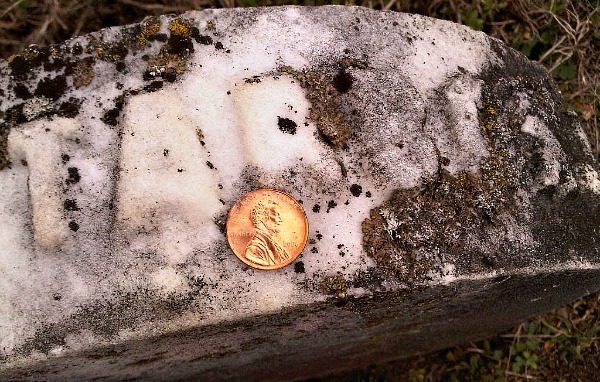
For the past 15 months, I have traveled throughout Connecticut -- from Brooklyn in the east to Bristol in the west -- visiting the graves of solders with a connection to the Battle of Antietam. It's not hard to find them. Scores of men and boys from Connecticut were killed or mortally wounded in the fields and woodlots outside Sharpsburg, Md., on Sept. 17, 1862 -- the bloodiest day in American history. Each time I visit a cemetery, I place a penny, Lincoln side up, on the soldier's gravestone. I figure that's a neat way to honor those who made the ultimate sacrifice nearly 150 years ago. As the 150th anniversary of Antietam nears, perhaps you'll want to do the same in a cemetery near you. (Lincoln side up, of course.)

Sunday, April 22, 2012

Antietam: Reading Private Tarbox's final letter

Private Daniel Tarbox
Fellow blogger John Rogers (Oliver Case blog) and I got up before the crack of dawn today to walk a soggy battlefield, proving that we're slightly obsessed about this Civil War thing. (Or perhaps that our SAT scores were extremely low.) We also discovered exactly what Antietam looks like at 6 a.m. on a rainy morning: very dark.

Besides walking part of the Final Attack trail with John, I intended to fulfill a promise to a descendant of 11th Connecticut private Daniel Tarbox by reading the soldier's final letter home to his father, Daniel Sr. Only 18 years old, Tarbox was mortally wounded near Burnside Bridge. The video was shot close to where Tarbox was shot. Other than calling the descendant an "ancestor" in the video, I think it turned out nicely.

Daniel's brother, Louis, arranged for the return of the body to Brooklyn, Conn., where Daniel was buried in early October 1862. His grave in South Cemetery is marked with a flag in the foreground of the panoramic image at bottom. The tall memorial 10 feet in back of Daniel's gravestone notes that he was wounded near Burnside Bridge. Carved into the memorial near the bottom are these words: "Father and brothers, all a long farewell!””
Daniel Tarbox was mortally wounded approximately where the 'X' is in this photo.
                                               Click on image for full-screen panorama.

Saturday, April 21, 2012

Antietam: 11th Connecticut photo/video journal

11th Connecticut monument at Antietam. Thirty-six soldiers in the regiment were killed
in the battle, including Colonel Henry Kingsbury.
Close-up of reverse of the 11th Connecticut monument.
Daniel Tarbox was mortally wounded at Antietam.
His first name is listed incorrectly on the 11th Connecticut monument at Antietam, surely not the first time a soldier's name has been screwed up by the government. So to properly honor Daniel Tarbox at Connecticut Day on Saturday, I plan to read aloud his final letter home, a short note to his father that mentioned an imminent battle. (UPDATE: I read the letter Sunday.)

"If we go in," the private in the 11th Connecticut  wrote on Sept. 6, 1862, "we can't think of coming out. If I do fall, you take what money I have sent home and appropriate it to yourself as a present."

Eleven days later, Tarbox was mortally wounded near Burnside Bridge at Antietam. Only 18 years old, he died the next day.

Early this morning, I walked the ground young Daniel and his fellow soldiers fought on and visited the off-the-beaten path 11th Connecticut monument, approximately 150 yards southeast of Burnside Bridge. Daniel's name is listed as David near the bottom left corner, but there's no hope of correcting that, according to a Tarbox descendant.

Captain John Griswold and Corporal John Holwell, whose stories are told on my blog, also died near Burnside Bridge. A natural-born leader and a Yale graduate, Griswold was wounded in the middle of Antietam Creek as he led a group of 11th Connecticut skirmishers. After staggering to the opposite bank, he was rescued by four privates and a surgeon and carried to a small barn nearby.

"My first station was in a little barn by Antietam Creek," Surgeon Nathan Mayer wrote in a post-war account, "but the Rebel sharpshooters from behind the trees, across the creek, soon drove me out. There, however, I dressed Captain Griswold, shot through the belt and body fording the stream." (1)

Griswold died the next day.  "Tell my mother," the 25-year-old soldier from Lyme, Conn., said, "I died at the head of my company."

Holwell, in Company H of the 11th Connecticut, frequently wrote his wife back in Norwich, often mentioning his children. His young son, Eddy, apparently was his father's favorite.

Surgeon Nathan Mayer treated wounded
 soldiers at the Henry Rohrbach Farm.
"Your dagerreotype and the children's look very natural and I was very glad to receive them. ..." he wrote Rebecca Holwell. "I hope little Eddy will keep on going to school and be smart. The men down here all like his picture and praise it up highly."

A Mexican War veteran, John Holwell was 42 years old when he was killed at Antietam. His gravesite is unknown.

Not far from the bridge is the Henry Rohrbach Farm, where many of the 11th Connecticut wounded -- including the beloved Colonel Henry Kingsbury -- were treated. Shot through the stomach and liver as he stepped from behind a tree, Kingsbury died the next day.

"Every room was soon filled (with wounded)," Mayer wrote of the Rohrbach farmhouse. "The barnyard and garden were crowded with wounded. And (I) should not have known where to place more." (2)

After his gruesome work was done that day, Mayer took advantage of the bounty of riches on the Rohrbach farm. "There were some 300 chickens and some calves about the place which the rebels had been too hurried to capture," he wrote. "And flour, and meal and bread." (3)

Connecticut Day visitors to Antietam will stop at the national cemetery, attend a short service at the church where soldiers from the state were treated and tour the battlefield. But I think the highlight of the day will be when descendants read aloud letters of their ancestors near the Visitors' Center. I'll share the best stories and photos later today.

(1) Reminescences of the Civil War, Nathan Mayer, M.D., Connecticut Historical Society Civil War Manuscripts Project.

(2) Ibid.

(3) Ibid.


Daniel Tarbox was mortally wounded approximately where the 'X' is in this photo I shot this morning.

Henry Rohrbach's barn was used as a field hospital during the Battle of Antietam.
Note the initials H.R. on the side of the brick barn wall.
Henry Rohrbach's farmhouse also was used as a field hospital.

Saturday, April 14, 2012

Faces of the Civil War: Private Daniel Tarbox

Wearing a uniform with corporal's stripes, Private Daniel Tarbox of the
 11th Connecticut posed for this photo at a Hartford studio. The 18-year-old
 from Brooklyn, Conn., was  mortally wounded at Antietam. 
(Photo courtesy Scott Hann.)

In his final letter home, Daniel Tarbox had a sense of impending doom.

"I expect we are going into it now for good," the private in the 11th Connecticut wrote his father, Daniel Sr., from Washington on Sept. 6, 1862. "Right where grape & shrapnel and chain shot fly thick. And whole company’s and Reg’ts are mowed down at one volley.

"If we go in, we can’t think of coming out," he continued. "If I do fall, you take what money I have sent home and get my bounty and appropriate it to yourself as a present. But I hope for the best."

Wrapping up the letter by noting that dead horses lay in the middle of the road from Alexandria and members of Congress "rode by in hacks," the teenager signed off:

From your Affect. Son
Daniel Tarbox

Eleven days after he wrote that letter home, the 18-year-old soldier from Brooklyn, Conn., was mortally wounded near Burnside Bridge at Antietam on Sept. 17, 1862. He expired a day later, one of more than 2,000 Union soldiers to die at Antietam.

According to Tarbox descendant, this is the approximate location and time of the
 private's mortal wounding at Antietam. This photo was taken by famed Civil War
 photographer Alexander Gardner  after the battle. (Library of Congress collection)

Thanks to Antietam collector Scott Hann, who provided the carte de visite of Daniel above, and a Tarbox descendant, who e-mailed me a copy of his ancestor's final letter, I have a more complete picture of the teen-aged soldier.

Word of Daniel's death apparently traveled slowly back to Brooklyn, a small farming community about 45 miles east of Hartford. On Sept. 25, eight days after the battle, a worried Louis Tarbox, obviously eager for news on his brother's fate, wrote his father from New York about the Antietam casualty list that had appeared in the New York Tribune:

Dear Father:

I noticed in this morning's Tribune a list of the killed & wounded in the 11th Regt. Conn. Vols, among which is Daniel's name as killed. I will send you a copy of the Tribune & you can see for yourself. I have every reason to believe the list in here.

On Sept. 26, 1862, the Hartford Courant published a list 
of Antietam  casualties. Daniel Tarbox of Company F
 was listed as killed.
Hopefully you have heard from another source as it is the Captain's (Kies) duty to inform you. Please write to me whether you have heard or not.

Yours affectionately, Louis.

Perhaps the family first found out the terrible news of Daniel's fate when the Hartford Courant published a list of Antietam casualties on Sept. 26. Daniel's name was one of 37 soldiers listed as killed in the 11th Connecticut.

Or perhaps the Tarbox family first got word when they received this letter, dated Sept. 21, 1862:

Mr. Tarbox


Dear sir, it becomes my pain full duty to inform you of the death of your son Daniel Tarbox. Your son was wounded in the battle of Sharpsburg on the 17th and died the next day of his wound. His effects were taken pocession of by G. Preston. I did not see Daniel after he was taken from the field but as soon as I see Preston I will write you all the particulars.

Yours Respectfully,
John Kies Capt. Co F

Because the Union army was ill-equpped to deal with death on such a massive scale, many families had to arrange to retreive their dead loved ones from the battlefield. That duty fell to Louis, who paid a man named Augustus Martin to disinter his brother's body and provide a zinc coffin for his return to Connecticut.

Sometime in early October, Louis returned to Brooklyn with Daniel's body. A funeral was held and Daniel Tarbox Jr., the son of a prosperous farmer, was buried in South Cemetery, about a quarter-mile from the center of town.
Receipt provided Louis Tarbox for payment to disinter his brother's body and 
purchase of a zinc coffin  to transport him back to Connecticut. Daniel Tarbox 
was buried in Brooklyn, Conn. (Receipt courtesy of Daniel Tarbox Jr. descendant)
CLICK ON IMAGE TO ENLARGE.
Daniel Tarbox's memorial marker in South Cemetery in Brooklyn, Conn.
 At the bottom are these words: "Father and brothers, all a long farewell!"

Thursday, April 05, 2012

Antietam dead: 18-year-old Private Daniel Tarbox

Mortally wounded at Burnside Bridge at Antietam, Daniel Tarbox died a day after the battle,
 on Sept. 18, 1862. Only 18 years old,  Tarbox is buried in South Cemetery in Brooklyn, Conn.
Scores of Connecticut dead from Antietam are buried throughout the state, in large cemeteries such as Spring Grove Cemetery in Hartford in the west to tiny, rural cemeteries such as Bedlam Road Cemetery in Chaplin in the east.

Close-up of G.A.R. marker embedded next to Tarbox's gravestone.
On Sunday afternoon in historic Brooklyn, Conn., about 45 miles east of Hartford, I found the final resting place of Daniel Tarbox Jr. of the 11th Connecticut among many other well-marked gravestones of Civil War veterans in South Cemetery.

A private in Company F,  the son of  a prosperous farmer was mortally wounded at Burnside Bridge and died the day after Antietam, on Sept. 18, 1862. Like fellow Antietam casualties Lieutenant Marvin Wait of the 8th Connecticut and Private John Bingham of the 16th Connecticut, Tarbox, 18, was just a teenager.

According to a post-war history of Connecticut Civil War service, Tarbox was cut down along with Sergeant John R. Read of Hartford, Sergeant Hiram C. Roberts of Winchester, Corporal Theodore S. Bates of Norfolk, Private Oliver R Ormsby of Franklin, Sergeant George E. Bailey of Saybrook, "and a score of others, in the fatal charge on the bridge." (1)

Of  105 soldiers from Brooklyn who served during the Civil War, 22 died, undoubtedly a huge toll on a small farming community that had a population of barely over 2,000 in 1860. (2)

An American flag and a heavy, old Grand Army of the Republic (G.A.R.) marker, perhaps embedded near Tarbox's gravestone for a century or more, mark the teenager's gravestone in the cemetery about a quarter-mile from the center of town. I added a penny atop his marker in his memory. The circumstances of the young man's death are noted on a nearby family memorial, which also includes these barely legible words:

Mother I may not hear thy voice again.

Father and brothers, all a long farewell!

(1) The Military and Civil History of Connecticut During the War of 1861-65, William A. Croffut and John Moses Morris, Ledyard Bill, 1869, Page 281

(2) 1860 U.S. census

According to the 1860 U.S. census, Daniel Tarbox was one of five children living with
Daniel Tarbox Sr. and his wife, Lucelia in Brooklyn, Conn. Tarbox Sr. was a farmer.

The small, well-marked gravestone of Private Daniel Tarbox of the 11th Connecticut.
A penny in memory of  Daniel Tarbox Jr. atop his gravestone..