Sunday, March 17, 2019

In 25 images: My 'brutal' trip down (and up) Lookout Mountain

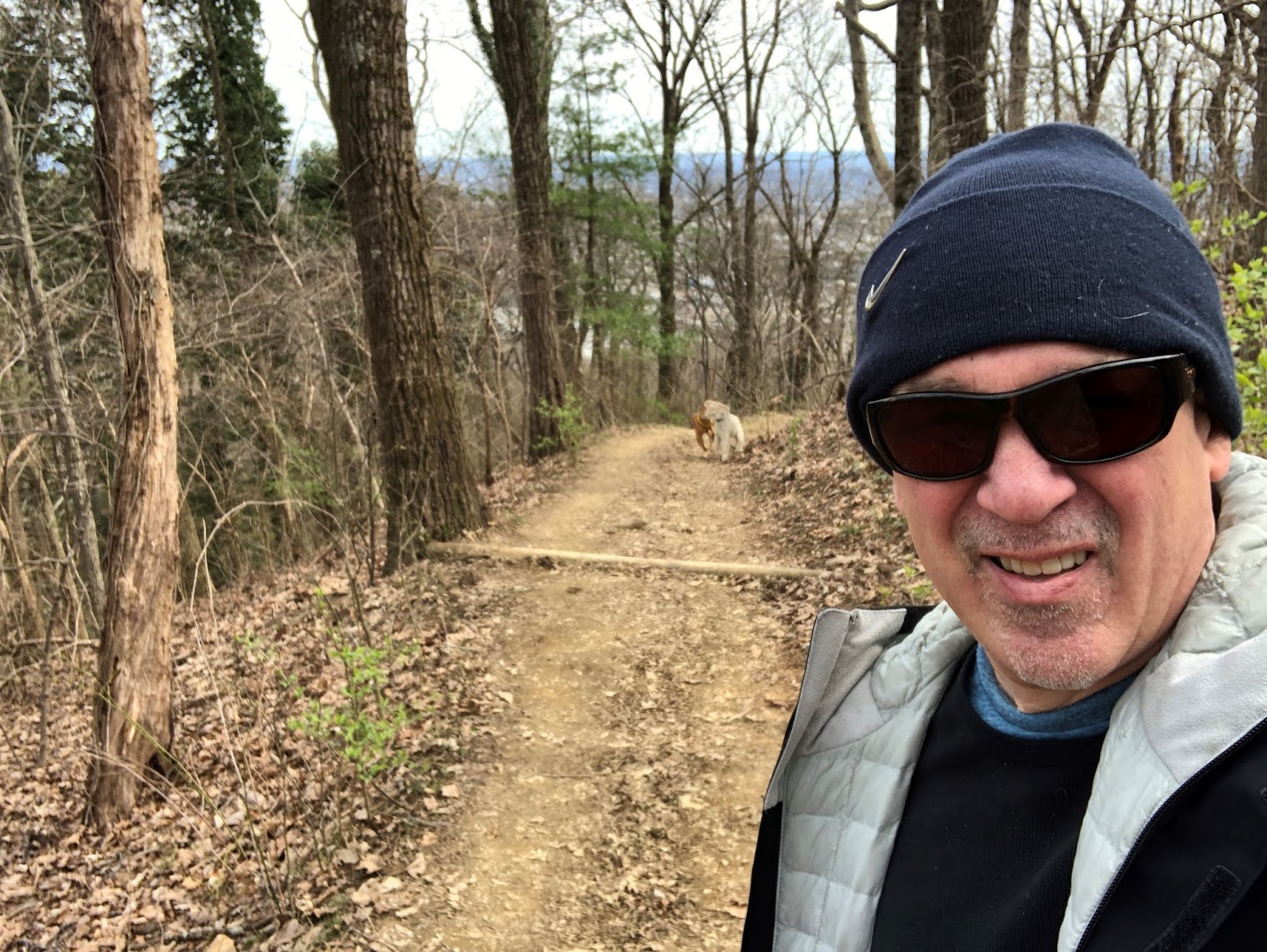
Those two "wild" dogs in the background could not prevent me from completing my mission.
(CLICK ON ALL IMAGES TO ENLARGE.)
My goal: Reach the Cravens House, opposite the Iowa monument in the middle distance.
Like this blog on Facebook | Follow me on Twitter

On Nov. 24, 1863, gutsy U.S. Army soldiers fought their way up rugged Lookout Mountain during the "Battle Among The Clouds." On March 16, 2019, armed with a Fitbit and blessed with well-honed backwoods instincts, I battled my way down the Tennessee mountain—stepping through a puddle or two, climbing over 2-foot-high log obstacles, and easily dodging a small but vicious white terrier. Simply brutal. My mission: Hike the Cravens Trail from the summit of Lookout Mountain at Point Park to the bottom ...  and then back up again. (And live to blog about it.) Estimated round-trip time: Two hours. Temperature: 40 degrees.

... I deftly walked down two long flights of steps, tightly grasping the ice-cold metal handrails. Seconds later, I was rewarded with a view of these remarkable works of art on the face of Lookout Mountain. Amazing placement for the weather-worn 29th Pennsylvania plaques. The regiment was organized in Philadelphia in 1861 ...


... and steps away is this fabulous plaque for the 111th Pennsylvania, soldiers recruited from Erie, Crawford and Warren counties. ...


... a close-up of the massive, bas-relief plaque reveals how some of the Pennsylvania boys advanced up the mountain. Yup, they occasionally deployed ladders during the assault ...


... the boulder-strewn side of Lookout Mountain. ...


... I photographed this helpful information on the trail marker during my descent. You know, just in case. ...


... One slip on the narrow Cravens Trail can lead to painful results. ...


... Tempting fate? Nah, I wouldn't do that, would I? ...


.... 45 minutes after my journey began, I reached the Robert Cravens House and plateau, the vortex of the Battle of Lookout Mountain. The house, destroyed during the war, was rebuilt in 1866...


... The beautiful view of Chattanooga, Tenn., and the Tennessee River from the front porch of the Cravens House. Ah, this would be a perfect time for one of those Cracker Barrel rocking chairs and a beer. But alas, I must be on my way. That's the Iowa monument in the middle distance. Perhaps my wife, an Iowa native, will appreciate. (On second thought, nah.) ...


... Confederates valiantly defended the Cravens plateau, but they were vastly outnumbered and outgunned. ...


... and be sure to visit the outstanding New York State monument near the Cravens House. ...


... On the lawn behind Cravens House, an early sign of spring. ...


... The seldom-visited 28th Pennsylvania and 59th Illinois monuments on a trail behind the Cravens House. Be warned: Poison ivy could ruin your visit here during the summer, according to a source extremely close to this blogger. ...


... A panoramic view of the monuments on the ridge behind the Cravens House. From left, the 28th Pennsylvania, 96th Illinois, 59th Illinois, 12th Illinois (in distance) and 147th Pennsylvania monuments (in foreground). ...


... On the 28th Pennsylvania monument, a tremendous carved forage cap. ...


... What? I have to go back up? Where's my vehicle? Oh, wait ...


...  I'm doomed! ...


... But nothing can truly stop me on the way up, not even this massive log. Thankfully I got a running start for my leap. ...


... It's not one of those high-tone, boutique hotels, but this will do if your fragile body can't make it back to the summit. (I wonder if a soldier used this crevice for refuge.) ...


.... I am almost back where this journey began. Hey, kid, get off of my steps. ...


... Like Douglas MacArthur, "I have returned." Slightly winded, but pride not wounded. On this spot in 1863, a certain high-ranking Union officer was photographed ....

(Library of Congress collection)
... Yes, Ulysses S. Grant (bottom left), clenching a stick -- or is it a cigar? -- in his mouth ...


... No victory cigar for me, however. My final results: 77 floors climbed, 12,500 steps walked, 2,000 calories burned, two hours elapsed and a deep appreciation achieved for the courage and grit of  Union soldiers who fought their way up Lookout Mountain.

Until next time ...

-- Have something to add (or correct) in this post? E-mail me here.

Thursday, March 14, 2019

Nashville Then & Now: Union troops in entrenchments in 1864

MID-DECEMBER 1864: Union troops in entrenchments at Nashville.  (Jacob Coonley | Library of Congress)
MARCH 13, 2019: A "Now" image of the 1864 photograph above.
(CLICK ON IMAGES TO ENLARGE.)
Like this blog on Facebook | Follow me on Twitter

In mid-December 1864, Jacob Coonley photographed  Union entrenchments stretching toward Fort Casino on a hill in the distance. As the Battle of Nashville was fought nearby, the troops seen in the image were held in reserve. I recently aimed to shoot a passable “Now” version of Coonley’s 1864 image from a hill at the base of old Fort Negley, about a mile or so from downtown Nashville.

Forts Negley and Casino were integral to the defenses of Nashville, the second-most heavily defended city next to Washington during the Civil War. Fort Casino is long gone — it’s site of the 8th Avenue Reservoir. Fort Negley, atop St. Cloud Hill, is a popular spot for joggers, walkers and picnickers. When visiting Nashville, check out the ruins of the fort, which offers a great view of the Nashville skyline. For present-day images of Fort Negley, check out this post on my blog here.

-- Have something to add (or correct) in this post? E-mail me here.


Monday, March 11, 2019

Andersonville anguish: 'Hand of God ... laid heavily upon me'

16th Connecticut Private Emerson Nichols' gravestone at Andersonville (Ga.) National Cemetery. 
Like this blog on Facebook | Follow me on Twitter

On a gloomy afternoon in Andersonville, Ga., I walked the grounds of the national cemetery, a place of immense sadness. It reminded me of a long-ago visit to the German World War II concentration camp at Dachau, where one almost expects the earth to open up and groan.

An angel figure hovers over bas-relief figures of Union prisoners 
on the huge plaque on the New York monument.
(CLICK ON IMAGES TO ENLARGE)
In the national cemetery, the pearl-white gravestones for nearly 13,000 Union POWs — mostly victims of disease at the notorious Confederate prison camp nearby — are grouped closely together. Row upon staggering row of markers stretch across the landscape.

Throughout the vast, well-kept grounds, memorials honor Federal dead  On a massive plaque on the New York monument, certainly a work of art, a glorious figure of an angel hovers over bas-relief figures of two prisoners — one looking hopeful, the other hopeless. "Death before dishonor," an inscription on the Iowa memorial reads. On the Illinois monument nearby, a statue of a doleful Union officer stands next to a slab of granite inscribed with that magnificent quote from Lincoln’s first inaugural address:
“The mystic chords of memory, stretching from every battle-field, and patriot grave, to every living heart and hearth-stone, all over this broad land, will yet swell the chorus of the Union, when again touched, as surely they will be, by the better angels of our nature.“
The monument honoring the 258 Connecticut dead is beautiful in its simplicity: A 7-foot bronze figure of a young soldier, kepi in hand, stands atop a granite pedestal. ”Andersonville Boy,” as the statue is known, reminded me of one of the reasons for my trip: Emerson A. Nichols of Company G of the 16th Connecticut. A friend suggested I visit his grave.

"Andersonville Boy" is featured on the Connecticut monument at Andersonville (Ga.) National Cemetery.
A private from Bristol, Conn., Nichols rests in red Georgia clay, Grave No. 5044, between soldiers from Wisconsin and Pennsylvania. He  enlisted six days before Christmas in 1863. In April 1864, he was captured at Plymouth, N.C., with most of the rest of his regiment and eventually shipped by train to Andersonville. On Aug. 8, 1864, a grievously ill Nichols was carried from the prison stockade a short distance to the camp hospital. He was so far gone he couldn't speak. He died later that day.

Emerson was only 16.

My God, 16 years old. 

In a letter to the Pension Bureau in July 1865, Emerson’s mother Candace told of multiple family tragedies. Her husband William died in April 1861, shortly before the war began. In the previous six years, Candace said she had also lost another son and two grandchildren. A son-in-law, too. A Union soldier, he was shot and mortally wounded while on picket duty in Louisiana.

"I feel that the hand of God has been laid heavily upon me," the widow wrote.

Candace Nichols, whose pension request was approved at the standard $8 a month, died in 1904. Whether or not she ever visited her son's grave in Georgia is unknown.


MRS. NICHOLS' LETTER TO PENSION BUREAU: "I AM A POOR WIDOW"


National Archives via fold3.com.
Bristol July 10/65

Mr. A. Johnson, Sir


May I ask one favor of you that is in regard to a pension that I made application for in April. It was sent back for want of evidence of my son's death, Emerson A. Nichols. He was a member of Co. G, 16 Regt C.V. He was taken prisoner in April 1864 at Plymouth [and] was taken to Andersonville with his Regt. except Co. K whitch was away at that time. Last Oct. I saw the chaplain of the 16th and he says the sutlers clerk gave a list of names of the dead and he was one of the number. He says he died the 8 of Aug. Edward Allen of this place helped carry Emerson out of the stockade and others took him away to the hospital. Edward says he don't think he lived to get there. He could not speak when he left him he was so near gone.


Mr. Albert Walker of Hartford Ct a member of the 16 Regt C.V. brought a list of the 16th that died there and the number of their graves. Emersons was among the number. He says their graves were all numbered where their name was known. I am a poor widow and this son I looked to for my support in part for I am not able to do but very little. I don't feel as though I should want help long. I feel that the hand of God has been laid heavily upon me for within the past 6 years I have buryed my husband, 2 sons, one son in law and 2 grand children. My son in law was buryed at Port Hudson. He was shot while on picket. I will not weary your patience any longer. I only ask your advise in regard to this pension.

Candace M. Nichols

-- Have something to add (or correct) in this post? E-mail me here.


Saturday, March 09, 2019

'Hidden' details in 1865 Bull Run monument dedication photos

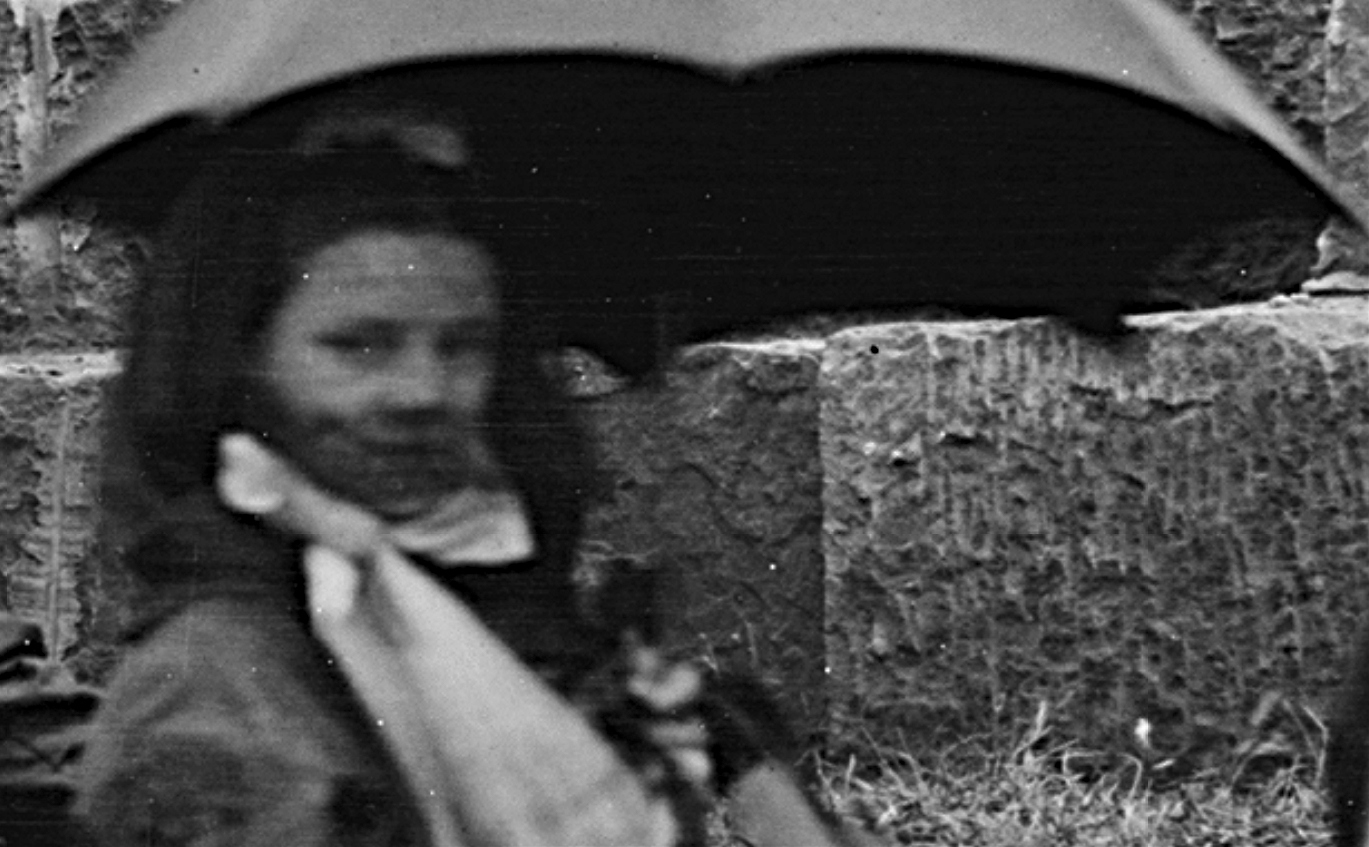
Shy or weather-wary? Or both? This woman had cover for her photo op at Bull Run on June 10, 1865.
(CLICK ON ALL IMAGES TO ENLARGE.)
In the uncropped, original image, civilians and soldiers gather at the monument at Henry House Hill.
(William Morris Smith | Library of Congress)

Like this blog on Facebook | Follow me on Twitter

At 6 a.m. on June 10, 1865, generals James Farnsworth, Montgomery Meigs, Samuel Heintzelman, Henry Benham and Orlando Wilcox boarded a westbound train in Washington with nearly 100 other passengers. The group's final destination was the Bull Run battlefield for the  dedication of  two monuments "in memory of the Patriots" who fell in United States Army defeats there in July 1861 and August 1862.

In this cropped enlargement
 from Photo No. 2 below,
  we find a young soldier,

 perhaps a teenager.
At Alexandria, 100 more "excursionists" boarded the train before the party continued on through Virginia countryside devastated by a civil war that ended two months earlier. 

"We watched carefully along the entire route for evidence of returning peace and prosperity in this part of the State," a New York Times correspondent wrote, "but the people will recover their wrecked fortunes slowly, for they have suffered with terrible severity."

At 8 a.m., 15 miles from Washington, the train reached Fairfax Station, the end of the line for the Orange & Alexandria Railroad. Most in the 200-person group then boarded ambulances, carriages and army wagons provided by the military for the final, 17-mile leg of the journey to the battlefield. In a stunningly long sentence no present-day English teacher would appreciate, The Times correspondent described the scene: 
"Our cavalcade, composed of some seventy-five carriages and ambulances, with a large number of equestrians, many of whom were ladies, who generally rode exceedingly well, caused quite an excitement among the inhabitants of the country, who are now at home in increased numbers, though the population is still as sparse as in some of the newest regions of the West, they were all at the roadside, and gazed with astonishment at so extensive and peaceful a demonstration."
Dedication day was a grand affair, with the usual speeches by politicians and military flourishes. At Henry House Hill, where the monument honoring the Union fallen of the July 21, 1861, battle was dedicated, a hymn was sung to the tune of "Old Hundred." The second stanza was especially noteworthy:

William Morris Smith photographed two monuments
at Bull Run on dedication day in June 1865.

(Library of Congress)
Here on Virginia's sacred soil. 
Where slavery bred and drove the gangs. 
The horrid serpent lay in coil --
Here Freedom's sons first felt her fangs.

After the dedication later that afternoon of the second monument, at Groveton, some went searching for battle relics. Pieces of artillery shells and broken muskets lay everywhere on the Second Bull Run battlefield. Shallow graves and human bones were found, too. 

"Many of the party gathered some relics from the field," The Times correspondent wrote, "while one person with eccentric taste, brought to the city part of a human skull, exhibiting the hole of a deadly bullet."

The day was also well documented photographically. At the Henry House Hill monument dedication, William Morris Smith shot a series of images. At first glance, Smith's two uncropped photographs in this post seem unremarkable. When we zoom in, however, fascinating details emerge.


SOURCE: The New York Times, June 13, 1865.


... a young lady, her face partially covered by a veil, holds an umbrella, protection from the sun ...


... men tower over this woman, who stares at the photographer. She appears ghost-like, a result of the limitations of the medium. ...


... this ornery-looking gentleman, perhaps in in late 50s or early 60s, sports an impressive top hat ...


... while this apparently unhappy lad, arms folded, shows little interest in holding the hand of the man (his father?) in front of him. Of course, he must have been pleased with that tremendous hat. ...


... a youthful-looking artilleryman stands next to the wooden fence near the monument ...


...which includes these massive, 100-pounder artillery shells. Were they live?

(Update from Civil War photo expert John Cummings: "Those shells were found to be live when the NPS restored the monument some years ago. They have some on display in the visitor center, in the hallway leading to the bookstore. The shells that are there now on the monument are reproductions.")


PHOTO NO. 2: THE  SOLDIERS ON HENRY HOUSE HILL

Union soldiers pose in front of the Bull Run monument on Henry House Hill in the uncropped version ...


... zooming into the original photo, we see a soldier standing ramrod straight and the inscription on the simple, red sandstone monument. It stands today yards from the rebuilt Henry House that was destroyed during the Civil War ...


... arms folded almost defiantly, this soldier stands atop the mound of dirt next to the 27-foot monument. And there's another one of those imposing artillery shells ...


... the detail is so impressive in the glass-plate image that we can easily see the hobnails on the leather, brogan-style shoes of this soldier, who's seated on the ground near the bottom right in the original photograph. These shoes were often fitted with metal in the heels to reduce wear ...


... did this black youth, dressed in military uniform, serve as a soldier, too?


... a 19th-century gang sign? Missing tips of  his digits because of a war wound? More likely this soldier merely has his fingers partly tucked inside his blouse ...


... were these bushy faced soldiers father and son? Gotta love these mugs.

What else do you see? E-mail me or add your comments to the post below or on my Civil War Facebook page. Find high-resolution versions of the original photographs in this post on the excellent Library of Congress web site here and here.


-- Have something to add, correct? E-mail me at jbankstx@comcast.net

Saturday, March 02, 2019

'A place full of pitiful memories': A reporter's 1881 Bull Run visit

Union soldiers at the dedication of a Federal war memorial on Henry House Hill in June 1865.
(Library of Congress | CLICK ON ALL IMAGES TO ENLARGE.)

Like this blog on Facebook | George Morgan's battlefield accounts

A hodge-podge of shopping malls, housing developments and industrial parks long ago overwhelmed suburban Washington. Ah, to have seen the landscape of rolling hills, woods, ravines and lush fields in the area as Philadelphia Times correspondent George Morgan did when he visited Bull Run, 30 miles west of the capital, in the summer of 1881.

"Riding north on the road to Sudley Springs one sees the clearly marked outlines of a fort in a cornfield, and, passing further, the eye is attracted by the beautiful line of the Blue Ridge far away to the northwest," Morgan wrote in a Page 1 story published in the Times on July 11, 1881. He described the immediate area near the Bull Run battlefield as a "pleasant country of farms."

In 1881-82, Morgan lived a charmed life as a reporter, touring Civil War battlefields at Franklin, Cold Harbor, Chickamauga, Lookout Mountain and elsewhere. The ugly effects of war -- bullet-scarred trees, earthworks and entrenchments -- were often evident. Morgan discovered evidence of the human toll, too. In the woods at Chickamauga, the reporter and his guide found a pair of skulls, undoubtedly victims of the September 1863 battle. Morgan's descriptive accounts of his battlefield trips were published in the Times and other U.S. newspapers, including The National Tribune, a popular publication for Civil War veterans.

Fortunately for Morgan, he had an excellent guide at Bull Run: the man who lived on Henry House Hill, the heart of the battlefield. A formerly enslaved man named Shedrick, who apparently witnessed Bull Run's aftermath, served as Morgan's driver. Here's the correspondent's complete Bull Run account, written nearly 20 years after the armies clashed there on July 21, 1861:


Special Correspondence of The Times

MANASSAS, Va. July 9

The lapse of twenty years has left the fields and wooded hills upon which the Battle of Bull Run was fought much as they were when on that hot Sunday in July, 1861, the young armies of the people for the first time joined in combat. At this spot this month twenty years ago the raw nucleus of the Grand Army of the Potomac fell upon the equally undisciplined enemy and forced him through thick woods, across ravines, on hillsides and into what promised to be utter rout, but accident of war turned the tide of battle and under vigorous counter-attack the assailants fled dismayed to the banks of the Potomac. What the writer wishes to set down in plain terms is the appearance of the battle-field now and the impression that the surroundings make upon an admirer of those who fought.

Bull Bun is best reached from Manassas village, a pretty place, which shelters snugly on level land a few hundred people, who, being at a point on the Virginia Midland Railroad, thirty miles west of Washington, take the trade of the country for a considerable distance around. Riding north on the road to Sudley Springs one sees the clearly marked outlines of a fort in a cornfield, and, passing further, the eye is attracted by the beautiful line of the Blue Ridge far away to the northwest. At the end of a six-mile trot through a pleasant country of farms, the most interesting part of the battlefield, Henry Hill, is reached.

The field's key-point


A war-time image of the ruins of the original Henry House.
(Library of Congress)

The Henry House stands upon Henry Hill, a flat, bare crest, the field's key-point, whence came the first great outburst of battle and across which forwards and backwards the contending lines surged from noon until the day was lost. The house is a pleasant structure, with marks of newness about it, and it is made inviting by a lawn in which there is a large elm and several small locust trees. The eye of the approaching visitor does not rest upon these trees, however, delightful as they appear, for the objects of prominence are a little God's-acre grove in front of the house and a rude monument in its rear.

"Coase I wuz heah just arter de fightin'," said Shedrick, the darkey driver, as we climbed the hillside road to the house; "'coase I wuz, en I seed moah dead uns stretched stiff in dat ar oat field ober dar den I eber seed afore nor sence. Dar's Mars Henry, he kin tell ye."

Under the elm sat an elderly gentleman bending over what I afterwards saw were Latin textbooks. His soft hand, heartily extended, pointed as a sure index to its owner as one concerned with the windrows of learning rather than with those long lines of fallen grain in the trail of the reaper which at that moment was seen swinging slowly down a distant Fairfax hill. From the warmth of his welcome Mr. [Hugh Fauntleroy] Henry, who is a professor in the Alexandria Academy, soon made his visitor feel in its fullness that which has been so much praised -- the hospitality of the old-time Virginian.

A glance from a hilltop

William Sherman
"Be so kind as to stand under this tree," he said; "this point is the best from which to study the battle-field. General [William] Sherman so regarded it when he called here some time ago. I was sitting in the place where you saw me reading to-day when I observed the General approaching across the field. He came to the house, and standing here pointed out with wonderful accuracy the various positions held during the battle. Sir, that ridge beyond the Bull Run stream is in Fairfax county. Look to the east. On this side of that Fairfax ridge lay the Federal army on the night before the battle. The country there was partly cultivated then as it is now, but, turning your eyes further to the north, you see a forest extending to the stream. Through that forest, now of larger growth, the Federals, who were to turn [Pierre] Beauregard's left, moved, cutting their road as they went, to Sudley Springs, which you see in the distance there to the north. Then crossing Bull Run they come down directly upon this point. There remain few evidences of that movement. The oak and pine stands as it did then.

Confederate Colonel Barnard Bee,
 mortally wounded at Bull Run.
"Now mark, sir! The Confederate Colonel [Nathan] Evans, 'Shanks,' as they called him, faced [Daniel] Tyler just down there at the stone bridge, on the Warrenton pike. Is it clear to you? Well, sir, Evans, suspecting something wrong, faced up stream and, with Colonels [Barnard] Bee and Barton, threw himself into that field just beyond the valley. You see that field now; it is still clear. To make a long story short, when the Federal attacking column, clumsily handled, struck Evans they thought Beauregard's whole army was in their front. If they had pushed forward they would have crushed Beauregard. No doubt about it. Evans, with a handful of men, held them for an hour and a half and, when he was forced back, he retreated to this plateau, where the fiercest fighting was done. The Confederates ran past this house towards General Jackson, who had just posted his brigade at that ridge a few hundred yards to the northeast of the house. Jackson's men were lying flat on the ground, but Jackson was on his horse. He sat there as still and steadfast as this monument. Now and then he waved his hand to his men, among whom shells were falling and around whose heads bullets were flying like bees in harvest time. A soldier of that brigade was here a few years ago and he told me that he thought it too hot to stay. He was slipping back, when Jackson, seeing him, lifted his hand. The fellow dropped into his place."

Where Jackson became 'Stonewall'


As he talked Mr. Henry led his visitor beyond the lawn into a field where grew long grass, daisies, dandelions, dock weeds, blue thistle and thickly-matted blackberry briars. Slightly in advance and at the further edge of the field was a line of young pines which have sprung up since the battle, making the field narrower now than it was then. Beyond this growth of small pines stretches a wide belt of oak timber, then standing. Eating blackberries as we walked along we came to a slight ridge near the woods. It needed no one to explain that this was where Jackson stood "like a stone wall." From this spot, where his horse's hoofs made their memorable mark, I could trace, by the red road-bed leading to Sudley Springs, one line of Federal approach, and immediately below, in the little valley of Young's Branch, I could see the Warrenton pike that brought Union help from the Stone bridge across Bull Run. Far away in beautiful undulations roll pleasant fields and sternly in the background still grow the very oaks that once were bruised and shattered in the shock of battle.

Battle-field fancies


A group of mostly civilians at the June 1865  dedication of the Federal war memorial at Bull Run.
(Library of Congress)

Standing where Jackson stood, it is easy to re-people this beautiful crest, and with slight effort fancy fills in the picture. Panting after a hot run of a mile and a half, Bee's men and Barton's huddle panic- stricken at the edge of the woods. The rebels are routed. The hard-worked men of the North, driving constantly forward, cross Warrenton road, push up the hill and reach the plateau. Their batteries sweep the crest and send death-dealing bolts, hissing hot, into the woods.

Bee is in sore extremity. His face is streaked with the smut of powder. His eyes are wild. His sword is in constant motion above his head. His voice is husky, for shouts of command long since gave place to whispers of entreaty. Over the field he comes in search of his badly-smitten runaways.

"General," he exclaims, reaching Jackson, "they are beating us back."

"Sir," replies Jackson, "we will give them the bayonet."

Again Bee's sword waves encouragement to his troops, and in a rain of bullets he runs forward, saying to some who are with him: "There is Jackson, standing like a stone wall!"

Instantly thereafter Bee smites his breast, and, stumbling, falls backward upon clump of briars. To and fro across his body fly the bits of lead, regiment meets regiment in fierce charge and the thick of the fight is on. A dozen rocks in the midst of a tangle of pine bush mark the spot where Bee died, and a few steps distant a similar mound designates the place of Barton's fall. One conviction forces itself upon the visitor who walks from point to point in this field -- that the people never have done justice to the heroism of the Union soldiers who through no fault of their own lost the battle here.

"May I ask what has become of the hall In your house?" said General Sherman to Mr, Henry. "The house had to be rebuilt," was the reply, " and it was remodeled."

"I thought so," said Sherman, with a grim smile.

"I was in that hall, but it got too hot for me."

It is not pleasant for the gentleman who, with an aged sister, made deaf by the battle and so remaining now, occupies the Henry mansion to tell of the fighting in and around the house. In the graveyard grove is a tombstone with the inscription:

JUDITH HENRY
Killed near this spot by the explosion of shells in her dwelling - during the battle on the 21st of July, 1861, When killed she was in her 85th year and confined to her bed by infirmities of age. Her husband, Dr, Isaac Henry, was a surgeon in the United States Navy, on board the frigate Constellation.

A cropped enlargement of the Henry House Hill photo from June 1865 reveals the inscription
 on the war memorial. (Library of Congress)

When the artillery began to rock the hill and shot came tearing through the house Mrs. Henry's invalid son took his mother in his arms and bore her across the field down the hill to a sheltered place. Two daughters of the house followed. When the tide of battle momentarily rolled away to the right the party returned to the house, but scarcely had they reached the lawn when a fiercer storm than ever circled around. Mrs. Henry was shot in several places, one of the daughters was made deaf for life and the terrible shock hastened the son's death.

Great locust trees that then stood around the lawn wore broken off and swept down, and from their stumps the lesser locusts now standing have grown. In a grove ot these trees, on a grass-covered mound in the rear of the house, is monument of rough red granite, whereupon are scratched the names of visiting veterans. The shaft is capped with shells, one of which was hurled by "Long Tom" from Fairfax Heights far across Bull Run. Though the monument was put up by Union soldiers the bones of five Confederates are buried beneath. Pushing aside some hollyhocks, now in flower around the mound, I was able to read the inscription:

In Memory of
The Patriots
Who Fell at Bull Run,
July 21, 1861

Down at the Bridge


A war-time image of the Stone House at Bull Run astride the Warrenton Turnpike.
(Library of Congress)
With taut reins Shedrick led his horses down the farm road leading from the plateau, and crossing Young's Branch, we emerged upon the Warrenton pike. The Stone House known to history still stands at the intersection of the Sudley Springs and Warrenton roads, and we drank from the same well whence thirsty hundreds drew refreshing draughts twenty years ago. From the Stone House along  the pike to the stone bridge across Bull Run it is a long mile, the road being up hill and down and twice crossing the rivulet.

"The Yankees retreated along this road after the fighting on the Henry farm, didn't they, Shedrick?"

"I's free to say, sir, dat day kind o' made fur de bridge."

"But didn't they run?"

"No, sah; when de rebels got de Union gemmon on the go back dey kind o' went along dis road toards de bridge. '

"But what's the difference between 'on the run and 'on the go back'?"

"Heap o' difference, sah, heap o' difference."

This cute distinction appeared to tickle Shedrick, who, at the time of the battle, was a slave and who, in his respect for the North, could not be induced to admit that those who set him free were driven in wild flight across the bridge now before our very eyes. Tho bridge looks old, but steadfast. A wall of stone is on either side and the road-bed on the bridge is of red clay, just as on the pike itself. The stream that passes under the bridge is now narrow and sluggish, but a rain storm sends the waters roaring down between the high walls of red rock and the dry undergrowth of summer in the run's race track is frequently submerged. To the east is Fairfax county, filled upon this side with fields and thick woods, in the depths of which the bones of men and horses are found to this day. To the west, along the road that took us thither, stretch the undulating lands of Prince William county. Things are somewhat desolate at the bridge, but it is a novelty to sit on the stone buttress and read of war's deadly doings while from the dank grass and dark water below the bull-frog mocks the drum.

Where the Porter trouble began


Union General Fitz-John Porter.
A year after the first battle the second battle of Bull Run was fought upon the same ground. But in the second battle the positions of the opposing forces were reversed. Henry Hill and the adjoining Bald Hill are the points from which the operations during the second battle can best be studied. Far to the west stretch the Bull Run Mountains and in the distance the Blue Ridge. Thoroughfare Gap, through which Jackson marched and in which Ricketts disputed Longstreet's passage, looks like a notch in a huge saw. Bones have been found within the last few years in the Gap, but it behooves the searcher for such uncanny relics to beware lest he himself be turned to bones, for in the Bull Run Mountains the rattlesnake lurks. There are slight traces of Jackson entrenchments on the Highlands near Groveton, and the unused railroad cut, in which there was such fierce fighting, remains today as it was in August, 1862.

The Fitz John Porter case has caused a number of army officers to visit the Henry House and some adjacent points recently, and not long ago General Warren passed several days in the vicinity preparing maps for use in the trial. The people of the vicinity are interested in the development of the case, almost all taking sides with Porter, who, as a Manassas man put it, "is merely the scapegoat of a lost battle."

A year or so ago Senator Don Cameron found himself at the Henry farm, and, having examined the two battlefields, he said to Mr. Henry: "What will you take for your property? I've a notion to buy it." The reply was that the spot was too dear to be bought: a place full of pitiful memories for the owner and of sad reflection for the friends of those whose gathered ashes rest at Arlington.

G.M

-- Have something to add (or correct) in this post? E-mail me here.