Showing posts with label Battle of Franklin. Show all posts

Sunday, October 23, 2022

Talking Civil War with a fellow Jew on the Franklin battlefield

Chuck Byrn and I on the Lotz House porch

Like this blog on Facebook | Follow me on Twitter | My YouTube videos

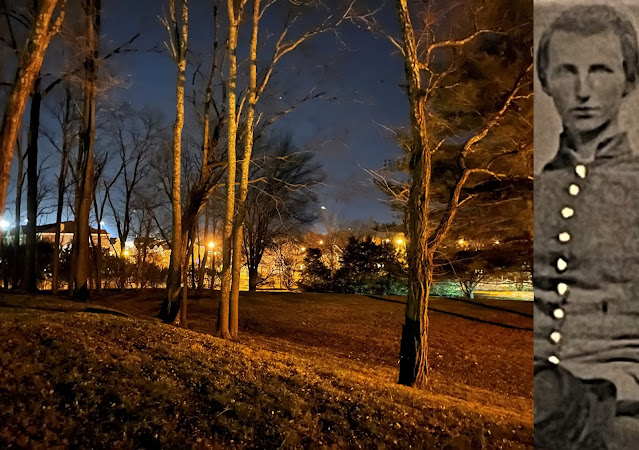
On a sun-kissed morning in Middle Tennessee, I power walk along Cleburne Street in Franklin, halfway to my starting point at Fort Granger on the north side of the serpentine Harpeth River. On Nov. 30, 1864, this ground — a residential neighborhood today — became a bloody hellscape during the Battle of Franklin.

I hang a right into a small park, passing cannons marking a U.S. Army artillery position, foundation stones of the old Fountain Carter cotton gin, and brilliantly colored trees just showing off. Then I spot a pipe-smoking dude in a vest, checkered shirt, and blue jeans.

“Hey, Chuck.”

Chuck Byrn often communes with the spirits 
in this park in Franklin, Tenn.
It’s my Civil War pal Chuck Byrn, a docent/tour guide at the historic Lotz House on Columbia Pike. He’s a proud Jew and a 110 percent colorful character. Byrn is eager to park himself on a bench, yards from the stony path marking U.S. Army earthworks of 1864. His back aches, the result of all that weightlifting from his high school football playing days long ago.

“I love this place,” he says as we stare at hallowed ground. This is where Byrn often comes to commune with the spirits.

Besides the Civil War, Byrn and I share a common heritage.

“You know I’m 2.6 percent Ashkenazi Jew,” I tell him as we walk to the Lotz House.” At least that’s what my 23andMe DNA test says. 

At the Lotz House, 75 yards or so behind the Union line, Byrn waves me inside. He shows off a six-pound solid shot unearthed in the side yard with several others and invites me to look around. In a corner, under Plexiglas, stands a large cooking pot containing 10,000 Minies, found years ago by a relic hunter. I wonder who counted ‘em. 

Outside, on the Lotz porch, Byrn and I shoot selfies and enjoy small talk. Then he greets guests from the comfort of a wooden bench and takes several tokes on his pipe. 

“Flip that sign around to ‘Open,’” he tells a man from Colorado. Then I bid Chuck goodbye.

“I need to get back to Fort Granger.”

“I love that place,” he says.

—— 

You might read more about Byrn in my book, “A Civil War Road Trip Of A Lifetime,” coming spring 2023. 🙏

Let’s keep history alive. 👊

In a small park along the Columbia Pike in Franklin, Tenn., a cannon marks a U.S. Army artillery position.
The stony path marks the line of Union earthworks.
Foundation stones of wartime Fountain Carter cotton gin — the site of intense fighting
on Nov. 30, 1864.

 Have something to add (or correct) in this post? E-mail me here.


Wednesday, December 01, 2021

The ghosts of Franklin: 15 images on hallowed ground

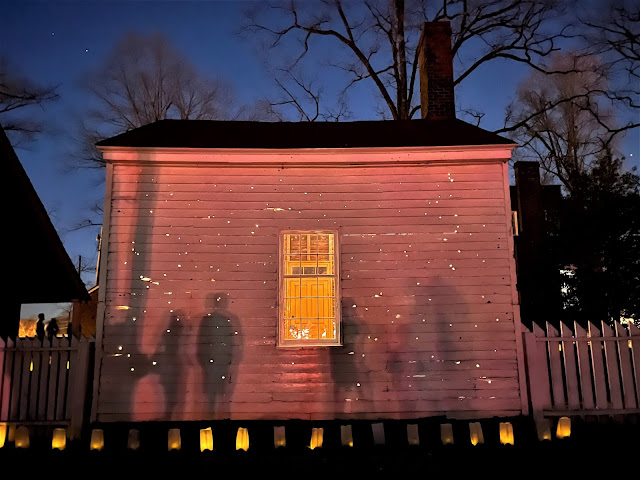
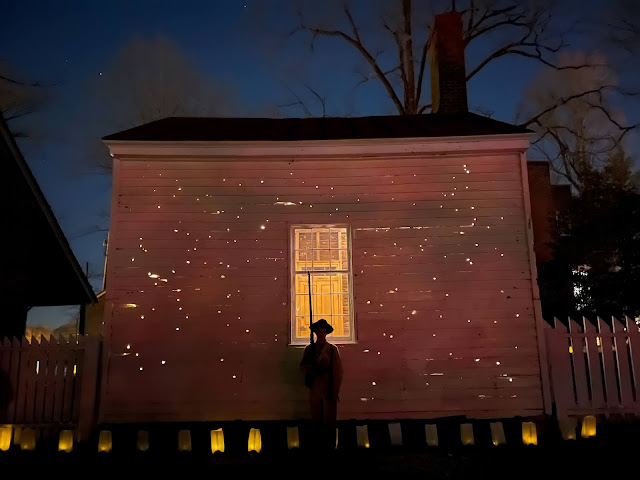
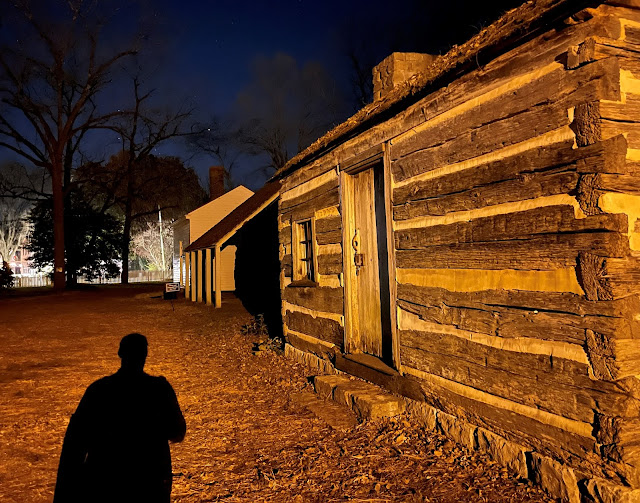
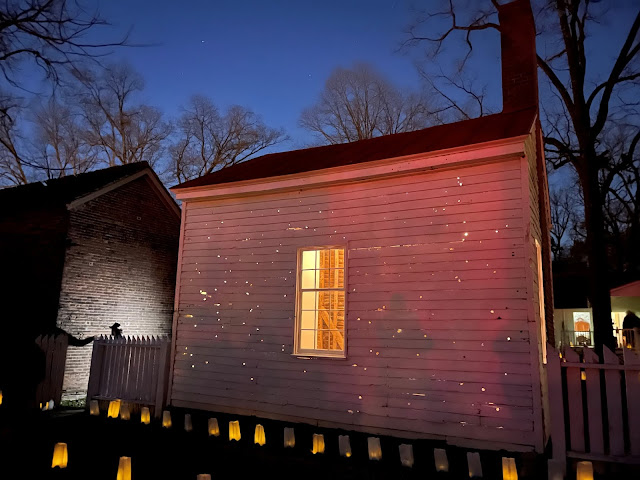
Shadow play on the bullet-riddled Fountain Carter outbuilding, bathed in a red light.
(CLICK ON ALL IMAGES TO ENLARGE.)

Like this blog on Facebook
 | Follow me on Twitter

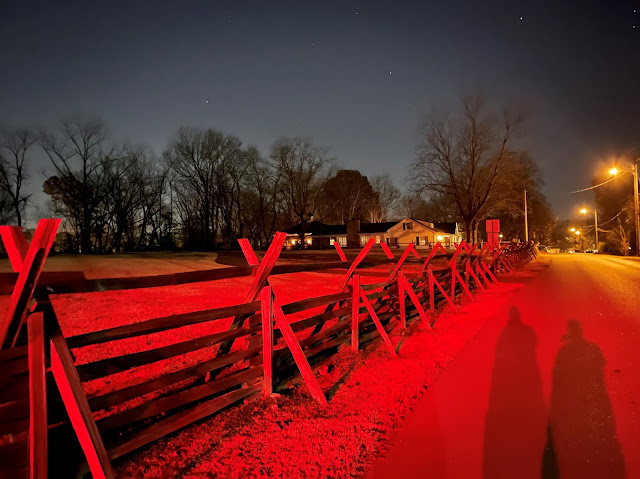
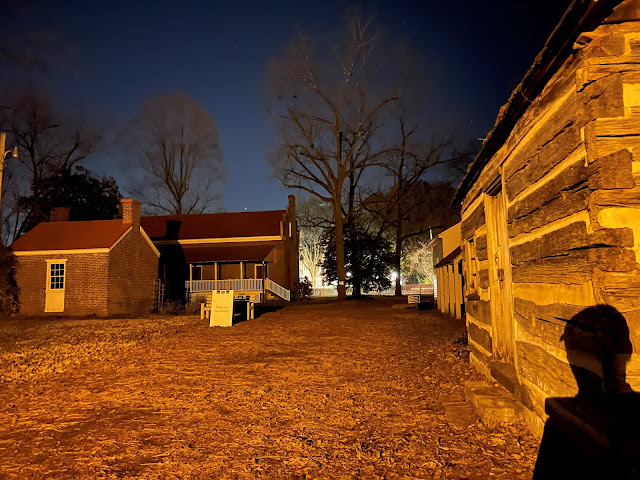
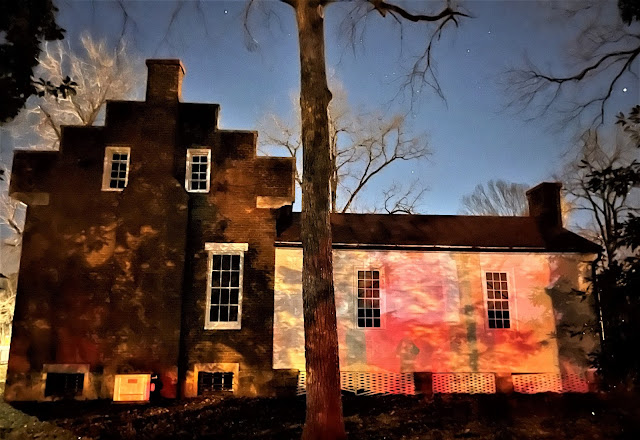
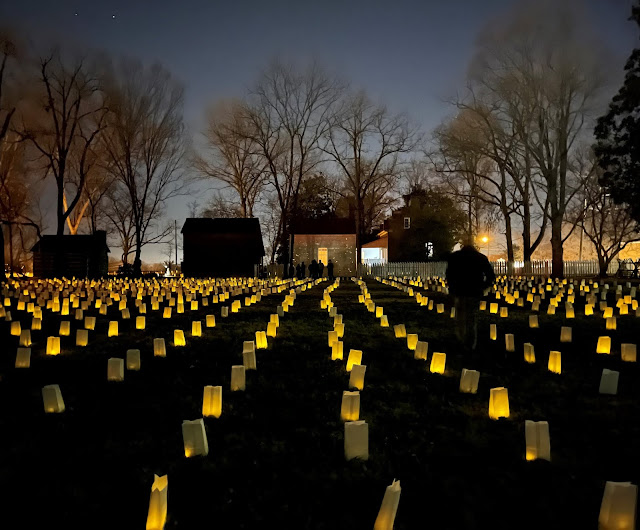
What a fabulous experience it was Tuesday night on hallowed ground at Franklin (Tenn.) on the 157th anniversary of the battle. Brisk weather, hundreds of luminaries “burning” on the old Fountain Carter farm, a robust crowd, parking lot packed—this was as special and powerful as the annual Antietam luminary event I have attended several times. Lights at the Carter house property as well as from cars and traffic signals on Columbia Pike cast an eerie glow for photography. What a shooting gallery.

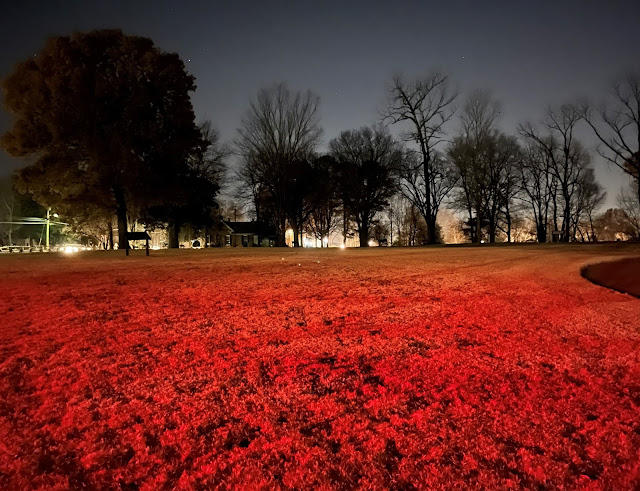
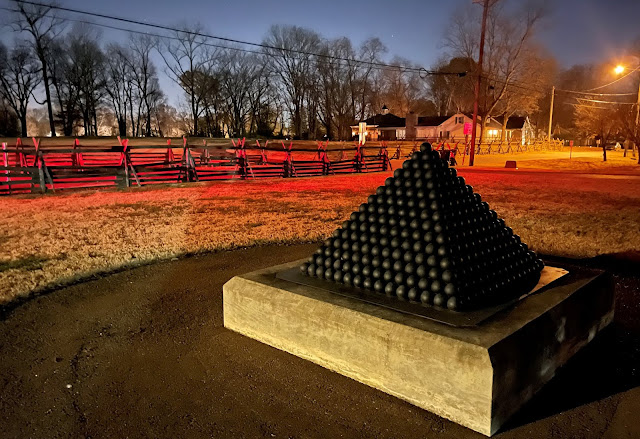
A red glow from a traffic light on Cleburne Street gives the battlefield an eerie look.
The Carter house yard, site of savage fighting behind the U.S. Army line.
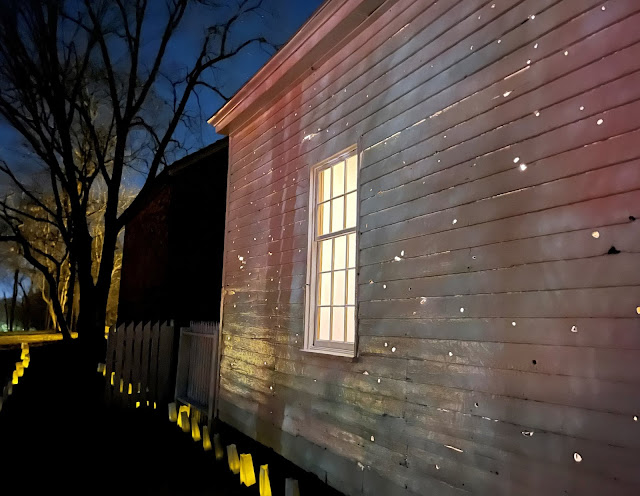
The north side of the Carter house bathed in a light.
The ground a few feet from the U.S. Army works. A park today, littered with dead then.
Living historian John Decker poses in front of a bullet-riddled Carter outbuilding.
The view through a bullet hole.
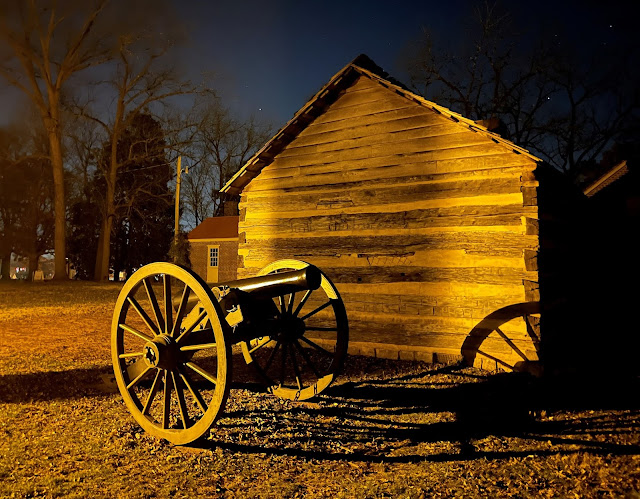
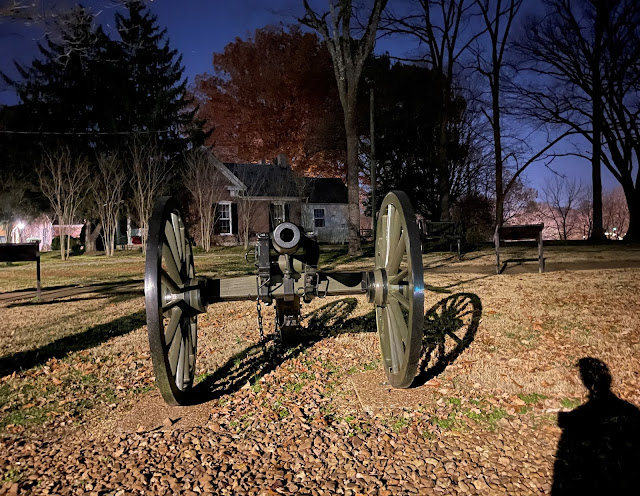
U.S. Army artillery position in Carter yard.
Luminaries at the Carter farm outbuildings.
A "mysterious" shadow in the Carter house yard.
Vicinity where Confederate Gen. Patrick Cleburne was killed during epic charge.
U.S. Army artillery position near Columbia Pike.
A visitor (left) inspects the bullet-marked, brick outbuilding.
20th Tennessee officer Tod Carter was mortally wounded here, within site of his boyhood
home. He died in the house where he was born on Dec. 2, 1864. He was 24.
Luminaries at the 157th anniversary of the Battle of Franklin.

-- Have something to add (or correct) in this post? E-mail me here.

Saturday, March 27, 2021

A visit to grave of Tod Carter, a Franklin battle casualty


Like this blog on Facebook | Follow me on Twitter | Battle of Franklin Trust

On your visits to the Franklin (Tenn.) battlefield, you've probably heard the poignant story of Tod Carter (right), the 20th Tennessee captain who was mortally wounded about 150 yards from his boyhood home on Nov. 30, 1864. The 10th of 12 children of  Fountain Carter died two days after the battle in the house where he was born in 1840. The Carter house and battle-scarred outbuildings still stand and are open to the public. Roughly a mile away, in Rest Haven Cemetery, you'll find Tod Carter's grave, a worthy stop on your next battlefield visit.

The Carter House on Columbia Pike, where Tod Carter died on Dec. 2, 1864.


-- Have something to add (or correct) in this post? Email me here.

Sunday, February 14, 2021

A brief visit to 'lost' Franklin battlefield stone wall


Like this blog on Facebook | Follow me on Twitter

Ever since my friend Jack Richards showed it to me recently, I haven't been able to get the old stone wall along Columbia Pike in Franklin, Tenn., out of my head. The roughly 150-yard section of wall --  unknown to most battlefield visitors -- sits a few feet below the current pike on the Bloody Plain upon which John Bell Hood's Army of Tennessee advanced to attack Federals on Nov. 30, 1864. About a mile north, at the Fountain Carter farm, the U.S. Army awaited behind crude earthworks. Jump-off point for Hood's soldiers was Winstead Hill, about a mile south. The wall -- part of the old Merrill farm -- undoubtedly was here in 1864, but Richards still seeks rock-solid, official confirmation. I shot this video recently, deftly maneuvering through mud, litter and who knows what else. Oh, the life of a Civil War rambler.  

The stone wall, part of the old Merrill farm, sits along busy Columbia Pike.

-- Have something to add (or correct) in this post? E-mail me here.

Friday, February 05, 2021

What happened to Patrick Cleburne's sword and watch?

Patrick Cleburne, killed at the Battle of Franklin on Nov. 30, 1864, and a story
 about the general's sword in the Atlanta Journal Constitution on March 20, 1878.

Like this blog on Facebook | Follow me on Twitter

At about dawn the day after the Battle of Franklin (Tenn.), Confederate General Patrick Cleburne's body was found among other fallen Rebels -- he was flat on his back, his kepi partially covering his eyes. The division commander's remains were taken by wagon to the McGavock family’s Carnton Plantation mansion, accompanied by the hat as well as the general’s watch and sword. The kepi may be found on display in the excellent Tennessee State Museum in Nashville. The watch and sword? Well, I know a few folks who are interested in their whereabouts.

Can you help?

Oh, and here's a neat story about the circuitous journey of Cleburne's 36-caliber Colt revolver.

Patrick Cleburne's kepi in the Tennessee State Museum in Nashville.

-- Have something to add (or correct) in this post? E-mail me here.

Friday, December 18, 2020

Condolences to 'Stumpy': A Mississippian's death at Franklin

Sergeant Mat Dunn of the 33rd Mississippi was killed at the Battle of Franklin on Nov. 30, 1864. His wife, whom he affectionally called "Stumpy," is at right in a post-war photo.
(Photos courtesy Dunn family descendants.)

Like this blog on Facebook | Follow me on Twitter | Read more condolence letters here.

The casualty lists from the Battle of Franklin tell us nearly 10,000 soldiers were killed, wounded and missing. But we can only guess the number of hearts broken in families because of the carnage in Tennessee on Nov. 30, 1864. 

Four months before his death at Franklin, 33rd Mississippi Sgt. Mathew Andrew Dunn aimed to prepare his wife Virginia — he affectionately called her "Stumpy" — for awful possibilities.

"Oh my love," he wrote from Atlanta,  "if I could only See you and our dear little ones again what a pleasure it would be. But God only knows whether I will have that privilege or not. I want you to try and raise them up right. Train them while they are young.

"And if I am not Spared to See you I hope we will meet in a happier world. ... if I am killed I hope that I am prepared to go."

Markers for unknown Mississippians in McGavock Confederate Cemetery in Franklin, Tenn. Perhaps 33rd Mississippi Sergeant Mathew A. Dunn rests beneath one of them.
 (CLICK ON IMAGES TO ENLARGE.)


On Jan. 11, 1865, Major C.P. Neilson provided details of  Dunn's death in Tennessee to "Stumpy," who lived in the hamlet of Liberty, Miss. After emerging through dense woods, Winfield S. Featherston's brigade advanced toward Union breastworks. Ordered to charge, the 33rd Mississippi and six other regiments in the brigade fought their way near Federal lines, Neilson wrote, with hand-to-hand fighting briefly breaking out. But "we were compelled to give way," the major recalled, "and fell back some two or three hundred yards and there remained until next morning."

Wounded four times, Dunn was believed to have been killed instantly. Later that night, Neilson discovered the 30-year-old father of two children lying on his back. "He appeared," the major wrote, "to be peacefully sleeping with a smile." Neilson informed Mrs. Dunn of her husband injuries — he was struck by a bullet "directly in the front, just below the breast bone" and also suffered wounds in the right side, right cheek and left hand.

Dunn fought in Winfield Featherston's
 brigade at Franklin.
Neilson found Dunn's Bible on his chest, and planned to present the testament to "Stumpy" when he returned to Mississippi during the winter. Because he had duties elsewhere on the battlefield, Neilson left Dunn's body where he lay but noted friends and comrades decently buried the sergeant. The soldier's knapsack and blanket had been stolen, Neilson added, by "inhuman robbers of the dead." Another soldier in the 33rd Mississippi preserved a lock of Dunn's hair for his widow.

"It would certainly be a consolation to you to have received some last message from your loving one," added the officer, "but the unexpected mess of the battle and the circumstances of his death precluded the possibility of such a thing."

Concluded Neilson:
"You have two strong sources of consolation Mrs. Dunn. That your husband died as he had lived, a true Christian, and his death was such as becomes the true soldier on the battle field with his face to the foe and followed by love and regrets of all his comrades. Your loss is great and deeply so. I sympathize with you but you 'mourn not as one without hope.' '' 
Nearly three months after the battle, 33rd Mississippi Private John Cain Wilkinson, Dunn's messmate, also wrote his widow. Virginia's husband was among nine soldiers in Company K of the 33rd Mississippi, the Amite County Defenders, to die of wounds suffered at Franklin. The condolence letter — dated Feb. 15, 1865, and presented in its entirety below — is remarkable for its eloquence.

"I am incompetent to write a eulogy upon such a character," wrote the 40-year-old Wilkinson, who became a pastor at the Plymouth Primitive Baptist Church in Liberty after the war. 

To the contrary, the Mississippian's powerful words resonate through time.


McGavock Cemetery, where nearly 1,300 Confederate dead from the Battle of Franklin are buried.
Hamburg, Edgefield District, S.C.
February 15, 1865

Mrs. M.A. Dunn

My Dear Friend, I seat myself with a heart filled with sorrow to pen you a few lines to let you know that I do truly mourn and sympathize with you on account of you great irreparable loss.

Post-war image of
John C. Wilkinson
(Courtesy Pat Ezell)
On the 22nd____, I received the sad and heartrending intelligence that Mr. M. A. Dunn and L.L. Anderson of my mess and seven others of our Co. were killed at the Battle of Franklin, Tennessee on the 30th of November 1864.

Mr. Dunn and I were only slightly acquainted when our Co. organized, but before leaving our beloved homes, we agreed to be members of the same family in Camp and drew our first rations together and continued so until I was wounded in May last.

And to me, he proved to be a true friend under all circumstances, in sickness, in health, in trials, and under all the hardships we had to undergo, he was always a patient and cheerful friend.

I am incompetent to write a eulogy upon such a character, and will only say to you that M. A. Dunn was free from the influence of the many vices and evils so common in Camp which entice so many from the path of rectitude.

But he did by a well ordered walk and godly conversation make manifest to his comrades that he was a devoted Christian, true gentleman and patriotic soldier.

Being kind and obliging, he enjoyed the good will and confidence of all who had the pleasure of being acquainted with him.

Mississippi section of McGavock Confederate
Cemetery
in Franklin, Tenn.
Sergeant Mathew A. Dunn may be buried
 here.
By this sad bereavement our Co. lost one of its first members, Amite County a good citizen, Ebenezar a worthy member, and you and your dear little ones, a kind and dearly beloved husband and father.

Dear Friend, though I join you in shedding a tear of grief, let us not mourn as those who are without hope, for we feel assured that our loss is his Eternal gain, that his freed spirit is now singing praises to our Blessed Savior in the Paradis above where all is joy and peace.

Oh, that we could truly adopt the language of Paul under this heavy affliction - "And we know that all things work together for good to them that love God, to them who are the called according to his purpose." Then, how consoling would be the language of our Saviour, "Let not your heart be troubled. Ye believe in God believe also in me. In my Father's house are many mansions: if it were not so, I would have told you. I go to prepare a place for you. And if I go to prepare a place for you, I will come again and receive you unto myself, that where I am there you may be also. Peace I leave with you, my peace I give unto you, not as the world giveth, give I unto you. Let not your heart be troubled, neither let it be afraid. For because I live, ye shall live also." Then, my afflicted Sister, be admonished by the poorest of the poor to look to the fountain whence cometh all our help and strength; Jesus alone can comfort you in all your trails.

"For the eyes of the Lord are over the righteous, his ears are open unto their prayers." We have the promise of the comforter, and Paul says, "Likewise, the spirit also helpeth our infirmities for we know not what we should pray for as we ought, but the Spirit itself maketh intercession for us with groaning which cannot be uttered."

And to give us full assurance, our Blessed savior informs us that He maketh intercession for the Saints, that according to the will of God.

Close-up of the Mississippi monument at McGavock Confederate Cemetery.
And so, there remaineth therefore a rest to the people of God, and we have so many sweet and precious promises. Let us therefore come boldly into the throne of grace, that we may obtain mercy and find grace to help in each time of need.

I know that the ties of nature are such that you cannot refrain from weeping and though your dear husband cannot return to you, yet you have hope that you may go where he is, and join him in singing a song of deliverance.

And may God on tender mercy remember you and your dear Little Ones. May He lead, rule, guide, and direct you safely through this life, giving you that sweet consolation which He alone can give. And finally, through the merits of his dear Son, crown you His (with your dear husband) in his kingdom above where "God will wipe away all tears from your eyes; and there shall be no more death, neither shall there be any more pain, but where all is Joy and Peace is the desire of one who wished you well.

Sign on entrance gate to McGavock Confederate
Cemetery.
You have no doubt seen a list of the killed, wounded and missing at the Battle of Franklin, Tenn. on the 30th November 1864. And many more must have fallen at the Battle of Nashville on the 15th of December from which I have no news from my company.

When I left Camp I left six messmates whom I loved, four of them, J.P. and C.C. Lea, L.L Anderson, and M. A. Dunn have poured out their life's blood in defense of their country. R.S. Capell is severely wounded and my dear son, W.H.W. reported captured. Truly, we have cause to mourn but I desire not to mourner.

Not wishing to weary you with my imperfection, I close; when at the throne of grace, remember me and mine and believe me to be your friend in deep affliction.

John C. Wilkinson

-- Have something to add (or correct) in this post? E-mail me here.


SOURCES

-- 33rd Mississippi Infantry web site, "To Live and Die in Dixie. We Are a Band of Brothers," accessed Aug. 18, 2018.
-- Pat Ezell genealogical research on John Cain Wilkinson.
-- The Ohio State University, eHistory, accessed Aug. 18, 2018.

Tuesday, December 01, 2020

A seldom-visited pocket of Franklin (Tenn.) battlefield


Take a walk with me on hallowed ground where Confederates faced a "withering fire" during an attack on the Federal left on Nov. 30, 1864.

Friday, November 29, 2019

'Bodies were everywhere': My visit to killing field at Franklin

Once occupied by a small strip mall and house, this hallowed ground at Franklin is now preserved as a
 battlefield park. The cannons mark position of a Union battery. Stones mark the line of Union earthworks.
(CLICK ON IMAGES TO ENLARGE.)

NOTE: This story was reported and written in spring 2018. 

Like this blog on Facebook | Battle of Franklin Trust

It's not difficult to understand why the Battle of Franklin (Tenn.) remained seared in the minds of those who fought there. The fighting on Nov. 30, 1864, was one of the most concentrated slaughters of the Civil War, with hundreds falling dead and wounded on the farm of 67-year-old Fountain Branch Carter.

"It was awful!" a Confederate recalled of the five-hour battle. "The ditch at the enemy's line — on the right and left of the [Columbia] pike — was literally filled with dead bodies lying across each other, in all unseemly deformity of violent death." Another Confederate veteran remembered standing in a ditch with "blood to the depth of shoe soles."

Bullet-scarred outbuildings on the old Carter
 farm are testament 
to the ferocity of the
 fighting here  on Nov. 30, 1864.
Every time I read the terrible recollections of soldiers and others about the savagery of the fighting near Carter’s house and outbuildings --  preserved today -- I wince.

“In trying to clean up,” Carter’s son, Moscow, said years after the battle, “I scraped together a half bushel of brains right around the house, and the whole place was dyed with blood.“

Pitiless bulldozers and developers long ago turned the hallowed ground on the plain leading to the Carter house into a hodge-podge of residential neighborhoods, office parks, fast-food restaurants, convenience stores and other suburban schlock. Although tremendous (and costly) preservation efforts have reclaimed battleground, much of the Franklin field is left to our imaginations.

Curious, I walked the neighborhood near the bullet-scarred Carter house and outbuildings – ground that was strewn after the battle with scores of bodies. Here's what I found out about the killing field in the midst of suburbia.

The war-time Carter house along Columbia Pike is a popular Franklin attraction.
            PANORAMA: Bullet-scarred Carter farm outbuildings along Columbia Pike.
                                    (Click at upper right for full-screen experience.)


Wearing a dark-blue suit, light-blue shirt and sporting a well-manicured, brown goatee, Eric Jacobson looks like a distinguished Union officer. This battleground holds deep meaning for the Battle of Franklin Trust chief executive officer, who long ago made it his goal to understand “every inch” of the hallowed ground. “I wanted to know it,” says the Minnesota native, “like I know myself.”

Close-up of bullet hole in Fountain Carter
outbuilding.
Our walk in the battlefield park near the Carter house, epicenter of the battle, occurs on the anniversary of D-Day, another momentous event in American history. The Allies suffered 4,900 casualties on June 6, 1944. At Franklin, there were nearly 9,000 casualties in five hours on a two-mile front during a battle fought mostly a night, a rarity during the war; 189 Federal soldiers were killed and a staggering 1,750 Confederates.

Jacobson still remembers the day in 1999 when he first walked the hallowed ground near the Carter house. “I was stunned,” he says as we cross busy Columbia Pike, main route of advance of John Bell Hood’s Army of Tennessee. “How the hell could this happen?”

“This” was a small strip mall, two pizza restaurants and a Victorian house built on core battlefield land near the site of the infamous Carter cotton gin. Irishmen Patrick Cleburne – one of six Rebel  generals to die from wounds suffered at Franklin -- was killed nearby.

Another view of bullet-scarred Carter
 farm outbuilding.
Decades ago, Jacobson couldn’t see the Carter house from this spot near modern-day Cleburne Street, the most poignant on the battlefield for him. Thankfully, those awful battlefield intrusions were demolished in 2014, two years after the one-acre property had been purchased by preservation organizations. Jacobson's vista is restored. (The area where Cleburne was killed, once occupied by a pizza restaurant, was reclaimed and restored to open space in 2006. It's a small memorial park today.)

As we walk through the battlefield park, roughly along the line where Union earthworks stood, Jacobson tells of his ultimate goal for a battlefield. He wants visitors to be able to walk from where we stand to historic Carnton Plantation, about 1 ¼  miles away, on preserved battlefield land.

About 15 feet from the foundation of the old Carter cotton gin and an easy bean-bag toss from a 20th-century house, we stand by a cannon marking the position of the 6th Ohio Light Artillery battery. During the battle, Lieutenant Aaron Baldwin’s artillerymen held this spot against swarms of Confederates. This land, Jacobson says, is akin to the Bloody Angle at Gettysburg, where the Union Army made another desperate stand. “Baldwin had no support here. He stays while others fall back,” he says. “At what point do you run?”

In 1864, Baldwin’s artillery pointed into an open field. “Just look at his field of fire,” says an admiring Jacobson, gesturing into a neighborhood filled with houses.

The field of fire for Union Lieutenant Aaron Baldwin's battery is a residential neighborhood today..
     PANORAMA: Foundation stones for war-time Carter cotton gin, behind Union lines 
          during the battle. This was site of some of the most intense fighting of the war.
                                  (Click at upper right for full-screen experience.)


If Aaron Baldwin’s artillery battery were in action today, it probably could do significant damage to Tom Henderson’s property on the killing field. Red, white and blue bunting hangs from the porch of the one-story house in which the North Carolina native and his wife have lived for 30 years. Three American flags are planted in the front yard. “We’re a very patriotic family,” says the 76-year-old Navy veteran, whose ancestors fought in the Confederate infantry and cavalry.

Confederates swept from right to left
 across the plain in front of 

the Carter house. This ground today is a
 residential neighborhood.
“Right here,” Henderson says, pointing in a 180-degree arc, “bodies were everywhere.” Confederates made one of their six charges across this relatively flat ground in his development, built in the late 1980s.

Henderson says his neighbors have found evidence of the great struggle on the Bloody Plain – “ton of bullets,” soldiers’ belt buckles and even a gold coin. But the battle holds no special sway over him.

“We respect the history here,” Henderson says, “but we don’t dwell on it.” As we part, he waves to a neighbor, grabs two of his empty garbage cans and heads back up his driveway.

         GOOGLE STREET VIEW: Williamson County Library (left) was built on "core                      battlefield." The war-time Carter farmhouse is a little more than 250 yards away.
                                    (Click on image to explore the neighborhood.)


Over the objections of battlefield preservationists, the Williamson County Public Library was built in 2003 on land near the Columbia Pike. “Core battlefield,” Jacobson calls the site.

If Confederate Gen. John C. Brown’s division of battle-hardened veterans were to charge over this ground again, he would need several batteries of artillery to take down the large, two-story building and probably a regiment just to remove the fences around the four tennis courts behind it. In Gettysburg terms, it’s like a building was plopped on the Nicholas Codori farm, ground Confederates swept over during Pickett’s Charge.

Inside the library, a friendly Franklin resident talks about the local blood drive. Near the circulation desk, bespectacled librarian Jennie Williams sits with a co-worker behind a long desk in the children’s section. Unsurprisingly, she has a Confederate ancestor – he was wounded near Murfreesboro, Tenn., during the war.

A 60-year-old Nashville native, Williams doesn’t consider the library an intrusion on hallowed ground. She believes the Carter house, about 800 feet from her library chair, “is more Ground Zero” of the battlefield.

Before I depart, Williams and her co-worker casually mention an unusual library holding, perhaps unique in the U.S. public library system. With a library card, anyone can check out a metal detector to hunt for Civil War relics. Be warned: The waiting list is lengthy.

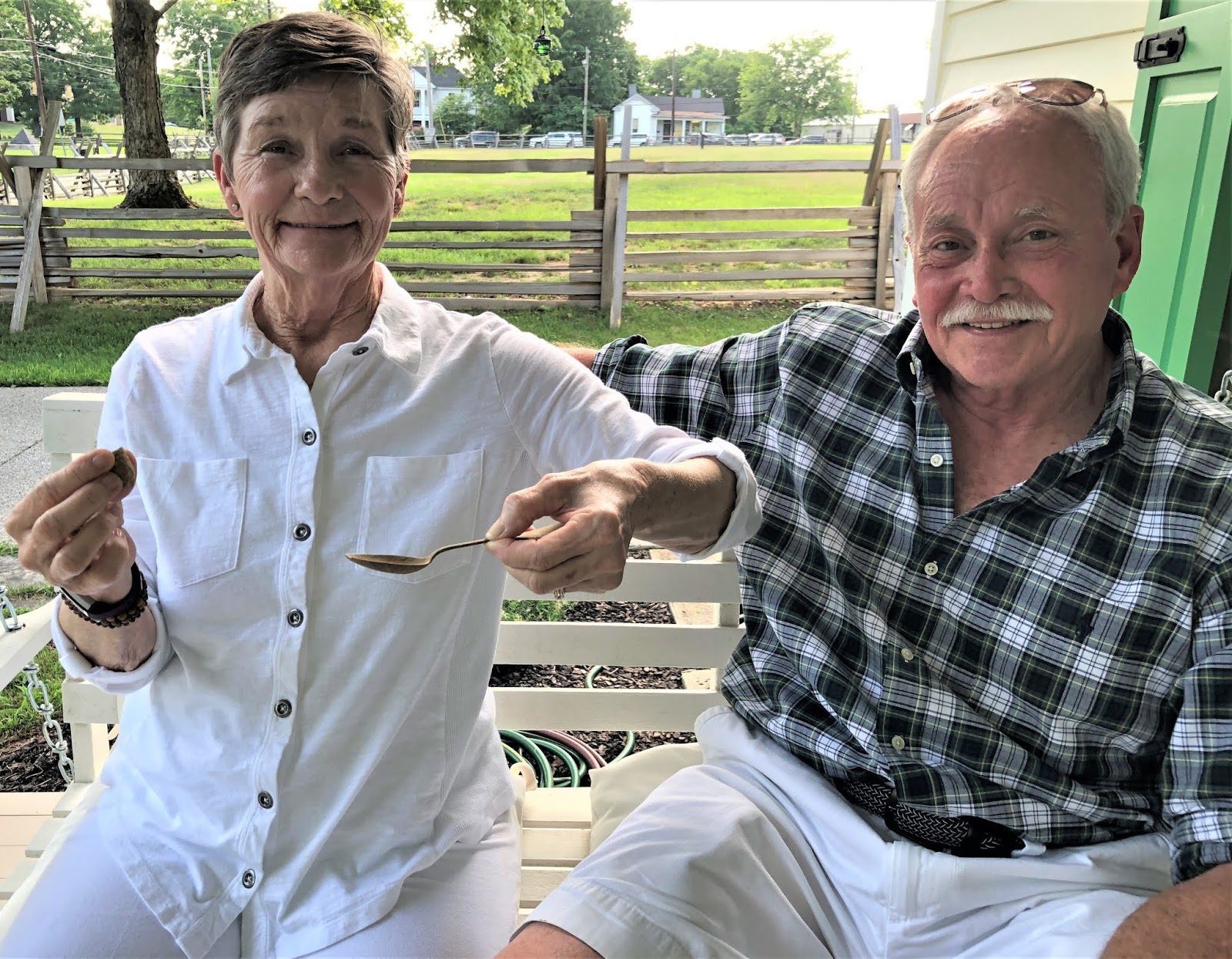
Rita and Tony Holcomb sit on the front porch of their house, which sits on land upon which 
Union earthworks were built in November 1864.  Confederate General Patrick Cleburne 
was killed nearby. Rita holds a bullet and spoon found on their property.

Early on a sultry evening, Tony Holcomb sips a Bulleit bourbon under the shade of a tree in his front yard while his toy fox terrier strains on a leash. A semi-retired Air Force veteran, Holcomb and his wife, Rita, live on Cleburne Street in a 1936 house with an impressive, recent addition. In 1864, Union earthworks cut through his property, about right where a framed photo of Patrick Cleburne hangs on the wall of the Holcombs' living room.

From his front porch, Tony Holcomb can see the pyramid-shaped battlefield monument that many believe marks where Cleburne was killed. (it doesn't.) If he stands on a chair on his side porch, he can see the blocks of the foundation of the Carter cotton gin, where some of the most ferocious fighting of the war occurred.

A civil engineer, Holcomb knows about buildings and terrain, and we spend several minutes talking about the sloping ground yards from his house on which Confederates charged in 1864.

A pyramid-shaped monument battlefield
 monument. Some believe it marks
where Patrick Cleburne was killed. 
It doesn't. 
“How could these guys stand the onslaught?” says Tony, pointing to a Union artillery position over a fence steps from his house. “And how could these guys,” nodding toward where Cleburne’s soldiers charged yards away, “keep on coming? How could they do this?”

Although he’s not a history buff, Tony has a deep respect for the battlefield. So does his wife, Rita, a gregarious Alabama native who calls her home a “little slice of heaven.”

While we engage in small talk on a swing on the porch, Rita ventures inside the house and returns with a shopping bag. She pulls from it several smaller plastic bags, each holding pieces of Franklin’s Civil War past. When the foundation for the Holcombs’ addition was built, a local man asked if he could sweep his metal detector across the ground. He gave the Holcombs everything he found – bullets, what looks like a piece of harmonica, clumps of lead and other detritus of war.

Before my visit ends, we examine an area just off the Holcombs’ property, near the cotton gin site.

“Dead bodies were everywhere in our back yard,” Rita says of the long-ago fighting here.

After a tour of their home, Rita pulls an unfired Union bullet from one of her plastic bags of relics. Handing the one-ounce piece of lead to me as a gift, she reminds me to not remove the dirt from it.

Just another day on a killing field.

-- Have something to add (or correct) in this post? Email me here.


SOURCES

-- Confederate VeteranJanuary 1894.
-- Philadelphia Times, Aug. 21, 1882.

Tuesday, July 16, 2019

Bullet-riddled outbuildings on Fountain Carter's farm


Like this blog on Facebook | Follow me on Twitter

If you dare, you can now follow me live on my Civil War travels. Ah, the beauty of technology. "Like" my Civil War Facebook page and you'll receive alerts when I go live for videos. All the videos will later be archived on the page for your viewing pleasure. (Or grief. Warning: Some IQs have been lowered.)  In the past few weeks, I've ventured to Lookout Mountain, Shy's Hill at Nashville and Franklin, Tenn., where we walked the grounds of the old Fountain Carter farm and examined the pockmarked outbuildings. Where will I be next? Let's just say it will be far, far out West.

Life.

Enjoy the journey.

Always. 

Friday, November 30, 2018

In his footsteps at Franklin: 'Suffering more or less all the time'

Stuart Hoskinson wrote about his experience at Franklin in a letter to The National Tribune,
a Civil War veterans newspaper. (Find A Grave)

Like this blog on Facebook | Follow me on Twitter

Long before their arrival on the Franklin battlefield, 73rd Illinois soldiers Riley and Stuart F. Hoskinson endured great hardship. At Chickamauga on Sept. 20, 1863, Confederates captured father and son at a Federal field hospital, where each had been assigned to care for wounded.  "As we were perfectly powerless," recalled Riley, a sergeant, "we made the best we could of a bad bargain."

Five days later, Riley and his son escaped -- "God's will," the father called their plan. Eluding scores of Confederates during a journey through woods, up and over Lookout Mountain and down a stream on a makeshift raft, the Hoskinsons remarkably found their way back to Federal lines near Chattanooga. Neither man suffered a serious injury.

73rd Illinois Private Stuart Hoskinson was
 wounded near the Carter house, perhaps
by friendly fire.
At the Battle of Franklin on Nov. 30, 1864, Stuart wasn't as fortunate.

About 5:30 p.m., Confederates threatened to smash through both lines of Union works near Fountain Carter's house. Urged on by Major Thomas Motherspaw, the 73rd Illinois, one of seven regiments in Emerson Opdycke 1st Brigade, rushed to help fill the gap. Stuart recalled firing nearly 60 rounds during the desperate fighting on Carter's Hill, wounding at least one Confederate. The 21-year-old private suffered severe wounds himself, perhaps from friendly fire, when a bullet crashed into his collarbone. 

"Sergeant," a captain told 45-year-old Riley M. Hoskinson, "your son is killed; he is shot through the lungs and is bleeding from his mouth and nose.' "

Taken to a makeshift hospital at a church in Franklin, Stuart became a prisoner again when the Confederates retook the town. But Hoskinson survived his grievous wounds thanks, in part, to the care of a local mother and daughter. "... They waited on us," he remembered, "just as well as they could have done if we had belonged to the other side."

Nearly 20 years after the battle, Stuart Hoskinson recalled his harrowing experience at Franklin in a letter published in The National Tribune, a newspaper for Civil War veterans. The physical toll from Franklin was still evident: "I am suffering more or less all the time from it," he wrote of his war wound.

Let's follow in Stuart's footsteps at Franklin:


An Illinois Soldier's Experience


Emerson Opdycke:
Died in 1884 after

 accidentally
shooting himself.
To the Editor: In The National Tribune of July 10 I saw a letter from J. D. Remington, Co. I, 73d Ill, Ill., in which he refers to the death of Brig.-Gen. [Emerson] Opdycke and the part taken by him and our brigade at Franklin, Tenn. As he says in his letter, we all loved the General as a commander, and I was deeply grieved to hear of his death and the manner in which it came. I have good reason to remember that eventful evening of Nov. 30, 1864, and well remember seeing our troops who were holding the works in front of us falling back in confusion before the charge of the rebels; then hearing our Major (Motherspaw, not Motherspan) give the order to the 73d to charge to the front; then of the confused mass of our retreating men who tried in vain to check right in front of Carter's house, they rushing to the rear pell-mell through the gaps in the picket-fence, and we in as big a hurry to get to the front to salute the Johnnies. When we got to the inside line of works the rebels had full possession of the outer line and many were between the two. Our fire, given as fast as we got into position, soon checked their advance and sent them to grass or to the rear.

"When we got to the inside line of works," Stuart Hoskinson recalled, "the rebels had full possession of the  outer line," about 20 yards in front of Fountain Carter's smokehouse (left).

Some few of our men had failed to make good their retreat to the rear from their position behind the outer works and were crouched close down, not seeing any way to get out of a bad fix. One rebel, I noticed in particular, was on the works above the head of one of our men and, I suppose, having fired his gun, had raised it in an act of clubbing the man below. I quickly brought my gun to bear on him about his waist-belt and fired, and the last I saw of him he was falling backward with his hands in the air. He might have received other shots than mine, but as he was not over 100 feet from me I could have wagered he carried my first shot of the battle with him. I never knew just what hour the fight ended, but at about 8 o'clock, as near as I should judge, for I had fired nearly 60 rounds.

"I managed to get to the rear, behind Carter's house, where I lay down ...," Stuart Hoskinson recalled.
I received a shot in my left shoulder, which (barring accidents) I will carry to my grave, striking me on the point of collar-bone and coming out at the backbone near the bottom of the shoulder-blade. At the time, and for three or four days, till suppuration set in and the pieces of cloth came out of the wound, I was not certain but what I had been accidentally shot by some of our men in rear of me. The blood rushed from my mouth in a stream and I thought my last hour was near, but after a short time the inward bleeding stopped and I took courage. A lull in the firing taking place shortly after, I managed to get to the rear, behind Carter's house, where I lay down for an hour or more, when I heard some one inquire if there were any of the 73d there. I answered "here," and three or four of our regiment came to me and carried me into town and left me in the brick church on the east of the turnpike, with about 100 others of our severely wounded. Having been on picket at Spring Hill the night before and rear-guard all day from there to Franklin, I was worn out, so I fell into a troubled sleep, and about midnight wakened to find we were prisoners.

"Three or four of our regiment came to me
 and carried me into 
 town and left me in
 the brick church on the east of the

 turnpike," recalled Stuart Hoskinson.
The Presbyterian church, 

severely damaged during the war, was replaced by 
another church in Franklin in 1888.
There were 190 of our wounded taken there, and at the end of 17 days, at the recapture of Franklin, we were reduced to 140. One Surgeon staid with us, and with the assistance of one or two resident physicians cared for our wounds. Had it not been for the kindness of some of the ladies of Franklin I do not know how we would have fared, as what little rations of flour and poor beef was issued to us had to be cooked, and no one to do it but them. One old lady and her daughter, named Courtney, we will never forget. for although they had a son and brother who was a Lieutenant in the rebel service, yet they waited on us just as well as they could have done if we had belonged to the other side.

"As brave an officer as we ever had
 in the regiment," Stuart Hoskinson wrote of
 Major Thomas Motherspaw, who was
mortally wounded at Franklin.

(Find A Grave)
Our Major (Motherspaw) was shot in the groin, and I saw him clap his hand to the wound, but had too much to attend to in my front to see more. He was on his horse close to the turnpike and near where [Confederate General Patrick] Cleburne was killed. He died December 18, in Nashville, one day after we were recaptured by our forces. As brave an officer as we ever had in the regiment, kind and considerate to his men and loved by all. He was formerly Captain of Co. D, and commanded the regiment, as our Lieutenant-Colonel was on service in Nashville, and Col. Jas. F. Jacques was in Washington, having been called there by President Lincoln to go to .Richmond in May preceding. There were only two others of my regiment among the wounded left in Franklin besides myself -- Serg't [Joseph] Allison, Co. C, and a young man of Co. D, I have forgotten his name. [In the 73rd regimental history, Stuart notes it was James D. Branch.] Allison was shot in the small of the back and died Dec. 10, 1864; the other man lived long enough to reach the station seven miles from his home, on the Wabash Railroad, east of Springfield, Ill., and died there. He was shot through the neck and both collar bones broken. I should like some of his friends to let me know what his name was.

I received my discharge Feb. 10, 1865 from "gunshot wound of left shoulder" but after reaching home it proved to be an injury to the left lung also, and for nearly 30 months the wound in my back remained open, so I could blow by breath through the opening. I am suffering more or less all the time from it, and am at present drawing $12 per month pension. The loss of the rebels at Franklin must have been greatly understated in their official report, for more than one of their men told me while prisoners that their loss was 6,000 killed, and I know when our men recaptured the town there were 1,500 or more rebel wounded there.

-- Stuart F. Hoskinson, Co. G, 73d Ill., Seattle, King Co.. W. T.

-- Have something to add (or correct) in this post? E-mail me here.


SOURCES

-- A History of the Seventy-Third Regiment of Illinois Infantry Volunteers, Regimental Reunion Association, Springfield, Ill., 1890.
-- The National Tribune, Aug. 7, 1884.

Friday, November 16, 2018

10 'outtakes' from my story on epic 1923 Franklin battle film

Director Allen Holubar (right) poses with extras for the epic battle scene.
(Nashville Tennessean via newspapers.com)

Like this blog on Facebook | Read my story on the movie in Civil War Times.

In 1923, 16 years before Gone With The Wind debuted in American movie theaters, a Civil War-themed movie was filmed on location in Tennessee. The Human Mill, the first Hollywood-produced film made in the state, featured an epic Battle of Franklin scene shot on the very plain upon which John Bell Hood's Army of Tennessee charged on Nov. 30, 1864. Think of it as Saving Private Ryan before all the whiz-bang special effects of late-20th century movie-making.

Allen Holubar, the 33-year-old director
of The Human Mill.
California-based director Allen Holubar, a 33-year-old former silent movie actor, set up home base at The Hermitage, the first million-dollar hotel in Nashville. Almost immediately, he sought thousands of soldier extras for the filming of the great battle scene. Tennessee did not disappoint. A military academy in nearby Columbia and two schools in Spring Hill supplied their entire student bodies. Franklin’s Battle Ground Academy and high school also offered up their male students. World War I and Spanish-American War veterans — even Confederate vets — eagerly volunteered for bit parts.

The day of the battle scene filming, Sept. 27, 1923, became one of the more eventful in Franklin history. A holiday was declared, schools and businesses closed, and from 10,000-12,000 people gathered on the outskirts of small town 17 miles south of Nashville to watch Hollywood movie magic. (Check out my lengthy feature story about the filming in the February 2019 issue of Civil War Times. The story is online here.)

Don't look for The Human Mill on YouTube. In fact, you won't find it ... ah, read my CWT piece for viewing information. In the meantime, pop some popcorn, grab a drink and enjoy these "outtakes" from one of my favorite Civil War-related stories.

Director Allen Holubar (right) was loaned Tennessee's "oldest stage coach," according
to the Nashville Tennessean, for use in his movie. (Newspapers.com)
Blanche Sweet, shown in the
 Nashville Tennessean on 
Sept. 26, 1923, had a starring role
 in the film. (Newspapers.com)
WANNA BE A MOVIE STAR? Days before filming began, the director put out word in a Nashville newspaper (right) seeking a local for a big part in the film:
Here's a piece of news that will interest local screen aspirants: Allen Holubar, prominent motion picture director, who is making Nashville his headquarters while filming a number of big scenes for "The Human Mill," stated this morning that he is still looking for some Nashville miss who resembles Blanche Sweet to take one of the big parts in the production he is filming. Every theatre-goer has seen Blanche Sweet on the screen many, many times. Above is a new picture of her. If you believe there Is a resemblance between yourself and. this well known screen star, get in touch with Mr. Holubar immediately at the Hermitage hotel. If you meet with the requirements, you will be given a real part in "The Human Mill." This offer is not in the nature of a contest, but is a sincere attempt to secure a Nashville girl for the role. Many local girls have already called on the director to apply for the part, but the exact type preferred has not as yet put in her appearance at the Metro headquarters.
It's unknown if Holubar found his Blanche Sweet lookalike.

WHERE, OH WHERE:. The battle scene was filmed on the farm of J.W. Yowell, known as "the old Fly place," about a mile south of Franklin and about a half-mile west of Columbia Pike. Like nearly the entire plain upon which Hood's men marched, the farmland where the movie was shot was developed long ago. No marker notes the site of The Human Mill filming. (Hood's army suffered 7,000 casualties at Franklin; six Confederate generals, including Patrick Cleburne, died of wounds suffered in the battle.)

Masonic Lodge in Franklin, wardrobe depot
for the movie and hospital in the aftermath of the real 

Battle of Franklin on Nov. 30, 1864.
GET YOUR UNIS: 2,000 soldier extras received their military uniforms and other accoutrements at Franklin's old Masonic Lodge,  which served as a wardrobe depot. The hall, used as a makeshift hospital following the real Battle of Franklin, still stands on 2nd Avenue South. "Gives us Confederate uniforms!" shouted many of the extras. "We don't want any damn Yankee uniforms!" Unsurprisingly, sentiment in Tennessee was pro-Confederate in 1923, although the state supplied 31,000 soldiers to the Union army.

ABOUT THOSE OL' REBELS: The director was adamant about using them in the film. "Mr. Holubar declared ... that the Battle of Franklin would not be realistic, nor would it be satisfactory to him, without the presence of real Confederate soldiers in the lines," according to a newspaper account.

SPEAKING OF EPIC: Marshall Morgan crafted an outstanding, two-part account about the filming of the battle scene for the Nashville Tennessean in 1950.  In Part II of "Second Hour of Glory," he wrote:
Although the battle was not scheduled to begin until 10 o'clock, daylight found the Columbia highway almost impassable under its burden of automobiles, buggies, wagons, bicycles, baby carriages and plodding hundreds of pedestrians. Twenty special deputies had been sworn in to augment the everyday forces of law; and as fast as the movie-spellbound throngs arrived on the scene they were herded into a roped-off hillside area. 
LOTS OF BANG: Beginning about daybreak, the "battlefield" was mined with explosives that, when exploded, simulated the results of artillery fire. "For its explosive effects," director Holubar said, "this battle scene surpasses any I have seen taken."

The Human Mill coverage on Page 1 of the Nashville Tennessean on Sept. 28, 1923. (Newspapers.com)
STOP THE PRESSES! The filming of The Human Mill received extensive coverage in the Nashville Tennessean, including Page 1 stories the day after the movie's battle scenes were shot in Franklin. Wrote the newspaper:
Shells burst overhead, gallant troops of the Confederacy charged recklessly forward, only to recoil and then return to the attack; federal gunners and foot soldiers fought silently and doggedly and the plain was strewn with the dead as shells and mines sent up showers of dirt and rock near Franklin, Thursday while thousands watched the Battle of Franklin re-enacted as Allen Holubar, of the Metro forces directed the big scene in the filming of "The Human Mill," movie version of John Trotwood Moore's "Bishop of Cottontown."
Isaac Sherwood
A REAL FRANKLIN VETERAN'S TAKE: Congressman Isaac Sherwood, who fought in the 1864 battle as an officer in the 111th Ohio, was "deeply" interested in the film. The 88-year-old veteran reportedly attended the filming of the battle scene, serving as an unofficial advisor.  "[B]ut no moving picture," he wrote in a letter published in the Nasvhille Tennessean after the filming, "can move like the stalwart host moved at Franklin November 30, 1864, and the world will never again see a battle to compare with Franklin.

"But I am going to travel many miles," he added. "to see the mock Franklin when it is ready."

HURRAH FOR HOLUBAR! Days after completion of the battle scene, praise poured in for the director. Wrote the Nashville Tennessean:
Mr. Holubar had conjured better than he knew. The day of the 60's was back again. In that tense retrospect, the past itself was here. What had been done to bring it back was a matter of little moment. All the more praise for him that he made us forget the quick lire of his imagination, his art, and all his dominance of a thousand details, in the grip of the thing he had produced. It is not Allen Holubar that we remember as the thrill of the scene still strikes at our hearts, but the gray ghosts that he brought to life and the old battle that roared again across a famous field because of him."
 WHAT HAPPENED TO THE DIRECTOR? Oh, no!

-- Have something to add (or correct) in this post? E-mail me here.