Marfut graduated from the U.S. Army War College with a master’s degree in strategic studies. In 2019, she was certified as an Antietam National Battlefield guide. Marfut is also a board member of the Antietam Institute, which you can read more about here. | Join the Antietam Institute.
Showing posts with label John Banks. Show all posts
Showing posts with label John Banks. Show all posts
Thursday, February 29, 2024
Podcast: Antietam guide Laura Marfut on The Bloody Cornfield

Wednesday, October 24, 2018
'What are you thinking, Momma?': A goodbye to Peggy Banks
 |
| Peggy Banks, "movie star," as a teenager. |
 |
| Mom, brother David and a mischievous mini-me long ago. She often said David resembled her. |
Watching a loved one die is tough. Watching a loved one die from Alzheimer’s -- as Mom, 81, did at noon Wednesday -- is doubly awful because you lose them when their mind goes and again when they pass on. But while we grieve for Peggy, we have much to celebrate, just as we did two years ago when we lost Dad, “Big Johnny.” What tremendous lives they led. What great examples they were for their children, David, Mary Ann and me.
 |
| Mom and my sister, Mary Ann, in Glenside, Pa. |
Mom didn't have an opportunity to go to college, but she enjoyed telling us she skipped third grade because she was so smart. She also won a school contest for memorizing the Gettysburg Address. Perhaps Peggy passed along the "Civil War gene" to me.
Mom worked as a bank teller for a time, and had an innate ability to pick stocks. We had no clue until near the end of her life. She had a few idiosyncrasies, too. "Don't use so much hot water," she always told us before we showered in our bathroom with the funky blue-and-pink tiles.
 |
Dad, Mom and our daughters, Meredith and Jessica, atop
Mount Washington overlooking downtown Pittsburgh.
|
Mom was beloved by my pals in the Sunset Hills area of Mount Lebanon, Pa., who called her the “sweetest lady on Old Farm Road.” But this sweet, little lady once chased a teenager behind a toilet in the downstairs powder room in our house, smacking him with a broom. My punishment was well deserved. Years afterward, we often laughed about it.
Our friends often observed Peggy tooling around town in her blue Volkswagen Beetle with a sunroof. She didn't learn how to drive until she was in her late 20s. Rarely, if ever, did she top 35 mph, and she never drove on an interstate. At least we think she never did. How Dad had the patience to teach Mom to drive remains one of the great mysteries of life.
When we kids married and had our own children, she and Dad made 321 Old Farm Road a welcoming home base for all of us. Oh how she loved her grandchildren, Evan, Ryan, Camille,Travis, Jessica and Meredith. “How are the girls?” she often inquired in a sing-song voice about our daughters. Those words will forever remain on the soundtrack in my mind.
 |
| The Banks family at 321 Old Farm Road, Mount Lebanon, Pa. |
In the hospice room near Mom's bed, my sister hung our paternal grandmother's painting of a guardian angel. Neil Diamond songs played. She loved his singing. Mary Ann and David believe it brought her comfort. Thank you, Neil. Dressed in a beautiful purple top, Peggy fought until the end. "She had a strong heart," my sister said. We all knew that.
 |
| How to donate to Alzheimer's Association |
Wherever your spirit soars now, Peggy Banks, know you’ll always be in our hearts. Tell Dad in heaven we said hello. We know he'd appreciate several of those little roast beef sandwiches now, too. We're so proud of both of you. Bravo for lives well lived.
 |
| Holding Peggy Banks' hand for the last time. |
-- Have something to add (or correct) in this post? E-mail me here.
Monday, June 05, 2017
Cold Harbor Then & Now: Union cavalry at Old Church Hotel

(THEN: Timothy O'Sullivan, Library of Congress | NOW: John Banks, June 5, 2017)
On June 4, 1864, Union cavalry gathered at Old Church Hotel while their infantry comrades about five miles south in Cold Harbor, Va., dodged fire from Confederates and dug in for an extended standoff. Photographer Timothy O'Sullivan captured the hotel scene, which appears unremarkable at first glance.
One-hundred and fifty-three years and one day later, I dodged nothing but raindrops and busy morning traffic along Old Church Road to shoot a present-day image of O'Sullivan's long-ago stereoview. Enhanced by increasing contrast and using other modern magic, cropped enlargements of O'Sullivan's photo reveal cool details. (William Frassanito analyzed the image in his 1983 book, Grant And Lee: The Virginia Campaigns 1864-1865.) In need of TLC, the old inn in the hamlet of Old Church is a private residence today.
 |

... while two other soldiers — one standing and leaning on his saber and another sitting on a railing — appear among at least two dozen horses in the photo. Animals found plenty of forage in fields in the immediate area, which, unlike much of the vicinity today, remains rural ...

... O'Sullivan's photograph shows the name of the hotel's proprietor — J.A. Lipscomb — which appears on the large sign in front of the two-story structure. Too bad we can't see anyone peering from the windows or porch on the second floor ...

... but we can easily see these two horses. Or is it three? One apparently is unable to remain still for O'Sullivan. And is that what we think it is at the hind legs of these nags? Ah, fellas, c'mon!
-- Have something to add (or correct) in this post? E-mail me here.
-- For large-format Then & Now images, visit my blog here.
Sunday, September 25, 2016
Antietam: Is this house where General Joseph Mansfield died?
 |
| 2000: During a renovation of the house, the current owner discovered log construction underneath. (Images showing log construction courtesy Marvin Diller) |
 |
| TODAY: The old Daniel Bovey house. The log portion of the house is behind the brick and to the right of the front porch. |
WARNING! FOR HISTORY GEEKS ONLY. :)
Three Union generals suffered mortal wounds at Antietam, and for students of the battle, the sites where two of them died are well known.
Israel Richardson, struck in the chest by an artillery shell fragment near the Sunken Road on the morning of Sept. 17, 1862, was taken to the Philip Pry farm, where a makeshift hospital had been set up in the barn and house. President Lincoln visited him in Pry's house in early October, and the general's wife Fannie and sister traveled from Michigan to help care for him there. But the 46-year-old officer -- "Fighting Dick," he was called because of his prowess on the battlefield -- died of complications from his wound on the second floor on Nov. 3, 1862. The beautiful, brick house is now home for excellent displays by the National Museum of Civil War Medicine.
Wounded in the chest during the IX Corps' afternoon attack, Isaac Rodman died on Sept. 30 in Henry Rohrbach's farm house, near Burnside Bridge. His wife Sally, who had traveled from Rhode Island, was by his side. Before his death, the smell of the 40-year-old brigadier general's wound became so offensive, according to a witness, that the dinner table was moved outside to the porch for meals. Privately owned, the Rohrbach house is inaccessible to the public.
Antietam proved to be the first and last Civil War field command for Joseph Mansfield, who had served far from major action until he was given the reins of the XII Corps only two days before the battle.
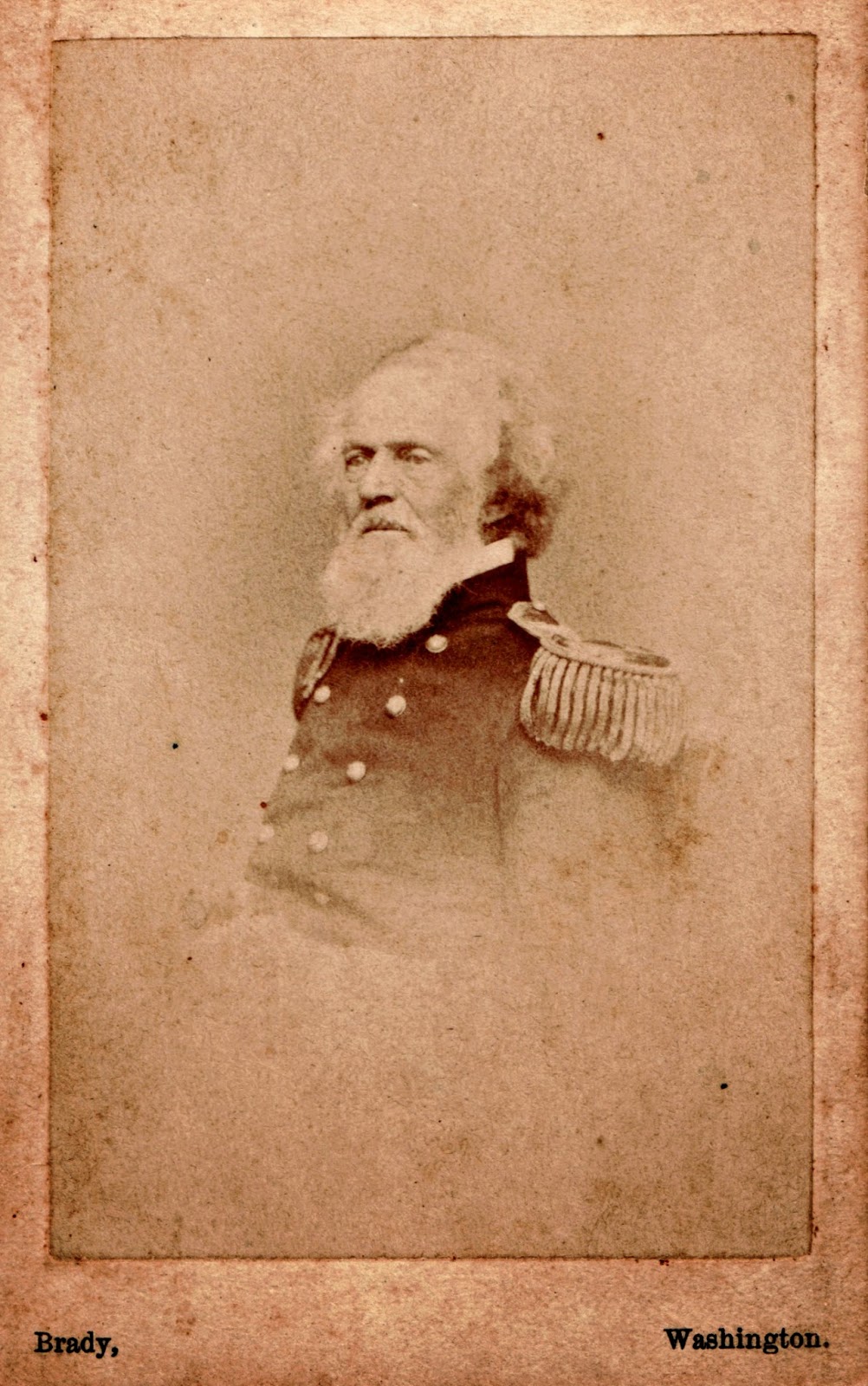 |
| General Joseph Mansfield of Middletown, Conn., died of his Antietam wound on Sept. 18, 1862. (Middlesex County History Society) |
Line's two-story house, which measured about 26 feet by 22 feet, became known as the "White House Hospital," undoubtedly because the logs were painted white. A thousand wounded soldiers, including more than 100 Confederates, received care in his house and in the outbuildings on his farm.
Patrick Henry Flood, the 107th New York surgeon who came to Mansfield's aid after he was shot, feared the general would die before he even arrived at Line's farm. The bullet penetrated about "two inches from the nipple ... passing out at the back, near the shoulder blade," Flood wrote to Mansfield's wife, Louisa, in April 1863. (Read the complete letter on my blog here.) "The lung was much torn," the surgeon added, "and I saw at a glance the wound must prove fatal."
At 8:30 a.m. on Sept. 18, 1862, about 24 hours after Mansfield was shot, the 58-year-old officer from Middletown, Conn., died in a bedroom in Line's small house. Just off the gravel, war-time portion of Smoketown Road, a short distance from the site of Line's house, a small, black-and-white metal marker points to where Mansfield's life ended.
That sign is wrong.
Mansfield didn't die at noon on Sept. 17, and although he indeed died in the house on George Line's farm, the 1862 log house was long ago moved and forgotten.
Until now.
 |
| A sign just off Smoketown Road incorrectly notes the date and time of Mansfield's death. The log house in which the general died was purchased by Daniel Bovey, who moved it sometime during the 19th century and reassembled it on his nearby farm. |
 |
| This house on the site of George Line's log house was probably built after the Civil War. This is private property. Do not trespass. |
is in the grove of trees to the right of the long, thin outbuilding.
On a Saturday morning in Captain Bender's Tavern on Main Street in Sharpsburg Md., my friend John Rogers and I marveled at tales told by Richard Clem, who has a longtime passion for hunting for Civil War relics in area fields and woods. Clem pulled from a small case pieces of art made from lead by Civil War soldiers -- a VI Corps badge, a cannon tube and even a small, intricately carved walnut. A lifetime Washington County, Md., resident, Clem also has a remarkable knowledge of local history. The 78-year-old retired woodworker still fondly remembers his grandmother recounting visits with Civil War veterans, proving the war isn't as long ago as some of us might think.
 |
| An 1877 Washington County atlas shows the location of the old Daniel Bovey farm near Hooker Bridge, also known as Upper Bridge. |
And so we three history geeks hopped into Rogers' car to find out more about a footnote in history.
After a quick stop at the site of the old O.J. Smith farm/Civil War hospital on Mansfield Road near the battlefield, we drove a short distance before we made a right turn up a long, gravel lane. At the top of the hill, we saw a two-story brick house with a modern addition and a friendly dog. (See Google Earth view below.) In the far distance, we could barely make out the old Hooker Bridge (or Upper Bridge), named for the general whose I Corps marched across it on the way to battle. Richard knew the owner of the farm, Marvin Diller, who had an interesting story to tell. During renovation work on the house in 2000, he discovered a log structure beneath the brick exterior. He even had pictures to prove it. Each log was marked with Roman numerals, Diller said, which seemed odd a first.
A little local history lesson made sense of it all.
In 1906, O.T. Reilly authored The Battlefield of Antietam, a 32-page booklet of photos, stories and remembrances about the battle. Reilly, who claimed he witnessed the battle as a 5-year-old, was the first Antietam guide, serving as a battlefield expert for decades. In his booklet, the longtime area resident wrote this brief passage:
 |
| O.T. Reilly (Image courtesy Stephen Recker) |
The brick house that stands near the Hooker Bridge, on the southwest side, is the old log house that formerly belonged to George Line and was purchased by Mr. Bovey, removed, rebuilt and brick-cased, and was the house in which General Mansfield died. Mr. George Line built a new house on the site of the old one. The road to the left (southwest) of the Hooker Bridge was, during war times, only a private farm road, but now is a county road. The road to the right is the old road running through Bakersville to Williamsport; a portion of the army took this road before the battle to get on the right. All the buildings as you pass along were, for a short while, filled with wounded soldiers until they could be placed in the regular hospitals.A similar account, perhaps borrowed from Reilly, appeared in the regimental history of the 124th Pennsylvania, which bivouacked on Line's farm the night before the battle. Further evidence that Line's log house was moved comes from this 1996 survey by the Maryland Historical Trust, which noted the brick house on the property today "shows characteristics of later 19th century construction."
Bovey was Daniel R. Bovey, a local minister, farmer and longtime Keedysville, Md., resident. The exact date of his purchase of the house from Line is unknown, although it must have been before 1892, the year Bovey died. When Bovey reassembled the house on the hill near the Hooker Bridge, the Roman numerals on the logs evidently made reassembling it easier. The date the house was brick-cased, apparently a fairly common practice in Washington County, merits more research. Diller's property encompasses what was the old Bovey farm, which is shown in the 1877 Washington County atlas.
The available evidence seems to add up -- the house Mansfield died in has indeed survived the ravages of time.
Whether Mansfield died in his house or on Mars, it doesn't really make a difference to Diller. When I asked him how he felt living where a Civil War general died, he looked me in the eye and smiled.
"We don't even think about it," he said.
 |
| A 1906 reunion of the Bovey family at the family farm. An arrow points to Mary Ann Bovey, Daniel's wife. Daniel Bovey died in 1892. (Courtesy Bovey descendant) CLICK ON IMAGE TO ENLARGE. |
 |
| Another view of the log construction of what once was George Line's house... |
 |
| ... and the same view today. The current owner of the house, Marvin Diller (blue pants), appears at right. |
 |
| View from the front of the house. The Hooker Bridge. or Upper Bridge, crosses Antietam Creek in the middle distance. |
 |
| A brick on the house designates the year it was renovated. |
Have something to add (or correct) in this post? E-mail me here.
SOURCES:
--Find a Grave
--Hagerstown Daily Mail, Feb. 16, 1934. Description of Rodman's offensive wounds comes from Fred Cross, a military archivist at the Massachusetts Archives, who was told the story by area resident Jacob McGraw. McGraw helped Rohrbach clean up his property after the battle.
--Maryland Historical Trust, Inventory of Historic Properties, accessed online Sept. 25, 2016.
--Nelson, John H, As Grain Falls Before The Reaper, The Federal Hospital Sites And Identified Federal Casualties at Antietam, Privately published CD, Hagerstown, Md., 2004. (Nelson's excellent work is source for description of Line's farm as the "White House Hospital" and dimensions of Line's log house. He cites The Medical Department of the United States Army in the Civil War by Louis Duncan, published early in the 20th century, as source for number of wounded treated at the Line Farm. He cites Dr. Elisha Hunt's "Report on Field Hospitals Indicated on Map of Battlefield of Antietam" for note on Confederate wounded treated at Line farm. Harris was in charge of distribution of supplies by the United States Sanitary Commission.)
--Dr. Patrick Henry Flood letter to Louisa Mansfield, April 28, 1863, Middlesex County Historical Society, Middletown, Conn.
--Reilly, Oliver T., The Battlefield of Antietam, Hagerstown Bookbinding and Printing Co., Hagerstown, Md., 1906
Subscribe to:
Posts (Atom)