Showing posts with label Brigadier General Isaac Rodman. Show all posts

Sunday, September 25, 2016

Antietam: Is this house where General Joseph Mansfield died?

2000: During a renovation of the house,  the current owner discovered log construction underneath.
(Images showing log construction courtesy Marvin Diller)
TODAY: The old Daniel Bovey house. The log portion of the house is behind 
the brick and to the right of the front porch.
Like this blog on Facebook | Follow me on Twitter

WARNING! FOR HISTORY GEEKS ONLY. :)


Three Union generals suffered mortal wounds at Antietam, and for students of the battle, the sites where  two of them died are well known.

Israel Richardson, struck in the chest by an artillery shell fragment near the Sunken Road on the morning of Sept. 17, 1862, was taken to the Philip Pry farm, where a makeshift hospital had been set up in the barn and house. President Lincoln visited him in Pry's house in early October, and the general's wife Fannie and sister traveled from Michigan to help care for him there. But the 46-year-old officer -- "Fighting Dick," he was called because of his prowess on the battlefield -- died of complications from his wound on the second floor on Nov. 3, 1862. The beautiful, brick house is now home for excellent displays by the National Museum of Civil War Medicine.

Wounded in the chest during the IX Corps' afternoon attack, Isaac Rodman died on Sept. 30 in Henry Rohrbach's farm house, near Burnside Bridge. His wife Sally, who had traveled from Rhode Island, was by his side. Before his death, the smell of the 40-year-old brigadier general's wound became so offensive, according to a witness, that the dinner table was moved outside to the porch for meals. Privately owned, the Rohrbach house is inaccessible to the public.

Antietam proved to be the first and last Civil War field command for Joseph Mansfield, who had served far from major action until he was given the reins of the XII Corps only two days before the battle.
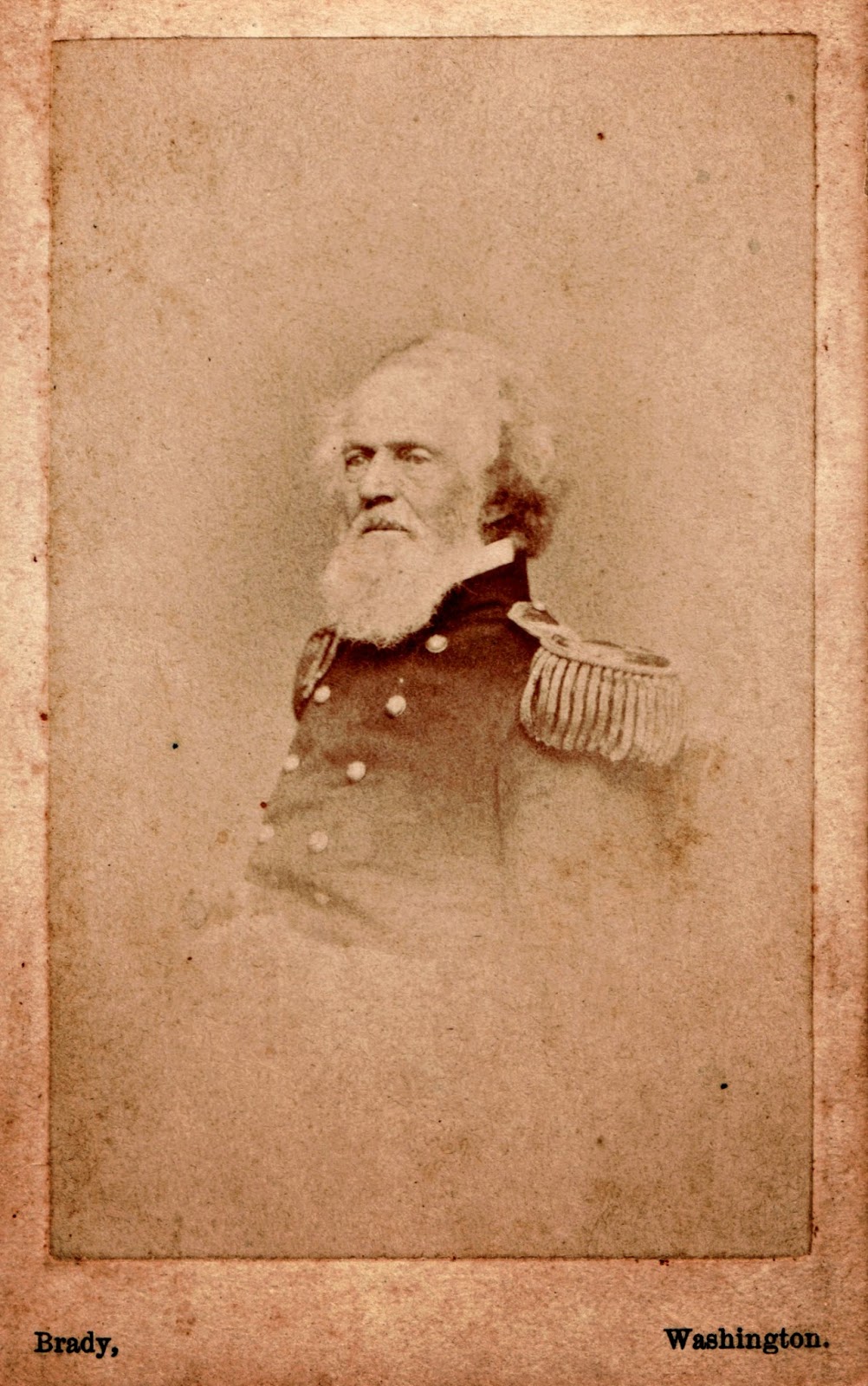
General Joseph Mansfield of Middletown, Conn., died 
 of  his Antietam wound on Sept. 18, 1862.
(Middlesex County History Society)
Wounded in the chest by a bullet in the East Woods, Mansfield was carried about a quarter-mile to the rear by soldiers, who used their muskets to form a stretcher. Then he was taken by ambulance another quarter-mile or so to to a log house owned by farmer George Line. On his way there, Mansfield, his wound tightly bandaged to stop the bleeding, repeatedly said, "Oh my God, am I to die thus!" and "Oh my poor family!"

Line's two-story house, which measured about 26 feet by 22 feet, became known as the "White House Hospital," undoubtedly because the logs were painted white. A thousand wounded soldiers, including more than 100 Confederates, received care in his house and in the outbuildings on his farm.

Patrick Henry Flood, the 107th New York surgeon who came to Mansfield's aid after he was shot, feared the general would die before he even arrived at Line's farm. The bullet penetrated about "two inches from the nipple ... passing out at the back, near the shoulder blade," Flood wrote to Mansfield's wife, Louisa, in April 1863. (Read the complete letter on my blog here.) "The lung was much torn," the surgeon added, "and I saw at a glance the wound must prove fatal."

At 8:30 a.m. on Sept. 18, 1862, about 24 hours after Mansfield was shot, the 58-year-old officer from Middletown, Conn., died in a bedroom in Line's small house. Just off the gravel, war-time portion of Smoketown Road, a short distance from the site of Line's house, a small, black-and-white metal marker points to where Mansfield's life ended.

That sign is wrong.

Mansfield didn't die at noon on Sept. 17, and although he indeed died in the house on George Line's farm, the 1862 log house was long ago moved and forgotten.

Until now.

A sign just off Smoketown Road incorrectly notes the date and time of Mansfield's death. The
 log house in which the general died was purchased by Daniel Bovey, who moved it
sometime during the 19th century and reassembled it on his nearby farm.
This house on the site of George Line's log house was probably built after the Civil War. 
This is private property. Do not trespass.
             Google Earth view of the old Line farm. The house shown in the image above 
                        is in the grove of trees to the right of the long, thin outbuilding.

On a Saturday morning in Captain Bender's Tavern on Main Street in Sharpsburg Md., my friend John Rogers and I marveled at tales told by Richard Clem, who has a longtime passion for hunting for Civil War relics in area fields and woods. Clem pulled from a small case pieces of art made from lead by Civil War soldiers -- a VI Corps badge, a cannon tube and even a small, intricately carved walnut. A lifetime Washington County, Md., resident, Clem also has a remarkable knowledge of local history. The 78-year-old retired woodworker still fondly remembers his grandmother recounting visits with Civil War veterans, proving the war isn't as long ago as some of us might think.

An 1877 Washington County atlas shows the location of 
the old Daniel Bovey farm near Hooker Bridge, also
known as Upper Bridge.
During our visit, Clem casually mentioned he knew the location of General Mansfield's death house.
And so we three history geeks hopped into Rogers' car to find out more about a footnote in history.

After a quick stop at the site of the old O.J. Smith farm/Civil War hospital on Mansfield Road near the battlefield, we drove a short distance before we made a right turn up a long, gravel lane. At the top of the hill, we saw a two-story brick house with a modern addition and a friendly dog. (See Google Earth view below.) In the far distance, we could barely make out the old Hooker Bridge (or Upper Bridge), named for the general whose I Corps marched across it on the way to battle. Richard knew the owner of the farm, Marvin Diller, who had an interesting story to tell. During renovation work on the house in 2000, he discovered a log structure beneath the brick exterior. He even had pictures to prove it. Each log was marked with Roman numerals, Diller said, which seemed odd a first.

A little local history lesson made sense of it all.

In 1906, O.T. Reilly authored The Battlefield of Antietam, a 32-page booklet of  photos, stories and remembrances about the battle. Reilly, who claimed he witnessed the battle as a 5-year-old, was the first Antietam guide, serving as a battlefield expert for decades. In his booklet, the longtime area resident wrote this brief passage:
O.T. Reilly 
(Image courtesy Stephen Recker)
The brick house that stands near the Hooker Bridge, on the southwest side, is the old log house that formerly belonged to George Line and was purchased by Mr. Bovey, removed, rebuilt and brick-cased, and was the house in which General Mansfield died. Mr. George Line built a new house on the site of the old one. The road to the left (southwest) of the Hooker Bridge was, during war times, only a private farm road, but now is a county road. The road to the right is the old road running through Bakersville to Williamsport; a portion of the army took this road before the battle to get on the right. All the buildings as you pass along were, for a short while, filled with wounded soldiers until they could be placed in the regular hospitals.
A similar account, perhaps borrowed from Reilly, appeared in the regimental history of the 124th Pennsylvania, which bivouacked on Line's farm the night before the battle. Further evidence that Line's log house was moved comes from this 1996 survey by the Maryland Historical Trust, which noted the brick house on the property today "shows characteristics of later 19th century construction."

Bovey was Daniel R. Bovey, a local minister, farmer and longtime Keedysville, Md., resident. The exact date of his purchase of the house from Line is unknown, although it must have been before 1892, the year Bovey died. When Bovey reassembled the house on the hill near the Hooker Bridge, the Roman numerals on the logs evidently made reassembling it easier. The date the house was brick-cased, apparently a fairly common practice in Washington County, merits more research. Diller's property encompasses what was the old Bovey farm, which is shown in the 1877 Washington County atlas.

The available evidence seems to add up -- the house Mansfield died in has indeed survived the ravages of time.

Whether Mansfield died in his house or on Mars, it doesn't really make a difference to Diller. When I asked him how he felt living where a Civil War general died, he looked me in the eye and smiled.

"We don't even think about it," he said.

A 1906 reunion of the Bovey family at the family farm. An arrow points to Mary Ann Bovey, 
Daniel's wife.  Daniel Bovey died in  1892. (Courtesy Bovey descendant)
CLICK ON IMAGE TO ENLARGE.
Another view of the log construction of what once was George Line's house...
... and the same view today. The current owner of the house,  Marvin Diller (blue pants), appears at right.
View from the front of the house. The Hooker Bridge. or Upper Bridge, crosses
Antietam Creek in the middle distance.
A brick on the house designates the year it was renovated.
Google Earth view of the old Daniel Bovey farm. The brick-cased log house
is next to the Creekview Dairy designation.

Have something to add (or correct) in this post? E-mail me here.


SOURCES:

--Find a Grave

--Hagerstown Daily Mail, Feb. 16, 1934. Description of Rodman's offensive wounds comes from Fred Cross, a military archivist at the Massachusetts Archives, who was told the story by area resident Jacob McGraw. McGraw helped Rohrbach clean up his property after the battle.

--Maryland Historical Trust, Inventory of Historic Properties, accessed online Sept. 25, 2016.

--Nelson, John H, As Grain Falls Before The Reaper, The Federal Hospital Sites And Identified Federal Casualties at Antietam, Privately published CD, Hagerstown, Md., 2004. (Nelson's excellent work is source for description of Line's farm as the "White House Hospital" and dimensions of Line's log house. He cites The Medical Department of the United States Army in the Civil War by Louis Duncan, published early in the 20th century, as source for number of wounded treated at the Line Farm. He cites Dr. Elisha Hunt's "Report on Field Hospitals Indicated on Map of Battlefield of Antietam" for note on Confederate wounded treated at Line farm. Harris was in charge of distribution of supplies by the United States Sanitary Commission.)

--Dr. Patrick Henry Flood letter to Louisa Mansfield, April 28, 1863, Middlesex County Historical Society, Middletown, Conn.

--Reilly, Oliver T., The Battlefield of Antietam, Hagerstown Bookbinding and Printing Co., Hagerstown, Md., 1906

Thursday, May 01, 2014

Good news: Isaac Rodman's final resting place cleaned up

NOW AND THEN: No longer choked by weeds, the Rodman family cemetery looks much better
 today than it did when I shot the bottom photo last November. 
(Top photo courtesy Michael J. Stewart)
Isaac Rodman was mortally wounded at Antietam on Sept. 17, 1862
Last November, I wrote about the deplorable state of the small family cemetery in Peace Dale, R.I., where Brigadier General Isaac Rodman, who was mortally wounded at the Battle of Antietam, lies buried. Weeds, briars and poison ivy choked the small plot of land that is surrounded by a thick, 2 1/2-foot high stone wall. Many markers were toppled or broken and Rodman's gravestone, masked by vegetation, was difficult to find. The Providence Journal took note of my post and wrote about the awful condition of the cemetery, and the president of a sand and gravel company that owns the property vowed to clean it up.

On Thursday night, Jamie McGuire of the Rhode Island Sons of Union Veterans of the Civil War, Elisha Dyer Camp No. 7 delivered good news. Someone indeed cleaned up the cemetery, removing those weeds, briars and poison ivy and placing upright once-toppled tombstones.  I'll aim to find out who did the good deed.

"Went down to scout it today with an intention of getting in there on this coming Sunday and doing a big clean-up," McGuire messaged me. "Imagine my surprise when I saw that the whole area looked pretty great. It is now my intention to get in there and upright some of the fallen stones and repair the broken ones, but that's not something for this weekend." McGuire is hopeful that he'll be able to take on that project later this summer.

Last November, this memorial to Rodman in his family cemetery was surrounded by weeds. 
Photo courtesy Michael J. Stewart. (See interactive panorama and 
video I shot at the cemetery in November below.)

Monday, December 16, 2013

Antietam: General Rodman's resting place then and now

SEPT. 15,  2012: In time for the 150th anniversary of the Battle of Antietam, a local 
Boy Scout troop  cleaned up the cemetery where Union General Isaac Rodman lies buried
 in Peace Dale, R..I.  Rodman was mortally wounded at Antietam. (Photo: Tom Filiberto)
NOV. 20, 2013: A little more than a year after Boys Scouts cleaned up the cemetery, nature
 took over again.  Rodman's memorial obelisk is at right.
Brigadier General Isaac Rodman was mortally wounded
at the Battle of Antietam on Sept. 17, 1862.
On a spring day decades ago, the well-manicured fields surrounding the small cemetery on a hill in rural Rhode Island were full of huge dandelions and Holsteins grew fat on the lush pasture land. A local boy used to harvest those dandelions by the basket full for salads before he went to examine the headstones in the walled graveyard near a tree line of oaks and blueberries. "Once you entered," Robert Gough wrote of that long-ago visit with his grandfather, "a feeling welled up deep inside of you that struck you dumb, and words seemed trivial and unneeded." Gough was especially impressed with the tallest obelisk in the cemetery, the one in honor of Civil War Brigadier General Isaac Rodman, who was mortally wounded at the Battle of Antietam. "I marveled at it in the spring sunshine," he wrote, "the lichen-dabbled marble, the edges of its raised and graved letters smoothed and rounded by time and salt air. This was a serene plot untouched by vandals; a little piece of ground from another time."

Today, the lush fields and pasture land are a distant memory. A sand and gravel operation has carved up the area surrounding the once-serene plot of land where Rodman was buried in Peace Dale in early October 1862. During my visit in November, the nearly inaccessible cemetery was a weed-choked jungle, with many of the tombstones toppled or broken. An old metal Grand Army of the Republic marker and an American flag lay haphazardly beside Rodman's obelisk. A few feet away, the general's small tombstone was nearly obscured by briars, weeds and grass.

"It is amazing how quickly Mother Nature reclaims her space," Tom Filiberto e-mailed me recently. An assistant Scoutmaster of Troop 1 in Kingston, R.I., Filiberto and his Boy Scouts took on cleaning up the Rodman Cemetery as a community service project on Sept. 15, 2012, two days before the 150th anniversary of Antietam.  "I was there from beginning to end and can say it was a daunting task that I didn't think we'd be able to complete in one day," wrote Filiberto, who supplied the photo of the result of his scouts' labors at the top of this post.

Thankfully, there soon may be good news about the status of the Civil War hero's final resting place. In a story about the neglected cemetery that was posted recently on the Providence Journal web site, the owner of property, Roland Fiore of South County Sand And Gravel Co., vowed to have his employees clean it up. Kudos to him. Good for history. In the spring, I am eager to visit Rhode Island again to see the result of their labor.

When he visited the Rodman memorial as a youth, Robert Gough "marveled at it in the
 spring sunshine." During my November visit, the memorial was surrounded by weeds.
I found this toppled flag and Grand Army of the Republic marker beside the
 Rodman memorial during a November 2013 visit.
Many of the markers in the cemetery were toppled or broken  during my November visit.

Wednesday, November 20, 2013

Isaac Rodman: Antietam hero's neglected final resting place

Brigadier General Isaac Rodman's grave marker is lost in the weed-choked family 
cemetery in Peace Dale, R.I. The tall memorial for Rodman, who was
mortally wounded at the Battle of Antietam, appears in the background.

 (CLICK ON IMAGES TO ENLARGE.)
The approach to the cemetery where Rodman is buried.
I.P.R, initials for Isaac Peace Rodman, on his gravestone among the weeds.
I placed a shiny penny, Lincoln side up, on Isaac Rodman's memorial today.
The date Rodman suffered his mortal wound at Antietam is incorrect on his monument.
He was mortally wounded in the left breast on Sept. 17, 1862. He died 13 days later in

 a Sharpsburg field hospital with his wife, Sally, by his side.

Isaac Rodman was only 40 years old when he died.
 Like this blog on Facebook.

Days after Brigadier General Isaac Peace Rodman died from a minie ball wound suffered at the Battle of Antietam, his body was returned to his native Rhode Island, where he was given a hero's funeral. On Friday, Oct. 3, 1862, flags in Providence were at half-mast and business in the state capital "ceased its harsh and discordant hum" as citizens mourned the highest-ranking officer from the state to die during the Civil War. A funeral service for the married father of six children was held at the State House, the first time it had been used for such a purpose.

Thousands viewed Rodman's body as he lay in state in the hall of the House of Representatives under a canopy of black and white drapery and an American flag. Evergreens and flowers covered the metallic casket that was inscribed with Rodman's age ("40 years, 1 month, and 16 days") and upon which rested the general's cap, sword and belt.

"Our country mourns his loss," an inscription on the north side of the hall read. Shields that included the names of all the battles Rodman participated in -- Bull Run, Roanoke, Fort Macon, Newbern and Antietam -- also adorned the hall.

Later that weekend, Rodman's coffin, escorted by the Pettaquamscutt Light Infantry and Narragansett Guards, was placed on a train bound for the general's hometown of South Kingstown, 35 miles south of Providence. At the railroad stop in South Kingstown, a half-mile procession of carriages and people on foot escorted Rodman's casket, which was covered with flowers and an American flag, to the Union general's house.

At Rocky Hill that Sunday morning, "the business acquaintances of the deceased, his friends and neighbors for miles around, came pouring in to mingle their tears of sympathy with those of the bereaved family." In all, nearly 1,500 people paid respects to the man who before the war ran a textile mill with his brother in South Kingstown.

In the afternoon, mourners gathered at the small Rodman family cemetery atop a hill in Peace Dale to bid him a final farewell. "Here, at the mouth of this opening grave, a voice is addressed to us which we must heed," a reverend reminded those who attended. "To this we all are coming. Dust to dust." Three volleys were fired over the casket before it was covered by earth that fall day, the sharp reports undoubtedly heard less than a mile away in the center of town.


"He is rather to be envied than pitied," an account of his funeral noted. "We have no further solicitude for him. No accident can now tarnish his fame. No temptation can assail human nature at its weak point. The seal of finished virtue is set upon him. Happy is he, and he alone, who has begun, continued and finished his course in virtue. As a Christian patriot, he has done his appointed work, and it now becomes a part of our national history."

Sadly, Rodman's final resting place today is in a state of neglect. (See my interactive panorama below.) Once surrounded by open pasture land, the small cemetery is now an ugly island bordered by a large, and noisy, sand and gravel operation. Weeds, briars and poison ivy choke the small plot of land that is surrounded by a thick, 2 1/2-foot stone wall. Many markers are toppled or broken. The general's gravestone, masked by vegetation, is simply marked with raised initials "I.P.R." On Wednesday, a tipped-over flower pot with a U.S. flag and an old, metal Grand Army of the Republic marker lay in front of a tall family memorial for Rodman. "His country called him," the inscription on it reads, "and for her he died."

UPDATE: The owner of the property said he will have his employees clean up the cemetery, according to this Providence Journal story.

Source: The Narragansett Times, Oct. 10, 1862.

                    Click on image for full-screen interactive panorama of Rodman cemetery.