Showing posts with label Shiloh. Show all posts

Monday, April 13, 2026

A flood of memories: How rising water imperiled Shiloh wounded

View of U.S. Naval Station at Mound City during the Civil War. (Library of Congress) 

                                   Like this blog on Facebook | My YouTube videos

Days of heavy rain in late April 1862 sent the Ohio River over its banks at Mound City, Illinois, flooding a brick warehouse turned hospital and imperiling wounded soldiers from the Battle of Shiloh.

"Mound City is entirely underwater," the Chicago Tribune warned, noting that pools of stagnant water could breed malaria and kill patients. “If we do not remove the wounded quickly, our men will die like sheep.” [1]

“A wild waste of waters,” a witness called the surreal scene near the junction of the Ohio and Mississippi rivers. [2]

“Old Father Mississippi is on a bender,” another newspaper warned. [3]

“MOUND CITY HOSPITAL SUBMERGED!” shouted a headline in an Ohio newspaper. [4]

A 1912 image of a building in Mound City
used as the U.S. Naval Hospital. The warehouse
was destroyed by fire in 1976.
(A History of Southern Illinois)
Floodwater crept into the hospital’s first floor, scrambling caregivers, who placed 24-year-old Otto Heimberger, 22-year-old Charles Kimbell and four other soldiers from Battery A of the 1st Illinois Light Artillery onto cots and slipped them through second-floor windows to safety.

The flooding briefly turned the hospital into a rescue operation within its own walls, as caregivers carried patients to higher floors or elsewhere and later moved them by boat and rail. But the facility continued operating as Union casualties poured in along the river.

Heimberger had arrived by steamer around April 20, nursing a leg wound from the battle’s first day, April 6. His fiancée soon joined him, watching him “with incessant solicitude and love." [5]

“Many anxious hearts here await tidings of their condition,” wrote the hometown newspaper about Kimbell and another gunner from the battery. [6]

Mound City had been transformed by the war into a Union hospital complex, supply depot and naval base supporting the Mississippi Squadron. Steamers and flatboats crowded the docks, ferrying wounded soldiers ashore. Carts and stretcher-bearers moved through the streets while brick buildings, warehouses and hastily erected tents served as hospital wards and storehouses for medical supplies.

Headlines in The Cleveland Leader
on April 21, 1862.
About two weeks after the battle, “upwards of one thousand wounded officers and soldiers” were receiving care in Mound City — more than doubling the town’s pre-war population of 900. In all, the town accommodated roughly 1,500 beds for patients.

Amid the surge, soldiers assigned to hospital duty moved through the wards alongside surgeons and nurses. A 15th Illinois soldier, designated to aid patients, described one hospital as a “splendid building.” The previous day, he had helped move 900 soldiers into it. [7]

“We are detailed to take care of the poor fellows, and shall probably remain some time,” he wrote in the aftermath of Shiloh. “You cannot think of the various ways men are shot in; most of ours are arm and leg wounds.” [8]

Another witness found the wounded in “every conceivable form.” Yet despite the rising waters, “an air of comfort” pervaded the hospital complex. [9] “Admirably arranged” and “well ventilated,” a Wisconsin newspaper called the complex, adding it provided “abundant and excellent” care. [10]

After his arrival at Mound City, Kimbell pleaded with surgeons not to amputate his wounded leg. He and the others in his regiment — “all Chicago boys,” according to the Tribune — had suffered leg wounds while hauling a cannon off the battlefield.

After arriving via Paducah, Kentucky, Kimbell’s father persuaded doctors to cancel the operation, and they reluctantly complied. (Charles survived, living until 1905.) The elder Kimbell even paid to send three other “Chicago boys” home, and the Illinois Central Railroad placed them in one of its best cars.

Not all were as fortunate.

Union vessels at Mound City. (Library of Congress)

Private Charles Augustus Brier of the 14th Wisconsin reached Mound City with a severe gunshot wound to the knee. Pneumonia soon followed, killing the 18-year-old from Webster’s Prairie on April 26.

“[W]e look around and behold a lovely family circle broken — a father in tears, a mother in anguish, brother and sisters bowed in sorrow and sadness,” William Thompson, a Baraboo, Wisconsin, businessman, wrote about Brier in a letter published in the local paper. [11]

Reflecting on the private's death, Thomson added:

An aerial view of flooding at flood-prone
Mound City in 1937. (Chronicling Illinois)
“Who then shall be held responsible for the sacrifice of the thousands of our young men, who have gone forth in the hour of our country's peril, to save us and our posterity from the otherwise fearful doom which awaits us? But the record has been made! Thus fell Charles Brier, of Baraboo, Wis., at the battle of Shiloh, in the 19th year of his age; and died at the Mound City Hospital, April 26, 1862.” 

After leaving the Mound City hospital, caregivers loaded Heimberger, Kimbell and other wounded onto a northeastbound flatboat, navigating the flooded docks and churning riverfront. Attendants later transferred them to an Illinois Central Railroad train, placing stretchers across the tops of the last car’s seats for the journey to Chicago, where friends met them and cared for them in private homes. [12]

Despite that care, Heimberger — one of more than 13,000 Union casualties at Shiloh — died on May 16, shattering his fiancée and a “large circle of friends.” The next day at 2 p.m., Chicago Light Artillery soldiers and members of the Cigar Makers’ Association attended the former fireman’s funeral at 220 East Van Buren Street, a short walk from Lake Michigan. [13]

These dramas began at Shiloh. In Mound City — a nondescript river town remade by war — they played out under the most trying circumstances and often ended in tragedy. Nearly 4,700 Civil War soldiers rest in the town's national cemetery.


SOURCES

[1] Chicago Tribune, April 25, 1862
[2] Chicago Tribune, April 22, 1862
[3] Salem [Illinois] Weekly Advocate, April 24, 1862
[4] The Cleveland Leader, April 21, 1862
[5] Chicago Tribune, May 17, 1862
[6] Baraboo [Wisconsin] Republic, May 7, 1862
[7] Chicago Tribune, April 22, 1862
[8]  The Woodstock [Illinois] Sentinel, April 23, 1862
[9] Chicago Tribune, April 22, 1862
[10] Wisconsin State Journal, April 19, 1862
[11] Baraboo [Wisconsin] Republic, May 7, 1862
[12] First Illinois Light Artillery Volunteers, Chicago, Cushing Printing Co., 1899, Page 48
[13] Chicago Tribune, May 17, 1862

Sunday, November 24, 2024

Tales from the road: 'Disappearing' into Dill Branch Ravine

Dill Branch Ravine (right) on the Shiloh (Tenn.) battlefield

                                  Like this blog on Facebook | My YouTube videos

Minutes after leaving Tom Petty and Bob Dylan behind, I stiff-arm the 21st century and disappear into the woods above Dill Branch Ravine on the Shiloh (Tenn.) battlefield.

“Watch for snakes,” a ranger had warned me earlier.

A stark reminder of the cost of war.
But on this glorious morning, I see no snakes — and no humans, either. I’m apparently the only living soul traipsing toward the ravine where, on the evening of April 6, 1862, Confederates mounted a desperate, doomed attack to break Ulysses S. Grant’s army on the ridge.

As leaves and twigs crunch beneath my hiking boots, I stumble upon an eye-opening, sobering marker: “Burial place. 14th Wisconsin Infantry. Bodies removed to Nat’l Cemetery.”

Shiloh loves to spring these surprises. 

A few yards away, I study the exposed underside of a massive, uprooted tree. Surely a Gardner bullet or sliver of artillery iron once burrowed itself among the mosaic of stones tangled in its roots.

Later, I enter the ravine from the Tennessee River side, skittering down a steep embankment into the muck of Dill Branch. During the battle, two Union gunboats — the wooden USS Lexington and USS Tyler — anchored in the river and hurled their massive shells into this earth. Combined with Grant’s cannons firing from the ridge near Pittsburg Landing, the noise must have been apocalyptic.

“Terrorizing,” a ranger later told me. But apparently the fire accomplished little. 

“Every two minutes, the enemy threw two shells from his gunboats,” Confederate Brigadier General Patrick Cleburne wrote, “some of which burst close around my men, banishing sleep from the eyes of a few, but falling chiefly among their own wounded, who were strewn thickly between the camp and the river…”

"Sounded terribly and looked ugly and hurt but few," Confederate Colonel John D. Martin wrote of the fire from the gunboats. 

Ulysses Grant's artillery protected Pittsburg Landing during the Battle of Shiloh.
Dill Branch Ravine on the Shiloh battlefield
Using cannons like these, Union gunboats in the Tennessee River shelled the ravine.

Surely several of those 32-pound shells still lie buried here — silent, heavy reminders capable of unleashing their contents even now if disturbed. 

A gift from nature.
Deep in the ravine, as sunlight squeezes between the trees, I marvel at its steep, enclosing walls. Climbing back toward my starting point, my heart hammers past 100 beats a minute. Under fire and burdened with equipment, men attacked here? What extraordinary courage.

Yet the ravine offers its own small mercies: a single red leaf blazing among the drab tones, brilliant green moss clinging to a gray rock, a decaying stump the color of rust, a lone cackling bird, a jittery squirrel. 

Maybe I should disappear into Dill Branch Ravine more often.


SOURCES

 — War of the Rebellion: Serial 010, Page 582, Kentucky, Tennessee, Northern Mississippi, Northern Alabama and southwestern Virginia, Chapter XXII
 — Ibid, Page 622. 

Thursday, June 01, 2023

Finding treasure in the Shiloh battlefield parking lot

Barbie and Ken Varner pose with their treasure.

Like this blog on Facebook | Follow me on Twitter | My YouTube videos

After stuffing ourselves at Hagy’s Catfish Hotel Restaurant, frog leg connoisseur Jack Richards and I made our way back to the Shiloh National Military Park. Moments after parking, I happened upon an incredible scene: a Civil War-themed motorcycle and trailer emblazoned with illustrations of battle scenes and other important events. I hadn’t seen anything this ridiculously cool since I met a dude years ago who re-created the Battle of Antietam in miniature in his basement in Sharpsburg, Md.

Helmets for Ken and Barbie Varner.
Naturally, I vowed to hunt down the motorcycle owner. Then I mentally prepared myself for asking Mrs. B if we could add one of these things to our 2023-24 fiscal year budget.

After watching the excellent Battle of Shiloh movie in the visitors center, I cornered the owners of the motorcycle in the parking lot and peppered them with questions while others ogled their treasure. 

And the owners are…

Ken and Barbie Varner of McKenzie, Tenn. Seriously! I’ve never met ANYONE named Varner in my whole, entire life! 😁

“This is incredible,” I told Ken, a 65-year-old trucker. “How much did you pay for this?”

“Thirty thousand.”

I started to get nervous. No way Mrs. B will rubber stamp $30,000 for a motorcycle.

My favorite details on the bike.
The bearded illustrator put himself in the Civil War-themed paint job.

Anywho, the Varners purchased the motorcycle — an 1800CC, 2008 Honda Gold Wing — and trailer in 2021 from a history teacher from Pittsburgh, my hometown. That man had a talented illustrator create the Civil War scenes on the magnificent machine. The motorcycle has other excellent, Civil War-related touches, including Lincoln, Lee and Grant etched into the windshield.

Lee's surrender on the motorcycle trailer
“It was after midnight and I was winding down from a day at work,” Ken told me about the blessed day he first laid eyes on the work of art. “I went online and the thing jumped off the screen.”

Moments later, he rushed to see Barbie, who was sleeping.

“You gotta see what I found!”

The next day, Ken—who had always wanted a Civil War-themed motorcycle—closed the deal.

“I never dreamed of having one like this, though,” he said.

Well, I’ve never dreamed of waking Mrs. B after midnight.

Memorial Day happened to be the first day the Varners took the motorcycle out for a spin this year.

“When I pulled into the parking lot, I had goosebumps on my arm,” Ken told me about the visit to Shiloh, the couple’s first to the Tennessee battlefield. What a great day. What an adventure.

Oh, Mrs. B … 😁

Hey, Mrs. B, it's time we get one of these rides.

— Have something to add (or correct) in this post? E-mail me here.

Tuesday, September 08, 2020

In search of 'Old Brains': A Shiloh-to-Corinth (Miss.) round trip

Your dazed blogger at Shiloh following an awful bug attack.
Like this blog on Facebook | Follow me on Twitter

At the spring of 1862 Siege of Corinth (Miss.), his only field command of the war, Henry Halleck wasn't known for bold initiatives or lightning strikes. Plodding and overcautious, the 47-year-old Union commander took more than a month to conquer the strategic northern Mississippi town that eventually was abandoned by a vastly outnumbered enemy.

Mr. Bold, Henry Halleck, also known
as "Old Brains. (Library of Congress)
"Old Brains" had more than 100,000 troops! No wonder Abe Lincoln finally put this guy behind a desk for good.

"We have let them slip through our fingers," a Union soldier wrote about the Confederates' escape.

Bleh. Let's not be like "Old Brains."

On our Civil War journeys, let's emulate J.E.B. Stuart: Be bold, deliver a few great results, occasionally ride aimlessly through the countryside, and when appropriate, party like it's September 1862. (But when riding a bicycle, do not stick a plume feather in your helmet.)

Summoning my inner Stuart, I drove from Shiloh, Tenn., to Corinth, Miss., and back on Monday, following the serpentine road “Old Brains” himself may have taken. (And then I returned to Nashville. It's not called "Labor Day" for nothing.) It was stunning I made the roughly 40-mile Shiloh-to-Corinth round trip at all because a massive insect violently struck my helmet earlier, nearly knocking me from my road bike at Shiloh.

But I was uber-determined to visit the “Crossroads of the Confederacy," where Halleck set up shop after Pierre Gustave Toutant Beauregard abandoned it for good on May 30, 1862. Join me for the ride.


En route to Corinth, near the Shiloh battlefield, I found this. Damn, I'm a sucker for every historical marker -- especially ones nearly obscured by weeds ...


... And unsurprisingly, I also discovered a Civil War Trails marker near the site of Albert Sidney Johnston's last bivouac. (They. Are. Everywhere.) The next day, April 6, 1862, ASJ was mortally wounded at Shiloh. Shot behind the right knee, the 59-year-old commander bled to death in a ravine -- even though he had a tourniquet in his pocket. (Quick plug: Read my Civil War Times column about Shiloh battlefield markers -- including the one at Johnston's death site.) ...


Keeping an eye out for angry dogs, I slowly walked down the lane to the bivouac site. Hey, did Johnston's staff forget something? ...


Arrival!

Albert Sidney Johnston
Here's the story, according to info in the wayside exhibit: "This site was not marked by the Shiloh Battlefield Commission when Shiloh National Military Park was being developed. Only a small sign was placed on Highway 22 pointing to its location. Fortunately, there were local citizens who knew the location of this site.

"In 1862, James Wood (1831-1923) lived on the site of his Cotton Gin which was just north of the present restaurant at the intersection of Highway 22 and 142. Having learned that a battle was coming, he gathered his family and a few possessions, and late in the afternoon of April 5, 1862, headed southwest along the Corinth-Pittsburg Landing Road. This old road is still partially visible in the woods just north of this site.

"At this location, now marked, he found General Albert Sidney Johnston camped under a large Post Oak tree."

Over the years, Woods' relatives frequently pointed out the site to visitors. ...


... and sprinkled along Route 22, near the national military park, you'll find these fabulous, old cast-iron Shiloh historical tablets. The veterans themselves determined where most of these were placed. This one happens to be smack-dab in someone's front yard. ...


... and this one, which desperately needs TLC, denotes the position of a brigade of Johnston's Army of the Mississippi. Off to our main destination ...


"Corinth, Mississippi, to be Waterloo of the war," the New York Herald predicted in early April 1862," before the result of the Battle of Shiloh.

Well, Beauregard's boys held out much longer than expected -- thanks to Halleck's case of the slows  and some ingenious subterfuge that included Quaker guns in earthworks.

A few miles north of downtown Corinth, the National Park Service maintains a small site where you can view Confederate earthworks in the woods. Trust me. They are out there. Somewhere. ...


... and deep in those same woods, I also found this. Hmmm... not encouraging.


Finally, the Crossroads of the Confederacy! 

On my last visit to Corinth, I ignored this famous junction, visiting instead an indoor Civil War axe throwing venue on North Fillmore. ("Whether you want to channel your inner lumber jack or just try out a fun and competitive hobby," according to this tout, "axe throwing is a fun and unique sport that’s taking North America by storm.") Hmmm ... that wouldn't cut it for me this time.

Corinth was at the junction of two vital railroad lines, the Mobile & Ohio and Memphis & Charleston, hence the U.S. Army’s huge interest in occupation. Strange as it may seem, this humble town helped keep the Confederate Army fueled for fighting in the Western theater and beyond. "More important than Richmond," some big-wigs in the Federal command called Corinth.

There's a museum at the depot, but it was closed because of the holiday. Bummer.


... but there's still plenty to see near the railroad junction. Here's the site on Fillmore Street of long-gone Rose Cottage, where Johnston made his HQ and after Shiloh his body lay in state.


... and here's the beautiful, privately owned house down the street that Confederate general Leonidas Polk used as headquarters.


... and on Polk Street Street stands the old W.L. Duncan House, used by Beauregard as a headquarters and later by Union General William Rosecrans during the Battle of Corinth in early October 1862. (It's now a private dwelling.) Confederate Private Thomas Duncan wrote his war-time recollections here in his boyhood home, which once stood on Jackson Street. 


...and on Jackson Street, we find the outstanding Verandah-Curlee House, the exclamation point of my visit. OMG! OMG! Owned by the city and open for tours, it was used by Confederate generals John Bell Hood and Braxton Bragg as a headquarters and by "Old Brains" himself in 1862. Ah, I could feel my IQ rising as I soaked in this scene. The site of Ulysses Grant's HQ, now occupied by Corinth police headquarters, is directly across the street.

OK, we're done with ya, Corinth. Until next time ...


... and whoa! On the return trip to Shiloh, I was jolted by this unusual sight outside Larry DeBerry's Shiloh museum/shop.

OK, time's up. Thanks for riding along.

Let's keep history alive.

-- Have something to add, correct? E-mail me at jbankstx@comcast.net

Sunday, June 07, 2020

Where Albert Sidney Johnston fell at Battle of Shiloh


 Like this blog on Facebook | Follow me on Twitter

Albert Sidney Johnston
In 1902, Confederate Army commander Albert Sidney Johnston’s wounding site at Shiloh was marked with a large monument that includes pyramids of 8-inch shells and an upright 30-pounder Parrott tube. A bronze plaque on the old cannon notes the time of Johnston’s mortal wounding: “2:30 p.m., April 6, 1862.”

Fifty yards away, in the ravine, a large, red-bordered historical tablet marks the spot and time -- 2:45 p.m – of Johnston’s death. A large crack snakes through the cast iron, slicing between the last two letters in the general’s first name. In raised, red letters, visitors may read details of Johnston’s death.

This video was shot months before a fallen tree (below) narrowly missed severely damaging the old marker.


-- Have something to add (or correct) in this post? E-mail me here.

Sunday, May 31, 2020

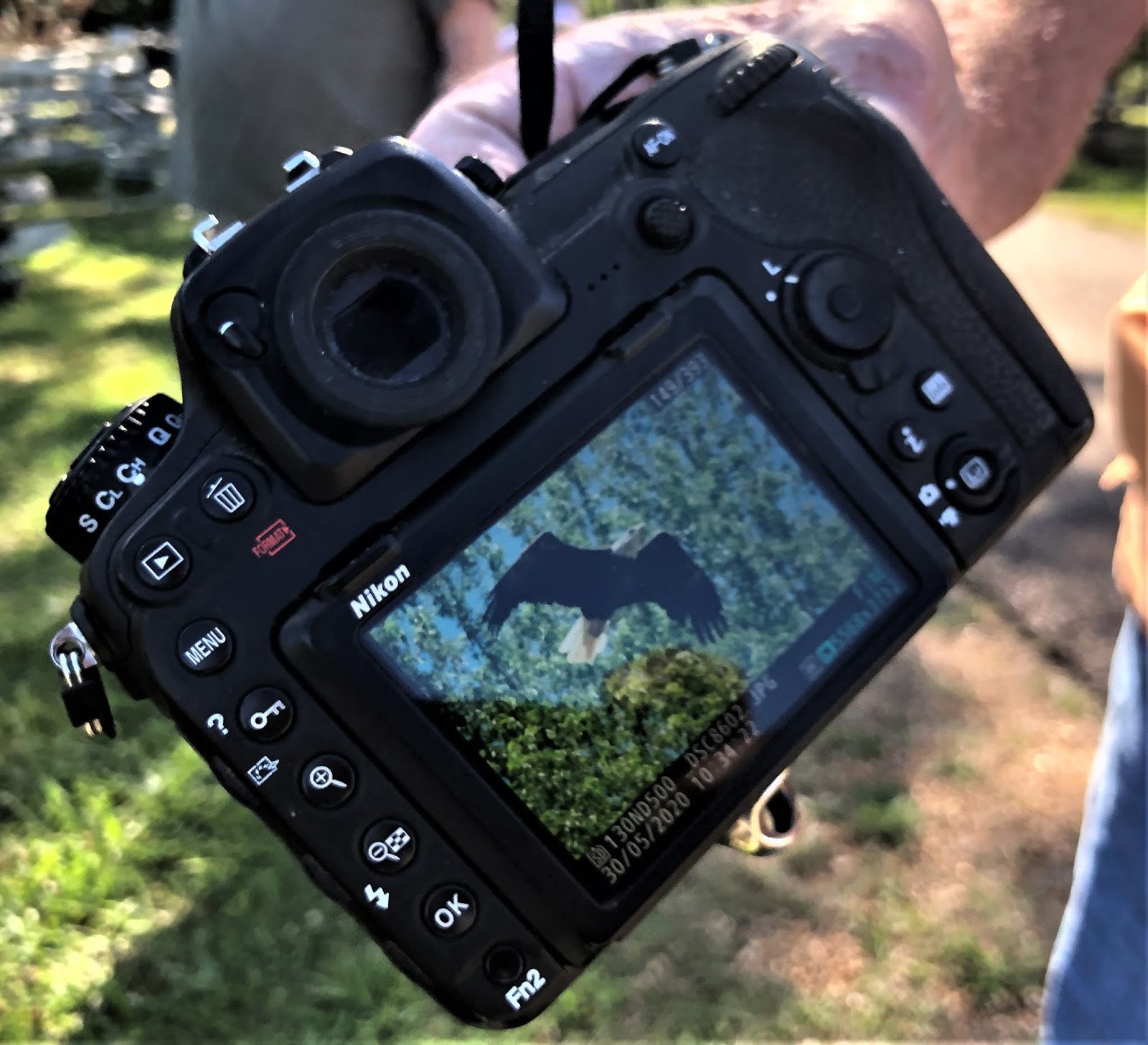
Meet the eagle-eyed birdwatchers at Shiloh battlefield

Shiloh National Military Park's resident bald eagles live in a nest in the pine in the far distance.
 Like this blog on Facebook | Follow me on Twitter

They sit in their lawn chairs along Brown's Landing Road at Shiloh National Military Park, their eyes (and cameras) trained on the sky, searching, searching ... searching. Yards away, in Cloud Field, four cannon marking a Federal battery position loom ominously.

Will their quarry come from the east, from near the banks of the Tennessee River? Or will they come from the south, following the approximate course of the Hamburg-Savannah Road? Then something appears in the distance. Could it be?

"Look up there," says Faye Armour, pointing to the flapping figure in a baby-blue sky dotted with billowy clouds. "Oh, it's just a heron."

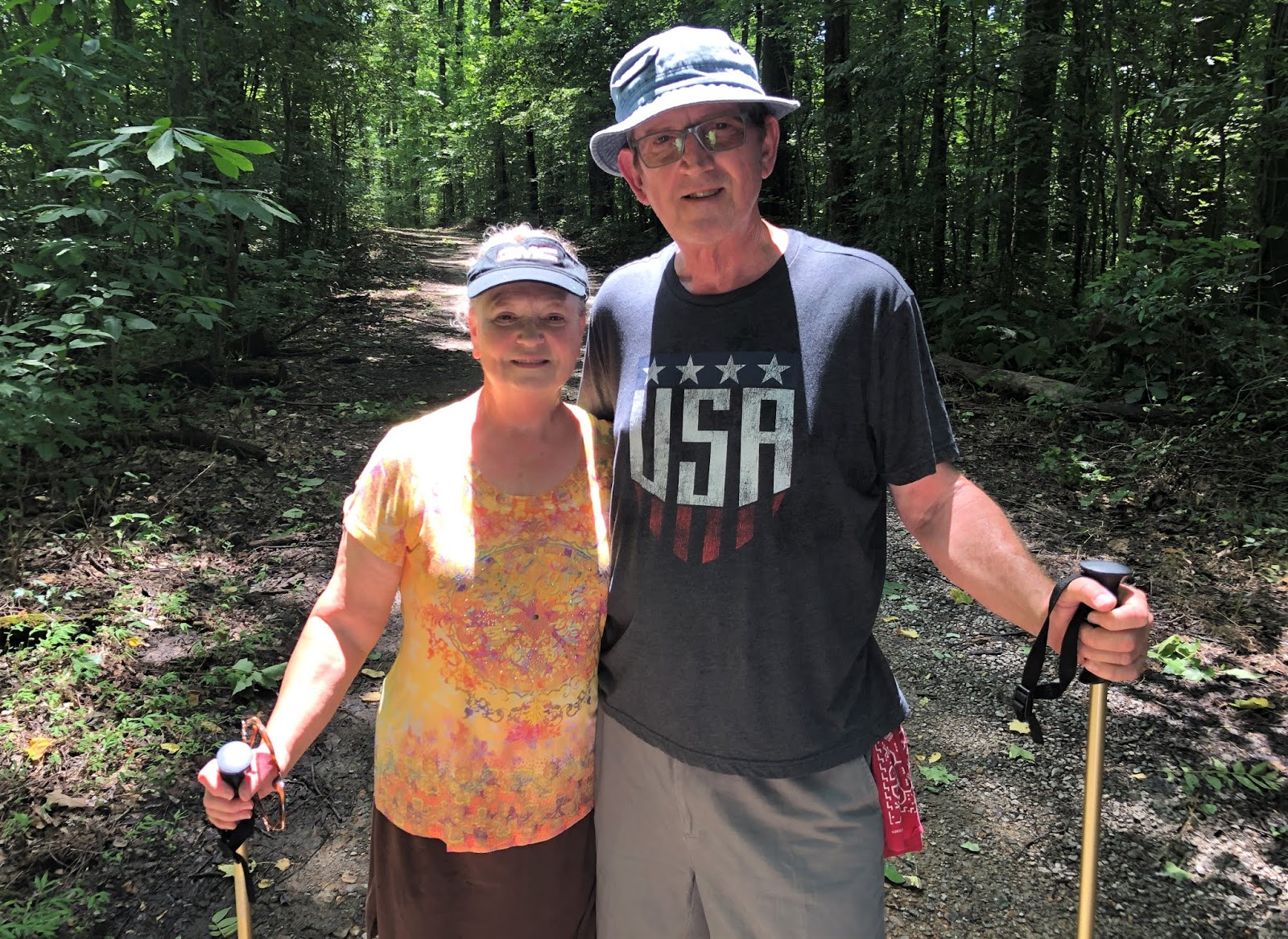
Shiloh eagle-watchers Faye and Ronald Armour.
Meet the six-person Shiloh bald eagle photographers/social club, a group of friends whose birdwatching adventures on hallowed ground sometimes last until dark. The object of their attention during their frequent Shiloh visits are the resident eagles that nest in a massive pine roughly 100 yards away. The two adults were named "Hiram" and "Julia" by the park staff. That's homage to General Ulysses Grant --- whose real name was Hiram, and his wife, whom some small part of me wishes was named Lady Bird. 

The eagles have made their home at Shiloh, where Grant whipped the Rebs in April 1862, since the fall of 2007, according to the National Park Service web site.

Faye, 69, is a retired floral designer; husband Ronald, also 69, is a retired electrician. The couple, married for 52 years, live in Selmer, Tennessee -- about 15 miles away as the eagle flies. The county is best known as home of the famous crime-fighting sheriff, Buford Puser. (Ronald even recalls seeing Puser -- whose story was told in the 1973 movie Walking Tall -- on the night he died in a car accident in 1974.)

Faye, whose ancestor George Washington Foster fought as a private for the 66th Illinois at Shiloh, and Ronald first came to the battlefield to see the eagles in 2012. "They flew over the trees," Ronald says, "and we just fell in love with it." The next year, the couple came armed with cameras for eagle photography.

As she awaits an eagle sighting, Faye cradles a $2,000 Canon 7D Mark 2 camera with a $1,500 lens. Some who come here for eagle shooting bring cameras that cost much more. Clearly, this can be serious business.

"I even gave up fishing to come here," Ronald says, half-kiddingly.

A bald eagle captured in flight Saturday.

On this gorgeous Saturday afternoon, the Armours are joined by four friends. When they aren't shooting picture of eagles, the group enjoys shooting the breeze at the battlefield. There's lots of laughter from this bunch, which has become so close that they even have vacationed together.

In pre-COVID 19 times, their spot at Shiloh might be occupied by dozens of eagle photographers. But the disease has thinned the flock, so to speak, and the Armours and their friends are the only shooters. In their years photographing eagles, the group has met battlefield visitors from Australia, Scotland, England, Germany, Israel, and elsewhere around the globe.

As for the eagles, well, they can be a little flighty. By roughly 5 p.m., only two adults and an eaglet have been spotted by the group, which started gazing at the Shiloh sky about noon. "Eagles," one the Armours' friends chimes in with a chuckle, "have minds like Confederate generals -- minds of their own." When the eaglets are small, the adults tend to be more active, bringing in plenty of food to feed their young.

With my bird brain stuffed with knowledge, I slowly walk to my car for the trip back to Nashville. Before departing, I glance over my shoulder. Sure enough, the collective gaze of the eagle-eyed group is aimed skyward.

"When the eagle comes in," Faye assures me with a smile, "you will be totally ignored."


-- Have something to add (or correct) in this post? E-mail me here.

Monday, March 23, 2020

Shiloh snapshot: Shot, rescued in hospital, he dies in hometown

After fighting in Sarah Bell's cotton field at Shiloh on April 6, 1862,
Private Otto Heimberger's 1st Illinois Light Artillery unit retreated here, near Bloody Pond. 

                                   Like this blog on Facebook | My YouTube videos 

Days after heavy rain in late April 1862, the Ohio River overflowed its banks in Mound City, Ill., threatening wounded soldiers from the Battle of Shiloh who filled a brick warehouse-turned-hospital.

"Mound City is entirely underwater," the Chicago Tribune warned, noting that pools of stagnant water could breed malaria and kill patients. "If we do not remove the wounded quickly, our men will die like sheep," the newspaper added. 

1912 image of building in Mound City, Ill., used
as military hospital. The warehouse was destroyed
 by fire in 1976. (A History of Southern Illinois)
Floodwaters surged onto the hospital’s first floor. Caregivers scrambled, placing 24-year-old Otto Heimburger and others from Battery A of the 1st Illinois Light Artillery on cots and slipping them through second-floor windows to safety. 

Heimburger had arrived by steamer around April 20, nursing a leg wound from the battle’s first day, April 6. His fiancée soon joined him, "watching him with incessant solicitude and love," a report noted. 

Afterward, caregivers loaded Heimberger and the wounded onto a north-bound flatboat. Later, attendants transferred them to an Illinois Central Railroad train, placing their stretchers across the tops of the seats in the last car. 

Among them, 21-year-old Private Charles B. Kimbell pleaded with surgeons not to amputate his leg. His father intervened upon arrival from Paducah, Ky., persuading the doctors to cancel the operation and saving his son’s life. 

The train carried the wounded 350 miles to Chicago, where friends met them and tended to them in private homes. But Heimberger — one of over 13,000 Union casualties at Shiloh — died on May 16, shattering his fiancée and a "large circle of friends." 

The next day at 2 p.m., Chicago Light Artillery soldiers and members of the Cigar Makers Association attended his funeral at 220 East Van Buren Street, a short walk from Lake Michigan.


SOURCES

— Chicago Tribune, May 17, 1862.
— First Illinois Light Artillery Volunteers, Chicago, Cushing Printing Co., 1899, Page 48.

Wednesday, December 25, 2019

Rambling: A year of listening, observing and learning

Ken Rutherford on the Cross Keys (Va.) battlefield in the Shenandoah Valley.
(CLICK ON IMAGES TO ENLARGE.)
Like this blog on Facebook | Follow me on Twitter

In rambling from Picacho Pass, Ariz., to Resaca, Ga., over the past year, I've focused on becoming a better listener. A better observer, too. Ah, what stories can be mined -- and what lasting connections can be made -- if you do. "If you make listening and observation your occupation," a smart person once said, "you will gain much more than you can by talk."

Here are people who have enriched my life over the past year:

On Father's Day weekend, Ken Rutherford and I toured the Cross Keys, Port Republic and Piedmont battlefields in the Shenandoah Valley in Virginia. We talked about the Civil War, football, life and his life-altering experience: In 1993, Dr. Rutherford, a professor at James Madison University, was critically injured in a landmine explosion in Somalia. His legs were amputated. Ken's tremendously inspiring. Read my Civil War Times column.

W.C. "Burr" Datz holds a copy of an old image of the creation of the Robert E. Lee sculpture behind him.
Moments after I pass through the white doors of Lee Chapel on the Washington and Lee University campus in Lexington, Va., docent W.C. "Burr" Datz springs into action. “Do you have 10 minutes?” the Long Island native asks from atop the stage. Datz, whose white beard gives him a passing resemblance to Robert E. Lee, is flanked by a large painting of George Washington to his right and one of Lee to his left. Next to him is the chapel's original wooden podium, a work of art that dates to 1868. Behind Datz is the main attraction: a small room that houses Edward Valentine's impressive memorial sculpture of the recumbent Lee. Read more.

Stan Hutson in the Slaughter Pen at Stones River (Tenn,) battlefield.
“It’s all gone,” Stan Hutson tells me, referring to core Stones River (Tenn.) battlefield. Remorseless developers have pounded the life out of much of this great battlefield, where more than 24,000 souls became casualties in one of the bloodiest fights of the Civil War. Our aim on this deep-blue sky afternoon is to find where five of them fought and received their mortal wounds. What would we see on this battlefield lost? Read my Civil War Times column.

Larry DeBerry at his relic shop near the Shiloh (Tenn.) battlefield.
Shortly after greeting a visitor at his small museum/shop near the Shiloh (Tenn.) battlefield, 72-year-old Larry DeBerry deploys a time-tested technique to win him over: He tells a great story. "See over there?" he says, gesturing to painted toy figurines that fill several shelves at Shiloh Battlefield Museum and Souvenirs. The longtime accountant tells how he acquired the massive set (from an elderly man in New Mexico) and points out figurines of Chinese communist leader Mao Zedong ("look at that receding hairline") and a reviled Japanese World War II military commander (Hideki Tojo) whose name escapes him. Later, DeBerry hands me a very special gift. Read more.


Trapper Haskins founded a vintage baseball league -- it plays by 1864 rules -- in Middle Tennessee.
On the 157th anniversary of the Battle of Shiloh, I met Trapper Haskins at Duncan Field, scene of savage fighting in April 1862. The National Park Service granted permission for his Tennessee Association of Vintage Base Ball to play a doubleheader on the hallowed ground. In 2007, Haskins, a custom wood worker, was in Port Huron, Mich., working on a Gloucester schooner. At the local library, he saw a flyer for a vintage baseball team seeking players. He joined and was hooked. Read my story in America's Civil War magazine.


Along a wall at the H Clark Distillery in Thompson's Station, Tenn., site of the 1863 battle, sat a massive tub of brown liquid. Spent grain, it's called. A local farmer takes this waste product from the alcohol-making process and feeds it to his cows, a pleasing feast for the animals. “The cows love our bourbon mash,” Kim Peterson, the distillery's tour experience manager told me. "They come running for it. Then they just lay in the field, chilling.” She wants to shoot video of the cows enjoying the mostly alcohol-free slop someday. What a scene that must be. Read more.


At Point Park atop Lookout Mountain, Tenn., I briefly spoke with a group of Union reenactors portraying a Kentucky unit. The distinctive smell of burning firewood filled the air. Small talk led to a discussion of Civil War flags, which led to this image of Todd Watts of Nashville. The flag was a tremendous backdrop for a photo that was an exclamation point for a great day walking an awe-inspiring battlefield.


“Ladies and gentlemen, on our right is the oldest living fossil,” a reenactor said in jest about 83-year-old Jere McConnell at the reenactment at Resaca, Ga., in May. Jere sat by a tent eating a hamburger, giving visitors pointers in between bites. Wearing Federal blue pants and Confederate homespun, he told me he has reenacted for 30 or so years. What a distinctive face! Read my Civil War Times column.


And then there's 76-year-old Charles Garvin, a reenactor since 1962. He was chewing on the stubby remains of an unlit cigar at Resaca as we talked about his hobby. He made me laugh when he mentioned a reenactor who used to put moonshine in his canteen. “He put in some water," he told me, "to make it 100 proof.”


On the 2.5-mile trail at Fort Pillow (Tenn.), I met a terrific couple from Louisiana, Carolyn and Mike Goss from Bossier City. Carolyn's great-grandfather George "Washie" Johnson, who served in a Louisiana regiment, lost a leg at the Battle of Mansfield (La.) on April 8, 1864. He was probably only a teenager. After the war, "Washie" eventually turned to drinking and gambling. (He apparently had a fondness for slot machines.) Johnson also befriended a former slave named Dick Chaney, who was treated like a member of the family. When Chaney died, he was buried next to the Johnson family cemetery in Louisiana, outside the fence. Years later, Carolyn discovered the fence was extended around Chaney's grave. How cool. Read more.


No one on the planet knows more about the rich Civil War history of Culpeper County, Va., than Clark "Bud" Hall. No one is as passionate about saving hallowed ground there than the ex-FBI agent and former Marine. “Young Americans fought, bled, and died on our Civil War battlefields,” he told me, “and I profoundly believe we share a collective responsibility to secure and save these sacred fields.” Above, Hall leans against a pillar at Powhatan Robinson’s war-time home, “Struan.” It was used by Union Maj. Gen. Gouverneur K. Warren as a headquarters and by the Army of the Potomac as a hospital in the aftermath of the Battle of Morton Ford’s in early February 1864. Hall knows the 1840 house and its owner well; its expansive porch is a perfect place for a man with a full flask and an active imagination. Read my Civil War Times column.


As a steady rain sent many fans scattering for shelter in the bars at the NFL draft in Nashville in late April, David McCormick watched from behind the counter at Ernest Tubbs Record Shop. The 69-year-old Tennessee native has worked at the store since 1968, owned it since 1972. Outside the Lower Broadway landmark, a large sign proclaims “Real Country Music Lives Here. Our 72nd Year.” Inside, the aisles are filled with country music albums and memorabilia. "It’s a joy for me every day to meet people from all over the world who may find something here they want," McCormick said. Oh, man, I wish I asked him one more question: "Did you know your building was used as a Civil War hospital during the Union occupation?" Read my Yardbarker story.


Retired chimney sweep John Mack – you can call him “The Mad Hatter” -- aimed to persuade visitors at the Resaca reenactment to purchase replica coonskin caps. The 6th Alabama, the “Raccoon Roughs," wore them, he insisted. Years ago, Mack was passionate about the Revolutionary and French and Indian wars, leading an inquisitor to believe the caps with real raccoon tails may simply be, ah, re-purposed.


Melea Medders Tennant has lived on the Resaca (Ga.) battlefield most of her life. "I can’t tell you how many times I've been working, pulling weeds and [visitors] come by telling me about a great-great uncle or great-great granddaddy who fought here." Occasionally, Tennant gives them a bullet she found on the battlefield. Melea regrets not keeping a diary to document meetings with battlefield tourists. On a Saturday afternoon, Tennant took me to see the remains of embrasures for Captain Maximillian Van Den Corput's "Cherokee Battery" of four Napoleons (above). It used to be her family's property. Read more.


On a Sunday morning, Gary Burke and I stood on a graffiti-marred, modern overpass in South Nashville to view a seldom-seen railroad cut. It was there on Dec. 15, 1864, that Burke's ancestor and his comrades in the U.S. Colored Troops were caught “like pickles in a barrel” during the Battle of Nashville and routed by Confederates. Burke once sneaked into the cut — it’s about 10 feet deeper than it was during the war — because he wanted “to feel the fear that went through them.” Read my Civil War Times column.


At the Resaca reenactment, Robert Miller sat at table with a pile of his books on the 129th Illinois, his great-great grandfather's regiment. His ancestor was killed at the northwestern Georgia battlefield, less than a quarter-mile from where we talked on a blazing-hot Saturday. The 78-year-old retired computer programmer from Oklahoma enjoyed telling me about Private Joseph Peters of Company F. Miller eagerly agreed to be photographed holding a copy of an image of his ancestor. We shook hands as we parted. It was one of the firmest handshakes I can remember.


In the pre-dawn darkness in Plains Ga., Mayor Lynton Earl Godwin III – almost everyone calls him “Boze” -- talked about his friend, Jimmy Carter.  He has known the former president most of his life. “He has not forgot where he comes from,” the 75-year-old told me. “He hasn’t changed one bit.” How I got to Plains in the wee hours on Super Bowl Sunday was, well, a little odd. The day before in nearby Andersonville -- site of the notorious Civil War prison camp -- I stopped in a small antiques store. "Does President Carter still teach Sunday school in Plains?" I asked the lovely woman behind the counter. "He sure does," she told me. "You should go." I had nothing to wear but a sloppy sweatshirt and black sweat pants. It's OK, she said. And so I booked a room in Americus, got up super-early the next morning and ...


... attended a Sunday school lesson  with these nice folks.

Life.

Enjoy the journey.

Always.

-- Have something to add (or correct) in this post? E-mail me here.