Showing posts with label Rhode Island. Show all posts

Thursday, May 01, 2014

Good news: Isaac Rodman's final resting place cleaned up

NOW AND THEN: No longer choked by weeds, the Rodman family cemetery looks much better
 today than it did when I shot the bottom photo last November. 
(Top photo courtesy Michael J. Stewart)
Isaac Rodman was mortally wounded at Antietam on Sept. 17, 1862
Last November, I wrote about the deplorable state of the small family cemetery in Peace Dale, R.I., where Brigadier General Isaac Rodman, who was mortally wounded at the Battle of Antietam, lies buried. Weeds, briars and poison ivy choked the small plot of land that is surrounded by a thick, 2 1/2-foot high stone wall. Many markers were toppled or broken and Rodman's gravestone, masked by vegetation, was difficult to find. The Providence Journal took note of my post and wrote about the awful condition of the cemetery, and the president of a sand and gravel company that owns the property vowed to clean it up.

On Thursday night, Jamie McGuire of the Rhode Island Sons of Union Veterans of the Civil War, Elisha Dyer Camp No. 7 delivered good news. Someone indeed cleaned up the cemetery, removing those weeds, briars and poison ivy and placing upright once-toppled tombstones.  I'll aim to find out who did the good deed.

"Went down to scout it today with an intention of getting in there on this coming Sunday and doing a big clean-up," McGuire messaged me. "Imagine my surprise when I saw that the whole area looked pretty great. It is now my intention to get in there and upright some of the fallen stones and repair the broken ones, but that's not something for this weekend." McGuire is hopeful that he'll be able to take on that project later this summer.

Last November, this memorial to Rodman in his family cemetery was surrounded by weeds. 
Photo courtesy Michael J. Stewart. (See interactive panorama and 
video I shot at the cemetery in November below.)

Monday, December 16, 2013

Antietam: General Rodman's resting place then and now

SEPT. 15,  2012: In time for the 150th anniversary of the Battle of Antietam, a local 
Boy Scout troop  cleaned up the cemetery where Union General Isaac Rodman lies buried
 in Peace Dale, R..I.  Rodman was mortally wounded at Antietam. (Photo: Tom Filiberto)
NOV. 20, 2013: A little more than a year after Boys Scouts cleaned up the cemetery, nature
 took over again.  Rodman's memorial obelisk is at right.
Brigadier General Isaac Rodman was mortally wounded
at the Battle of Antietam on Sept. 17, 1862.
On a spring day decades ago, the well-manicured fields surrounding the small cemetery on a hill in rural Rhode Island were full of huge dandelions and Holsteins grew fat on the lush pasture land. A local boy used to harvest those dandelions by the basket full for salads before he went to examine the headstones in the walled graveyard near a tree line of oaks and blueberries. "Once you entered," Robert Gough wrote of that long-ago visit with his grandfather, "a feeling welled up deep inside of you that struck you dumb, and words seemed trivial and unneeded." Gough was especially impressed with the tallest obelisk in the cemetery, the one in honor of Civil War Brigadier General Isaac Rodman, who was mortally wounded at the Battle of Antietam. "I marveled at it in the spring sunshine," he wrote, "the lichen-dabbled marble, the edges of its raised and graved letters smoothed and rounded by time and salt air. This was a serene plot untouched by vandals; a little piece of ground from another time."

Today, the lush fields and pasture land are a distant memory. A sand and gravel operation has carved up the area surrounding the once-serene plot of land where Rodman was buried in Peace Dale in early October 1862. During my visit in November, the nearly inaccessible cemetery was a weed-choked jungle, with many of the tombstones toppled or broken. An old metal Grand Army of the Republic marker and an American flag lay haphazardly beside Rodman's obelisk. A few feet away, the general's small tombstone was nearly obscured by briars, weeds and grass.

"It is amazing how quickly Mother Nature reclaims her space," Tom Filiberto e-mailed me recently. An assistant Scoutmaster of Troop 1 in Kingston, R.I., Filiberto and his Boy Scouts took on cleaning up the Rodman Cemetery as a community service project on Sept. 15, 2012, two days before the 150th anniversary of Antietam.  "I was there from beginning to end and can say it was a daunting task that I didn't think we'd be able to complete in one day," wrote Filiberto, who supplied the photo of the result of his scouts' labors at the top of this post.

Thankfully, there soon may be good news about the status of the Civil War hero's final resting place. In a story about the neglected cemetery that was posted recently on the Providence Journal web site, the owner of property, Roland Fiore of South County Sand And Gravel Co., vowed to have his employees clean it up. Kudos to him. Good for history. In the spring, I am eager to visit Rhode Island again to see the result of their labor.

When he visited the Rodman memorial as a youth, Robert Gough "marveled at it in the
 spring sunshine." During my November visit, the memorial was surrounded by weeds.
I found this toppled flag and Grand Army of the Republic marker beside the
 Rodman memorial during a November 2013 visit.
Many of the markers in the cemetery were toppled or broken  during my November visit.

Wednesday, November 20, 2013

Isaac Rodman: Antietam hero's neglected final resting place

Brigadier General Isaac Rodman's grave marker is lost in the weed-choked family 
cemetery in Peace Dale, R.I. The tall memorial for Rodman, who was
mortally wounded at the Battle of Antietam, appears in the background.

 (CLICK ON IMAGES TO ENLARGE.)
The approach to the cemetery where Rodman is buried.
I.P.R, initials for Isaac Peace Rodman, on his gravestone among the weeds.
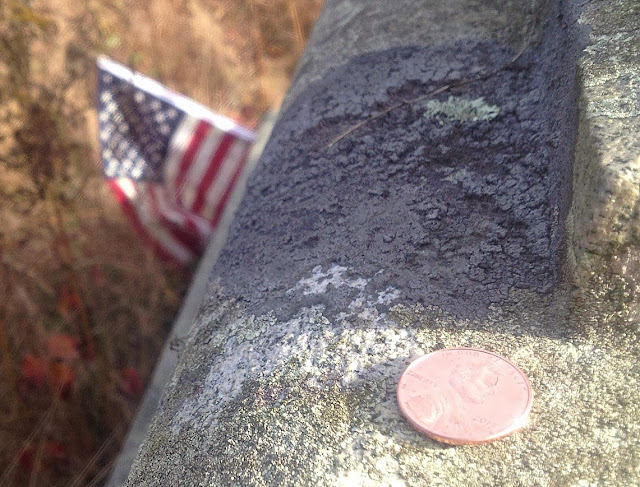
I placed a shiny penny, Lincoln side up, on Isaac Rodman's memorial today.
The date Rodman suffered his mortal wound at Antietam is incorrect on his monument.
He was mortally wounded in the left breast on Sept. 17, 1862. He died 13 days later in

 a Sharpsburg field hospital with his wife, Sally, by his side.

Isaac Rodman was only 40 years old when he died.
 Like this blog on Facebook.

Days after Brigadier General Isaac Peace Rodman died from a minie ball wound suffered at the Battle of Antietam, his body was returned to his native Rhode Island, where he was given a hero's funeral. On Friday, Oct. 3, 1862, flags in Providence were at half-mast and business in the state capital "ceased its harsh and discordant hum" as citizens mourned the highest-ranking officer from the state to die during the Civil War. A funeral service for the married father of six children was held at the State House, the first time it had been used for such a purpose.

Thousands viewed Rodman's body as he lay in state in the hall of the House of Representatives under a canopy of black and white drapery and an American flag. Evergreens and flowers covered the metallic casket that was inscribed with Rodman's age ("40 years, 1 month, and 16 days") and upon which rested the general's cap, sword and belt.

"Our country mourns his loss," an inscription on the north side of the hall read. Shields that included the names of all the battles Rodman participated in -- Bull Run, Roanoke, Fort Macon, Newbern and Antietam -- also adorned the hall.

Later that weekend, Rodman's coffin, escorted by the Pettaquamscutt Light Infantry and Narragansett Guards, was placed on a train bound for the general's hometown of South Kingstown, 35 miles south of Providence. At the railroad stop in South Kingstown, a half-mile procession of carriages and people on foot escorted Rodman's casket, which was covered with flowers and an American flag, to the Union general's house.

At Rocky Hill that Sunday morning, "the business acquaintances of the deceased, his friends and neighbors for miles around, came pouring in to mingle their tears of sympathy with those of the bereaved family." In all, nearly 1,500 people paid respects to the man who before the war ran a textile mill with his brother in South Kingstown.

In the afternoon, mourners gathered at the small Rodman family cemetery atop a hill in Peace Dale to bid him a final farewell. "Here, at the mouth of this opening grave, a voice is addressed to us which we must heed," a reverend reminded those who attended. "To this we all are coming. Dust to dust." Three volleys were fired over the casket before it was covered by earth that fall day, the sharp reports undoubtedly heard less than a mile away in the center of town.


"He is rather to be envied than pitied," an account of his funeral noted. "We have no further solicitude for him. No accident can now tarnish his fame. No temptation can assail human nature at its weak point. The seal of finished virtue is set upon him. Happy is he, and he alone, who has begun, continued and finished his course in virtue. As a Christian patriot, he has done his appointed work, and it now becomes a part of our national history."

Sadly, Rodman's final resting place today is in a state of neglect. (See my interactive panorama below.) Once surrounded by open pasture land, the small cemetery is now an ugly island bordered by a large, and noisy, sand and gravel operation. Weeds, briars and poison ivy choke the small plot of land that is surrounded by a thick, 2 1/2-foot stone wall. Many markers are toppled or broken. The general's gravestone, masked by vegetation, is simply marked with raised initials "I.P.R." On Wednesday, a tipped-over flower pot with a U.S. flag and an old, metal Grand Army of the Republic marker lay in front of a tall family memorial for Rodman. "His country called him," the inscription on it reads, "and for her he died."

UPDATE: The owner of the property said he will have his employees clean up the cemetery, according to this Providence Journal story.

Source: The Narragansett Times, Oct. 10, 1862.

                    Click on image for full-screen interactive panorama of Rodman cemetery.