Showing posts with label Tom Clemens. Show all posts
Showing posts with label Tom Clemens. Show all posts
Monday, June 01, 2026
Podcast: Historian Tom Clemens on Antietam preservation news

Thursday, February 15, 2018
Antietam Then & Now: Exploring site of 1891 Gould photo
In September 1891, 10th Maine veteran John Mead Gould and his son, Oliver, traveled to Sharpsburg, Md., to photograph the Antietam battlefield. Keenly interested in documenting where his regiment fought, the 51-year-old former Maine officer had his son photograph sites in the East Woods, including where Union General Joseph Mansfield was mortally wounded. In all, the Goulds may have documented dozens of spots at Antietam, but only seven of the photographs have surfaced. In January, I was fortunate to acquire six of them.
 |
| War-time image of John Mead Gould (Courtesy Nicholas Picerno) |
For Civil War photo nerds, it was nirvana -- sort of like getting a double helping of your favorite dessert or watching the Patriots lose in the Super Bowl. (Sorry, I couldn't help myself.)
Of the photographs we matched up, the image of the Smoketown Road and the unheralded Samuel Poffenberger "10-acre Cornfield" is my favorite. By using the slider, you may toggle from Gould's 1891 view to a present-day image that I shot there.
What's really cool about my six Gould images -- the cherry on top of the sundae, if you will -- is his detailed descriptions in his own handwriting on the reverse of each photograph. That's gold for a historian. Regarding the Smoketown Road image, Gould wrote:
"The 10th Maine crossed the Smoketown Road (as well as I can tell) about where the small bush is growing to the right of the mulberry tree. We came to 'front' here east of the road, then advanced down & up the gentle slope & deployed about in the shadow of the tree on the extreme right."In the video, Recker explains the significance of the Smoketown Road photograph -- a unique window into the state of Antietam in 1891, four years before the War Department added avenues for tourists.
 |
| Stephen Recker, author of Rare Images of Antietam, shows the reverse (below closeup) of the framed Gould image of Smoketown Road on the site where the photo was taken on Sept. 21, 1891. (CLICK ON IMAGES TO ENLARGE.) |
 |
| Veteran John Mead Gould's handwritten description of the Smoketown Road photograph. (Blogger's collection) |
-- Have something to add (or correct) in this post? E-mail me here.
Saturday, July 08, 2017
Can you unlock secrets to Antietam's 'Amos Humiston' story?
 |
| A close-up of the face of the young woman in the CDV below. |
 |
| CDV of an unknown woman with a tie to the Battle of Antietam. (Manuscripts and Archives Division, The New York Public Library. "Woman" The New York Public Library Digital Collections. 1827 - 1934.) |
 |
| CDV of a Union officer found in the Ezra Carman Papers with the image of the young woman in this post. (Manuscripts and Archives Division, New York Public Library. "Soldier" New York Public Library Digital Collections. 1827 - 1934.) |
At an unknown date after Antietam, fought Sept. 17, 1862, in the farm fields and woodlots near Sharpsburg, Md., the ambrotype was copied and made into a CDV by Bascom William Tell Phreaner, who ran a photography business in Hagerstown, Md., from 1864-1907. In addition to shooting images of the Antietam battlefield, Phreaner was a portrait photographer.
That one line on back of the Phreaner CDV prompts scores of questions, among them:
Who is the young woman?
What is the "unknown" soldier's name? Was the woman his wife or sweetheart?
Was the ambrotype found in the grave of a Confederate or Union soldier?
Where on the battlefield was the image found?
When was the photograph found? Many remains of Union soldiers who died at Antietam were moved to the national cemetery in 1867; others were removed and buried in hometown cemeteries. In the years immediately after the Civil War, remains of Southern soldiers were removed from the field and often re-buried in the Confederate section of Rose Hill Cemetery in Hagerstown or Elmwood Cemetery in Shepherdstown, W.Va.
Was the copy of the image part of a publicity effort to discover the identity of the woman and the soldier? If so, did stories about it appear in publications in Maryland, or was a national effort made to discover the identity of the soldier and the sad-eyed, young woman? What was published about this image, if anything? A initial search of Maryland newspapers of the era available on newspapers.com provided no clues.
 |
| A close-up of the officer in the CDV above. |
Adding another twist to our photo mystery, the image of the woman was found with a CDV of a Union soldier in the Ezra A. Carman Papers in the New York Public Library by preeminent Antietam historian Tom Clemens. Is the officer part of this story? Could his identification lead to solving the mystery? Perhaps the badge (see enlargement below) could be a clue to his identity.
 |
| Could this badge on the officer's chest be a clue to unlocking our mystery? This is a cropped enlargement of the photograph above. |
This post is sprinkled with clues. Our hope is Civil War brainpower around the world can lead to identification of the soldier and woman. Photographs in this post may be downloaded at the New York Public Library site here, here and here. And, by all means, please share this post on social media.
My deep-dive into this story has officially begun. Let's solve a Civil War mini-mystery.
 |
| The reverse of the carte-de-visite of the young woman with the sad eyes. (Manuscripts and Archives Division, The New York Public Library. " Woman" The New York Public Library Digital Collections. 1827 - 1934.) |
Have something to add (or correct) in this post? E-mail me here.
Friday, October 09, 2015
Wading into history: A Shepherdstown battlefield tour
 |
| Taking the plunge on Sept. 19, 2015: Civil War enthusiasts cross the Potomac River at Boteler's Ford. |
(CLICK ON IMAGE FOR FULL-SCREEN INTERACTIVE EXPERIENCE.)
 |
| Antietam battlefield guide Jim Rosebrock (left) and your friendly blogger in the Potomac. |
Armed with an iPhone, determination and knowledge that the water was only waist-high at its greatest depth, I waded the Potomac River from Maryland to West Virginia at Boteler's Ford with nearly 40 other Civil War nuts. Clutching my phone like a thief grips a large bag of cash, I aimed to document the 250-yard crossing and subsequent tour of the seldom-visited Shepherdstown battlefield on the opposite bank. Our mission Sept. 19 was accomplished nearly flawlessly -- only two people slipped on the rocky river bottom and plunged into the clear, cold water. Meanwhile, I nervously shot photos while standing precariously in the middle of the Potomac.
 |
| A brief mention of Pack Horse Ford, also known as Boteler's Ford, on a historical sign on the West Virginia side of the Potomac. |
The next morning, two Federal brigades crossed the river, climbed the bluffs, ventured into the fields beyond them and were routed by the Rebels, who later picked off Yankees as they attempted to escape across the river back to Maryland. "The broad surface of the Potomac was blue with the floating bodies of our foe," Confederate General A.P. Hill wrote in his after-action report. "But few escaped to tell the tale.”
In its first battle of the war, the 118th Pennsylvania, the 767-man Corn Exchange regiment, suffered the worst: 64 killed, 124 wounded and 94 missing. It was a "sad and purposeless affair, with a most disastrous and fatal termination," a regimental historian later wrote. Total casualties for both sides at the Battle of Shepherdstown were more than 600, far less than the 23,000-plus at Antietam, but the Union army's pursuit of Lee was over.
 |
| Union pickets fire across the Potomac at Rebels on Virginia side in this sketch by Alfred Waud. The cement mill, a prominent landmark at the Battle of Shepherdstown, appears in distance. (Library of Congress) |
Two groups made the trip -- one led by Maryland Campaign expert Tom Clemens and another by young historian Kevin Pawlak, author of a recently released book on Shepherdstown's Civil War experience. The SBPA has been instrumental in helping preserve parts of the battlefield, much of which is privately owned, and an effort to incorporate it into Antietam National Battlefield is under consideration.
And so with an eye on what happened to the poor boys in the 118th Pennsylvania, off we went for a 3 1/2-hour journey back in time ...
'Peacefully picturesque'
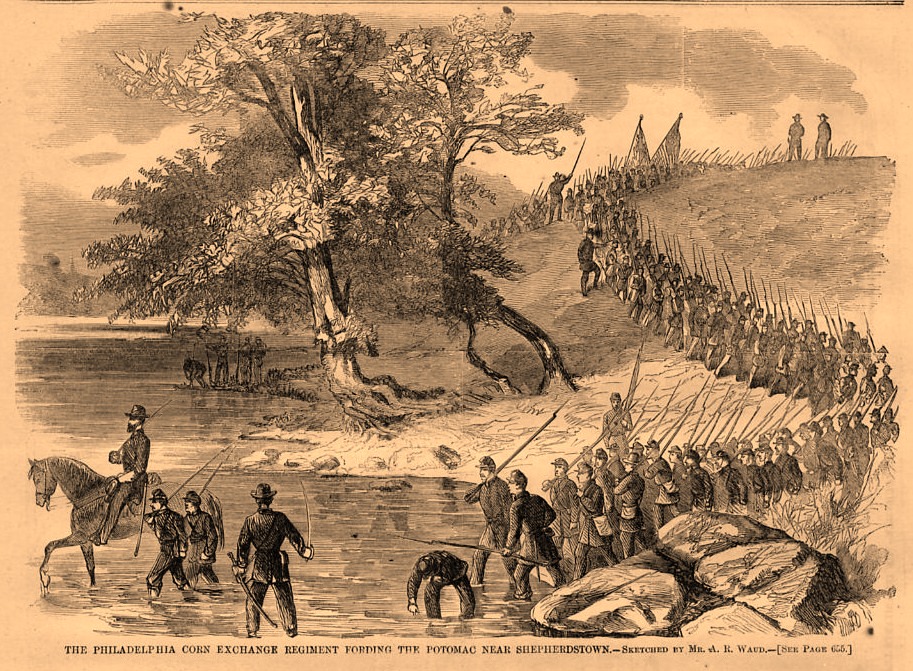 |
| In a Harpers Weekly illustration on Oct. 11, 1862, the 118th Pennsylvania prepares to cross Potomac. |
 |
| Recruiting poster for 118th Pennsylvania. It was also known as the Corn Exchange Regiment because a bounty for each soldier was provided by the Corn Exchange Association of Philadelphia. (Duke Libraries collection) |
To my knowledge, none of us carried a musket or other accoutrements, which surely made the crossing a challenge for Rebels and Yankees in 1862. After Antietam, Lee's army crossed Boteler's Ford at night, with the aid of torches. Try that sometime.
From the 118th Pennsylvania history: "Dew glistened on grass and leaf, and the old Potomac, calm and placid as if it had never known strife, visible for a considerable distance, swept on its course tranquilly. The landscape, varied with its valley and hillside, its meadows and woodlands, sprinkled with barn, house and garden, was peacefully picturesque in the refreshing sunlight of a soft September morning. There were no harbingers that by noon-day the regiment should suffer casualties, severer for a single combat than probably ever fell to the lot of soldiers, even in the heaviest battles of the war.
"An early breakfast was interrupted by orders to move. The meal completed, the brigade started in the direction of the river. With a few hurried personal preparations, some of the men removing their shoes and stockings, the column at 9 a.m. began the passage of the stream at Blackford's Ford. There was a good deal of pleasant shouting as the troops splashed through the stream, and roars of laughter greeted those who, less fortunate than their fellows, stumbled and fell headlong into the water."
A 'hot fire'
 |
| Confederates attacked toward the camera. |
(CLICK ON IMAGE FOR FULL-SCREEN INTERACTIVE EXPERIENCE.)
My take: In pursuit of the Rebels, the 118th Pennsylvania waded across the Potomac unmolested and then marched through a wooded ravine to a plateau above the river. We followed the route in another ravine, making our way past ruins of cement kilns and up the steep slope to a large field. I made a makeshift walking stick from a large tree branch to help navigate my way to the top. The ground atop the bluffs on which the 118th Pennsylvania fought is mostly woods today and was inaccessible during our tour. We were granted special access of the private property.
At Shepherdstown, the 118th Pennsylvania was plagued by poor leadership and bad luck. Outnumbered by the Rebels on the plateau above the river, most of the Union V Corps retreated back across the Potomac into Maryland. But the 118th Pennsylvania remained because its commander, Colonel Charles Prevost, thought an order to retreat had not come through the proper chain of command. In the thick of the fight, the regiment discovered that some of its newly issued Enfield rifles were defective. The spring of the hammer in some of the muskets did not explode the percussion caps. The rout was on.
From the 118th Pennsylvania regimental history: "The enemy had now succeeded in pressing as close to the front as fifty yards,| and the hot fire at such close range was increasing the casualties with frightful fatality. At the same moment he succeeded in developing a regiment across the ravine, completely covering the entire right. The two right companies, under the immediate supervision of the colonel, promptly changed direction by the right flank and gallantly checked the manoeuvre. This movement, mistaken by the hard-pressed centre for a withdrawal, induced it to break temporarily, and with the colors in the advance move in some disorder order to the rear. Colonel Prevost caught the disorder in time to promptly check it. Heroically seizing the standard from the hands of the color-sergeant and waving it defiantly, he brought the centre back again to the conflict and completely restored the alignment. He was still waving the flag in defiance at the enemy when a musket-ball shattered his shoulderblade and he was borne to the rear by Corporal Francis Daley, of Company E. The severity of his wound forced him to withdraw entirely from the action."
Terror on the bluffs
 |
| 118th Pennsylvania soldiers were seriously injured or killed when they scrambled down the jagged cliff. |
 |
| Captain Courtney O'Callaghan was seriously injured when he made his escape down a cliff. |
"The men poured like a cataract over the edge and down the declivity," a soldier in the 32nd Massachusetts remembered, "and so long as they stayed at its immediate base they were tolerably safe, but their assailants soon gained the edge of the bluff and lying flat, could pick off any who attempted to cross to the Maryland side, and many were killed or wounded or drowned before our eyes."
Here are two names to remember:
 |
| Musician Ephraim Layman's grave in Antietam National Cemetery. |
Private William Madison: Many of the fleeing Pennsylvanians attempted to escape to the Maryland side across a slippery, ramshackle 10-foot-wide dam-breast. Others were shot while they swam or waded across the Potomac. One who barely made his escape via the dam was 46-year-old Madison, who was peppered with five shots, including one that shattered his jaw.
"He vented his anger in a frightful howl," according to the 118th Pennsylvania regimental history, "and facing squarely about gave his enemies the last shot he ever fired in the army, for his wounds terminated his service, but not his life." Madison survived the war.
From the 118th Pennsylvania regimental history: "The greater part of the regiment made furiously for the ravine, down which they dashed precipitately. Since the march up, a tree, in a way never accounted for, had fallen across the path. This materially obstructed the retreat. Over and under it the now thoroughly demoralized crowd jostled and pushed each other, whilst, meanwhile, the enemy, having reached the edge of the bluff, poured upon them a fatal and disastrous plunging fire. The slaughter was fearful; men were shot as they climbed over the tree, and their bodies suspended from the branches were afterwards plainly visible from the other side of the river."
Death at the arches
 |
| Maryland Campaign expert Tom Clemens explains the significance of the cement kilns. |
 |
| Ruins of old cement kilns on West Virginia side of the Potomac. The first three arches are post-war. |
 |
| 118th Pennsylvania soldiers sought refuge in this arch after they were routed on the bluffs. |
 |
| 118th Pennsylvania soldiers were killed or seriously wounded by friendly artillery fire here. |
From 118th Pennsylvania regimental history: "At this moment a battery from the Maryland side opened heavily. The practice was shameful. The fuses, too short, sent the terrible missiles into the disorganized mass fleeing in disorder before the serious punishment of the enemy's musketry. It was a painful ordeal, to be met in their effort to escape an impending peril by another equally terrible. Shell after shell, as if directly aimed, went thundering into the arches, bursting and tearing to pieces ten or twelve of those who had crowded there for cover.
"A cry and wail of horror went up, plainly heard above the din and roar of battle. Waving handkerchiefs fixed to ramrods, they endeavored by their signals to warn the gunners to desist, but to no avail; the fatal work continued. Hoping for better treatment, numbers turned with their white insignia of truce towards the enemy and, again ascending to the hill-top, surrendered. The artillerists continued to pound away with an ardor indicative of satisfaction, until Captain B. F.Fisher and Lieutenant L. R. Fortescue, two officers of the Signal Corps, fortunately detected, with the aid of their long-range telescopes, the damage inflicted, when lengthened fuses and better practice brought their aim more directly towards the accomplishment of its intended purpose."
'Relentless, persecuting fire'
 |
| Ruins of cement mill office building. |
 |
| Another view of the ruins of a cement mill office building , which faces the Potomac River. |
 |
| Ruins of the main cement mill building, where 118th Pennsylvania soldiers sought refuge. Later, Rebels poured fire from this building into the Yankees, who attempted to flee across the Potomac. |
My take: Just off the River Road, we found ruins of the old cement mill, from which Rebels fired upon Yankees who attempted to escape across the river. After he somehow made it to the Maryland side of the river, 118th Pennsylvania Lieutenant J. Rudhall White was greatly relieved. "Thank God, I am over at last!" said White, a Virginia native. Suddenly, a bullet tore through his bowels, mortally wounding the 20-year-old soldier who began the war in the Rebel army. Perhaps the fatal shot came from one of the buildings above.
From 118th Pennsylvania regimental history: "An old abandoned mill stood upon the ford road, at the base of the cliff. It completely commanded the ford and the dam-breast. When the last of the fugitives had disappeared from the bluff, the enemy crowded the doors, windows and roof and poured their relentless, persecuting fire upon those who had taken to the water. Numbers, observing the telling effect of the fire upon those who had essayed to the venture of crossing, huddled together and crowded each other in the arches at the base of the bluff; whilst others, hoping to escape the fatal effect of the avenging bullets, took to deeper water and crossed where the stream was deep enough to cover the entire body and leave the head alone exposed."
My take: There are thousands of examples of heroism and courage during the Civil War. One of the lesser-known stories of valor involves Lemuel Crocker, a 33-year-old captain in the 118th Pennsylvania. A day after the battle, wounded and dead from the Corn Exchange regiment were scattered across the Virginia side of the Potomac. Crocker, who had served in the Union army for barely a month with the regiment, aimed to do something about it.
Disobeying an order from Union V Corps commander Fitz John Porter forbidding his mercy mission, Crocker crossed the dam from Maryland to the Virginia side of the Potomac to help his wounded comrades. One by one, Crocker, a large, muscular man, carried bodies of dead and wounded to the river bank, where an orderly for Porter told him he would be shelled by Federal artillery if he continued.
"Shell and be damned," replied Crocker, who continued his work. A Rebel officer allowed Crocker to retrieve other wounded and even pointed out a small boat in which he could take the soldiers back to the Maryland. Upon his return, Crocker was promptly arrested and reprimanded by Porter. Figuring a stern reprimand was enough punishment, the commander released Crocker for his "unquestioned courage" and allowed him to return to duty.
Like this Rebel soldier, Lemuel Crocker merits a statue somewhere for his heroism, too.
From the 118th Pennsylvania regimental history: "The fight was a sad and purposeless affair, with a most disastrous and fatal termination. Yet it secured for the regiment a reputation among its new associates for staying qualities which, maintaining it thoroughly, as it did, down to the very end, bore most excellent fruits.
"Experienced soldiers, jealous of their hard-earned glories, are prone, until their mettle is tested, to receive their inexperienced brethren with no boisterous, cheery demonstrations of hearty welcome. This treatment was more pronounced when the soldiers of 1862 joined the Army of the Potomac, as the impression was abroad that their enlistment was prompted solely by a moneyed consideration. Of course, this soon wore away, and the entire army was, as in the beginning, one harmonious whole
in feeling, sentiment and purpose.
"The 118th's reception in the brigade was not attended by any joyous, gladsome shouts, nor was it exempt from the intimation that its presence at the front was largely due to the paltry shekels. The stolid indifference it met at every hand during the few days previous to the fight was frequently accompanied with epithets apparently intended to be enduring : 'Here come the $200 boys from Philadelphia,' and others of like import. The affair at Shepherdstown, though, wiped everything out. That was a crucial test, and one which conquered the prejudices of men whose trials of battle fitted them to judge of the worth of their fellows. Opprobrious allusions were changed to plaudits, and, for months afterwards, the command was pointed out everywhere to strangers as 'the men who fought at Shepherdstown.' "
From 118th Pennsylvania regimental history: "An old abandoned mill stood upon the ford road, at the base of the cliff. It completely commanded the ford and the dam-breast. When the last of the fugitives had disappeared from the bluff, the enemy crowded the doors, windows and roof and poured their relentless, persecuting fire upon those who had taken to the water. Numbers, observing the telling effect of the fire upon those who had essayed to the venture of crossing, huddled together and crowded each other in the arches at the base of the bluff; whilst others, hoping to escape the fatal effect of the avenging bullets, took to deeper water and crossed where the stream was deep enough to cover the entire body and leave the head alone exposed."
'Shell and be damned'
 |
| A view of the Potomac River from Maryland side at Boteler's Ford, also known as Pack Horse Ford, among other names. |
Disobeying an order from Union V Corps commander Fitz John Porter forbidding his mercy mission, Crocker crossed the dam from Maryland to the Virginia side of the Potomac to help his wounded comrades. One by one, Crocker, a large, muscular man, carried bodies of dead and wounded to the river bank, where an orderly for Porter told him he would be shelled by Federal artillery if he continued.
"Shell and be damned," replied Crocker, who continued his work. A Rebel officer allowed Crocker to retrieve other wounded and even pointed out a small boat in which he could take the soldiers back to the Maryland. Upon his return, Crocker was promptly arrested and reprimanded by Porter. Figuring a stern reprimand was enough punishment, the commander released Crocker for his "unquestioned courage" and allowed him to return to duty.
Like this Rebel soldier, Lemuel Crocker merits a statue somewhere for his heroism, too.
 |
| Captain Lemuel Crocker: Disobeying orders, he aided wounded comrades on the Virginia side of the Potomac. (History of Corn Exchange Regiment, 118th Pennsylvania) |
"Experienced soldiers, jealous of their hard-earned glories, are prone, until their mettle is tested, to receive their inexperienced brethren with no boisterous, cheery demonstrations of hearty welcome. This treatment was more pronounced when the soldiers of 1862 joined the Army of the Potomac, as the impression was abroad that their enlistment was prompted solely by a moneyed consideration. Of course, this soon wore away, and the entire army was, as in the beginning, one harmonious whole
in feeling, sentiment and purpose.
"The 118th's reception in the brigade was not attended by any joyous, gladsome shouts, nor was it exempt from the intimation that its presence at the front was largely due to the paltry shekels. The stolid indifference it met at every hand during the few days previous to the fight was frequently accompanied with epithets apparently intended to be enduring : 'Here come the $200 boys from Philadelphia,' and others of like import. The affair at Shepherdstown, though, wiped everything out. That was a crucial test, and one which conquered the prejudices of men whose trials of battle fitted them to judge of the worth of their fellows. Opprobrious allusions were changed to plaudits, and, for months afterwards, the command was pointed out everywhere to strangers as 'the men who fought at Shepherdstown.' "
-- Have something to add (or correct) in this post? E-mail me here.
Subscribe to:
Posts (Atom)