Showing posts with label Crampton's Gap. Show all posts

Tuesday, November 02, 2021

'The Rambler' visits Crampton's Gap in Maryland countryside

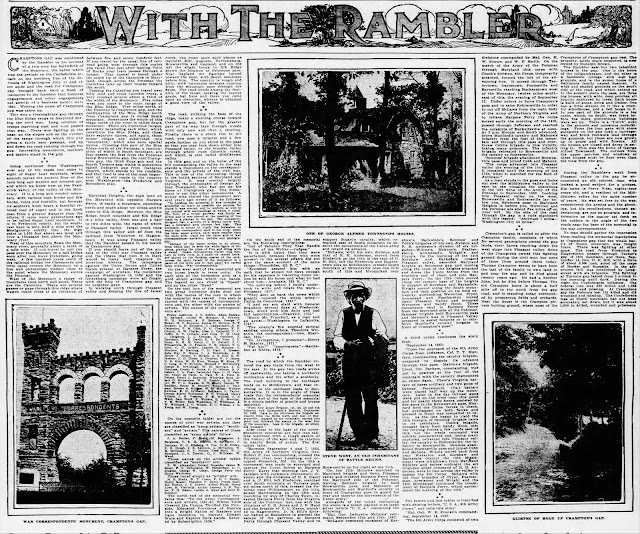
"The Rambler" visited Crampton's Gap in 1915. (Click on image to enlarge.)

Like this blog on Facebook | Follow me on Twitter

In the 1910s, the Washington Evening Star ran a feature called "The Rambler." It was a simple concept: Reporter travels to historic site within a day's car ride of the capital and writes about the journey. In September 1915, "The Rambler" — the stories were not bylined — stopped at one of my favorite Civil War sites: Crampton's Gap in Maryland. He visited with a former slave named Steve, examined historical tablets and the monument to journalists, and saw only two inhabited houses at the site of a Maryland Campaign battle on Sept. 14, 1862.

Imagine traveling in a Model T Ford over one-lane roads in some of the most beautiful countryside in America instead of on multi-lane highways. Top speed: 40 mph. Greatness.

"If one should leave out of the annals of the civil war Pleasant Valley and the ridges that hem it in," the reporter wrote, "there would be many void chapters in American history."

This account was published Sept. 12, 1915. Fascinating stuff. Curses to you, newspapers.com, for sending me down this rabbit hole!


-- Have something to add (or correct) in this post? Email me here.

Friday, September 25, 2020

Buried with comrades under an elm near Crampton's Gap

The American Battlefield Trust has saved some of the old Jacob Goodman farm, where
3rd New Jersey Private Charles Hamilton Bacon was originally buried.
(CLICK ON IMAGE TO ENLARGE.)

Like this blog on Facebook | Follow me on Twitter | Crampton's Gap map from ABT
 
I have driven Mountain Church Road, near the beautiful, forever-in-a-19th-century time caspule village of Burkittsville, Md., scores of times. Now that drive near Crampton's Gap will be even more meaningful.

A father of five, Charles H. Bacon
was killed at Crampton's Gap
on Sept. 14, 1862.
(Historic Days in
 Cumberland County
 New Jersey
)
Late on the afternoon of Sept. 14, 1862, VI Corps troops swept across Mountain Church Road in hot pursuit of vastly outnumbered Confederates retreating toward Crampton's Gap. Among those soldiers was 3rd New Jersey Private Charles Hamilton Bacon, a father of five and a "consistent Christian" from Bridgeton, N.J. Sometime during the attack -- perhaps at Crampton's Gap on the mountain or near Mountain Church Road below it -- the 32-year-old soldier in Company F suffered a fatal wound in the abdomen.

When I returned from my weekend trip to Antietam and beyond, I found an email from a Bacon descendant in my in-box. "I am obsessed," she wrote, "with trying to find any information I can about him." 

Serendipitiously, the final image I took during my  Burkittsville excursion was of the very farm on Mountain Church Road where Charles was buried under an elm tree with eight other comrades. I forwarded the photo and other information on Private Bacon to her.

The descendant also shared with me this heart-rending condolence letter -- published in the West-Jersey Pioneer on Sept. 25, 1862 -- from regimental chaplain George R. Darrow to Bacon's widow, Ann: 

            GOOGLE STREET VIEW: View of old Jacob Goodman farm and ground upon
    which VI Corps advanced near Burkittsville, Md., on Sept. 14, 1862. (Battlefield map)


Mrs. Charles Bacon

The papers, 'ere you receive this, will have announced to you the sad intelligence of the death of your husband. Amid the carnage of the battlefield he fell, having with his regiment charged on the enemy and while pursuing them in hot haste and pouring a deadly fire upon a routed foe. He went into the fight with unusual vigor, his health having greatly improved recently, faltering not until a ball passing through his Testament, which he always carried with him, entered his abdomen and caused his immediate death. His captain was wounded at the same time, and while I was assisting in getting him to the rear where a surgeon could be found, he told me of Bacon's fall.

I went immediately in pursuit of him and found him dead. His diary, Testament and purse I took from his person and handed them to his Lieut. [Charles F. Salkeld], who will forward them to you [at] the earliest opportunity. I buried him with eight of his comrades, who fell in the same fight, under an elm tree in the same field where the regiment charged on the enemy, on the estate of Jacob Goodman, north of the village of Burkittsville, about half a mile distant. We had our funeral on Monday afternoon, the drum corps and comrades of the deceased assisting in the burial of our brave dead. 

Brother Bacon was a good man, a consistent Christian, and I feel that his loss to me is very great. But what an affliction to you, his companion. May the God of all grace abundantly sustain you in your loneliness and sorrow -- you know how to trust Him. Let your faith take hold of the Everlasting arm and you shall be borne up a little while longer when all our sorrow shall end.

Yours truly, 

G. R. Darrow, Chaplain 3d N.J. Volunteers, Franklin's Army Corps

In the 1860 census, Charles Bacon's occupation was listed as "roller." He probably was
a factory worker. (National Archives via fold3.com.)

On Nov. 8, 1862, the West-Jersey Pioneer wrote that "perhaps our sadest duties as a journalist is to chronicle the decease of the brave hearts who go forth to battle for their country," And it singled out Bacon, noting the "stern worth, intelligence and patriotism" of the private "entitles him to more than a passing notice, and will long keep green the memory of that brave, true man." 

The remains of Bacon and his comrades probably were disinterred from the Goodman farm shortly after the war. Charles' final resting place is unknown. 

-- Have something to add, correct? E-mail me at jbankstx@comcast.net

Monday, December 04, 2017

Can General William Franklin's Crampton's Gap HQ be saved?

The circa-1820 Shafer house was Union General William B. Franklin's headquarters during the
 Battle of Crampton's Gap on Sept. 14, 1862.  (CLICK ON ALL IMAGES TO ENLARGE.)
The Burkittsville Preservation Association aims to restore the historic property.
Like this blog on Facebook.

From the outside, the old brick house near Burkittsville, Md., looks like it belonged in The Blair Witch Project, the 1999 horror film set in the hamlet at the foot of South Mountain.

Union General William B. Franklin, the
 VI Corps commander, made his headquarters
at Martin Shafer's farmhouse, about a mile east of
Burkittsville, Md., during Battle of Crampton's Gap. 
(Photo illustration courtesy Paul Mitchell)
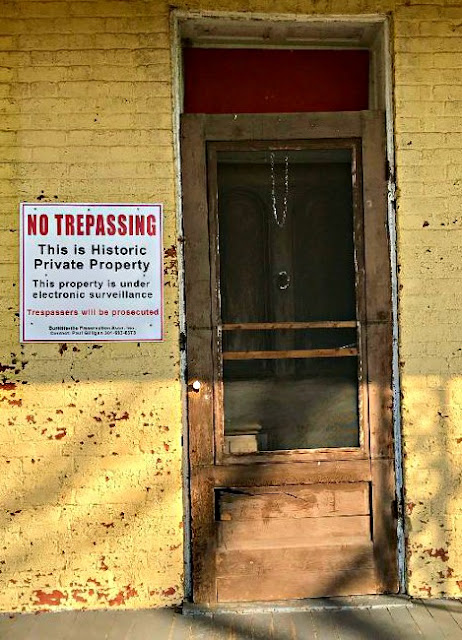
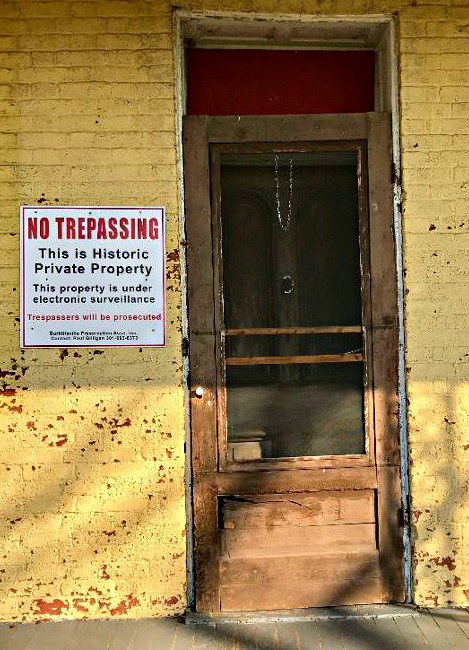
Yellow paint on the exterior is peeling, and the foundation and walls badly need expert repair. Several outside window panes are broken, perhaps victims of wayward youths. A large board covers the front entrance to a post-Civil War addition, an effort to keep out vandals. And next to the ancient, brown door on the creaky front porch, a sign near a recently placed holiday wreath warns: "No Trespassing. This is Historic Private  Property."

More than 155 years ago, this circa-1820 house at the corner of Gapland and Catholic Church roads was the setting for momentous events. In September 1862, thousands of soldiers in the Union Army's VI Corps camped in the fields surrounding Martin Shafer's house, about a mile east of Burkittsville. As cannon boomed nearby, Union General William B. Franklin established his headquarters on the property on the afternoon of Sept. 14. The 39-year-old corps commander, a career soldier and expert engineer, apparently made himself at home, enjoying a meal and smoking cigars in the yard with fellow generals Baldy Smith, Winfield Scott Hancock and Henry Slocum, among other VI Corps brass.

From a broken window inside the house, a view
 of South Mountain, where the armies
clashed on Sept. 14, 1862. The hamlet of
 Burkittsville, Md., is a mile down the road.
Meanwhile, about two miles away at Crampton's Gap on South Mountain, vastly outnumbered Confederates under the command of General Howell Cobb awaited Franklin's soldiers, who used the Shafer farm as a staging area. After several fits and starts, the Federals routed the enemy in the key but often forgotten Maryland Campaign clash. Three days later, the armies would fight again nearby at Sharpsburg, Md., during the much more costly Battle of Antietam.

After years of neglect, the property was donated in September 2016 by a relative of its last owner to the Burkittsville Preservation Association, which aims to restore it and make it a tourist attraction in the Civil War-rich area. The BPA, led by Paul Gilligan, faces significant challenges, not the least of which are financial. In addition to suffering from old age, the house has been abused by squatters and other trespassers. The outbuildings -- a Pennsylvania-style bank barn, meat house and a well house -- also need significant repairs. Total cost to save the property could perhaps top $1 million. (If you wish to donate money to help save the property, go to the donation section of the BPA site.) Preservation Maryland is also involved in the effort to save the Shafer farm.

                      GOOGLE STREET VIEW: Explore the area near Shafer house.

While the stunningly beautiful area surrounding the Shafer farm looks much as it did in 1862, the  farmhouse is much changed since the Civil War. Volunteers have made significant outside repairs and removed heaps of trash and other debris from inside the once-stately home, a veritable time capsule. Among the items discovered inside was a late-19th century William Jennings Bryan political pin.

A bottle of DDT, the
long-banned  insecticide,
on a shelf.
A recent visit inside the house revealed damage done by vandals,  time and nature. Graffiti defaces walls and a door. Perhaps a target of thieves, an old fireplace mantle is loosened from its moorings. A bird's nest rests on a beam in a small room. On the floor in an upstairs room, damage caused by an attempt to light a fire is apparent. Cracks snake their way through interior walls.

On my impromptu tour with BPA board member Todd Remaley, I examined curiosities. Covered with dust, an old brown bottle of DDT, the long-banned insecticide, stands on a dusty shelf. In the attic, beams are numbered with Roman numerals, a common construction practice long ago. In a downstairs room, perhaps the very one where Franklin met with Union commanders in 1862, four old ironing boards rest against a wall. Were they used by the most recent owner, who may have used the house as a laundry during the Depression?

Of course, many other questions remain: What would an archaeological study of the property reveal? Where are accounts of soldiers who briefly made the Shafer property home in the fall of 1862? What other secrets does the house, last lived in in 2000, hold?

But the greatest question is this one: Can this historic property really be saved for future generations?

The well house (left) and meat house in the backyard.
The meat house must be stabilized.
The foundation and walls of the house need significant repairs.
Front entrance to the Shafer farmhouse.
A downstairs room shows the ravages of time.
An apparent target of a thief, the fireplace mantle is loosened from its moorings.

An old mirror in a downstairs room reflects recent visitors.
Roman numerals carved into ancient attic beams.

Have something to add (or correct) in this post? E-mail me here.