Showing posts with label Civil War under my nose. Show all posts

Saturday, October 01, 2011

Civil War under my nose: Deaths of Lee brothers

Edwin R. Lee, killed at New Bern, N.C. on March 14, 1862, is buried in
Riverside Cemetery, near the Farmington River, in Barkhamsted, Conn.

Worn by the elements, the words carved on Edwin Ruthven Lee's brownstone memorial still resonate nearly 150 years after he was laid to rest with military honors in Riverside Cemetery in tiny Barkhamsted, Conn.

"His last words were Go on for your Country.

"He died that his country might live."
Brothers Edwin and Henry Lee were killed during the
 Civil War. Edwin was never married. Henry left behind a wife
 and four children.
(Photos from John Lee of Hartford Co. and His Descendants)

A captain in the 11th Connecticut Infantry, Lee was just 28 years old when he was killed in battle at New Bern, N.C. on March, 14, 1862. His body was buried near the battlefield and eventually brought back north for burial.

A little more than two years later, Edwin's oldest brother, Henry Bryan Lee, suffered the same fate. A 37-year-old lieutenant in the 7th Connecticut Infantry, Henry was mortally wounded at the Battle of Deep Run (also called Deep Bottom), near Richmond, on Aug. 16, 1864. Although his name and place and date of death are carved on the side of his brother's grave marker, Henry isn't buried next to Edwin. His final resting place is in Virginia in a grave marked "Unknown," the sad fate of many Civil War soldiers.

The deaths of the Lee brothers is another reminder of the immense toll the war took on some Connecticut families. During the past two years, I have found four western Connecticut families who lost multiple members during the Civil War. Three Wadhams brothers died in battle in Virginia in the summer 1864. Elijah Bacon, awarded the Medal of Honor for capturing a flag at Gettysburg, was killed in battle at the Wilderness, and his brother, Andrew, died in a prisoner-of-war camp in South Carolina. Brothers Alvin and George Flint, as well as their father, Alvin Sr., also died in service to their country.

I often pass by the Lee brothers' 10-foot marker, a stone's throw from the Farmington River, during bike rides along scenic River Road near People's State Forest. Until today, I knew little about them. Here's some of what I have uncovered:

Edwin Lee, described as a "young man of a clear head and earnest convictions," was a supporter of  Abraham Lincoln, often making speeches for the Republican  candidate during the 1860 presidential campaign. (1) Inspired by the Union cause, Edwin raised a company of men, enlisted from Hartford as a captain in the 11th Connecticut on Sept. 27, 1861, and was commissioned into Company D two months later. One of three brothers who served in the Union army (another brother was rejected as unfit to serve because of a disability), Edwin was a rifle maker before the war. (2)  He was employed at the Colt Armory and Sharps Rifle Company in Hartford, both of which supplied a large number of small arms to the Union army during the war. (3)

After drilling in Hartford, Lee and his comrades headed for New York, where the 11th Connecticut left by steamer on Dec. 17, 1861, bound for Annapolis, Md. In early January, the 11th broke camp and eventually made its way to North Carolina as part of Gen. Ambrose Burnside's Expedition.

Edwin Lee's occupation was listed a rifle maker on the 1860 U.S. census.

In early March, the 11th Connecticut moved from Roanoke Island to take part in an attack near New Bern, an important link in the Confederate supply chain and thus a key military target. In helping overwhelm the poorly trained and hugely outnumbered rebels, the 11th Connecticut suffered 14 wounded and six men killed.

"It was a sickening sight that met us, dead horses, mangled men, broken cannons, knapsacks and guns were slung in every direction," an officer in the 11th Connecticut wrote of the battle's aftermath.

Among the dead was Captain Edwin R. Lee, struck in the abdomen by a shell that also killed five other men. Lee, just 44 days short of his 29th birthday, died shortly after being wounded as he was leading a company into line. "Tell my brother I died at the post of duty," he said shortly after suffering the mortal wound. "Good-by. Go on for your country!" (4)

Edwin Lee (upper right) was listed as killed in action at New Bern in the
Hartford Courant on March 20, 1862.
A day after the battle, Lee was buried on the bank of the Neuse River. Because he was an officer, Lee's body probably was handled with care and eventually shipped back north, perhaps at the army's expense, for burial. "I was conversing with him the morning of the battle," Henry Roger Jones of New Hartford, a sergeant in the 8th Connecticut, wrote after the war. "He was killed about 9 o'clock a.m. ... He was a young man of talent, and a gallant soldier." (5)

Like his brother Edwin, Henry apparently also was well regarded by his comrades. A machinist who resided in Derby, Conn,  about 45 miles southeast of Hartford, Henry was described as a "brave, faithful, uncomplaining soldier" and an "honest, conscientious, devoted patriot." (5) Henry, who enlisted as a sergeant on Sept. 9, 1861, was married to a woman from Massachusetts. He and wife Arre Ann had four young children under 10 years old at the start of the war in April 1861: Ellen, 7; Emma, 4; Charles, 2; and Maria, 2 months. (Another child, Henry, died shortly after he was born in March 1853.) (6)

Against his brother's wishes, Henry Lee re-enlisted in the army in 1864
When Henry's enlistment was up in 1864, William Wallace Lee, the brother who was rejected for service in the 2nd Connecticut Artillery because of a disability, urged him to stay at home with his young family. But Henry re-enlisted anyway and was promoted to Second Lieutenant on March 1, 1864.

"I will fight the enemies of my country while I live," Henry replied to William. "I'll see the end of this, or it shall see the end of me." (7)
Henry B. Lee, a lieutenant in the
 7th Connecticut,  died at Deep Run, Va.,
 on Aug. 16, 1864.

The 7th Connecticut served in South Carolina, Georgia and Florida from April 1862 to late February 1864 before being moved to Virginia in May 1864. Believing he could end the siege of Petersburg and Richmond, General Ulysses Grant concentrated his forces, including the 7th Connecticut, on Rebel entrenchments near the James River beginning Aug. 13, 1864.

Three days later, Henry B. Lee, the father of four young children, was mortally wounded in another assault on Confederate entrenchments in the Battle of Deep Run.  The eldest Lee brother died in enemy hands as the Union army hastily retreated, and was buried on the battlefield. (8). Henry was later reburied in Fort Harrison National Cemetery, near Richmond, where his body lies with many other Union soldiers whose tombstones are marked "Unknown." (9)

(1) The Military and Civil History of Connecticut During the War of 1861-65, William Augustus Croffut, John Moses Morrism 1869, Page 175
(2) 1860 U.S. Census
(3) Ellery Bicknell Crane. Genealogy of the Crane family (Volume 1)
(4) The Military and Civil History of Connecticut During the War of 1861-65, Page 175
(5) Barkhamsted And Its Centennial, William Wallace Lee and Henry Roger Jones, 1881, Page 175
(6) John Lee, of Farmington, Hartford County, Conn., and His Descendants, Sarah Marsh Lee, 1878, Page 144
(7) The Military and Civil History of Connecticut During the War of 1861-65, Page 655
(8) Ibid
(9)  John Lee, of Farmington, Hartford County, Conn., and His Descendants, Sarah Marsh Lee 

Two Grand Army of the Republic markers and two American flags adorn the gravesite of
Edwin R. Lee, a captain in the 11th Connecticut.
The fate of Lee's brother,  Henry, is also
carved into this brownstone memorial in Barkhamsted, Conn., but he is buried elsewhere. 

Saturday, September 17, 2011

Civil War under my nose: Hartford, Conn.

Some guy named Lincoln and Connecticut Civil War governor William Buckingham speak
Saturday at a commemoration ceremony for the Solders and Sailors Memorial Arch in Hartford.
It's not every day that you see a governor, a senator, a U.S. president and a dictator.

Today was one of those days.
Detail of the Soldiers and Sailors
Memorial Arch in Bushnell Park.

On a crisp fall-like morning, the 125th anniversary of the dedication of the Civil War Soldiers and Sailors Memorial Arch in Hartford's Bushnell Park was marked by speeches by Sen. Richard Blumenthal, as well as by impersonators of William Buckingham, Connecticut's Civil War governor, and ol' Honest Abe himself.

I've chugged under the arch several times during Max's O'Hartford 5K runs but never really knew much about its history until today. (Cue the tour guide voice.) The arch commemorates the 4,000 Hartford men who served in the Union army and navy during the Civil War. About 400 of them died, losing their lives in battle in such places as Sharpsburg. Md.,  Cedar Mountain, Va., and Irish Bend., La., or in POW camps such as  Andersonville in Georgia. The memorial was formally dedicated in 1886, 25 years after Antietam -- the bloodiest day in American history and in Connecticut's history as well. The 8th, 11th, 14th and especially the 16th Connecticut Infantry suffered casualties at Antietam.

When the morning sun hits the brownstone just right, the arch is a photographer's dream. Rich hues. Blue sky. Ornate monument details. Ahh, that's nice stuff.

Of course, no Civil War-themed day is complete without checking out a  cannon and a whole bunch of old lead. Several Civil War memorials are located near the gold-domed State Capitol building, a short walk from Bushnell Park. The most intiguing is the First Connecticut Heavy Artillery monument that is topped with a squatty cannon on steroids. Actually a 13-inch seacoast mortar and nicknamed the "Dictator," it was capable of lobbing 200-pound shell several miles. The First Connecticut may have used this one during the sieges of Yorktown and Petersburg, although that's in some dispute.
A rare Civil War relic monument pyramid.

At the Museum of Connecticut History across the street from the capitol building (free admission today!), museum administrator Dean Nelson was kind enough to show me exhibits of guns made in the state during the Civil War. (The Connecticut River Valley supplied a huge number of arms to the Union army.) As a bonus, Nelson took me to a small back room where the museum keeps items currently not on public display --- including Samuel Colt's Civil War uniform (cost to state: $150K) and a rare Antietam relic monument pyramid.

In the years immediately after the war, relic collectors and war veterans made displays of bullets, shrapnel, belt buckles, bayonets and the like to commemorate a battle. Until today, I've only seen one of these highly collectible and rare relics in books or on the Internet. The Horse Soldier, a Gettysburg antiques store, offers a similar Antietam relic monument pyramid for $22,500; Nelson said the one in the museum is probably worth $12,000 to $13,000. I don't think I'll be adding one to my collection anytime soon.

I really needed a Civil War fix today, the 149th anniversary of the Battle of Antietam, so a trip to the Hall of Flags at the State Capitol building was a must. Thanks to terrific -- and costly -- conservation work, Civil War battle flags carried by Connecticut regiments at places such as Gettysburg and Cold Harbor are displayed so the fragile cloth relics won't be damaged further. Most Civil War battle flags in other states are too deteriorated to display.  Kudos to Connecticut for making these unique pieces of history available to the public.

Say hello to my little friend! A 13-inch mortar on the First Connecticut Heavy Artillery
monument on Capitol Street in Hartford. The state capitol building is in the background.

The beautiful Soldiers and Sailors Memorial Arch in Hartford's Bushnell Park.
The arch was dedicated on Sept. 17, 1886 -- 25 years after the Battle of Antietam. 
Regimental flags in the Hall of Flags in the State Capitol building in Hartford.

Monday, September 05, 2011

Civil War under my nose: Simsbury, Conn.

The Civil War memorial in Simsbury, Conn., just off Route 10.

Joseph R. Toy is one of 194 names etched
on the Simsbury Civil War memorial. Toy
died of disease in 1862.

Visit almost any small town in Connecticut and you're bound to stumble upon a Civil War memorial. Western Connecticut, in particular, is rich with Civil War history.

In Simsbury, about 15 miles from Hartford, the Civil War memorial is just off Route 10, near the Farmington Trail path and Abigail's restaurant, which dates to 1780 and, of course, is haunted. Runners and cyclists probably seldom venture off the trail for a peek at the gray granite war memorial that was dedicated before a crowd of 2,000 on a rainy Fourth of July in 1895. (1)

Out of a population of about 2,400, 217 men from Simsbury served in the Union army. Thirty-five of them died -- 10 in combat, eight as prisoners of war and 17 of disease -- in places such as Sharpsburg, Md., Andersonville, Ga., Drewry's Bluff, Va., and Kinston, N.C. (2)

Joseph R. Toy, a captain in Co. H of the 12th Connecticut Infantry, is one of those 35 unfortunate Simsbury sons who gave his life to the Union. Toy, whose name is etched on the left side of the memorial, died of disease on June 21, 1862, probably while serving near New Orleans.

(1) Connecticut's Civil War Monuments web site
(2) American Civil War Research Database

A modern plaque, dedicated in 1995, sits at the front of the memorial.

Sunday, August 21, 2011

Civil War under my nose: Mansfield's grave

Joseph Mansfield died Sept. 18, 1862, a day after being wounded at Antietam. He
is buried in Middletown, Conn.

Gen. Joseph Mansfield's demise is one of the incredible hard-luck stories of the Civil War.

Mansfield was 58 when he died.
A longtime professional soldier -- he was wounded in the leg in 1846 during the Mexican War -- Mansfield saw little serious fighting during the first 17 months of the Civil War. Itching to lead troops in the field, the 58-year-old soldier from Middletown, Conn. was given command of the XII Corps of the Army of the Potomac on Sept. 15, 1862. Three days later, he was dead, succumbing to a bullet wound in the chest suffered Sept. 17 during fighting near the East Woods at Antietam.

I visited Mansfield's grave this morning at Indian Hills Cemetery in Middletown, Conn., about 30 minutes from my home in Avon. He's buried near a majestic, old oak near the crest of the hill at the cemetery off Washington Street. Mansfield's large brownstone marker is topped with an ornamental sword, the top portion of which is missing. His wife, Louisa, who died in 1870, and a son, Joseph, who died as an infant in 1844, are buried nearby.

Mansfield was one of six generals killed at Antietam -- three Union and three Confederate. Amazingly, 12 generals were wounded during the bloodiest day of the war -- six from each side. General John Sedgwick, a Connecticut native who commanded a division in the II Corps at Antietam, was wounded three times during the battle. He was killed by a sharpshooter's bullet at Spotsylvania Courthouse on May 9, 1864 and is buried in tiny Cornwall Hollow, also about 30 minutes from my house.

The date of Mansfield's death is incorrect on his memorial.  The general died at the
George Line farm on Sept. 18, 1862, a day after Antietam.

Sunday, August 14, 2011

Civil War under my nose: Newport, R.I.


Artillery tube outside historic Fort Adams, at the mouth of Newport Harbor.

Massive walls of the fort.
Historic Newport, R.I., only a two-hour drive from our Connecticut home, is one of my favorite places. Besides the incredible mansions on Bellevue Avenue, the church where JFK was married and very underrated beaches, Newport is home to a good deal of Civil War history.

Fort Adams, situated at the mouth of the beautiful Newport Harbor, was the largest coastal fortification during the Civil War. During the war, the headquarters for the U.S. Naval Academy was moved from Annapolis, Md., to Fort Adams because the government wasn't quite sure of the political sympathies of Marylanders.

We made a quick drive-by of the fort on Friday afternoon, "thrilling" my youngest daughter. The visitors center closed at 4 p.m., so we didn't get a chance to tour the interior of the massive fort. The current Fort Adams, built in 1824, also was the site of the first X Games on ESPN, in 1995. You can rent the place out for corporate functions and weddings. I'm sure both my daughters will file that nugget away.

Six artillery tubes lay outside Fort Adams. The fort  was the largest coastal fortification in the U.S.

Thursday, June 30, 2011

Civil War under my nose: West Brookfield, Mass.

Augustus Potter, a private in the 15th Massachusetts, was wounded at Antietam,
Gettysburg and Mine Run, Va.. He survived the Civil War.
As Andy Hall notes on his outstanding Dead Confederates blog, good stories don't fit on a slab of stone in a cemetery. A recent trip to Massachusetts reinforced that.

I visited West Brookfield, Mass, about and hour or so from my home in Connecticut, two weeks ago to do research on Justus Collins Wellington, a private in the 15th Massachusetts who was killed at Antietam on Sept. 17, 1862. Wellington's parents are buried in Pine Grove Cemetery in West Brookfield, but I believe Justus is probably buried  under a gravestone marked "Unknown" in the national cemetery in Sharpsburg, Md.

A small Second Corps, II Division flag
on Potter's grave.
In searching for the gravestones of Justus' parents, I stumbled upon the final resting place of one of his comrades: Augustus N. Potter, also a private in Co. F. in the 15th Massachusetts. Potter, who survived the Civil War, has a very interesting story.

A 24-year-old shoemaker from West Brookfield, Potter enlisted as a private in the 15th Massachusetts on July 12, 1861, the same day as Wellington. Potter probably knew Justus, who also was a shoemaker in West Brookfield. He mustered out because of a disability on Jan. 10, 1862, but was back with his regiment when it was decimated in the West Woods at Antietam on Sept. 17, 1862. Potter suffered a slight leg wound at Antietam, one of 325 casualties (including 70 killed) in his regiment in about 20 minutes.

Less than a year later, Potter was at Gettysburg, where he was wounded on July 2, 1863. A little more than four months later, Potter was wounded at Mine Run, Va., and seven months later, on June 22, 1864, he was captured at Petersburg, Va., sent to Libby Prison in Richmond and later paroled. Thanks to three of his descendants, there's an excellent breakdown of Potter's service on Susan Harnwell's terrific 15th Massachusetts site. Potter's brother, Henry, a private in Co. C of the 4th New Hampshire Infantry, was killed at Drewry's Bluff in Virginia on May 16, 1864.

Wounded three times, captured, survived the war -- I'll bet Potter had some amazing tales to tell.

After the Civil War, Potter was busy too. He fathered 10 children with his wife, Mary. He died March 9, 1918 at age 81.

I'll look to dig up much more on Potter at the National Archives next spring.

Sunday, June 26, 2011

Civil War under my nose: Avon, Connecticut

The 16th Connecticut, including 15 men from Avon, fought in this field on the Otto Farm  at
Antietam on Sept. 17, 1862.  The 16th Connecticut monument is in the distance.

 Robert Hawley, a private in the 16th
Connecticut  from Avon, Conn., was mortally
wounded at Antietam. 
 This is
his marker at West Avon Cemetery. 
After walking a Civil War battlefield, I always come away with a renewed respect -- heck, make that awe -- for the common soldiers.

How did they do it?

What kind of courage did it take for soldiers to blast away at each other with rifled muskets from 75 yards?

How could they march, sometimes barefoot, 10 or more miles in a woolen uniform on a hot summer day?

What kind of fortitude did it take to subsist on green apples, hardtack and corn?

Incredible.

At the Battle of South Mountain, near Boonsboro, Md., on Sept. 14, 1862, soldiers killed and maimed each other fighting over tremendously difficult, rocky terrain. Three days later, at nearby Sharpsburg, Md., barely trained troops of the 16th Connecticut Infantry fought on terrain that, while not as imposing as South Mountain, was nonetheless trying. I've walked that same ground on a warm spring day, and it's a haul.
Private Newton Evans of Avon, Conn., was
wounded  at Antietam and later died at
Andersonville prison in Georgia.

The John Otto Farm at Antietam includes gulleys, ridges and  a 40-acre cornfield that was the scene of terror for the 16th Connecticut. After finally slugging their way across Antietam Creek at the Rohrbach Bridge, Union troops briefly re-grouped on the Otto property. As they pursued the Rebels on the afternoon of Sept. 17, 1862, the Federal army was in sight of the village of Sharpsburg. Robert E. Lee's Army of Northern Virginia was in desperate straits.

Part of Ambrose Burnside's left flank in the Army of the Potomac at Antietam, the 16th Connecticut formed in Hartford on Aug. 24. 1862. It was comprised of men from towns in Hartford County, including the small farming community of Avon, where I live now. In 1860, 1,059 people lived in Avon, and at least 84 men from the town served in the Union army during the Civil War. (1)

The 16th Connecticut, which included 15 men from Avon, was green. None of the Connecticut boys had even fired a weapon in battle before Antietam. Could they be counted on? Or would they, like some rookie soldiers in the 14th Connecticut in fighting at the Roulette Farm at Antietam, "shut their eyes" and fire their muskets in the air? (2)

Corporal Henry Evans of Avon, Conn.,
was killed at Antietam. This marker is in West
Avon Cemetery, but Evans is actually buried
in the national cemetery in Sharpsburg, Md.
Before navigating a hill to reach the 40-acre cornfield on the Otto Farm, the 16th Connecticut came under heavy fire.

"The air was filled with bullets and fiendish missiles," Bernard Blakeslee, a lieutenant in the 16th Connecticut from Hartford recounted in a memoir published 10 years after the war. "Hundreds of cannon were now aimed at us; grape and cannister, marbles and railroad iron were showered down like rain. The crest of the hill was a great protection to the Sixteenth, and only about a dozen were disabled. A battery was ordered up to engage the enemy, but it was whirled back in less than five minutes, losing every officer, seven men, and five horses. To see those men stand there and be shot down till they received orders to retire was a fearful sight." (3)

Eventually, the 4th Rhode Island and the 16th Connecticut made their way up a ridge and reached the head-high corn in the 40-acre cornfield, where they were blasted in the left flank and scattered by troops from A.P. Hill's division, which had marched 17 miles from Harpers Ferry. Hill's division saved Lee at Antietam.
Sign for second-most infamous
cornfield at Antietam.

"General Rodman observed that the rebels were about to flank us and get in our rear, and ordered the Fourth Rhode Island, and Sixteenth Connecticut to swing to the left that we might face them, but at that particular moment the rustling of cornstalks warned us that the rebels were on us," Blakeslee wrote. "Colonel Beach gave the order 'Attention!' While this order was being executed a terrible volley was fired into us. Volley after volley in quick succession was hurled into our midst. The Sixteenth sprang up and returned the fire with good effect; some fixed bayonets, advanced, and were captured. The most helpless confusion ensued. Our men fell by scores on every side." (4)

Out of 779 engaged, the 16th Connecticut lost 43 killed, 161 wounded and 204 captured or missing. Corporal Henry D. Evans of Avon was killed and three of his fellow townsmen -- privates Newton Evans, Wallace Woodford and Robert Hawley were wounded. Hawley died eight days later. (Woodford and Evans later became prisoners of war; Evans died in Andersonvile on Sept. 9, 1864, and Woodford died at home on Jan 10, 1865)
Wallace Woodford, a private from Avon in the 16th Connecticut,
was  wounded at Antietam. As this marker in West Avon
Cemetery notes, he was "eight months a sufferer
in Rebel prisons." He died at home on  Jan. 10, 1865.

Woodford is buried in West Avon Cemetery, about three miles from my house, under a large brownstone family memorial that notes he was "eight months a suffererer in Rebel prisons."

There are markers for Evans and Hawley in the West Avon Cemetery, but neither is buried there. Evans' final resting place is the national cemetery in Sharpsburg, gravesite No. 1,084. Hawley's final resting place is unknown.

(1) American Civil War Research Database.
(2) Mr. Dunn's Experiences in the Army: The Civil War Letters of Samuel W. Fiske, Pages 8-9, edited by Stephen W. Sears, 1998.
(3) History of the Sixteenth Connecticut Volunteers, B.F. Blakeslee, 1875
(4) Ibid.
Flags and Grand Army of the Republic markers by headstones in West Avon
(Conn.) Cemetery. At least 84 men from Avon served in the Union army during the Civil War. 

Tuesday, June 21, 2011

Civil War under my nose: Kensington, Conn.

This flag in the Kensington Congregational Church in Kensington, Conn, was sewn by
church members during the Civil War and hung from the belfry.

In researching Berlin's Bacon brothers -- try saying that three times really fast -- I stumbled upon a few nuggets of Civil War history early Sunday afternoon.

The Kensington Congregational Church
was dedicated in 1774.
Behind the Kensington Congregational Church stands what some claim is the first monument in the United States dedicated to Civil War soldiers. (Kentuckians may want to duel Nutmeggers for that honor.) If you think it's a little odd for a war monument to be placed next to a church, you aren't alone. But passions ran high during the Civil War.

On July 28, 1863, a little more than three weeks after the Battle of Gettysburg, a small crowd gathered at the church for dedication of the 18-foot brownstone obelisk, a word that will never again appear on this blog. The event would have been better attended, but area farmers had more important things to do, according to an account in the Hartford Courant. (1) Rev. Elias Brewster Hillard apparently was instrumental in developing the idea for the monument and another church member, Nelson Augustus Moore, designed it. Church members and area residents raised funds to build it -- some accounts say it cost $350, others $475. (2)

On the monument are listed the names of 14 area soldiers who died during the Civil War, including a pair of brothers (John and William Warner) and a father and son (Richard and James Ringwood).  A bronze plaque for Berlin's Elijah Bacon, who was killed at the Wilderness on May 6, 1864, was added at the base of the monument in 1988. (Another soldier listed, Nelson Ritchie of the 16th Connecticut, died after the Civil War.) Interestingly, Bacon's father, a stonecutter from Berlin, may have cut the stone for the memorial. That merits more research.
"Erected to commemorate the death of those who perished in
suppressing the Southern Rebellion." an inscription
on the monument reads.

I wanted to know more about this large, old relic, so I rang the church doorbell. Rev. Olivia Robinson, a friendly, soft-spoken woman, answered and quickly took me to the back parlor of the church, where she pointed out an even more impressive relic behind protective glass: a 10-foot by 18-foot red, white and blue flag with 33 stars. (Thanks for correcting me on the stars, mstrauch.)

There's a neat story on the history of the flag that I found in a book published in 1912 on the 200th anniversary of the founding of the congregation. On the morning of April 13, 1861, the good Rev. Elias Brewster Hilliard, apparently an excitable sort, heard word that the Rebels had shelled Fort Sumter in Charleston Harbor in South Carolina.
“(Hilliard) was standing at the door of the church … when Mr. Samuel Upton, at the time the village postmaster, came in, bringing the news that Fort Sumter had been fired on the day before. Mr. Hillard entered the pulpit, laid away his prepared sermon, and delivered a stirring patriotic address whose echoes rang in the town for many a day. During the following week the ladies of the church held a meeting, and made, without the aid of sewing-machines, the grand old flag which was hung from the belfry of the church at its completion, and continued to float in the breeze throughout the war.” (3)
Nice.

The flag was restored in 2002.

(1) Connecticut Civil War monuments web site
(2) Research by Cathy Nelson, historian and assistant director Berlin-Peck Memorial Library
(3) Two Hundreth Anniversary, Kennington Congreational Church, Page 100, 1912

This Civil War monument next to the Kensington Congregational Church
  was  dedicated July 28, 1863.  The cannon was added in 1913.
  Approximately the same view as above in 1913, on the 50th anniversary of the  monument's
dedication. Note the ivy on the monument. (Photo courtesy Kensington Congregational Church)

Sunday, June 19, 2011

Civil War under my nose: Berlin's Bacon brothers

Elijah William Bacon, awarded the Medal of Honor posthumously for capturing a Rebel flag at
Gettysburg, was killed at the Wilderness on May 6, 1864. 
Almost every family in Connecticut was touched in some way by the Civil War. Many families were jolted more than once by tragedy.

As I wrote in this post, Edwin and Mary Wadhams of Litchfield lost three sons, all dying within 18 days of each other in fighting near Richmond, Va., in 1864.

The Bacon family of Berlin also suffered more than most.
Marker for Andrew Bacon, who served 
in the 14th  Connecticut,  in Maple Cemetery
in Berlin, Conn.

By 1860,  Roswell and Betsy Bacon had a typically large family for the era: sons Oliver, Andrew, Elijah and Almeron and a daughter, Maria. In his early 50s, Roswell was a stonecutter, and at least two of his sons followed in his footsteps at the family quarry in Berlin, a small town about 15 miles from Hartford. Because of  the expansion of the railroads in the 1840s and a thriving brickmaking industry, Berlin enjoyed a solid economy at the start of the Civil War in April 1861. (1)

Like many Berlin men, the Bacon's sons joined the Union army, with Oliver enlisting first, on Aug, 9, 1861, as a saddler in the 1st Connecticut Volunteer Cavalry. After President Lincoln called for 300,000 volunteers in the summer of 1862, Andrew and Elijah enlisted as privates in Co. F of the 14th Connecticut Infantry on July 28. Berlin, a stop on the Underground Railroad for runaway slaves, strongly supported the Union cause: 216 men from the town served in the Federal army out of a population of nearly 2,200. (2).

On Aug. 25, the 1,015 soldiers of the 14th Connecticut left the state for Washington, where they served in the defenses of the capital until early September. By that time, Andrew and Elijah Bacon likely were well aware that a Rebel army under Robert E. Lee was moving north to draw the Army of the Potomac from its encampments around Washington.
At Antietam, 14th Connecticut troops
"didn't know what they were expected
to do," Captain Samuel Fiske wrote.

Along with the rookies of the 108th New York and 130th Pennsylvania, the barely trained troops of the 14th Connecticut received their baptism of fire at Antietam on the morning of  Sept. 17, 1862. The performance of the Connecticut boys at the Roulette Farm and nearby sunken road was hailed as "behaving like veterans" in some accounts, but the reality was probably quite different.

"The battle was a scene of indescribable confusion. Troops didn't know what they were expected to do and sometimes, in their excitement, fired at their own men," Captain Samuel Fiske of the 14th Connecticut wrote. Some of the raw troops even "shut their eyes, and fired up in the air" (3). Elijah and Andrew escaped unscathed, but the 14th Connecticut suffered 38 killed and mortally wounded, 88 wounded and 21 missing.

By July 1, 1863, the 14th Connecticut had suffered heavy losses in major battles at Fredericksburg and Chancellorsville and was "reduced in size to a battalion," according to its chaplain, Henry Stevens. The remaining 200 men in the regiment fought well at Gettysburg, flushing sharpshooters from the Bliss Farm and helping stop the Rebels during Pickett's Charge on July 3. Incredibly, the 14th Connecticut captured nearly 200 prisoners and five Rebel battle flags during that fighting.

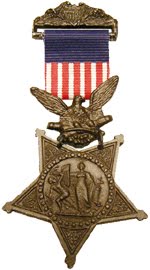
I haven't found an account detailing the specifics of Elijah Bacon's role at Gettysburg, but he captured a flag of the 16th North Carolina during Pickett's Charge. For his valor, he was awarded the Congressional Medal of Honor on Dec. 1, 1864 --  one of 63 Union soldiers so honored for their actions at Gettysburg.

But the son of a stonecutter from Berlin, Conn., never received the medal.
 Medal of Honor marker for  Elijah Bacon.

Civil War Medal of Honor.
(National Park Service)
Elijah William Bacon was killed in action at the Wilderness on May 6, 1864. He left behind a wife, Eliza, and two daughters. (4)
Also in early May, Andrew was captured at Ely's Ford, Va., and sent to Andersonville, the notorious Rebel prisoner-of-war camp in Georgia. Seven months later, he too was gone. After being transferred from Andersonville to another camp in Florence, S.C., Andrew died on Jan. 25, 1865, one of 10 Berlin men to die as a prisoner of war. He left behind a wife, Marissa, but no children. (5)


Word likely traveled slowly, but sometime in May 1864, Roswell and Betsy Bacon were notified that one son was dead and another was captured. Sadly, this was not unusual news in Berlin -- at least 42 soldiers from the town died during the Civil War. (6)

Oliver Bacon, whose cavalry regiment also served at Gettysburg, survived the war, but not without tragedy. After he was discharged Sept. 15, 1864, he married a Berlin girl, Rosa Woods, the 16-year-old daughter of Charles Woods. Rosa was "pretty as a picture, with her great brown eyes and dark curling hair." Soon after they were married, however, Rosa died, another terrible blow for the Bacon family. (7)

It's unclear if the bodies of either brother were returned to Connecticut..

Markers for Elijah Bacon (left) and Andrew Bacon next to the grave of their father.
a Confederate prisoner-of-war camp in Florence, S.C., on Jan. 25, 1865.

(1) Berlin (Conn.) Historical Society
(2) American Civil War Research Database
(3) Mr. Dunn's Experiences in the Army: The Civil War Letters of Samuel W. Fiske, Pages 8-9, edited by Stephen W. Sears, 1998.
(4) Research by Cathy Nelson, historian and assistant director Berlin-Peck Memorial Library
(5) Cathy Nelson research
(6) American Civil War Research Database
(7) The History of Berlin, Catherine M. North, Page 249, 1916

Friday, June 10, 2011

Civil War under my nose: Springfield Armory

An "Organ of Muskets" at the Springfield (Mass.) Armory holds 645 1861 Springfield muskets.

Arms manufacturers in the Connecticut River Valley produced a vast quantity of weapons for the Union army during the Civil War. Rifles, muskets, pistols and other arms were manufactured in Connecticut by Colt in Hartford, Whitney U.S. Navy Rifle in New Haven, Welch and Brown in Norfolk and by James D. Mowry and Norwich Arms Co. in Norwich. More than 200,000 bayonets were supplied to the army by the Collins Co. in Collinsville, about six miles from my house.
This Gatling gun -- an early machine gun -- was first used
during the Civil War.  It's on display at
 the Springfield Armory musuem.

In Massachusetts,  the Federal armory overlooking the Connecticut River in Springfield, about a 35-minute drive from Hartford, competed with other manufacturers in the valley to supply small arms to the Union. The destruction of the armory in Harpers Ferry, Va., (now West Virginia) during the Civil War left the Springfield Armory as the only federal manufacturing point for arms until the 1900s. The Springfield Armory manufactured, repaired, tested and designed weapons from 1777, when President Washington authorized its creation, until it closed in 1968.

My first impression of the Springfield armory grounds: Hey, this place is huge. Surrounded by more than a mile of wrought-iron fence, many of the armory buildings are now occupied by Springfield Technical Community College. The most fascinating display in the museum is the two-story tower of 645 Springfield muskets, stacked Jenga-like. It's called an "Organ of Muskets," and it was made famous by Henry Wadsworth Longfellow's anti-war poem in 1843. I was tempted to ask the National Park Service employees behind the main desk at the Armory museum today if they cared to part with just one -- a pristeen 1861 Springfield musket like the ones displayed can easily go for $3,000 or more -- but figured that would not go over well. :)

This was just a drive-by visit today, but it's definitely worth another trip and a couple hours of my time.

The Main Arsenal building at the Springfield (Mass.) Armory.

Carbines manufactured during the Civil War.


Wednesday, June 01, 2011

Civil War under my nose: Dorence Atwater

The Dorence Atwater monument is in Baldwin Park in Terryville, Conn.
As I have noted in posts here, here and here, you don't have to look hard to find a marker, monument or grave related to Civil War history in Connecticut. On a drive from Thomaston, Conn., back to Avon on a rainy Memorial Day morning, I pulled off the road into a park in the village of Terryville. That's when I happened upon a sign that -- surprise, surprise -- told an intriguing Civil War tale.

Dorence Atwater

I wasn't familiar with the incredible story of Dorence Atwater, who was born in Plymouth Center, Conn. (Terryville) and probably lied about his age when he enlisted in the Union army at the start of the Civil War when he was barely 16.

After being captured at Hagerstown, Md., on July 7, 1863, Atwater was sent to a prisoner of war camp in Richmond before eventually ending up in the notorious Rebel POW camp in Andersonville, Ga. (1) While imprisoned there, he had the presence of mind to secretly record the deaths and burial locations of many of his fellow soldiers. He survived Andersonville and then turned over the death records after the war to Clara Barton., the famous Civil War nurse (and later the founder of  the American Red Cross). Atwater and Barton used the records to help properly mark the many previously unknown graves at Andersonville, no doubt bringing comfort to their families back north.

Clara Barton in 1902
In his amazingly colorful life, Atwater was a gold speculator, selected as U.S. Consul to the Seychelles by President Andrew Johnson at age 23, married a Tahitian woman and worked with lepers. (2) Pretty incredible stuff. Atwater died in 1910 in San Francisco and was buried in Tahiti. Deborah Safranski has an excellent account of her ancestor here, and Judith Giguere of the Plymouth (Conn.) Historical Society has more detail on Atwater here.

As for the cannon at the memorial, well, it's a biggun'. I am not a Civil War cannon expert, but I think this is a  Columbiad tube, many of which are on display at courthouses and memorials throughout the United States. The barrel of the cannon (bottom photo below) has markings and a serial number, which I believe identifies the foundry where it was made.

By the way, Atwater isn't the only famous citizen of Terryville. Tadeusz Wladyslaw Konopka, better known as Ted Knight of "Mary Tyler Moore Show" fame, is also from Terryville.

Clara Barton, the famous Civil War nurse who founded the American Red Cross
after the war, attended the dedication of the Atwater monument in 1906.

A look straight down the barrel of the Atwater monument cannon.

(1) American Civil War Database
(2) Angel of Andersonville: The Extraordinary Life of Dorence Atwater by Deborah Safranski, 2008