Showing posts with label Abraham Lincoln. Show all posts
Showing posts with label Abraham Lincoln. Show all posts
Friday, November 14, 2025
Podcast: George Rable on Lincoln-McClellan relationship

Wednesday, August 06, 2025
Podcast: Justin Martin on his book, A Fierce Glory
Saturday, February 05, 2022
'Life of an ox': Where Abraham Lincoln lived ages 2 through 7
 |
| Knob Creek Farm, near Hodgenville, Ky. |
 |
| Gravestone of Abe Lincoln's brother, Thomas, who died in infancy. The marker is in the visitors' center at Lincoln's birthplace in Hodgenville, Ky. |
The family — Abraham, father Thomas, mother Nancy and sister Sarah — lived in a one-room cabin with a dirt floor, On the farm's wide fields, Lincoln’s father planted corn and pumpkins.
In front of the Lincolns’ door, on the road from Louisville to Nashville, the world passed: pioneers with heavily laden wagons, peddlers, slaves, local politicians, missionaries and soldiers returning from the War of 1812.
In rain-swollen Knob Creek in 1816, a Lincoln playmate may have saved Abraham from drowning. That story bears more scrutiny. In 1812, Lincoln’s infant brother Thomas died on the farm.
Roughly two miles down the road from Knob Creek farm, Lincoln sporadically attended with Sarah an ABC school—a so-called “blab” school in which the students repeated oral lessons from a teacher.
In the winter of 1816, the family left Knob Creek for a settlement in southern Indiana.
 |
| A replica of the cabin the Lincolns lived in at Knob Creek. |
 |
| Knob Creek, where Lincoln may have nearly drowned. |
 |
| Avoid snakes near Knob Creek! |
 |
| A "knob" looms near Lincoln farm site. |
 |
| The Lincolns planted corn and pumpkins here in the rich soil. |
 |
| Roughly two miles from the farm, Lincoln and his sister attended a school at this site. |
— Have something to add (or correct) in this post? E-mail me here.
Tuesday, January 11, 2022
In baby steps of Abraham Lincoln in Hodgenville, Kentucky
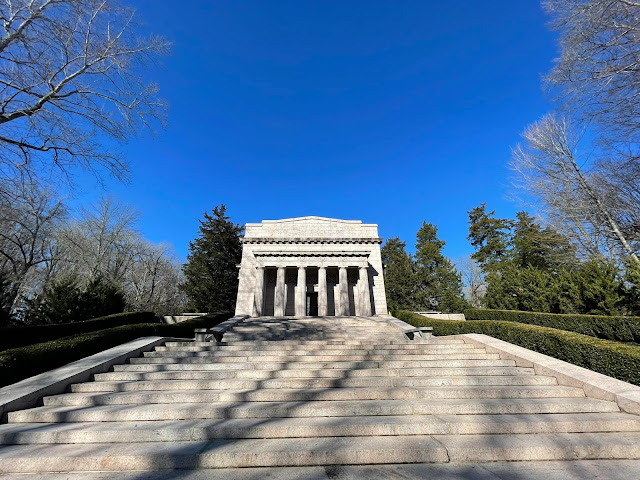 |
| Fifty-six steps to the top -- one for every year of Lincoln's life. |
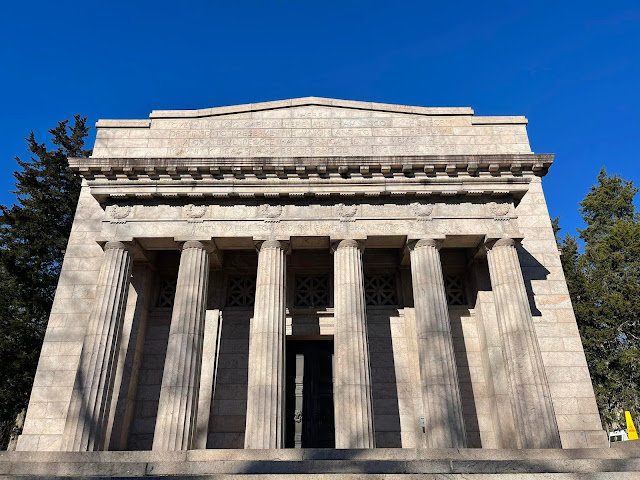 |
| I made it to the top, slightly winded. |
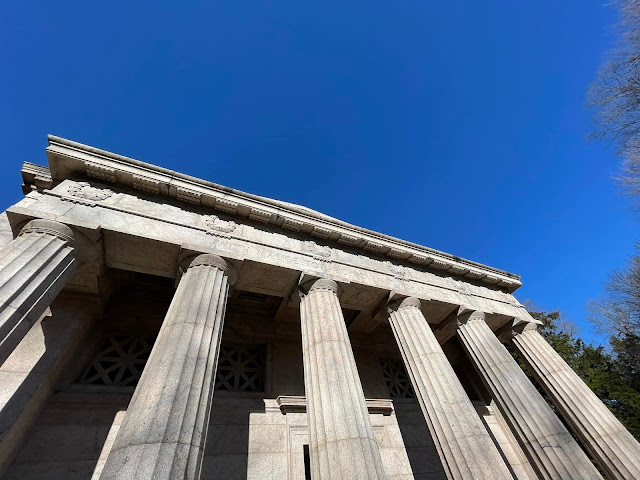 |
| The deep-blue sky made for an excellent backdrop. |
 |
| The view from the Lincoln memorial. |
 |
| A replica of the cabin on the site where Lincoln was born on Feb. 12, 1809. |
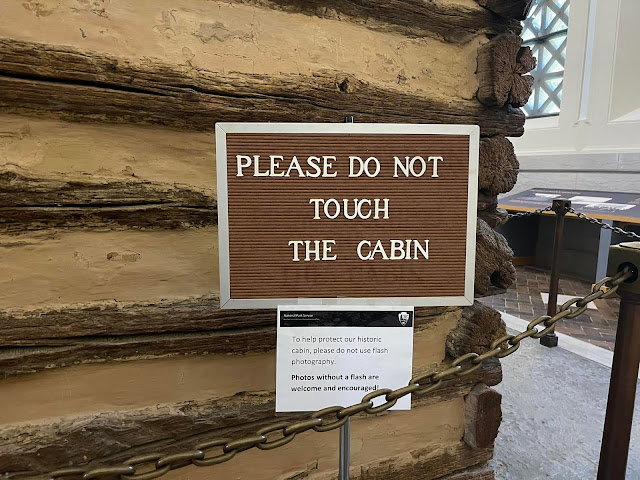 |
| Don't get handsy at the replica cabin. |
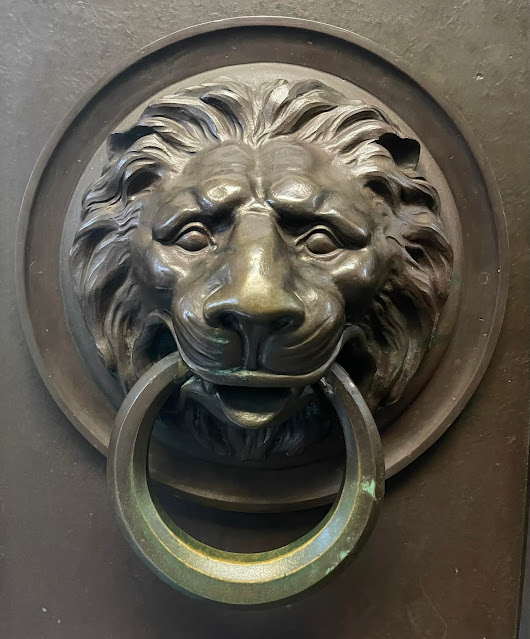 |
| Lion's door handles would be nice addition to Banks Manor. |
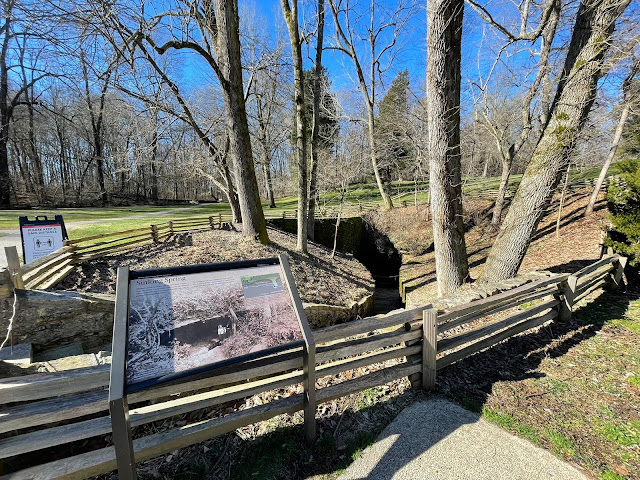 |
| A historical marker explains Sinking Spring. |
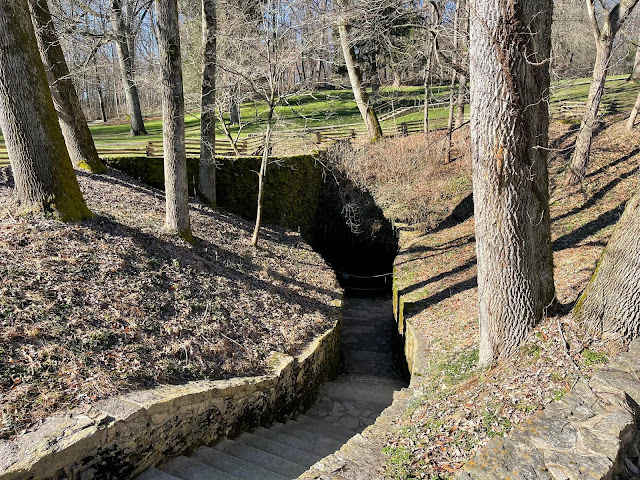 |
| Another view of the spring. |
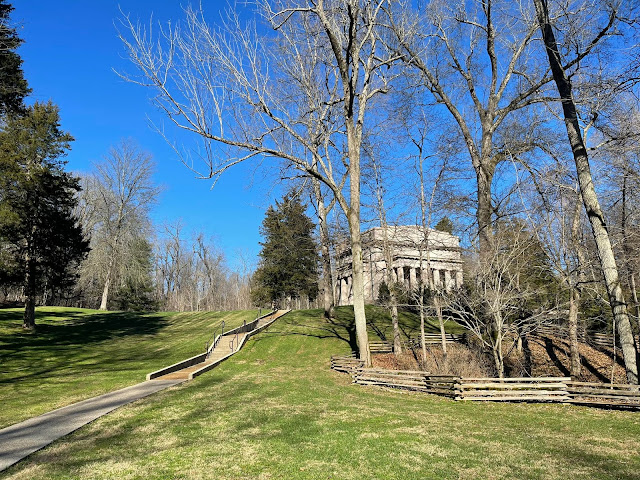 |
| The spring (right) is below the memorial. |
— Have something to add (or correct) in this post? E-mail me here.
Saturday, April 24, 2021
Fun with Lincoln: But can this also be done with hardtack?

Spotted in Sharpsburg, Md., in the home of an Abraham Lincoln fanatic: a framed Oreo cookie with an icing topping of the profile of you-know-who. This was the highlight of my recent Power Tour of the Eastern Theater. Let's keep history alive. 😁
Sunday, December 23, 2018
On Christmas Day 1862, an epic feast for wounded, ill soldiers
 |
| A ward in Washington's Armory Square Hospital, where a Christmas dinner was held for patients in 1862. (Library of Congress) |
On Christmas Day 1862, a grateful nation showed its appreciation for the sacrifices of the U.S. Army with dinners for thousands of sick and wounded soldiers in military hospitals in and near the nation's capital. President Lincoln and the first lady attended the event — one of the more extraordinary of its kind during the Civil War.
"Nowhere else in the world than in America," a New York newspaper wrote, "could have been the sight which has made this holiday in Washington remarkable and memorable — the banqueting of 35,000 wounded and sick soldiers upon a Christmas dinner, spread by the hands of individual benevolence."
Financial contributions for the event — organized by Elizabeth Smith, wife of the Secretary of the Interior — poured in from individuals, businesses, states and elsewhere. (Indiana contributed $700 while Philadelphia collected $2,500.)
"[T]he whole was prepared in a style to please the most epicurean taste," a newspaper wrote about the fare served at College Hospital in Georgetown. Topped with flowers, a pyramid of seven large cakes stood near the door of the hospital near the Potomac River. Desert included ice cream for at least one dinner.
Volunteers decorated hospitals with patriotic touches.
At Dumbarton Hospital, patients found red, white and blue ribbons displayed in "lavish profusion" and the motto "Union" prominently displayed. At Presbyterian Church Hospital, crossed muskets on each side of the altar gave the room "somewhat of a military appearance." A large American flag "gracefully festooned" another part of the room. "Union" and "Constitution" formed in cedar twigs appeared beneath it. Mini-national flags decorated the Finley Hospital dining hall.
Apparently with no regard for soldiers' suffering, senators, congressmen and members of President Lincoln's cabinet "made speeches happily fit for the occasion." Then they mingled with soldiers. Entertainers serenaded soldiers with songs of home or country. At Stone Hospital, music by a glee club of patients enlivened the dinner.
Abraham and Mary Lincoln visited at least two hospitals.
As Lincoln was about to depart Judiciary Square Hospital, a short carriage ride from the White House, an elderly gentleman approached the president. "Notwithstanding your extensive public duties," the man told the president, "you managed to hold your own."
"Yes," the tall and lanky president replied with a laugh, "but I have not got much to hold."
Volunteer waiters eagerly served wounded warriors. They first fed soldiers too injured or sickly to be moved to a dinner table. "The feasting of this army," according to an account, "was a touching sight."
At 2 p.m., volunteers served Christmas dinner at the Contraband Camp at 12th and Q streets, the temporary home of about 500 escaped slaves and other African Americans. The feast included turkey, chicken, roast beef, boiled ham, vegetables and candy, mostly contributed by Mary Lincoln. Afterward, each child received a toy. Earlier that morning, volunteers distributed clothing to grateful adults and children.
Soon after the Christmas dinner, soldiers and others sought contributions to buy Elizabeth Smith a "magnificent present" for her excellent work. They quickly raised several hundred dollars.
 |
| Elizabeth Smith, wife of President Lincoln's Secretary of the Interior, was a driving force behind the Christmas Day dinner for soldiers. (Lincoln Financial Foundation Collection) |
"A grand Christian event," a newspaper called the dinner, greatly aided by contributions from other "noble ladies."
Food came from throughout the Union. Pennsylvania and Maryland shipped an "immense amount" of poultry. "Ever-generous" Albany, N.Y., provided 300 turkeys, "cooked and ready to eat." Four carloads of poultry arrived from Chicago. Volunteers served the feasts in hospital wards decorated with Christmas trees, evergreens, green holly, crimson berries, wreaths and red roses.
Food came from throughout the Union. Pennsylvania and Maryland shipped an "immense amount" of poultry. "Ever-generous" Albany, N.Y., provided 300 turkeys, "cooked and ready to eat." Four carloads of poultry arrived from Chicago. Volunteers served the feasts in hospital wards decorated with Christmas trees, evergreens, green holly, crimson berries, wreaths and red roses.
"[T]he whole was prepared in a style to please the most epicurean taste," a newspaper wrote about the fare served at College Hospital in Georgetown. Topped with flowers, a pyramid of seven large cakes stood near the door of the hospital near the Potomac River. Desert included ice cream for at least one dinner.
Volunteers decorated hospitals with patriotic touches.
At Dumbarton Hospital, patients found red, white and blue ribbons displayed in "lavish profusion" and the motto "Union" prominently displayed. At Presbyterian Church Hospital, crossed muskets on each side of the altar gave the room "somewhat of a military appearance." A large American flag "gracefully festooned" another part of the room. "Union" and "Constitution" formed in cedar twigs appeared beneath it. Mini-national flags decorated the Finley Hospital dining hall.
 |
| President Lincoln visited military hospitals in Washington with his wife on Christmas Day 1862. (Library of Congress) |
Abraham and Mary Lincoln visited at least two hospitals.
"In one or two the President found time to bring excitement and sunshine with him among the bandage and becrutched revelers," according to a newspaper account. "Mrs. Secretary Smith," the event's organizer, visited at least a half-dozen hospitals.
At Judiciary Square Hospital, which accommodated 500 patients, attendees took in an impressive scene. In the dining hall, portraits of George Washington and Secretary of the Interior Caleb Blood Smith looked down from the walls. "Merry Christmas" in blue letters appeared on a large banner. "The Union must and shall be preserved," read another sign near the dinner table, which was "furnished in a style of actual magnificence." Stacks of chickens and turkeys formed "perfect" pyramids — one of the gobblers reportedly weighed 25 pounds. The fare also consisted of roast beef, mutton, hams, oysters, chickens, "side dishes of all sorts" and pies.
At Judiciary Square Hospital, which accommodated 500 patients, attendees took in an impressive scene. In the dining hall, portraits of George Washington and Secretary of the Interior Caleb Blood Smith looked down from the walls. "Merry Christmas" in blue letters appeared on a large banner. "The Union must and shall be preserved," read another sign near the dinner table, which was "furnished in a style of actual magnificence." Stacks of chickens and turkeys formed "perfect" pyramids — one of the gobblers reportedly weighed 25 pounds. The fare also consisted of roast beef, mutton, hams, oysters, chickens, "side dishes of all sorts" and pies.
As Lincoln was about to depart Judiciary Square Hospital, a short carriage ride from the White House, an elderly gentleman approached the president. "Notwithstanding your extensive public duties," the man told the president, "you managed to hold your own."
"Yes," the tall and lanky president replied with a laugh, "but I have not got much to hold."
Volunteer waiters eagerly served wounded warriors. They first fed soldiers too injured or sickly to be moved to a dinner table. "The feasting of this army," according to an account, "was a touching sight."
 |
| Only 100 of the 280 patients were well enough to eat at the dinner tables at Douglas Hospital in Washington on Christmas Day 1862. This is an undated wartime image. (U.S. Military Institute) |
In two editions after Christmas, the Evening Star of Washington published detailed, hospital-by-hospital reports of the festivities:
- At Trinity Church Hospital, a small Christmas tree rested on each of the four tables in the dining area. The smell of flowers and cedar filled the air, and an organist played The Star-Spangled Banner and Gloria In Excelsis, surely inspirational songs for all in attendance.
- At Stanton Hospital, wives of Indiana's two senators supervised the dinners. "They had the assistance of a large number of other ladies, whose beauty and smiles were enough to gladden the hearts of the brave men who are amongst the unfortunate of those who have volunteered to sustain the nation and its honor," a newspaper reported.
- At Douglas Hospital, only 100 of the 280 patients were well enough to eat at the dinner table. Wounded from the Battle of Fredericksburg, fought two weeks earlier, had arrived there only recently.
- At Emory Hospital, the 1st Michigan Cavalry band played "eloquent music," and the sick and wounded who couldn't eat at the table enjoyed food "bounteously supplied by the ladies — those angels of mercy who ever to delight to soothe the sufferings of our honored soldiers."
- At Camp Parole in Alexandria, Va., across the Potomac River from Washington, nearly 15,000 convalescents and paroled prisoners were served. A toast to the men and women who provided the meal drew a warm response.
- At Union Chapel Hospital, those at the gathering asked Dr. Joseph Hubbard of the National Observatory to speak. Apparently uncomfortable as a public speaker, he refused. "Doctor," the patients shouted, "tell us about the stars!” He complied.
- At Fourth Presbyterian Church Hospital, 50 of the 150 patients could not leave their beds. Every sick and wounded patriot, however, received a pint of ale. So, too, did each of the 500 patients at Finley Hospital. Christmas cheer, indeed.
 |
| At Convalescent Camp, near Alexandria, Va., the Christmas Day dinner was delivered late. (Library of Congress) |
Not all the dinners went smoothly, unsurprising given the scale of the event. At Convalescent Camp, near Alexandria, soldiers did not eat until late in the evening because the late delivery of food. And at Armory Square Hospital, tables in the wards were "devoid of all attractive embellishment." Worse, hospital attendants and nurses, who ate off "china plates," received their meals first.
The "invalid soldiers were obliged to wait until a long while after before they were supplied," the Evening Star reported, "and then the dinner was served to them on tin plates, and in such a manner as to convey with it no pleasing thoughts whatsoever." (Surgeons, attendants, clerks, wardmasters and others at the hospital complained the account was fake news, but the newspaper stuck by the story.)
 |
| Mary Lincoln, the president's wife, contributed food for the dinner at the Contraband Camp on Christmas Day. |
Soon after the Christmas dinner, soldiers and others sought contributions to buy Elizabeth Smith a "magnificent present" for her excellent work. They quickly raised several hundred dollars.
Newspapers touted the event. The Evening Star called it “a bright day for all,” a rare moment when generosity briefly eclipsed the war’s misery.
And the National Republican understood why it mattered: “This war,” it wrote, “will develop a great many manly, Christian and noble qualities in our people that the times of peace can never bring out.”
For thousands of wounded and ill soldiers — and for the volunteers who made the dinners possible — Christmas Day 1862 proved it.
- New York Tribune, Dec. 26, 1862
- The Evening Star, Washington, D.C., Dec. 26, 27, 1862
- The National Republican, Washington, D.C., Dec. 15 and 25, 1862
- The Pittsburgh Gazette, Dec. 24, 1862
- Washington Evening Star, Dec. 27, 1862
Saturday, September 15, 2018
Antietam Q&A: In 'A Fierce Glory,' Lincoln takes center stage
 |
| President Lincoln during a visit with General George McClellan near the Antietam battlefield in early October 1862. (Alexander Gardner | Library of Congress) CLICK ON IMAGES TO ENLARGE. |
Like this blog on Facebook | Read more Q&As on my blog here.
 |
| Released Sept. 11, 2018, Justin Martin's A Fierce Glory is available on amazon.com and elsewhere. |
And then the Union soldiers emerged from the corn. Rise up. Rise up, commanded Colonel Douglass. From the furrow, a wall of Rebels suddenly became visible. They loosed a terrifying unison volley, hundreds of bullets traveling in a tight synchronized constellation streaked across 200 yards in an eye-twitch, smack into the Union line. Hot metal ripped into the soldiers. The soft lead of the bullets expanded on contact, shattering bones and slicing through sinew. "The volley made them stagger and hesitate," Gordon Bradwell," a private with the 31st Georgia, would recall.Unlike other Antietam books, Abraham Lincoln -- featured in a cool, colorized version of a black-and-white image on the cover of A Fierce Glory -- is deeply embedded in the narrative. For Lincoln, Antietam may have been the most consequential battle of all. On Sept. 22, 1862, five days after fighting in Sharpsburg ended, the president issued the preliminary Emancipation Proclamation, formally alerting the Confederacy of his intention to free slaves in rebellious states.
In crafting his fifth book, Martin used music as creative aid. (But never while writing.) His theme song for A Fierce Glory (Da Capo Press) was Bob Dylan's One More Cup of Coffee. "It seems fitting," the 53-year-old Kansas City native told me. "It has an old-timey mood, but I suspect he isn't referring to Antietam."
When he's not enjoying time with his wife and twin sons, Martin may be found tending to his postage-stamp-sized garden in the backyard of his house in Queens, N.Y. The avid gardener says he had a banner year for tomatoes and morning glories, but his first crack at edible flowers was a bust. Martin is a huge fan of the Kansas City Royals, New York Jets, Tottenham Hotspur, The Red Badge of Courage by Stephen Crane --- and ice cream at a store in a certain Western Maryland town. (Read on.)
In the following Q&A, Martin explains why he chose to write a book about Antietam, briefly details his research process, identifies his favorite spot on the battlefield and provides a two-word assessment of Little Mac's performance nearly 156 years ago. (You may be shocked!)
 |
| A Fierce Glory author Justin Martin (second from left), his mother (far left) and father (center), longtime battlefield guide John Schildt (third from left) and Martin's aunt and uncle at the Antietam National Battlefield visitors' center. (Image courtesy Justin Martin) |
Antietam has not been the subject of nearly as many books as Gettysburg. Still, it has been well covered -- by James Murfin (Gleam of the Bayonets), Stephen Sears (Landscape Turned Red) and others. What do you bring that's new?
 |
| Robert E. Lee |
Here’s another difference: Lincoln occupies the heart of my Antietam tale, looming much larger than in a typical military account. Given that the battle was the occasion for the Emancipation Proclamation, seems only fitting for Lincoln and his views on slavery to be woven right into the story.
Meanwhile, I attend to Robert E. Lee as a brilliant military leader, but also as a cruel slaveholder. Past histories of Antietam tend to gloss over the latter issue — if they touch on it at all. But in a battle that would have such a dramatic impact on the fate of slavery, the Confederate commander’s views on the so-called peculiar institution seem relevant and worth exploring.
Describe your research process, and specifically, what percentage do you estimate you were able to do online?
Martin: I read and read, everything I can track down. I visited the New York Public Library, National Archives, and other invaluable repositories of information on the battle.
As for how much research I was able to do online: I’d hazard 50 percent. This is my fifth book, and the percentage has been steadily increasing since my first one in 1989.
Obtaining an old document via the Internet is instant gratification at its finest: While researching the tragic fate of the 7th Maine at Antietam, for example, someone suggested I consult a book called Following the Greek Cross by Thomas Hyde, the regiment’s leader during the battle. It was published in 1894. I Googled the title and a nanosecond later — voila!
 |
| Stephen P. Grove farmhouse, where President Lincoln visited with Confederate and Union wounded. |
Martin: Lincoln was such an inspiring leader. Only six months before Antietam, his 11-year-old son Willie died. This unthinkable loss left Lincoln with such great empathy for the soldiers that fought in the battle, and the terrible price so many paid.
There’s a touching scene, which I recount in my book. Following the battle, Lincoln visited Antietam, a strip of black crepe encircling his stovepipe hat as a symbol of mourning for Willie. The president stopped at the Grove Farm, a hospital where both Union and Rebel wounded were being cared for. Lincoln offered comfort to the Union injured, of course. But then he made a gesture to Rebels, telling them that he “bore them no malice, and could take them by the hand with sympathy and good feeling,” according to a contemporary newspaper account. One by one, Confederates came forward to shake the Union president’s hand. Such humanity: Lincoln was showing a willingness to act as leader for all the people of a fractured nation.
What's commonly misunderstood about the battle?
Martin: I think it’s hard for people to comprehend the sheer mental and physical exhaustion brought on by a battle like Antietam. It must have been sensory overload: deafening sound, minie balls zipping in all directions, cannon shell raining from above. Many of the men fought even while hungry, exhausted, or ill. They were weighed down by gear, yet had to climb hillsides or ford Antietam Creek, often under withering fire.
People always ask: Why didn’t McClellan resume the battle on Sept. 18? Following a day fueled by pure terror and adrenaline, after watching one’s comrades fall dead and wounded, precious few of his men were truly “combat ready,” claims of some historians to the contrary. Same goes for Lee. He didn’t attempt one of his trademark-bold strikes against the Union that day because his army was in even worse shape.
Without giving too much away here, what surprises might the reader find in A Fierce Glory?
Martin: For starters, there was a two-hour lull smack in the middle of the bloodiest day in American history. The fighting pretty much stopped from 1 to 3 PM, while the Federal IX Corps moved into position for its final assault.
 |
| Robert Toombs: Confederate brigadier general redeemed himself at Antietam, Justin Martin says. (Library of Congress) |
Another surprise grew out of my extensive research on Robert Toombs, the man who would be president of the C.S.A. Early in 1861, during the nominating convention in Montgomery, Ala., he got stinking drunk and made a public fool of himself. The nod went to Jeff Davis instead.
At Antietam, Brigadier General Toombs redeemed himself, serving as overall commander of a group of 450 stalwart Georgians who held off 12,500 Federals, delaying their crossing of Antietam Creek for several crucial hours. Ask a Civil War buff “list some Confederate generals at Antietam that come quickly to mind,” and you’re likely to hear Longstreet, Stonewall Jackson, the Hills (A.P. and D.H.), maybe "Neighbor" Jones. But not Toombs. For his inspired leadership during the battle, he deserves to be top of mind.
Thanks, by the way, for not demanding that I give away too many surprises; suffice it to say my book is full of them. That’s due to the wealth of primary sources on Antietam. Depending on one’s focus and sensibilities, a researcher can examine the same documents and cue in on different details. As a consequence, whatever Antietam book follows mine is virtually guaranteed to contain fresh surprises, and I look forward to reading it.
 |
| Terrain played a key role in the fighting at Antietam, Justin Martin and many historians agree. Here's the 16th Connecticut monument, with the undulating ground of the 40-Acre Cornfield in the background. |
Martin: The role the landscape played. In the modern world, it’s possible to destroy a target viewed only at a distance, perhaps even relying on a satellite image.
But Antietam was on such an intimate scale. Soldiers regularly traded volleys over the length of a football field. Terrifying! Every feature of this humble farming community came into play: fences, barns, stands of trees and country lanes. All had potential to serve as hiding spots, or as impediments to the enemy. Everything was consequential, even a seeming quirk like the fact that Farmer Miller’s cornfield was as-yet unharvested, the stalks standing taller than a man. Had his crop been in stubble, the Bloody Cornfield — that notorious deathtrap — wouldn’t have figured in the battle.
 |
| Bloody Lane, the sunken road where scores of Confederate dead lay on Sept. 17, 1862. |
In researching the book, you walked the ground at Antietam -- the West Woods, Bloody Lane, the 40-Acre Cornfield. Describe the experience. And what's your favorite place on the field and why?
Martin: I did my research in stages, focusing on different parts of the action: The Bloody Lane, as you mention, or the West Woods. I’d read up in my home office in Queens, New York, and then I’d make a trip to Sharpsburg.
 |
| Here's how to contribute to the Save Historic Antietam Foundation: Donate | Mission | More |
I should mention here that on every visit, I arranged for a tour with an Antietam guide. The first time, I called the main office and said, “Do you have a guide that can give me a tour focused exclusively on the Cornfield action?” I figured this might be a bizarrely specific request, but they set it right up, no problem. The guides really know their stuff and have the best stories. I couldn’t have written this book without their help.
As for my favorite spot: Burnside Bridge. Here’s this beautiful stone bridge spanning Antietam Creek, woods to both sides. I always like to end my visits with a stop there, regardless of what part of the field has served as my day’s focus. I’m drawn by the tranquility of the spot, to be honest. Because this site is so well preserved, seemingly unchanged by the passage of time, it’s also very easy — if one so chooses — to conjure the scene on that single long-ago day when it wasn’t so peaceful.
 |
| Burnside Bridge, Justin Martin's favorite spot on the battlefield. |
If you could go back into time and interview one person from your book -- not including Lincoln or the commanding generals -- whom would that be and why?
Martin: Since you’ve granted me the power of time travel, seems a missed opportunity not to interview McClellan. Although I’ve written books about Walt Whitman and Frederick Law Olmsted, Little Mac has the honor of being the most complex character I’ve ever grappled with. I have about a thousand questions I’d like to ask him.
But your house, your rules: If I had the chance to interview someone besides a commanding general, I would choose Private Roland Bowen, Company H, 15th Massachusetts. During my research, I thoroughly enjoyed his vivid published diary, From Ball’s Bluff to Gettysburg … And Beyond. He was a colorful character, and very insightful. Describing his quick retreat from the West Woods massacre, he wrote: “No God Damned Southerner is a going to catch me unless he can run 29 miles an hour.” The perspective of foot soldiers often gets lost in history. I’d bring Pvt. Bowen a Coke (an exotic treat from the future), and we’d talk for hours.
Fill in the blank: At Antietam, George McClellan was ________________.
Martin: Uncharacteristically effective.
Finally, did you grab an ice cream at Nutter's in Sharpsburg?
Martin: Every single visit — even in February.
-- Have something to add (or correct) in this post? E-mail me here.
Friday, October 27, 2017
For Charleston TinTypist, work-of-art photography isn't a snap
 |
| Christine Eadie, the Charleston TinTypist, explains the old-time photographic process. (CLICK ON IMAGE TO ENLARGE.) |
 |
| Before the tintype is "fixed," it appears as a negative. |
 |
| Eadie "fixes" the image, turning it from a negative to a positive. |
 |
| Eadie's nearly complete image of Center For Civil War Photography Image of War attendees. |
On an unseasonably hot October afternoon in Charleston, S.C., 60 Center For Civil War Photography Image of War seminar attendees gathered in the shade of a huge tree next to the historic Old Exchange. Twenty feet away, Christine Eadie pulled the cap on her vintage wooden camera for about three seconds, exposing an aluminum plate coated with collodion and silver nitrate.
Then the real magic began.
Eadie, the Charleston TinTypist, hustled over a cobblestone street a short distance to her portable darkroom, where she developed the plate in a bath of chemicals. As the image of the CCWP group slowly appeared on the plate as a negative, she washed off the developer using distilled water, stopping the development.
When Eadie brought the plate out of the darkroom, she "fixed" the photograph, turning it from a negative to a positive image before our eyes. Once the plate was dry, she varnished it to seal it and protect it from the air. (For an in-depth take on Eadie's process, go to her web site here.)
For the Charleston TinTypist, the photograph was one of her biggest challenges -- the Australia-born artist, who has been shooting tintypes since 2013, had never created a single image of so many people. But the final product dazzled at least one amateur photographer, who prefers an iPhone and picmonkey to create his "tintypes." It takes 35-40 minutes for a work-of-art tintype to be created by Eadie, who recently answered five of my questions about her remarkable craft.
You travel to re-enacting and living history events throughout the Southeast, photographing people at those events. What is that experience like?
 |
| Christine Eadie's finished product, a tintype of five Confederate re-enactors. (SEE MORE IN A GALLERY ON HER WEBSITE.) |
I find it interesting that I am often met with a lot of pre-conceived notions -- people assuming I hadn't done any photography before I got into making tintypes. I was shooting film from the age of 11 and did commercial digital work (portraits, weddings and fashion) before I ever learned how to make tintypes. I've also been exhibiting my artwork in galleries for over 12 years. People seem so surprised when I tell them that. I guess because most Civil War photographers were first reenactors who got into the process that way. I was the opposite.
Of course, there are many challenges involved with doing the wet-plate process at a three-day event in the middle of nowhere. Most people don't realize just how challenging it is. Usually these events are held in a field or at an old battle site. Not only do I have to bring along a portable darkroom -- chemicals, camera, backdrops, props, etc. -- but I have to be as period correct as possible and sleep in a tent and put up a canvas canopy for shade. The chemicals can act a little crazy sometimes in the hot humid summers in the Southeast. I have to put my chemicals on ice in the summer. It's one of the most technically challenging photographic processes in the best of circumstances. Contrary to what some people believe, it is not all that financially rewarding even when you're at the top of the field and going to the biggest events. Many photographers have given up going to reenactments altogether because it's just so much trouble for very little financial gain. I'm going to stick with it for now and see how it goes.
 |
| "... in a roundabout sort of way, I feel as though I have already photographed Lincoln," Eadie says. (Library of Congress) |
Eadie: I'd probably be extremely nervous about photographing a real president. I'd look at other portraits that had been made of him before and try to do something a little different. I did photograph a man who does a very good Lincoln impression. He has been reenacting for many years. When commissioning me to make his portrait, he said, "I have been photographed by just about every tintype photographer there is who goes to reenactments. Let's see how you do!" No pressure or anything. Of course, I really tried hard to make a great picture for him. Thankfully I must have done a good job because he loved the picture so much he put it on his business card. He came back the following year and had another one made. So in a roundabout sort of way, I feel as though I have already photographed Lincoln.
If you could ask Civil War photographers Alexander Gardner or Mathew Brady questions, what would those be?
Eadie: Honestly, I'd probably be more interested in checking out their set up and look at their gear! Based on what I'd see, I'd probably ask boring technical questions. I would ask them for any advice they could offer.
 |
| "It would pain me to see these soldiers and their wounds in real life," Eadie says. (Soldier image from National Museum of Health and Medicine) |
Eadie: I haven't really thought about that before. Had I been offered that commission, I probably would have turned it down because it would upset me to see the wounds. I am very squeamish. It would pain me to see these soldiers and their wounds in real life.
Is there a Civil War photograph you especially admire, and why?
Eadie: I admire good photographs no matter when or where they were taken. I have a couple of books of Civil War photography, and I have to admire the technical expertise of some of the photographers. It takes a lot of practice to get to the point of making clear and clean wet-plate images out in the field. I can't really think of any particular photograph that really sticks out in my brain. I prefer portraits in landscape settings or in camps that show how life was back then. The posed portraits are great, too, but you can learn so much more from the more candid pictures of camp scenes. I like it when I see some motion blur from flags waving in the wind or anything out of the ordinary. Photographs that tell a story are my favorite.
Have something to add (or correct) in this post? E-mail me here.
Saturday, September 17, 2016
A visit to Stephen Grove farm, site of Lincoln photos
 |
| The front door of the Stephen Grove farmhouse. |
In early October 1862, the Union Army Fifth Corps—part of George McClellan's "bodyguard," a perturbed President Lincoln called it—camped in the fields surrounding Stephen Grove's impressive, brick farmhouse. On Oct. 3, the president—who had hoped to prod 'Little Mac" into action after Antietam—met with Michigan troops and posed in front of the house with McClellan and other Union Army brass for photographer Alexander Gardner.
More than two weeks after the battle, hundreds of wounded lay in makeshift hospitals or private homes throughout the area. (See here, here and here.) At Grove's farm, Confederates cared for their wounded in the house, barn and yard. They buried their dead, including 28th Georgia Lieutenant Benjamin Brantley, in the woods behind Mount Airy, as Grove's house also was known. Union wounded also were cared for on Stephen and Maria Grove's property.
Surgeons used a rough-hewn table inside the house for operations. An area behind the barn, near a stone fence, became a dumping ground for amputated limbs. Surgeons in both armies shared quarters in Grove's attic, where they "ate together ... drank together, and had a high old time."
Decades after Antietam, a Sharpsburg man named William Blackford, a boy at the time of the battle, told of scores of wounded Confederates at Grove's farm. He remembered a wounded soldier who lay near the kitchen door. The young North Carolinian talked about his mother and complained only of being cold. "Do you suppose that lady in the house would let me come into the kitchen and sit by the fire?" he said. He died the next day.
In 1934, a day after Blackford recounted that story to Fred Cross, the Massachusetts historian visited the Grove farm. When he told Blackford's account to the current "lady of the house," she invited Cross in and showed him the large kitchen fireplace. Then she took him to the parlor, lifted the rug, and pointed to a large bloodstain on the floor—evidence of a Civil War tragedy.
"I have washed and scrubbed that spot again and again until I had I have thought I got it all out," she told Cross, "but as soon as the floor dried that spot would reappear as plain as ever."
NOTE: The Grove farm is private property. Do not trespass.
THEN & NOW of President Lincoln at Grove Farm. Larger version here.
PANORAMA: V Corps of Union army camped in Grove's field in early October 1862.
Pan to the right to see the long lane Lincoln used to reach the farmhouse.
SOURCES:
--Nelson, John H, As Grain Falls Before The Reaper, The Federal Hospital Sites And Identified Federal Casualties at Antietam, Privately published CD, Hagerstown, Md., 2004. (Nelson's outstanding work is the source for the description of the Grove farm's use as a hospital. He cites the source of that information, Stephen P. Grove's granddaughter, as the John Philemon Smith file in the Antietam National Battlefield Visitor's Center Library.)
--Hagerstown (Md.) Daily Mail, March 12, 1934.
-
 |
| The farmhouse was probably built by Philip Grove in 1821. Click here for more information. |
 |
| The farmhouse, privately owned today, is badly in need of repair. |
 |
| Another view of the Stephen P. Grove farmhouse. Private property. Do not trespass. |
Pan to the right to see the long lane Lincoln used to reach the farmhouse.
-- Have something to add, correct? E-mail me at jbankstx@comcast.net
SOURCES:
--Nelson, John H, As Grain Falls Before The Reaper, The Federal Hospital Sites And Identified Federal Casualties at Antietam, Privately published CD, Hagerstown, Md., 2004. (Nelson's outstanding work is the source for the description of the Grove farm's use as a hospital. He cites the source of that information, Stephen P. Grove's granddaughter, as the John Philemon Smith file in the Antietam National Battlefield Visitor's Center Library.)
--Hagerstown (Md.) Daily Mail, March 12, 1934.
-
Saturday, March 22, 2014
Antietam Up Close: President Lincoln visits George McClellan
 |
| Acclaimed photographer Alexander Gardner took this famous image of President Lincoln's meeting with General George McClellan on Oct. 4, 1862. (Library of Congress collection) |
The detail is remarkable in this Alexander Gardner glass-plate image of Abraham Lincoln and General George McClellan, taken during the president's visit near the Antietam battlefield in early October 1862. McClellan's tent was pitched on a hillside overlooking what today is Mills Road, about two miles from Burnside Bridge. (The site was first identified by Antietam expert and historian Dennis Frye.) A small home occupies the present-day site. (Click on all images to enlarge, and click here for the Antietam Up Close series on my blog.)
 |
 |
... on the early fall day, the president wore gloves ...

 |
... and on the ground next to Lincoln lies a trophy of war, one of 39 Rebel flags captured at the Battle of Antietam.
Have something to add (or correct) in this post? E-mail me here.
Subscribe to:
Posts (Atom)