Showing posts with label 1st Connecticut Heavy Artillery. Show all posts

Saturday, July 30, 2016

German private at Petersburg: 'Balls are whistling through ... '

1st Connecticut Heavy Artillery at Fort Richardson in Arlington, Va., in 1863.
Like this blog on Facebook.

On Aug. 12, 1864, four days before he was wounded at the siege of Petersburg (Va.), 20-year-old August Freitag wrote a letter in old German to his parents in Collinsville, Conn. “One must always pay attention and make sure that the ink jar is not taken out of his hand by a bombshell,” wrote the soldier, who also went by Earnest, “because, large or small, the balls are whistling through here day and night.”

A private, Freitag died of his wounds August 26 at a hospital at Fortress Monroe, Va.,  only nine months after German immigrants Henry and Rosa Freitag went with their son to Hartford for his enlistment in the 1st Connecticut Heavy Artillery.

I found Freitag's letter in pension records in National Archives in Washington early last year, and posted it to Facebook when I returned home. Thanks to Facebook readers, the three-page letter, a brief window into the world of a young soldier, was quickly translated.

Freitag's name appears on a bronze plaque on a Civil War memorial in Collinsville among the names of 37 other Union soldiers whose remains lie in unknown graves in the South.

(Is the translation of Freitag's letter below correct? Do you have more information on the private? E-mail me here.)


Near Petersburg, 
August 12 1864

We were paid on the day which I have written to you about and yesterday on the 11th, I put $70 in a convert and entrusted it to our Lieutenant like all of the others. He is wounded in the arm and is going home for a vacation. If the money is not delivered to you, then you will have to ask at the post office or the delivery man.

I have so much news to write to you about but when I start to write, I forget it; first, it is difficult to write while under a tree, on the ground or on one knee, and second, one must always pay attention and make sure that the ink jar is not taken out of his hand by a bombshell, because, large or small, the balls are whistling through here day and night. Monday, a ship here at the landing blew up. It was heavily loaded with powder and shells, also Adams Express officer was on it. It was from our side and was probably blown up on purpose. It had come directly from Washington.

Converts are not sent any more with stamps because they are worth as much as silver money here on the front. When you have the money, write back to me.

Greetings to mother and my sister, as well as Heinrich.

Adieu…
August

Since I can’t send the letter until tomorrow, I have time to write to you that we have had orders since 8 days to await an air party every minute of the night, that is to say, that our fort would be blown into the air, and then it is up to us to do everything to persevere. Nothing has done like this up until now, since the Generals can’t hit anything with that kind of attack because they are far, far away.

But still, every evening when it gets dark some, including myself, go 1 or 2 miles down the line and then in the morning back to the artillery battery. The others can enjoy the beautiful view from up there, while we are down here, should there be an air party.

Don’t forget to send stamps.

Greetings from August.

Monday, February 17, 2014

Virginia soldiers' cemetery: Enemies in life, together in death

In 1865, photographer William Frank Browne, a former Union soldier, shot this image of a soldiers' cemetery
 at Drewry's Bluff in Virginia. This is the right half of a glass plate.  (Library of Congress Civil War collection)
 Like this blog on Facebook | Follow me on Twitter

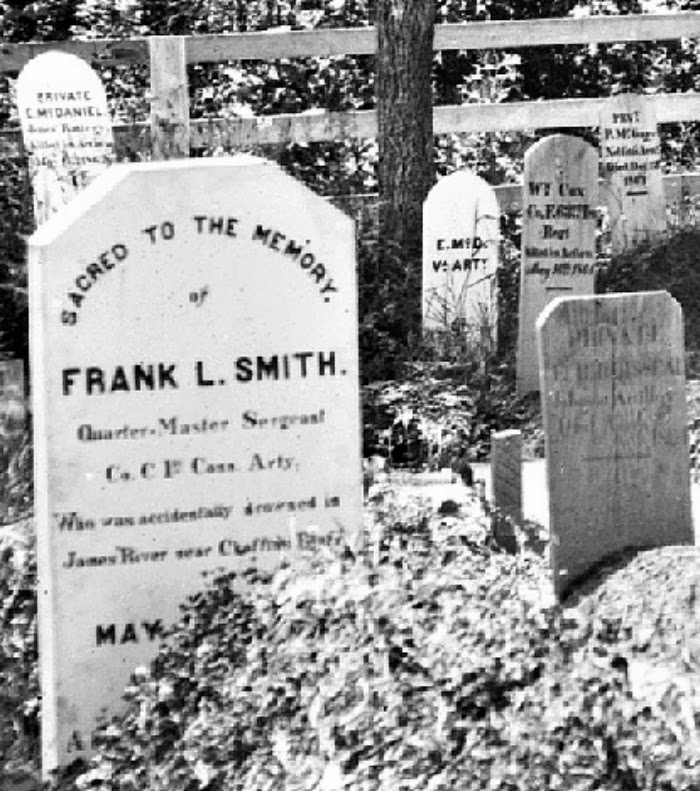
In life, they tried to kill each other. In death, Frank L. Smith of the 1st Connecticut Heavy Artillery and at least six Confederate soldiers were buried together in the same small graveyard next to a woodlot at Drewry's Bluff, near the banks of the James River, seven miles south of Richmond.

Weeks after the Civil War officially ended, photographer William Frank Browne, a former Union soldier, shot the poignant image above of a soldiers cemetery. Perhaps he was drawn by the large, well-marked grave marker for Smith, a quartermaster sergeant who drowned in the James River on May 4, 1865, a little more than three weeks after Lee surrendered to Grant. The 30-year-old soldier's name, rank, company and cause of death were carefully carved or painted onto a marker, and his initials "F.L.S." were etched into a small, wooden footboard.

The grave was only temporary for the soldier from Granby, Conn., who enlisted in the Union Army as a private on May 23, 1862. In a massive post-war Federal effort, the remains of Smith and other Union dead were recovered and re-interred in national cemeteries. Smith's final resting place is in Section A, Plot No. 196 in City Point National Cemetery in Hopewell, Va.

A cenotaph (left) in Silver Street Cemetery in Granville Center, Mass., for Frank Smith; his grave is
at City Point National Cemetery in Hopewell, Va. The date on the  cenotaph notes he died May 3, 1865. 
Other sources denote May 4, 1865. (Cenotaph photo: Dave McCaffrey; City Point photo: Find A Grave.com)
Smith's name appears in this old ledger book of re-burials of Civil War soldiers.
(CLICK IMAGE TO ENLARGE.)
At least 17 gravesites appear in Browne's image at Drewry's Bluff, site of Confederate fort called Fort Darling by the Union. Upon closer inspection, six are Confederate:

An enlargement of the cemetery image reveals
the name of Archer Neill of the 23rd Tennessee

 on a slender wooden headboard. Neill was listed as 
Archibald in the 1850 U.S. census.
Private Archer Neill, 23rd Tennessee: The Civil War rocked the Bedford, Tenn., family of wealthy farmer John Lambert Neill and his wife, Sally. All three of their sons served in the same regiment in the Confederate Army. A private in Company D, John was captured at Petersburg in June 1864 and died in the wretched Union prisoner-of-war camp in Elmira, N.Y., on Nov. 25, 1864. His gravesite is in Woodlawn National Cemetery in Elimira. James, who by the end of the war was promoted to colonel, was wounded at Shiloh on April 7, 1862, and apparently survived the war. Archer, whose given name was Archibald, was killed at the Battle of Drewry's Bluff on May 17, 1864. Only 26 years old, he served in Company D with his brother. (Starting at Drewry's Bluff, tragedy also rocked a family from Connecticut. On May 16, 1864, Lieutenant Edward Wadhams of the 8th Connecticut was killed during an attack on the Rebel fort. Within 18 days, two of his brothers who served in the Union army also had died.)

Private Ebberlee R. Boisseau, Virginia Chesterfield Artillery: He enlisted in Company Epes', Virginia Chesterfield Light Artillery Battery, on Sept. 17, 1861. Boisseau, buried to the right of Quartermaster Smith, was killed at Drewry's Bluff on Aug. 4, 1864.

Private William Cox, 63rd Tennessee: Little is known about Cox, whose date of death appears to be May 1864 on his grave marker, which is just above Boisseau's in the image directly below. Organized in July 1862, the 63rd was comprised of men who lived in Claiborne, Roane, Washington, Knox, Hawkins and Sullivan counties. The regiment fought at Chickamauga before it joined the Army of Northern Virginia in the spring of 1864.

E. McD: Probably E. McDonald or E. McDowell, he served in a Virginia artillery unit.

Private Burwell Orange, 20th Virginia Heavy Artillery: Orange's age -- he was 45 years old in 1860 -- didn't deter him from joining the army. Neither did his family circumstances. According to the 1860 census, Orange, a laborer, had a 28-year-old wife named Ann and three children: Silman, 4;  William Edward, 2; and Eliza, 1. From Buford Depot in western Virginia, Burwell and his brother Edward enlisted Feb. 25, 1862, and both served in Company C of Jones' Artillery. Burwell was killed during an attack by Union gunboats at Drewry's Bluff on May 15, 1862.

Private E. McDaniel:  Upon close inspection, the grave for this soldier noted that he served in Jones' Artillery, the same unit in which Orange served. An E. McDaniel,  a 21-year-old private in the 22nd North Carolina, died of disease in Richmond on May 18, 1862, but it's unlikely he was buried near Drewry's Bluff.

In 1893. Confederates who were buried at Drewry's Bluff were disinterred and re-buried in Hollywood Cemetery in Richmond. Perhaps the Confederates mentioned in this post are among them.

Frank L. Smith's grave was also marked with a foot board that included his initials. 
In this enlargement, the graves of more Rebel soldiers are revealed near Smith's grave. 
Privates Burwell Orange (20th Virginia Heavy Artillery) and E. McDaniel (unit unknown) 
 were buried behind Frank Smith. They served in Jones' Artillery.
Private Ebberlee R. Boisseau of the Virginia Chesterfield Light Artillery was killed 
at Drewry's Bluff on Aug. 4, 1864. He buried to the immediate right of Sergeant Frank Smith.
The enlargement of the background of the cemetery image reveals several buildings,
most likely living quarters for soldiers. (CLICK ON IMAGE TO ENLARGE.)

Have something to add (or correct) in this post? E-mail me here.


SOURCE: Ancestry.com

Monday, December 24, 2012

The Soldier's Funeral: A Civil War poem

Glued to the back cover of a  tattered, old photo album of Connecticut soldiers who died during the Civil War, I found this poem, crinkled and yellowed with age, called "The Soldier's Funeral" by Amelia Cooke. I thought it would be nice to post it tonight with two photos of Connecticut soldiers found in the album and two others, a small tribute to the men who made the ultimate sacrifice so long ago.

 Charles Meigs, a private in the 1st Connecticut Heavy Artillery,
was mustered out on May 21, 1864, but died of consumption less
than a month after the Civil War ended. He's buried in Hartford's

Spring Grove Cemetery. (Photo: Connecticut State Library archives)

With muffled drums and measured tread And arms reversed, they bore the dead From battle’s din and a world of pain When the thread of his life had been snapped in twain

Miles Shepard, a private in the 16th Connecticut, died of pneumonia
at Weverton Hospital, near Harpers Ferry, W.Va., on Nov. 13, 1862.
The final resting place of the soldier from Simsbury, Conn.,

 is unknown. (Photo: Connecticut State Library archives)
CLICK ON IMAGE TO ENLARGE.


His cap, sash, belt, and trusty sword,
(The best beloved of his simple hoard of relics)
Now his coffin crowned: --
They could only be part of the charnel ground.
Though his funeral notes are passing sweet,
From
him they will no rapture meet;
The martial strains may fill the air,
But not disturb the slumberer there.


LEFT: Nathan Hale, a private in the 16th Connecticut, died in Baltimore on
Oct. 12, 1862. He was from Wethersfield. RIGHT: William T. Loomis, a private 

in the 1st Connecticut Heavy Artillery from Torrington, died in a railroad 
accident on Jan. 28, 1863. (Photos: Connecticut State Library archives)

Play on, play on – he sleeps too well
To hear the music’s melodious swell
Or the trampling of feet upon the ground;
He’ll not wake till the last trumpet’s sound.

When the prayer was said, and requiem played;
In the bosom of earth the warrior laid,
About the spot the soldier pressed,
Where the bones of their comrade were put to rest,

And eyes grew dim, and tongues were mute,
As they fired their thrice farewell salute,
That meed was his due and
they paid the "brave,"
And then left him alone in his soldier grave


Amasa Norton, a private in the 11th Connecticut from Stafford, died
on Jan. 3, 1863 at Fredericksburg, Va., probably of disease.
He is buried in Stafford Street Cemetery in Stafford, Conn.

Friday, November 30, 2012

Connecticut's Photographic 'Album of the Dead'


Left: Captain Charles Tennant of the 16th Connecticut was mortally wounded in battle
near Suffolk, Va., in 1864. Captain Henry C. Smith of the 20th Connecticut was

 killed by a falling tree. (Photos: Connecticut State Library archive)
CLICK ON IMAGE TO ENLARGE.
Private William T. Loomis died a gruesome death, crushed by railroad cars near Alexandria, Va.

Private Charles Comstock met his demise on the Washington turnpike, shot by a civilian "residing near the road."

Captain Charles Tennant and Lieutenant Charles Greenleaf were mortally wounded in battle, each dying far from their homes in Hartford.

Sergeant George H. Marsh was killed by the concussion of a Rebel artillery shell.

Captain Henry C. Smith was the victim of a falling tree.

Photographs of each of these soldiers appear in a small, fragile Civil War-era album, its front cover barely attached, found in the Connecticut State Library archives. Clearly, this is no ordinary family photo album. Rather, it's an “Album Of The Dead” -- an effort by its long-ago owner, whose name is lost to history, to memorialize a few of the more than 5,000 soldiers from Connecticut who died during the Civil War. A short newspaper account of each man's demise is pasted under many of the images, mostly carte de visites. Poems about death and remembrance are glued inside the front and back covers.

Oh comrades dead, whose spirits bright
Are gazing from the skies above
You've bravely done your deeds of might
Gaze down upon your work of love
The millions, whom ye freedom gave,
Hold equal rights eternal lease;
The land that you have died to save
Rests in the glorious light of peace
Comrades, each year these graves will still increase
And every year our numbers will be less
Until in distant times, with tottering knees,
The last survivors, bent with age's distress
Will throw a handful of the springday flowers
Upon our graves -- while yet they may --
But the memory of these deeds of ours
Will never, never, pass away!

Photos of dead soldiers from Connecticut are found in this tattered, old photo album in the 
Connecticut State Library archives.
During the Civil War, a constant drumbeat of death was reported in Connecticut newspapers, especially the Hartford Courant and Hartford Evening Press. Usually under the headline "Military Items," the Courant published reports of funerals and lengthy lists of the dead and wounded after major battles such as Antietam, Fredericksburg, Gettysburg and Drewry’s Bluff. Connecticut soldiers died of disease, wounds suffered in battle or, in the case of William T. Loomis of Hartford, by accident.

"Young Loomis was an excellent soldier and was much liked by the members of his company," notes the blurb under the album image of the 1st Connecticut Heavy Artillery soldier, who was killed Jan. 28, 1863. Only 23 years old, he was stationed at Fort Blenker, one of the many defensive fortifications ringing Washington.

A little more than four months later, Loomis’ Company A tentmate, Charles Comstock, suffered the same fate. He was killed instantly when he was shot by an Alexandria civilian named Isaac Welburn, who was quickly arrested by military authorities. Whether by accident or malice, the circumstances of Comstock’s death are unknown. “The company have thus been deprived of two of their much loved friends,” the Courant reported, “and fellow soldiers who deeply mourn their loss.” (1)

When the prayer was said, and the requiem played;
In the bosom of earth the warrior laid,
About the spot the soldiers pressed
Where the bones of their comrades were put to rest
And eyes grew dim, and tongues were mute,
As they fired their thrice farewell salute,
That meed was his due, and they paid the "brave,"
And then left him alone in his soldier grave

After he was wounded the right leg in battle near Suffolk, Va., Charles Tennant “expressed a strong desire to see his mother,” who traveled from Hartford to Fortress Monroe  on the southern tip of Virginia peninsula, where her son’s health was rapidly failing. The young man's wound had been probed up to 8 1/2 inches, but the bullet couldn't be found. (2) Tennant, who replaced Samuel Brown as captain of Company D of the 16th Connecticut after Brown was killed at Antietam, died May 24, 1863. His church service in Hartford was so well attended – 50 soldiers arrived on the noon train from Knight Hospital in New Haven -- that many were forced to stand outside.

“There has not been a burial in this city since the war began of one of its heroes,” the Courant reported. “which called out a larger number of people than were attended on this occasion.” (3) Under Tennant’s image in the photo album is a crinkled report, brown with age, of his death. "He was but about 23 years of age,” it notes, “and was a highly esteemed member of the North Baptist church."

Left: Private Charles Comstock of the 1st Connecticut Heavy Artillery was killed
by a civilian near Alexandria, Va. Charles Greenleaf, a lieutenant in the 5th New York
Cavalry, was mortally wounded at Kearneyville, W.Va. He was from Hartford.
(Photos: Connecticut State Library archives)

CLICK ON IMAGE TO ENLARGE.

Enlisting on April 18, 1861, as a private in the 1st Connecticut, Charles Greenleaf was among the first from the state to join the Union army. After his three-month term of service elapsed, he re-enlisted in a cavalry unit and was later transferred to the 5th New York Cavalry, also known as the Ira Harris Guard. Three days after Antietam, Greenleaf viewed the horrors of that battlefield. “On our way here we marched through that part of the field where the right wing fought,” he wrote in a letter home on Sept. 20, 1862. “ I have been in the service a year but I never knew what war meant till to day. All along both sides of the road for two miles dead rebels lay piled up like cord wood. They have lain there two days in the sun and are all bloated.... I was also up to one of the hospitals and saw over a hundred arms and legs in the yard." (4)

A little more than two years later, Greenleaf also became part of the grim Civil War body count. Wounded in a skirmish near Kearneyville, W.Va., the 22-year-old soldier died at U.S. General Hospital in Sandy Hook, Md.., on Aug. 27, 1864. "The funeral of Lieut. Greenleaf will take place from the residence of his father, Henry Greenleaf, on North Main street to-morrow (Sunday) at 1 o'clock," the newspaper account beneath his photo notes.

May heaven spread amaranths over each grave
Or plant these some evergreen tree;
May corals grow round and anemones wave
Where they’re lying down in a deep sea

May billows dash lightly against the lone shore,
And sing a low, mournful refrain;
May flowers of spring-time bloom evermore
And be wet by the tears of the rain

Left: William T. Loomis, a private in the 1st Connecticut Heavy Artillery, was killed in
a railroad accident near Alexandria, Va. George Marsh, a sergeant in the 8th Connecticut,
was killed at the Battle of Antietam on Sept. 17, 1862.
(Photos: Connecticut State Library archives)

CLICK ON IMAGE TO ENLARGE.
If he had to meet his maker, Captain Henry C. Smith, a member of the Hartford Fire Department before the war, probably would have preferred a glorious death in battle. Never in his dreams could the 20th Connecticut soldier have expected what happened to him on Jan. 28, 1863, while camped near Stafford Court House, Va.  A tree fell on him, killing the man whom "everyone with the regiment loved and respected."

"A spirit of gloom was thrown over all by the sudden death of Captain Henry C. Smith of Co. C.," according to a regimental history. "He was a genial companion, a devoted friend, a thorough soldier, and his loss was severely felt by all. ... The best and only tribute which his fellow officers could now pay was to gather up his remains and forward them to his sorrow-stricken wife and children that he might be buried among friends, and not in the land of the stranger." (5)

Ill but determined to fight, George Marsh was resting about sunrise on Sept. 17, 1862, as the 8th Connecticut prepared for battle. Suddenly, Rebel artillery across Antietam Creek lobbed three solid shots into the regiment, wounding four and killing three -- including Marsh.

"He was lying on the ground when a ball entered the ground in front of him and came out of the earth a few feet from where he lay," notes the newspaper account below his photo in the "Album Of The Dead." "The concussion caused his death, as he was not hit by anything."

In late September, Marsh's brother-in-law traveled to the battlefield to retrieve George's remains. Marsh's body arrived back in Hartford on Sept. 30, and a funeral service was held at his father's residence at 77 Main Street at 3 p.m. (6)

"He died a trusty soldier with a spotless reputation," a post-war history noted about Marsh, one of scores of Connecticut victims at the Battle of Antietam. (7)

(1) Hartford Courant, March 9, 1863, Page 2
(2) Hartford Courant, May 23, 1863, Page 2.
(3) Hartford Courant, May 29, 1863, Page 2
(4) Charles Henry Greenleaf letters, Civil War Manuscripts Project, Connecticut Historical Society
(5) The Twentieth Connecticut, A Regiment History, John Whiting Storrs, Ansonia, Conn, Press of the Naugatuck Valley Sentinel, 1888, Page 278
(6) Hartford Courant, Sept. 29, 1862, Page 2
(7) The Military and Civil History of Connecticut: The War of 1861-1865, W.A. Croffut and John M. Morris, Ledyard Bill, New York, 1868

Sunday, March 18, 2012

Brothers: Connecticut's Civil War sacrifice (Cont.)

Brothers John and William Wallace Porter are buried in Green Cemetery in Glastonbury, Conn.
William was mortally wounded at Antietam; John died near Petersburg.

Close-up of the grave of William Porter, a "Christian soldier
 and patriot." He was only 27 years old when he died at a
 Sharpsburg, Md., field hospital. 
The number of Civil War deaths is mind-blogging. At least 620,000 men died, and one scholar believes that figure is way too low. 

Also astounding are the double tragedies many Connecticut families suffered during the war. I have found 13 sets of brothers from the state who died during the war, including one more today during a visit to  ancient Green Cemetery in Glastonbury, about 15 miles southeast of  Hartford. In late November, I wrote about eight sets of brothers who perished during the war, plotting out their hometowns on a map that accompanied the post.

The Historical Society of Glastonbury offers walking tours
 of Green Cemetery.
Glastonbury's William Wallace Porter, a 27-year-old private in Company H of the 16th Connecticut, suffered a severe wound in his left leg at Antietam on Sept. 17, 1862. Twenty-three days, Porter, whose leg was amputated, died in a Sharpsburg-area field hospital.
William's brother, John, a 28-year-old private in Company D of the 1st Connecticut Heavy Artlillery, was killed in battle near Petersburg on Nov. 25, 1864.

According to a diary of a man named Joseph Wright, the Porter brothers' father took his wagon south, retrieved the bodies of both his sons and returned them for burial at Green Cemetery. I'm eager to tap into Wright's diary, part of the Historical Society of Glastonbury collection, for further research on the brothers.

Two weeks ago, Connecticut Civil War researcher Mary Falvey shared with me the stories of two more brothers who died during the war: Hartford's Charles and Lewis Weld. A colonel in the U.S. Colored Troops 41st Infantry, Lewis died of disease on Jan. 9, 1865. Charles, a captain in the U.S. Army 17th Infantry, was mortally wounded at Chancellorsville on May 1, 1863. Both brothers are buried in Old North Cemetery in Hartford.

If you know of other sets of brothers from Connecticut who died during the Civil War, drop me a line. I have a major project I am interested in pursuing on the topic.

Some gravestones at Green Cemetery in Glastonbury, Conn., date to the late 17th century.
Here's a close-up of the interesting top of an old marker.

Saturday, September 17, 2011

Civil War under my nose: Hartford, Conn.

Some guy named Lincoln and Connecticut Civil War governor William Buckingham speak
Saturday at a commemoration ceremony for the Solders and Sailors Memorial Arch in Hartford.
It's not every day that you see a governor, a senator, a U.S. president and a dictator.

Today was one of those days.
Detail of the Soldiers and Sailors
Memorial Arch in Bushnell Park.

On a crisp fall-like morning, the 125th anniversary of the dedication of the Civil War Soldiers and Sailors Memorial Arch in Hartford's Bushnell Park was marked by speeches by Sen. Richard Blumenthal, as well as by impersonators of William Buckingham, Connecticut's Civil War governor, and ol' Honest Abe himself.

I've chugged under the arch several times during Max's O'Hartford 5K runs but never really knew much about its history until today. (Cue the tour guide voice.) The arch commemorates the 4,000 Hartford men who served in the Union army and navy during the Civil War. About 400 of them died, losing their lives in battle in such places as Sharpsburg. Md.,  Cedar Mountain, Va., and Irish Bend., La., or in POW camps such as  Andersonville in Georgia. The memorial was formally dedicated in 1886, 25 years after Antietam -- the bloodiest day in American history and in Connecticut's history as well. The 8th, 11th, 14th and especially the 16th Connecticut Infantry suffered casualties at Antietam.

When the morning sun hits the brownstone just right, the arch is a photographer's dream. Rich hues. Blue sky. Ornate monument details. Ahh, that's nice stuff.

Of course, no Civil War-themed day is complete without checking out a  cannon and a whole bunch of old lead. Several Civil War memorials are located near the gold-domed State Capitol building, a short walk from Bushnell Park. The most intiguing is the First Connecticut Heavy Artillery monument that is topped with a squatty cannon on steroids. Actually a 13-inch seacoast mortar and nicknamed the "Dictator," it was capable of lobbing 200-pound shell several miles. The First Connecticut may have used this one during the sieges of Yorktown and Petersburg, although that's in some dispute.
A rare Civil War relic monument pyramid.

At the Museum of Connecticut History across the street from the capitol building (free admission today!), museum administrator Dean Nelson was kind enough to show me exhibits of guns made in the state during the Civil War. (The Connecticut River Valley supplied a huge number of arms to the Union army.) As a bonus, Nelson took me to a small back room where the museum keeps items currently not on public display --- including Samuel Colt's Civil War uniform (cost to state: $150K) and a rare Antietam relic monument pyramid.

In the years immediately after the war, relic collectors and war veterans made displays of bullets, shrapnel, belt buckles, bayonets and the like to commemorate a battle. Until today, I've only seen one of these highly collectible and rare relics in books or on the Internet. The Horse Soldier, a Gettysburg antiques store, offers a similar Antietam relic monument pyramid for $22,500; Nelson said the one in the museum is probably worth $12,000 to $13,000. I don't think I'll be adding one to my collection anytime soon.

I really needed a Civil War fix today, the 149th anniversary of the Battle of Antietam, so a trip to the Hall of Flags at the State Capitol building was a must. Thanks to terrific -- and costly -- conservation work, Civil War battle flags carried by Connecticut regiments at places such as Gettysburg and Cold Harbor are displayed so the fragile cloth relics won't be damaged further. Most Civil War battle flags in other states are too deteriorated to display.  Kudos to Connecticut for making these unique pieces of history available to the public.

Say hello to my little friend! A 13-inch mortar on the First Connecticut Heavy Artillery
monument on Capitol Street in Hartford. The state capitol building is in the background.

The beautiful Soldiers and Sailors Memorial Arch in Hartford's Bushnell Park.
The arch was dedicated on Sept. 17, 1886 -- 25 years after the Battle of Antietam. 
Regimental flags in the Hall of Flags in the State Capitol building in Hartford.