Showing posts with label 14th Connecticut Infantry. Show all posts

Thursday, June 14, 2012

Help wanted: Antietam graves in Connecticut

Close-up of Theodore DeMars' gravestone.
Theodore DeMars of Cromwell, Conn., was only 19 when he was killed at Antietam.
He is buried in Kelsey Cemetery in Cromwell, Conn.

Antietam casualty listed printed in the
Hartford Courant on Sept. 27, 1862. 

This list continued elsewhere on the page
 and did not include the 14th Connecticut.
(CLICK IMAGE TO ENLARGE.)

For a pretty cool project, I'm aiming to find graves of Connecticut soldiers killed or mortally wounded at the Battle of Antietam who are buried in the state. A little odd, yes, but it beats what these people do.

Using the casualty list from the Sept. 27, 1862 Hartford Courant as a macabre checklist,  I have visited many Antietam graves in Connecticut during the past year and told the heart-rending stories of men such as Captain Newton Manross of Bristol, Lieutenant Marvin Wait of Norwich and Private John Bingham of East Haddam. (Find A Grave also is a terrific resource, by the way.)

Four regiments from Connecticut -- the 8th, 11th, 14th and 16th -- fought in the fields and woodlots outside Sharpsburg, Md., on Sept. 17, 1862. Scores of Connecticut men, including 19-year-old Thomas DeMars of Cromwell, were killed there. A private in Company A of the 16th Connecticut, DeMars is buried (above) in Cromwell's Kelsey Cemetery, once a quiet country graveyard but now airport runway loud thanks to nearby I-91.

Funerals for soldiers were a common occurrence in Connecticut  in the days and weeks after Antietam.  "It is seldom that we are called upon to bury so many braves in so short a space of time," the Hartford Courant noted on Oct. 13, 1862, nearly a month after the battle.

If you can help with my unusual detective work, shoot me an e-mail here.

A penny atop the gravestone of 19-year-old Theodore DeMars, killed at Antietam.

Saturday, January 21, 2012

Faces of the Civil War: Robert Hubbard

"I feel I never could forgive myself if this government should be overthrown,"
Robert Hubbard, a private in the 14th Connecticut,  wrote his brother on Aug. 13, 1862.
Hubbard was killed at Antietam about a month later.  (Photo: Middlesex Historical Society)

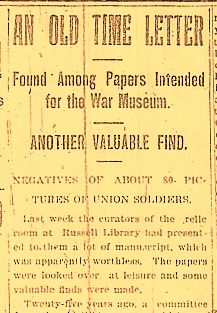
Sifting through donated documents originally thought to be worthless, curators at the Middletown (Conn.) library more than a century ago discovered a letter from a young Civil War soldier to his brother.

On April 13, 1898, the Middletown (Conn.) Penny Press
reported the discovery of a moving letter
from a Civil War soldier to his brother.  The
current whereabouts of the letter are unknown.
The letter, a reporter for the Middletown Penny Press wrote on April 13, 1898, "should fire the hearts of the younger generation of today with patriotic fire."

Convinced that the cause of  his nation was just, the soldier in Company B of the 14th Connecticut Infantry explained why he enlisted in the Union army a week earlier.

"My mind was made up to take this step," the private wrote on Aug. 13, 1862, "after hearing the President's order for a draft of 300,000 soldiers. A company was nearly full in Middletown at the time and there were several of my acquaintances in it, and everyone says that it is the best, or one of the best, companies that has been raised."

"I don't know if I feel quite as belligerent as I did when the war first broke out, but the time seems to have arrived when everyone who can must leave the plow in the furrow as old Putnum did and go to the battlefield. The prospect is not a very pleasant one, all things considered. The swamps of the Chickahominy and the guerillas of Kentucky, Tennessee and Missouri, not to mention the great Rebel army in the field, are ugly things to look at, and the hardships of a soldier's life I can imagine better than many.

"But necessity is laid upon the young men of the nation, and woe is them if they preserve not the inheritance of their fathers. I am becoming convinced that the secession leaders mean to conquer this nation if the nation does not conquer them, and Oh! Freedom, how can we give that up?"

Close-up of Private Robert Hubbard's marker at
New Farm Hill Cemetery in
Middletown, Conn.
The man concluded his letter to his brother Josiah with these words:

"I feel as if I could not forgive myself if this government should be overthrown and I had no weapon in its defense."

A little more than a month later, letter writer Robert Hubbard, an adventurous spirit from Middletown, was killed at Antietam, one of many soldiers from the state who died on the bloodiest day in American history. Hubbard, who sought his fortune in California during the gold rush of the 1850s, died on William Roulette's farm, "shot by the careless handling of a rifle by a member of his own company" during the chaos of battle. (1)

Afterward, Hubbard apparently was buried near the corn crib by Roulette's barn, one of at least 700 soldiers from both sides buried on the farmer's property.

Weeks after his death, Hubbard's family back in Middletown contacted Roulette about arranging for the return of their loved one's body to Connecticut for re-burial. Roulette, whose property was ruined during the battle, suffered his own tragedy in the weeks after Antietam. His 20-month-old daughter Carrie May, who was just learning how to talk, died of typhoid fever, perhaps spread by the many wounded soldiers cared for in the Sharpsburg, Md., area.

Robert Hubbard, a private in the 14th Connecticut who was killed at Antietam, may
have been buried near the corn crib of the barn on  William Roulette's farm.
Longtime Civil War relic hunter Richard Clem of Hagerstown, Md. discovered a letter Roulette wrote the Hubbards on New Year's Eve 1862:

Dear Friends
I have received your draft of $70.00 and have forwarded the remains of your brother by express as you expressed by the dispatch. I did not buy the coffin from the undertaker as I wrote to you. I bought it from the cabinet maker at first cost which saved $15.00 for practically the same kind of coffin. The freight by express was $30.00, the dispatch was $1.15 for disinterring the body and delivering it to the depot at Hagerstown the distance of 13-miles making all the expense $55.00 and I enclose your $15.00 makes in all.

Hubbard, killed by friendly fire at Antietam on Sept. 17, 1862, was
re-buried in this cemetery in Middletown, Conn., on Jan. 6, 1863.
Added Roulette:

"Allow me to introduce to you my family, wife and 5 children, 2 girls and 3 boys of which the oldest Ann Elizabeth 13-years-old. Our youngest died since the battle -- a charming little girl 20-months-old Carrie May just beginning to talk. The battle caused considerable destruction of property here. My nearest neighbor [Samuel Mumma] lost his house and barn to fire. I lost valuable horses, some sheep and hogs. Please write as soon as you receive this and inform me whether all is right."

On Jan. 2, 1863, Hubbard's body arrived in Middletown and four days later, a funeral service was held at North Church at 10 a.m. After a scripture was read and "a beautiful piece was sung by the choir, Reverend Taylor spoke of "war as often a necessity." (2)

"The deceased left the peaceful avocations in which he had been engaged for the life of a soldier," the Middletown Constitution reported. "He went because he believed he ought to go, and he met his death as a brave man only can."

At 11:30 a.m., Hubbard's coffin was placed into a hearse and escorted by the Mansfield Guard, a local militia group, the short distance down Main Street to New Farm Hill Cemetery. The son of the late Josiah M. Hubbard was laid to rest in a family plot.

On the 12-foot brownstone marker below Hubbard's name are these still-legible words:

"For whoever will save his life shall lose it and whoever will lose his life for my sake shall save it."

Robert Hubbard was 31 years, 5 months old when he died.

(1) History of the 14th Regiment, Connecticut Vol. Infantry, Charles D. Page, 1906 , Page 44

(2) Middletown Constitution, Jan. 6, 1863

Robert Hubbard is buried in a family plot that includes his brother, Josiah,
who served in the 11th Kansas Cavalry. Josiah survived the war.

Crossed swords and a shield adorn Robert Hubbard's marker.

Wednesday, November 09, 2011

A Connecticut soldier's gruesome Antietam death

In the Chicopee Soldiers Record, handwritten accounts of the Civil War service of 600 men
from Chicopee, Mass., the gruesome cause of Private William P. Ramsdell death
at Antietam is noted. (Click on image to enlarge.)

As the 14th Connecticut was under fire during the Battle of Antietam, William Ramsdell quietly talked about how he preferred a quick death if he were shot. A short time later, he was killed, struck in the back of the head by a fragment of artillery shell.

In reporting a blog post that included an account of  Henry and Samuel Talcott, brothers from Coventry, Conn., who died of wounds suffered at Antietam, I discovered the story of the gruesome -- and unusual -- death of one of their Company D comrades.
Benjamin Hirst (above):  "The first man I
recognized  was W. P. Ramsdell with the
top of  his head blown off." (Company G
14th Regiment  Conn. Volunteer Infantry, Inc
.)

A 28-year-old private, Ramsdell was born in Belchertown, Mass., and apparently lived most of his life in that state. The son of Porter Ramsdell, William, a machinist, enlisted for three years in the 14th Connecticut on July 28, 1862. (1) His residence during the war was Vernon, Conn., about 15 miles northeast of Hartford.

On Sept. 17, 1862 -- a little more than a month after breaking camp in Hartford -- Ramsdell and the 14th Connecticut fought in the farm fields of Samuel Mumma and William Roulette on the outskirts of Sharpsburg, Md. Antietam was the first battle of the Civil War for the 14th Connecticut, which had marched from its camp near Washington only 10 days earlier.

As Company D hugged the ground by a stone wall near a lane on Roulette's farm, a sergeant overheard Ramsdell softly remark "that if he was going to be hit, he would prefer to have the top of his head blown off." (2)

"When midway between the wall and the position assigned to us, I was about the center of Fourteenth Regiment, C. V. Infantry company, urging the boys to close up, when a rebel shell came whizzing by and struck about two files in my rear," Company D Sergeant Benjamin Hirst of Vernon recounted. "As soon as I could turn I saw about a dozen men lying in a heap and the first man I recognized was W. P. Ramsdell with the top of his head blown off."

In this engraving in the Oct. 18, 1862 edition of Frank Leslie's 
Illustrated, a popular newspaper during the Civil War,
 civilians watch as Antietam dead are 
buried near Bloody Lane.
Besides Ramsdell, Company D soldiers Henry Tilley and Russell Griswold were killed by the shell and four others were wounded -- including Henry Talcott of Coventry, who died of his injuries on Nov. 10, 1862.

"Although the bursting of the shell was a great shock to regiment," the regimental history noted, "it closed up and moved on." (3)

I found a corroborating account of the circumstances of Ramsdell's ugly demise in the Chicopee Soldiers Record, a late-19th century compilation of the Civil War experiences of 600 men from Chicopee, Mass. The Chicopee Public Library recently digitized the entire handwitten ledger, a terrific resource for Civil War researchers. Although unclear, Ramsdell, who was single, apparently had ties to Chicopee.

According to the Soldiers Record, a fragment of artillery shell struck the back of Ramsdell's head and "literally tore his head in pieces." Along with his two other dead comrades, Ramsdell was buried on the battlefield -- one of at least 700 soldiers buried on farmer William Roulette's property after Antietam. Soon after the battle, Ramsdell's remains were disinterred and re-buried in Maple Grove Cemetery in Chicopee, Mass. Unfortunately, I could not find his final resting place among the many well-worn and tipped-over markers in the cemetery that dates to 1836.

In an interesting twist, a veteran from the 14th returned to the Roulette farm a few years after the battle and spotted in the ground a piece of artillery shell he believed killed his comrades.  "It does not require much imagination," the 14th Connecticut regimental history noted, "to conclude that this was the same deadly missile." (4)

William Ramsdell is buried in Maple Grove Cemetery in Chicopee, Mass.
(1) Chicopee Soldiers Record, Town of Chicopee, Page 220
(2) History of the Fourteenth Regiment, Connecticut Volunteer Infantry, Charles Davis Page, Pages 43-44, 1906
(3) Ibid, Page 44
(4) Ibid, Page 44

Saturday, November 05, 2011

Faces of the Civil War: Jarvis E. Blinn

Jarvis E. Blinn, a captain in the 14th Connecticut, was killed at Antietam on Sept. 17, 1862.
This is a copy of an albumen. (Courtesy Rocky Hill Historical Society)
Pierced through the heart by a bullet, Jarvis E. Blinn knew it was time to meet his maker.

"I am a dead man!" the 26-year-old captain in the 14th Connecticut Infantry said moments after he was shot during fighting on the Samuel Mumma or William Roulette farms at Antietam on the morning of  Sept. 17, 1862. (1)
Jarvis Blinn is buried in Center Cemetery in Rocky Hill,
Conn., about nine miles from Hartford. Blinn was born in
Rocky Hill on July 28, 1836. He later moved to New Britain.

Barely a month after he enlisted in the Union army, Blinn -- a man who had an "expression of quiet but earnest resolve tinged with a dash of sadness in his air" (2) -- was one of  38 men killed or mortally wounded in the 14th Connecticut on the bloodiest day in American history. A mechanic from New Britain before the war,  Blinn left behind a wife, Alice, and two young children.

Well-liked by his peers, Blinn was unanimously selected captain of Company F on Aug. 15, 1862, one week after he enlisted. After his death, his fellow officers in the 14th Connecticut described him and captain Samuel F. Willard of Madison -- also killed at Antietam --as "two brave and devoted citizen soldiers." In fact, on Sept. 27, 1862, the Hartford Courant printed a resolution submitted by 37 officers in the 14th Connecticut that eloquently praised Blinn and Willard.

"Resolved," the statement written on Sept. 20 from a camp near Sharpsburg, Md., began. "That we, their fellow officers and comrades in battle, are doing but bare justice to the memory of these brave and devoted officers, in testifying, in this public manner, to their efficiency in every public and private duty; to their earnestness and zeal in the patriotic cause for which they drew their swords; to their watchful kindness and care over the soldiers of their respective companies; and to their fraternal courtesy ever manifested in their intercourse with ourselves."

Jarvis Blinn's cracked, well-worn gravestone includes his date and place of death.
A Hartford undertaker named W.W. Roberts brought Blinn and the bodies of seven other soldiers killed at Antietam back to Connecticut in the second week of  October. (3) His funeral was held at Center Church in New Britain on Oct. 14, 1862. Afterward, his body was escorted to Rocky Hill, about 10 miles away, in "one of the largest processions ever seen" in New Britain. (4) After a short service at the Congregational Church in Rocky Hill, where he was born, Jarvis E. Blinn was buried in Center Cemetery, about a quarter-mile from the church.

Today, he lies there under a cracked, well-worn tombstone, the date and place of  his death still easily seen on the marker.

After a funeral service in New Britain, where Blinn resided, another service was held for him at the
Congregational Church in Rocky Hill, where he was born. Afterward, he was buried in
Center Cemetery, about a quarter-mile away. The church was built in 1808.
(1) Memorial of Deceased Officers in the Fourteenth Regiment Connecticut Volunteers, Henry P. Goddard, 1872, Page 7
(2) History of the Fourteenth Regiment, Connecticut Volunteer Infantry, Charles Davis Page, Page 51, 1906
(3) Hartford Courant, Oct. 11, 1862, Page 2
(4) Memorial of Deceased Officers in the Fourteenth Regiment Connecticut Volunteers, Henry P. Goddard,  1872, Page 7