|
Howard Pyle's famous painting of the charge of the 5th and 9th Minnesota at Nashville
on Dec. 16, 1864. The mural hangs in the Governor's Reception Room
of the Minnesota State Capitol building in St. Paul. | READ MORE. |
 |
A present-day view from Harding Place Road shows a view similar to Pyle's
early 20th-century vantage point. Shy's Hill looms in the background.
(CLICK ON IMAGE TO ENLARGE.) |
With Shy's Hill -- the left anchor of John Bell Hood's Army of Tennessee -- partially obscured by battle smoke, determined Midwesterners lean into the fighting near Granny White Pike in countryside south of Nashville. In the foreground, Pyle shows a U.S. Army soldier, his forehead wrapped in a blood-soaked, white cloth, approaching a patch of ice-covered ground amidst trampled cornstalks. At least two wounded Federals flail backward in the mass of frenzied soldiers while the regiments' tattered colors flap in a storm of Confederate lead.
 |
Artist Howard Pyle, who died in 1911,
painted the Battle of Nashville
scene in 1906. |
What drama in this 1906 painting!
In the charge of the 5th and 9th Minnesota through a muddy cornfield, Colonel Lucius F. Hubbard, the 28-year-old, New York-born commander of the II Brigade, suffered a bullet wound in the neck and had a horse shot out from under him and another wounded. The colors of the 5th Minnesota were shot down four times.
"My line of advance lay across a corn-field, through every foot of which the men were exposed to a direct fire from the line of works in front and a cross-fire on either flank,"
wrote Hubbard in his after-action report. "My line was no sooner in motion than it was met by a most withering volley, and as the regiments struggled on through the muddy field, softened by the recent rain, their ranks were sadly decimated by the continuous fire they encountered." (Hubbard was depicted by Pyle astride his horse, at the far right of the painting.)
In all, Minnesota's four regiments at Nashville suffered nearly 90 killed on Dec. 15-16, 1864 -- the deadliest battle of the war for the state.
Pyle,
a gifted artist who died in 1911, probably would be shocked if he were to walk the hallowed ground today. Heavily trafficked Harding Place Road slices through the heart of the battlefield he depicted. Beside busy Granny White Pike, a historical marker notes the fighting, but few stop to read it. The cornfield through which the Minnesotans charged in 1864, well, that's a residential neighborhood that includes a recently constructed private school. Nearby, a mansion about the size of a small college dorm nears completion.
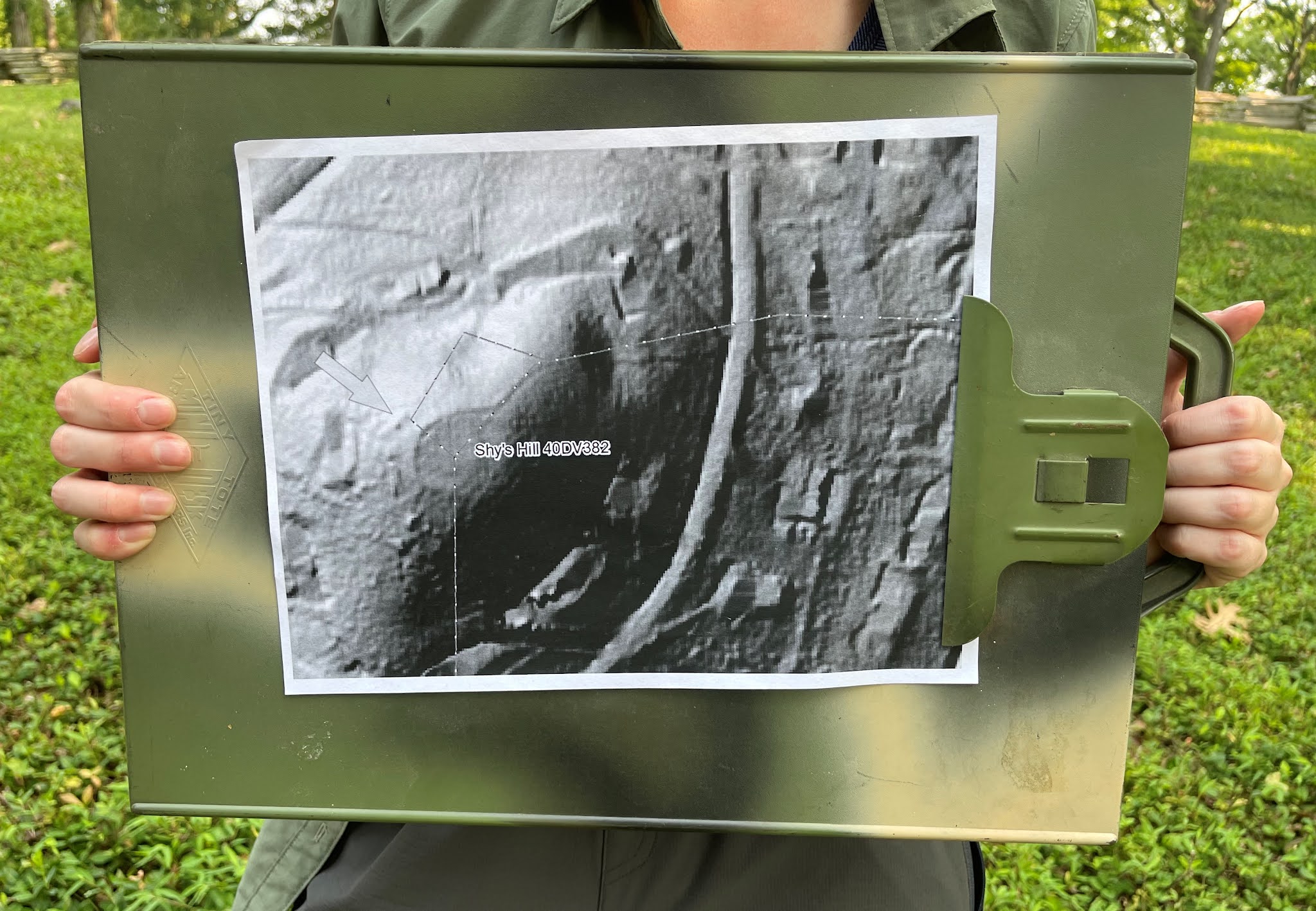
Even heartrate-raising Shy's Hill, where 20th Tennessee Colonel Bill Shy was killed by a point-blank headshot, was long ago covered with houses. Cloaked in leaves during a recent visit, a small section of the hill is preserved. The Battle of Nashville Trust will hold a wreath-laying ceremony there on the 156th anniversary of the fighting. Perhaps there will be a whiskey-fueled toast or two, in honor of the men who fought there.
It's hard to wrap your head around this place. How could a neighborhood be built atop hallowed ground, site of so much pain and suffering on both sides? Didn't they know about the Civil War stories that lurk here?
Battle of Nashville Trust president Jim Kay explains the charge of the Minnesotans.
EXPLORE GOOGLE STREET VIEW: The 5th and 9th Minnesota, part of the II Brigade, attacked from right to left during the Battle of Nashville on Dec. 16, 1864.
In the epic charge of Minnesotans, German-born Nicholas Augelsberg, a private in his early 20s, was mortally wounded. His 57-year-old father, Mathias, filed for a dependent's pension in 1866. Mr. Augelsberg was approved to receive the standard $8-a-month pension -- a pittance for his family's sacrifice.
Irish-born Hanley Bartley and German-born John Battles, barely in the Union Army a month, were killed here, too. Were the 5th Minnesota privates wounded near the $1 million-plus dollar house on Granny White Pike, perhaps at the end of the long driveway?
 |
Lucius Hubbard in 1857. At
Nashville, he commanded
the II Brigade, which
consisted of the 5th and 9th
Minnesota, 8th Wisconsin,
11th Missouri and an
Iowa light artillery battery. |
Irish-born Patrick Byrnes, wounded at Corinth, Miss., in October 1862, was also among the fallen. His mother, Mary White, filed for a pension after his death -- she got $8 a month, too. Her first husband died in 1855; her second abandoned her, fleeing to Missouri. Perhaps Patrick was killed near the present-day McArthur Ridge Court cul-de-sac, where the trees burst with white flowers every spring.
Did Private Lysias Raymond of Company I of the 5th Minnesota die somewhere in the cornfield-turned-tony-21st-century neighborhood? Or was he killed on the pike, choked by traffic on a recent Sunday? Lysias was the married father of two girls -- Agnes, 4, and Alvira, 1. On June 29, 1856, he married Sarah Ann McNutt in Waukon, Iowa, a town near the Minnesota border.
First Sergeant Samuel H. Horton of the 9th Minnesota was two paces from John Huston on the skirmish line when a Minie ball sliced into the corporal's hip. "I heard him call me," Horton recalled, "and in about five to 10 minutes from the time I heard his call I went to him [and] found him lying on his face. [I] turned him over and found him dead. Just at this time the line was driven back and the body of John Huston was left on the ground." Did the married father of two young girls lay near the four-way stoplight at the intersection of Granny White and Tyne Boulevard?
I also wonder about that courageous Lucius Hubbard, who became Minnesota governor in 1882. Was he wounded by Confederate lead near the porch of that ranch house across Harding Place Road? "Large bodies of the enemy surrendered in the works," wrote the
former newspaper editor after the battle. Maybe the Johnny Rebs waved a white flag near a recently completed modern mansion, across the pike from a
war-time, dry-stack wall.
So many stories here. So many lives lost. So much blood spilled on both sides. A painting tells their story. Try wrapping your head around that.
 |
Marriage certificate for Lysias Raymond, who was killed at Nashville on Dec. 16, 1864
(National Archives via fold3.com) |
-- Have something to add, correct? E-mail me at jbankstx@comcast.net
SOURCES
-- Nicholas Augelsberg, Patrick Byrnes, John Huston, Lysias Raymond pension files, National Archives & Records Service, Washington D.C. via
fold3.com.