|
| Author Dennis Frye, longtime chief historian at Harpers Ferry National Military Park, at Burnside Bridge. |
Like this blog on Facebook | Save Historic Antietam Foundation
After 20 years as chief historian at Harpers Ferry (W.Va.) National Military Park, Dennis Frye is ready to turn in his National Park Service uniform. "Hard to believe only days left on the job," he e-mailed me recently.
 |
Dennis Frye's latest book, Antietam Shadows, is
available on amazon.com. |
Although
his retirement from the NPS becomes official this week, don't expect one of the top Maryland Campaign and Antietam experts to ditch his love of Civil War history. Frye plans to continue to lead tours in Harpers Ferry as a licensed guide and wants to write another book about the Civil War-torn town. (The Washington County, Md., native's
Harpers Ferry Under Fire was published in 2012.)
And don't expect Frye to quit challenging convention either, which he does superbly in his latest book,
Antietam Shadows, Mystery, Myth & Machination (Antietam Rest Publishing). What you think you know about the battle and Maryland Campaign may be ... well ... flat-out wrong.
"History is presented as facts," Frye writes in Chapter 1 of the 274-page volume. "It is not. History is deemed immutable. Not so. History is declared as truth. Nein. Nyet. Non.
"So what, then, is history?" he adds. "Opinion."
"Beware opinion," Frye continues. "... History, as a record of human activity, is flawed because humans insert their opinion into the record, upon the onset of the recording."
In this excerpt from
Shadows, Frye -- who lives with his wife Sylvia in a restored home used by
General Ambrose Burnside as his post-Antietam headquarters -- takes on the story of Robert E. Lee's (in)famous Maryland Campaign Lost Order. Follow along ... if you dare.
Chapter 18: Charade Crescendo
[A]ffectation is fond of making a greater show than reality. —Lydia M. Child (1)
Exaggeration is a human temptation.
Everyone does it; no one avoids it. We engage in embellishment. It’s our natural condition. Historians must be alert for this omnipresent characteristic.
When conducting our research—or the detective work of a historian—we must be cognizant of hyperbole and be careful not to accept it as truth. We must challenge our sources, question our discoveries and be sage with our skepticism. Discernment is our defense.
Yet some stories are just too good to resist. Here’s one. The place is Frederick. The time is just before noon on Saturday, September 13 (yes, Friday the 13th would be more dramatic). The scene — George McClellan’s headquarters tent. A small group is gathered around the deliberating general. He studies something. It’s Lee’s
Lost Order. The tense silence suddenly explodes.
“Now I know what to do!” McClellan exclaims. Powerful quotation. These few resounding words inform us — help us feel — one of the most momentous moments in American military history. Terrific theatrics; high drama. We thrive on drama.
But the dispassionate historian should exercise caution and not be trapped in euphoria of emotion. Instead of a Shakespeare, when it comes to sources, we should practice like Einstein. We must be deliberate and methodical, in case something’s diabolical. The first question the discerning historian should ask actually is two: What is the source?, then who is the source?
The “Now I know what to do!” quotation was unearthed by preeminent Southern historian Douglas Southall Freeman. The original memoranda containing the quote literally arrived in Freeman’s mailbox in the late 1930s — sent to him by a Confederate descendant seventy years after the Civil War. 2
Most historians, upon such a discovery, would have back flipped at this find of a lifetime. Freeman, however, relegated it to a lonely appendix, easily lost in his timeless trilogy
Lee’s Lieutenants.
The memoranda concerned the Lost Orders. The two 1868 documents summarized an interview with General Lee six years after Antietam and nearly three years after Appomattox. It claimed Lee first heard of McClellan’s possession of the Lost Order through cavalry commander J.E.B. Stuart. Specifically, the memoranda stated, “Stuart learned from a gentleman of Maryland who was in McClellan’s headquarters when the dispatch . . . was brought to McClellan, who after reading it, threw his hands up and exclaimed ‘now I know what to do.’” 3
Stephen Sears retold this tale in
Landscape Turned Red, but with embellishment. The “gentleman of Maryland” became a “Confederate sympathizer.” How did Sears know that? Perhaps the man —whose name is unknown — cared less about sympathies and simply had a big mouth, telling anyone who would listen what he had wit- nessed. Ever meet anyone like that?
Sears further postulated that the mysterious man “was soon on his way through the lines, and about dusk, managed to locate Jeb Stuart near Turner’s Gap [where] he explained what he had seen.” 4
Nothing in the original document transcribed by Freeman asserted this notion. Because, perhaps ... it did not happen?
Consider the difficulty, as a civilian, of barging your way through at least 3,000 U.S. infantrymen, dodging hundreds of Yankee cavalry, routing around dozens of bulky artillery, navigating through hundreds of horses and mules, following the main thoroughfare into enemy country and slipping through unnoticed? What were the odds of successfully reaching Rebel lines?
 |
James Murfin's well-received
book on the Battle of Antietam. |
Even more, what was the likelihood of locating General Stuart, who was galloping around incessantly, attempting to determine what the Federals were up to? What chances of meeting with Stuart?
Instead of inquisitiveness, however, historians have accepted this story as gospel. James Murfin, for his part, upstaged Sears in his version of the tale, employing more fluorescent flourish. Enjoy this irresistible passage of happenstance from
The Gleam of Bayonets:
“[McClellan] was in conference with several businessmen of Frederick, possibly discussing arrangements for supplies. One of his guests was a Southern sympathizer. It was difficult for this man to conceal his shock when McClellan threw his arms in the air and exclaimed that he now knew Lee’s secret. As soon as the conference was completed, the man made immediate arrangements to pass through the lines. Near dusk, he approached Confederate pickets at the base of South Mountain. He had a message for General Lee, he told the men. They took him to Jeb Stuart who . . . questioned the stranger extensively. The story the man told was utterly fantastic, but certainly one that could not be ignored. ... Lee must be notified.” 5
Murfin acknowledged the story as “fantastic” -- in other words, almost unbelievable -- at that moment, in that time. But the story has turned true in historians’ time, with embellishment and excitement galore.
The denouement of this drama revealed General Lee pulling back his forces in alarm, once alerted that McClellan had his plans. According to the original 1868 memorandum in Freeman’s possession, Lee reportedly said, “[I]t is probable the loss of the dispatch changed the character of the campaign.” 6
 |
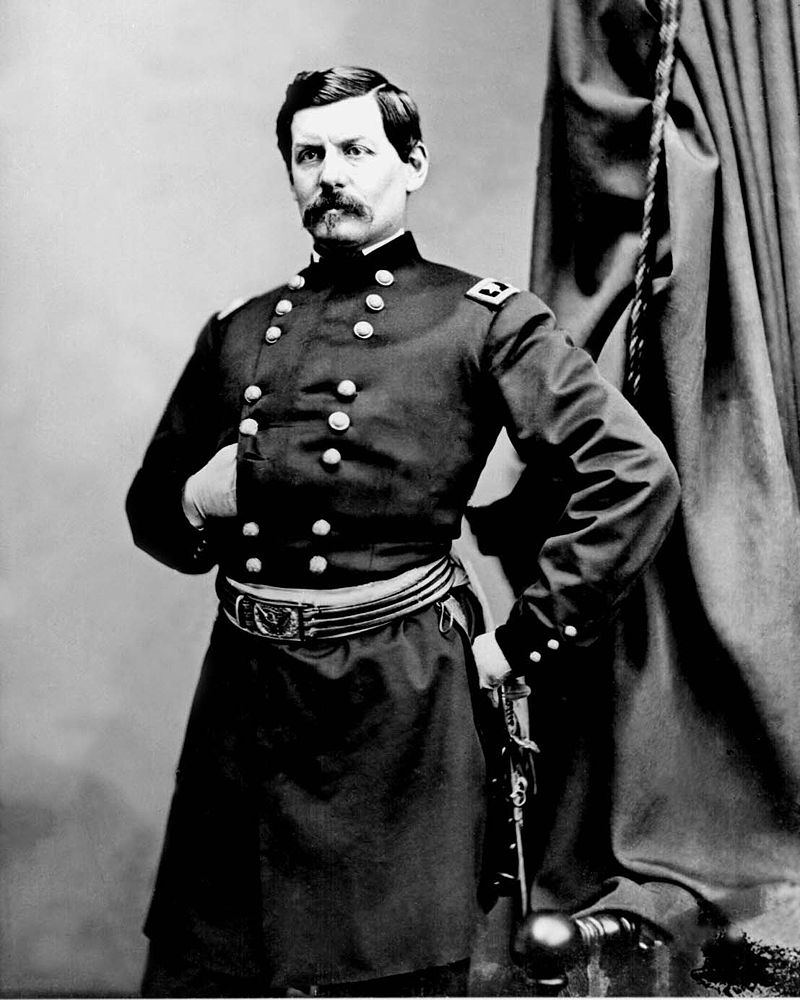
| George McClellan |
True. General Lee, for his part, made no mention of this mysterious civilian notification in any of his 1862 writings. If so important and life-altering -- as historians have claimed -- we would expect Lee to address it in his September 16 campaign update to President Davis. But there’s nothing. Nada. In 697 words in his message to Davis, not a single word mentioned the “gentleman of Maryland” -- not a peep from Lee about Stuart learning of McClellan’s discovery of the Lost Order, and not a reference to any such fiasco. Lee, instead, acknowledged that “the enemy was advancing more rapidly than convenient.”
That was Lee’s explanation for his unexpected withdrawal from the Pennsylvania border. 7 Cavalry commander Stuart himself shared not a single notation of an encounter with this mysterious man in any of his contemporary reports. In his official campaign summary, comprising eight pages in the lofty
Official Records of the War of the Rebellion, Stuart made no mention of meeting. 8
Interestingly though, in General Lee’s official campaign report (dated August 19, 1863 -- eleven months after Antietam), Lee admitted knowledge of the Lost Order: “A copy of the order directing the movement of the army from Fredericktown had fallen into the hands of General McClellan, and disclosed to him the disposition of our forces.” 9 In this matter-of-fact statement, Lee offered no details. He didn’t explain when, or from whom, he learned this information. Was it, perhaps, from the “gentleman from Maryland”?
Or was George McClellan himself the source of Lee’s knowledge?
How can this be? Am I accusing McClellan of providing the enemy with information, intentionally? No -- though that strategy has merit. Wait . . . that makes no sense . . . unless you employ Machiavellian tactics.
Leaking the orders — and permitting the Confederates to know, that you know, their intentions --- is a classic Machiavellian maneuver. The result may slow Lee, stall him or even force the Rebel commander abruptly to alter his plans. From a Machiavellian perspective, perhaps the “gentleman from Maryland” (presuming he existed) was no Confederate sympathizer, but an agent on behalf of McClellan. Sound fantastic? Not any more so than the traditional and hackneyed version.
 |
| Robert E. Lee |
Another possible source was Yankee newspapers. General Lee received much of his intelligence concerning the Federal army and its movements through the Northern press. Censorship of military matters seldom occurred at this stage of the war, and Lee gained advantages through freedom of the press.
So enjoy this titillation. Two days after the Lost Order fell into McClellan’s hands, the
Washington Star reported the discovery on the second page of its September 15 issue. Someone had leaked to the press! The article, however, mislabeled the order as “Order No. 119.” The next day, the
Baltimore Sun published the same article verbatim. 10
Lee typically had access to these papers. But since he was maneuvering and fighting to save his army and salvage the invasion when these papers were published, doubtless he had little time for recreational reading. Still, this could have served as the source for Lee’s official report in August 1863. More likely McClellan’s own official report informed Lee of the Lost Order.
McClellan’s review of the Antietam campaign was released on August 4, 1863. Published widely throughout the North, it included the verbiage of Special Orders 191 in its contents. McClellan introduced his discovery as follows: “On the 13th an order fell into my hands, issued by General Lee, which fully disclosed his plans.” 11
Compare that statement with General Lee’s official campaign report, appearing only 15 days later: “A copy of the order directing the movement of the army from Fredericktown had fallen into the hands of General McClellan, and disclosed to him the disposition of our forces.” 12
Notice similarities?
NOTES AND SOURCES
-- 1 Child quote is from
here.
-- 2 Douglas Southall Freeman,
Lee’s Lieutenants: A Study in Command, Vol. II, (New York: Charles Scribner’s Sons, 1943), 716-718. Dr. Freeman copies verbatim two “highly interesting memoranda of conversations held on the same day, Feb. 15, 1868, with General Lee at Lexington.” Lee at that time was serving as president of Washington College. One memoranda was by Colonel William Allan, who had served as a close aide of Lee’s throughout the war, and was a professor at Washington College. The other memoranda came from E. C. Gordon, who was a clerk at Washington College. Both men spoke with Lee about the Lost Order on the same date in 1868. The two memoranda were handed down to the son of Colonel Allan, who sent them to Dr. Freeman. Freeman includes nine pages of discussion on Special Orders 191 in his only appendix in volume two.
-- 3 Freeman,
Lee’s Lieutenants, 718.
-- 4 Stephen Sears,
Landscape Turned Red (New York, Houghton Mifflin Harcourt Publishing, 1983), 113, 125.
-- 5 James Murfin,
Gleam of the Bayonets, 165.
-- 6 Freeman,
Lee’s Lieutenants, 721.
-- 7 OR,
Vol. 19, Pt. 1, 140. Lee to Davis, September 16, 1862.
-- 8 OR,
Vol. 19, Pt. 1, 814-821. Stuart’s official campaign report, February 13, 1864.
-- 9 OR,
Vol. 19, Pt. 1, 146. Statement in Lee’s official campaign report, August 19, 1863.
-- 10 Dennis E. Frye,
Antietam Revealed: The Battle of Antietam and the Maryland Campaign as You have Never Seen it Before (Collingswood, NJ: C.W. Historicals, LLC), 18.
-- 11 OR, Vol. 19, Pt. 1, 42-43. McClellan’s official campaign report, August 4, 1863.
-
- 12 OR, Vol. 19, Pt. 1, 146.