Showing posts with label General John Pemberton. Show all posts
Showing posts with label General John Pemberton. Show all posts
Thursday, July 21, 2022
5 minutes at grave of Confederate Lt. general John Pemberton

Thursday, July 13, 2017
Grave matters: Meet the man who helps make a great site go
 |
| "I've been fascinated and immersed in learning history," says Russ Dodge, a senior administrator for the Find A Grave web site. |
Among my go-to online sources for information is Find A Grave, a contributor-based web site that documents, often with photographs, the final resting places of thousands associated with the Civil War. Digging into Find A Grave led to my published accounts about a 54-year-old Connecticut private who was killed at Antietam and a Confederate soldier who wrote a beautiful, haunting post-war letter to his sister. Using the site, I contacted their descendants, who generously shared letters, photographs and other information with me about those Civil War soldiers. (I am also a big fan of Find A Grave's searchable, aggregated information for cemeteries -- especially this one for the national cemetery at Antietam.)
 |
| Find A Grave was founded in the mid-'90s by Jim Tipton. |
"I've been fascinated and immersed in learning history," Dodge told me, "with Civil War history being my favorite topic." Of course, he also enjoys visiting cemeteries, especially the historic Laurel Hill Cemetery -- an "underground museum," he calls it -- high on the banks of the Schuylkill River in Philadelphia.
Dodge, who lives in Conshohocken, Pa., recently answered my questions about Find A Grave, Laurel Hill Cemetery, what beverage he would raise at the grave of his favorite Civil War soldier and more.
For the uninitiated, tell us what Find a Grave is and how it came about.
Dodge: Find A Grave is a contributor-based gravesite documentation web site. That’s its main purpose, which has not changed since its inception. Over the years, it has evolved two secondary purposes – as a memorial site to those who have passed and as a genealogical resource.
Jim Tipton started it in the mid-1990s as a venue for his hobby, which was seeking out and photographing the final resting places of famous and infamous people. Once people like me starting finding it, he started accepting contributions from other grave photographers. It grew to a point where he expanded it to include anyone who has lived and died. He opened it up to direct contributions from anyone who cared to register and contribute to it in 2001, and the rest, as they say, is history. There are now over 162 million names on the site. (Here's the site's FAQ.)
 |
| Russ Dodge (far left) pursues his passion for history during a tour of Laurel Hill Cemetery in Philadelphia. Here, he is at the family plot for Union General George Meade. |
Dodge: I sent in a pack of photos in October 1996, which he accepted and put on his site. That started my now 20+ years' association with Find A Grave. For a while, he had a small group of “power users,” which he granted limited autonomy in contributing to the database. When he made the 2001 switch to allow anyone to contribute, it quickly grew to point where he couldn’t run it by himself anymore, so in April 2002, he asked me and another well-regarded contributor, A.J. Marik, to become site administrators. For a good portion of the 2000s, it was just us three. Together we formulated standards and policies that for the most part are still in place today, and have seemed to serve the site well so far.
What's your favorite Civil War-related story regarding Find A Grave?
 |
| Dodge's efforts led to a new marker for the grave of 71st Pennsylvania Sergeant Albert Gesner Bunn, who was killed at Gettysburg. (Photo: Russ Dodge) |
PANORAMA: George Meade's gravesite at Laurel Hill Cemetery in Philadelphia.
(Click at upper right for full-screen experience.)
 |
| Union General George Meade, who lived in Philadelphia after the Civil War, died there in 1872. |
 |
| Confederate General John Pemberton, vanquished at Vicksburg in 1863, is buried in historic Laurel Hill Cemetery in Philadelphia. |
As a cemetery expert, what advice do you have for amateurs?
Dodge: Be prepared. Have a camera handy, a notebook, water, and during the summer, sunscreen and bug spray. Learn to read a cemetery – they have patterns and “flow” that develop over the vast years that are only apparent after a long stretch of time. Doing so will help you find what you are looking for if it's something or someone specific. Be cautious and especially be respectful, and always remember someone’s loved one’s physical remains are under your feet. We are the custodians of their memory – always try to honor that.
I have found that Find A Grave is an excellent Civil War research tool. Give us three tips for using it for Civil War research.
Dodge: Get to know the three main web sites outside of Find A Grave that have an incredible amount of Civil War information at your fingertips – ancestry.com, Fold3.com and Genealogybank.com. People are put off by them because they are all for-profit pay sites, but I've found that the ease of information access is worth the price for me (Full disclosure: ancestry.com bought Find A Grave three years ago, so now via Find A Grave, I am an employee of Ancestry.) Information found on the site can really help you either flesh out a biography of a Civil War veteran you would like to add to the Find A Grave database, or it can help you determine if a Find A Grave memorial with scant info on it is indeed a Cvil War veteran.
Understand that there can be many variants of a soldier’s or sailor’s name, due to the unregulated record keeping of the time period, the lack of universal literacy amongst the general populace, and the very common use of aliases during service. Often the soldier you are looking for can be found if you spell his name in a different way. Don’t give up right away if you at first can’t find the name in the database.
Use the “Virtual Cemetery” aspect of Find A Grave to gather memorials together for easy reference. I have a “virtual cemetery” for every New Jersey Civil War regiment, so if I stumble upon a New Jersey Civil War veteran memorial, I have a place to add them to where I can easily find if needed.
 |
| Russ Dodge would enjoy raising a craft porter or stout to the memory of Philip Kearny, who's buried in Arlington National Cemetery. |
Dodge: I do indeed. After photographing and noting a Civil War veteran grave, I briefly touch the marker (depending upon its condition) as my way of silent saying, “I was here visiting you, and I am remembering you.” I also give a thanks for their service.
Ever been creeped out walking through a cemetery?
Dodge: Only by human neglect and human indifference to the memory of those buried there. It still astounds me that some places and some cemeteries are treated as badly as they are by the local populace.
Finally, if you could raise a pint of your favorite beverage at the grave of a Civil War soldier, whom would you choose and why?
Dodge: It would probably be a good craft porter or stout, and it would be at the grave of General Phil Kearny in Arlington National Cemetery. I feel he was personally the bravest general to serve in the Union army, and had he not died at the Battle of Chantilly on Sept. 1, 1862, the war in the East might have gone much differently.
Have something to add (or correct) in this post? E-mail me here.
Saturday, February 25, 2017
John Pemberton: Vanquished in Vicksburg, buried in Pennsylvania
 |
| John Pemberton is buried near his wife, Martha, in Laurel Hill Cemetery in Philadelphia. |
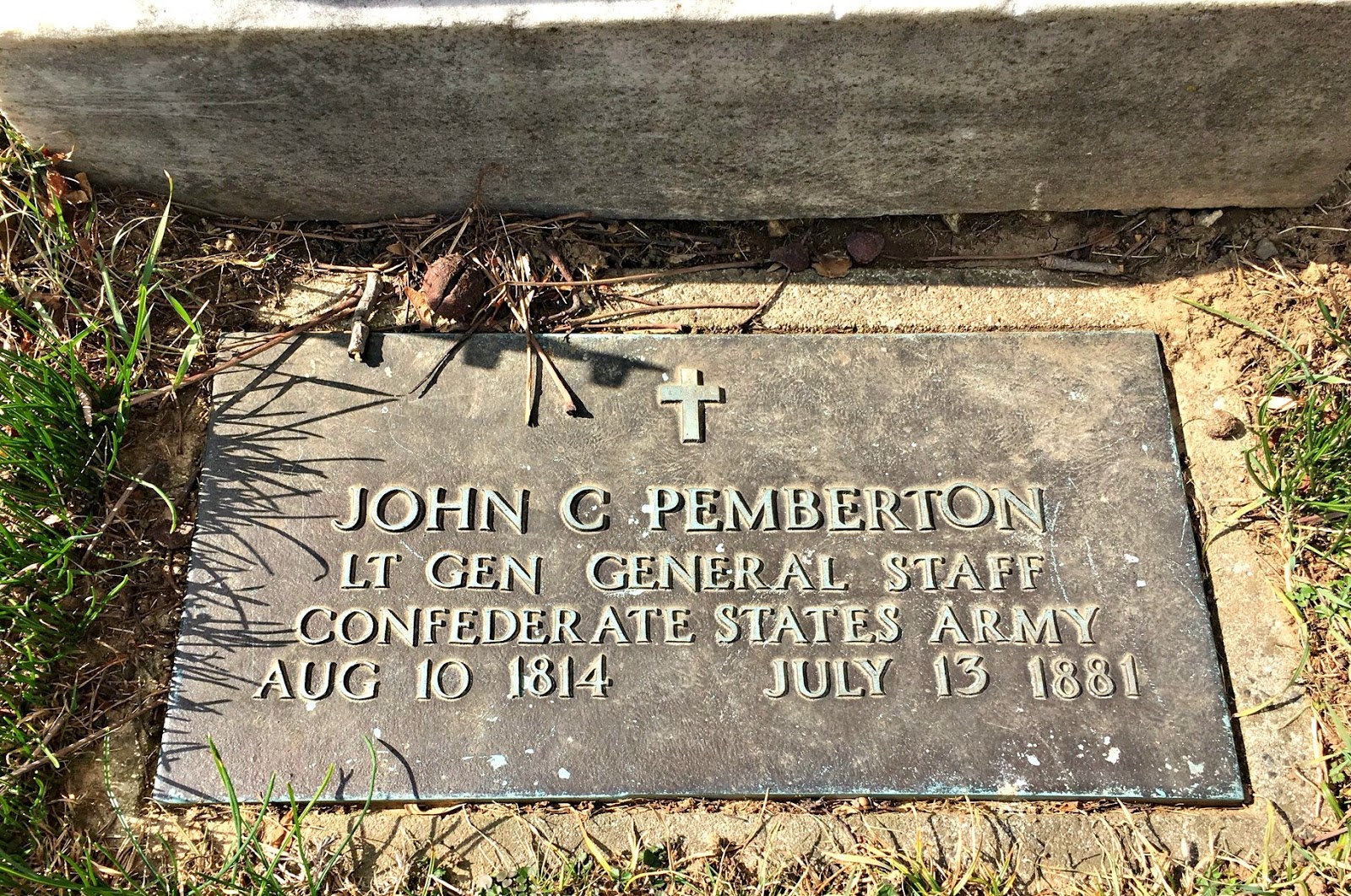 |
| Plaque in front of Pemberton's tombstone notes his Confederate service. |
Both men rest in Philadelphia's Laurel Hill Cemetery — Meade on a slope overlooking the Schuylkill River, Pemberton in a family plot on a hill about a 15-minute walk from the former commander of the Army of the Potomac's modest gravesite. (Of the 41 Civil War generals buried at Laurel Hill, Pemberton is the only Confederate.)
Local newspapers mentioned Pemberton's death on July 13, 1881 on inside pages, nowhere near the massive number of column inches devoted to Meade's death and funeral service. An eight-line report in the Philadelphia Inquirer on July 16, 1881, noted mourners could gather at the residence of Pemberton's brother at 1947 Locust Street in the city. Coverage of Pemberton's burial at Laurel Hill was similarly scant.
 |
| Circa-1860 image of John Pemberton. |
A friend in the highest of places aided Pemberton's rise through the Confederate army: Jefferson Davis, president of the Confederacy, was fond of him — a friendship that made his promotion in the "rebel army sure and rapid," the New York Times reported after his death.
By the spring of 1863, Lieutenant General Pemberton's assignment was to defend the fortress city of Vicksburg, Miss. But Ulysses Grant, his former Mexican War comrade, outmaneuvered Pemberton in battles at Champion Hill and Big Black River Bridge, leading to a siege of the strategic city on the Mississippi River.
In war, Pemberton apparently lived a charmed life. "Through perils of the storm and stress of battle," his obituary in the Philadelphia Times noted, "he seemed to bear immunity from harm. Horses white and gray and brown were shot from under him, caps and cloaks he wore were pierced with bullets, but in the front and midst of the fray through some of the most disastrous affrays he passed unscathed."
 |
| A metal Confederate marker next to John Pemberton's gravestone. |
The loss of Vicksburg "so stirred up the popular feeling of the South against [Pemberton]" the Philadelphia Times reported after his death, "that he never had the opportunity to retrieve the disaster." Even in 1881, the Vicksburg Campaign, according to the newspaper, was "still the subject of controversy among ex-Confederate officials."
After he was paroled, Pemberton — never fully trusted in the South because of his Northern roots and often branded a traitor — served out the war in lesser roles for the Confederacy.
After the war, Pemberton farmed in a "remote and isolated" corner of Warrenton, Va., where he "passed a quiet, uneventful life," the Philadelphia Times wrote. Later, he lived in Norfolk, Va., his wife's hometown; South Amboy, N.J., and Allentown, Pa. "He had given up nearly everything for the cause in which he cast his lot," the Philadelphia newspaper noted, "and his fortune was necessarily diminished." In his later years, he reportedly was loath to discuss the Civil War.
In the summer of 1881, Pemberton lived in Penllyn, a stop on the Pennsylvania Railroad. In May that year, he complained of indigestion, and the pain gradually grew worse. A doctor performed a "remarkable operation" on his bladder, providing Pemberton temporary relief. But the 66-year-old Confederate veteran later became delirious and slipped in and out of consciousness.
With old friends, son Francis and other family members at his bedside, the life of the man whose long career was filled "with disappointment and daring" ended early on a Wednesday evening.
"At eleven minutes after five, bearing to the last the evidences of his soldierly training and gentleness of character," the Philadelphia Times reported, "he passed away."
Have something to add (or correct) in this post? E-mail me here.
SOURCES
"At eleven minutes after five, bearing to the last the evidences of his soldierly training and gentleness of character," the Philadelphia Times reported, "he passed away."
Have something to add (or correct) in this post? E-mail me here.
SOURCES- The Donaldsville (La.) Chief, July 30, 1881
- New York Times, July 14, 1881
- Philadelphia Times, July 14, 1881.
Subscribe to:
Posts (Atom)