Showing posts with label General George Custer. Show all posts

Saturday, December 18, 2021

Then & Now: The sad decline of Custer's 'honeymoon house'

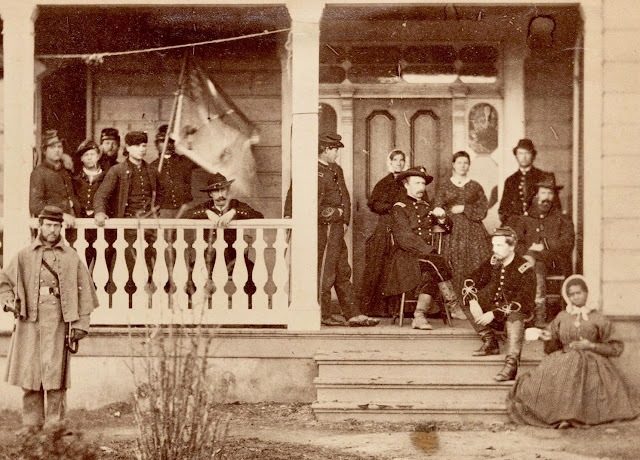
"Clover Hill" in March 1864
A cropped enlargement of Custer with his staff on the front porch of "Clover Hill"
 in March 1864. (CLICK ON ALL IMAGES TO ENLARGE.)

Like this blog on Facebook | Follow me on Twitter

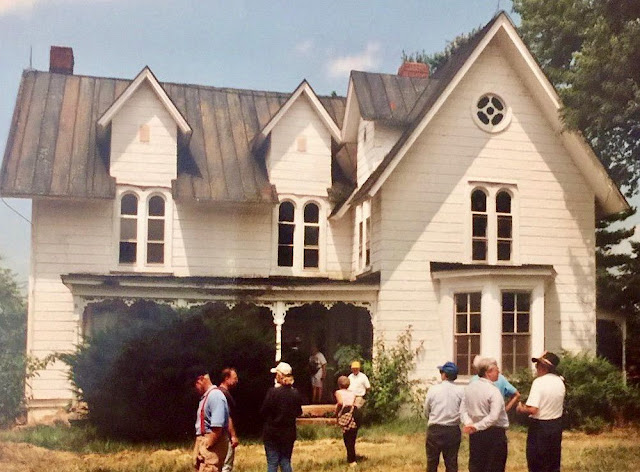
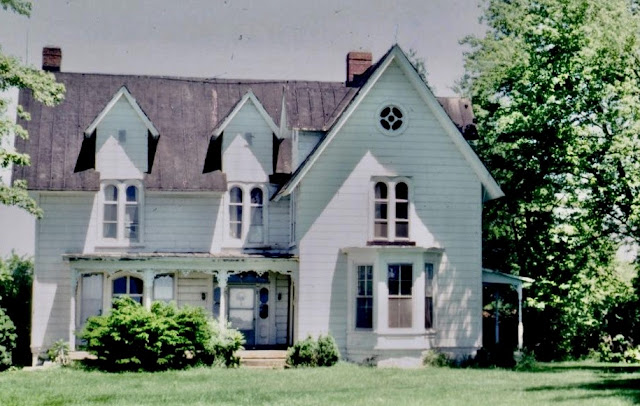
Every year since 1984, my friend Clark "Bud" Hall — a Vietnam vet and former FBI agent — has photographed "Clover Hill," the Stevensburg, Va., plantation house where George Armstrong Custer honeymooned with his 22-year-old bride, Elizabeth "Libbie" Bacon. The most recent photographs of the abandoned. circa-1775 house aren't pretty — nearly obscured by trees and undergrowth, it barely clings to life.

Frank Hampton
(Find A Grave)
Clover Hill — which sits 300 yards north of Route 3, near Culpeper — has a rich history beyond "The Boy General": It was home to James Barbour, a prominent lawyer, planter and delegate to the Virginia secession convention. Barbour served as a major in the Confederate Army. 

In the aftermath of the Battle at Brandy Station, 2nd South Carolina Cavalry Lt. Col. Frank Hampton — Rebel cavalry commander Wade Hampton's younger brother — died in the house from a saber wound suffered in fighting nearby. "Utterly disfigured," diarist Mary Chestnut wrote about his wound. (Hall was instrumental in saving "Brandy" from developers.)

Last week, Hall — who lives in Culpeper — shot his annual Clover Hill photograph. Here's a selection of those photos and Hall's story about the house, Libbie and her "dear life hero.":

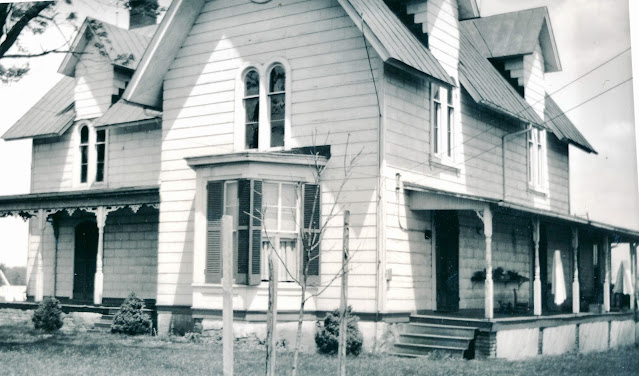
1937

Works Progress Administration photo


Most married men — if honest about it — will admit their good fortune to have wed women who are better human beings than themselves. (I confess.) This marital dynamic proved uniquely valid when George Armstrong Custer won the hand of Elizabeth Clift Bacon, one of the most persevering wives in American military history. It is of note that nearly 158 years ago, “Autie and Libbie” honeymooned in Stevensburg, Va.

Spending part of his boyhood i n Monroe, Mich., George “Autie” Custer went off to West Point, where the undisciplined cadet graduated last in the class of 1861. Advancing rapidly in the Civil War, Lieutenant Custer functioned as a key aide and received high marks for his role at the Battle of Brandy Station, June 9, 1863. Appointed in late June 1863 as a brigadier at the age of 23 — the youngest general in the Union army — Custer received command of the Michigan Cavalry Brigade. He then effectively led his “Wolverines” in the Gettysburg Campaign. 

Incontestably, Custer was a superb cavalry officer. Further, his men adored him simply because he led them into battle.

George Armstrong Custer and his
bride, Elizabeth — best known
as "Libbie," — about Feb. 15, 1864.
(Library of Congress)
On Sept. 13, 1863, General Custer received a slight leg wound at the Battle of Culpeper Court House. Granted leave, the opportunistic Custer traveled west and audaciously courted Monroe’s most beautiful belle, 22- year old Libbie Bacon. Judge Daniel Bacon had no desire to see his beloved only child marry an intemperate soldier of modest roots, especially one known to favor “excessive alcohol and gambling.”

Now a nationally heralded officer, however, Custer convinced both Judge Bacon and Libbie he had given up alcohol (true) and gambling — untrue; he never quit gambling. As usual, Custer succeeded in capturing his objectives, and vows were exchanged on Feb. 9, 1864, in the “most splendid wedding ever seen in the state,” according to a reconciled Judge Bacon.

Departing on their honeymoon, Custer escorted his bride to West Point, New York City and Washington, where huge receptions awaited them. An attentive Custer never left Libbie’s side, and her own early devotion to him was evident: “Every other man seems so ordinary beside my own particular star.” She also referred to Custer as “my dear life hero, my boy general.”

While in Washington, Custer received urgent telegrams from Army of the Potomac winter headquarters at Brandy Station directing him to report immediately for a “secret” assignment. Libbie pleaded not to be left behind, and the couple trained to Brandy Station in late February.

Soon arriving by coach at Stevensburg, Libbie was made comfortable at “Clover Hill,” the beautiful, church-appearing home of Jack Barbour. Barbour was not in residence. Custer quickly departed for a raid toward Charlottesville on Feb. 28 and returned to Clover Hill on March 2, where he determined to provide his wife an “army honeymoon.” 

In honor of his bride, General Custer re-named Clover Hill “Camp Libbie.” For entertainment, Libbie was often hoisted into a “silver harnessed coach” and escorted to Mount Pony, where she toured the army’s main signal station. From atop the summit, Libbie wrote her parents that she observed the “white tents of the Army ... stretched far as eye could see.”

With her coach accompanied by mounted escort, Libbie also attended “six-course dinners” hosted by Custer’s superiors at Rose Hill and at the Dr. Daniel Green farm near Brandy. After spending just short of a month at Camp Libbie, General Custer secured a leave and took his wife on General Ulysses Grant's “special train” to Washington where their “official honeymoon” continued.

In mid- April, Custer deposited his wife in a Washington boarding house and he returned to the army for the “Overland Campaign.” Libbie much enjoyed Washington, where she met President Lincoln, commenting to her parents that he appeared to be the “most painfully careworn ... man I ever saw.”

Libbie lived in Washington throughout the remainder of the war and later followed her husband west to the plains. Following his death at the Little Big Horn, Libbie survived him by 57 years and “devoted the rest of her days to defending and gilding his memories.” They are buried together at West Point. 

One is certain Libbie never forgot her “Stevensburg honeymoon.”


1984
Clark Hall

1991

Clark Hall

1998

Clark Hall

2016

Clark Hall

2021

Clark Hall

2023

Clark Hall


-- Have something to
add (or correct) in this post? E-mail me here.


SOURCE:

Chestnut, Mary Boykin, A Diary From Dixie, Edited by Isabella D. Martin and Myrta Lockett Avary, New York: D. Appleton and Company, 1906

Monday, February 05, 2018

Video: Finding Custer, Buford, more at West Point Cemetery

On a frosty Saturday afternoon, I was the only soul on the grounds of West Point Cemetery, the final resting place for Civil War notables George Custer, Alonzo Cushing, John Buford, Winfield Scott and many more. Take a tour with me at the historic site overlooking the Hudson River at the U.S. Military Academy.

Tuesday, November 22, 2016

Grand Review of Union Army 'positively beggars description'

(Mathew Brady | Library of Congress)
A cropped version of a lithograph showing presidential viewing stand in front of White House.
(Library of Congress collection)

                                           Like this blog on Facebook | Contact me

On May 23, 1865, an estimated 80,000 soldiers in General George Meade's Army of the Potomac marched through the streets of Washington before thousands of spectators. The next day, nearly 65,000 soldiers in General William Sherman's Army of Georgia and Army of the Tennessee repeated the feat — a fitting exclamation point after four years of a brutal civil war. 

Each day, the armies marched down Pennsylvania Avenue and past the White House, where dignitaries and others watched the historic event from reviewing stands. Not surprisingly, the presidential reviewing stand in front of the mansion became a popular photographic subject. Although other photograph explorers have dissected the above image of the presidential reviewing stand at the Grand Review of the United States Army many times, it remains tantalizing.

Of the images of the presidential stand on the excellent Library of Congress web site, the photograph attributed to Mathew Brady at the top of this post includes the greatest detail. In the uncropped original, the blurred forms of soldiers and horses appear at right on the dirt road while a huge U.S. flag hangs limp above a packed reviewing stand. Behind the blurred figures, a detachment of soldiers stands guard in front of a massive U.S. banner.

Enlargements of the Grand Review image from May 23, 1865, reveal the leadership of the U.S. government and military and much more:


Easily recognized in the front row of the presidential reviewing stand are Union generals Ulysses Grant and George Meade and President Andrew Johnson, elevated to the highest office in the land 39 days earlier by the assassination of Abraham Lincoln at Ford's Theatre, only blocks from the White House.

Less obvious is Edwin Stanton, the blurred figure with the long beard sitting next to Grant. A review of other images taken that day confirms this man is Johnnson's Secretary of War. 

Seated near President Johnson, Major General Wesley Merritt — a cavalry commander — appears to be conversing with Meade. The ghostl-like figure at the far right is Secretary of the Navy Gideon Welles, a Connecticut native and a major Lincoln supporter.

NEW YORK TIMES (May 24, 1865): "The President arrives in his carriage. Directly after, however, almost at the same moment, Gen. Grant and Staff walk briskly from their headquarters and assume their designated positions. Gen. Meade and Staff having passed, they now return dismounted, and soon the sharply-defined head of the Commander of the Army of the Potomac adds another to the group of distinguished persons, on whom the eyes, the opera-glasses, and even the photographers' lenses are resting."


Ely Parker, who's seated next to a large, potted plant, appears only steps away from his boss. A Native American who served as Grant's adjutant during the war, Parker helped draft the surrender documents signed 45 days earlier by Robert E. Lee at Appomattox Court House, Va.

PITTSBURGH DAILY POST (May 24, 1865): "Pennsylvania Avenue presents a scene which probably has never been paralleled in the country. Certainly not south of New York. Its whole vast extent and breadth is compactly lined with people from pavement to housetops. Innumerable flags and banners are displayed all along the Avenue, and the whole scene is one of the most brilliant and imposing ever witnessed, making the heart fill with emotion and the eyes fill with tears of joy. The whole affair positively beggars description."


General Sherman, wearing a white glove, visits with William Dennison, the U.S. Postmaster General. Is the young woman in the background listening in to the conversation? Perhaps they all had just witnessed flamboyant General George Custer's feat, described in one of the local newspapers later that day:

WASHINGTON EVENING STAR (May 23, 1865): "Suddenly a thrill ran through the vast assemblage as a magnificent stallion dashed madly past the President and his associates, the rider, General Custar [sic], with a large wreath hanging upon his arm, his scabbard empty, and his long hair waving in the wind, vainly striving to check him. On swept the horse, the throng rising from their seats in breathless suspense that changed to murmur or applause at the horsemanship of the rider, and finally giving place to a long loud cheer as the General checked his frightened steed, and gracefully rode back to the head of his column, the third cavalry division."


Quartermaster General Montgomery Meigs, among the most able men in the Union army, also sits in the front row, apparently staring straight ahead. "[W]ithout the services of this eminent soldier," Secretary of State William Seward reportedly said of Meigs' Civil War service, "the national cause must have been lost or deeply imperiled." 

Seward, whose face was severely disfigured in a knife attack by John Wilkes Booth co-conspirator Lewis Powell the night Lincoln was assassinated, watched Day 2 of the Grand Review from the nearby Blair House. Do you recognize anyone else in the image?

SYRACUSE DAILY COURIER AND UNION (MAY 24, 1865): "In front of the President's house an immense stand has been erected on the south side of the street, for the President and Cabinet, and for the gallant soldiers, Grant and Sherman, who are to review the troops. Another stand on the north side is for the accommodation of Congress, the foreign ministers, and others. A stand is also erected on the square for wounded soldiers. The houses in the vicinity of the President's house are tastefully adorned with flags and evergreens. The route of the march is packed with people, all eager to give the gallant heroes of the war a hearty welcome on their march home."

Sewn into the massive patriotic banner above the reviewing stand are the names of the Union Army's greatest triumphs, including Petersburg, Richmond and ....

... and, of course, Gettysburg.

PITTSBURGH DAILY POST (May 24, 1865) "Never has Washington witnessed a more august occasion or presented a more beautiful or animated spectacle. The whole population of the city is in the streets, swollen by many thousands of strangers which have been pouring in here for days past from all points of the compass, and by every imaginable mode of conveyance. Those from abroad are estimated at fully fifty or sixty thousand, a large proportion of whom are ladies. Where they all found shelter and accommodations is a mystery."

We can't help but wonder if this guard detachment of the Veteran Reserve Corps, apparently led by the aged officer at left, was extra-vigilant given the recent, tragic event in the capital. President Johnson, members of his cabinet and some of the most important generals in the Union Army are just behind these soldiers. The day, one of the grandest in Washington's history, went off without a major incident. Most of the soldiers who marched during the historic, two-day event were soon mustered out of the army.

NEW YORK TIMES (May 24, 1865): "Though the city is so crowded, it is yet gay and jovial with the good feeling that prevails, for the occasion is one of such grand import and true rejoicing, that small vexations sink out of sight. With many it is the greatest epoch of their lives; with the soldier it is the last act in the drama; with the nation it is the triumphant exhibition of the resources and valor which have saved it from disruption and placed it first upon earth.

"So the scene of to-day (and that of to-morrow) will never be forgotten, and he who is privileged to be a witness will mark it as a white day in the calendar, from which to gather hope and courage for the future."

Have something to add (or correct) in this post? E-mail me here.

Friday, February 20, 2015

Cedar Creek (Va.) battlefield: Belgian-owned quarry operation threatens historic Belle Grove Plantation house

Click here for battlefield panoramas from Antietam, Cedar Mountain, Chickamauga, Gettysburg, Harris Farm, Manassas, Malvern Hill, Salem Church,  Spotsylvania Courthouse and more.
Union veterans gathered for a reunion at the Belle Grove Plantation in 1883. 
(PHOTO: United States Military History Institute, Carlisle Barracks, Pa. via National Park Service)
Union General Philip Sheridan used the Belle Grove manor house as a headquarters.
On Oct. 19, 1864, the Union and Rebel armies clashed near the Belle Grove mansion during the Battle of Cedar Creek, resulting in more than 8,000 casualties. Confederate General Stephen Ramseur, mortally wounded by a bullet through the lungs during the battle, was visited on his deathbed in the mansion by George Custer and other Union soldiers who attended West Point with the 27-year-old North Carolinian.  "Bear this message to my precious wife," said Ramseur, who shortly before the battle received word that Nellie Ramseur had given birth to the couple's first child, "I die a Christian and hope to meet her in heaven." 

Union General Philip Sheridan, who famously rushed down the Valley Pike from nearby Winchester, Va., and rallied his troops at Cedar Creek, used the Belle Grove mansion for his headquarters during the Shenandoah Valley campaign.  

But despite death and destruction so near, the 218-year-old manor house survived the Civil War surprisingly unscathed.  Today, however, the property faces a far different, and perhaps far greater, threat. Expansion of a Belgian-owned limestone quarry about a half-mile from the Belle Grove mansion threatens the core of the battlefield and the house itself. Last Wednesday, a caretaker at Belle Grove told me that he worries what blasting at the quarry, often felt more than a mile away, will do to the foundation of the house, which ironically was made from limestone quarried on the property. "That company," he said, "doesn't care about American history."

Unfortunately, there are plenty of examples along the historic Valley Pike of Americans not caring about their own history. The Kernstown battlefield, 10 miles north of the Cedar Creek, is bordered by a hodge-podge of business development and housing. Three miles south of Cedar Creek, Hupp's Hill, site of a large Union encampment and earthworks, sits across the road from a supermarket and just down the road from a sea of housing in Strasburg, Va.

Throughout Virginia, there are plenty of other examples of the destruction of Civil War history. The site of the Third Battle of Winchester, despite preservation efforts by the Civil War Trust and others, is so carved up by development that it's difficult to comprehend what happened there on Sept. 19, 1864. Beaver Dam Creek, Fair Oaks, Mechanicsville -- all those battlefields are mostly destroyed. And only 2 1/2 months ago, the historically significant farm house on the Harris Farm battlefield in Spotsylvania County (see my post here) was demolished to make way for another McMansion.


        Nearly 32,000 Union soldiers camped in fields surrounding Belle Grove mansion.
                              (Click at upper right for full-screen interactive panorama.)

Beautiful, rolling farmland on the Cedar Creek battlefield.
Union soldiers camped in this field before the Battle of Cedar Creek on Oct. 19, 1864.